
SUPPLY CHAIN MANAGEMENT PRESENTATION 11 March 2020 Table
SUPPLY CHAIN MANAGEMENT PRESENTATION 11 March 2020
Table of Content 1. Learning Outcomes. 2. PPR 2017: Section 8 -Local Production and Content. 3. PPR 2017: Section 4 - Pre Qualification Criteria. 4. PPR 2017: Section 9 - Compulsory Sub-Contracting. 5. Improving Capacity and Performance of SCM Units & Officials. 6. Impact of m’SCOA on SCM Business processes.

Learning Outcomes • Understand regulatory framework that governs Supply Chain Management within the Public sector and to be able to demonstrate how each piece of legislation and/or prescript regulates the decision making of SCM practitioners; • Supply chain management (SCM) is an integral part of Financial Management, it is one of the key mechanisms enabling government to implement national policies. • Supply Chain Management has four critical elements which are as follows: • • • Demand Management. Acquisition Management. Contract Management. Logistics Management. Risk Management. Disposal Management.

Key legislative framework applicable to SCM Municipal Systems & structures Act BBBEEA & Guidelines MFMA MSCM Regulations PPPFA & Regulations The Constitution SCM Municipal Policy procedure CIDBA PAIA PAJA MFMA Circulars Financial Misconduct Disciplinary Regulations Amendments to the PAA
PPR 2017: LOCAL PRODUCTION & CONTENT POLICY OBJECTIVE OF THE REGULATIONS § Government is committed to transformation and creation of a business environment conducive to all. The Preferential Procurement Regulations 2017 are premised on three interrelated government policy objectives: v To improve Socio-economic transformation, v Promotion of small enterprises, cooperatives, rural and township enterprises and v Promotion of local industrial development. • Section 217 of the Constitution of the republic states that’ When an organ of state… contracts for goods or services, it must do so in a manner that is…fair, equitable, transparent, competitive and cost-effective.
PPR 2017: Section 8: Local Production and Content • Regulation 8 (1): Empowers the DTI to designate specific industries/sectors, where only locally manufactured products that meet the stipulated minimum threshold for local content to be considered for procurement by Organs of State. • Regulation 8 (2): An Organ of state must advertise the invitation to tender with a specific condition that only locally produced goods or locally manufactured goods, meeting the stipulated minimum threshold for local production and content, will be considered. • Regulation 8 (4): Allows organs of state to “self designate goods or services locally produces even if the sector is not designated” provided they consult with the DTI and National Treasury. • Regulation 8 (5): bid that fails to meet the required local content are to be considered unacceptable
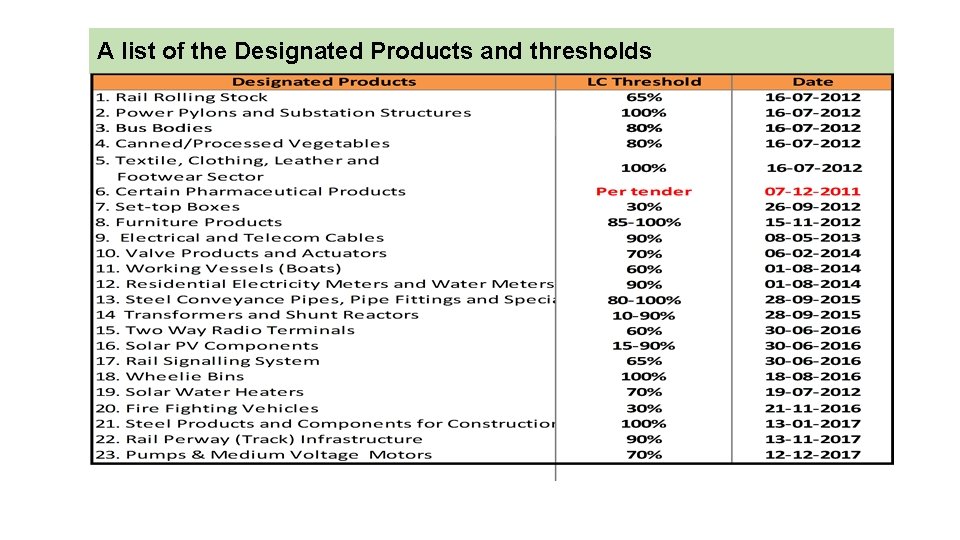
A list of the Designated Products and thresholds

LOCAL CONTENT REQUIREMENTS AND THE EXEMPTIONS q. Bids for all designated sectors/products must contain a specific bidding condition that only locally produced or locally manufactured goods, works and services with a stipulated minimum threshold for local production and content will be considered. • If the raw material or input to be used for a specific item is not available locally, bidders should obtain written exemption from the DTI should there be a need to import such raw material or input; and • Manufacturers must duly declare compliance with the thresholds required. • A copy of the exemption letter must be submitted together with the bid document at the closing date and time of the bid
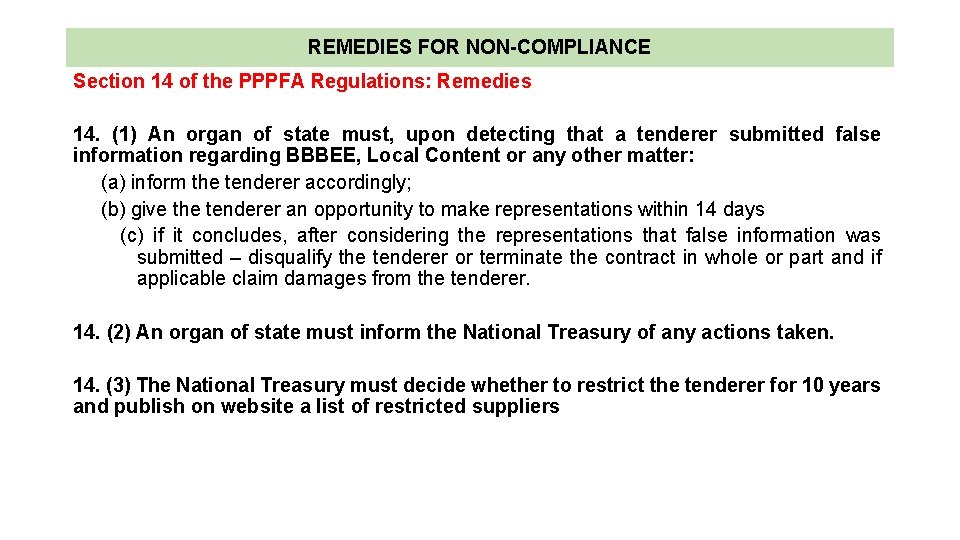
REMEDIES FOR NON-COMPLIANCE Section 14 of the PPPFA Regulations: Remedies 14. (1) An organ of state must, upon detecting that a tenderer submitted false information regarding BBBEE, Local Content or any other matter: (a) inform the tenderer accordingly; (b) give the tenderer an opportunity to make representations within 14 days (c) if it concludes, after considering the representations that false information was submitted – disqualify the tenderer or terminate the contract in whole or part and if applicable claim damages from the tenderer. 14. (2) An organ of state must inform the National Treasury of any actions taken. 14. (3) The National Treasury must decide whether to restrict the tenderer for 10 years and publish on website a list of restricted suppliers
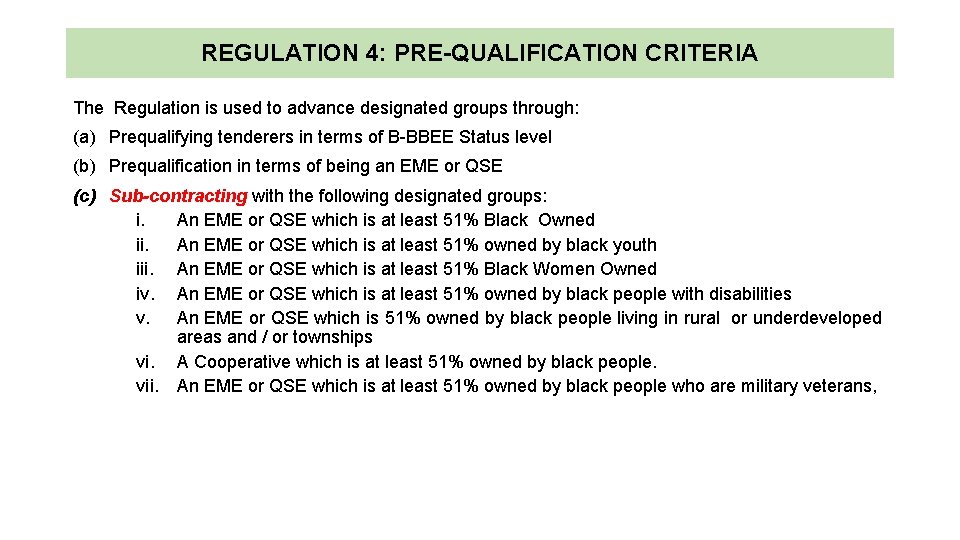
REGULATION 4: PRE-QUALIFICATION CRITERIA The Regulation is used to advance designated groups through: (a) Prequalifying tenderers in terms of B-BBEE Status level (b) Prequalification in terms of being an EME or QSE (c) Sub-contracting with the following designated groups: i. An EME or QSE which is at least 51% Black Owned ii. An EME or QSE which is at least 51% owned by black youth iii. An EME or QSE which is at least 51% Black Women Owned iv. An EME or QSE which is at least 51% owned by black people with disabilities v. An EME or QSE which is 51% owned by black people living in rural or underdeveloped areas and / or townships vi. A Cooperative which is at least 51% owned by black people. vii. An EME or QSE which is at least 51% owned by black people who are military veterans,
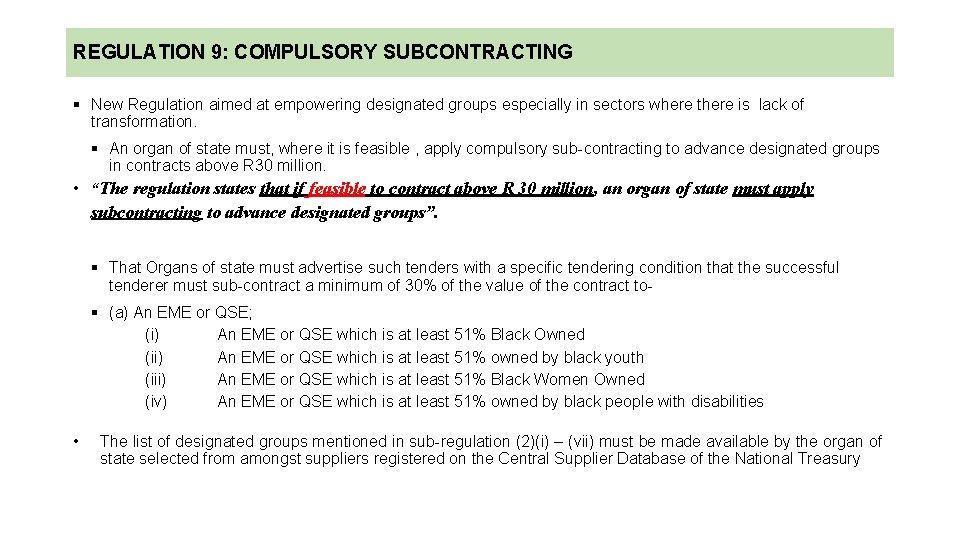
REGULATION 9: COMPULSORY SUBCONTRACTING § New Regulation aimed at empowering designated groups especially in sectors where there is lack of transformation. § An organ of state must, where it is feasible , apply compulsory sub-contracting to advance designated groups in contracts above R 30 million. • “The regulation states that if feasible to contract above R 30 million, an organ of state must apply subcontracting to advance designated groups”. § That Organs of state must advertise such tenders with a specific tendering condition that the successful tenderer must sub-contract a minimum of 30% of the value of the contract to§ (a) An EME or QSE; (i) An EME or QSE which is at least 51% Black Owned (ii) An EME or QSE which is at least 51% owned by black youth (iii) An EME or QSE which is at least 51% Black Women Owned (iv) An EME or QSE which is at least 51% owned by black people with disabilities • The list of designated groups mentioned in sub-regulation (2)(i) – (vii) must be made available by the organ of state selected from amongst suppliers registered on the Central Supplier Database of the National Treasury
Sub-Contracting as a condition of tender >R 30 mil…cont • The term “feasible” is used in recognition of the fact that it may not always be possible to subcontract in all tenders due to the nature of some tenders. (For instance, it may not be possible to sub-contract one piece of machinery that is above R 30 million). • Identify procurement opportunities for designated groups where compulsory sub-contracting must be applied to all contracts/ projects above R 30 million. • The responsibility to determine whether it is feasible or not rests with the institution preparing the tender. Institutions must ensure participation of EMEs and QSEs in contracts or projects and not just dismiss this provision on the basis that it is not feasible without providing facts and objective analysis to substantiate their decision. • Tenders must be advertised with a condition that tenderers who fail to comply with this requirement would be disqualified. • The Central Supplier Database (CSD) has been upgraded to allow bidders/ contractors/ suppliers access to CSD for identification of potential sub- contractors from the pool of EMEs or QSEs to advance designated groups.
Sub-Contracting as a condition of tender >R 30 mil…cont ü In the case of construction and built environment sectors, nothing prevents bidders/ contractors/ suppliers to select sub-contractors from the CIDB database who are registered on the CSD for the purposes of compliance with the minimum 30% compulsory sub-contracting provisions. ü Tenderers or contractors must submit proof of subcontracting arrangement between the main tenderer and the subcontractor. Proof of subcontracting arrangement may include a subcontracting agreement between main tenderer and the subcontractor. ü The responsibility for inclusion of compulsory subcontracting clause in the tender rests with the institution.
Sub-Contracting as a condition of tender >R 30 mil…cont • The contract will be concluded between the main contractor and the institution, therefore, the main contractor and not the sub-contractor would be held liable for performance in terms of its contractual obligations. • The responsibility to sub-contract with competent and capable subcontractors rests with the main contractor/ supplier. • Main contractors/ suppliers are discouraged from subcontracting with their subsidiary companies as this may be interpreted as subcontracting with themselves and / or using their subsidiaries for fronting. Where primary contractor subcontracts with a subsidiary this must be declared in tender documents. • Tenders that do not meet subcontracting requirements are considered as being not acceptable tenders and must be disqualified and may not be considered for further evaluation or award. • The report containing the list of potential subcontractors may be drawn by accessing the following link: www. csd. gov. za
Sub-Contracting as a condition of tender >R 30 mil…cont The following steps can be followed: • Step 1: Complete the basic search elements. • • Step 2: Refine the search using additional filters. • • Step 3: Refine the search using Preferential Procurement Regulations 2017 filters. • The Institution must make available the list of suppliers registered on the CSD to provide the required goods or services in respect of the applicable designated groups mentioned in the relevant tender from which the tenderer must select a supplier. • Where no tenderer meets sub-contracting criteria, institutions must cancel the tender and investigate reasons for tenderers failing to meet compulsory sub- contracting. • In the event of uncertainty with regard to information provided by the tenderer and the CSD is unable to verify such information at that stage, the institution may request necessary proof to substantiate the information provided.
Local Content Documents Websites The following are downloadable from the following National Treasury Website: http: //www. treasury. gov. za/divisions/sf/sc/Practice. Notes/default. aspx üStandard bidding document (SBD / MBD 6. 2) Latest version published by the National Treasury Should forms part of the bid document for all designated products üInstruction notes for each of the designated sectors/products The following are downloadable from the following the DTI website: http: //www. the. DTI. gov. za/industrial_development/ip. jsp üSABS technical specification Standard approach for the calculation of local content üGuidance document for calculation of Local Content üAnnex C, D & E for declaration of Local Content %
IMPROVING CAPACITY & PERFOMANCE OF SCM UNITS & OFFICIALS
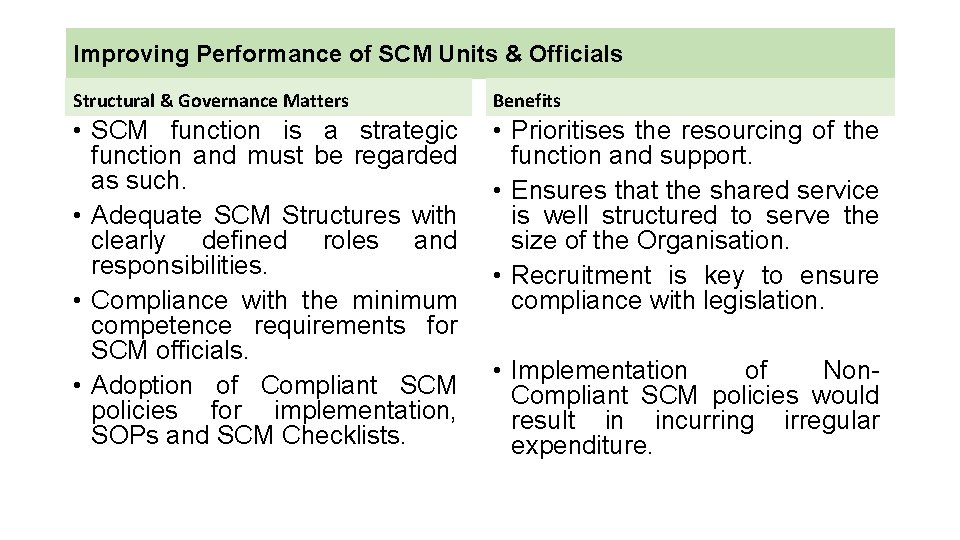
Improving Performance of SCM Units & Officials Structural & Governance Matters Benefits • SCM function is a strategic function and must be regarded as such. • Adequate SCM Structures with clearly defined roles and responsibilities. • Compliance with the minimum competence requirements for SCM officials. • Adoption of Compliant SCM policies for implementation, SOPs and SCM Checklists. • Prioritises the resourcing of the function and support. • Ensures that the shared service is well structured to serve the size of the Organisation. • Recruitment is key to ensure compliance with legislation. • Implementation of Non. Compliant SCM policies would result in incurring irregular expenditure.
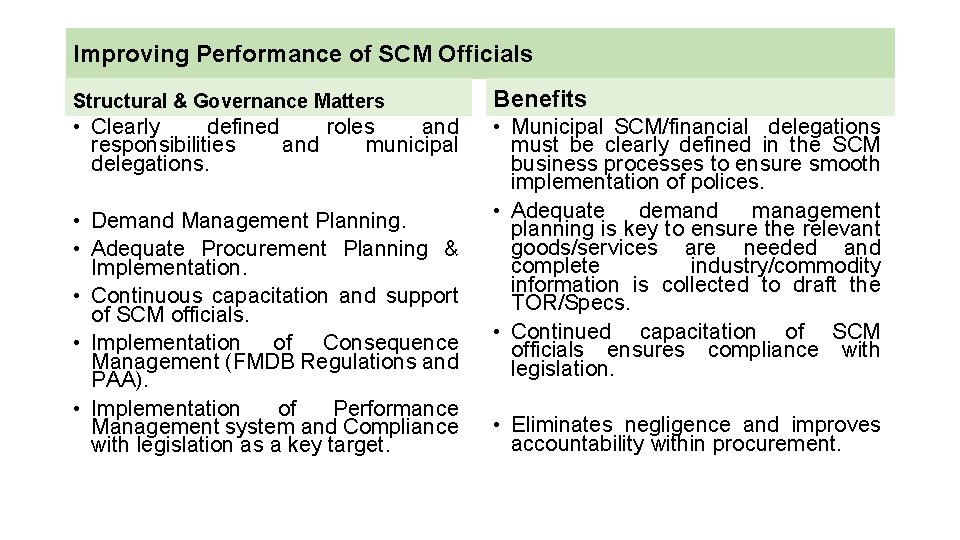
Improving Performance of SCM Officials Structural & Governance Matters Benefits • Clearly defined roles and responsibilities and municipal delegations. • Municipal SCM/financial delegations must be clearly defined in the SCM business processes to ensure smooth implementation of polices. • Adequate demand management planning is key to ensure the relevant goods/services are needed and complete industry/commodity information is collected to draft the TOR/Specs. • Continued capacitation of SCM officials ensures compliance with legislation. • Demand Management Planning. • Adequate Procurement Planning & Implementation. • Continuous capacitation and support of SCM officials. • Implementation of Consequence Management (FMDB Regulations and PAA). • Implementation of Performance Management system and Compliance with legislation as a key target. • Eliminates negligence and improves accountability within procurement.
Improving Performance of SCM Officials Structural & Governance Matters Benefits • Advocate for a change in perceived Culture and behaviour in Local Government. • Capacitate the Oversight structures to be effective, BEC and BAC. • Improved compliance Legislation. with • Improved procurement recommendations to the AO.
IMPACT OF m. SCOA ON SUPPLY CHAIN MANAGEMENT PROCESSES
Impact of m’SCOA Implementation to SCM Business Processes- Annexure B of Circular 80. • Expenditure management follows the SCM processes that should ensure an effective system of: - expenditure control, including procedures for the approval, authorisation, withdrawal and payment of funds. - These expenditures should be monitored against the approved budget, and reasons for variances must be explained and corrective action must be implemented to keep expenditure in line with budget estimates; • Material and inventory management deals with the maintenance of inventory catalogues: • classified according to the high-level categories provided for in the Standard Chart of Accounts. • Business processes need to incorporate at a minimum, ordering; issuing and management of inventory levels; EOQ and re-order levels etc • preferred suppliers linked to inventory categories; • flagging of stock levels with limited movements for substantial periods; • regular physical counts and reconciliation to system. • stock records; exception reporting and enhanced controls on stock items susceptible to misuse such as illegal stock-pilling; • and all sub stores to be activated on the system;
Impact of m’SCOA Implementation to SCM Business Processes- Annexure B of Circular 80. • Contract management entails the management of contracts through the entire Contract Life Cycle so as to maximise value for money that includes procedures for planning; contract creation; • collaboration; execution; administration; and close-out. Contracts should be listed in a contract register embedded into the financial application that automates all the activities necessary to manage the contract as informed and dependant on the nature of the work, the type of contract, the legal aspects and delivery timeframes. • It also entails the activities carried out to determine whether the service provider and the municipality are performing adequately to meet the requirements in listed contracts that had been awarded through the procurement process and the prescriptions in the MFMA; and
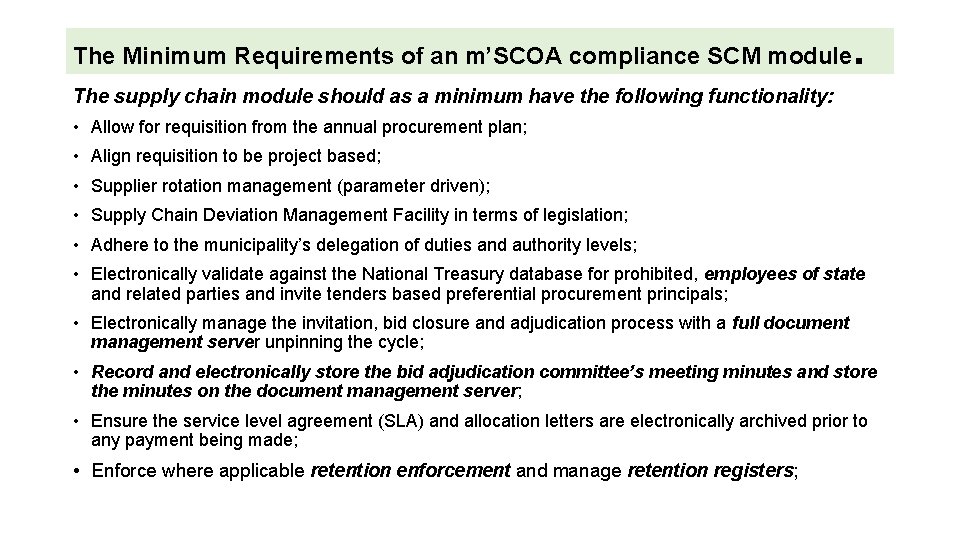
The Minimum Requirements of an m’SCOA compliance SCM module . The supply chain module should as a minimum have the following functionality: • Allow for requisition from the annual procurement plan; • Align requisition to be project based; • Supplier rotation management (parameter driven); • Supply Chain Deviation Management Facility in terms of legislation; • Adhere to the municipality’s delegation of duties and authority levels; • Electronically validate against the National Treasury database for prohibited, employees of state and related parties and invite tenders based preferential procurement principals; • Electronically manage the invitation, bid closure and adjudication process with a full document management server unpinning the cycle; • Record and electronically store the bid adjudication committee’s meeting minutes and store the minutes on the document management server; • Ensure the service level agreement (SLA) and allocation letters are electronically archived prior to any payment being made; • Enforce where applicable retention enforcement and manage retention registers;
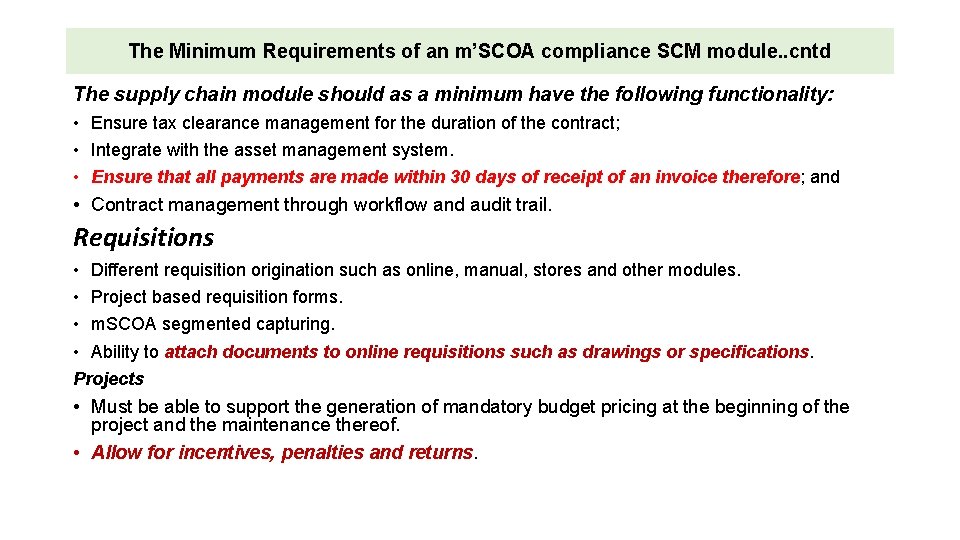
The Minimum Requirements of an m’SCOA compliance SCM module. . cntd The supply chain module should as a minimum have the following functionality: • Ensure tax clearance management for the duration of the contract; • Integrate with the asset management system. • Ensure that all payments are made within 30 days of receipt of an invoice therefore; and • Contract management through workflow and audit trail. Requisitions • Different requisition origination such as online, manual, stores and other modules. • Project based requisition forms. • m. SCOA segmented capturing. • Ability to attach documents to online requisitions such as drawings or specifications. Projects • Must be able to support the generation of mandatory budget pricing at the beginning of the project and the maintenance thereof. • Allow for incentives, penalties and returns.
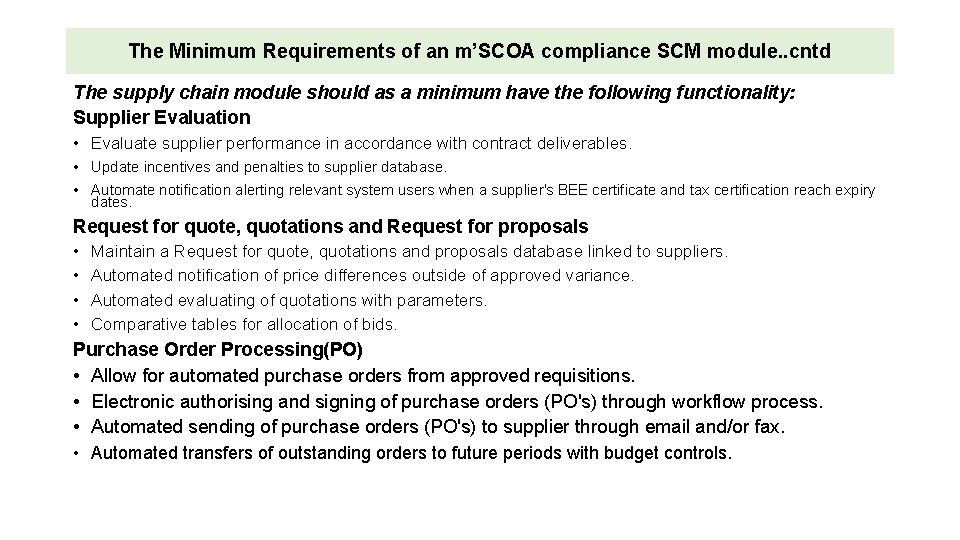
The Minimum Requirements of an m’SCOA compliance SCM module. . cntd The supply chain module should as a minimum have the following functionality: Supplier Evaluation • Evaluate supplier performance in accordance with contract deliverables. • Update incentives and penalties to supplier database. • Automate notification alerting relevant system users when a supplier's BEE certificate and tax certification reach expiry dates. Request for quote, quotations and Request for proposals • • Maintain a Request for quote, quotations and proposals database linked to suppliers. Automated notification of price differences outside of approved variance. Automated evaluating of quotations with parameters. Comparative tables for allocation of bids. Purchase Order Processing(PO) • Allow for automated purchase orders from approved requisitions. • Electronic authorising and signing of purchase orders (PO's) through workflow process. • Automated sending of purchase orders (PO's) to supplier through email and/or fax. • Automated transfers of outstanding orders to future periods with budget controls.
Thank you
- Slides: 27