
SUPPLY CHAIN MANAGEMENT INTRODUCTION VISION STRATEGY Ard Venema

- Slides: 24
SUPPLY CHAIN MANAGEMENT INTRODUCTION, VISION & STRATEGY Ard Venema | Chief, SCM Programme Office Logistics Support Division, Department of Field Support 08 May 2017 UNITED NATIONS | FIELD SUPPORT 1
Department of Field Support ST/SGB/2010/2 The Department of Field Support: Provides administrative and logistical support services to the Departments of Peacekeeping Operations and Political Affairs, as directed by the Secretary-General, through the delivery of dedicated support to United Nations peacekeeping operations, special political missions and other field presences, henceforth referred to as “field operations”. Directs and implements global peacekeeping logistics support and supply-chain management, conducts integrated logistic support planning, including acquisition planning, and maintains the rapid deployment capacity for field operations. UNITED NATIONS | FIELD SUPPORT
Logistics versus Supply Chain Management Definitions Logistics: Logistics is the process of planning, implementing and controlling procedures for the efficient and effective transportation and storage of goods including services and related information from the point of origin to the point of consumption for the purpose of conforming to customer requirements and includes inbound, outbound, internal and external movements. Supply Chain Management: Supply Chain Management encompasses the planning and management of all activities involved in sourcing, procurement, conversion, and logistics management. It also includes coordination and collaboration with channel partners, which may be suppliers, intermediaries, third-party service providers, or customers. Supply chain management integrates supply and demand management within and across companies. UNITED NATIONS | FIELD SUPPORT
Logistics versus Supply Chain Management Military logistics In military science, maintaining one's supply lines while disrupting those of the enemy is a crucial element of military strategy, since an armed force without resources and transportation is defenseless. Logistics: In military logistics, logistics officers manage how and when to move resources to the places they are needed. Supply Chain Management: Supply chain management in military logistics often deals with a number of variables in predicting cost, deterioration, consumption, and future demand. UNITED NATIONS | FIELD SUPPORT
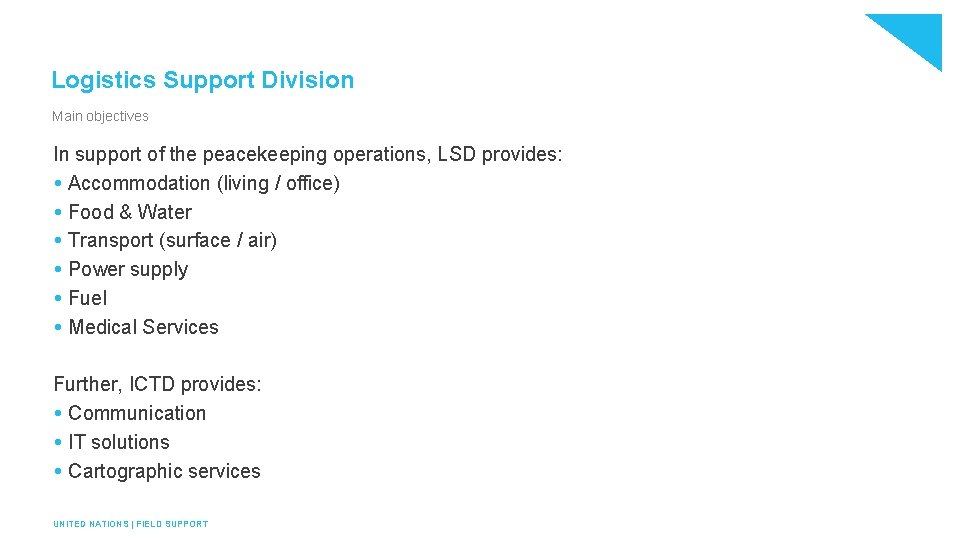
Logistics Support Division Main objectives In support of the peacekeeping operations, LSD provides: Accommodation (living / office) Food & Water Transport (surface / air) Power supply Fuel Medical Services Further, ICTD provides: Communication IT solutions Cartographic services UNITED NATIONS | FIELD SUPPORT
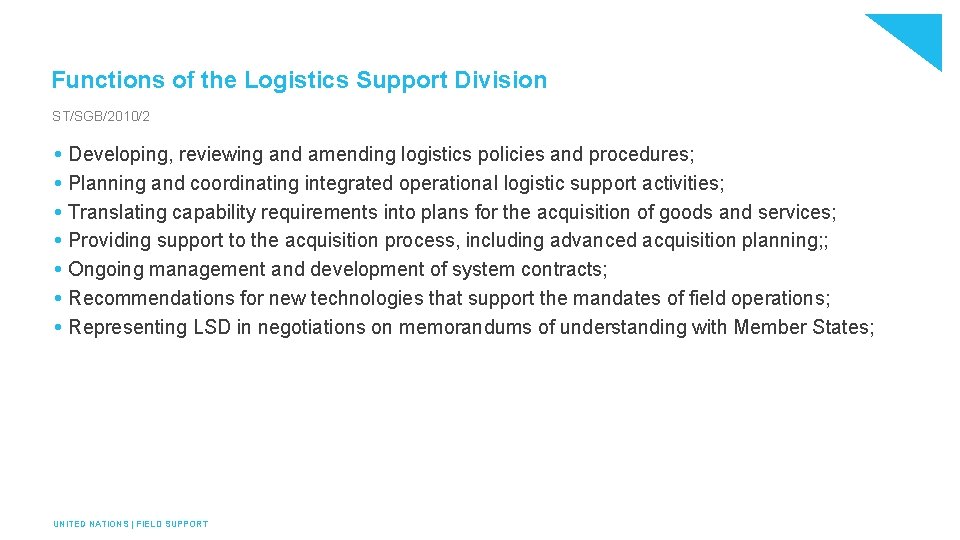
Functions of the Logistics Support Division ST/SGB/2010/2 Developing, reviewing and amending logistics policies and procedures; Planning and coordinating integrated operational logistic support activities; Translating capability requirements into plans for the acquisition of goods and services; Providing support to the acquisition process, including advanced acquisition planning; ; Ongoing management and development of system contracts; Recommendations for new technologies that support the mandates of field operations; Representing LSD in negotiations on memorandums of understanding with Member States; UNITED NATIONS | FIELD SUPPORT
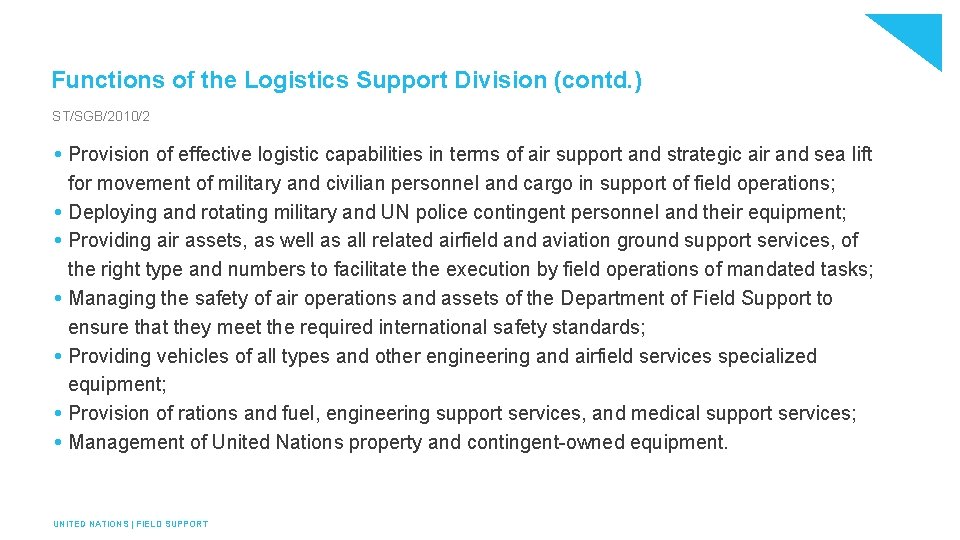
Functions of the Logistics Support Division (contd. ) ST/SGB/2010/2 Provision of effective logistic capabilities in terms of air support and strategic air and sea lift for movement of military and civilian personnel and cargo in support of field operations; Deploying and rotating military and UN police contingent personnel and their equipment; Providing air assets, as well as all related airfield and aviation ground support services, of the right type and numbers to facilitate the execution by field operations of mandated tasks; Managing the safety of air operations and assets of the Department of Field Support to ensure that they meet the required international safety standards; Providing vehicles of all types and other engineering and airfield services specialized equipment; Provision of rations and fuel, engineering support services, and medical support services; Management of United Nations property and contingent-owned equipment. UNITED NATIONS | FIELD SUPPORT
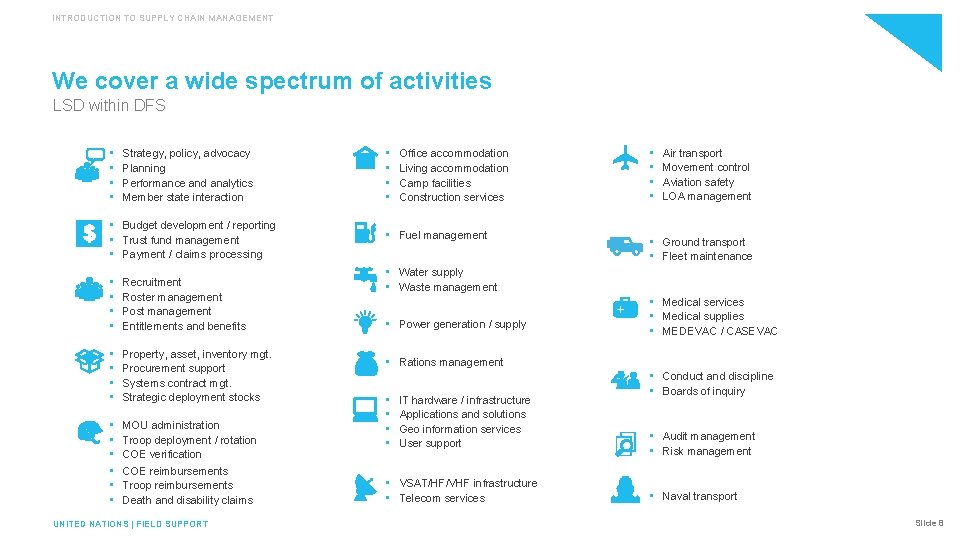
INTRODUCTION TO SUPPLY CHAIN MANAGEMENT We cover a wide spectrum of activities LSD within DFS • • Strategy, policy, advocacy Planning Performance and analytics Member state interaction • Budget development / reporting • Trust fund management • Payment / claims processing • • Recruitment Roster management Post management Entitlements and benefits • • Property, asset, inventory mgt. Procurement support Systems contract mgt. Strategic deployment stocks • • • MOU administration Troop deployment / rotation COE verification COE reimbursements Troop reimbursements Death and disability claims UNITED NATIONS | FIELD SUPPORT • • Office accommodation Living accommodation Camp facilities Construction services • Fuel management • • Air transport Movement control Aviation safety LOA management • Ground transport • Fleet maintenance • Water supply • Waste management • Power generation / supply • Medical services • Medical supplies • MEDEVAC / CASEVAC • Rations management • • IT hardware / infrastructure Applications and solutions Geo information services User support • VSAT/HF/VHF infrastructure • Telecom services • Conduct and discipline • Boards of inquiry • Audit management • Risk management • Naval transport Slide 8
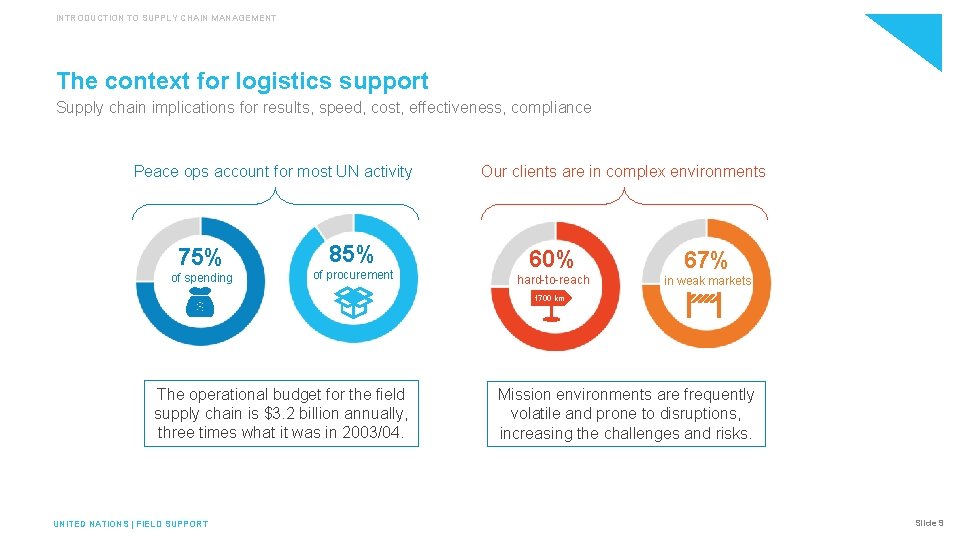
INTRODUCTION TO SUPPLY CHAIN MANAGEMENT The context for logistics support Supply chain implications for results, speed, cost, effectiveness, compliance Peace ops account for most UN activity 75% of spending 85% of procurement Our clients are in complex environments 60% 67% hard-to-reach in weak markets 1700 km The operational budget for the field supply chain is $3. 2 billion annually, three times what it was in 2003/04. UNITED NATIONS | FIELD SUPPORT Mission environments are frequently volatile and prone to disruptions, increasing the challenges and risks. Slide 9
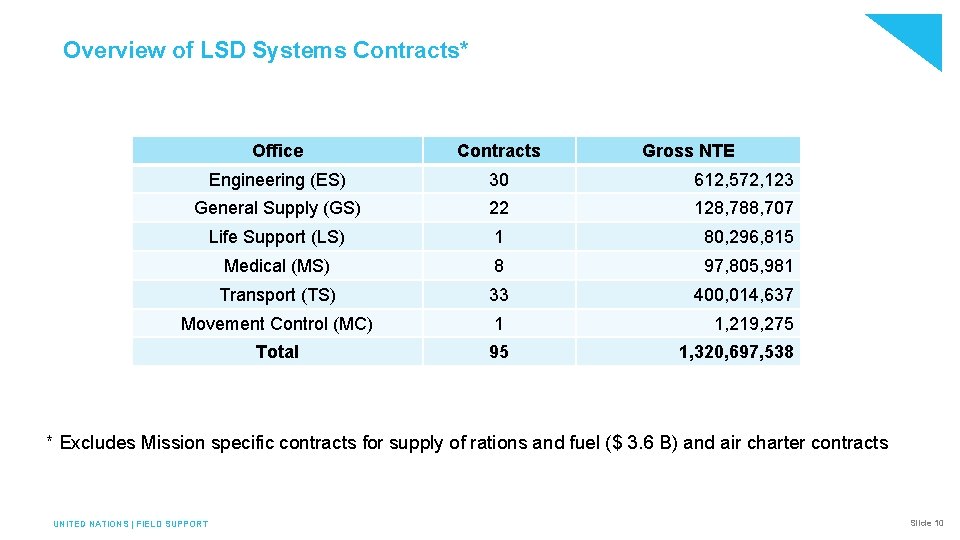
Overview of LSD Systems Contracts* Office Contracts Gross NTE Engineering (ES) 30 612, 572, 123 General Supply (GS) 22 128, 788, 707 Life Support (LS) 1 80, 296, 815 Medical (MS) 8 97, 805, 981 Transport (TS) 33 400, 014, 637 Movement Control (MC) 1 1, 219, 275 Total 95 1, 320, 697, 538 * Excludes Mission specific contracts for supply of rations and fuel ($ 3. 6 B) and air charter contracts UNITED NATIONS | FIELD SUPPORT Slide 10
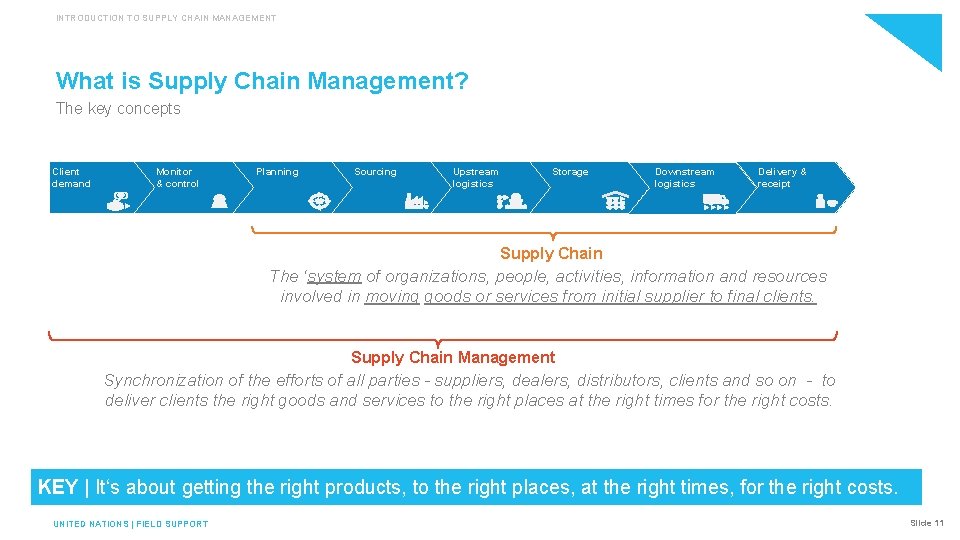
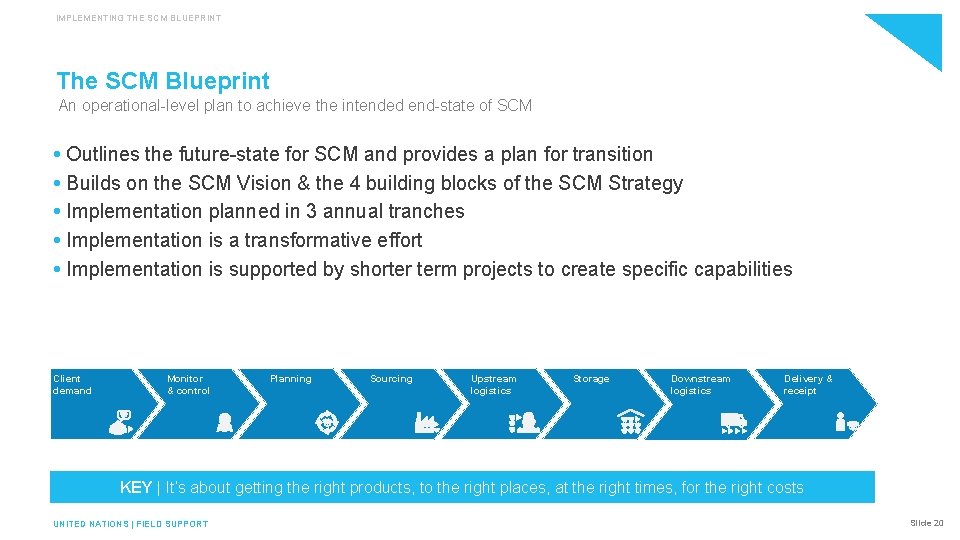
INTRODUCTION TO SUPPLY CHAIN MANAGEMENT What is Supply Chain Management? The key concepts Client demand Monitor & control Planning Sourcing Upstream logistics Storage Downstream logistics Delivery & receipt Supply Chain The ‘system of organizations, people, activities, information and resources involved in moving goods or services from initial supplier to final clients. Supply Chain Management Synchronization of the efforts of all parties - suppliers, dealers, distributors, clients and so on - to deliver clients the right goods and services to the right places at the right times for the right costs. KEY | It‘s about getting the right products, to the right places, at the right times, for the right costs. UNITED NATIONS | FIELD SUPPORT Slide 11
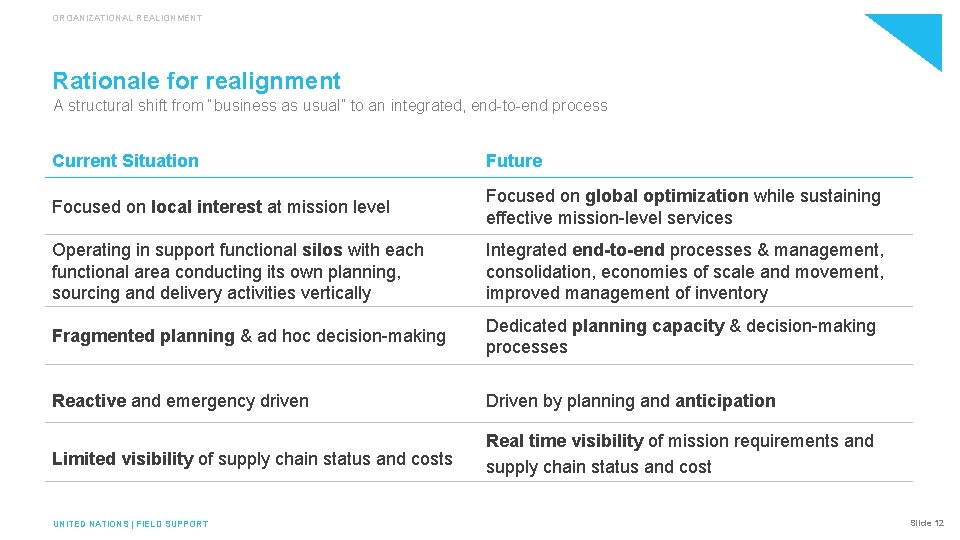
ORGANIZATIONAL REALIGNMENT Rationale for realignment A structural shift from “business as usual” to an integrated, end-to-end process Current Situation Future Focused on local interest at mission level Focused on global optimization while sustaining effective mission-level services Operating in support functional silos with each functional area conducting its own planning, sourcing and delivery activities vertically Integrated end-to-end processes & management, consolidation, economies of scale and movement, improved management of inventory Fragmented planning & ad hoc decision-making Dedicated planning capacity & decision-making processes Reactive and emergency driven Driven by planning and anticipation Limited visibility of supply chain status and costs Real time visibility of mission requirements and supply chain status and cost UNITED NATIONS | FIELD SUPPORT Slide 12
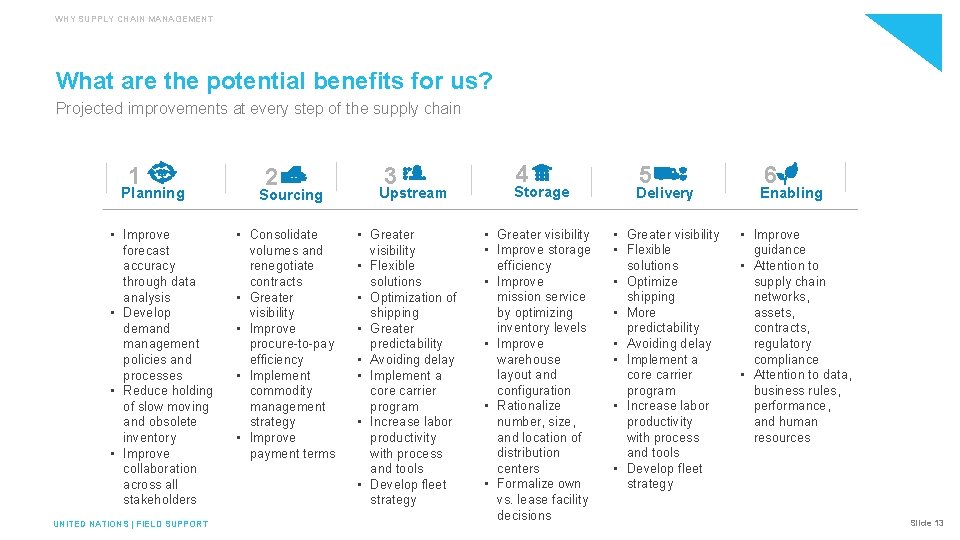
WHY SUPPLY CHAIN MANAGEMENT What are the potential benefits for us? Projected improvements at every step of the supply chain 1 Planning • Improve forecast accuracy through data analysis • Develop demand management policies and processes • Reduce holding of slow moving and obsolete inventory • Improve collaboration across all stakeholders UNITED NATIONS | FIELD SUPPORT 2 Sourcing • Consolidate volumes and renegotiate contracts • Greater visibility • Improve procure-to-pay efficiency • Implement commodity management strategy • Improve payment terms 3 Upstream • Greater visibility • Flexible solutions • Optimization of shipping • Greater predictability • Avoiding delay • Implement a core carrier program • Increase labor productivity with process and tools • Develop fleet strategy 4 Storage • Greater visibility • Improve storage efficiency • Improve mission service by optimizing inventory levels • Improve warehouse layout and configuration • Rationalize number, size, and location of distribution centers • Formalize own vs. lease facility decisions 5 Delivery • Greater visibility • Flexible solutions • Optimize shipping • More predictability • Avoiding delay • Implement a core carrier program • Increase labor productivity with process and tools • Develop fleet strategy 6 Enabling • Improve guidance • Attention to supply chain networks, assets, contracts, regulatory compliance • Attention to data, business rules, performance, and human resources Slide 13
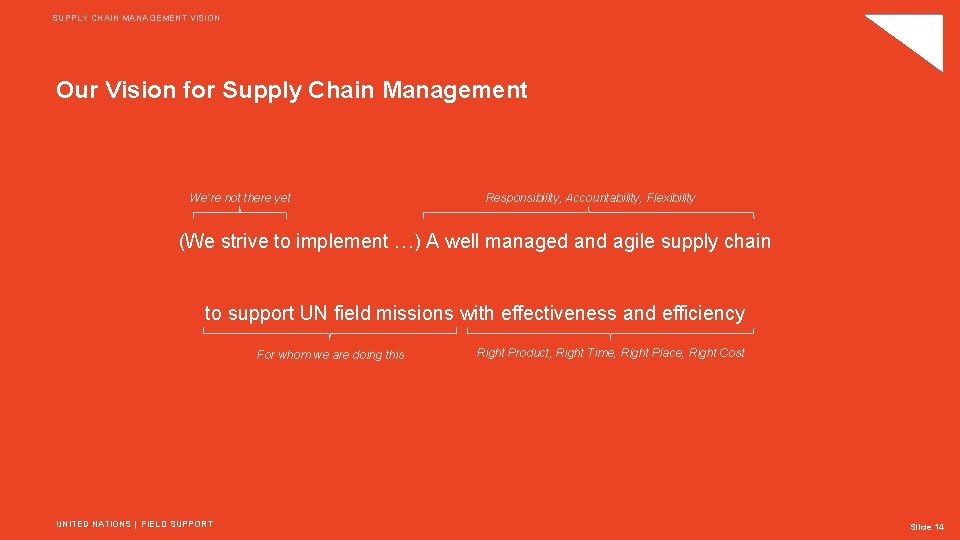
SUPPLY CHAIN MANAGEMENT VISION Our Vision for Supply Chain Management We’re not there yet Responsibility, Accountability, Flexibility (We strive to implement …) A well managed and agile supply chain to support UN field missions with effectiveness and efficiency For whom we are doing this UNITEDNATIONS| | FIELDSUPPORT Right Product, Right Time, Right Place, Right Cost Slide 14
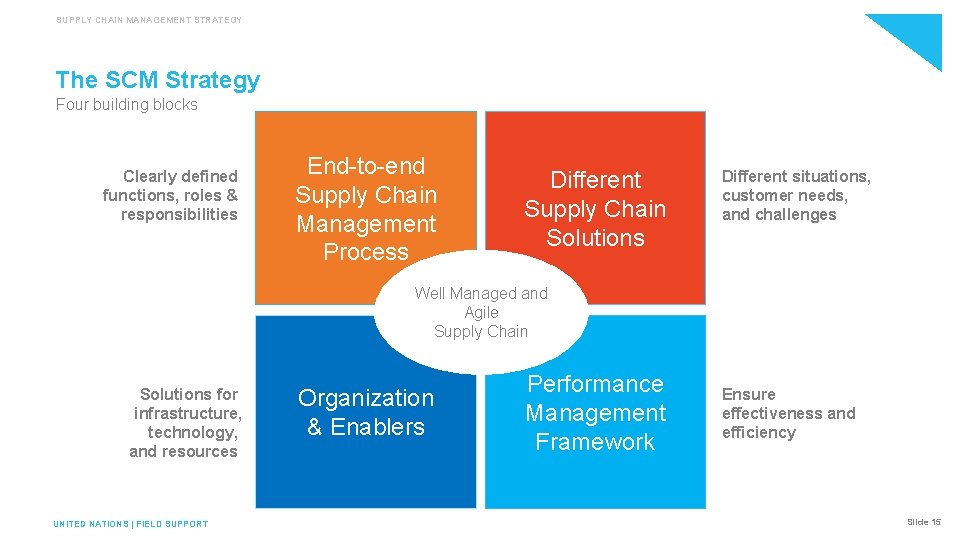
SUPPLY CHAIN MANAGEMENT STRATEGY The SCM Strategy Four building blocks Clearly defined functions, roles & responsibilities End-to-end Supply Chain Management Process Different Supply Chain Solutions Different situations, customer needs, and challenges Well Managed and Agile Supply Chain Solutions for infrastructure, technology, and resources UNITED NATIONS | FIELD SUPPORT Organization & Enablers Performance Management Framework Ensure effectiveness and efficiency Slide 15
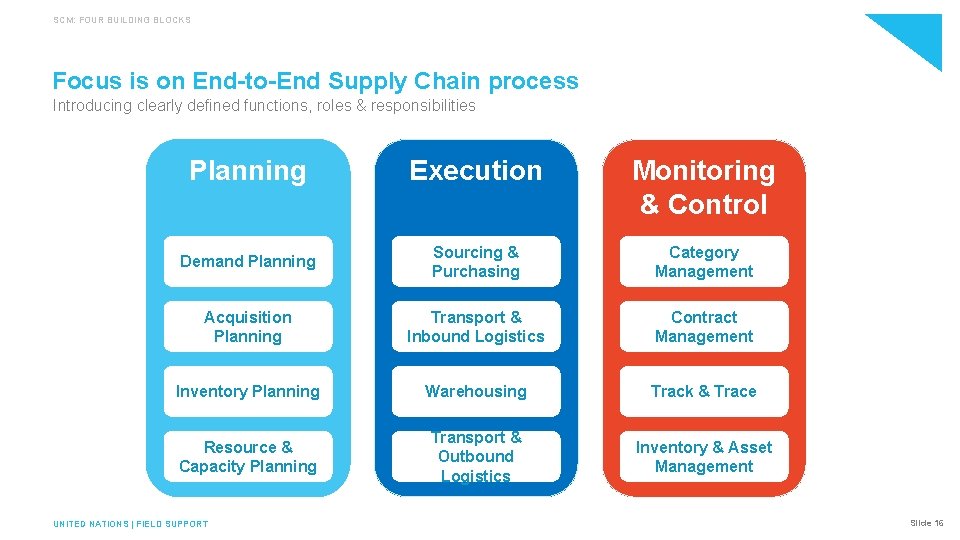
SCM: FOUR BUILDING BLOCKS Focus is on End-to-End Supply Chain process Introducing clearly defined functions, roles & responsibilities Planning Execution Monitoring & Control Demand Planning Sourcing & Purchasing Category Management Acquisition Planning Transport & Inbound Logistics Contract Management Inventory Planning Warehousing Track & Trace Resource & Capacity Planning Transport & Outbound Logistics Inventory & Asset Management UNITED NATIONS | FIELD SUPPORT Slide 16
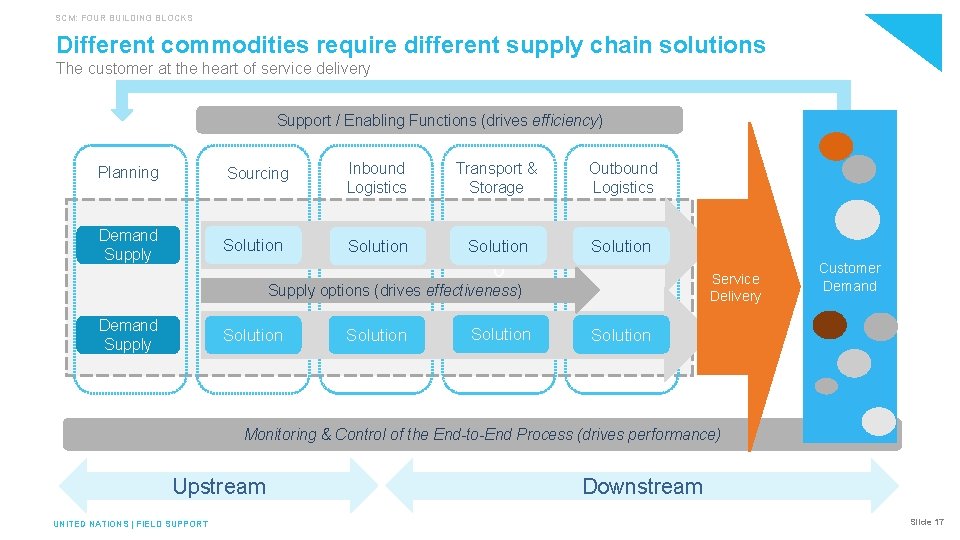
SCM: FOUR BUILDING BLOCKS Different commodities require different supply chain solutions The customer at the heart of service delivery Support / Enabling Functions (drives efficiency) Planning Sourcing Inbound Logistics Transport & Storage Outbound Logistics Demand Supply Solution 0 Service Delivery Supply options (drives effectiveness) Demand Supply Solution Custome r Customer Demand Solution Monitoring & Control of the End-to-End Process (drives performance) Upstream UNITED NATIONS | FIELD SUPPORT Downstream Slide 17
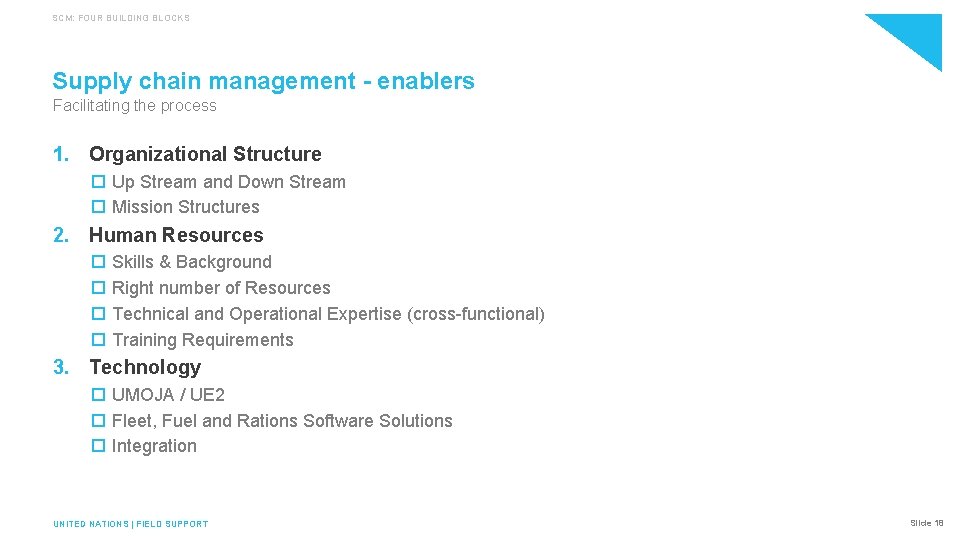
SCM: FOUR BUILDING BLOCKS Supply chain management - enablers Facilitating the process 1. Organizational Structure Up Stream and Down Stream Mission Structures 2. Human Resources Skills & Background Right number of Resources Technical and Operational Expertise (cross-functional) Training Requirements 3. Technology UMOJA / UE 2 Fleet, Fuel and Rations Software Solutions Integration UNITED NATIONS | FIELD SUPPORT Slide 18
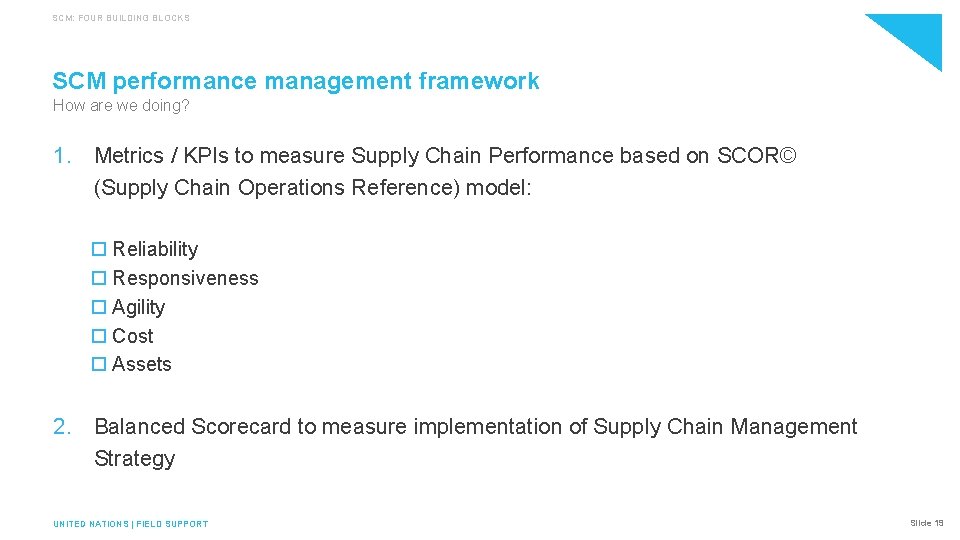
SCM: FOUR BUILDING BLOCKS SCM performance management framework How are we doing? 1. Metrics / KPIs to measure Supply Chain Performance based on SCOR© (Supply Chain Operations Reference) model: Reliability Responsiveness Agility Cost Assets 2. Balanced Scorecard to measure implementation of Supply Chain Management Strategy UNITED NATIONS | FIELD SUPPORT Slide 19
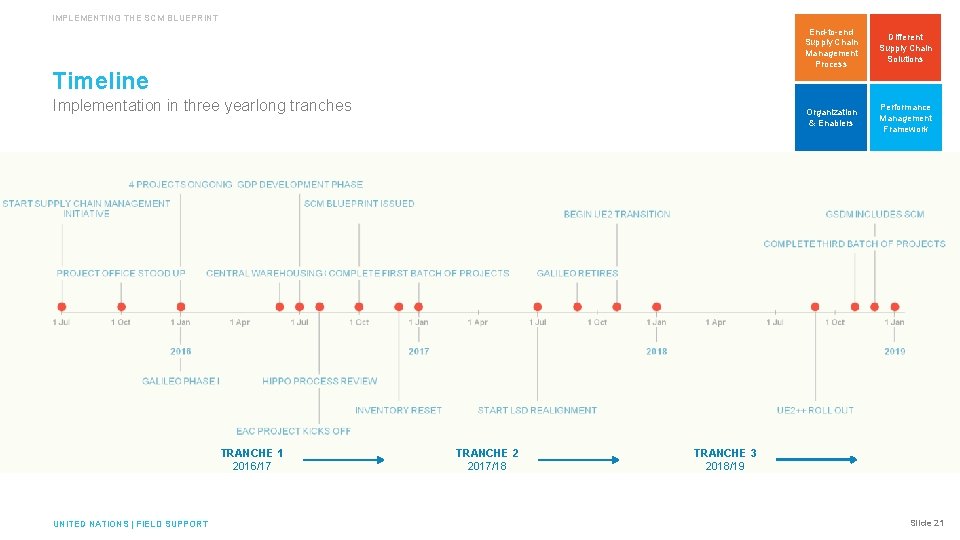
IMPLEMENTING THE SCM BLUEPRINT The SCM Blueprint An operational-level plan to achieve the intended end-state of SCM Outlines the future-state for SCM and provides a plan for transition Builds on the SCM Vision & the 4 building blocks of the SCM Strategy Implementation planned in 3 annual tranches Implementation is a transformative effort Implementation is supported by shorter term projects to create specific capabilities Client demand Monitor & control Planning Sourcing Upstream logistics Storage Downstream logistics Delivery & receipt KEY | It‘s about getting the right products, to the right places, at the right times, for the right costs UNITED NATIONS | FIELD SUPPORT Slide 20
IMPLEMENTING THE SCM BLUEPRINT Timeline Implementation in three yearlong tranches TRANCHE 1 2016/17 UNITED NATIONS | FIELD SUPPORT TRANCHE 2 2017/18 End-to-end Supply Chain Management Process Different Supply Chain Solutions Organization & Enablers Performance Management Framework TRANCHE 3 2018/19 Slide 21
QUESTIONS? UNITED NATIONS | FIELD SUPPORT
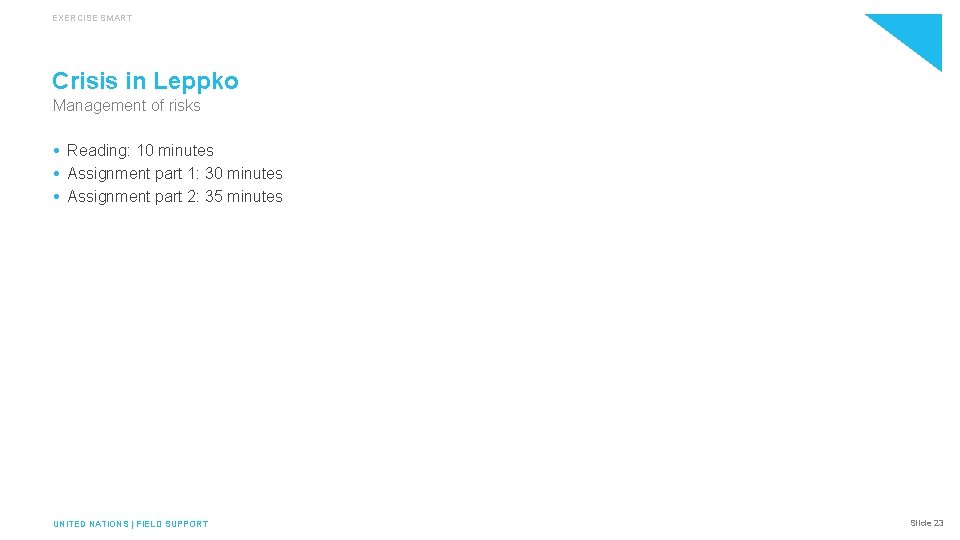
EXERCISE SMART Crisis in Leppko Management of risks Reading: 10 minutes Assignment part 1: 30 minutes Assignment part 2: 35 minutes UNITED NATIONS | FIELD SUPPORT Slide 23
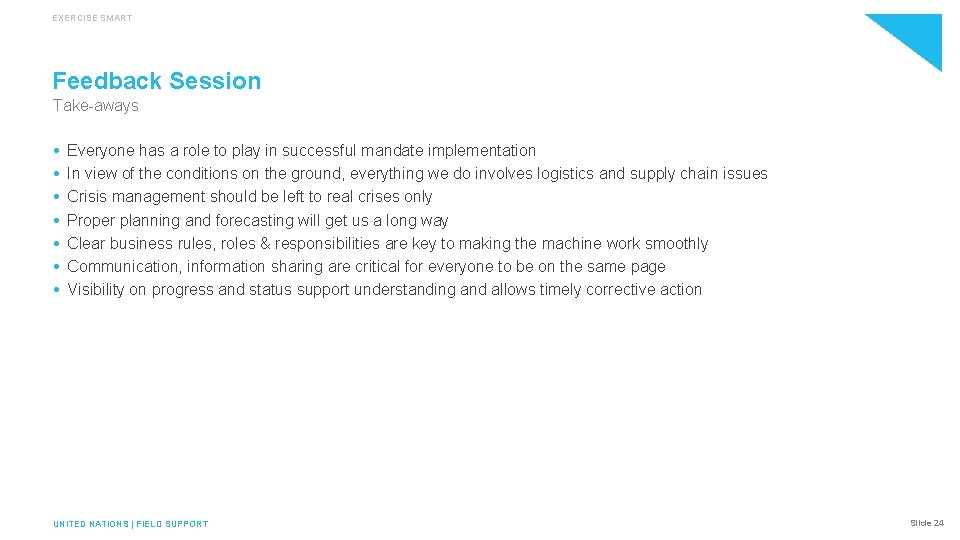
EXERCISE SMART Feedback Session Take-aways Everyone has a role to play in successful mandate implementation In view of the conditions on the ground, everything we do involves logistics and supply chain issues Crisis management should be left to real crises only Proper planning and forecasting will get us a long way Clear business rules, roles & responsibilities are key to making the machine work smoothly Communication, information sharing are critical for everyone to be on the same page Visibility on progress and status support understanding and allows timely corrective action UNITED NATIONS | FIELD SUPPORT Slide 24