
Supply Chain Management http hk youtube comwatch vEEh

Supply Chain Management http: //hk. youtube. com/watch? v=EEh. Nkzd. Kyrw MBA 655 B 2 B Marketing Prepared by: Henry G. Lam, Perry Lee and Desmond Ho Date: 13 December 2008
Agenda • • • Introduction Analysis of Dell’s Competitive Advantage Analysis of Dell’s Business Model Analysis of Dell’s IT Infrastructure Implications & Recommendations
Introduction • Dell Computer is a leader in the e-commerce computer hardware market. • It is an established brand that leads personal computer manufacturers both in U. S. sales and overall online sales. • The Dell Direct model, a Web-enabled infrastructure that allows both corporate and individual customers to customize their PCs and order other products they need or desire. • It uses the power of the Internet to share and exchange information with suppliers and vendors to build a truly superior supply chain that keeps inventory turnover low and costs to a minimum.
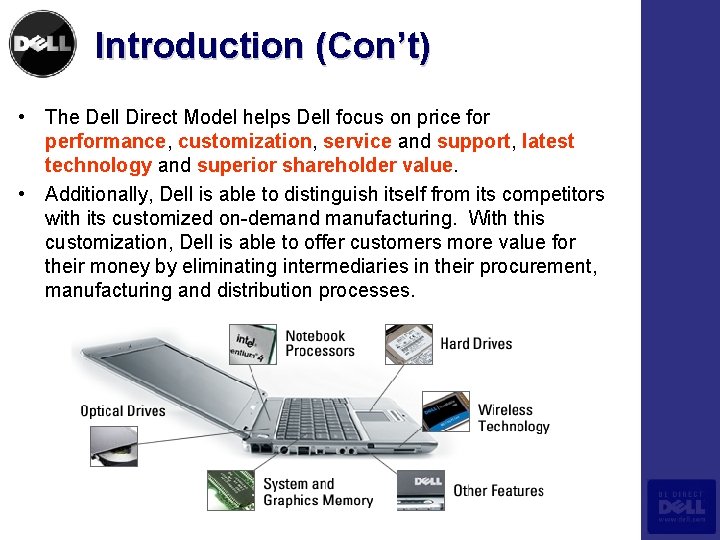
Introduction (Con’t) • The Dell Direct Model helps Dell focus on price for performance, customization, service and support, latest technology and superior shareholder value. • Additionally, Dell is able to distinguish itself from its competitors with its customized on-demand manufacturing. With this customization, Dell is able to offer customers more value for their money by eliminating intermediaries in their procurement, manufacturing and distribution processes.
Introduction (Con’t) • Dell’s primary resources include the most up-to-date technology and IT tools that allow it to successfully move along their superior supply chain and achieve the value they strive for. • Dell’s value chain allows Dell and its suppliers to exchange information and interact with each other. • The Internet, Dell’s key IT factor in its success, results in lower costs to customers than other retailers because customers tell Dell exactly what they want and Dell creates products for the consumer without experiencing wasteful resources in production. • It is evident that Dell’s competitive advantage lies in its Direct model success. Through Dell’s IT performance, which combines its resources, its relationship with suppliers and its consumer communication capabilities, Dell has developed one big advantage over its competitors.
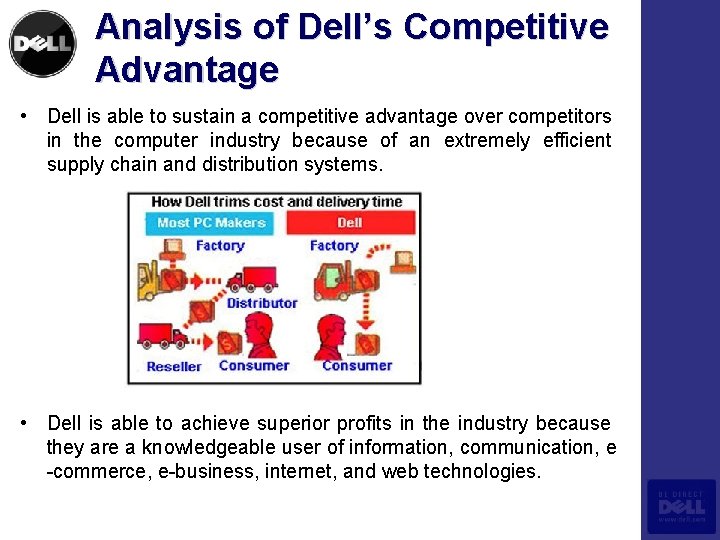
Analysis of Dell’s Competitive Advantage • Dell is able to sustain a competitive advantage over competitors in the computer industry because of an extremely efficient supply chain and distribution systems. • Dell is able to achieve superior profits in the industry because they are a knowledgeable user of information, communication, e -commerce, e-business, internet, and web technologies.
Analysis of Dell’s Competitive Advantage • Michael Dell states that Dell is so successful because of “Knowledge Management” physical assets are being replaced by intellectual assets. • This relates to Dell’s inventory system. Dell implements a Just. In-Time inventory system which operates on only 6 days of inventory achieve greater profit margins, increased profits, cut costs on warehousing, hiring people to track and maintain inventory, and avoid holding on to obsolete technology, to free up cash flow to invest in other value adding activities.
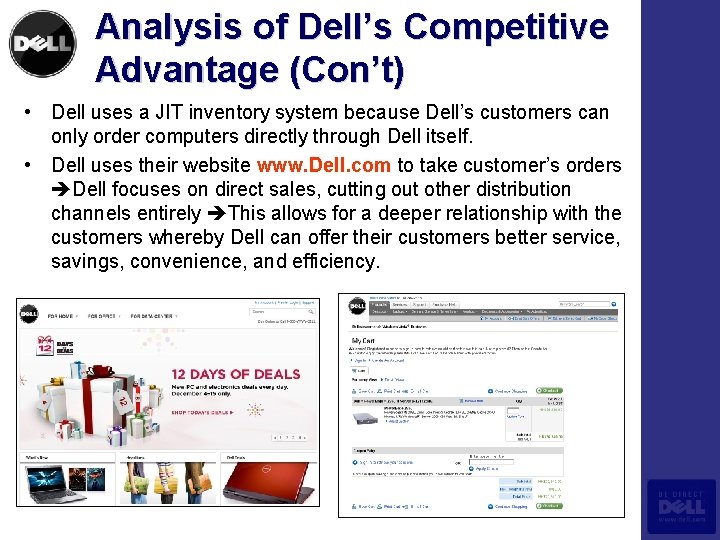
Analysis of Dell’s Competitive Advantage (Con’t) • Dell uses a JIT inventory system because Dell’s customers can only order computers directly through Dell itself. • Dell uses their website www. Dell. com to take customer’s orders Dell focuses on direct sales, cutting out other distribution channels entirely This allows for a deeper relationship with the customers whereby Dell can offer their customers better service, savings, convenience, and efficiency.
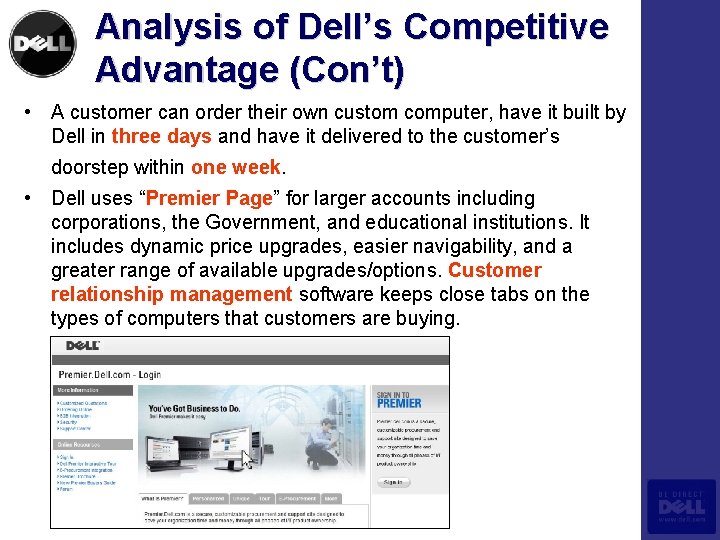
Analysis of Dell’s Competitive Advantage (Con’t) • A customer can order their own custom computer, have it built by Dell in three days and have it delivered to the customer’s doorstep within one week. • Dell uses “Premier Page” for larger accounts including corporations, the Government, and educational institutions. It includes dynamic price upgrades, easier navigability, and a greater range of available upgrades/options. Customer relationship management software keeps close tabs on the types of computers that customers are buying.
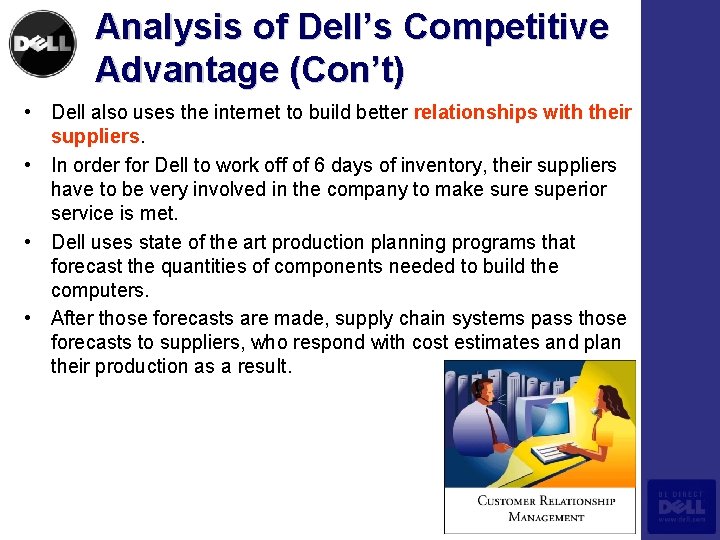
Analysis of Dell’s Competitive Advantage (Con’t) • Dell also uses the internet to build better relationships with their suppliers. • In order for Dell to work off of 6 days of inventory, their suppliers have to be very involved in the company to make sure superior service is met. • Dell uses state of the art production planning programs that forecast the quantities of components needed to build the computers. • After those forecasts are made, supply chain systems pass those forecasts to suppliers, who respond with cost estimates and plan their production as a result.
Analysis of Dell’s Competitive Advantage (Con’t) • To achieve their supply chain superiority, Dell uses solutions from i 2 Supply Chain Management. • i 2 streamlines the supply chain by providing component suppliers and Dell planners with global views of product demand material requirements. • It also provides real-time factory scheduling and inventory management, so employees can generate key reports based on accurate and timely data, pinpoint inventory on the factory floor, and receive supplier deliveries on a true just-in-time basis.
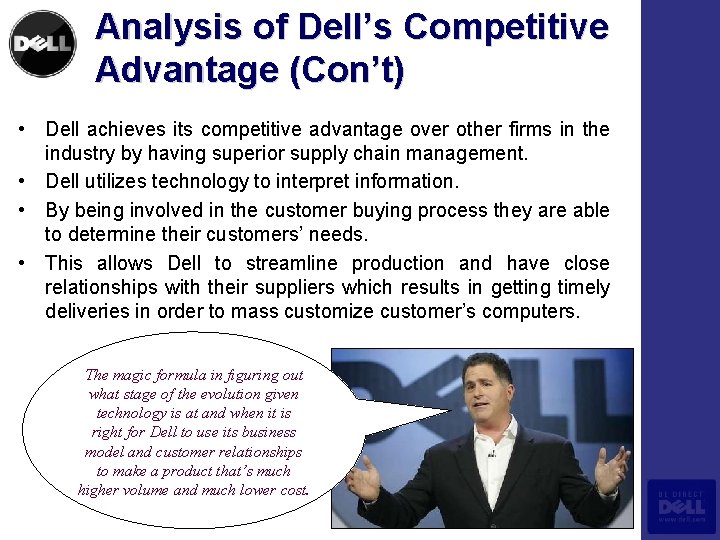
Analysis of Dell’s Competitive Advantage (Con’t) • Dell achieves its competitive advantage over other firms in the industry by having superior supply chain management. • Dell utilizes technology to interpret information. • By being involved in the customer buying process they are able to determine their customers’ needs. • This allows Dell to streamline production and have close relationships with their suppliers which results in getting timely deliveries in order to mass customize customer’s computers. The magic formula in figuring out what stage of the evolution given technology is at and when it is right for Dell to use its business model and customer relationships to make a product that’s much higher volume and much lower cost.
Analysis of Dell’s Business Model • Dell has four markets: B 2 B, B 2 C, C 2 B and C 2 C. But Dell focuses on B 2 B and B 2 C commerce to satisfy their business and individual customers. • Dell's business model is no secret, of course, and it's been emulated with considerably less success by many of its competitors. • Matching customer ease of ordering and direct interaction through the internet proved successful because Dell believes that it is the customer that drives the business model.
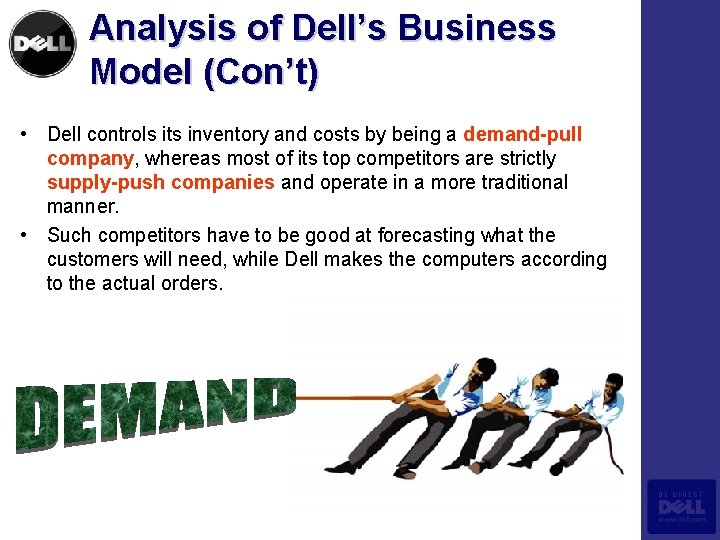
Analysis of Dell’s Business Model (Con’t) • Dell controls its inventory and costs by being a demand-pull company, whereas most of its top competitors are strictly supply-push companies and operate in a more traditional manner. • Such competitors have to be good at forecasting what the customers will need, while Dell makes the computers according to the actual orders.
Analysis of Dell’s Business Mobel (Con’t) • Dell is more efficient and therefore more profitable because it can buy its component parts based on the customer’s demand not have to worry about building up its supply of inventory that may or may not be used.
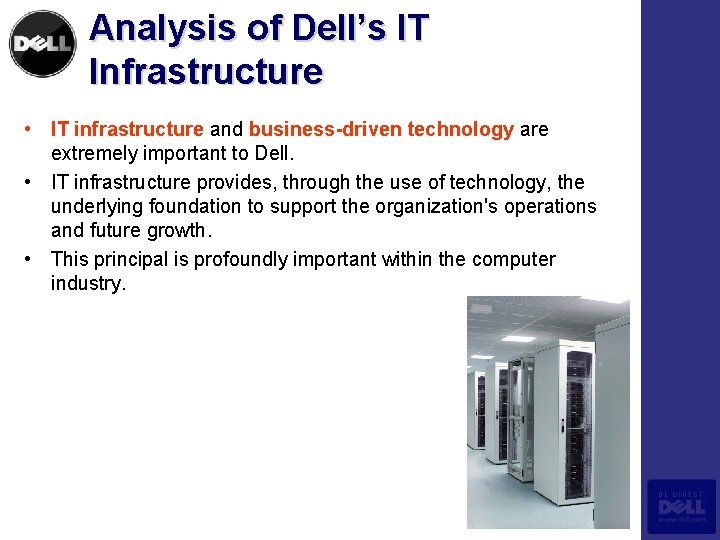
Analysis of Dell’s IT Infrastructure • IT infrastructure and business-driven technology are extremely important to Dell. • IT infrastructure provides, through the use of technology, the underlying foundation to support the organization's operations and future growth. • This principal is profoundly important within the computer industry.
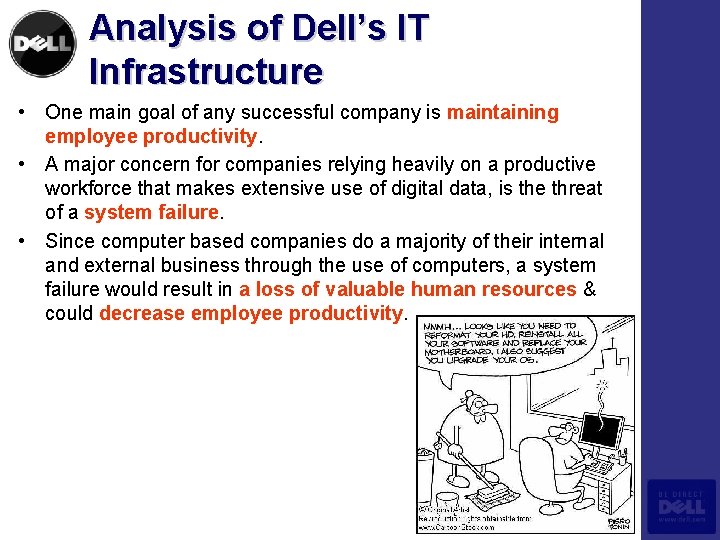
Analysis of Dell’s IT Infrastructure • One main goal of any successful company is maintaining employee productivity. • A major concern for companies relying heavily on a productive workforce that makes extensive use of digital data, is the threat of a system failure. • Since computer based companies do a majority of their internal and external business through the use of computers, a system failure would result in a loss of valuable human resources & could decrease employee productivity.
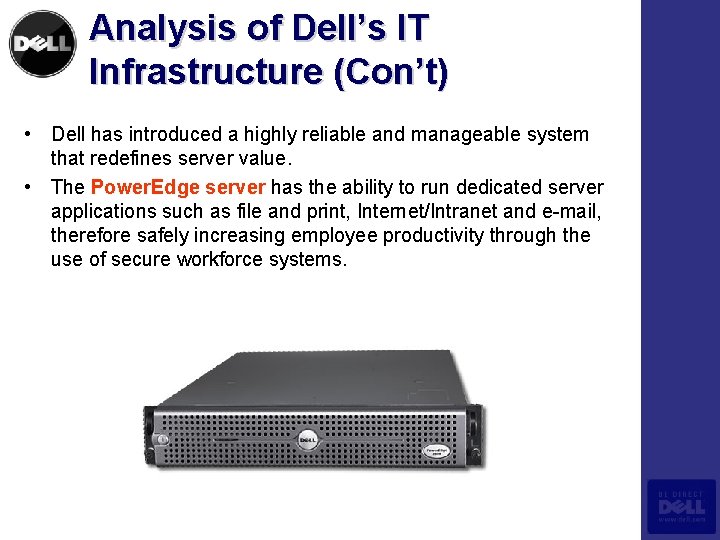
Analysis of Dell’s IT Infrastructure (Con’t) • Dell has introduced a highly reliable and manageable system that redefines server value. • The Power. Edge server has the ability to run dedicated server applications such as file and print, Internet/Intranet and e-mail, therefore safely increasing employee productivity through the use of secure workforce systems.
Analysis of Dell’s IT Infrastructure (Con’t) • Recently Altiris Recovery Solution has been selected by Dell for integrated delivery of backup and disaster recovery. • Altiris along with Dell Open. Manage Client Administrator (OMCA) will provide direct integration of Altiris backup and recovery technology with Dell OMCA which helps ensure business continuity and helps provide additional cost savings for Dell customers through proactive IT management.
Analysis of Dell’s IT Infrastructure (Con’t) • Dell has managed to maintain high employee productivity consistently. • One of the main ways in which they have managed to do this is to provide near unlimited availability to their IT infrastructure. • Dell keeps consumer information lines open 24 hours a day, 7 days a week and they also have an easily accessible online help services. • Full time access is crucial to the support of the IT infrastructure by allowing knowledgeable workers ease in admission to the source regardless of varied schedule. • The majority of Dell's business is done through the internet which allows the customer to customize his/her product directly for their purposes. • These factors give Dell a competitive advantage in its high scalability and flexibility.
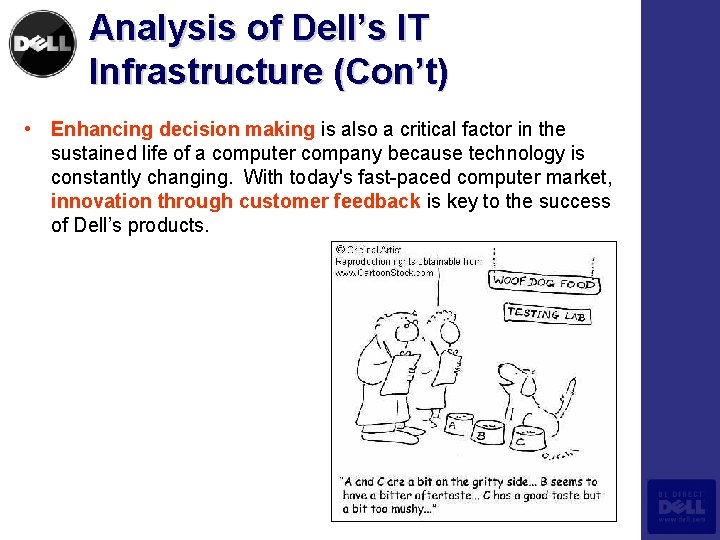
Analysis of Dell’s IT Infrastructure (Con’t) • Enhancing decision making is also a critical factor in the sustained life of a computer company because technology is constantly changing. With today's fast-paced computer market, innovation through customer feedback is key to the success of Dell’s products.
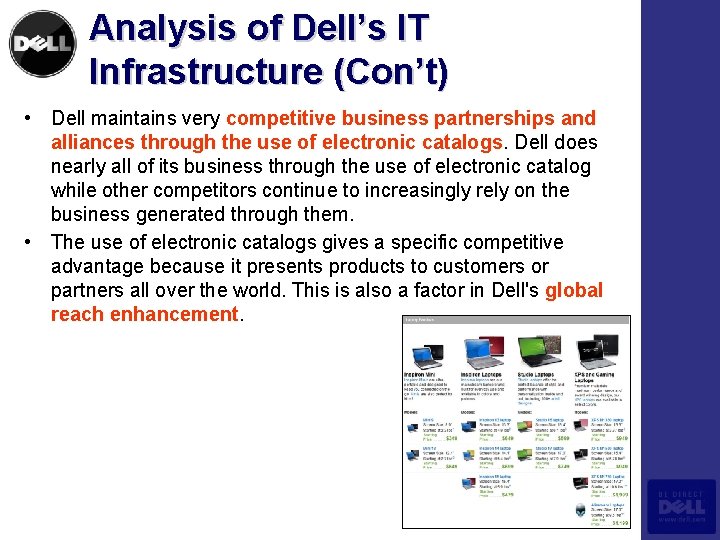
Analysis of Dell’s IT Infrastructure (Con’t) • Dell maintains very competitive business partnerships and alliances through the use of electronic catalogs. Dell does nearly all of its business through the use of electronic catalog while other competitors continue to increasingly rely on the business generated through them. • The use of electronic catalogs gives a specific competitive advantage because it presents products to customers or partners all over the world. This is also a factor in Dell's global reach enhancement.
Implications & Recommendations Dell should consider selectively adding other vendors to its supply chain management system. • Due to the increase in Dell’s global sales, Dell may need to consider to selectively adding additional suppliers to their supply chain management system. • The additional suppliers should not result in any significant cost to Dell and Dell might be able to negotiate better component costs from new suppliers. • New suppliers would want to participate in this exchange because they would be seen doing business with a leading technology company.
Implications & Recommendations (Con’t) Use “Customer Surveys” to gain market share. • Although Dell does well in its markets overseas, Dell has lost some domestic market share and has more potential overseas. • It is important for Dell to advertise and get their products noticed in international markets. • In order to achieve this goal, in-depth customer satisfaction surveys should be used in markets where they trail their competition. • Dell can also send out questionnaires to previous consumers to see how they can improve. • By going directly to the consumers, they can get feedback from sources they care most about. • It also makes consumers feel that Dell truly cares about how they feel about their products and service.
Implications & Recommendations (Con’t) Invest more in Research and Development. • With the growth of quality competition, it is crucial for Dell to keep its competitive advantage by offering new technology products and services. • Dell should consider expanding into peripheral product markets that would compliment their computer sales. • This might include specially designed systems for specific industries (architects, doctors, etc. ) or additional hardware for specific markets (gamers, music lovers, etc. ) • It is also important for Dell to watch its competitors and see what new products and techniques they introduce. R&D
Implications & Recommendations (Con’t) Dell could offer online data back-up capabilities. • Another way to increase revenue is to offer existing customers (business and individual consumers) back-up capabilities on Dell’s own servers. • This process will have advantages for both consumers and Dell. • For consumers, especially businesses, if something happens to their plants and computer systems, they can always retrieve their data from Dell who has their information backed up offsite on their system. • By keeping their data saved at another location that is maintained by Dell, Dell can make money by charging for this additional service. • Dell also has a built-in customer list based on the sales that they make for computer systems.
Implications & Recommendations (Con’t) Reduce errors in Dell’s direct Internet ordering system and create a “Clearance” area on its website. • It is important that Dell keeps their service of Dell. Direct efficient by avoiding mistakes and making sure that purchases online are correct. • Dell should enhance its online ordering system with customer confirmation before manufacturing starts. This would help reduce costs of production if there are incorrect orders and it will also help increase consumer satisfaction. • If there are cancelled orders or completed orders that don’t get paid for, Dell can start a clearance area on their website.
Implications & Recommendations (Con’t) Enhance customer support services. • Based on the results of some surveys that say that Dell might be losing customers because of actual or perceived decrease in support. • Dell should do a cost-benefit analysis to determine whether they should invest in more people who can answer technical questions & support customers with their problems and needs. • Dell has taken advantage of the cheaper labor in other countries by outsourcing most of its technical support calls from the US to headquarters in India. • The only problem with this was that Corporate customers didn’t like the level of support they were getting. • In the normal course of business, Dell should make some adjustments.
Implications & Recommendations (Con’t) Increase Company recognition through a national advertising campaign. • In order to keep the name Dell out in the market, it may be helpful for Dell to consider a national advertising campaign to increase Dell’s visibility. • These ads would probably be most effective for the small business and individual user markets. • This may include ads on the Internet, as well as commercial, magazine and newspaper ads. • Dell succeeded increasing its brand name recognition once before with its “Dell guy” campaign. This will only help Dell get its good name out there for all people to see, recognize and eventually result in purchasing Dell products.
Implications & Recommendations (Con’t) Enhance the Pre-installed Free Software campaign. • In 2007, Dell has announced to have Linux system pre-installed in desktop computers for customers • Linux has been gaining its popularity against Microsoft Windows because it’s free and expandability. • With the support with EMC and Oracle, Dell also offers free software such as system administration tools on the server platform. • With free software bundled, the cost of Dell’s products reduced and Dell will be more competitive. • The most important thing is the commercial success of Dell’s offering. A sustainable business in pre-installed free software in Western markets will give credibility to the Linux computers as well as providing to build relationship with the rest of the consumer PC ecosystem. • http: //hk. youtube. com/watch? v=Rfkuca. Gv 0 o. A
Implications & Recommendations (Con’t) Enhance the Pre-installed Free Software campaign. • http: //hk. youtube. com/watch? v=Rfkuca. Gv 0 o. A
References • i 2 supply chain management systems (March 30, 2004). Retrieved April 3, 2004, High Tech: Consumer Electronics Customers (Dell). • Dell selects Altiris recover solution to provide desktop and notebook customers with integrated backup and disaster recovery. EDP Weekly's IT Monitor. August 18, 2003, Retrieved, April 5, 2004. • Harrington, L. (April, 2002). Retrieved Mar 28, 2004, The accelerated Value Chain: Supply chain management just got smarter, faster and more cost-effective, thanks to a groundbreaking alliance between Intel and i 2 technologies, Industry Week. • Jacobs, D. (2003). Retrieved Mar 1, 2004, Anatomy of a Supply Chain, from http: //www. totalsupplychain. com

THANK YOU!!!
- Slides: 33