
SUPPLY CHAIN MANAGEMENT Background The Public Finance Management
SUPPLY CHAIN MANAGEMENT
Background • The Public Finance Management Act was approved and promulgated in March 1999 to give effect to Sections 213, 214, 215, 216, 217, 218 and 219 of the Constitution, but first and foremost, to promote sound financial management and to improve accountability in the public sector. It must be kept in mind that procurement and provisioning, or the new integrated supply chain management system, which is currently being promoted, forms an integral part of financial management. ICASA has implemented a Supply Chain Management structure in line with the National Treasury regulations.
Role of Council must oversee the implementation of this supply chain Management policy in line with Treasury Regulations: • For the purposes of such overseeing the Accounting Officer must within 30 days of the end of each financial year, submit a report on the implementation of the supply chain management policy of ICASA. • Whenever there are serious and material problems in the implementation of the supply chain management policy, immediately submit a report to the Council.
Role of the Chief Financial Officer In terms of section 38 (1), the Accounting Officer/Chief Executive Officer must ensure that the institution maintains an appropriate procurement and provisioning system which is fair, equitable, transparent, competitive and cost effective. The Treasury Regulation 16 A 3. 1 further states that the Accounting Officer must develop and implement an effective and efficient supply chain management system in his or her institution for: • Procuring goods or services. • Disposing of goods no longer needed. • Selecting contractors to provide assistance or services.

Role of Bid Evaluation Committee • ICASA has Bid evaluation committees that evaluates all bids received objectively. The Bid recommended by Adjudication Committee approves the appointment of the Bid Evaluation Committee the General Manager concerned. The Bid Evaluation Committee will evaluate bids and make a recommendation to the Bid Adjudication Committee for approval in terms of the delegation of authority. Bid Evaluation Committee members must be subject matter experts for that specific requirement.

Role of Bid Adjudication Committee • The Chief Financial Officer or the official designated by the Chief Financial Officer is the Chairperson of the Committee. Members of the Bid Adjudication Committee are appointed for a specific period, preferably not longer than 2 years with the option to extend each member’s individual appointment for a period not longer than another one year. The members of the Committee can include alternative members who must be appointed in writing. Each member should declare its interest in writing pertaining to the specific bid(s) in question before the start of the each meeting. A member of a Bid Evaluation Committee may not be a member of a bid adjudication/award committee. In order for the meeting to continue a minimum quorum of four (4) voting members must be present.

Delegation of Authority The Bid Adjudication Committee has a delegation to award a bid up to the value of R 2 million Rand, while the Chief Executive Officer awards bids between R 2 million to R 3 million. Council award bids above R 3 million Rand.
SCM Milestone The implementation of the Supply Chain Management system started in 2006 and among others the following milestones have been achieved: • A Supply chain policy is in place • A Bid Adjudication Committee has been established • Business processes are in place for the bid processes and other related activities
Challenges • National Treasury Preferred Procurement Act has not been promulgated to promote BBBEE. • There are few or no BEE companies that provide the technical equipment that we require. • Local institutions are not proactive to develop the courses that will empower the regulator and the industry on liberation dynamics.
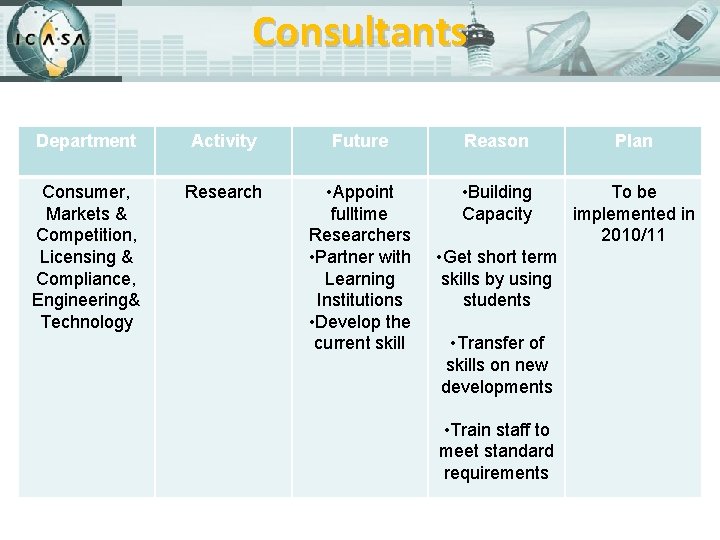
Consultants Department Activity Future Reason Plan Consumer, Markets & Competition, Licensing & Compliance, Engineering& Technology Research • Appoint fulltime Researchers • Partner with Learning Institutions • Develop the current skill • Building Capacity To be implemented in 2010/11 • Get short term skills by using students • Transfer of skills on new developments • Train staff to meet standard requirements
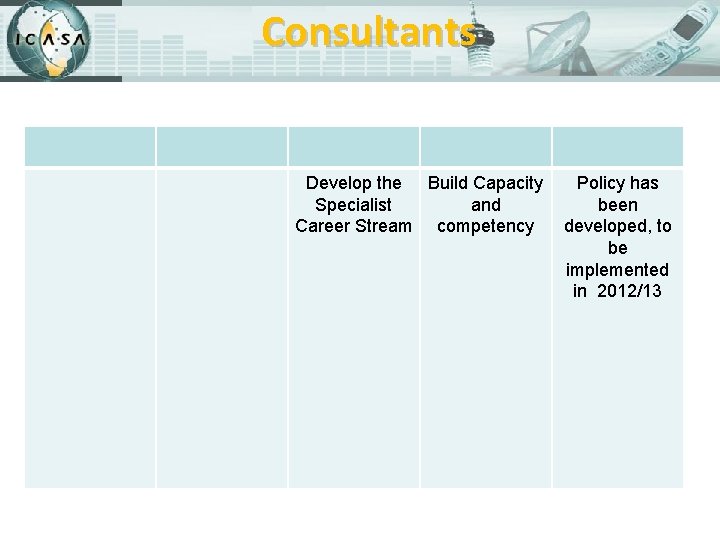
Consultants Develop the Build Capacity Specialist and Career Stream competency Policy has been developed, to be implemented in 2012/13
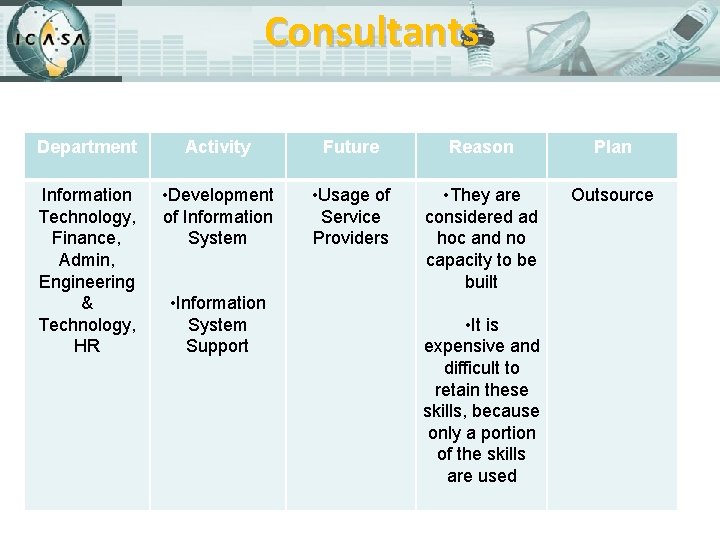
Consultants Department Activity Future Reason Plan Information Technology, Finance, Admin, Engineering & Technology, HR • Development of Information System • Usage of Service Providers • They are considered ad hoc and no capacity to be built Outsource • Information System Support • It is expensive and difficult to retain these skills, because only a portion of the skills are used
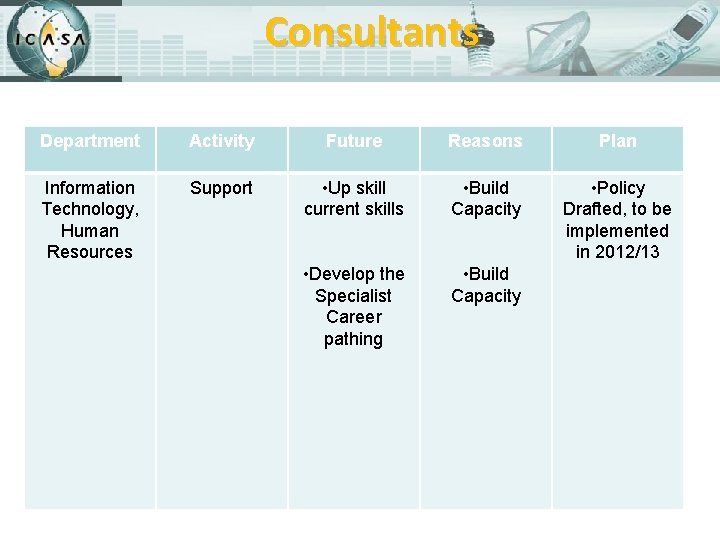
Consultants Department Activity Future Reasons Plan Information Technology, Human Resources Support • Up skill current skills • Build Capacity • Policy Drafted, to be implemented in 2012/13 • Develop the Specialist Career pathing • Build Capacity
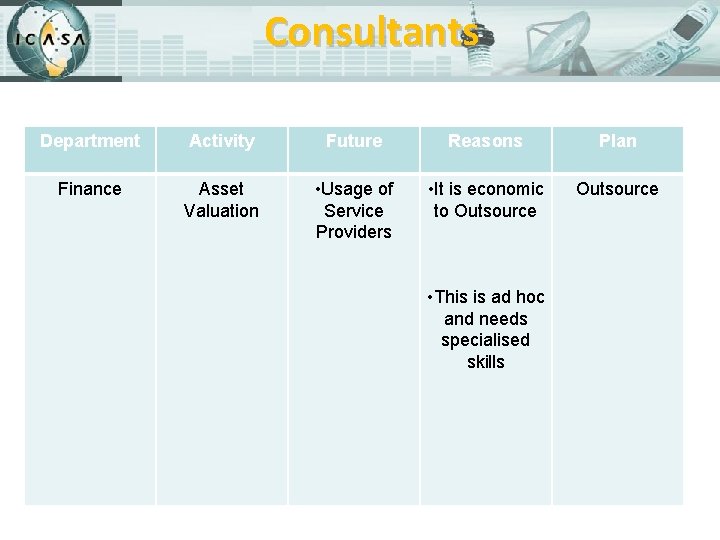
Consultants Department Activity Future Reasons Plan Finance Asset Valuation • Usage of Service Providers • It is economic to Outsource • This is ad hoc and needs specialised skills
- Slides: 14