
Supply Chain Inventory Management Chapter 9 Copyright 2013




- Slides: 91
Supply Chain Inventory Management Chapter 9 Copyright © 2013 Pearson Education, Inc. publishing as Prentice Hall 09 - 0
What is a Inventory Management? Inventory Management The planning and controlling of inventories in order to meet the competitive priorities of the organization. Copyright © 2013 Pearson Education, Inc. publishing as Prentice Hall 09 - 02
Inventory and Supply Chains Inventory A stock of materials used to satisfy customer demand or to support the production of services or goods. Copyright © 2013 Pearson Education, Inc. publishing as Prentice Hall 09 - 03
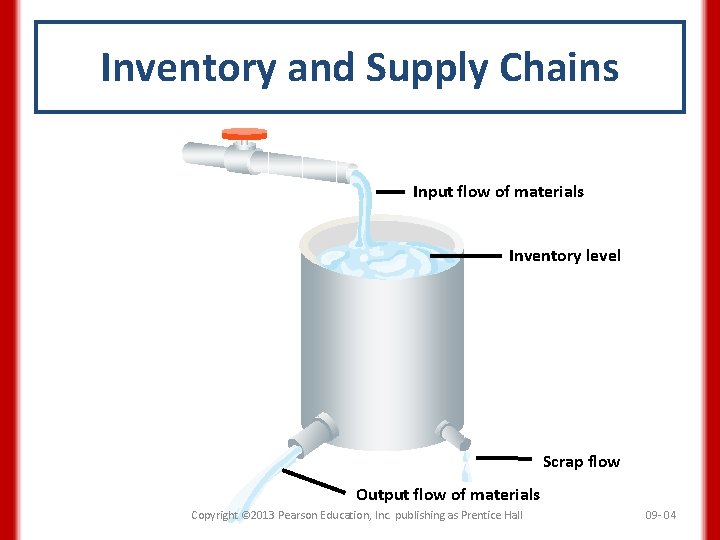
Inventory and Supply Chains Input flow of materials Inventory level Scrap flow Output flow of materials Copyright © 2013 Pearson Education, Inc. publishing as Prentice Hall 09 - 04
Pressures for Small Inventories • • • Inventory holding cost Cost of capital Storage and handling costs Taxes Insurance Shrinkage – Pilferage – Obsolescence – Deterioration Copyright © 2013 Pearson Education, Inc. publishing as Prentice Hall 09 - 05
Pressures for Large Inventories • Customer service • Ordering cost • Setup cost • Labor and equipment utilization • Transportation cost • Payments to suppliers Copyright © 2013 Pearson Education, Inc. publishing as Prentice Hall 09 - 06
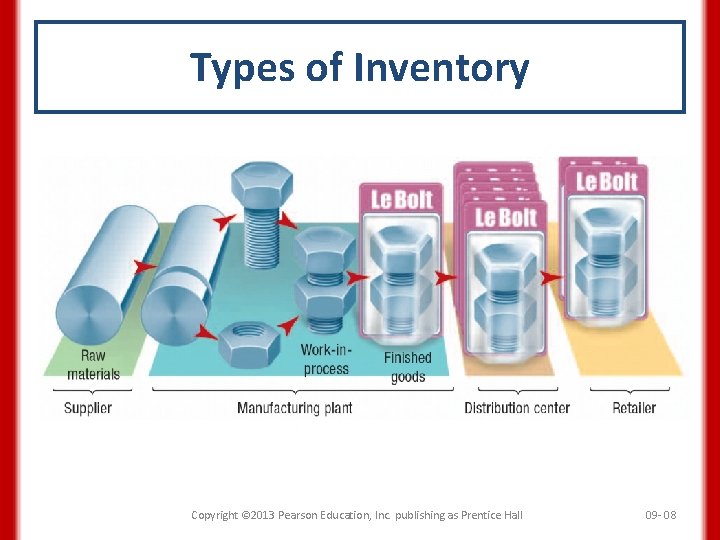
Types of Inventory • Raw materials • Work-in-process • Finished goods Copyright © 2013 Pearson Education, Inc. publishing as Prentice Hall 09 - 07
Types of Inventory Copyright © 2013 Pearson Education, Inc. publishing as Prentice Hall 09 - 08
Types of Inventory • Cycle Inventory • Safety Stock Inventory • Anticipation Inventory • Pipeline Inventory Copyright © 2013 Pearson Education, Inc. publishing as Prentice Hall 09 - 09
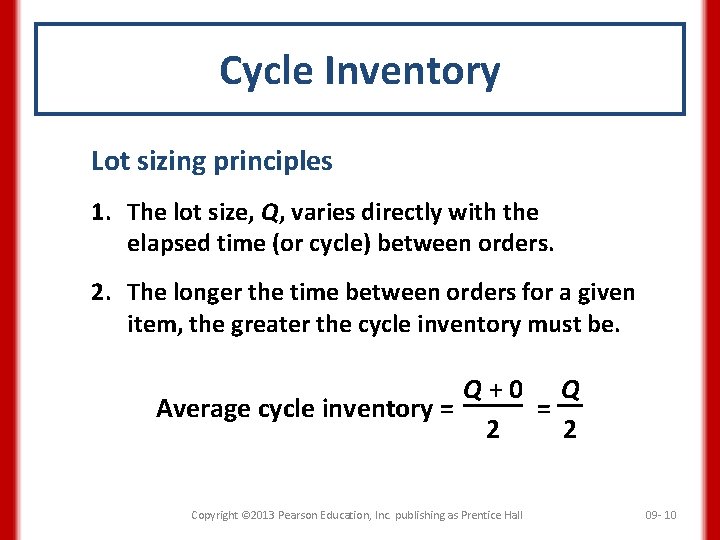
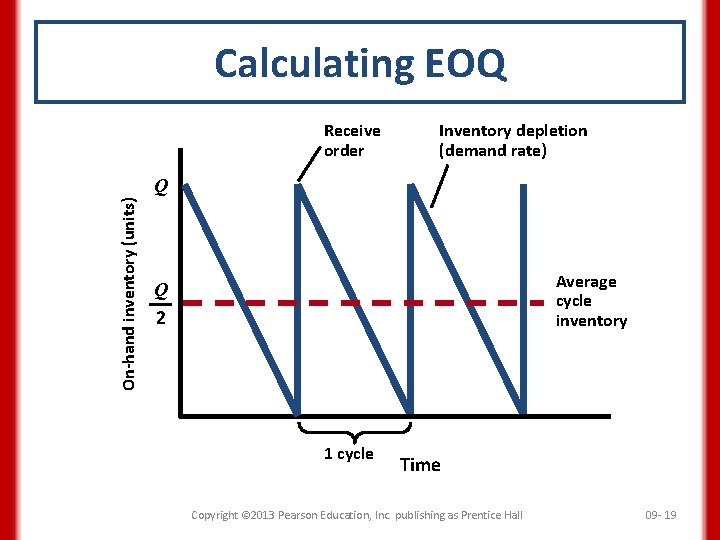
Cycle Inventory Lot sizing principles 1. The lot size, Q, varies directly with the elapsed time (or cycle) between orders. 2. The longer the time between orders for a given item, the greater the cycle inventory must be. Q+0 Q Average cycle inventory = = 2 2 Copyright © 2013 Pearson Education, Inc. publishing as Prentice Hall 09 - 10
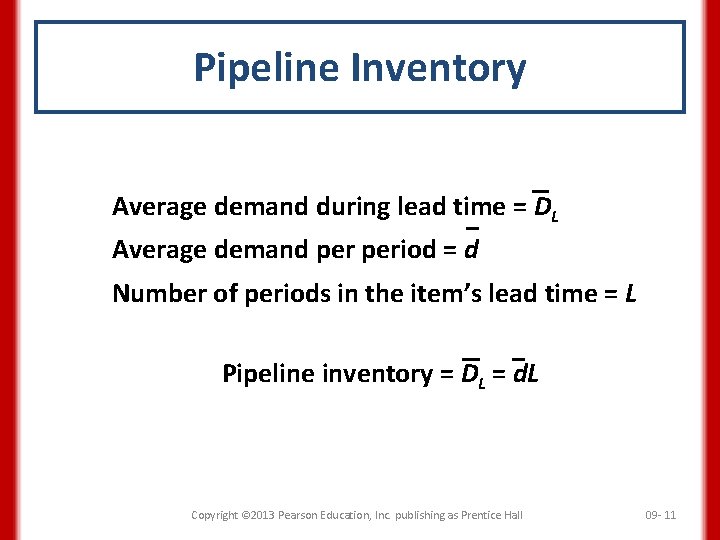
Pipeline Inventory Average demand during lead time = DL Average demand period = d Number of periods in the item’s lead time = L Pipeline inventory = DL = d. L Copyright © 2013 Pearson Education, Inc. publishing as Prentice Hall 09 - 11
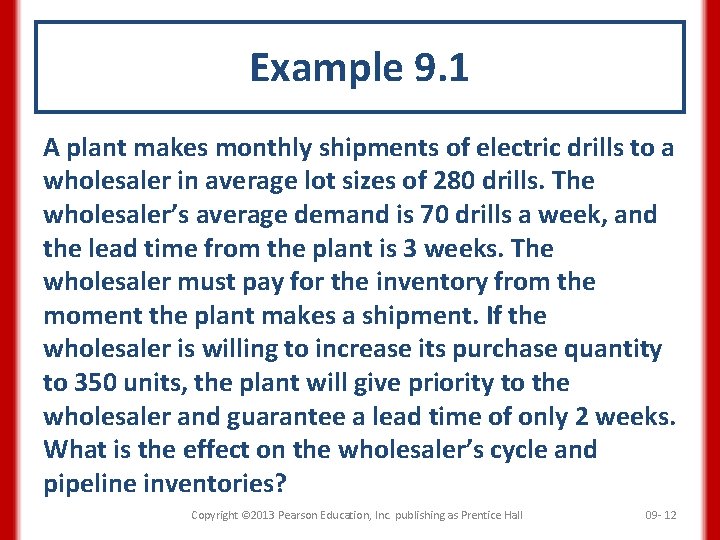
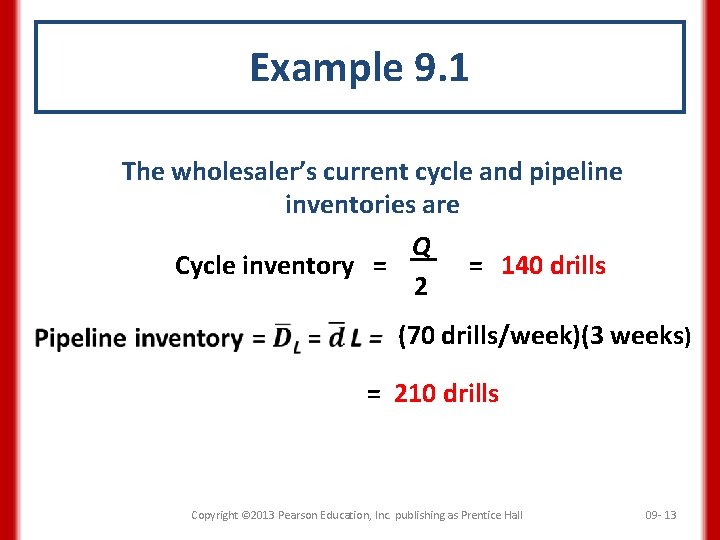
Example 9. 1 A plant makes monthly shipments of electric drills to a wholesaler in average lot sizes of 280 drills. The wholesaler’s average demand is 70 drills a week, and the lead time from the plant is 3 weeks. The wholesaler must pay for the inventory from the moment the plant makes a shipment. If the wholesaler is willing to increase its purchase quantity to 350 units, the plant will give priority to the wholesaler and guarantee a lead time of only 2 weeks. What is the effect on the wholesaler’s cycle and pipeline inventories? Copyright © 2013 Pearson Education, Inc. publishing as Prentice Hall 09 - 12
Example 9. 1 The wholesaler’s current cycle and pipeline inventories are Q Cycle inventory = = 140 drills 2 (70 drills/week)(3 weeks) = 210 drills Copyright © 2013 Pearson Education, Inc. publishing as Prentice Hall 09 - 13
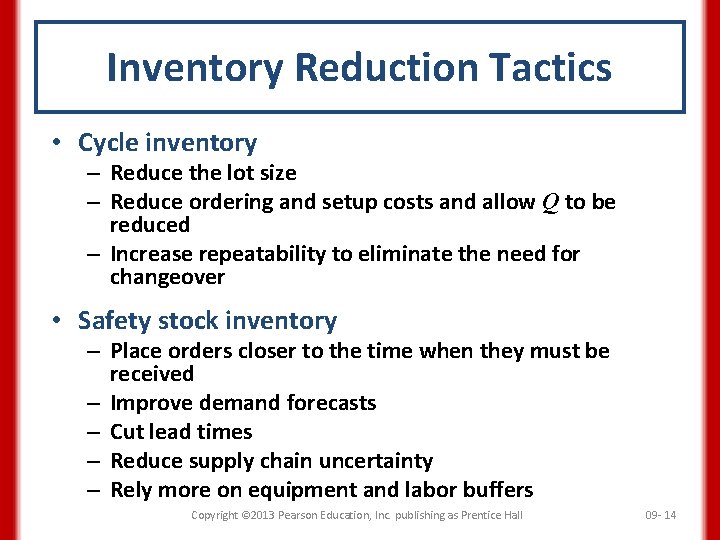
Inventory Reduction Tactics • Cycle inventory – Reduce the lot size – Reduce ordering and setup costs and allow Q to be reduced – Increase repeatability to eliminate the need for changeover • Safety stock inventory – Place orders closer to the time when they must be received – Improve demand forecasts – Cut lead times – Reduce supply chain uncertainty – Rely more on equipment and labor buffers Copyright © 2013 Pearson Education, Inc. publishing as Prentice Hall 09 - 14
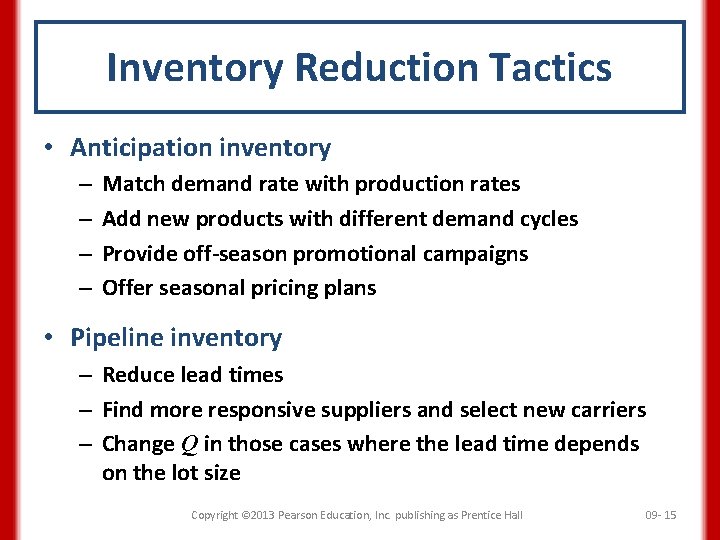
Inventory Reduction Tactics • Anticipation inventory – – Match demand rate with production rates Add new products with different demand cycles Provide off-season promotional campaigns Offer seasonal pricing plans • Pipeline inventory – Reduce lead times – Find more responsive suppliers and select new carriers – Change Q in those cases where the lead time depends on the lot size Copyright © 2013 Pearson Education, Inc. publishing as Prentice Hall 09 - 15
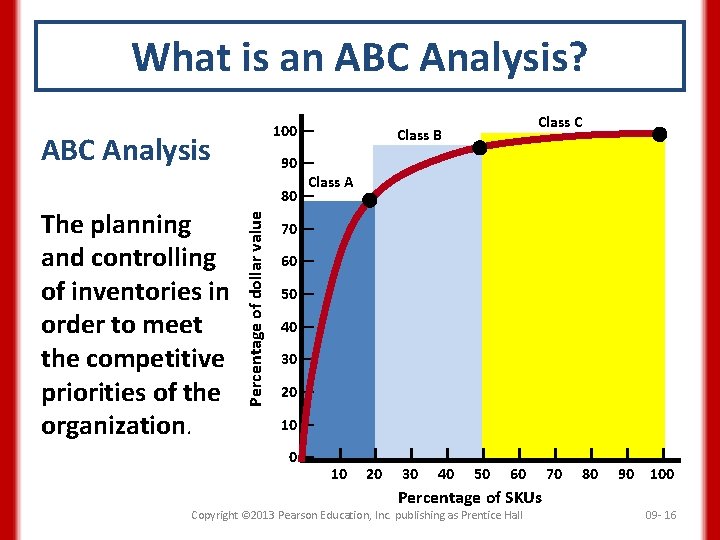
What is an ABC Analysis? 100 — ABC Analysis Class B 90 — Class A 80 — Percentage of dollar value The planning and controlling of inventories in order to meet the competitive priorities of the organization. Class C 70 — 60 — 50 — 40 — 30 — 20 — 10 — 0— 10 20 30 40 50 60 Percentage of SKUs Copyright © 2013 Pearson Education, Inc. publishing as Prentice Hall 70 80 90 100 09 - 16
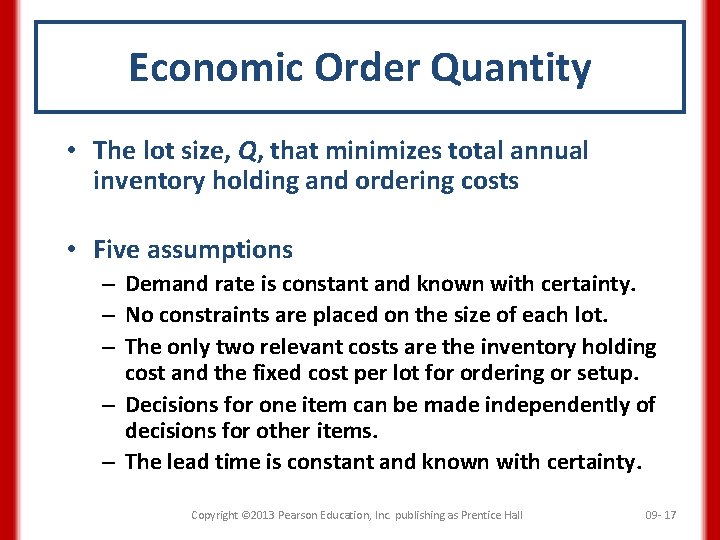
Economic Order Quantity • The lot size, Q, that minimizes total annual inventory holding and ordering costs • Five assumptions – Demand rate is constant and known with certainty. – No constraints are placed on the size of each lot. – The only two relevant costs are the inventory holding cost and the fixed cost per lot for ordering or setup. – Decisions for one item can be made independently of decisions for other items. – The lead time is constant and known with certainty. Copyright © 2013 Pearson Education, Inc. publishing as Prentice Hall 09 - 17
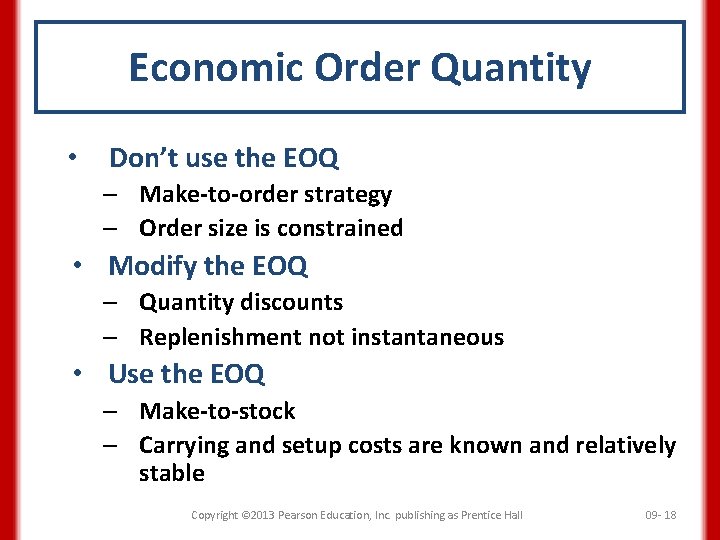
Economic Order Quantity • Don’t use the EOQ – Make-to-order strategy – Order size is constrained • Modify the EOQ – Quantity discounts – Replenishment not instantaneous • Use the EOQ – Make-to-stock – Carrying and setup costs are known and relatively stable Copyright © 2013 Pearson Education, Inc. publishing as Prentice Hall 09 - 18
Calculating EOQ Receive order Inventory depletion (demand rate) On-hand inventory (units) Q Average cycle inventory Q 2 1 cycle Time Copyright © 2013 Pearson Education, Inc. publishing as Prentice Hall 09 - 19
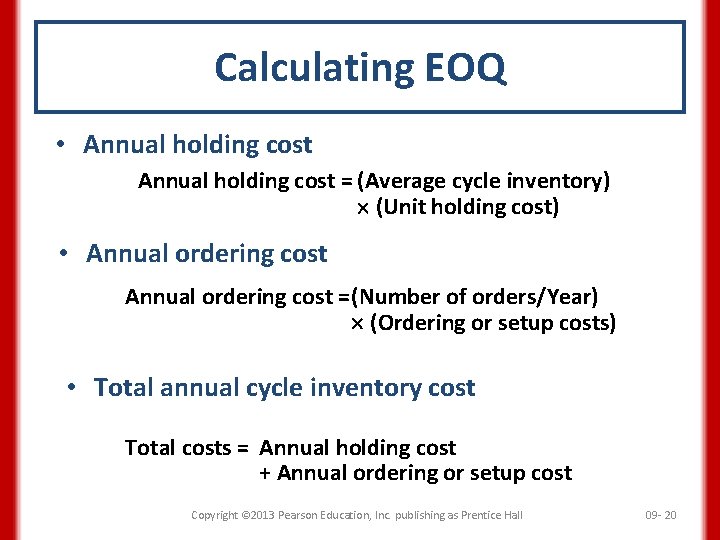
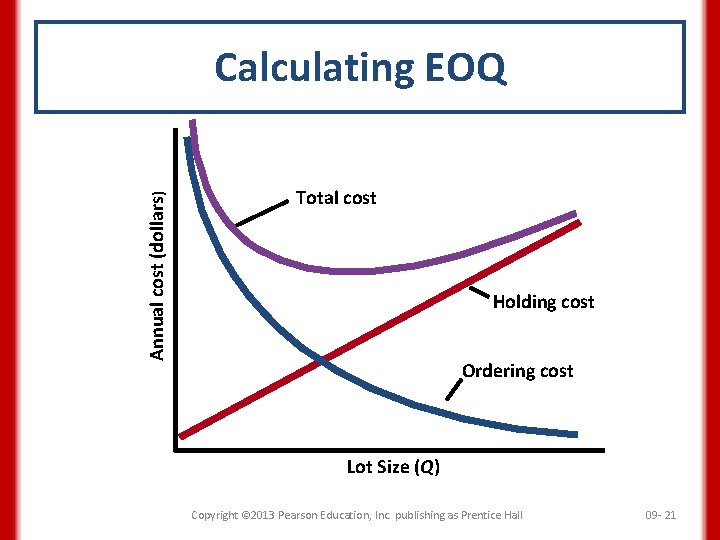
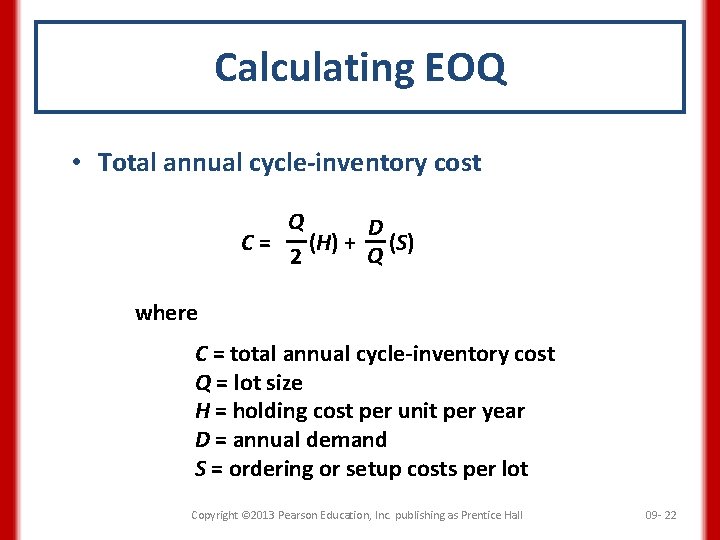
Calculating EOQ • Annual holding cost = (Average cycle inventory) (Unit holding cost) • Annual ordering cost =(Number of orders/Year) (Ordering or setup costs) • Total annual cycle inventory cost Total costs = Annual holding cost + Annual ordering or setup cost Copyright © 2013 Pearson Education, Inc. publishing as Prentice Hall 09 - 20
Annual cost (dollars) Calculating EOQ Total cost Holding cost Ordering cost Lot Size (Q) Copyright © 2013 Pearson Education, Inc. publishing as Prentice Hall 09 - 21
Calculating EOQ • Total annual cycle-inventory cost Q D C= (H) + (S) Q 2 where C = total annual cycle-inventory cost Q = lot size H = holding cost per unit per year D = annual demand S = ordering or setup costs per lot Copyright © 2013 Pearson Education, Inc. publishing as Prentice Hall 09 - 22
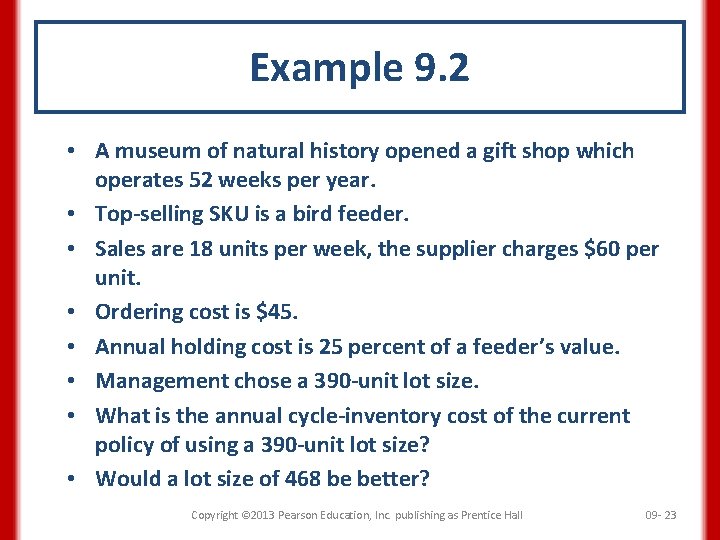
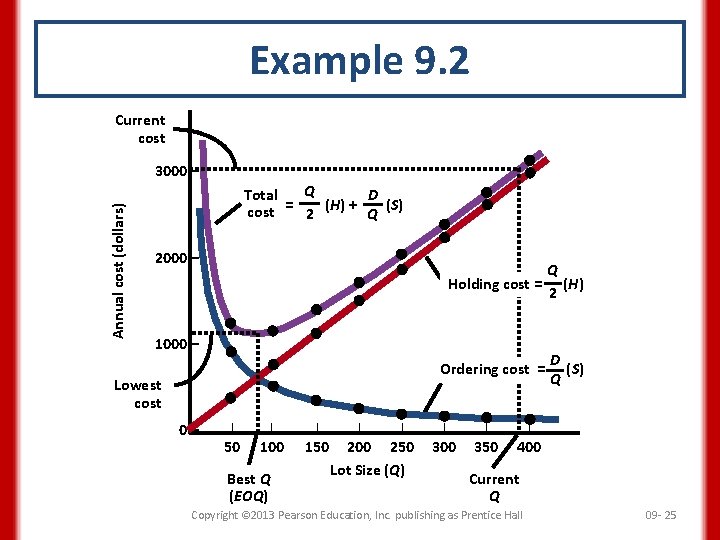
Example 9. 2 • A museum of natural history opened a gift shop which operates 52 weeks per year. • Top-selling SKU is a bird feeder. • Sales are 18 units per week, the supplier charges $60 per unit. • Ordering cost is $45. • Annual holding cost is 25 percent of a feeder’s value. • Management chose a 390 -unit lot size. • What is the annual cycle-inventory cost of the current policy of using a 390 -unit lot size? • Would a lot size of 468 be better? Copyright © 2013 Pearson Education, Inc. publishing as Prentice Hall 09 - 23
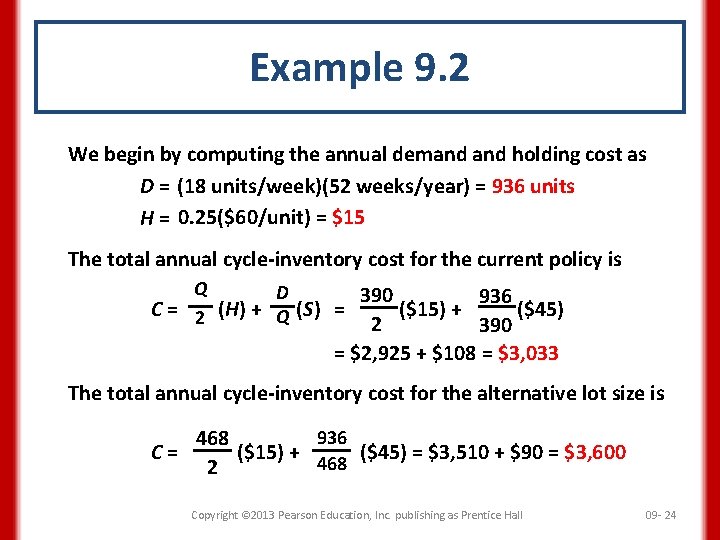
Example 9. 2 We begin by computing the annual demand holding cost as D = (18 units/week)(52 weeks/year) = 936 units H = 0. 25($60/unit) = $15 The total annual cycle-inventory cost for the current policy is Q D 390 936 ($15) + ($45) C = 2 (H) + Q (S) = 2 390 = $2, 925 + $108 = $3, 033 The total annual cycle-inventory cost for the alternative lot size is C= 936 468 ($15) + ($45) = $3, 510 + $90 = $3, 600 468 2 Copyright © 2013 Pearson Education, Inc. publishing as Prentice Hall 09 - 24
Example 9. 2 Current cost Annual cost (dollars) 3000 – Q Total D = (H) + (S) cost 2 Q 2000 – Q Holding cost = (H) 2 1000 – Ordering cost = Lowest cost 0– | | | 50 100 150 Best Q (EOQ) | | 200 250 Lot Size (Q) | | | 300 350 400 D (S) Q Current Q Copyright © 2013 Pearson Education, Inc. publishing as Prentice Hall 09 - 25
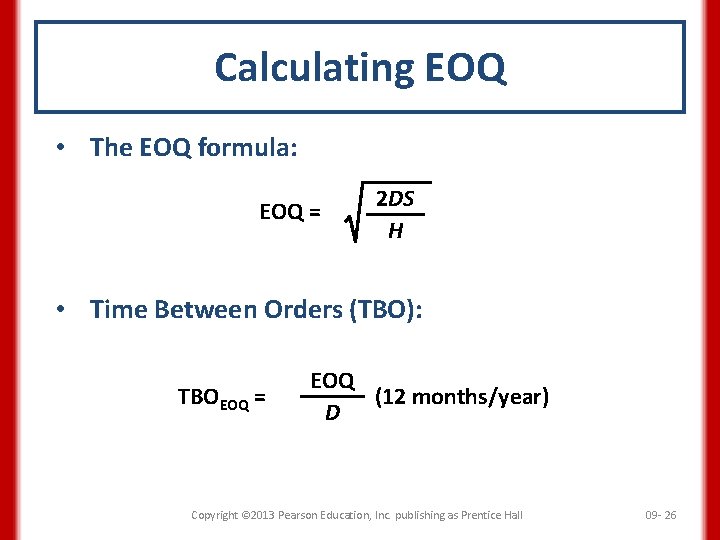
Calculating EOQ • The EOQ formula: EOQ = 2 DS H • Time Between Orders (TBO): TBOEOQ = EOQ (12 months/year) D Copyright © 2013 Pearson Education, Inc. publishing as Prentice Hall 09 - 26
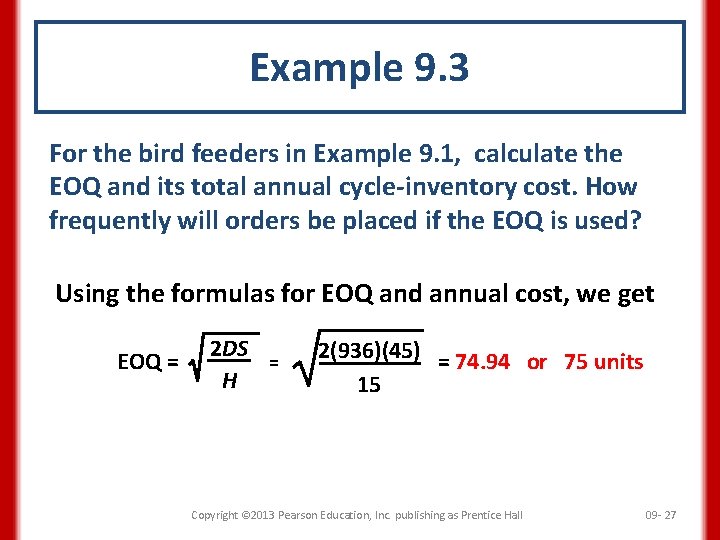
Example 9. 3 For the bird feeders in Example 9. 1, calculate the EOQ and its total annual cycle-inventory cost. How frequently will orders be placed if the EOQ is used? Using the formulas for EOQ and annual cost, we get EOQ = 2 DS = H 2(936)(45) = 74. 94 or 75 units 15 Copyright © 2013 Pearson Education, Inc. publishing as Prentice Hall 09 - 27
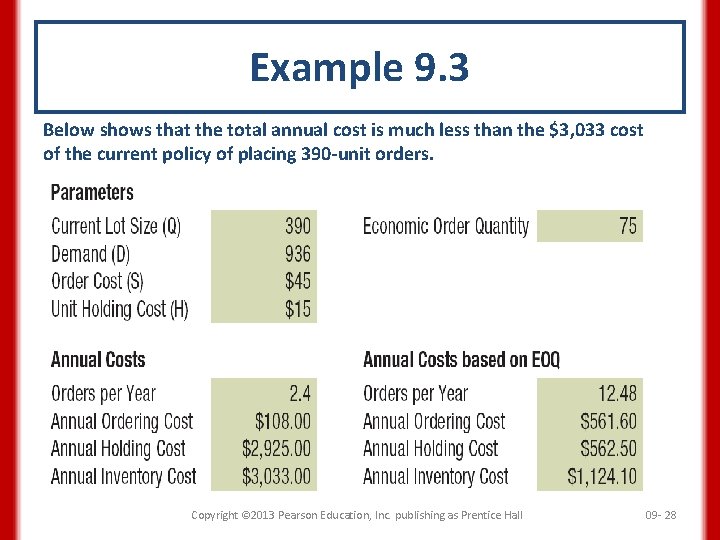
Example 9. 3 Below shows that the total annual cost is much less than the $3, 033 cost of the current policy of placing 390 -unit orders. Copyright © 2013 Pearson Education, Inc. publishing as Prentice Hall 09 - 28
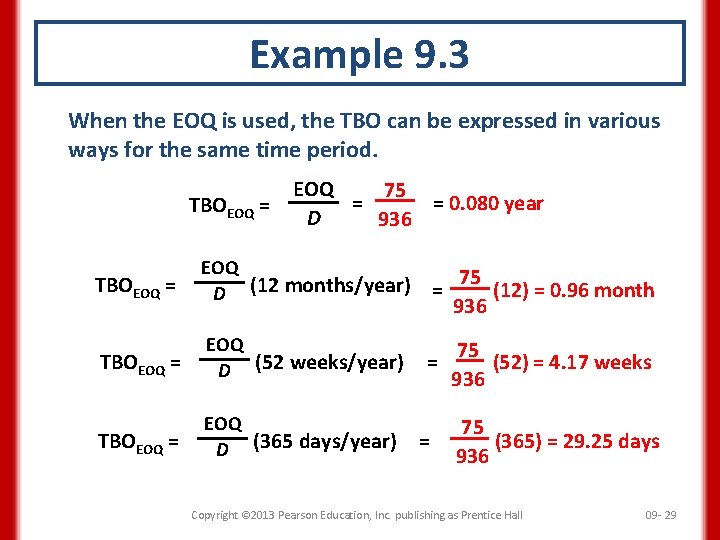
Example 9. 3 When the EOQ is used, the TBO can be expressed in various ways for the same time period. TBOEOQ = EOQ 75 = = 0. 080 year D 936 TBOEOQ = EOQ D (12 months/year) = 75 (12) = 0. 96 month 936 TBOEOQ = EOQ D (52 weeks/year) = 75 (52) = 4. 17 weeks 936 TBOEOQ = EOQ D (365 days/year) = 75 (365) = 29. 25 days 936 Copyright © 2013 Pearson Education, Inc. publishing as Prentice Hall 09 - 29
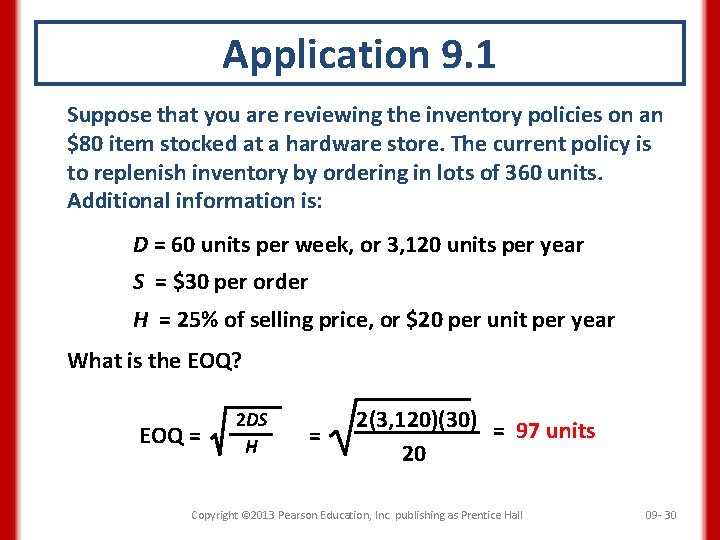
Application 9. 1 Suppose that you are reviewing the inventory policies on an $80 item stocked at a hardware store. The current policy is to replenish inventory by ordering in lots of 360 units. Additional information is: D = 60 units per week, or 3, 120 units per year S = $30 per order H = 25% of selling price, or $20 per unit per year What is the EOQ? EOQ = 2 DS H = 2(3, 120)(30) = 97 units 20 Copyright © 2013 Pearson Education, Inc. publishing as Prentice Hall 09 - 30
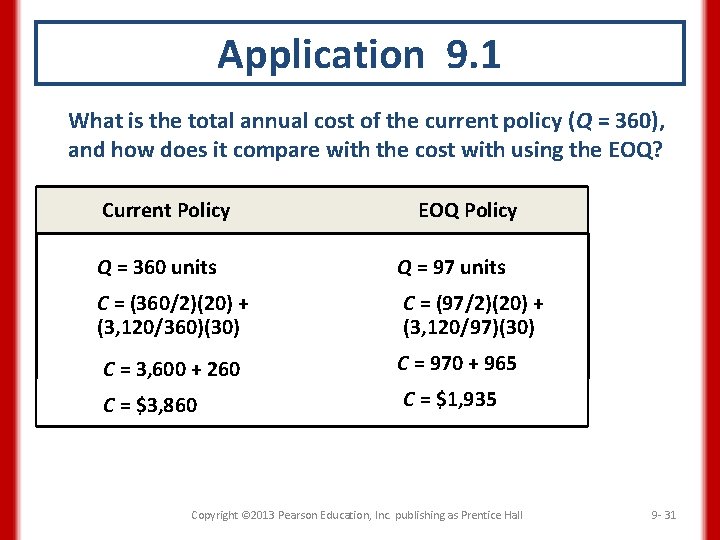
Application 9. 1 What is the total annual cost of the current policy (Q = 360), and how does it compare with the cost with using the EOQ? Current Policy EOQ Policy Q = 360 units Q = 97 units C = (360/2)(20) + (3, 120/360)(30) C = (97/2)(20) + (3, 120/97)(30) C = 3, 600 + 260 C = 970 + 965 C = $3, 860 C = $1, 935 Copyright © 2013 Pearson Education, Inc. publishing as Prentice Hall 9 - 31
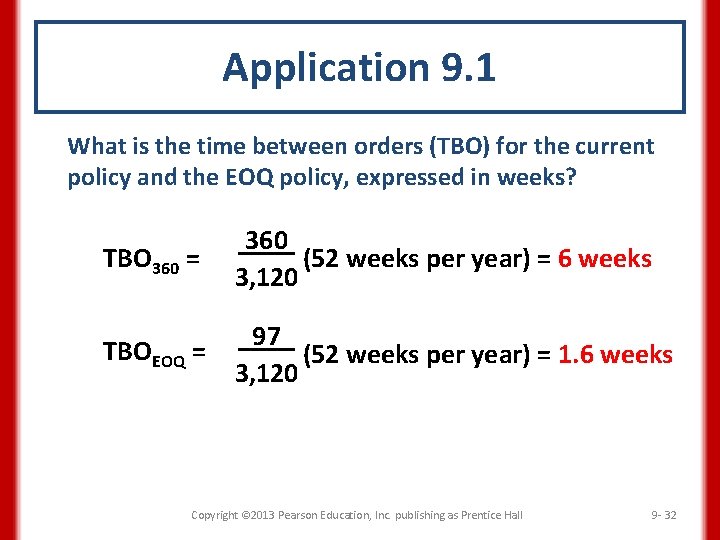
Application 9. 1 What is the time between orders (TBO) for the current policy and the EOQ policy, expressed in weeks? TBO 360 = 360 (52 weeks per year) = 6 weeks 3, 120 TBOEOQ = 97 (52 weeks per year) = 1. 6 weeks 3, 120 Copyright © 2013 Pearson Education, Inc. publishing as Prentice Hall 9 - 32
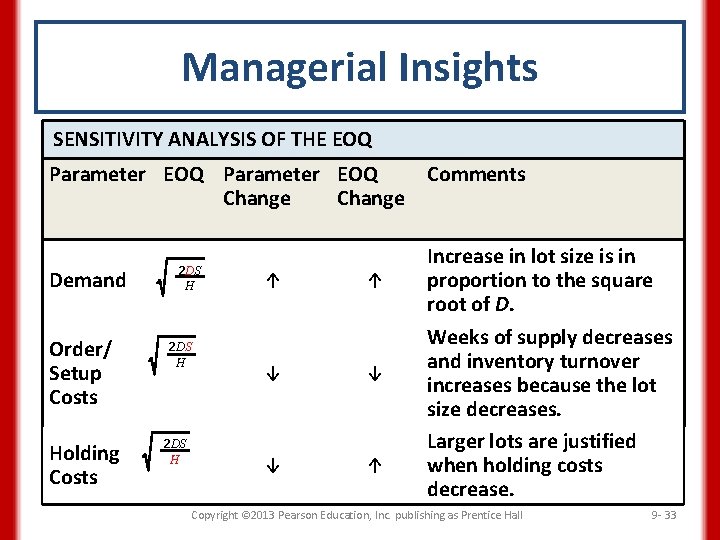
Managerial Insights SENSITIVITY ANALYSIS OF THE EOQ Parameter EOQ Change Demand Order/ Setup Costs Holding Costs 2 DS H ↑ ↑ ↓ ↓ ↓ ↑ Comments Increase in lot size is in proportion to the square root of D. Weeks of supply decreases and inventory turnover increases because the lot size decreases. Larger lots are justified when holding costs decrease. Copyright © 2013 Pearson Education, Inc. publishing as Prentice Hall 9 - 33
Inventory Control Systems • Two important questions: – How much? – When? • Nature of demand – Independent demand – Dependent demand Copyright © 2013 Pearson Education, Inc. publishing as Prentice Hall 09 - 34
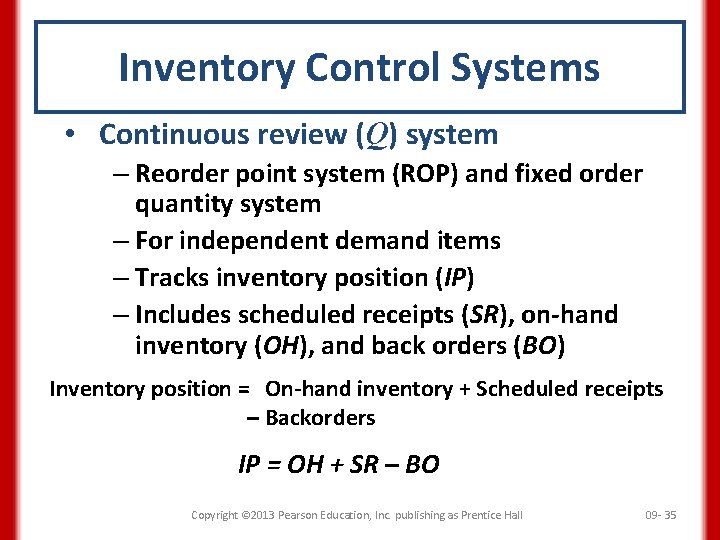
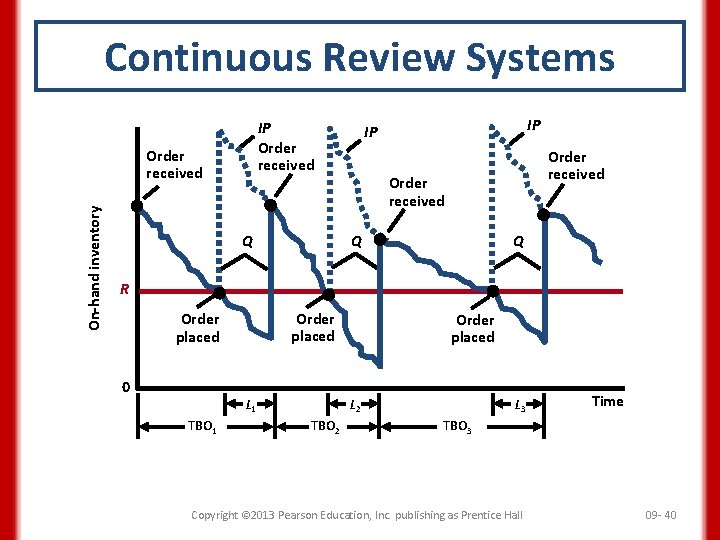
Inventory Control Systems • Continuous review (Q) system – Reorder point system (ROP) and fixed order quantity system – For independent demand items – Tracks inventory position (IP) – Includes scheduled receipts (SR), on-hand inventory (OH), and back orders (BO) Inventory position = On-hand inventory + Scheduled receipts – Backorders IP = OH + SR – BO Copyright © 2013 Pearson Education, Inc. publishing as Prentice Hall 09 - 35
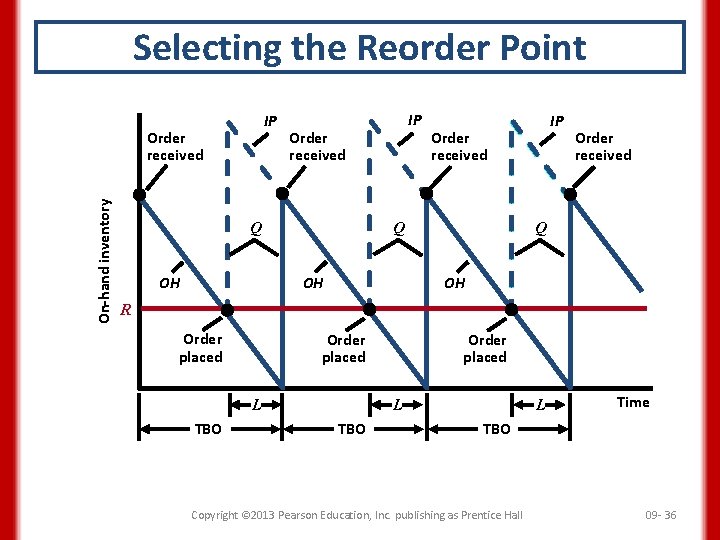
Selecting the Reorder Point IP On-hand inventory Order received IP Order received Q OH OH IP Order received Q OH R Order placed L TBO L Time TBO Copyright © 2013 Pearson Education, Inc. publishing as Prentice Hall 09 - 36
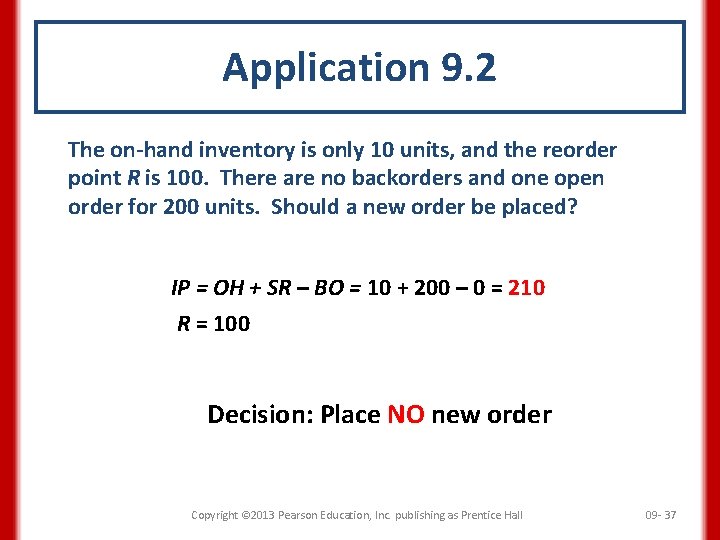
Application 9. 2 The on-hand inventory is only 10 units, and the reorder point R is 100. There are no backorders and one open order for 200 units. Should a new order be placed? IP = OH + SR – BO = 10 + 200 – 0 = 210 R = 100 Decision: Place NO new order Copyright © 2013 Pearson Education, Inc. publishing as Prentice Hall 09 - 37
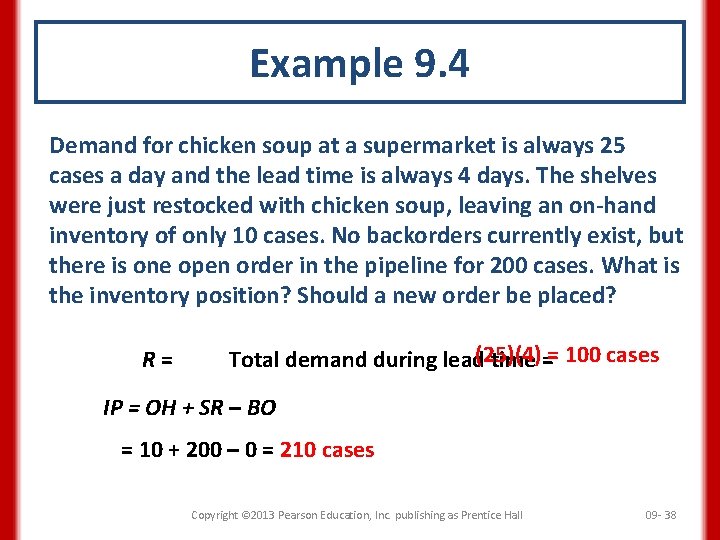
Example 9. 4 Demand for chicken soup at a supermarket is always 25 cases a day and the lead time is always 4 days. The shelves were just restocked with chicken soup, leaving an on-hand inventory of only 10 cases. No backorders currently exist, but there is one open order in the pipeline for 200 cases. What is the inventory position? Should a new order be placed? R= Total demand during lead(25)(4) time == 100 cases IP = OH + SR – BO = 10 + 200 – 0 = 210 cases Copyright © 2013 Pearson Education, Inc. publishing as Prentice Hall 09 - 38
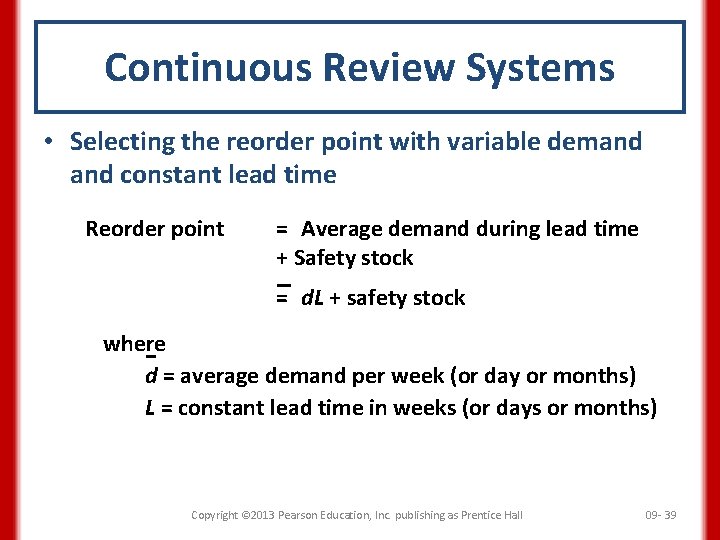
Continuous Review Systems • Selecting the reorder point with variable demand constant lead time Reorder point = Average demand during lead time + Safety stock = d. L + safety stock where d = average demand per week (or day or months) L = constant lead time in weeks (or days or months) Copyright © 2013 Pearson Education, Inc. publishing as Prentice Hall 09 - 39
Continuous Review Systems IP Order received On-hand inventory Order received IP IP Order received Q Q Q R Order placed 0 L 1 TBO 1 Order placed L 2 TBO 2 L 3 Time TBO 3 Copyright © 2013 Pearson Education, Inc. publishing as Prentice Hall 09 - 40
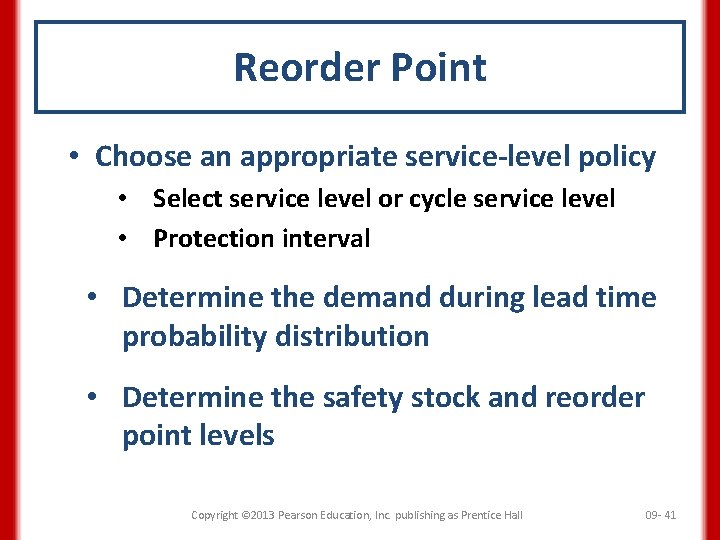
Reorder Point • Choose an appropriate service-level policy • Select service level or cycle service level • Protection interval • Determine the demand during lead time probability distribution • Determine the safety stock and reorder point levels Copyright © 2013 Pearson Education, Inc. publishing as Prentice Hall 09 - 41
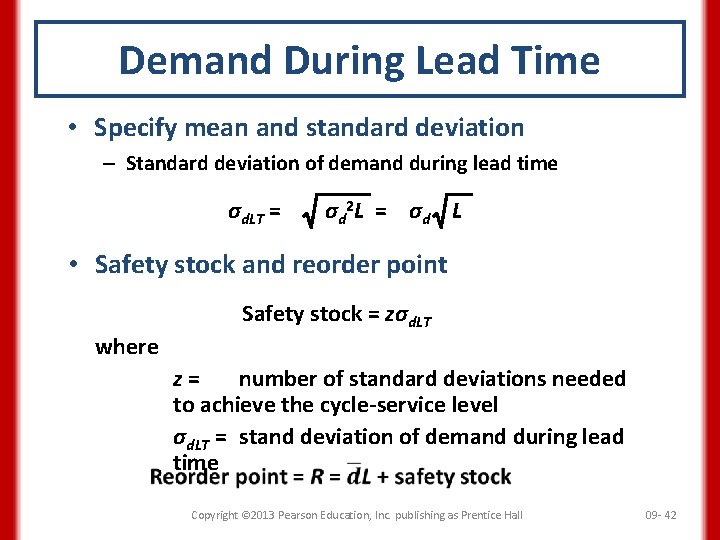
Demand During Lead Time • Specify mean and standard deviation – Standard deviation of demand during lead time σd. LT = σd 2 L = σd L • Safety stock and reorder point Safety stock = zσd. LT where z= number of standard deviations needed to achieve the cycle-service level σd. LT = stand deviation of demand during lead time Copyright © 2013 Pearson Education, Inc. publishing as Prentice Hall 09 - 42
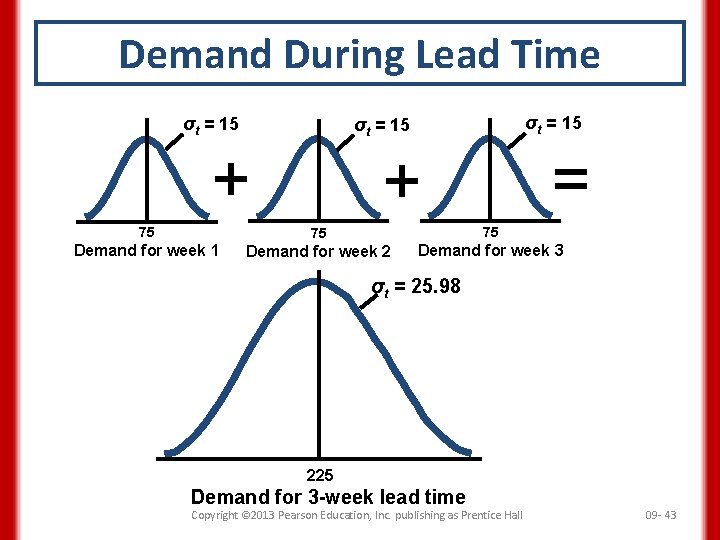
Demand During Lead Time σt = 15 + = + 75 75 75 Demand for week 1 Demand for week 2 Demand for week 3 σt = 25. 98 225 Demand for 3 -week lead time Copyright © 2013 Pearson Education, Inc. publishing as Prentice Hall 09 - 43
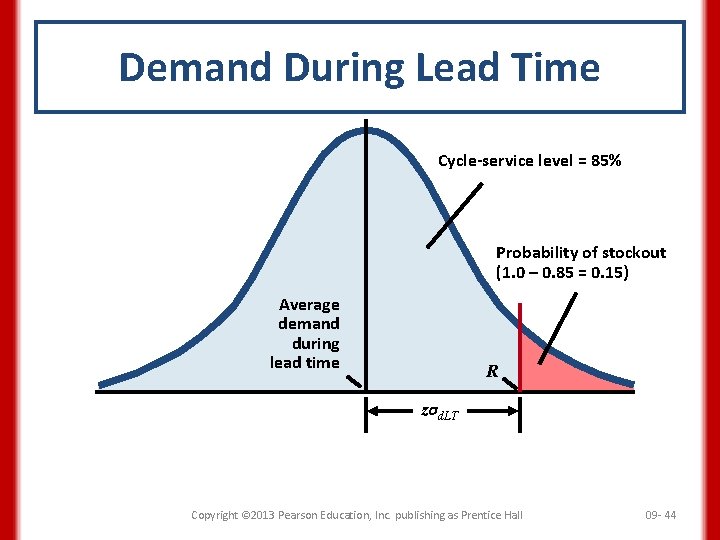
Demand During Lead Time Cycle-service level = 85% Probability of stockout (1. 0 – 0. 85 = 0. 15) Average demand during lead time R zσd. LT Copyright © 2013 Pearson Education, Inc. publishing as Prentice Hall 09 - 44
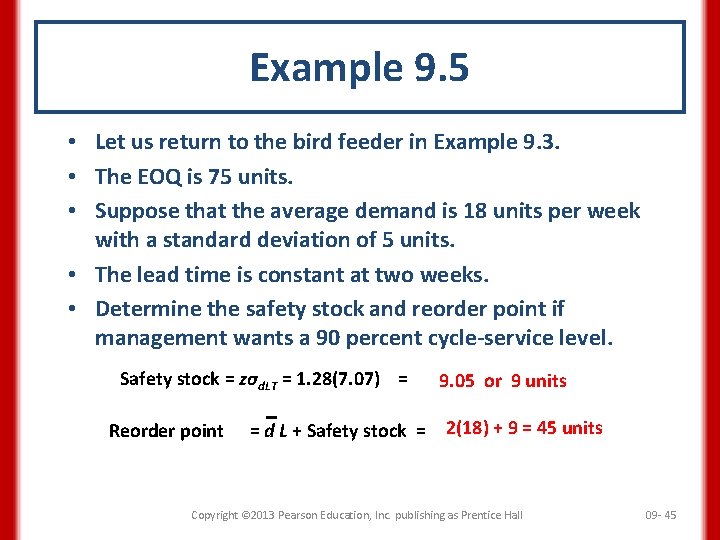
Example 9. 5 • Let us return to the bird feeder in Example 9. 3. • The EOQ is 75 units. • Suppose that the average demand is 18 units per week with a standard deviation of 5 units. • The lead time is constant at two weeks. • Determine the safety stock and reorder point if management wants a 90 percent cycle-service level. Safety stock = zσd. LT = 1. 28(7. 07) = Reorder point = d L + Safety stock = 9. 05 or 9 units 2(18) + 9 = 45 units Copyright © 2013 Pearson Education, Inc. publishing as Prentice Hall 09 - 45
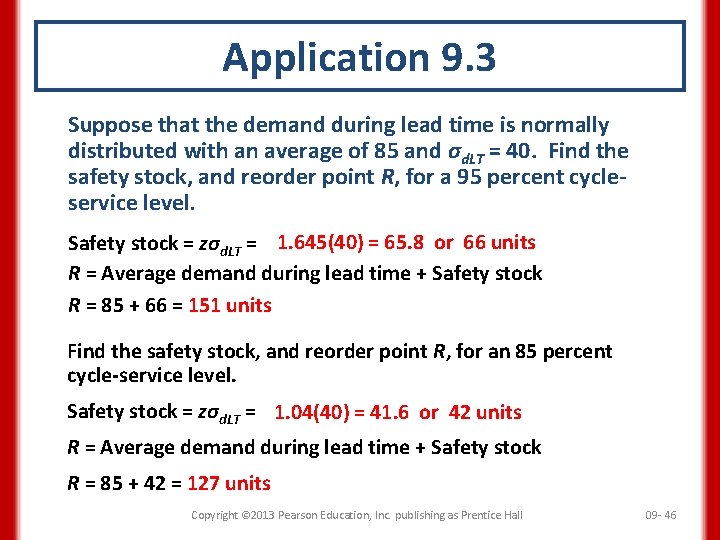
Application 9. 3 Suppose that the demand during lead time is normally distributed with an average of 85 and σd. LT = 40. Find the safety stock, and reorder point R, for a 95 percent cycleservice level. Safety stock = zσd. LT = 1. 645(40) = 65. 8 or 66 units R = Average demand during lead time + Safety stock R = 85 + 66 = 151 units Find the safety stock, and reorder point R, for an 85 percent cycle-service level. Safety stock = zσd. LT = 1. 04(40) = 41. 6 or 42 units R = Average demand during lead time + Safety stock R = 85 + 42 = 127 units Copyright © 2013 Pearson Education, Inc. publishing as Prentice Hall 09 - 46
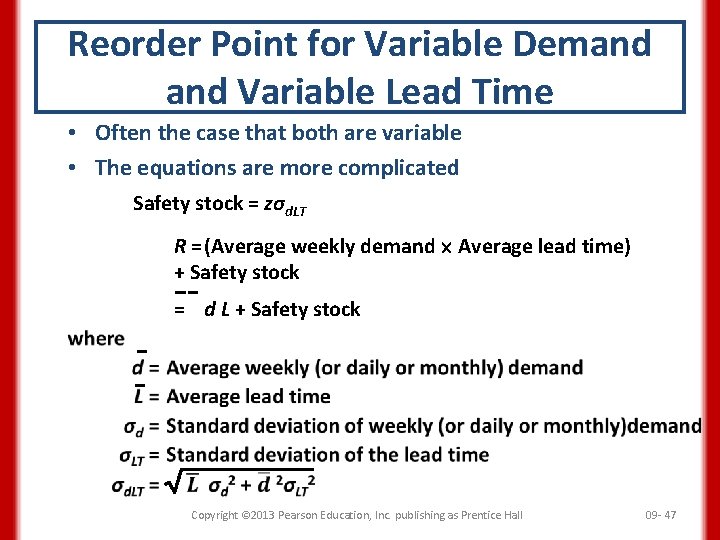
Reorder Point for Variable Demand Variable Lead Time • Often the case that both are variable • The equations are more complicated Safety stock = zσd. LT R =(Average weekly demand Average lead time) + Safety stock = d L + Safety stock Copyright © 2013 Pearson Education, Inc. publishing as Prentice Hall 09 - 47
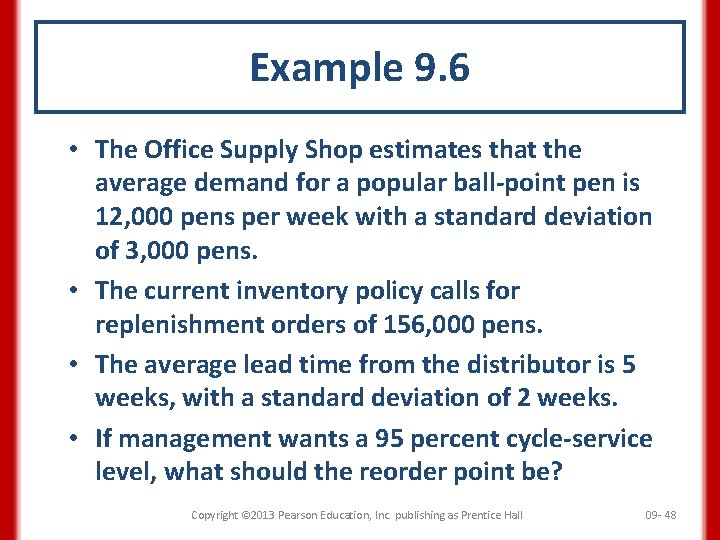
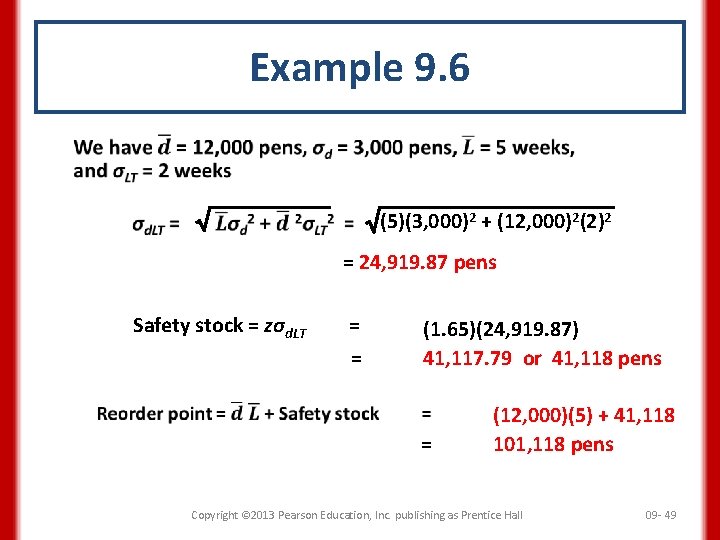
Example 9. 6 • The Office Supply Shop estimates that the average demand for a popular ball-point pen is 12, 000 pens per week with a standard deviation of 3, 000 pens. • The current inventory policy calls for replenishment orders of 156, 000 pens. • The average lead time from the distributor is 5 weeks, with a standard deviation of 2 weeks. • If management wants a 95 percent cycle-service level, what should the reorder point be? Copyright © 2013 Pearson Education, Inc. publishing as Prentice Hall 09 - 48
Example 9. 6 (5)(3, 000)2 + (12, 000)2(2)2 = 24, 919. 87 pens Safety stock = zσd. LT = = (1. 65)(24, 919. 87) 41, 117. 79 or 41, 118 pens = (12, 000)(5) + 41, 118 101, 118 pens Copyright © 2013 Pearson Education, Inc. publishing as Prentice Hall 09 - 49
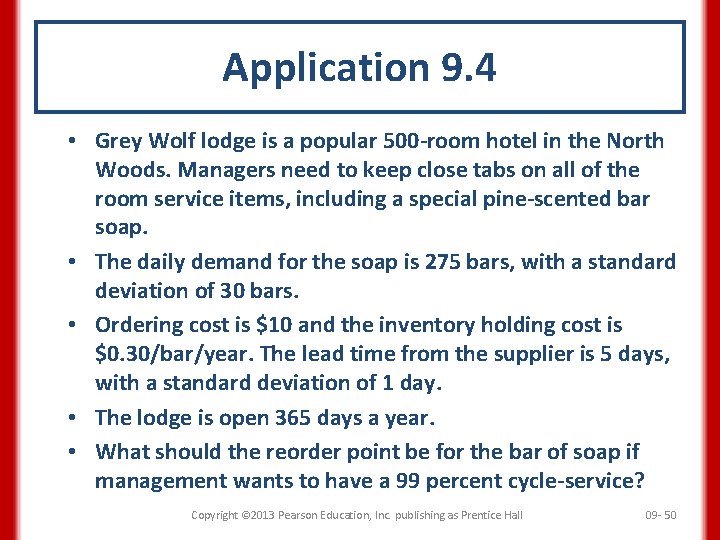
Application 9. 4 • Grey Wolf lodge is a popular 500 -room hotel in the North Woods. Managers need to keep close tabs on all of the room service items, including a special pine-scented bar soap. • The daily demand for the soap is 275 bars, with a standard deviation of 30 bars. • Ordering cost is $10 and the inventory holding cost is $0. 30/bar/year. The lead time from the supplier is 5 days, with a standard deviation of 1 day. • The lodge is open 365 days a year. • What should the reorder point be for the bar of soap if management wants to have a 99 percent cycle-service? Copyright © 2013 Pearson Education, Inc. publishing as Prentice Hall 09 - 50
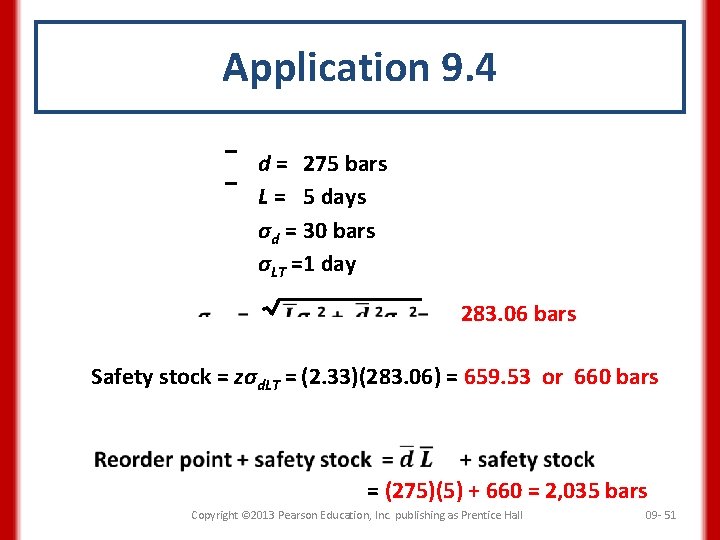
Application 9. 4 d = 275 bars L = 5 days σd = 30 bars σLT =1 day 283. 06 bars Safety stock = zσd. LT = (2. 33)(283. 06) = 659. 53 or 660 bars = (275)(5) + 660 = 2, 035 bars Copyright © 2013 Pearson Education, Inc. publishing as Prentice Hall 09 - 51
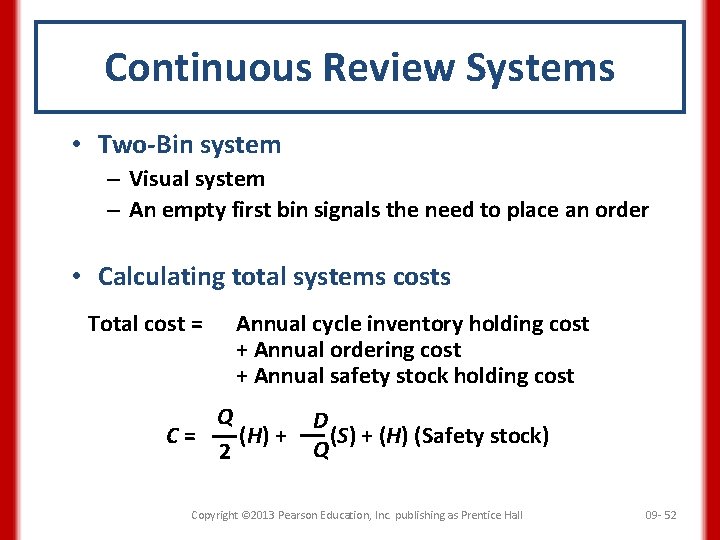
Continuous Review Systems • Two-Bin system – Visual system – An empty first bin signals the need to place an order • Calculating total systems costs Total cost = Annual cycle inventory holding cost + Annual ordering cost + Annual safety stock holding cost Q C= (H) + 2 D (S) + (H) (Safety stock) Q Copyright © 2013 Pearson Education, Inc. publishing as Prentice Hall 09 - 52
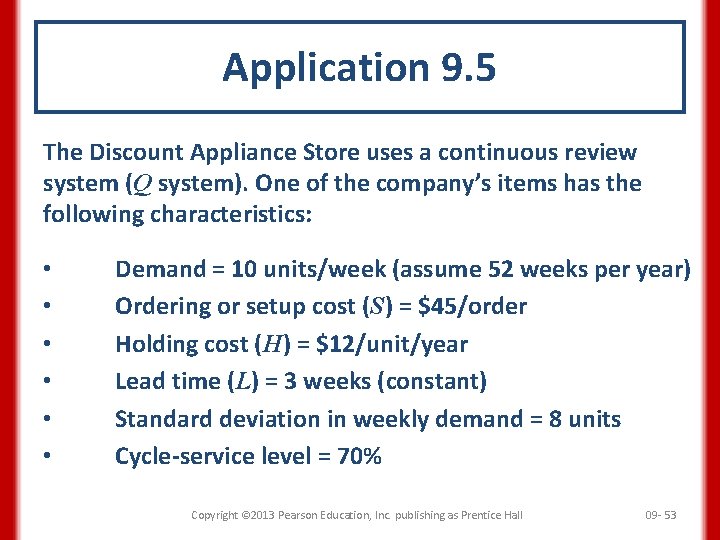
Application 9. 5 The Discount Appliance Store uses a continuous review system (Q system). One of the company’s items has the following characteristics: • • • Demand = 10 units/week (assume 52 weeks per year) Ordering or setup cost (S) = $45/order Holding cost (H) = $12/unit/year Lead time (L) = 3 weeks (constant) Standard deviation in weekly demand = 8 units Cycle-service level = 70% Copyright © 2013 Pearson Education, Inc. publishing as Prentice Hall 09 - 53
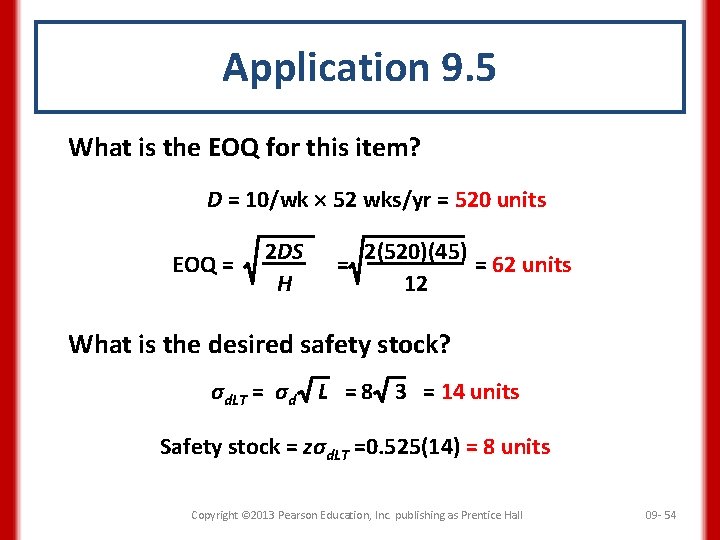
Application 9. 5 What is the EOQ for this item? D = 10/wk 52 wks/yr = 520 units EOQ = 2 DS H = 2(520)(45) = 62 units 12 What is the desired safety stock? σd. LT = σd L = 8 3 = 14 units Safety stock = zσd. LT =0. 525(14) = 8 units Copyright © 2013 Pearson Education, Inc. publishing as Prentice Hall 09 - 54
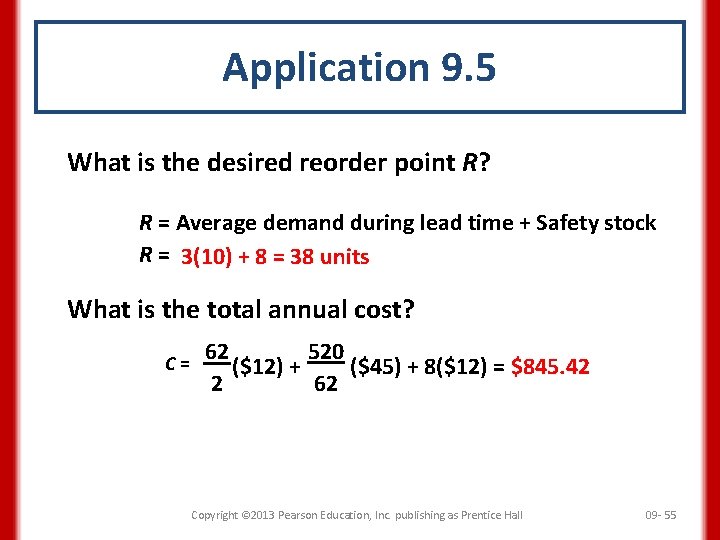
Application 9. 5 What is the desired reorder point R? R = Average demand during lead time + Safety stock R = 3(10) + 8 = 38 units What is the total annual cost? C= 62 520 ($12) + ($45) + 8($12) = $845. 42 2 62 Copyright © 2013 Pearson Education, Inc. publishing as Prentice Hall 09 - 55
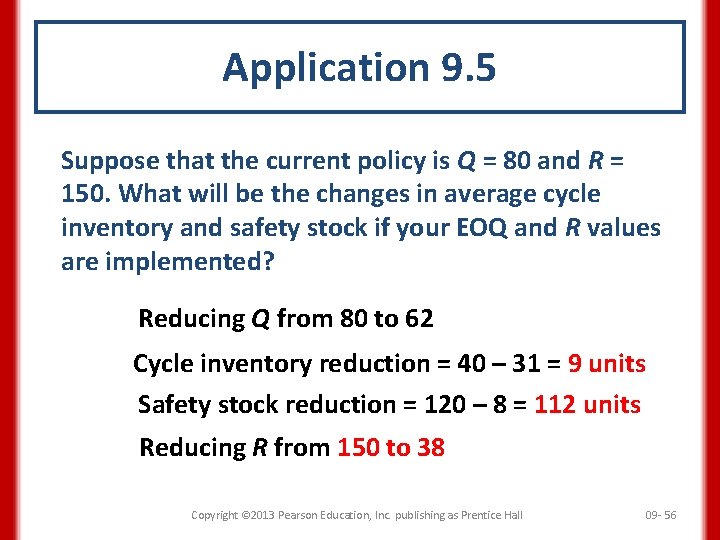
Application 9. 5 Suppose that the current policy is Q = 80 and R = 150. What will be the changes in average cycle inventory and safety stock if your EOQ and R values are implemented? Reducing Q from 80 to 62 Cycle inventory reduction = 40 – 31 = 9 units Safety stock reduction = 120 – 8 = 112 units Reducing R from 150 to 38 Copyright © 2013 Pearson Education, Inc. publishing as Prentice Hall 09 - 56
Periodic Review System (P) • Fixed interval reorder system or periodic reorder system • Four of the original EOQ assumptions maintained – No constraints are placed on lot size – Holding and ordering costs – Independent demand – Lead times are certain Copyright © 2013 Pearson Education, Inc. publishing as Prentice Hall 09 - 57
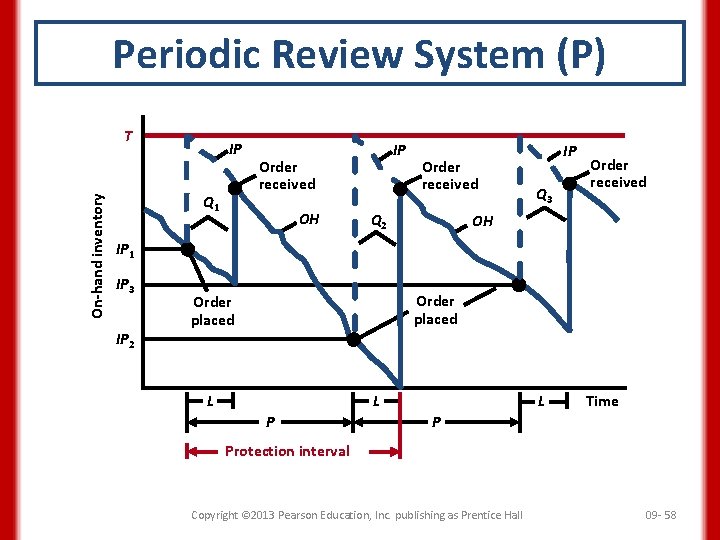
Periodic Review System (P) On-hand inventory T IP Q 1 IP Order received OH Order received Q 2 IP Q 3 Order received OH IP 1 IP 3 Order placed IP 2 L L P L Time P Protection interval Copyright © 2013 Pearson Education, Inc. publishing as Prentice Hall 09 - 58
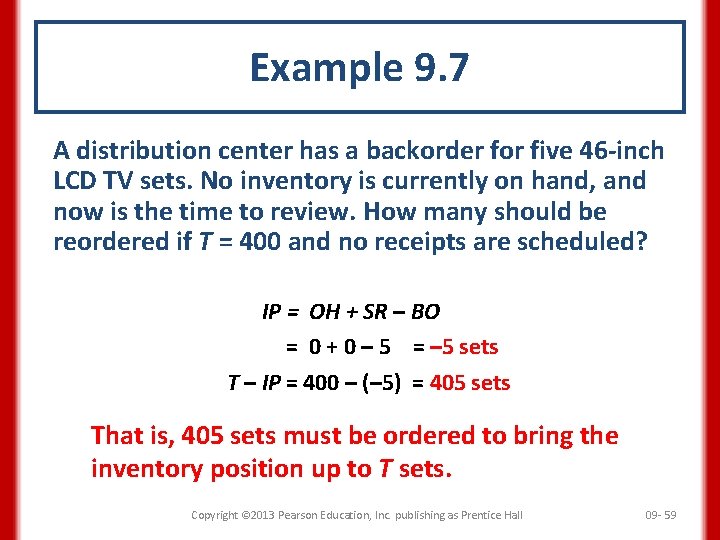
Example 9. 7 A distribution center has a backorder for five 46 -inch LCD TV sets. No inventory is currently on hand, and now is the time to review. How many should be reordered if T = 400 and no receipts are scheduled? IP = OH + SR – BO = 0 + 0 – 5 = – 5 sets T – IP = 400 – (– 5) = 405 sets That is, 405 sets must be ordered to bring the inventory position up to T sets. Copyright © 2013 Pearson Education, Inc. publishing as Prentice Hall 09 - 59
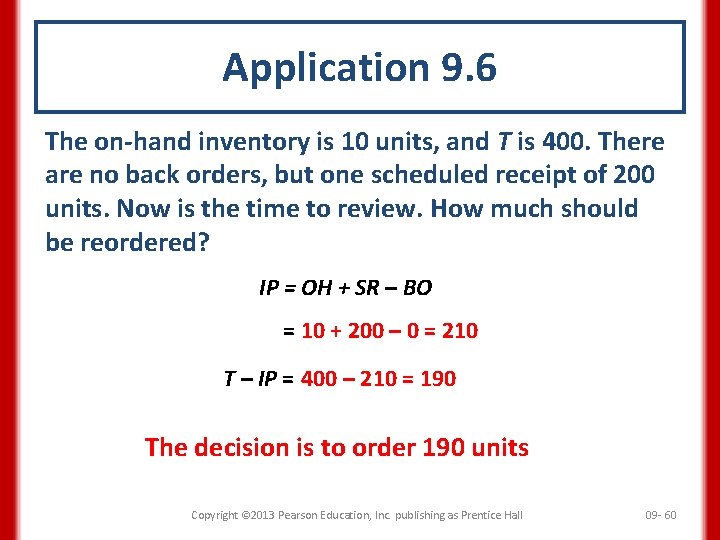
Application 9. 6 The on-hand inventory is 10 units, and T is 400. There are no back orders, but one scheduled receipt of 200 units. Now is the time to review. How much should be reordered? IP = OH + SR – BO = 10 + 200 – 0 = 210 T – IP = 400 – 210 = 190 The decision is to order 190 units Copyright © 2013 Pearson Education, Inc. publishing as Prentice Hall 09 - 60
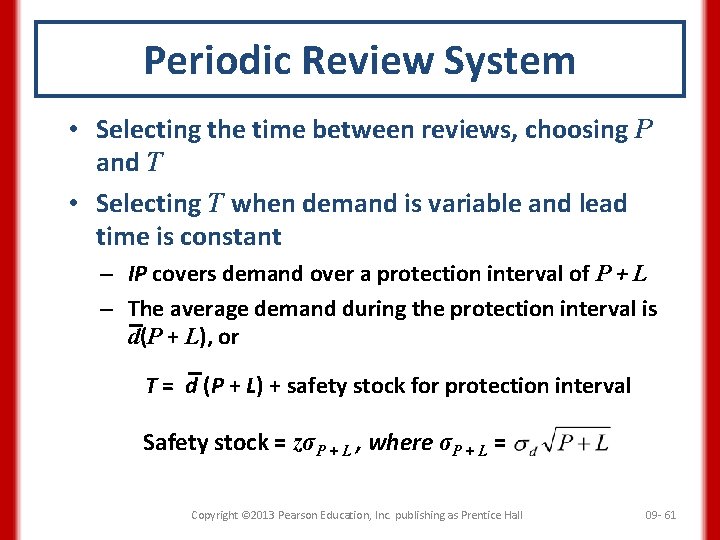
Periodic Review System • Selecting the time between reviews, choosing P and T • Selecting T when demand is variable and lead time is constant – IP covers demand over a protection interval of P + L – The average demand during the protection interval is d(P + L), or T = d (P + L) + safety stock for protection interval Safety stock = zσP + L , where σP + L = Copyright © 2013 Pearson Education, Inc. publishing as Prentice Hall 09 - 61
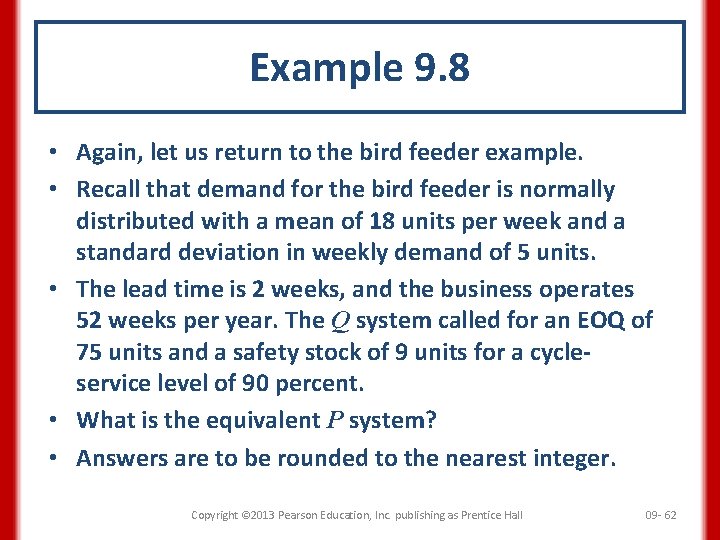
Example 9. 8 • Again, let us return to the bird feeder example. • Recall that demand for the bird feeder is normally distributed with a mean of 18 units per week and a standard deviation in weekly demand of 5 units. • The lead time is 2 weeks, and the business operates 52 weeks per year. The Q system called for an EOQ of 75 units and a safety stock of 9 units for a cycleservice level of 90 percent. • What is the equivalent P system? • Answers are to be rounded to the nearest integer. Copyright © 2013 Pearson Education, Inc. publishing as Prentice Hall 09 - 62
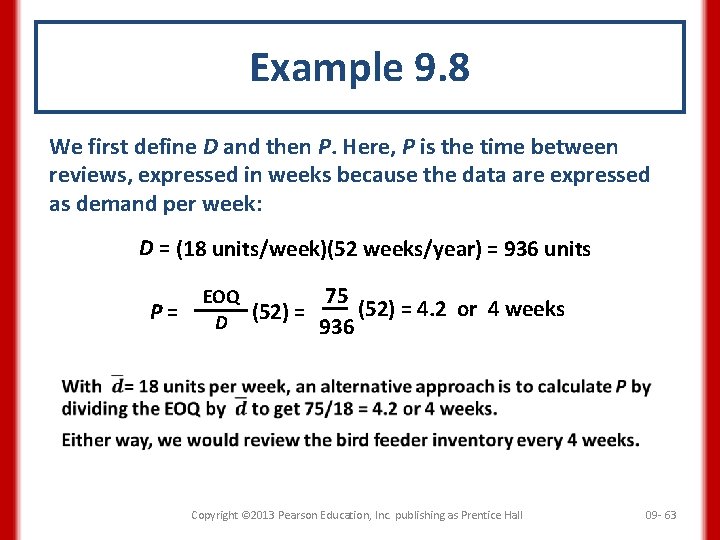
Example 9. 8 We first define D and then P. Here, P is the time between reviews, expressed in weeks because the data are expressed as demand per week: D = (18 units/week)(52 weeks/year) = 936 units P= EOQ 75 (52) = 4. 2 or 4 weeks (52) = D 936 Copyright © 2013 Pearson Education, Inc. publishing as Prentice Hall 09 - 63
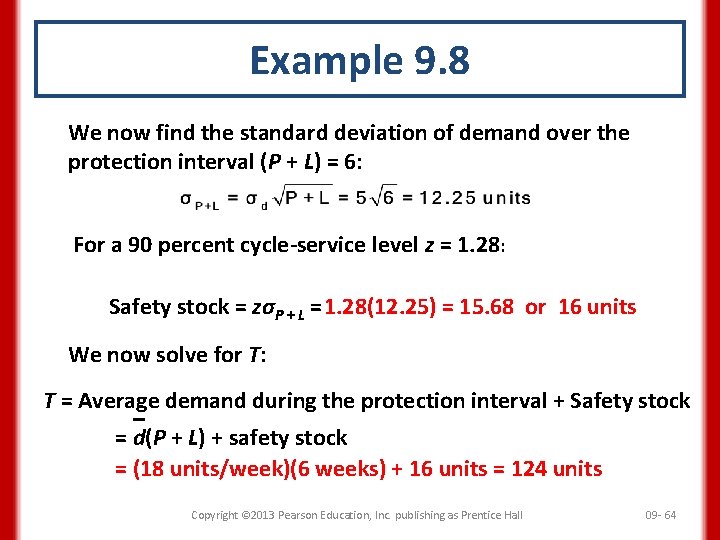
Example 9. 8 We now find the standard deviation of demand over the protection interval (P + L) = 6: For a 90 percent cycle-service level z = 1. 28: Safety stock = zσP + L = 1. 28(12. 25) = 15. 68 or 16 units We now solve for T: T = Average demand during the protection interval + Safety stock = d(P + L) + safety stock = (18 units/week)(6 weeks) + 16 units = 124 units Copyright © 2013 Pearson Education, Inc. publishing as Prentice Hall 09 - 64
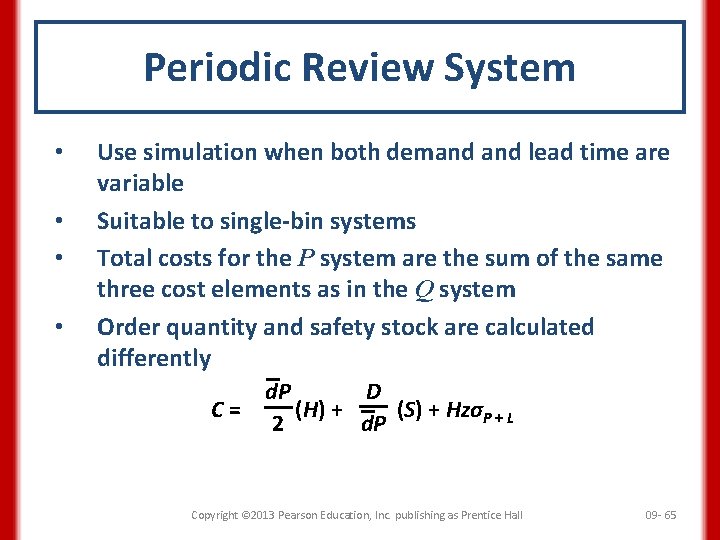
Periodic Review System • • Use simulation when both demand lead time are variable Suitable to single-bin systems Total costs for the P system are the sum of the same three cost elements as in the Q system Order quantity and safety stock are calculated differently C= d. P D (H) + (S) + HzσP + L 2 d. P Copyright © 2013 Pearson Education, Inc. publishing as Prentice Hall 09 - 65
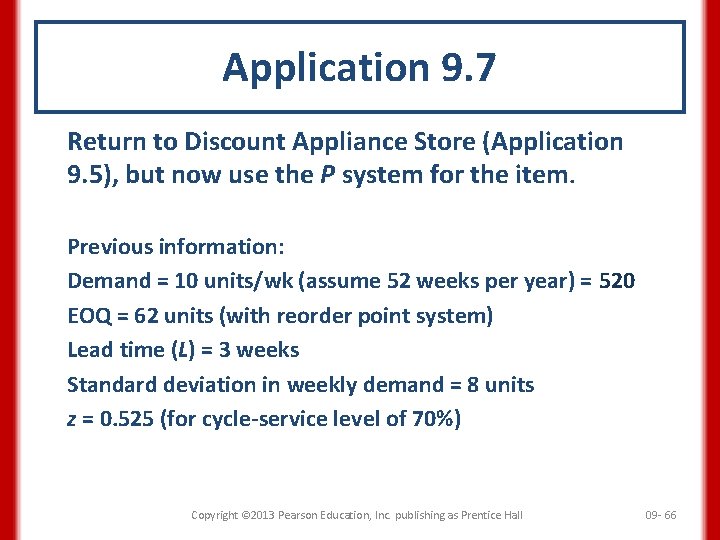
Application 9. 7 Return to Discount Appliance Store (Application 9. 5), but now use the P system for the item. Previous information: Demand = 10 units/wk (assume 52 weeks per year) = 520 EOQ = 62 units (with reorder point system) Lead time (L) = 3 weeks Standard deviation in weekly demand = 8 units z = 0. 525 (for cycle-service level of 70%) Copyright © 2013 Pearson Education, Inc. publishing as Prentice Hall 09 - 66
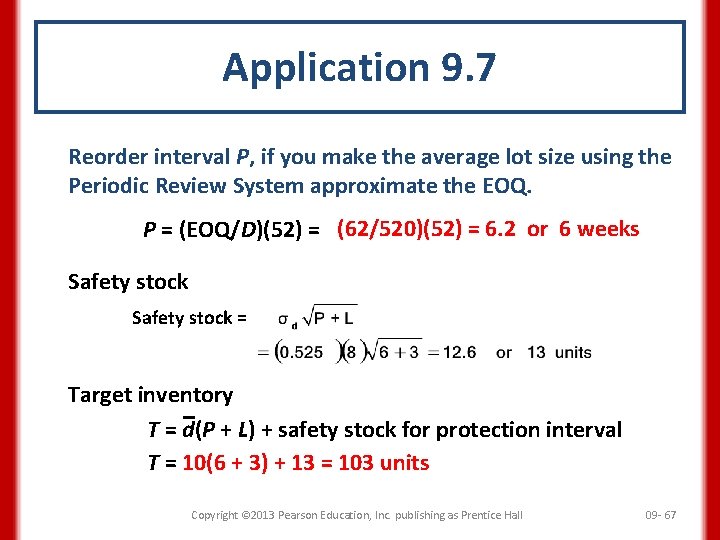
Application 9. 7 Reorder interval P, if you make the average lot size using the Periodic Review System approximate the EOQ. P = (EOQ/D)(52) = (62/520)(52) = 6. 2 or 6 weeks Safety stock = Target inventory T = d(P + L) + safety stock for protection interval T = 10(6 + 3) + 13 = 103 units Copyright © 2013 Pearson Education, Inc. publishing as Prentice Hall 09 - 67
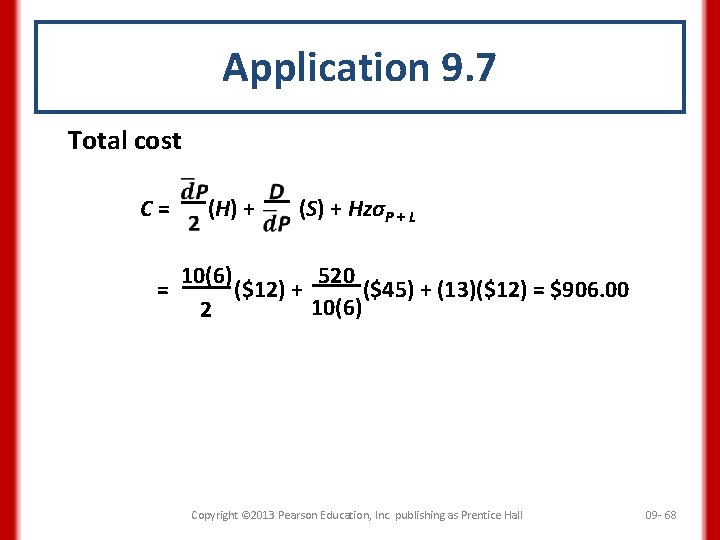
Application 9. 7 Total cost C= (H) + (S) + HzσP + L 10(6) 520 = ($12) + ($45) + (13)($12) = $906. 00 10(6) 2 Copyright © 2013 Pearson Education, Inc. publishing as Prentice Hall 09 - 68
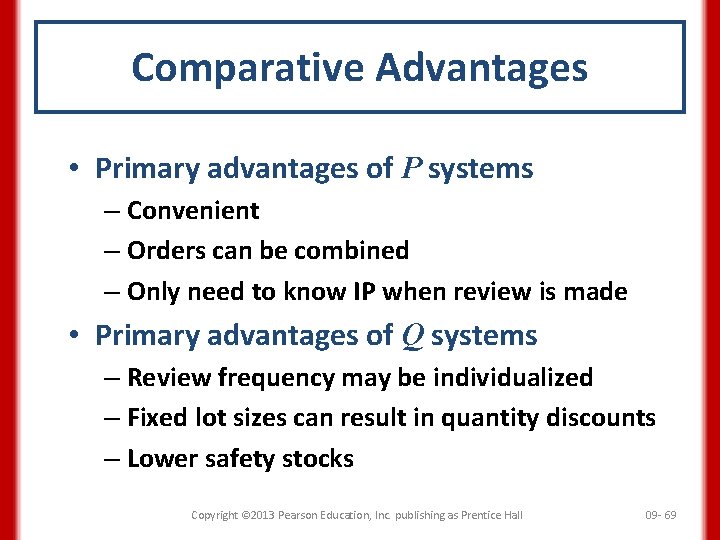
Comparative Advantages • Primary advantages of P systems – Convenient – Orders can be combined – Only need to know IP when review is made • Primary advantages of Q systems – Review frequency may be individualized – Fixed lot sizes can result in quantity discounts – Lower safety stocks Copyright © 2013 Pearson Education, Inc. publishing as Prentice Hall 09 - 69
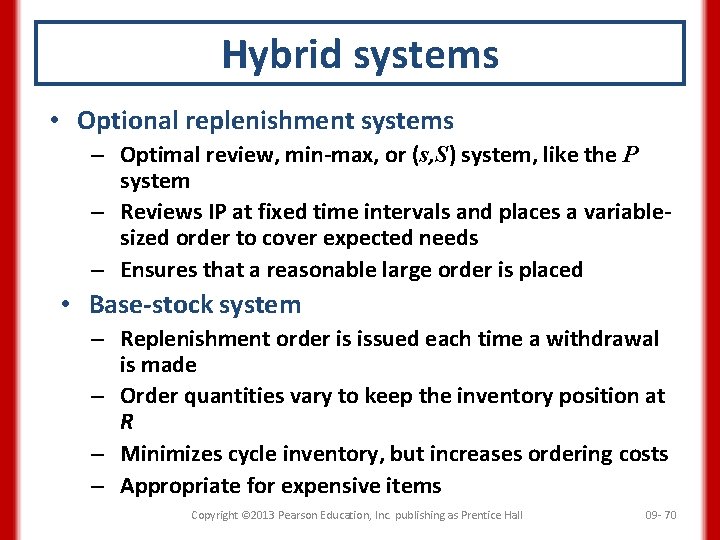
Hybrid systems • Optional replenishment systems – Optimal review, min-max, or (s, S) system, like the P system – Reviews IP at fixed time intervals and places a variablesized order to cover expected needs – Ensures that a reasonable large order is placed • Base-stock system – Replenishment order is issued each time a withdrawal is made – Order quantities vary to keep the inventory position at R – Minimizes cycle inventory, but increases ordering costs – Appropriate for expensive items Copyright © 2013 Pearson Education, Inc. publishing as Prentice Hall 09 - 70
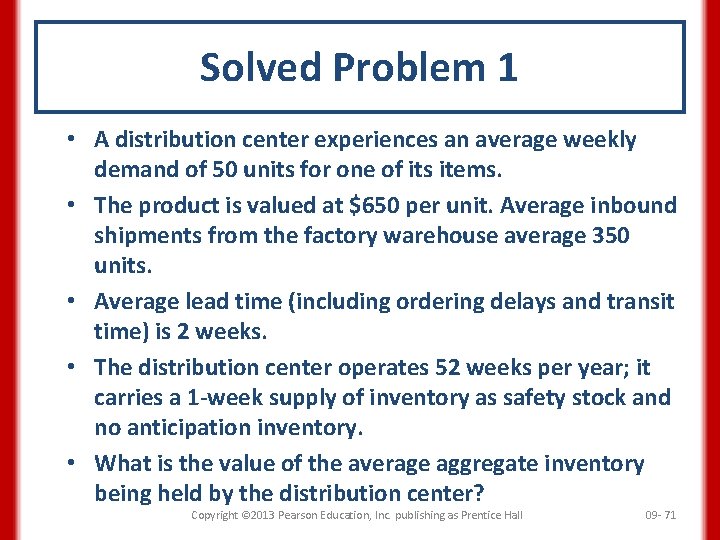
Solved Problem 1 • A distribution center experiences an average weekly demand of 50 units for one of its items. • The product is valued at $650 per unit. Average inbound shipments from the factory warehouse average 350 units. • Average lead time (including ordering delays and transit time) is 2 weeks. • The distribution center operates 52 weeks per year; it carries a 1 -week supply of inventory as safety stock and no anticipation inventory. • What is the value of the average aggregate inventory being held by the distribution center? Copyright © 2013 Pearson Education, Inc. publishing as Prentice Hall 09 - 71
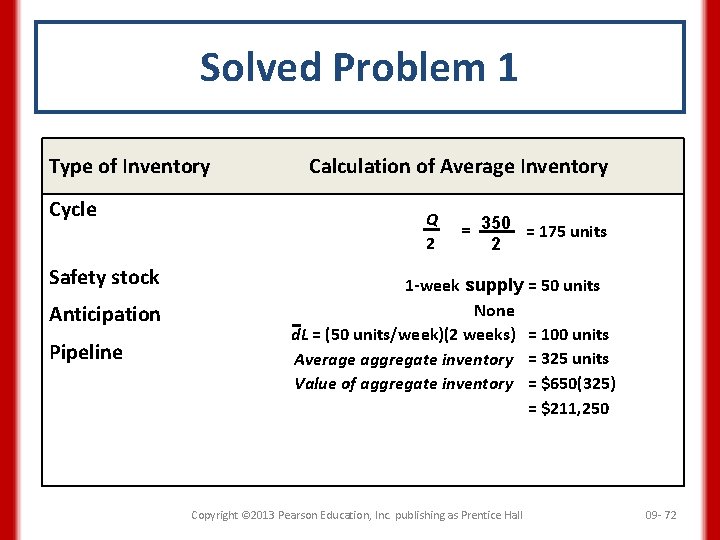
Solved Problem 1 Type of Inventory Cycle Safety stock Anticipation Pipeline Calculation of Average Inventory Q 2 = 350 = 175 units 2 1 -week supply = 50 units None d. L = (50 units/week)(2 weeks) = 100 units Average aggregate inventory = 325 units Value of aggregate inventory = $650(325) = $211, 250 Copyright © 2013 Pearson Education, Inc. publishing as Prentice Hall 09 - 72
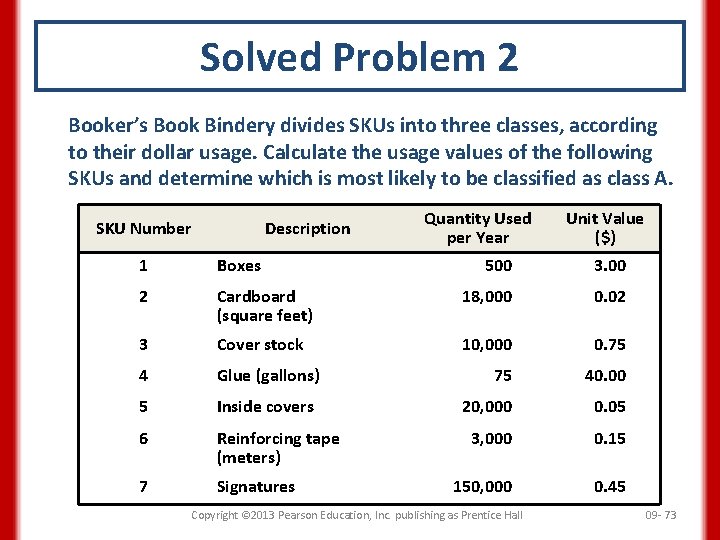
Solved Problem 2 Booker’s Book Bindery divides SKUs into three classes, according to their dollar usage. Calculate the usage values of the following SKUs and determine which is most likely to be classified as class A. SKU Number Description 1 Boxes 2 Quantity Used per Year Unit Value ($) 500 3. 00 Cardboard (square feet) 18, 000 0. 02 3 Cover stock 10, 000 0. 75 4 Glue (gallons) 75 40. 00 5 Inside covers 20, 000 0. 05 6 Reinforcing tape (meters) 3, 000 0. 15 7 Signatures 150, 000 0. 45 Copyright © 2013 Pearson Education, Inc. publishing as Prentice Hall 09 - 73
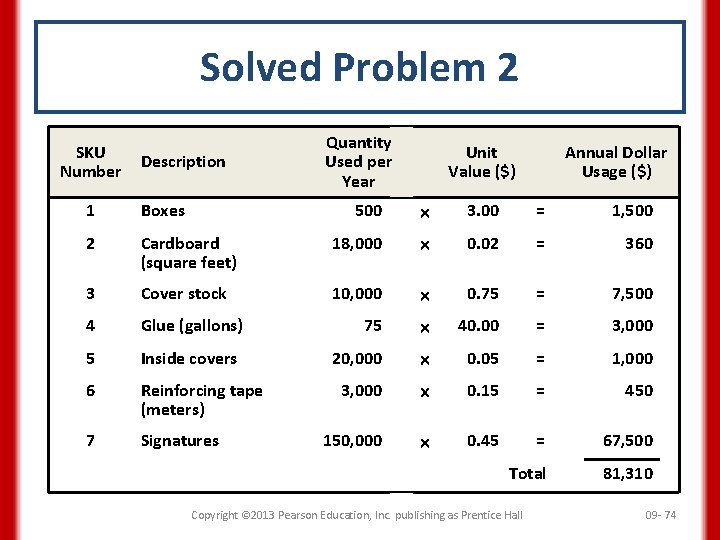
Solved Problem 2 SKU Number Description Quantity Used per Year Unit Value ($) Annual Dollar Usage ($) 500 3. 00 = 1, 500 Cardboard (square feet) 18, 000 0. 02 = 360 3 Cover stock 10, 000 0. 75 = 7, 500 4 Glue (gallons) 75 40. 00 = 3, 000 5 Inside covers 20, 000 0. 05 = 1, 000 6 Reinforcing tape (meters) 3, 000 0. 15 = 450 7 Signatures 150, 000 0. 45 = 67, 500 Total 81, 310 1 Boxes 2 Copyright © 2013 Pearson Education, Inc. publishing as Prentice Hall 09 - 74
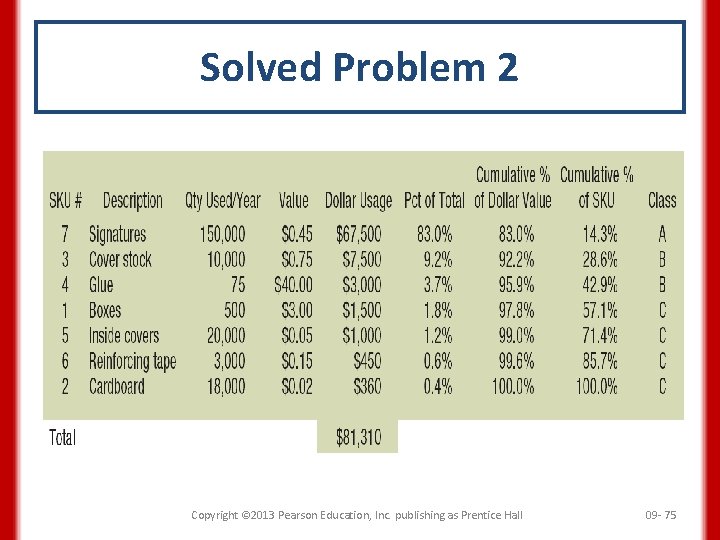
Solved Problem 2 Copyright © 2013 Pearson Education, Inc. publishing as Prentice Hall 09 - 75
Solved Problem 2 Copyright © 2013 Pearson Education, Inc. publishing as Prentice Hall 09 - 76
Solved Problem 3 Nelson’s Hardware Store stocks a 19. 2 volt cordless drill that is a popular seller. Annual demand is 5, 000 units, the ordering cost is $15, and the inventory holding cost is $4/unit/year. a. What is the economic order quantity? b. What is the total annual cost for this inventory item? a. The order quantity is EOQ = 2 DS H = = 2(5, 000)($15) $4 37, 500 = 193. 65 or 194 drills b. The total annual cost is Q D C = 2 (H) + Q (S) = 5, 000 194 ($4) + ($15) = $774. 60 194 2 Copyright © 2013 Pearson Education, Inc. publishing as Prentice Hall 09 - 77
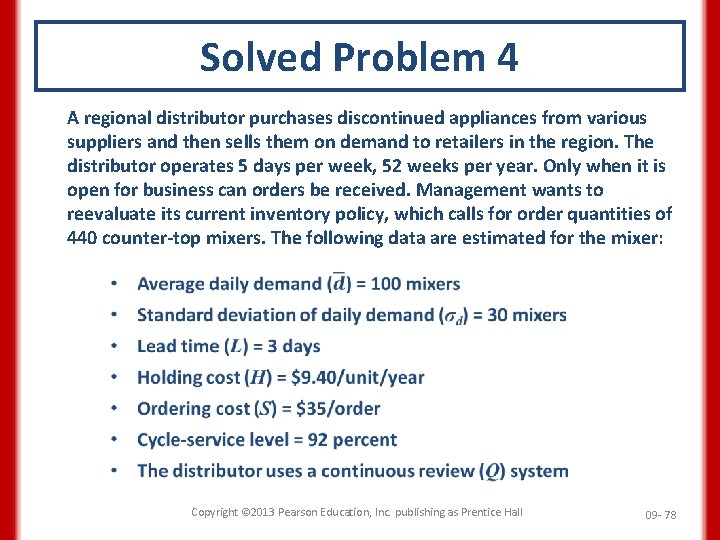
Solved Problem 4 A regional distributor purchases discontinued appliances from various suppliers and then sells them on demand to retailers in the region. The distributor operates 5 days per week, 52 weeks per year. Only when it is open for business can orders be received. Management wants to reevaluate its current inventory policy, which calls for order quantities of 440 counter-top mixers. The following data are estimated for the mixer: Copyright © 2013 Pearson Education, Inc. publishing as Prentice Hall 09 - 78
Solved Problem 4 a. What order quantity Q, and reorder point, R, should be used? b. What is the total annual cost of the system? c. If on-hand inventory is 40 units, one open order for 440 mixers is pending, and no backorders exist, should a new order be placed? Copyright © 2013 Pearson Education, Inc. publishing as Prentice Hall 09 - 79
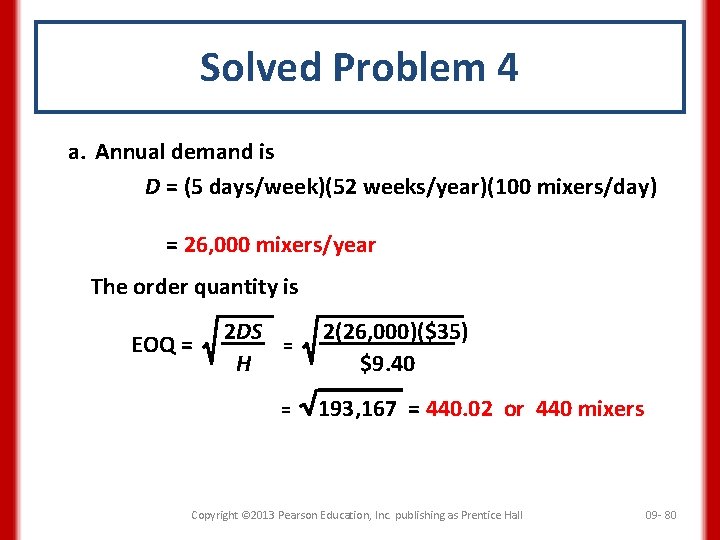
Solved Problem 4 a. Annual demand is D = (5 days/week)(52 weeks/year)(100 mixers/day) = 26, 000 mixers/year The order quantity is EOQ = 2 DS = H = 2(26, 000)($35) $9. 40 193, 167 = 440. 02 or 440 mixers Copyright © 2013 Pearson Education, Inc. publishing as Prentice Hall 09 - 80
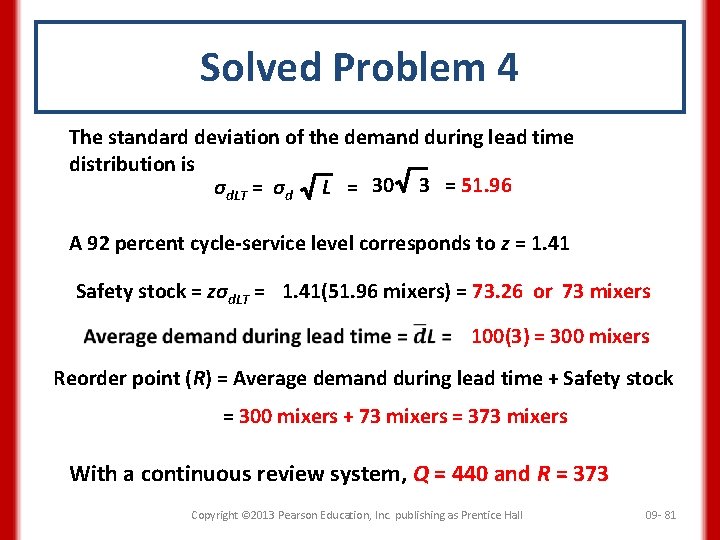
Solved Problem 4 The standard deviation of the demand during lead time distribution is σd. LT = σd L = 30 3 = 51. 96 A 92 percent cycle-service level corresponds to z = 1. 41 Safety stock = zσd. LT = 1. 41(51. 96 mixers) = 73. 26 or 73 mixers 100(3) = 300 mixers Reorder point (R) = Average demand during lead time + Safety stock = 300 mixers + 73 mixers = 373 mixers With a continuous review system, Q = 440 and R = 373 Copyright © 2013 Pearson Education, Inc. publishing as Prentice Hall 09 - 81
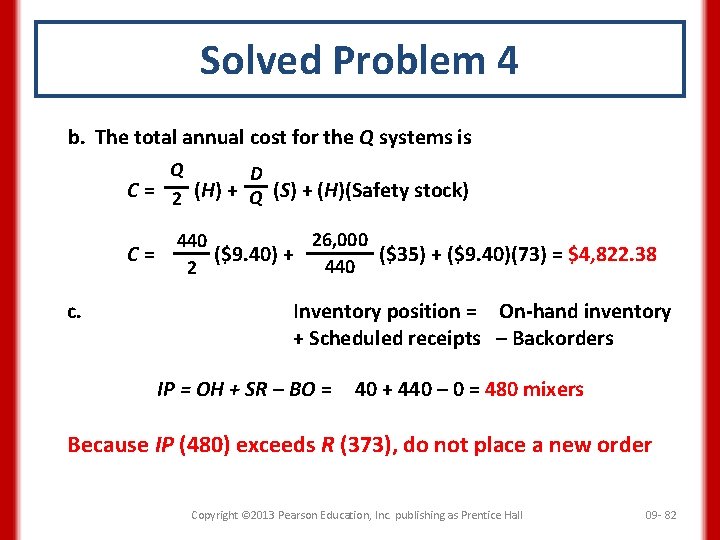
Solved Problem 4 b. The total annual cost for the Q systems is Q D C = 2 (H) + Q (S) + (H)(Safety stock) C= c. 26, 000 440 ($9. 40) + ($35) + ($9. 40)(73) = $4, 822. 38 440 2 Inventory position = On-hand inventory + Scheduled receipts – Backorders IP = OH + SR – BO = 40 + 440 – 0 = 480 mixers Because IP (480) exceeds R (373), do not place a new order Copyright © 2013 Pearson Education, Inc. publishing as Prentice Hall 09 - 82
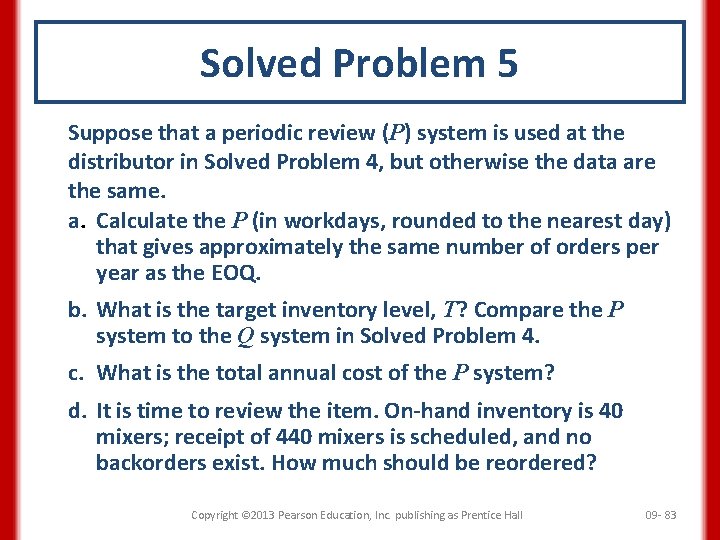
Solved Problem 5 Suppose that a periodic review (P) system is used at the distributor in Solved Problem 4, but otherwise the data are the same. a. Calculate the P (in workdays, rounded to the nearest day) that gives approximately the same number of orders per year as the EOQ. b. What is the target inventory level, T? Compare the P system to the Q system in Solved Problem 4. c. What is the total annual cost of the P system? d. It is time to review the item. On-hand inventory is 40 mixers; receipt of 440 mixers is scheduled, and no backorders exist. How much should be reordered? Copyright © 2013 Pearson Education, Inc. publishing as Prentice Hall 09 - 83
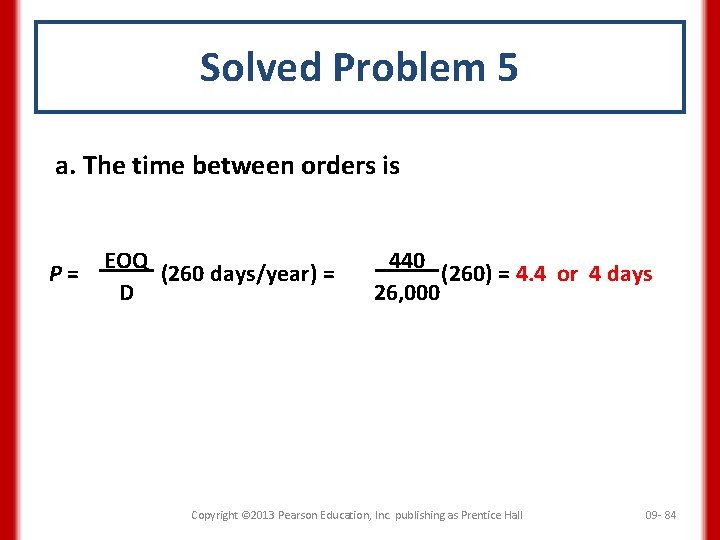
Solved Problem 5 a. The time between orders is P= EOQ (260 days/year) = D 440 (260) = 4. 4 or 4 days 26, 000 Copyright © 2013 Pearson Education, Inc. publishing as Prentice Hall 09 - 84
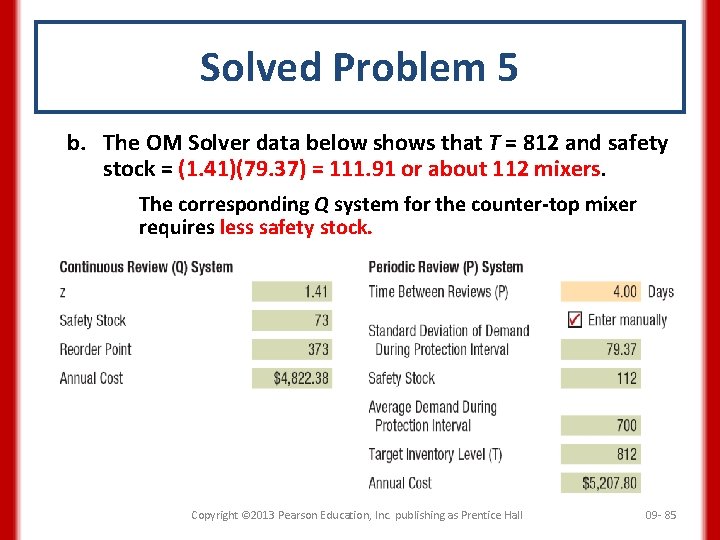
Solved Problem 5 b. The OM Solver data below shows that T = 812 and safety stock = (1. 41)(79. 37) = 111. 91 or about 112 mixers. The corresponding Q system for the counter-top mixer requires less safety stock. Copyright © 2013 Pearson Education, Inc. publishing as Prentice Hall 09 - 85
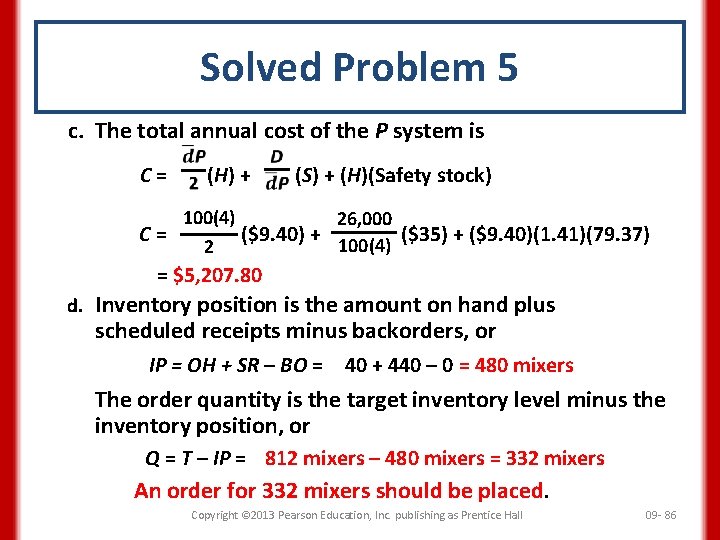
Solved Problem 5 c. The total annual cost of the P system is C= (H) + (S) + (H)(Safety stock) 100(4) 26, 000 C= ($9. 40) + 100(4) ($35) + ($9. 40)(1. 41)(79. 37) 2 = $5, 207. 80 d. Inventory position is the amount on hand plus scheduled receipts minus backorders, or IP = OH + SR – BO = 40 + 440 – 0 = 480 mixers The order quantity is the target inventory level minus the inventory position, or Q = T – IP = 812 mixers – 480 mixers = 332 mixers An order for 332 mixers should be placed. Copyright © 2013 Pearson Education, Inc. publishing as Prentice Hall 09 - 86
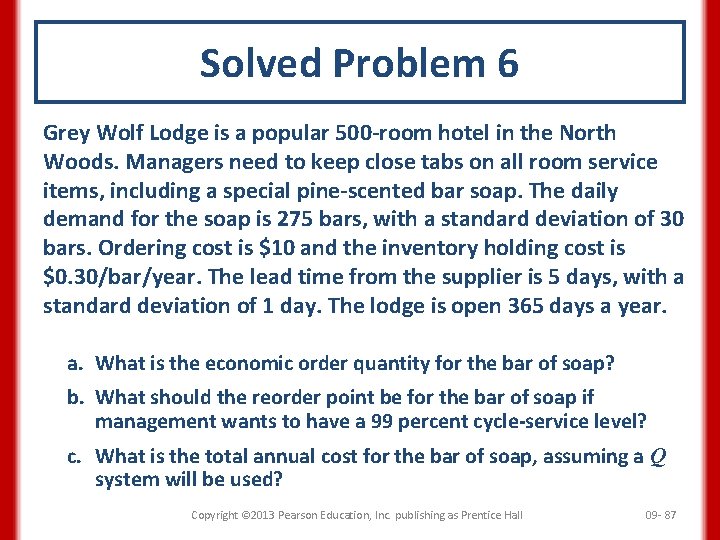
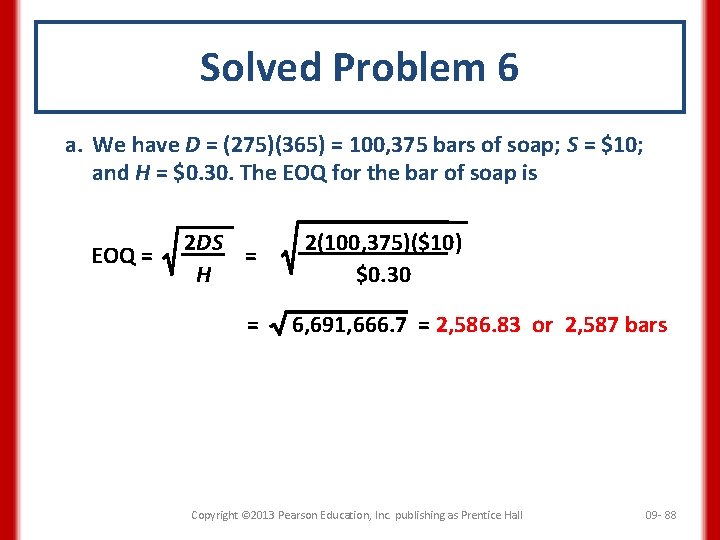
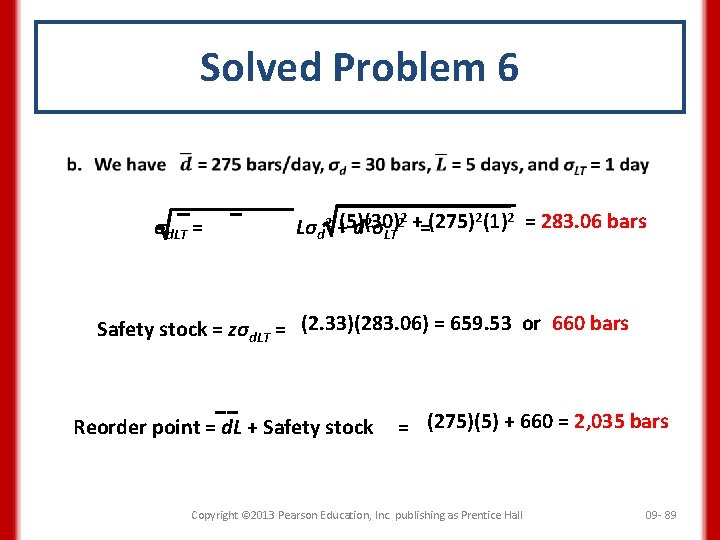
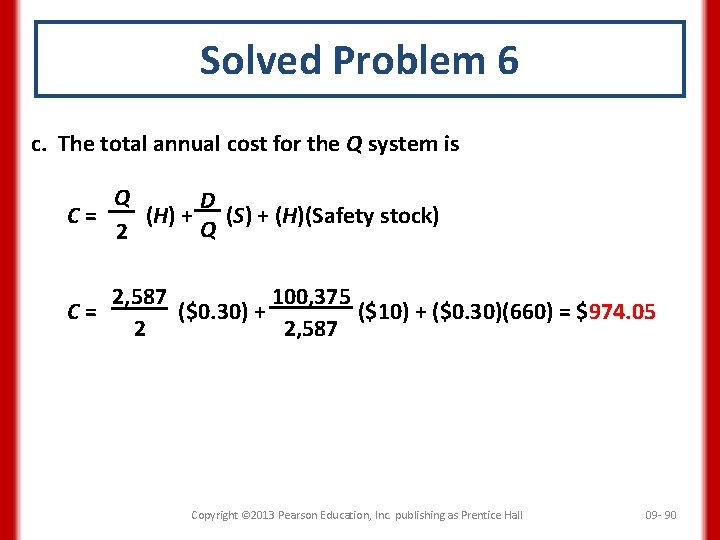
Solved Problem 6 Grey Wolf Lodge is a popular 500 -room hotel in the North Woods. Managers need to keep close tabs on all room service items, including a special pine-scented bar soap. The daily demand for the soap is 275 bars, with a standard deviation of 30 bars. Ordering cost is $10 and the inventory holding cost is $0. 30/bar/year. The lead time from the supplier is 5 days, with a standard deviation of 1 day. The lodge is open 365 days a year. a. What is the economic order quantity for the bar of soap? b. What should the reorder point be for the bar of soap if management wants to have a 99 percent cycle-service level? c. What is the total annual cost for the bar of soap, assuming a Q system will be used? Copyright © 2013 Pearson Education, Inc. publishing as Prentice Hall 09 - 87
Solved Problem 6 a. We have D = (275)(365) = 100, 375 bars of soap; S = $10; and H = $0. 30. The EOQ for the bar of soap is EOQ = 2 DS = H = 2(100, 375)($10) $0. 30 6, 691, 666. 7 = 2, 586. 83 or 2, 587 bars Copyright © 2013 Pearson Education, Inc. publishing as Prentice Hall 09 - 88
Solved Problem 6 σd. LT = 2 2 2 Lσd 2 +(5)(30) d 2σLT 2 +=(275) (1) = 283. 06 bars Safety stock = zσd. LT = (2. 33)(283. 06) = 659. 53 or 660 bars Reorder point = d. L + Safety stock = (275)(5) + 660 = 2, 035 bars Copyright © 2013 Pearson Education, Inc. publishing as Prentice Hall 09 - 89
Solved Problem 6 c. The total annual cost for the Q system is Q D C= (H) + (S) + (H)(Safety stock) Q 2 C= 2, 587 100, 375 ($0. 30) + ($10) + ($0. 30)(660) = $974. 05 2 2, 587 Copyright © 2013 Pearson Education, Inc. publishing as Prentice Hall 09 - 90
All rights reserved. No part of this publication may be reproduced, stored in a retrieval system, or transmitted, in any form or by any means, electronic, mechanical, photocopying, recording, or otherwise, without the prior written permission of the publisher. Printed in the United States of America. Copyright © 2013 Pearson Education, Inc. publishing as Prentice Hall 09 - 91