
Supply Chain Customer Order Decoupling Point Keep Source


- Slides: 6
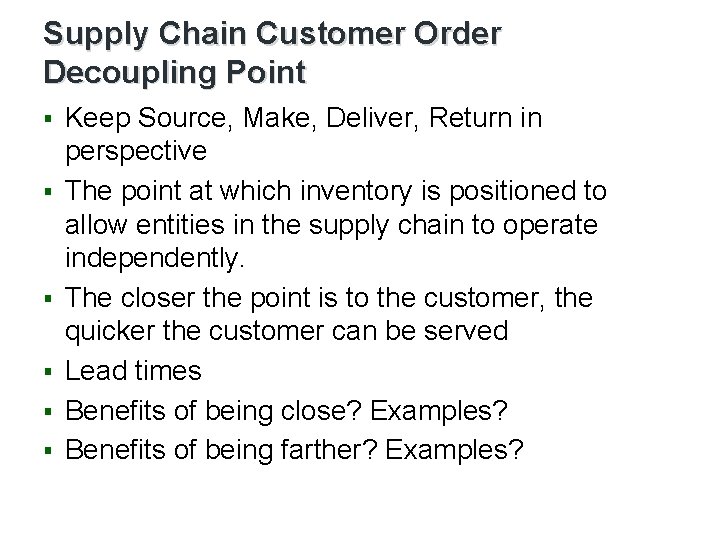
Supply Chain Customer Order Decoupling Point § § § Keep Source, Make, Deliver, Return in perspective The point at which inventory is positioned to allow entities in the supply chain to operate independently. The closer the point is to the customer, the quicker the customer can be served Lead times Benefits of being close? Examples? Benefits of being farther? Examples?
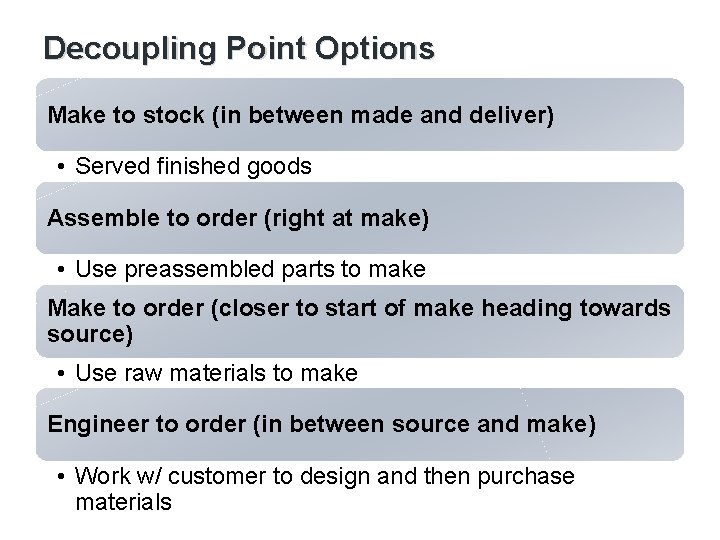
Decoupling Point Options Make to stock (in between made and deliver) • Served finished goods Assemble to order (right at make) • Use preassembled parts to make Make to order (closer to start of make heading towards source) • Use raw materials to make Engineer to order (in between source and make) • Work w/ customer to design and then purchase materials
Little’s Law § § Long term relationship between the inventory, throughput rate, and flow time A way to predict how many products are consistently in progress Inventory = throughput rate x flow time Ø If we are finishing on average 50 desks a day and it takes 3 days to build a desk Ø Day 1 = starting 50 Ø Day 2 = continuing 50 plus starting another 50 Ø Day 3 = finished 50, plus continuing 100 Ø Day 4 = Finishing 100 plus starting another 50
Assembly-Line Balancing ▶ ▶ Objective is to minimize the imbalance between machines or personnel while meeting required output Starts with the precedence relationships ▶ ▶ ▶ Determine cycle time Calculate theoretical minimum number of workstations Balance the line by assigning specific tasks to workstations
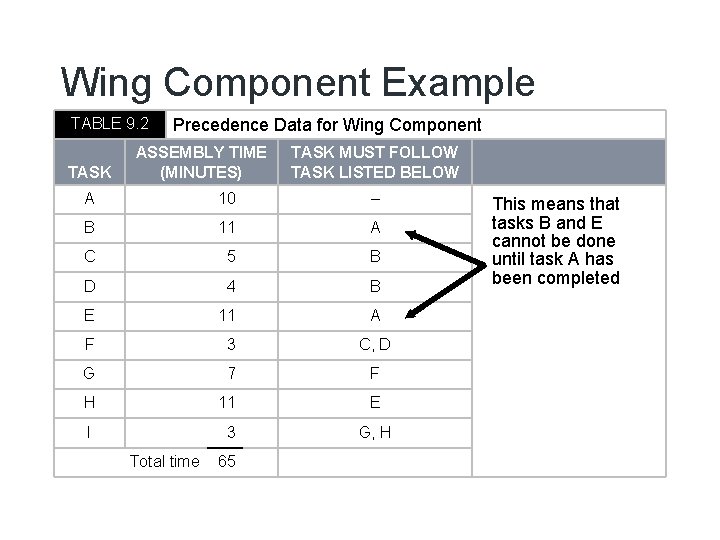
Wing Component Example TABLE 9. 2 TASK Precedence Data for Wing Component ASSEMBLY TIME (MINUTES) TASK MUST FOLLOW TASK LISTED BELOW A 10 – B 11 A C 5 B D 4 B E 11 A F 3 C, D G 7 F H 11 E I 3 G, H Total time 65 This means that tasks B and E cannot be done until task A has been completed
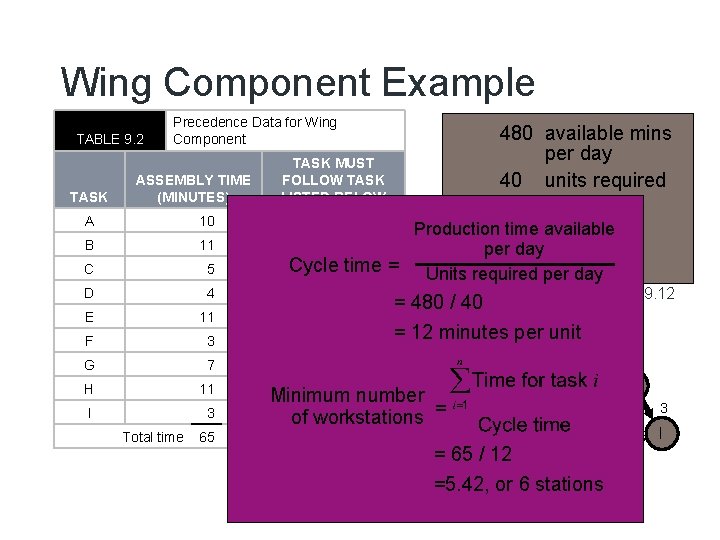
Wing Component Example TABLE 9. 2 TASK Precedence Data for Wing Component ASSEMBLY TIME (MINUTES) TASK MUST FOLLOW TASK LISTED BELOW A 10 B 11 C 5 D 4 B E 11 A F 3 C, D G 7 H 11 I 3 Total time 65 480 available mins per day 40 units required – Production time available A per day Cycle B time = Units required per day F = 480 / 40 5 = 12 minutes per unit 10 11 A B E Minimum number G, H of workstations 11 C 4 D Figure 9. 12 3 7 F G 3 11 = 65 E/ 12 H =5. 42, or 6 stations I