
Supply Chain Contracts and their Impact on Profitability
Supply Chain Contracts and their Impact on Profitability Double Marginalisation Supply Chain Co-ordination via Contracts
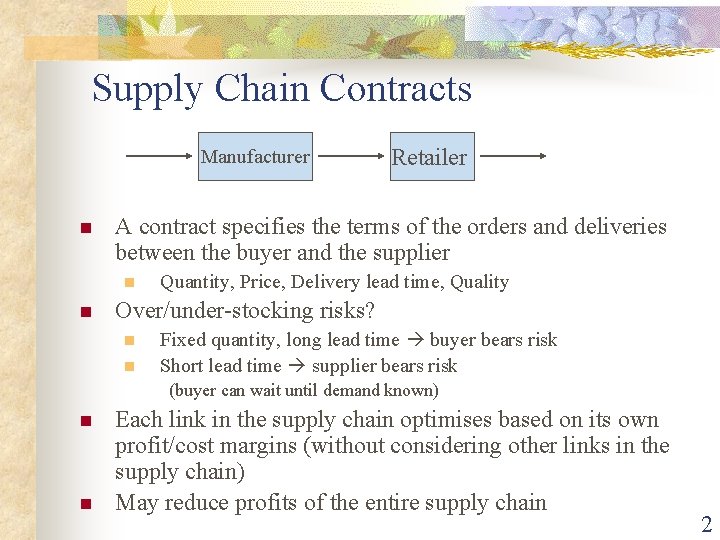
Supply Chain Contracts Manufacturer n A contract specifies the terms of the orders and deliveries between the buyer and the supplier n n Retailer Quantity, Price, Delivery lead time, Quality Over/under-stocking risks? n n Fixed quantity, long lead time buyer bears risk Short lead time supplier bears risk (buyer can wait until demand known) n n Each link in the supply chain optimises based on its own profit/cost margins (without considering other links in the supply chain) May reduce profits of the entire supply chain 2
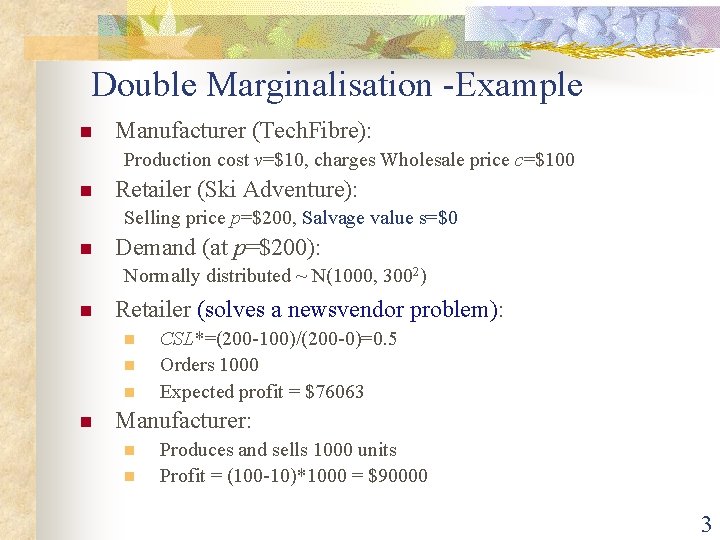
Double Marginalisation -Example n Manufacturer (Tech. Fibre): Production cost v=$10, charges Wholesale price c=$100 n Retailer (Ski Adventure): Selling price p=$200, Salvage value s=$0 n Demand (at p=$200): Normally distributed ~ N(1000, 3002) n Retailer (solves a newsvendor problem): n n CSL*=(200 -100)/(200 -0)=0. 5 Orders 1000 Expected profit = $76063 Manufacturer: n n Produces and sells 1000 units Profit = (100 -10)*1000 = $90000 3
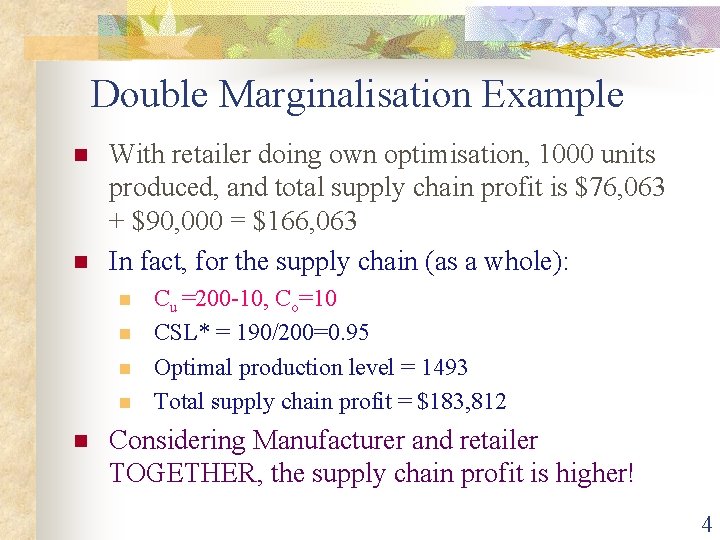
Double Marginalisation Example n n With retailer doing own optimisation, 1000 units produced, and total supply chain profit is $76, 063 + $90, 000 = $166, 063 In fact, for the supply chain (as a whole): n n n Cu =200 -10, Co=10 CSL* = 190/200=0. 95 Optimal production level = 1493 Total supply chain profit = $183, 812 Considering Manufacturer and retailer TOGETHER, the supply chain profit is higher! 4
Double Marginalisation If each party makes decisions considering only a part of the supply chain, the decisions may not maximize profits for the whole supply chain! 5
n n Supply Chain Co-ordination Can contracts/incentives be set to increase total supply chain profits? Incentives to retailers to order quantities that increase supply chain profits: n Buy-back contracts : A manufacturer specifies a wholesale price and a buyback price at which the retailer can return any unsold items at the end of the season n Revenue sharing contracts: The manufacturer charges the retailer a low wholesale price and shares a fraction of the revenue generated by the retailer n Quantity flexible contracts: Manufacturer allows retailer to change order quantity after observing demand 6
Returns Policy: Buy Back contracts Manufacturer specifies wholesale price and a buyback price b at which retailers can return unsold units at end of season n Retailer: n n n Salvage value becomes b (so, Co=c-b) Optimal Order y* increases! Manufacturer: n n Expected profit = y*(c-v) – b(expected overstock) Increases if b not too large. 7
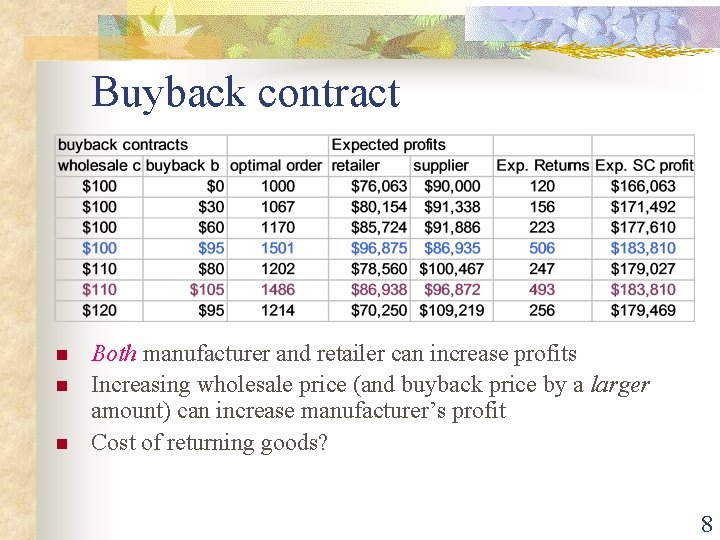
Buyback contract n n n Both manufacturer and retailer can increase profits Increasing wholesale price (and buyback price by a larger amount) can increase manufacturer’s profit Cost of returning goods? 8
Revenue Sharing Contracts n Manufacturer charges a low wholesale price and shares a fraction (f) of the revenue generated by the retailer n Lower wholesale price decreases cost of overstocking, so retailer increases level of product availability => increase profit for BOTH manufacturer and retailer 9
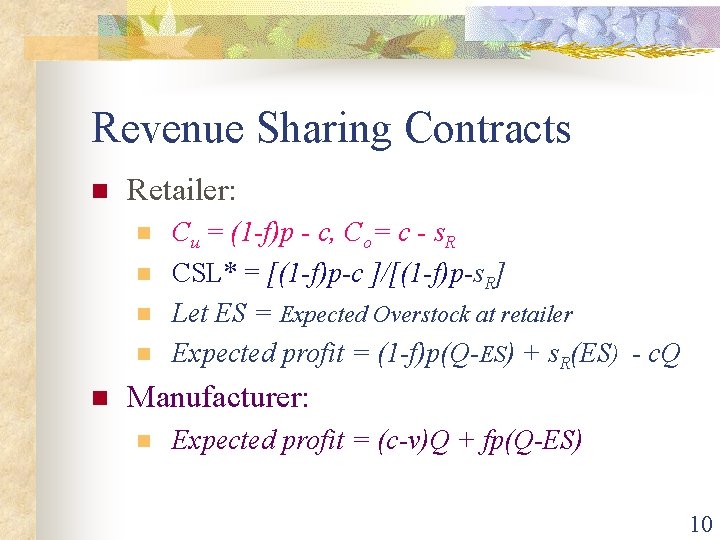
Revenue Sharing Contracts n Retailer: n n n Cu = (1 -f)p - c, Co= c - s. R CSL* = [(1 -f)p-c ]/[(1 -f)p-s. R] Let ES = Expected Overstock at retailer Expected profit = (1 -f)p(Q-ES) + s. R(ES) - c. Q Manufacturer: n Expected profit = (c-v)Q + fp(Q-ES) 10
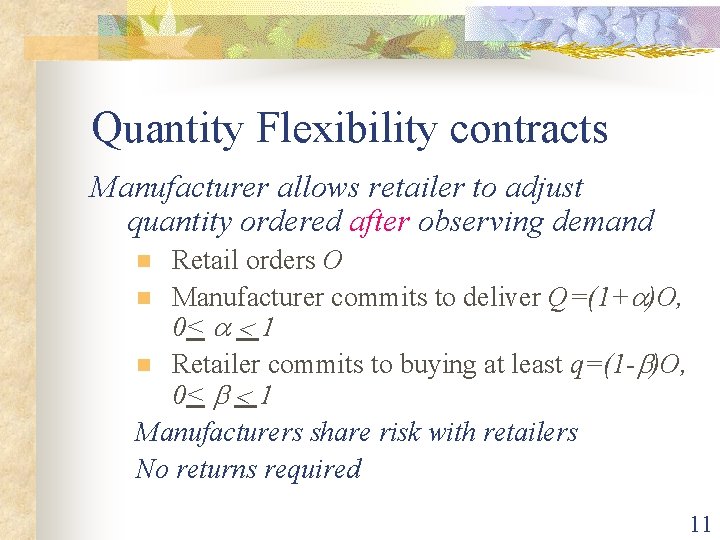
Quantity Flexibility contracts Manufacturer allows retailer to adjust quantity ordered after observing demand Retail orders O n Manufacturer commits to deliver Q=(1+a)O, 0< a < 1 n Retailer commits to buying at least q=(1 -b)O, 0< b < 1 Manufacturers share risk with retailers No returns required n 11
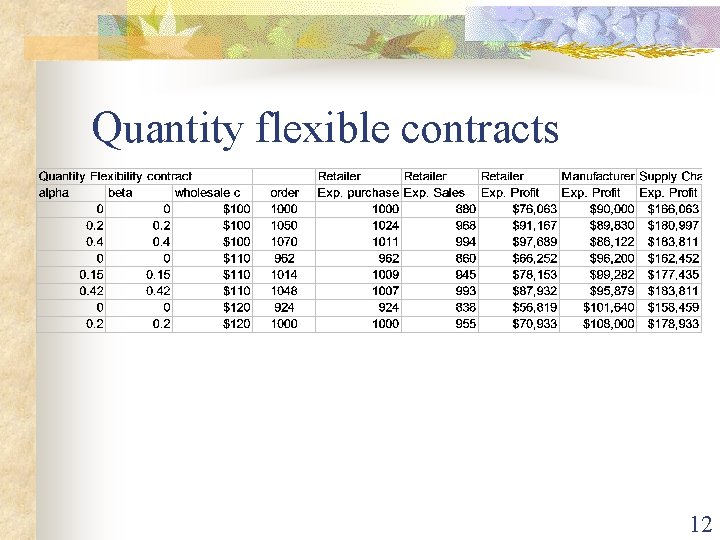
Quantity flexible contracts 12
Vendor Managed Inventory (VMI) n n n Manufacturer controls replenishments decisions Retailers share sales information VMI can mitigate the effects of double marginalisation VMI can improve manufacturer forecasts Retailers stock goods from competitors n n Confidentiality? Substitutability ignored by BOTH manufacturers -> stock too high for retailers 13
Summary n Newsvendor model n n Supply chain co-ordination by contracts n n n Tradeoff cost of over-stock and lost sales Buy-back Revenue sharing Quantity-flexible Vendor-managed inventory Incentives? Making supply meet demand! 14
- Slides: 14