
Suppliers Declaration of Conformity for ICT Regulations David




- Slides: 34
Supplier’s Declaration of Conformity for ICT Regulations David Ling Regulatory Policy and Strategy Manager Worldwide Technical Regulations © 2004 Hewlett-Packard Development Company, L. P. The information contained herein is subject to change without notice
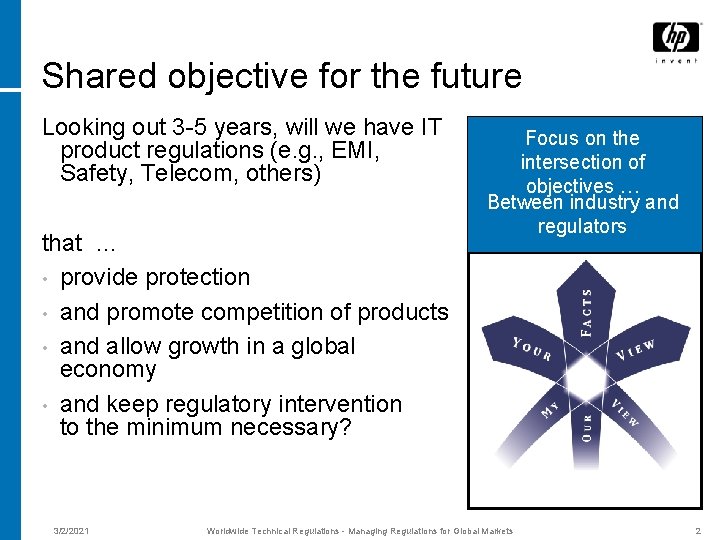
Shared objective for the future Looking out 3 -5 years, will we have IT product regulations (e. g. , EMI, Safety, Telecom, others) that … • provide protection • and promote competition of products • and allow growth in a global economy • and keep regulatory intervention to the minimum necessary? 3/2/2021 Focus on the intersection of objectives … Between industry and regulators Worldwide Technical Regulations - Managing Regulations for Global Markets 2
Likely scenario: Small and Medium-size Enterprises (SME’s) and Multinationals may misconstrue the regulatory intent of “certification” and how to manage for it. Challenge: Have regulatory requirements that rightfully and clearly places responsibility and accountability on the supplier for safe and legal products. 3/2/2021 Worldwide Technical Regulations - Managing Regulations for Global Markets 3
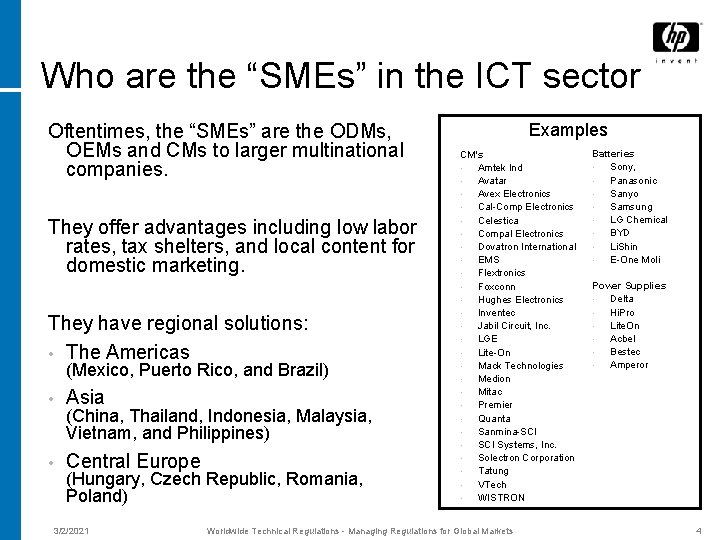
Who are the “SMEs” in the ICT sector Oftentimes, the “SMEs” are the ODMs, OEMs and CMs to larger multinational companies. They offer advantages including low labor rates, tax shelters, and local content for domestic marketing. They have regional solutions: • The Americas (Mexico, Puerto Rico, and Brazil) • Asia • Central Europe (China, Thailand, Indonesia, Malaysia, Vietnam, and Philippines) (Hungary, Czech Republic, Romania, Poland) 3/2/2021 Examples CM’s • Amtek Ind • Avatar • Avex Electronics • Cal-Comp Electronics • Celestica • Compal Electronics • Dovatron International • EMS • Flextronics • Foxconn • Hughes Electronics • Inventec • Jabil Circuit, Inc. • LGE • Lite-On • Mack Technologies • Medion • Mitac • Premier • Quanta • Sanmina-SCI • SCI Systems, Inc. • Solectron Corporation • Tatung • VTech • WISTRON Worldwide Technical Regulations - Managing Regulations for Global Markets Batteries • Sony, • Panasonic • Sanyo • Samsung • LG Chemical • BYD • Li. Shin • E-One Moli Power Supplies • Delta • Hi. Pro • Lite. On • Acbel • Bestec • Amperor 4
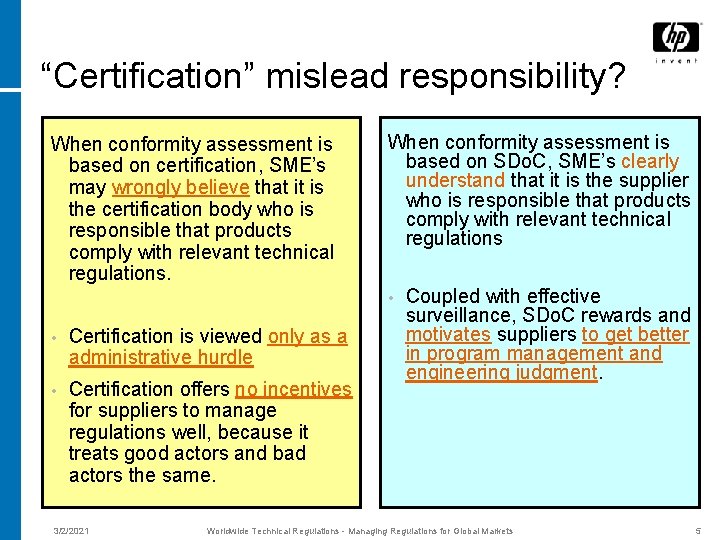
“Certification” mislead responsibility? When conformity assessment is based on certification, SME’s may wrongly believe that it is the certification body who is responsible that products comply with relevant technical regulations. When conformity assessment is based on SDo. C, SME’s clearly understand that it is the supplier who is responsible that products comply with relevant technical regulations • • Certification is viewed only as a administrative hurdle • Certification offers no incentives for suppliers to manage regulations well, because it treats good actors and bad actors the same. 3/2/2021 Coupled with effective surveillance, SDo. C rewards and motivates suppliers to get better in program management and engineering judgment. Worldwide Technical Regulations - Managing Regulations for Global Markets 5
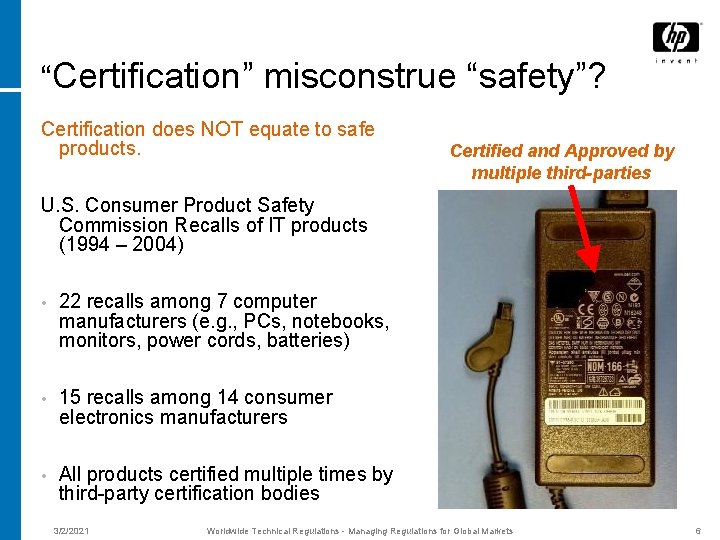
“Certification” misconstrue “safety”? Certification does NOT equate to safe products. Certified and Approved by multiple third-parties U. S. Consumer Product Safety Commission Recalls of IT products (1994 – 2004) • 22 recalls among 7 computer manufacturers (e. g. , PCs, notebooks, monitors, power cords, batteries) • 15 recalls among 14 consumer electronics manufacturers • All products certified multiple times by third-party certification bodies 3/2/2021 Worldwide Technical Regulations - Managing Regulations for Global Markets 6
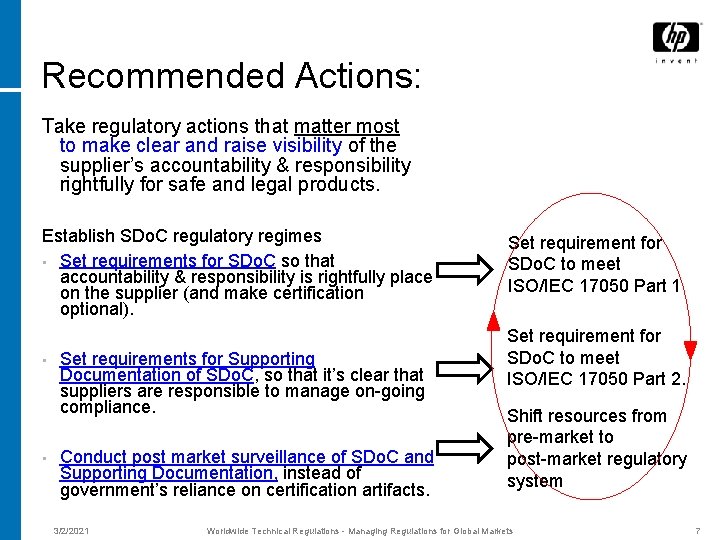
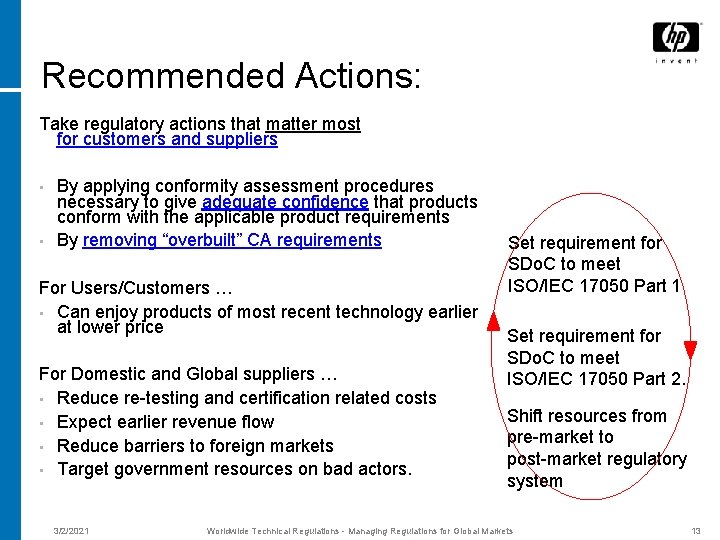
Recommended Actions: Take regulatory actions that matter most to make clear and raise visibility of the supplier’s accountability & responsibility rightfully for safe and legal products. Establish SDo. C regulatory regimes • Set requirements for SDo. C so that accountability & responsibility is rightfully place on the supplier (and make certification optional). • • Set requirements for Supporting Documentation of SDo. C, so that it’s clear that suppliers are responsible to manage on-going compliance. Conduct post market surveillance of SDo. C and Supporting Documentation, instead of government’s reliance on certification artifacts. 3/2/2021 Set requirement for SDo. C to meet ISO/IEC 17050 Part 2. Shift resources from pre-market to post-market regulatory system Worldwide Technical Regulations - Managing Regulations for Global Markets 7
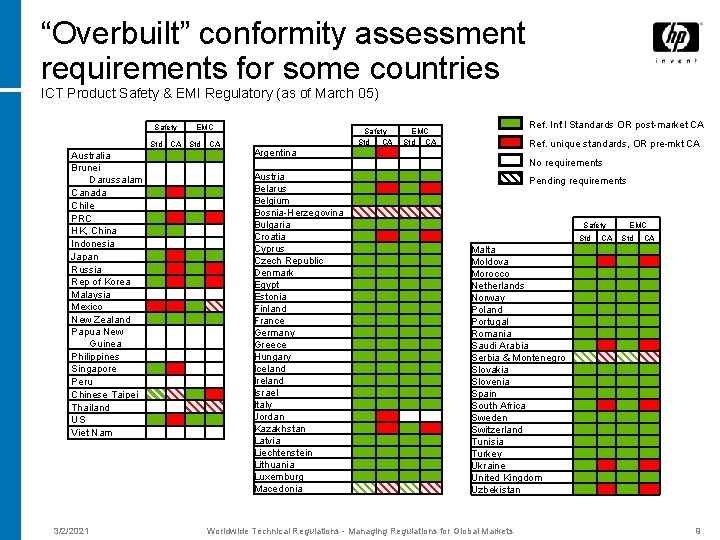
Likely scenario: “Over-built” conformity assessment requirements will continue to exist, and perhaps increase from country-to-country Challenge: “… conformity assessment procedures shall not be applied more strictly than is necessary to give adequate confidence that products conform with the applicable product requirements …” – Article 5. 1. 2, TBT Agreement 3/2/2021 Worldwide Technical Regulations - Managing Regulations for Global Markets 8
“Overbuilt” conformity assessment requirements for some countries ICT Product Safety & EMI Regulatory (as of March 05) Safety EMC Std CA Std Australia Brunei Darussalam Canada Chile PRC HK, China Indonesia Japan Russia Rep of Korea Malaysia Mexico New Zealand Papua New Guinea Philippines Singapore Peru Chinese Taipei Thailand US Viet Nam 3/2/2021 CA Safety Std CA Argentina Austria Belarus Belgium Bosnia-Herzegovina Bulgaria Croatia Cyprus Czech Republic Denmark Egypt Estonia Finland France Germany Greece Hungary Iceland Ireland Israel Italy Jordan Kazakhstan Latvia Liechtenstein Lithuania Luxemburg Macedonia Ref. Int’l Standards OR post-market CA EMC Std CA Ref. unique standards, OR pre-mkt CA No requirements Pending requirements Safety Std Malta Moldova Morocco Netherlands Norway Poland Portugal Romania Saudi Arabia Serbia & Montenegro Slovakia Slovenia Spain South Africa Sweden Switzerland Tunisia Turkey Ukraine United Kingdom Uzbekistan Worldwide Technical Regulations - Managing Regulations for Global Markets CA EMC Std CA 9
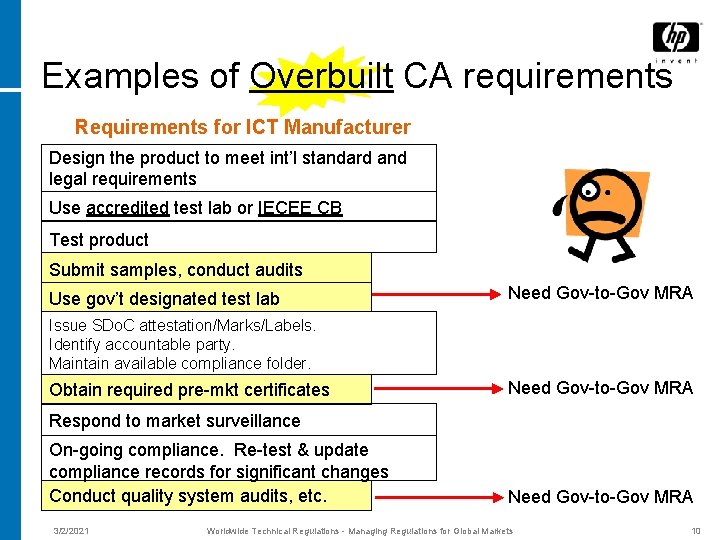
Examples of Overbuilt CA requirements Requirements for ICT Manufacturer Design the product to meet int’l standard and legal requirements Use accredited test lab or IECEE CB Test product Submit samples, conduct audits Use gov’t designated test lab Need Gov-to-Gov MRA Issue SDo. C attestation/Marks/Labels. Identify accountable party. Maintain available compliance folder. Obtain required pre-mkt certificates Need Gov-to-Gov MRA Respond to market surveillance On-going compliance. Re-test & update compliance records for significant changes Conduct quality system audits, etc. 3/2/2021 Need Gov-to-Gov MRA Worldwide Technical Regulations - Managing Regulations for Global Markets 10
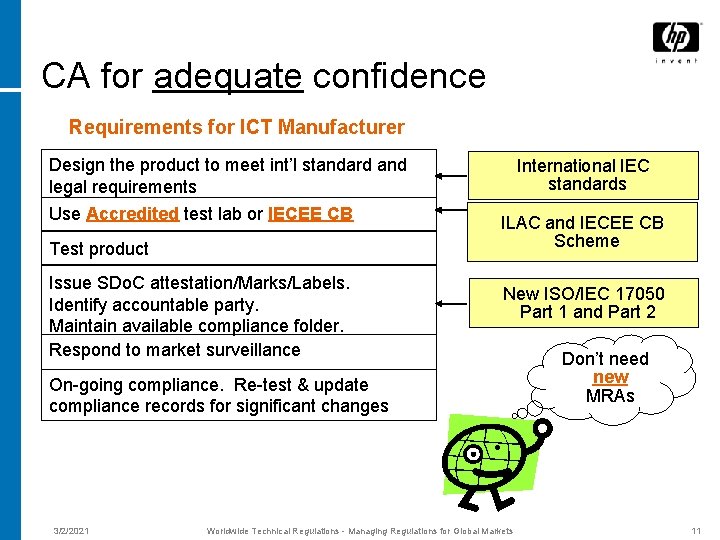
CA for adequate confidence Requirements for ICT Manufacturer Design the product to meet int’l standard and legal requirements Use Accredited test lab or IECEE CB Test product Issue SDo. C attestation/Marks/Labels. Identify accountable party. Maintain available compliance folder. Respond to market surveillance International IEC standards ILAC and IECEE CB Scheme New ISO/IEC 17050 Part 1 and Part 2 On-going compliance. Re-test & update compliance records for significant changes 3/2/2021 Worldwide Technical Regulations - Managing Regulations for Global Markets Don’t need new MRAs 11
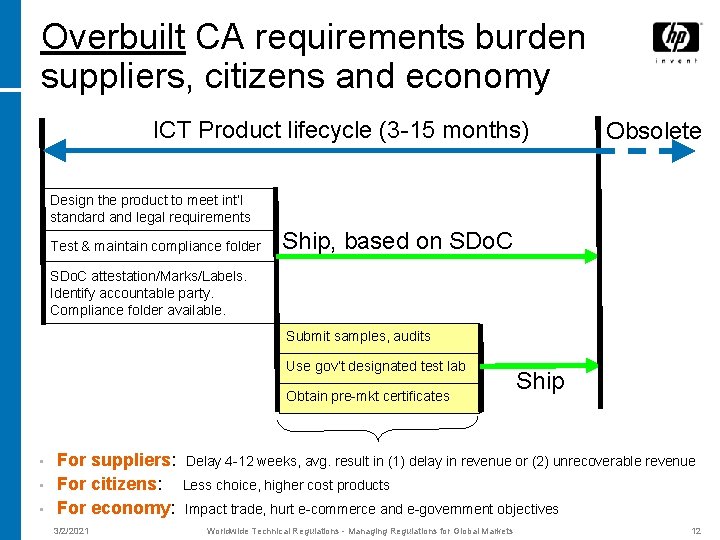
Overbuilt CA requirements burden suppliers, citizens and economy ICT Product lifecycle (3 -15 months) Obsolete Design the product to meet int’l standard and legal requirements Test & maintain compliance folder Ship, based on SDo. C attestation/Marks/Labels. Identify accountable party. Compliance folder available. Submit samples, audits Use gov’t designated test lab Obtain pre-mkt certificates • • • Ship For suppliers: Delay 4 -12 weeks, avg. result in (1) delay in revenue or (2) unrecoverable revenue For citizens: Less choice, higher cost products For economy: Impact trade, hurt e-commerce and e-government objectives 3/2/2021 Worldwide Technical Regulations - Managing Regulations for Global Markets 12
Recommended Actions: Take regulatory actions that matter most for customers and suppliers • • By applying conformity assessment procedures necessary to give adequate confidence that products conform with the applicable product requirements By removing “overbuilt” CA requirements For Users/Customers … • Can enjoy products of most recent technology earlier at lower price For Domestic and Global suppliers … • Reduce re-testing and certification related costs • Expect earlier revenue flow • Reduce barriers to foreign markets • Target government resources on bad actors. 3/2/2021 Set requirement for SDo. C to meet ISO/IEC 17050 Part 2. Shift resources from pre-market to post-market regulatory system Worldwide Technical Regulations - Managing Regulations for Global Markets 13
Likely scenario: Non-tariff trade obstacles related to CA will continue to exist, and perhaps increase from country-to-country Challenge: - “conformity assessment procedures are not prepared, adopted or applied with a view to or with the effect of creating unnecessary obstacles to international trade” … Article 5, TBT Agreement - “whenever possible, that results of conformity assessment procedures in other Members are accepted, even when those procedures differ from their own” … Article 6, TBT Agreement 3/2/2021 Worldwide Technical Regulations - Managing Regulations for Global Markets 14
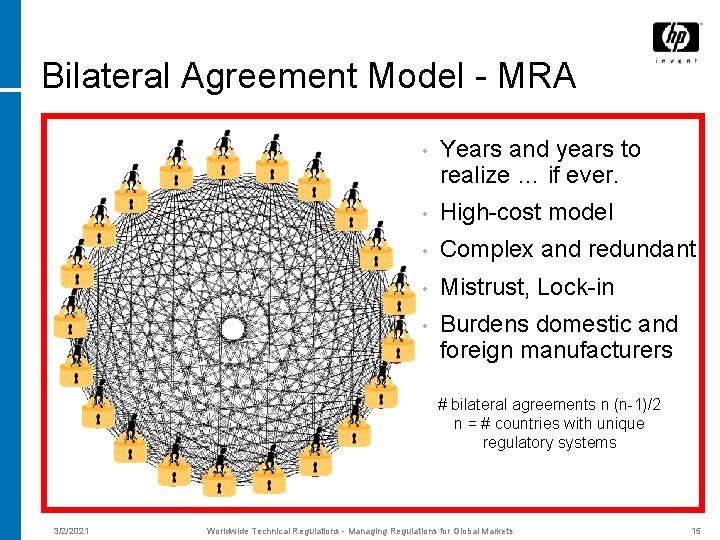
Bilateral Agreement Model - MRA • Years and years to realize … if ever. • High-cost model • Complex and redundant • Mistrust, Lock-in • Burdens domestic and foreign manufacturers # bilateral agreements n (n-1)/2 n = # countries with unique regulatory systems 3/2/2021 Worldwide Technical Regulations - Managing Regulations for Global Markets 15
SDo. C Model Lowest-cost model for safe, legal products to market 3/2/2021 Worldwide Technical Regulations - Managing Regulations for Global Markets 16
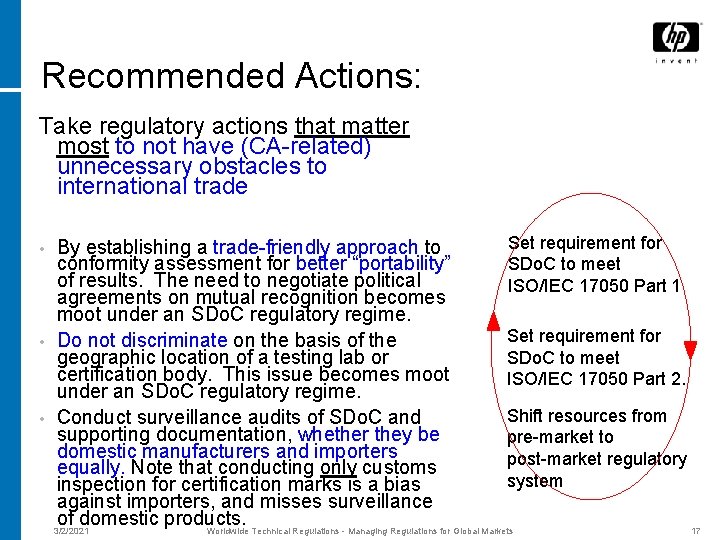
Recommended Actions: Take regulatory actions that matter most to not have (CA-related) unnecessary obstacles to international trade • • • Set requirement for By establishing a trade-friendly approach to conformity assessment for better “portability” SDo. C to meet of results. The need to negotiate political ISO/IEC 17050 Part 1 agreements on mutual recognition becomes moot under an SDo. C regulatory regime. Set requirement for Do not discriminate on the basis of the SDo. C to meet geographic location of a testing lab or certification body. This issue becomes moot ISO/IEC 17050 Part 2. under an SDo. C regulatory regime. Shift resources from Conduct surveillance audits of SDo. C and supporting documentation, whether they be pre-market to domestic manufacturers and importers post-market regulatory equally. Note that conducting only customs system inspection for certification marks is a bias against importers, and misses surveillance of domestic products. 3/2/2021 Worldwide Technical Regulations - Managing Regulations for Global Markets 17
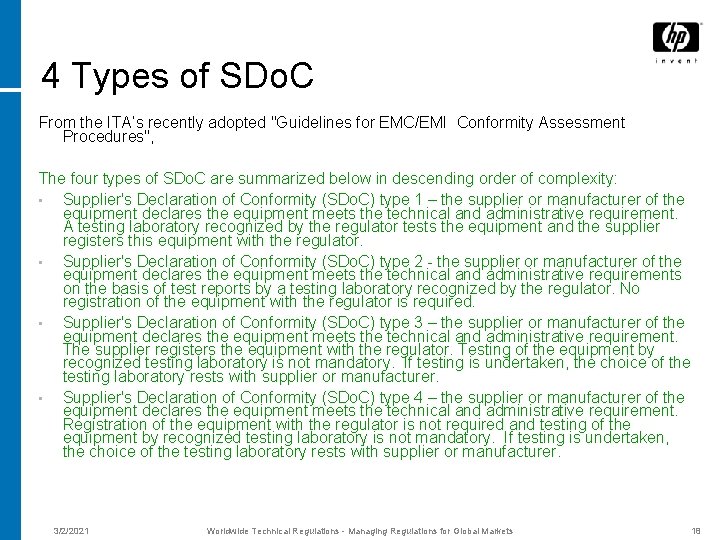
4 Types of SDo. C From the ITA’s recently adopted "Guidelines for EMC/EMI Conformity Assessment Procedures", The four types of SDo. C are summarized below in descending order of complexity: • Supplier's Declaration of Conformity (SDo. C) type 1 – the supplier or manufacturer of the equipment declares the equipment meets the technical and administrative requirement. A testing laboratory recognized by the regulator tests the equipment and the supplier registers this equipment with the regulator. • Supplier's Declaration of Conformity (SDo. C) type 2 - the supplier or manufacturer of the equipment declares the equipment meets the technical and administrative requirements on the basis of test reports by a testing laboratory recognized by the regulator. No registration of the equipment with the regulator is required. • Supplier's Declaration of Conformity (SDo. C) type 3 – the supplier or manufacturer of the equipment declares the equipment meets the technical and administrative requirement. The supplier registers the equipment with the regulator. Testing of the equipment by recognized testing laboratory is not mandatory. If testing is undertaken, the choice of the testing laboratory rests with supplier or manufacturer. • Supplier's Declaration of Conformity (SDo. C) type 4 – the supplier or manufacturer of the equipment declares the equipment meets the technical and administrative requirement. Registration of the equipment with the regulator is not required and testing of the equipment by recognized testing laboratory is not mandatory. If testing is undertaken, the choice of the testing laboratory rests with supplier or manufacturer. 3/2/2021 Worldwide Technical Regulations - Managing Regulations for Global Markets 18
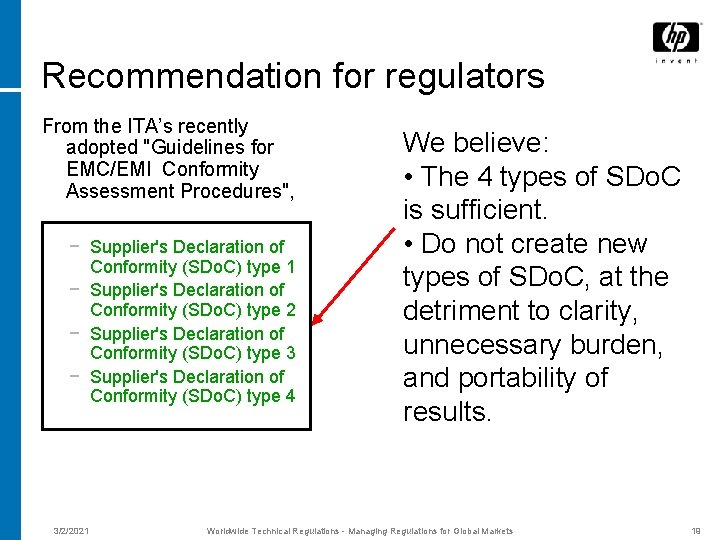
Recommendation for regulators From the ITA’s recently adopted "Guidelines for EMC/EMI Conformity Assessment Procedures", − Supplier's Declaration of Conformity (SDo. C) type 1 − Supplier's Declaration of Conformity (SDo. C) type 2 − Supplier's Declaration of Conformity (SDo. C) type 3 − Supplier's Declaration of Conformity (SDo. C) type 4 3/2/2021 We believe: • The 4 types of SDo. C is sufficient. • Do not create new types of SDo. C, at the detriment to clarity, unnecessary burden, and portability of results. Worldwide Technical Regulations - Managing Regulations for Global Markets 19
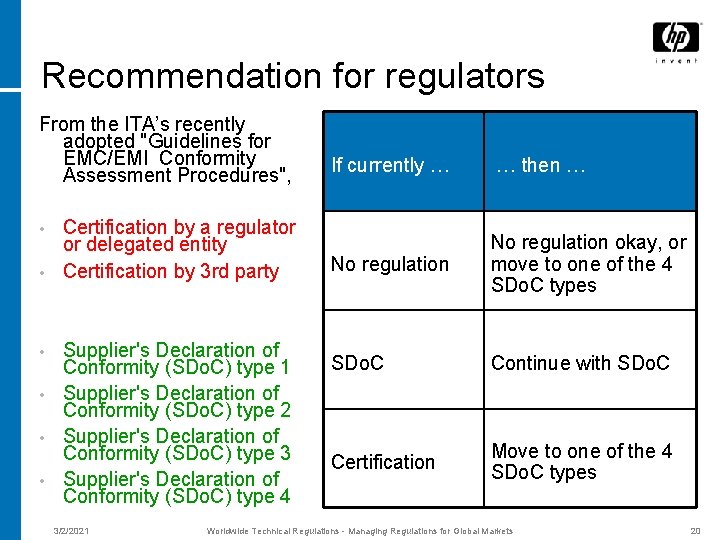
Recommendation for regulators From the ITA’s recently adopted "Guidelines for EMC/EMI Conformity Assessment Procedures", • • • Certification by a regulator or delegated entity Certification by 3 rd party Supplier's Declaration of Conformity (SDo. C) type 1 Supplier's Declaration of Conformity (SDo. C) type 2 Supplier's Declaration of Conformity (SDo. C) type 3 Supplier's Declaration of Conformity (SDo. C) type 4 3/2/2021 If currently … … then … No regulation okay, or move to one of the 4 SDo. C types SDo. C Continue with SDo. C Certification Move to one of the 4 SDo. C types Worldwide Technical Regulations - Managing Regulations for Global Markets 20
Sense of urgency • The necessary standards, private-sector accredited and/or CB test labs, and good regulatory practice know-how exist, and SDo. C is shown to be effective for IT regulations. There is no reason for incurring cost and lost opportunities for countries, manufacturers and citizens. • Doing so would improve an economy’s competitiveness by opening the way for ICT-enabling technology. • Now is the time to garner the political will and momentum to move to SDo. C, especially when new IT regulations are emerging. Or over time, the IT market will be fragmented and locked in by unique conformity assessment requirements. 3/2/2021 Worldwide Technical Regulations - Managing Regulations for Global Markets 21
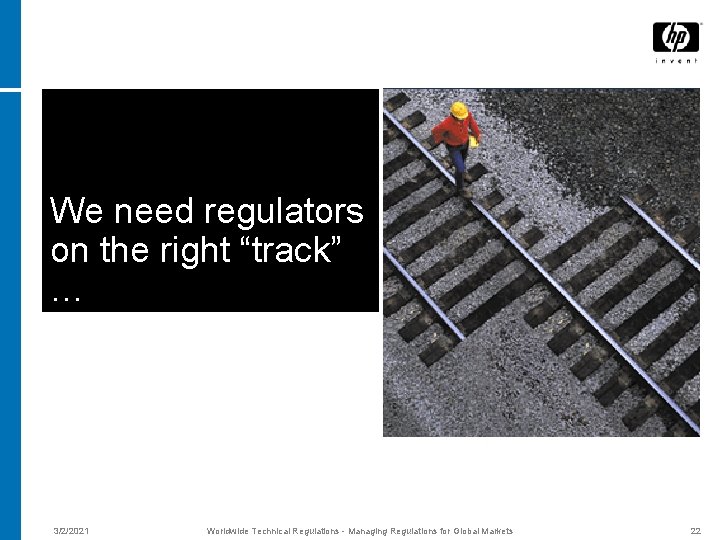
We need regulators on the right “track” … 3/2/2021 Worldwide Technical Regulations - Managing Regulations for Global Markets 22
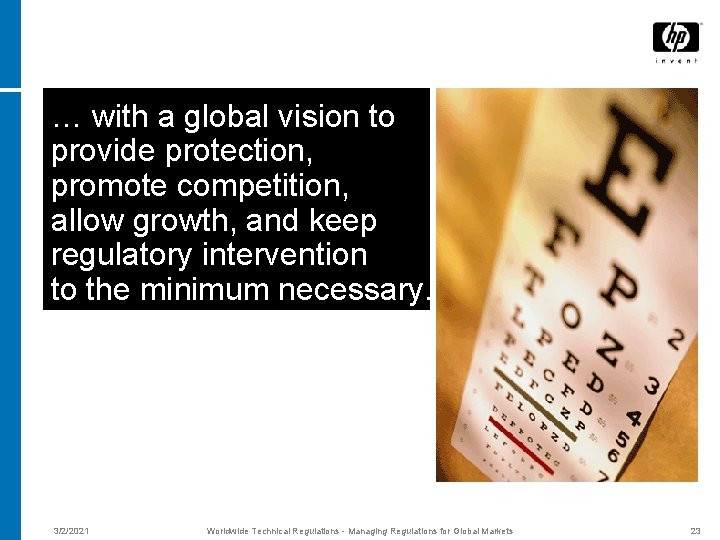
… with a global vision to provide protection, promote competition, allow growth, and keep regulatory intervention to the minimum necessary. 3/2/2021 Worldwide Technical Regulations - Managing Regulations for Global Markets 23
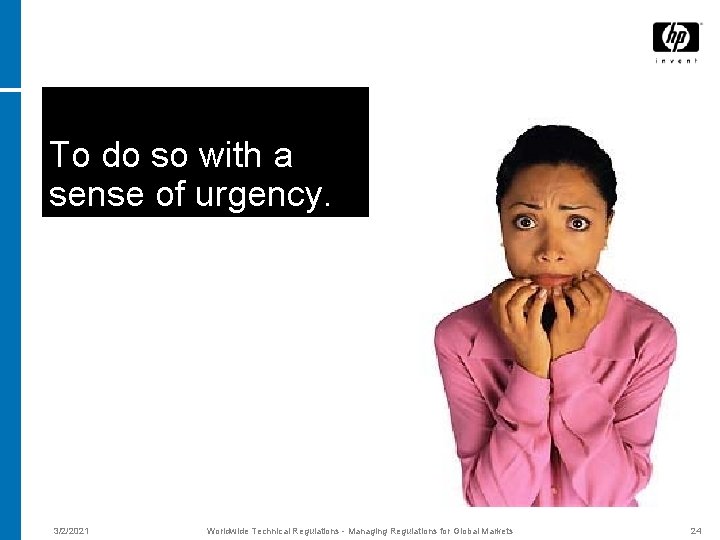
To do so with a sense of urgency. 3/2/2021 Worldwide Technical Regulations - Managing Regulations for Global Markets 24
With input from the private sector. 3/2/2021 Worldwide Technical Regulations - Managing Regulations for Global Markets 25
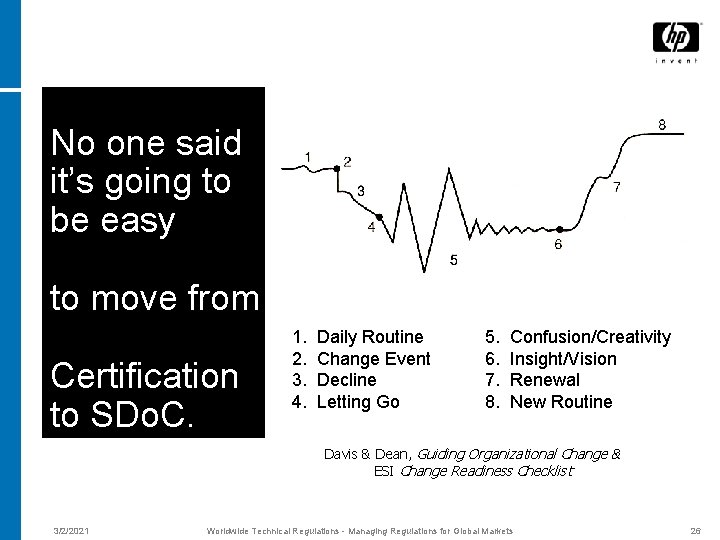
No one said it’s going to be easy to move from Certification to SDo. C. 1. Daily Routine 2. Change Event 3. Decline 4. Letting Go 5. Confusion/Creativity 6. Insight/Vision 7. Renewal 8. New Routine Davis & Dean, Guiding Organizational Change & ESI Change Readiness Checklist 3/2/2021 Worldwide Technical Regulations - Managing Regulations for Global Markets 26
If you can’t take a “GIANT” leap, start small … … with a small step. 3/2/2021 Worldwide Technical Regulations - Managing Regulations for Global Markets 27
… and reduce your risk. 3/2/2021 Worldwide Technical Regulations - Managing Regulations for Global Markets 28
Remember, you have to take a step if you want to keep up. 3/2/2021 Worldwide Technical Regulations - Managing Regulations for Global Markets 29
It’s all about you. 3/2/2021 Worldwide Technical Regulations - Managing Regulations for Global Markets 30
Because if you don’t, who will? 3/2/2021 Worldwide Technical Regulations - Managing Regulations for Global Markets 31
So that together, we can succeed. 3/2/2021 Worldwide Technical Regulations - Managing Regulations for Global Markets 32
Backup • Backup Slides 3/2/2021 Worldwide Technical Regulations - Managing Regulations for Global Markets 33
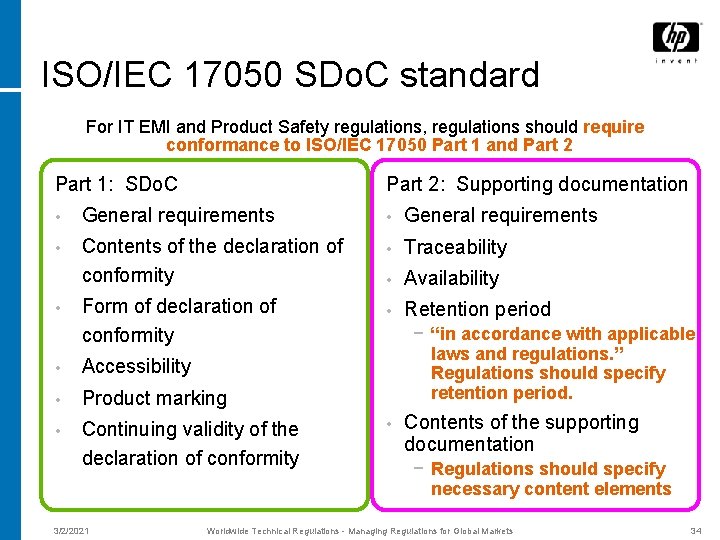
ISO/IEC 17050 SDo. C standard For IT EMI and Product Safety regulations, regulations should require conformance to ISO/IEC 17050 Part 1 and Part 2 Part 1: SDo. C Part 2: Supporting documentation • General requirements • Contents of the declaration of conformity • Traceability • Availability Form of declaration of conformity • Retention period • • Accessibility • Product marking • Continuing validity of the declaration of conformity 3/2/2021 − “in accordance with applicable laws and regulations. ” Regulations should specify retention period. • Contents of the supporting documentation − Regulations should specify necessary content elements Worldwide Technical Regulations - Managing Regulations for Global Markets 34