
Supplementing the Chosen Competitive Strategy Mc GrawHillIrwin Copyright



- Slides: 26
Supplementing the Chosen Competitive Strategy Mc. Graw-Hill/Irwin Copyright © 2008 by The Mc. Graw-Hill Companies, Inc. All rights reserved.
“Successful business strategy is about actively shaping the game you play, not just playing the game you find. ” Adam M. Brandenburger and Barry J. Nalebuff
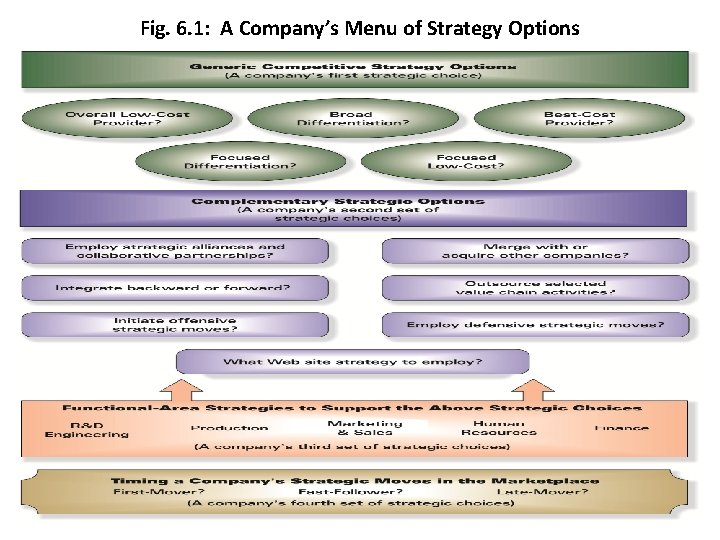
Fig. 6. 1: A Company’s Menu of Strategy Options
Collaborative Strategies: Alliances and Partnerships Companies sometimes use strategic alliances or collaborative partnerships to complement their own strategic initiatives and strengthen their competitiveness.
Characteristics of a Strategic Alliance • Strategic alliance – A formal agreement between two or more separate companies where there is – – – Strategically relevant collaboration of some sort Joint contribution of resources Shared risk Shared control Mutual dependence – – – Joint marketing Joint sales or distribution Joint production Design collaboration Joint research Projects to jointly develop new technologies or products • Alliances often involve
What Factors Make an Alliance Strategic? • It is critical to a company’s achievement of an important objective • It helps build, sustain, or enhance a core competence or competitive advantage • It helps block a competitive threat • It helps open up important market opportunities • It mitigates a significant risk to a company’s business
Merger and Acquisition Strategies • Merger – Combination and pooling of equals, with newly created firm often taking on a new name • Acquisition – One firm, the acquirer, purchases and absorbs operations of another, the acquired • Merger-acquisition strategy – Much-used strategic option – Especially suited for situations where alliances do not provide a firm with needed capabilities or cost-reducing opportunities – Ownership allows for tightly integrated operations, creating more control and autonomy than alliances
Objectives of Mergers and Acquisitions • To create a more cost-efficient operation • To expand a firm’s geographic coverage • To extend a firm’s business into new product categories or international markets • To gain quick access to new technologies or competitive capabilities • To invent a new industry and lead the convergence of industries whose boundaries are blurred by changing technologies and new market opportunities
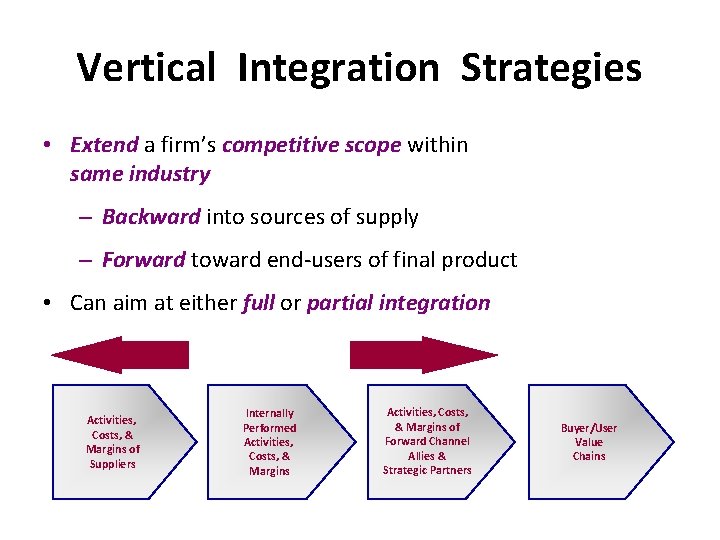
Vertical Integration Strategies • Extend a firm’s competitive scope within same industry – Backward into sources of supply – Forward toward end-users of final product • Can aim at either full or partial integration Activities, Costs, & Margins of Suppliers Internally Performed Activities, Costs, & Margins of Forward Channel Allies & Strategic Partners Buyer/User Value Chains
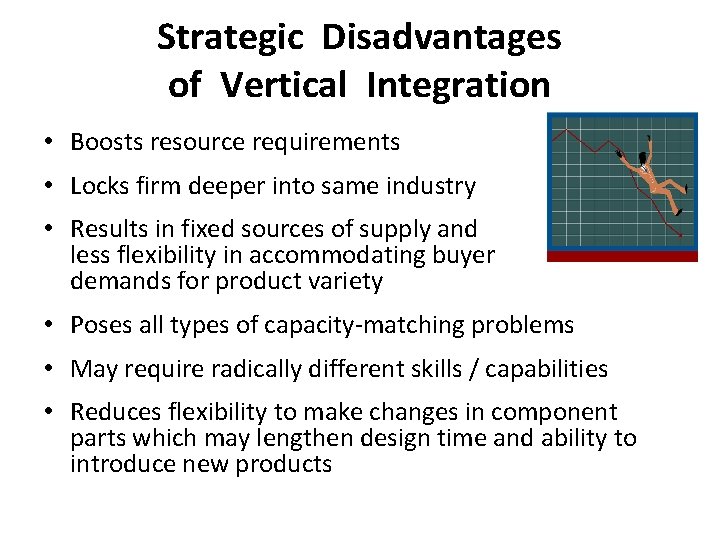
Strategic Disadvantages of Vertical Integration • Boosts resource requirements • Locks firm deeper into same industry • Results in fixed sources of supply and less flexibility in accommodating buyer demands for product variety • Poses all types of capacity-matching problems • May require radically different skills / capabilities • Reduces flexibility to make changes in component parts which may lengthen design time and ability to introduce new products
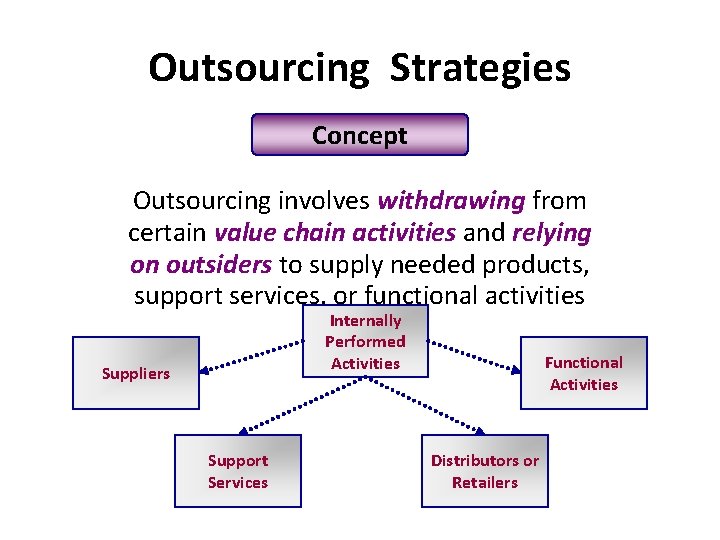
Outsourcing Strategies Concept Outsourcing involves withdrawing from certain value chain activities and relying on outsiders to supply needed products, support services, or functional activities Internally Performed Activities Suppliers Support Services Functional Activities Distributors or Retailers
When Does Outsourcing Make Strategic Sense? • Activity can be performed better or more cheaply by outside specialists • Activity is not crucial to achieve a sustainable competitive advantage • Risk exposure to changing technology and/or changing buyer preferences is reduced • It improves firm’s ability to innovate • Operations are streamlined to – Improve flexibility – Cut time to get new products into the market • It increases firm’s ability to assemble diverse kinds of expertise speedily and efficiently • Firm can concentrate on “core” value chain activities that best suit its resource strengths
Risk of an Outsourcing Strategy • Farming out too many or the wrong activities, thus – Hollowing out capabilities – Losing touch with activities and expertise that determine overall long-term success
Offensive and Defensive Strategies Offensive Strategies Defensive Strategies Used to build new Used to protect competitive or stronger market position advantage (rarely lead to and/or create competitive creating advantage) advantage
Types of Offensive Strategy Options 1. Offer an equally good or better product at a lower price 2. Leapfrog competitors 3. Pursue continuous product innovation 4. Adopt and improve on the good ideas of other companies 5. Deliberately attack market segments where a key rival makes big profits 6. Attack competitive weaknesses of rivals 7. Maneuver around competitors and concentrate on capturing unoccupied or less contested market territory 8. Use hit-and-run or guerrilla warfare tactics 9. Launch a preemptive strike
What Is a Blue Ocean Strategy? • Seeks to gain a dramatic, durable competitive advantage by – Abandoning efforts to beat out competitors in existing markets and – Inventing a new industry or distinctive market segment to render existing competitors largely irrelevant and – Allowing a company to create and capture altogether new demand
Blue Ocean Strategy • Kim & Mauborgne (2005) • Driving forces are increased supply capabilities and reduced demand distinctions • Reconstructionist view of strategy – Shift emphasis from supply to demand – Systemic strategy of driving up value while lowering costs
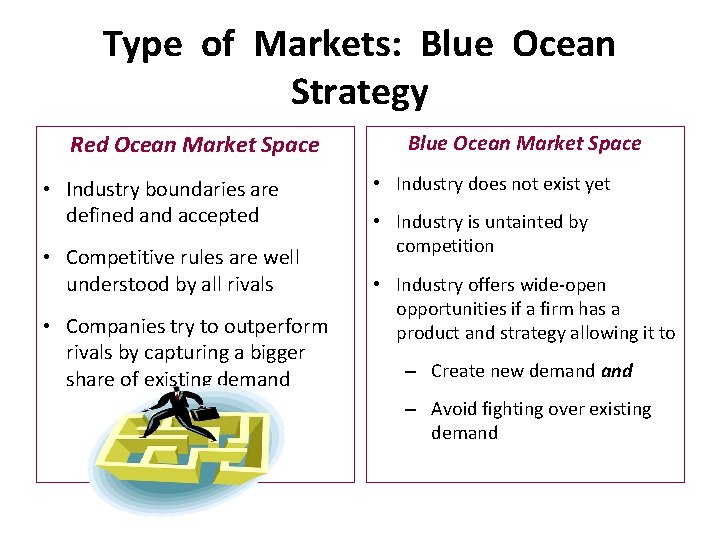
Type of Markets: Blue Ocean Strategy Red Ocean Market Space • Industry boundaries are defined and accepted • Competitive rules are well understood by all rivals • Companies try to outperform rivals by capturing a bigger share of existing demand Blue Ocean Market Space • Industry does not exist yet • Industry is untainted by competition • Industry offers wide-open opportunities if a firm has a product and strategy allowing it to – Create new demand – Avoid fighting over existing demand
US Wine Industry 20 billion, 3 rd largest aggregate consumption 33 rd place in per capita consumption Intense competition 8 top producers account for 75% of production; 1, 600 account for the remaining 25% • Entry of other regions and countries • California wines account for 2/3 rds of sales • Consolidation of retailers • •
Blue Ocean Tools • Strategy canvas • Four actions framework
Blue Ocean Strategy: Four Action Framework 1. Eliminate factors that companies in the industry have long competed on. 2. Determine whether products have been over designed. 3. Eliminate customer compromises. 4. Discover new sources of value.
Casella Wines
Web Site Strategies • Strategic Challenge – What use of the Internet should a company make in staking out its position in the marketplace? • Five Web site approaches – Use to disseminate only product information – Use as minor distribution channel to sell direct to customers – Use as one of several important distribution channels to access customers – Use as primary distribution channel to access buyers – Use as exclusive channel to transact sales with customers
Eat 2 Eat. com