
Supplementary Slides for Software Engineering A Practitioners Approach
- Slides: 10
Supplementary Slides for Software Engineering: A Practitioner's Approach, 5/e copyright © 1996, 2001 R. S. Pressman & Associates, Inc. For University Use Only May be reproduced ONLY for student use at the university level when used in conjunction with Software Engineering: A Practitioner's Approach. Any other reproduction or use is expressly prohibited. This presentation, slides, or hardcopy may NOT be used for short courses, industry seminars, or consulting purposes. These courseware materials are to be used in conjunction with Software Engineering: A Practitioner’s Approach, 5/e and are provided with permission by R. S. Pressman & Associates, Inc. , copyright © 1996, 2001 1
Chapter 25 Formal Methods These courseware materials are to be used in conjunction with Software Engineering: A Practitioner’s Approach, 5/e and are provided with permission by R. S. Pressman & Associates, Inc. , copyright © 1996, 2001 2
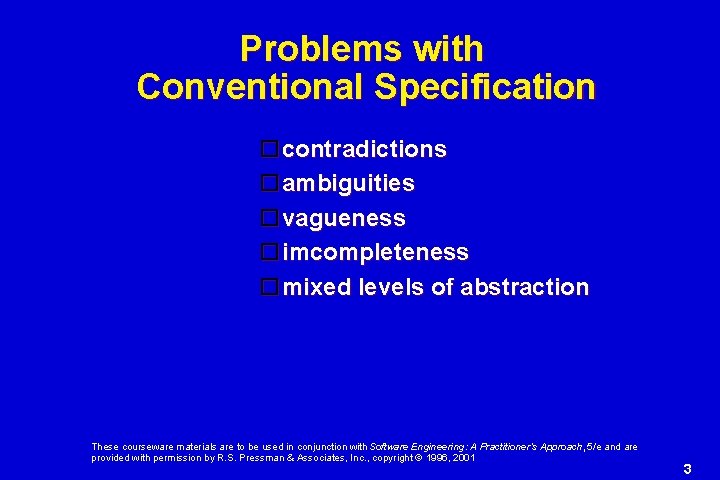
Problems with Conventional Specification contradictions ambiguities vagueness imcompleteness mixed levels of abstraction These courseware materials are to be used in conjunction with Software Engineering: A Practitioner’s Approach, 5/e and are provided with permission by R. S. Pressman & Associates, Inc. , copyright © 1996, 2001 3
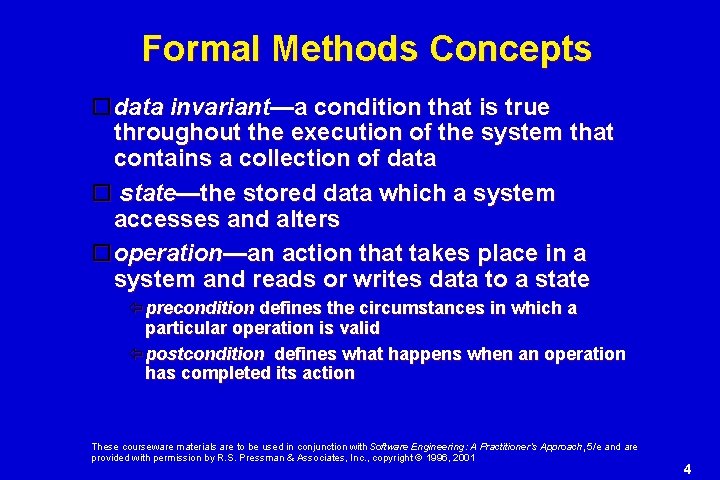
Formal Methods Concepts data invariant—a condition that is true throughout the execution of the system that contains a collection of data state—the stored data which a system accesses and alters operation—an action that takes place in a system and reads or writes data to a state precondition defines the circumstances in which a particular operation is valid postcondition defines what happens when an operation has completed its action These courseware materials are to be used in conjunction with Software Engineering: A Practitioner’s Approach, 5/e and are provided with permission by R. S. Pressman & Associates, Inc. , copyright © 1996, 2001 4
An Example—Print Spooler These courseware materials are to be used in conjunction with Software Engineering: A Practitioner’s Approach, 5/e and are provided with permission by R. S. Pressman & Associates, Inc. , copyright © 1996, 2001 5
States and Data Invariant The state of the spooler is represented by the four components Queues, Output. Devices, Limits, and Sizes. The data invariant has five components: • Each output device is associated with an upper limit of print lines • Each output device is associated with a possibly nonempty queue of files awaiting printing • Each file is associated with a size • Each queue associated with an output device contains files that have a size less than the upper limit of the output device • There will be no more than Max. Devs output devices administered by the spooler These courseware materials are to be used in conjunction with Software Engineering: A Practitioner’s Approach, 5/e and are provided with permission by R. S. Pressman & Associates, Inc. , copyright © 1996, 2001 6
Operations An operation which adds a new output device to the spooler together with its associated print limit An operation which removes a file from the queue associated with a particular output device An operation which adds a file to the queue associated with a particular output device An operation which alters the upper limit of print lines for a particular output device An operation which moves a file from a queue associated with an output device to another queue associated with a second output device These courseware materials are to be used in conjunction with Software Engineering: A Practitioner’s Approach, 5/e and are provided with permission by R. S. Pressman & Associates, Inc. , copyright © 1996, 2001 7
Pre- & Postconditions For the first operation (adds a new output device to the spooler together with its associated print limit): Precondition: the output device name does not already exist and that there are currently less than Max. Devs output devices known to the spooler Postcondition: the name of the new device is added to the collection of existing device names, a new entry is formed for the device with no files being associated with its queue, and the device is associated with its print limit. These courseware materials are to be used in conjunction with Software Engineering: A Practitioner’s Approach, 5/e and are provided with permission by R. S. Pressman & Associates, Inc. , copyright © 1996, 2001 8
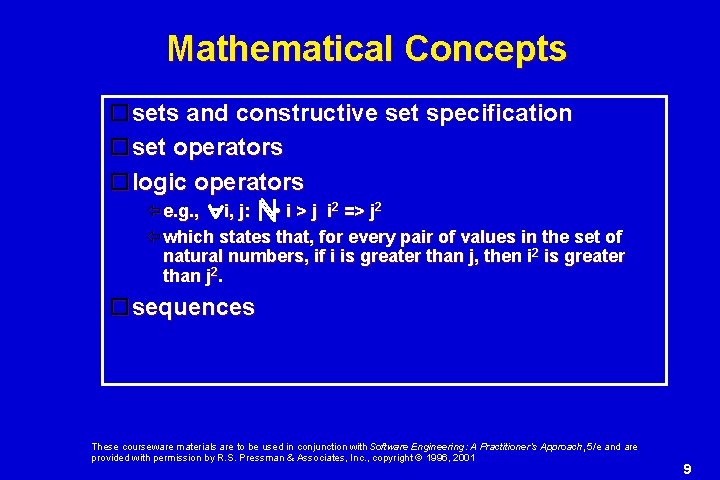
Mathematical Concepts sets and constructive set specification set operators logic operators e. g. , i, j: • i > j i 2 => j 2 which states that, for every pair of values in the set of natural numbers, if i is greater than j, then i 2 is greater than j 2. sequences These courseware materials are to be used in conjunction with Software Engineering: A Practitioner’s Approach, 5/e and are provided with permission by R. S. Pressman & Associates, Inc. , copyright © 1996, 2001 9
The Z Language organized into schemas defines variables establishes relationships between variables the analog for a “module” in conventional languages notation described in Table 25. 1, SEPA, 5/e These courseware materials are to be used in conjunction with Software Engineering: A Practitioner’s Approach, 5/e and are provided with permission by R. S. Pressman & Associates, Inc. , copyright © 1996, 2001 10