
Supplementary Channel for Talkaround Direct Communications Document Number
Supplementary Channel for Talk-around Direct Communications Document Number: IEEE S 802. 16 n-11/0154 Date Submitted: 2011 -09 -20 Source: Jihoon Choi, Young-Ho Jung Korea Aerospace University E-mail: jihoon@kau. ac. kr, yhjung@kau. ac. kr Sungcheol Chang, Seokki Kim, Eunkyung Kim, Miyoung Yun, Won-Ik Kim, Sungkyung Kim, Hyun Lee, Chulsik Yoon, Kwangjae Lim ETRI E-mail: scchang@etri. re. kr Re: Call for comments on the 802. 16 n AWD Base Contribution: IEEE C 802. 16 n-11/0154 Purpose: To be discussed and adopted by 802. 16 TGn Notice: This document does not represent the agreed views of the IEEE 802. 16 Working Group or any of its subgroups. It represents only the views of the participants listed in the “Source(s)” field above. It is offered as a basis for discussion. It is not binding on the contributor(s), who reserve(s) the right to add, amend or withdraw material contained herein. Copyright Policy: The contributor is familiar with the IEEE-SA Copyright Policy <http: //standards. ieee. org/IPR/copyrightpolicy. html>. Patent Policy: The contributor is familiar with the IEEE-SA Patent Policy and Procedures: <http: //standards. ieee. org/guides/bylaws/sect 6 -7. html#6> and <http: //standards. ieee. org/guides/opman/sect 6. html#6. 3>. Further information is located at <http: //standards. ieee. org/board/pat-material. html> and <http: //standards. ieee. org/board/pat >.
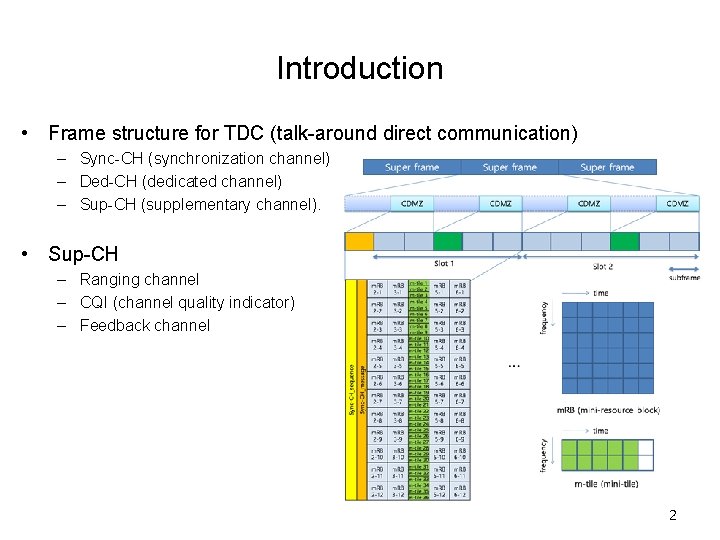
Introduction • Frame structure for TDC (talk-around direct communication) – Sync-CH (synchronization channel) – Ded-CH (dedicated channel) – Sup-CH (supplementary channel). • Sup-CH – Ranging channel – CQI (channel quality indicator) – Feedback channel 2
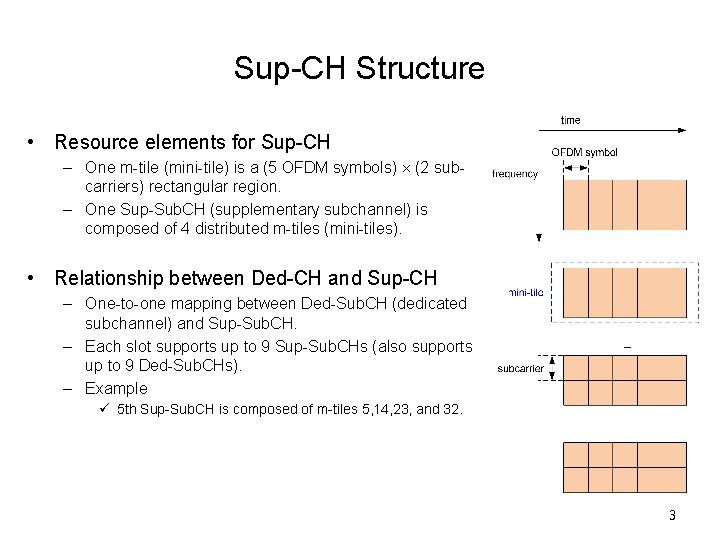
Sup-CH Structure • Resource elements for Sup-CH – One m-tile (mini-tile) is a (5 OFDM symbols) (2 subcarriers) rectangular region. – One Sup-Sub. CH (supplementary subchannel) is composed of 4 distributed m-tiles (mini-tiles). • Relationship between Ded-CH and Sup-CH – One-to-one mapping between Ded-Sub. CH (dedicated subchannel) and Sup-Sub. CH. – Each slot supports up to 9 Sup-Sub. CHs (also supports up to 9 Ded-Sub. CHs). – Example ü 5 th Sup-Sub. CH is composed of m-tiles 5, 14, 23, and 32. 3

Ranging Channel Structure • Ranging channel – Estimation of time offset, frequency offset, SINR (signal to interference plus noise ratio), etc. – Periodically transmitted, where the starting slot number and the period are determined during link initialization. • Sequence allocation for ranging channel – The ranging sequence is defined by a binary code with length 8, given by [S 0 S 1 S 2 S 3 S 4 S 5 S 6 S 7] = [1, -1, 1, 1, -1] – The same sequence is repeatedly transmitted for 5 OFDM symbols. 4
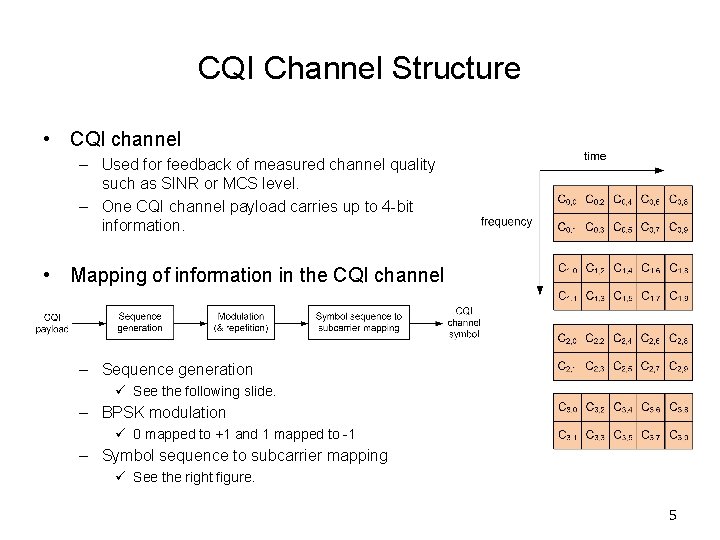
CQI Channel Structure • CQI channel – Used for feedback of measured channel quality such as SINR or MCS level. – One CQI channel payload carries up to 4 -bit information. • Mapping of information in the CQI channel – Sequence generation ü See the following slide. – BPSK modulation ü 0 mapped to +1 and 1 mapped to -1 – Symbol sequence to subcarrier mapping ü See the right figure. 5
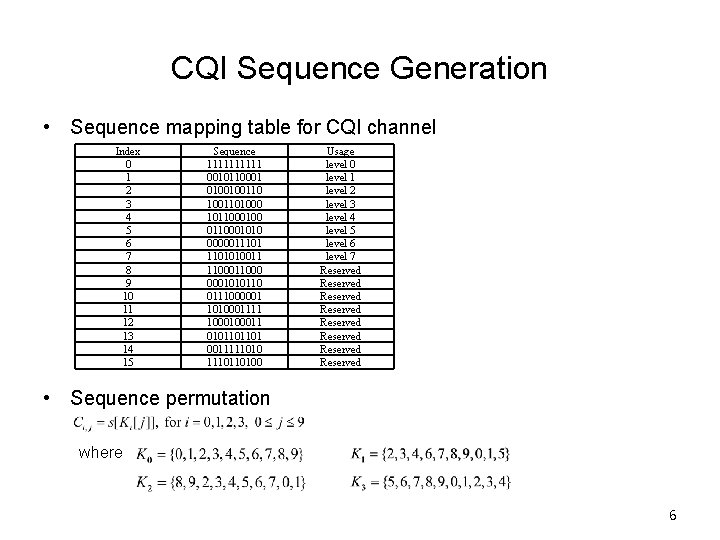
CQI Sequence Generation • Sequence mapping table for CQI channel Index 0 1 2 3 4 5 6 7 8 9 10 11 12 13 14 15 Sequence 11111 0010110001 01001001101000 1011000100 0110001010 0000011101010011 11000 0001010110 0111000001 1010001111 100011 0101101101 0011111010 1110110100 Usage level 0 level 1 level 2 level 3 level 4 level 5 level 6 level 7 Reserved Reserved • Sequence permutation where 6
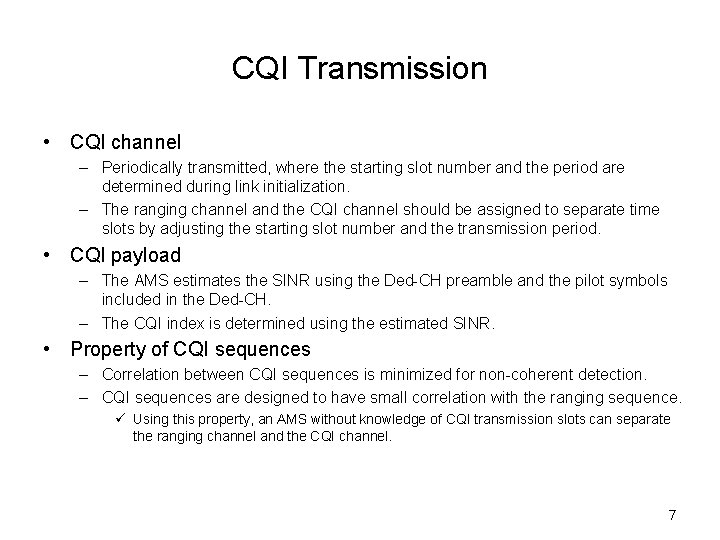
CQI Transmission • CQI channel – Periodically transmitted, where the starting slot number and the period are determined during link initialization. – The ranging channel and the CQI channel should be assigned to separate time slots by adjusting the starting slot number and the transmission period. • CQI payload – The AMS estimates the SINR using the Ded-CH preamble and the pilot symbols included in the Ded-CH. – The CQI index is determined using the estimated SINR. • Property of CQI sequences – Correlation between CQI sequences is minimized for non-coherent detection. – CQI sequences are designed to have small correlation with the ranging sequence. ü Using this property, an AMS without knowledge of CQI transmission slots can separate the ranging channel and the CQI channel. 7
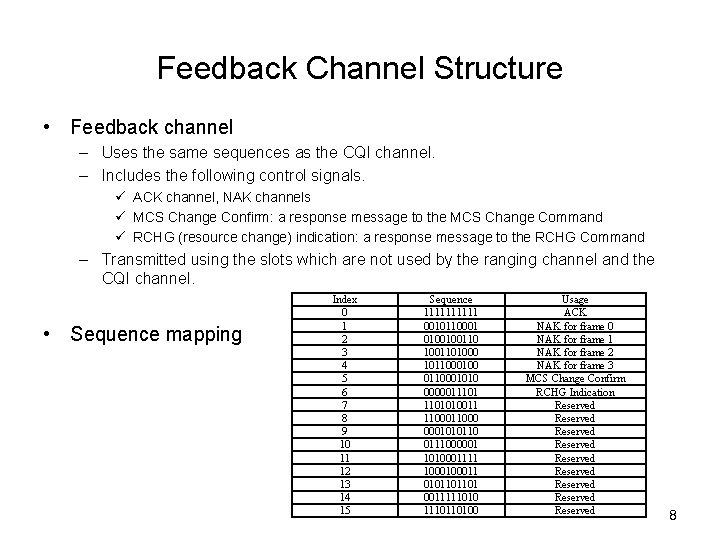
Feedback Channel Structure • Feedback channel – Uses the same sequences as the CQI channel. – Includes the following control signals. ü ACK channel, NAK channels ü MCS Change Confirm: a response message to the MCS Change Command ü RCHG (resource change) indication: a response message to the RCHG Command – Transmitted using the slots which are not used by the ranging channel and the CQI channel. • Sequence mapping Index 0 1 2 3 4 5 6 7 8 9 10 11 12 13 14 15 Sequence 11111 0010110001 01001001101000 1011000100 0110001010 0000011101010011 11000 0001010110 0111000001 1010001111 100011 0101101101 0011111010 1110110100 Usage ACK NAK for frame 0 NAK for frame 1 NAK for frame 2 NAK for frame 3 MCS Change Confirm RCHG Indication Reserved Reserved Reserved 8
Simulation Results 9
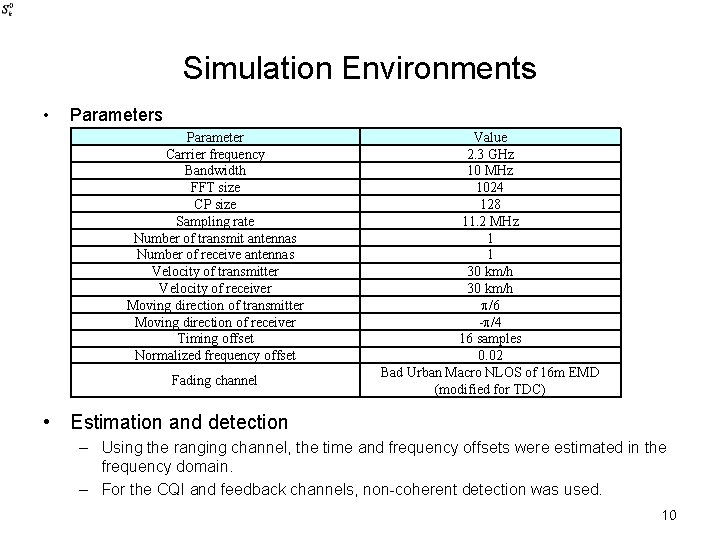
Simulation Environments • Parameters Parameter Carrier frequency Bandwidth FFT size CP size Sampling rate Number of transmit antennas Number of receive antennas Velocity of transmitter Velocity of receiver Moving direction of transmitter Moving direction of receiver Timing offset Normalized frequency offset Fading channel Value 2. 3 GHz 10 MHz 1024 128 11. 2 MHz 1 1 30 km/h /6 - /4 16 samples 0. 02 Bad Urban Macro NLOS of 16 m EMD (modified for TDC) • Estimation and detection – Using the ranging channel, the time and frequency offsets were estimated in the frequency domain. – For the CQI and feedback channels, non-coherent detection was used. 10
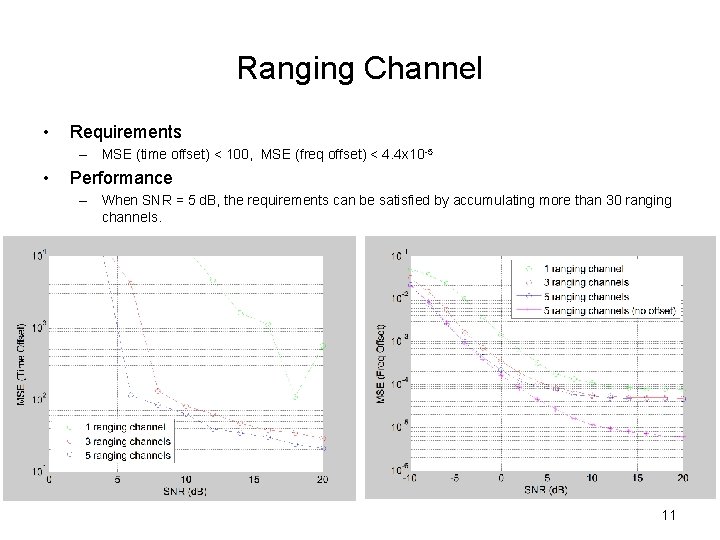
Ranging Channel • Requirements – MSE (time offset) < 100, MSE (freq offset) < 4. 4 x 10 -5 • Performance – When SNR = 5 d. B, the requirements can be satisfied by accumulating more than 30 ranging channels. 11
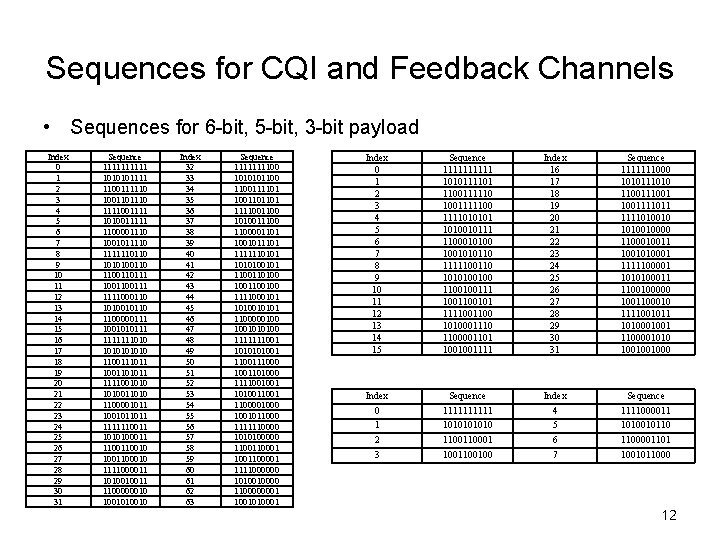
Sequences for CQI and Feedback Channels • Sequences for 6 -bit, 5 -bit, 3 -bit payload Index 0 1 2 3 4 5 6 7 8 9 10 11 12 13 14 15 16 17 18 19 20 21 22 23 24 25 26 27 28 29 30 31 Sequence 11111 1010101111 1100111110 1001101110 1111001111 1010011111 1100001110 1001011110 1111110110 1010100110 1100110111 100111 1111000110 1010010110 1100000111 1001010111 111111101010 1100111011 1001101011 1111001010011010 1100001011 1001011011 1111110011 1010100011 110010 1001100010 1111000011 1010010011 1100000010 10010 Index 32 33 34 35 36 37 38 39 40 41 42 43 44 45 46 47 48 49 50 51 52 53 54 55 56 57 58 59 60 61 62 63 Sequence 111100 1010101100111101 1001101101 111100 1010011100001101 1001011101 111111010100101 1100110100 100100 1111000101 1010010101 1100000100 1001010100 1111111001 101001 1100111000 1001101000 1111001001 101001 1100001000 1001011000 1111110000 1010100000 110001 1001100001 1111000000 1010010000 1100000001 1001010001 Index 0 1 2 3 4 5 6 7 8 9 10 11 12 13 14 15 Sequence 11111 1010111101 11001111100 1111010101 1010010111 1100010100 1001010110 1111100110 1010100100 1100100111 100101 111100 1010001110 1100001101 1001001111 Index 16 17 18 19 20 21 22 23 24 25 26 27 28 29 30 31 Sequence 1111111000 1010111010 11001111011 1111010010000 1100010011 1001010001 1111100001 1010100011 1100100000 1001100010 1111001011 101001 1100001010 1001001000 Index 0 1 2 3 Sequence 11111 101010 110001 100100 Index 4 5 6 7 Sequence 1111000011 1010010110 1100001101 1001011000 12
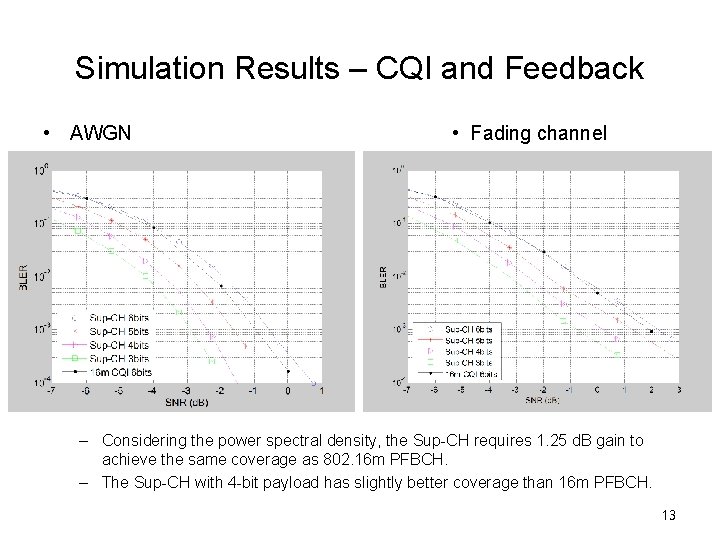
Simulation Results – CQI and Feedback • AWGN • Fading channel – Considering the power spectral density, the Sup-CH requires 1. 25 d. B gain to achieve the same coverage as 802. 16 m PFBCH. – The Sup-CH with 4 -bit payload has slightly better coverage than 16 m PFBCH. 13
Conclusion • Ranging channel – Only 8 subcarriers are used for the channel in TDC, while 72 subcarriers are used for the ranging channel in 802. 16 m. – The ranging period needs to be shortened. ü For example, when the ranging period is 100 ms, the adjustment of time and frequency requires about 3 sec. • CQI and feedback channel – When the 4 -bit payload is used, the CQI and feedback channels for TDC perform comparable to 802. 16 m PFBCH. • Note – The performance can be improved by ü Using more transmit and receive antennas ü Employing more elegant estimation algorithms or detection schemes. 14
- Slides: 14