
Supplemental testing methods Screening agar Agar contains known


- Slides: 21
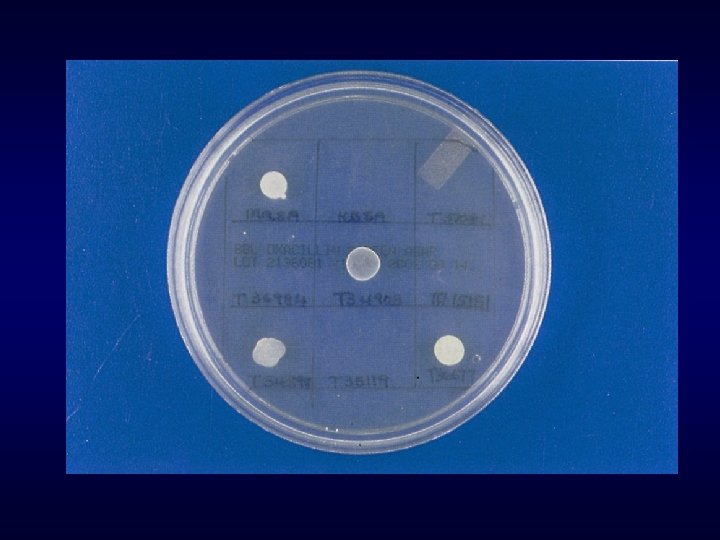
Supplemental testing methods Screening agar Agar contains known conc. of antibiotic Growth on agar indicates resistance Oxacillin screening agar: 6 g/ml oxacillin Screening of staphylococci Vancomycin screening agar: 6 g/ml vanco Screening of enterococci and staphylococci
Supplemental testing methods Predictor drugs Staphylococci R to Oxacillin = R to penicillins, cephalosporins, and imipenem High level gentimicin R in enterococci = R to all currently available aminoglycosides Ampicillin R in enterococci = R to all penicillin derivatives and imipenem
Direct detection of resistance mechanisms Beta-lactamase (phenotypic) Chromogenic substrate incorporated into disk - color change in presence of enzyme Usefulness is limited: Penicillin R in Neisseria gonorrhea Ampicillin R in Haemophilus influenzae Penicillin R in anaerobes
Direct detection of resistance mechanisms Extended spectrum beta-lactamase Mutations in plasmid-encoded beta-lactamases - hydrolyze extended spectrum cephalosporins and aztreonam - more than 100 types have been identified - isolates are often resistant to other classes Interpretive criteria available for: - E. coli, K. pneumoniae, K. oxytoca, P. mirabilis
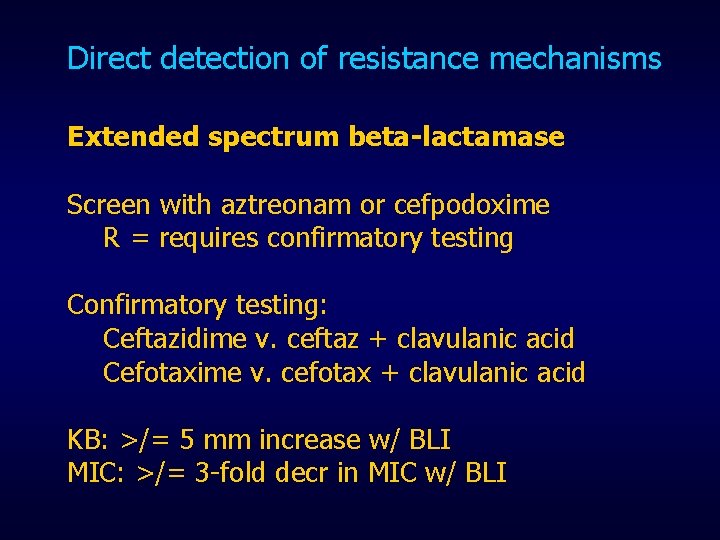
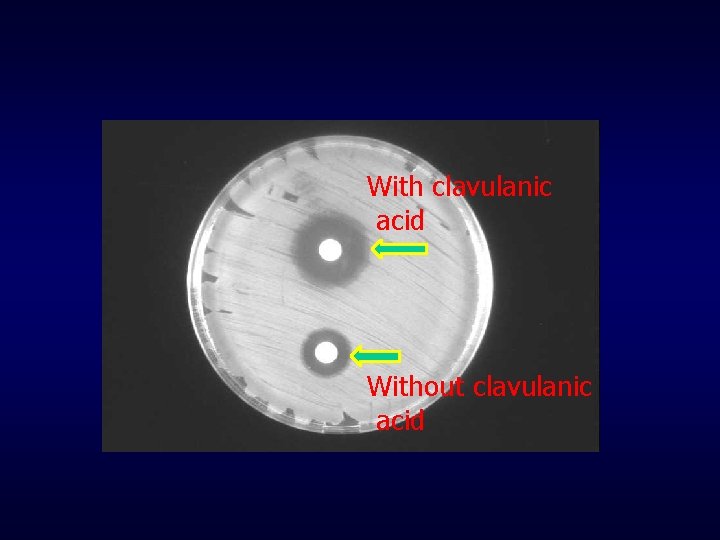
Direct detection of resistance mechanisms Extended spectrum beta-lactamase Screen with aztreonam or cefpodoxime R = requires confirmatory testing Confirmatory testing: Ceftazidime v. ceftaz + clavulanic acid Cefotaxime v. cefotax + clavulanic acid KB: >/= 5 mm increase w/ BLI MIC: >/= 3 -fold decr in MIC w/ BLI
With clavulanic acid Without clavulanic acid
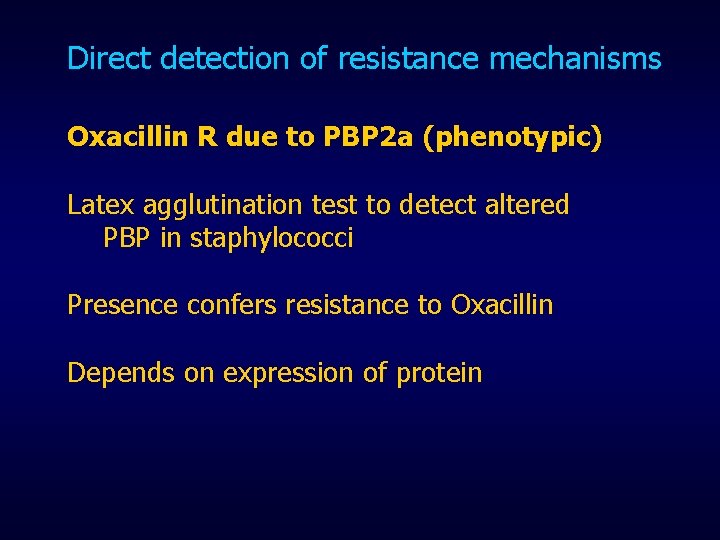
Direct detection of resistance mechanisms Oxacillin R due to PBP 2 a (phenotypic) Latex agglutination test to detect altered PBP in staphylococci Presence confers resistance to Oxacillin Depends on expression of protein
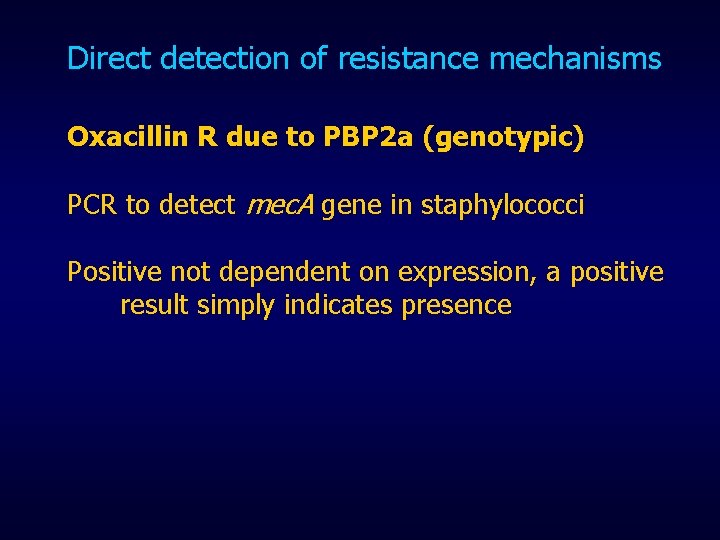
Direct detection of resistance mechanisms Oxacillin R due to PBP 2 a (genotypic) PCR to detect mec. A gene in staphylococci Positive not dependent on expression, a positive result simply indicates presence
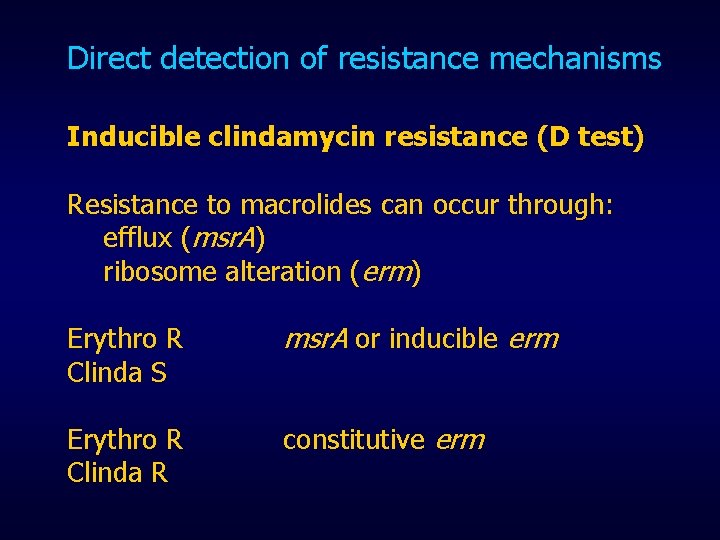
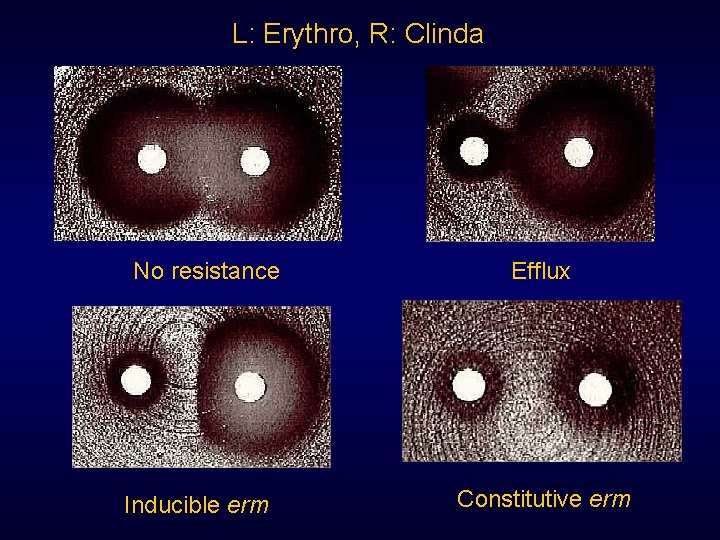
Direct detection of resistance mechanisms Inducible clindamycin resistance (D test) Resistance to macrolides can occur through: efflux (msr. A) ribosome alteration (erm) Erythro R Clinda S msr. A or inducible erm Erythro R Clinda R constitutive erm
L: Erythro, R: Clinda No resistance Inducible erm Efflux Constitutive erm
Laboratory strategies for testing Goals of effective strategies include: Relevance Accuracy Communication
Laboratory strategies for testing Criteria used for assessing relevance: Clinical significance of isolate Predictability of susceptibility against drugs of choice Availability of reliable standardized methods Selection of appropriate agents
Laboratory strategies for testing Clinical significance Abundance in direct smear Ability to cause disease in that body site Colonizer or pathogen? Body site of isolation
Laboratory strategies for testing Predictability of susceptibility Testing not required when susceptibility is predictable Pen S in beta-hemolytic streptococci Ceph S in GC Clinical requirements can result in exceptions
Laboratory strategies for testing Availability of standardized methods Testing cannot be performed if standardized method does not exist Method and interpretive guidelines required – CLSI guide Info available for most pathogenic bacteria Fungi, Nocardia, AFB (Mycobacterium)
Laboratory strategies for testing Selection of agents Previously discussed criteria: Organism ID or group Acquired resistance patterns Testing method used Site of infection Formulary
Laboratory strategies for testing Communication Prompt and thorough review of results Prompt resolution of unusual results Augment susceptibility reports with messages that help clarify and explain potential therapeutic problems not necessarily evident by data alone
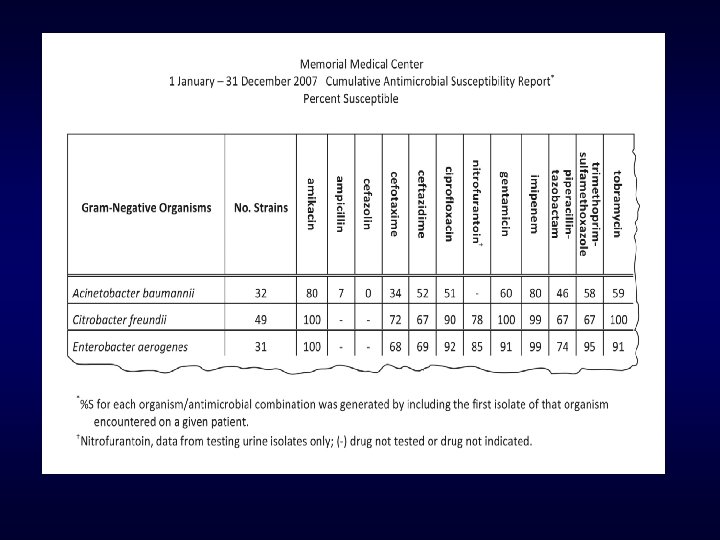
Antibiograms: The hospital antibiogram is a periodic summary of antimicrobial susceptibilities of local bacterial isolates submitted to the hospital's clinical microbiology laboratory. Antibiograms are often used by clinicians to assess local susceptibility rates, as an aid in selecting empiric antibiotic therapy, and in monitoring resistance trends over time within an institution.
Antibiograms: Antibiograms can also used to compare susceptibility rates across institutions and track resistance trends. These trends can then be used to develop the appropriate formulary for the hospital.