
Supplemental Power Point Slides Paraspinal muscle spindle response
- Slides: 4
Supplemental Power. Point Slides Paraspinal muscle spindle response to intervertebral fixation and segmental thrust level during spinal manipulation in an animal model William R. Reed DC, Ph. D 1* and Joel G. Pickar DC, Ph. D 1 1 – Palmer Center for Chiropractic Research, Palmer College of Chiropractic Davenport, IA, 52803, USA *william. reed@palmer. edu Copyright © 2015 Lippincott Williams & Wilkins. Unauthorized commercial reproduction of this slide is prohibited
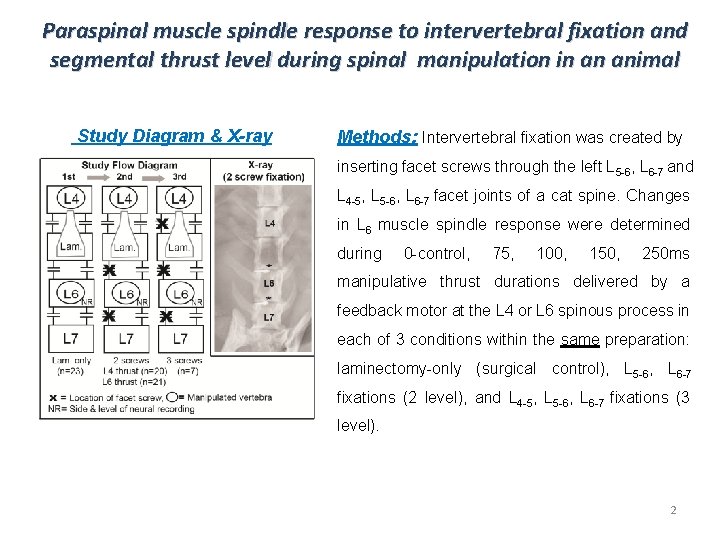
Paraspinal muscle spindle response to intervertebral fixation and segmental thrust level during spinal manipulation in an animal Study Diagram & X-ray Methods: Intervertebral fixation was created by inserting facet screws through the left L 5 -6, L 6 -7 and L 4 -5, L 5 -6, L 6 -7 facet joints of a cat spine. Changes in L 6 muscle spindle response were determined during 0 -control, 75, 100, 150, 250 ms manipulative thrust durations delivered by a feedback motor at the L 4 or L 6 spinous process in each of 3 conditions within the same preparation: laminectomy-only (surgical control), L 5 -6, L 6 -7 fixations (2 level), and L 4 -5, L 5 -6, L 6 -7 fixations (3 level). 2
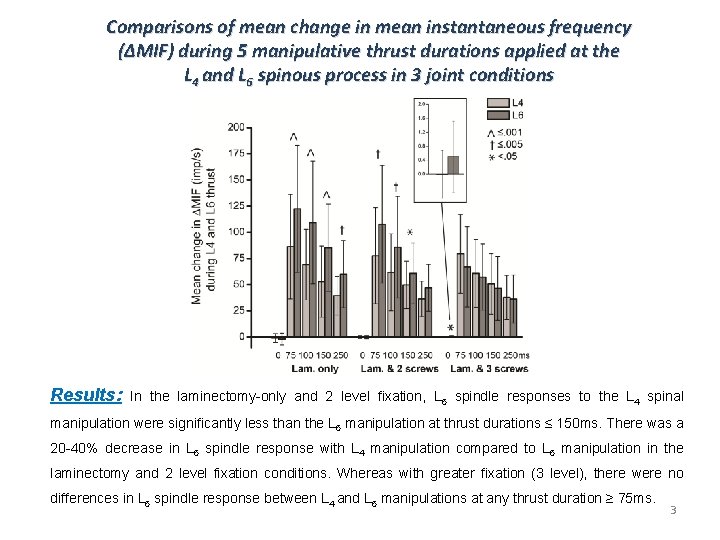
Comparisons of mean change in mean instantaneous frequency (ΔMIF) during 5 manipulative thrust durations applied at the L 4 and L 6 spinous process in 3 joint conditions Results: In the laminectomy-only and 2 level fixation, L 6 spindle responses to the L 4 spinal manipulation were significantly less than the L 6 manipulation at thrust durations ≤ 150 ms. There was a 20 -40% decrease in L 6 spindle response with L 4 manipulation compared to L 6 manipulation in the laminectomy and 2 level fixation conditions. Whereas with greater fixation (3 level), there were no differences in L 6 spindle response between L 4 and L 6 manipulations at any thrust duration ≥ 75 ms. 3
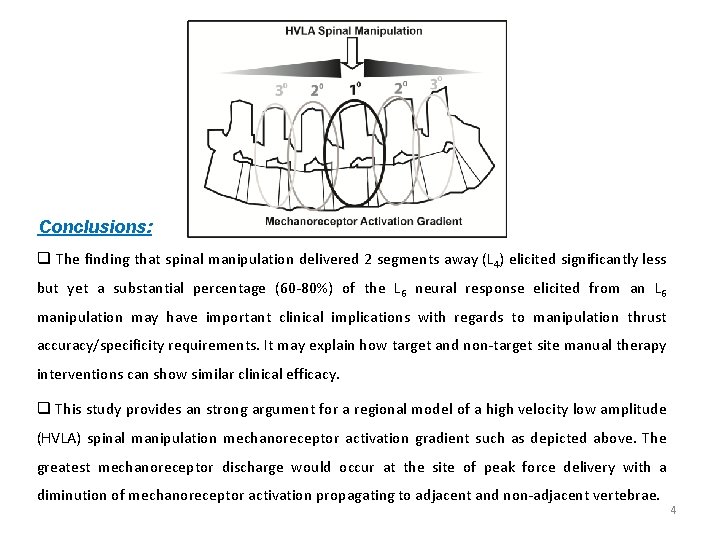
Conclusions: q The finding that spinal manipulation delivered 2 segments away (L 4) elicited significantly less but yet a substantial percentage (60 -80%) of the L 6 neural response elicited from an L 6 manipulation may have important clinical implications with regards to manipulation thrust accuracy/specificity requirements. It may explain how target and non-target site manual therapy interventions can show similar clinical efficacy. q This study provides an strong argument for a regional model of a high velocity low amplitude (HVLA) spinal manipulation mechanoreceptor activation gradient such as depicted above. The greatest mechanoreceptor discharge would occur at the site of peak force delivery with a diminution of mechanoreceptor activation propagating to adjacent and non-adjacent vertebrae. 4