
Supplemental Jursidiction Brian Ehrenberg Email brian ehrenbergjrgmail com
Supplemental Jursidiction Brian Ehrenberg Email: brian. ehrenbergjr@gmail. com Phone: 432 -557 -6774
Intro • Supplemental jurisdiction is a way for federal courts to get subject matter jurisdiction over state law claims. • Things to remember about Supplemental Jurisdiction: • To use Supplemental jurisdiction the parties must have already brought in a claim that invokes proper federal subject matter jurisdiction. • Diversity • Federal Question

How to use Supplemental Jurisdiction • First you figure out what are all the claims. • Second, you find out which claim has proper Federal SMJ. • Look at Diversity or Federal Question • Third, you see if the other claims come out of a common nucleus of operative facts as the claim with Fed SMJ. • Note: this type of jurisdiction is at the courts discretion
Common nucleus of operative fact • The basic question to ask yourself to determine if two claims came out of a common nucleus of operative facts is: “Would the court use the same facts to decide the claims? ” • The claims do not need to be identical. • Only the key facts need to be the same. • Key facts are facts of a case that decides the case • Example: “ A is being charged with attempted murder of B. The fact that A never intended to kill B would be a key fact because it establishes lack of intent and intent is an element of attempt. Thus, if that fact was different, the case would go the other way. ”
Supplemental with Diversity Jursidiction • Applies the same test, but there is another step. • The claim cannot destroy complete diversity. • P must always be from a different state than D. • Cross claims between Ds do not effect complete diversity.
Example • J, from Colorado, hires P, from Wyoming, to do some planting in his yard. P hires V, a Utah citizen, to come and dig the necessary holes for the plantings. P and V do the work and leave, but the new shrubs die, and J claims that V ran over his underground sprinkler, ruining it. J sues p and v in fedral court, based on diversity jurisdiction, for $90, 000 in damages based on the faulty yard work. After the suit is filed, P asserts a claim for contribution against V, for half the damages J may recover, on the ground that he was negligent for causing the damage and P asserts another claim for $5, 000 in damages that resulted when V hit his car.
Example Cont. • The Court would have jurisdiction over P’s contribution claim. • Both the claims would use the same key facts • That V was negligent in causing the damage to the plants • The court would NOT have supplement jurisdiction over P’s other tort. • The facts here do not involve any of the same facts let alone the key facts.

Tips for Comp • Review you past slides • Do at least ten questions a week for each subject • Make sure to time yourself (2 mins a question) • Go over every answer and see why the right answer is right • If you have a subject you are struggling in reach out to someone. • I will be happy to answer any question over any subject. • Help out your section mates. • Remember the comp decides how many A’s each section gets. So if you all do well there will be more A’s to share.
Quiz • 5 Questions • 2 Mins per Question(10 mins)
Question 1 • A • The defendant corporation’s motion will be granted. A corporation is deemed to be a citizen of every state in which it is incorporated and the one state in which it has its Principle place of business. To have Diversity all Ps must be citizens of different states then the states of the Ds. And the Amount in Controversy must be over $75, 000.
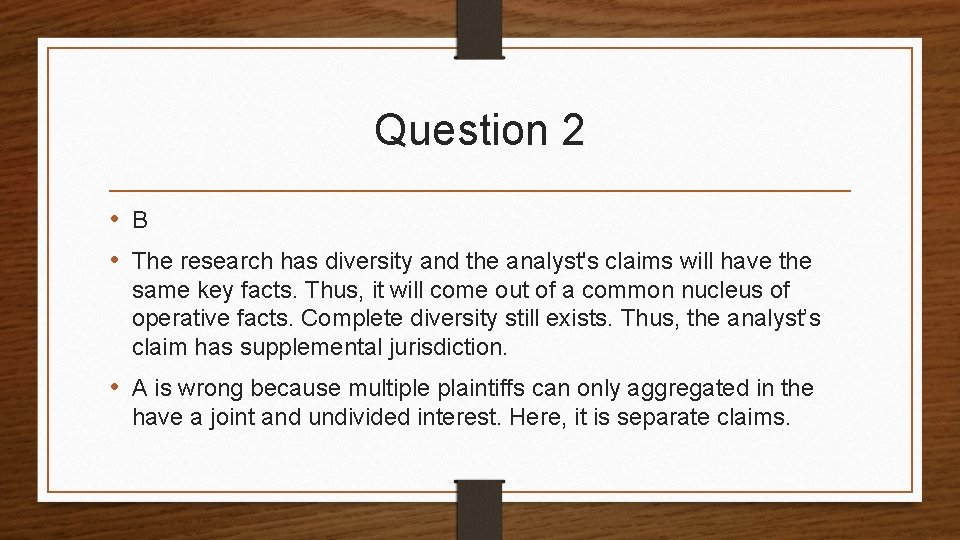
Question 2 • B • The research has diversity and the analyst's claims will have the same key facts. Thus, it will come out of a common nucleus of operative facts. Complete diversity still exists. Thus, the analyst’s claim has supplemental jurisdiction. • A is wrong because multiple plaintiffs can only aggregated in the have a joint and undivided interest. Here, it is separate claims.
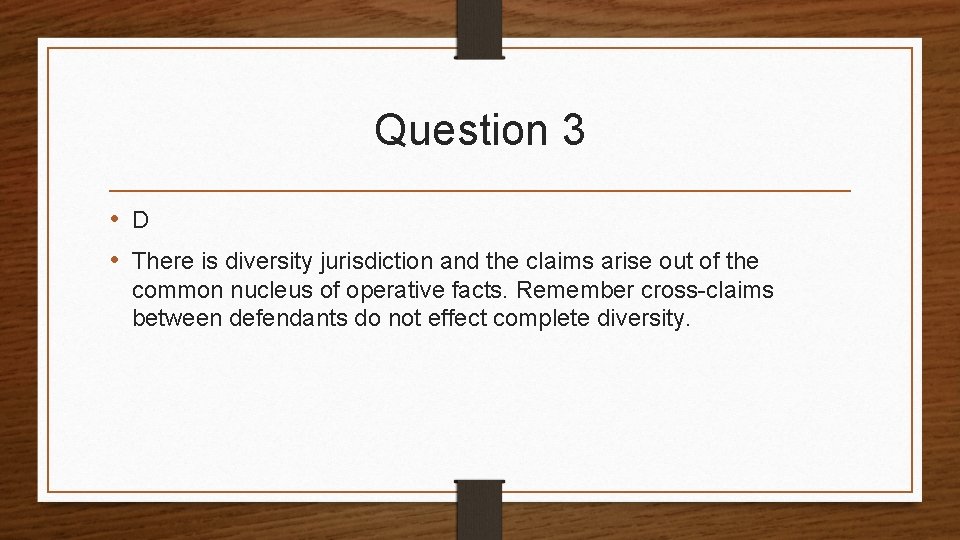
Question 3 • D • There is diversity jurisdiction and the claims arise out of the common nucleus of operative facts. Remember cross-claims between defendants do not effect complete diversity.
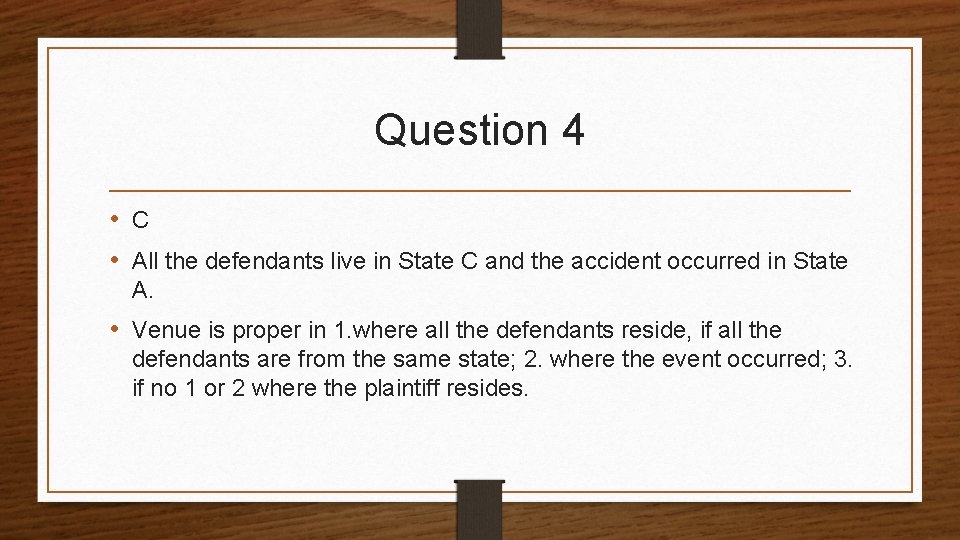
Question 4 • C • All the defendants live in State C and the accident occurred in State A. • Venue is proper in 1. where all the defendants reside, if all the defendants are from the same state; 2. where the event occurred; 3. if no 1 or 2 where the plaintiff resides.
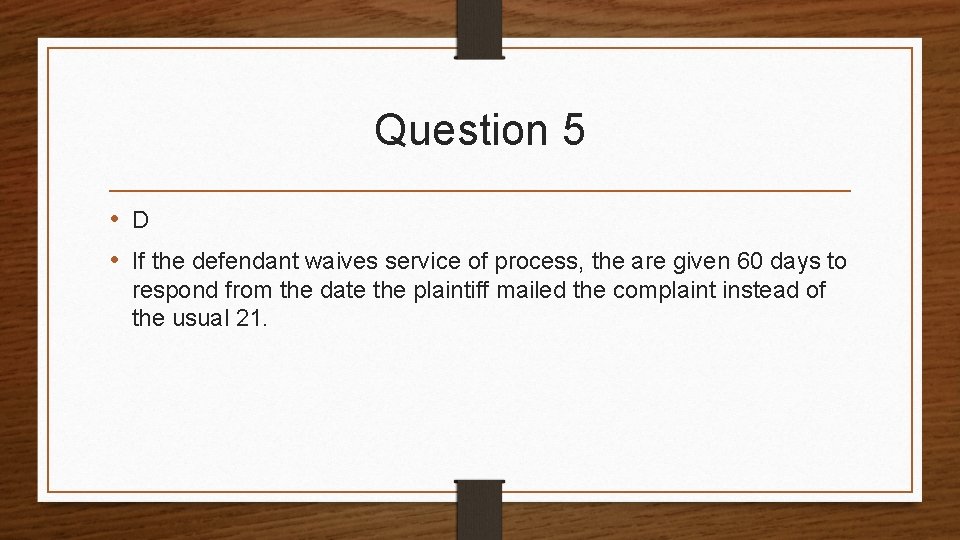
Question 5 • D • If the defendant waives service of process, the are given 60 days to respond from the date the plaintiff mailed the complaint instead of the usual 21.
- Slides: 14