
Superwoman Schema Implications for Physical and Mental WellBeing
Superwoman Schema: Implications for Physical and Mental Well-Being in African American Women Cheryl L. Woods-Giscombé, Ph. D, RN Postdoctoral Fellow, SAMHSA-ANA MFP The University of North Carolina at Chapel Hill, School of Nursing 3/10/2021 Woods-Giscombe, 2008 1
Thank you for your interest in this research! • The following slides have been selected from Dr. Cheryl Woods-Giscombé’s paper presentation at the 2008 National Black Nurses Association Annual Conference held in Las Vegas, Nevada. • Specific study results and participant quotations have been removed, but will be included in a paper that will soon be published to illuminate a more comprehensive version of this research. • Please contact Dr. Cheryl Woods-Giscombé if you would like more specific information about this study or its findings at Cheryl. Giscombe@unc. edu or 919 -966 -0455. • If you would like to cite material from the presentation, please use the following reference: Woods-Giscombé, C. L. (2008, August). Superwoman schema and emotional suppression: Implications for physical and mental well-being of African American women. Paper presented at the National Black Nurses Association Annual Conference, Las Vegas, Nevada. 3/10/2021 Woods-Giscombe, 2008 2
The Problem According to the US Department of Health and Human Services, African American women experience disparate morbidity and mortality related to various stress-related health conditions, including: n n Adverse birth outcomes (Giscombé & Lobel, 2005) Cardiovascular disease (Krieger, 1990) Obesity (Walcott-Mc. Quigg, 1995) Lupus (Bricou et al. , 2006) 3/10/2021 Woods-Giscombe, 2008 3
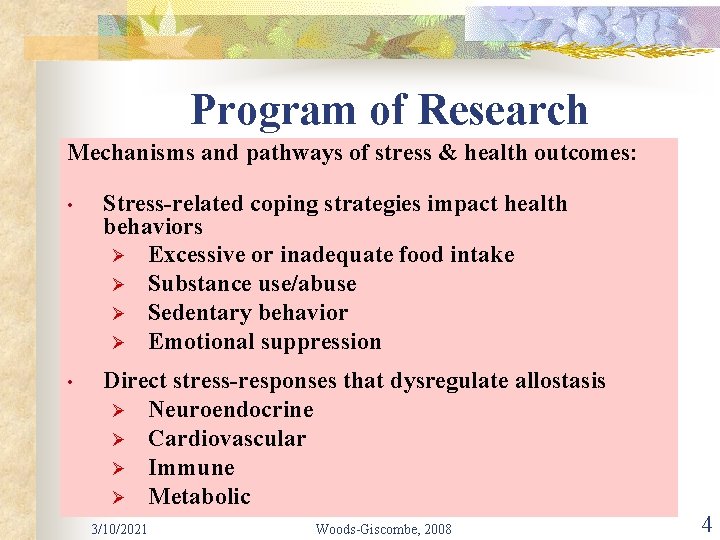
Program of Research Mechanisms and pathways of stress & health outcomes: • Stress-related coping strategies impact health behaviors Ø Excessive or inadequate food intake Ø Substance use/abuse Ø Sedentary behavior Ø Emotional suppression • Direct stress-responses that dysregulate allostasis Ø Neuroendocrine Ø Cardiovascular Ø Immune Ø Metabolic 3/10/2021 Woods-Giscombe, 2008 4
The Problem In order to effectively study the influence of stress on health in African American women … 3/10/2021 Woods-Giscombe, 2008 5
The Problem …we must use culturally-relevant definitions and operationalizations of stress (Woods-Giscombé & Lobel, 2008) 3/10/2021 Woods-Giscombe, 2008 6
Program of Research • Focuses on social determinants of health. • Examines the contributions of psychological distress (stress, anxiety, depressive symptoms) and coping to existing health disparities using both sociohistorical, cultural and biopsychosocial perspectives. • Focuses on developing culturally- and gender-relevant conceptualizations of stress and coping for African American women. 3/10/2021 Woods-Giscombe, 2008 7
Presentation Content Today I will: n Describe Superwoman Schema (SWS). n What are the sociocultural and historical factors r/t this phenomenon? n What are existing literary and empirical descriptions of SWS? 3/10/2021 Woods-Giscombe, 2008 8
Presentation Content 5. 6. 7. 8. What are the benefits and costs of SWS in in terms of coping and responding to stress? What are the potential health effects? What is the process of developing a theoretical model and an instrument to study SWS and health? What future research is needed/planned? 3/10/2021 Woods-Giscombe, 2008 9
SWS in African American Women Superwoman Schema: (preliminary definition) • The intersection of stress, strength, and emotional suppression, and health. 3/10/2021 Woods-Giscombe, 2008 10
SWS in African American Women Superwoman Schema: (preliminary definition) • The intersection of stress, strength, and emotional suppression, and health. • Perceived obligation to remain silent about feelings of distress or vulnerability, to present an image of strength for families and communities, and to take on the needs of others while neglecting one’s own needs (Beauboeuf-La. Fontant 2003; Hooks, 1993, Lovejoy, 2001). 3/10/2021 Woods-Giscombe, 2008 11
What is Superwoman Schema, and what do we know about it? Sex and Racism in America (Hernton, 1978) “Throughout the entire span of her existence on American soil, the Negro woman has been alone and unprotected, not only socially but psychologically as well. She has had to fend for herself as if she were a man; being black, even more so…And it has been this quality of austerity in the Negro woman which has enabled her to survive…” 3/10/2021 Woods-Giscombe, 2008 12
SWS in African American Women Existing theory includes associations between SWS and: • Historical events • Sociopolitical environment in the U. S. • Economics and Social Status • Race and gender discrimination 3/10/2021 Woods-Giscombe, 2008 13
What is Superwoman Schema, and what do we know about it? n The climate of racism during and after legalized slavery forced African American women to take on the roles of mother, nurturer, and breadwinner out of political, economic, and social necessity… a necessity for survival (Mullings, 2006). n SWS characteristics also arose as self-definition and affirmation to overshadow negative characterizations of African American womanhood (such as Mammy, Jezebel, Welfare Queen) and to affirm and highlight unsung attributes that developed and continue to exist despite oppression and adversity (Harris-Lacewell, 2001; Williams, 1990). 3/10/2021 Woods-Giscombe, 2008 14
What is Superwoman Schema, and what do we know about it? One quote about being strong from Thompkins, The Real Lives of Strong Black Women: Transcending Myths, Reclaiming Joy (2005, p. x) “Our legacy as black women began in Africa and it was built upon a very real strength. . we call upon that infrastructure of strength… One of the challenges of being a Strong Black Woman is living the legacy of past strength. Often times, our strength is misinterpreted in mythical terms by those we love and those who want to love us. ” 3/10/2021 Woods-Giscombe, 2008 15
What is Superwoman Schema, and what do we know about it? “Living the Legacy of Past Strength” n The literature refers to upward social comparison to African American women who are considered to be historical legends. n Could this be helpful or problematic for women to do? 3/10/2021 Woods-Giscombe, 2008 16
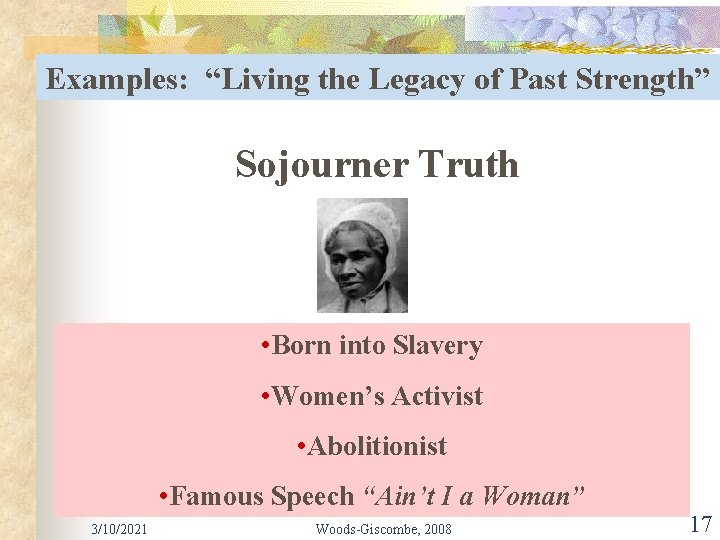
Examples: “Living the Legacy of Past Strength” Sojourner Truth • Born into Slavery • Women’s Activist • Abolitionist • Famous Speech “Ain’t I a Woman” 3/10/2021 Woods-Giscombe, 2008 17
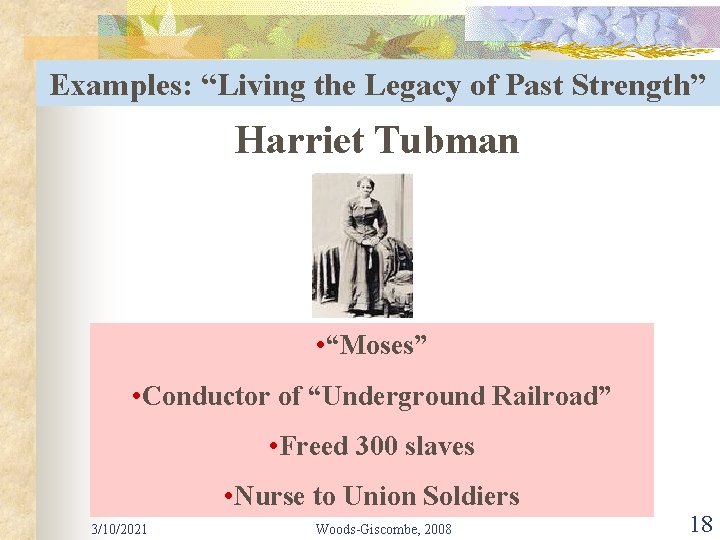
Examples: “Living the Legacy of Past Strength” Harriet Tubman • “Moses” • Conductor of “Underground Railroad” • Freed 300 slaves • Nurse to Union Soldiers 3/10/2021 Woods-Giscombe, 2008 18
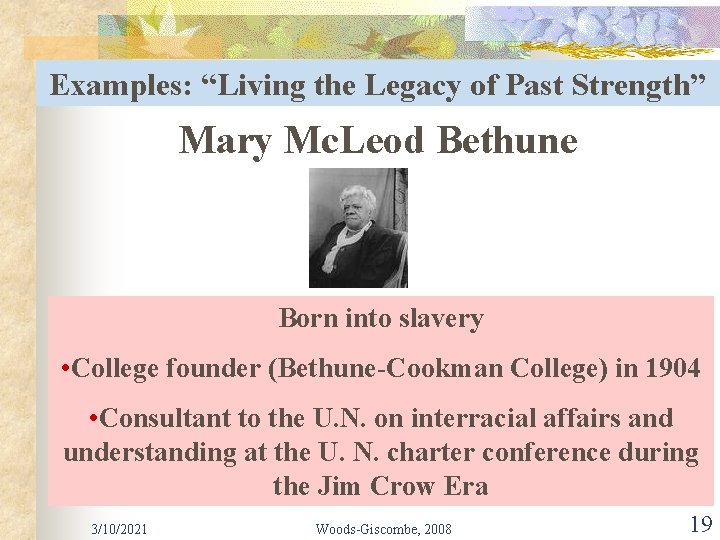
Examples: “Living the Legacy of Past Strength” Mary Mc. Leod Bethune Born into slavery • College founder (Bethune-Cookman College) in 1904 • Consultant to the U. N. on interracial affairs and understanding at the U. N. charter conference during the Jim Crow Era 3/10/2021 Woods-Giscombe, 2008 19
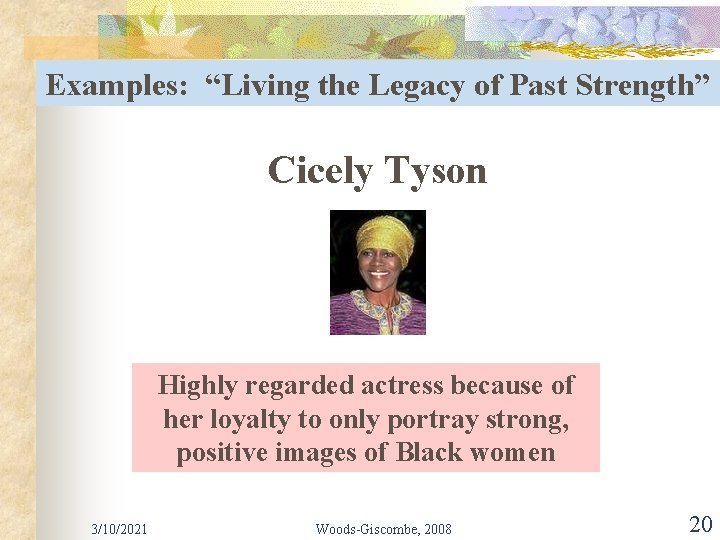
Examples: “Living the Legacy of Past Strength” Cicely Tyson Highly regarded actress because of her loyalty to only portray strong, positive images of Black women 3/10/2021 Woods-Giscombe, 2008 20
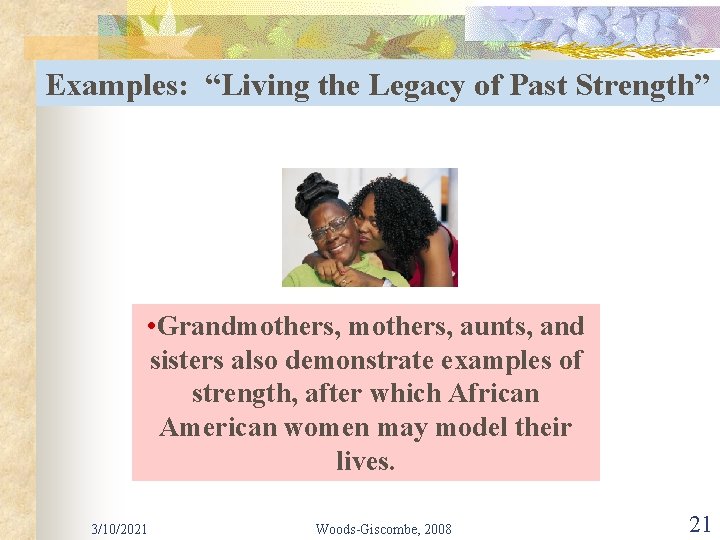
Examples: “Living the Legacy of Past Strength” • Grandmothers, aunts, and sisters also demonstrate examples of strength, after which African American women may model their lives. 3/10/2021 Woods-Giscombe, 2008 21
Is SWS an Asset? African American women’s strength in the face of social, personal, and historical challenges has been commonly viewed as a positive character trait or asset that has contributed to resilience and fortitude among this population. (Angelou, 1978; Giovanni, 1970). 3/10/2021 Woods-Giscombe, 2008 22
![Is SWS a vulnerability? “[however] an overused asset that develops uncritically without ongoing evaluation](http://slidetodoc.com/presentation_image_h/312fc3afb765bfa48a7d53b7a2709e96/image-23.jpg "Is SWS a vulnerability? “[however] an overused asset that develops uncritically without ongoing evaluation")
Is SWS a vulnerability? “[however] an overused asset that develops uncritically without ongoing evaluation and attention to changing needs and demands runs the risk of becoming a liability. ” (Romero, 2000) 3/10/2021 Woods-Giscombe, 2008 23
What is Superwoman Schema, and what do we know about it? Black Macho and the Myth of the Superwoman (Wallace, 1978, p. 107) “a woman of inordinate strength, with an ability for tolerating an unusual amount of misery and heavy, distasteful work. This woman does not have the same fears, weaknesses, and insecurities as other women, but believes herself to be and is, in fact, stronger emotionally than most men. ” 3/10/2021 Woods-Giscombe, 2008 24
Is SWS a Vulnerability? 1. The “superwoman/matriarch image may produce a sense of failure and frustration” (Barbara Warren, 1994, p. 31) and limit self-enhancing activities Additional references 2. James, 1983 3. Patricia Hill Collins, Black Feminist Thought (1991) 4. Harris, 2001, Saints, Sinners, Saviors : Strong Black Women in African American Literature 5. Mullings & Wali, 2001 6. Beauboeuf-Lafontant, 2005 3/10/2021 Woods-Giscombe, 2008 25
Is SWS a vulnerability? Women who suppress emotion because of this schema may assume that they have “built-in capacities” to deal with all manner of hardship without breaking down physically or mentally” (Hooks, 1993, p. 70). 3/10/2021 Woods-Giscombe, 2008 26
Is SWS a vulnerability? A problem of the SWS may not be that it requires African American women to exhibit strength in the face of adversity, but that the endorsement of this role is often accompanied by the suppression of emotion. 3/10/2021 Woods-Giscombe, 2008 27
Guidance from existing literature? • A growing body of literature suggests that the association of stress, strength, and emotional suppression may result in undesirable mental and physical health outcomes for African American women (e. g. , Beauboeuf-La. Fontant, 2007; Greene, 1994; Thompson, Witherspoon, & Speight, 2004). • However, a well-defined conceptual framework and an instrument to assess the characteristics of this phenomenon would facilitate empirical research that can more concretely identify how this contributes to adverse physical and mental health outcomes. 3/10/2021 Woods-Giscombe, 2008 28
Guidance from existing literature? • A growing body of literature suggests that the association of stress, strength, and emotional suppression may result in undesirable health outcomes for African American women (e. g. , Beauboeuf-La. Fontant, 2007; Greene, 1994; Thompson, Witherspoon, & Speight, 2004). • However, a well-defined conceptual framework and an instrument to assess the characteristics of this phenomenon is needed to facilitate empirical research that can more concretely identify how this contributes to adverse physical and mental health outcomes. 3/10/2021 Woods-Giscombe, 2008 29
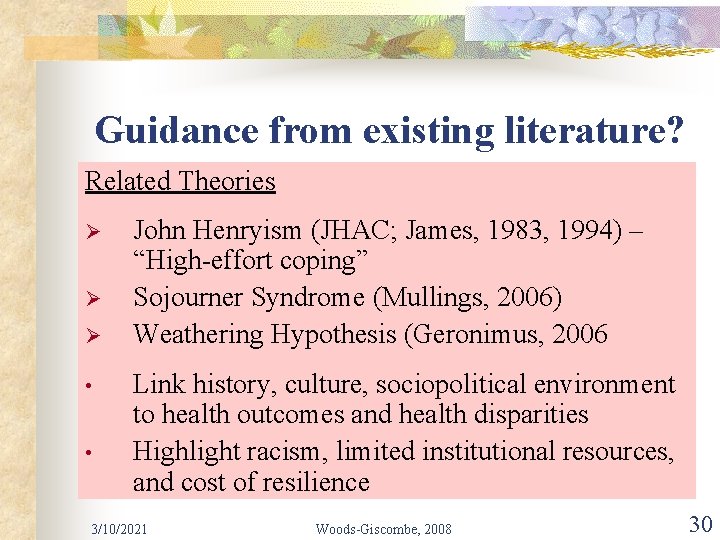
Guidance from existing literature? Related Theories Ø Ø Ø • • John Henryism (JHAC; James, 1983, 1994) – “High-effort coping” Sojourner Syndrome (Mullings, 2006) Weathering Hypothesis (Geronimus, 2006 Link history, culture, sociopolitical environment to health outcomes and health disparities Highlight racism, limited institutional resources, and cost of resilience 3/10/2021 Woods-Giscombe, 2008 30
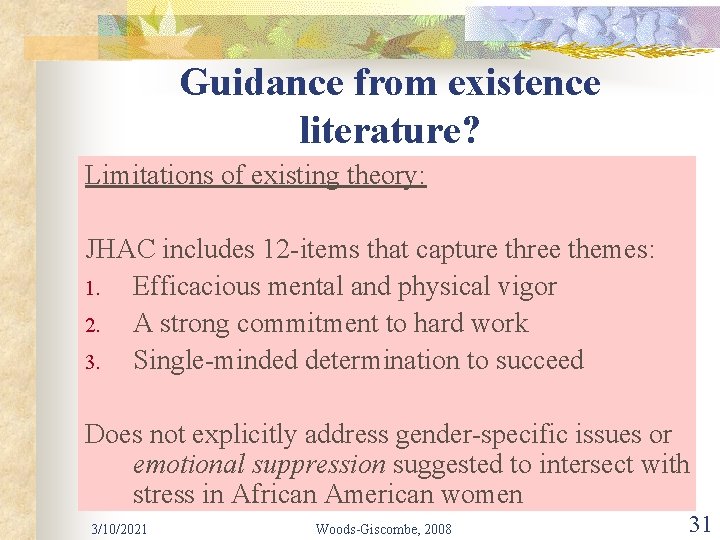
Guidance from existence literature? Limitations of existing theory: JHAC includes 12 -items that capture three themes: 1. Efficacious mental and physical vigor 2. A strong commitment to hard work 3. Single-minded determination to succeed Does not explicitly address gender-specific issues or emotional suppression suggested to intersect with stress in African American women 3/10/2021 Woods-Giscombe, 2008 31
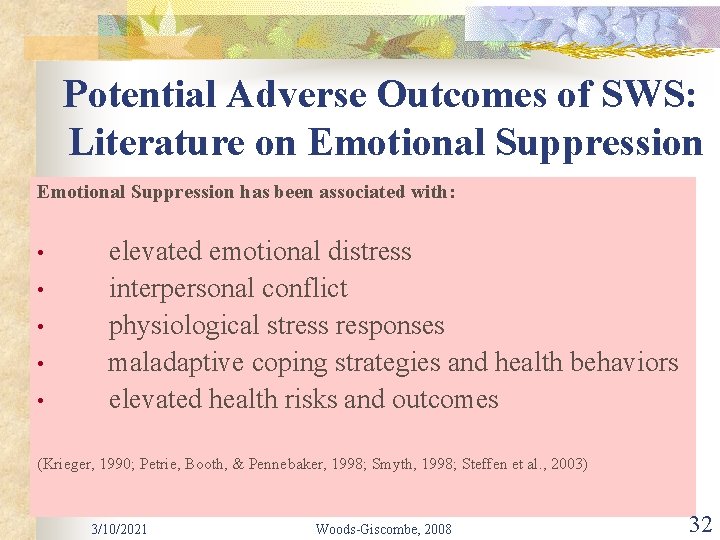
Potential Adverse Outcomes of SWS: Literature on Emotional Suppression has been associated with: • • • elevated emotional distress interpersonal conflict physiological stress responses maladaptive coping strategies and health behaviors elevated health risks and outcomes (Krieger, 1990; Petrie, Booth, & Pennebaker, 1998; Smyth, 1998; Steffen et al. , 2003) 3/10/2021 Woods-Giscombe, 2008 32
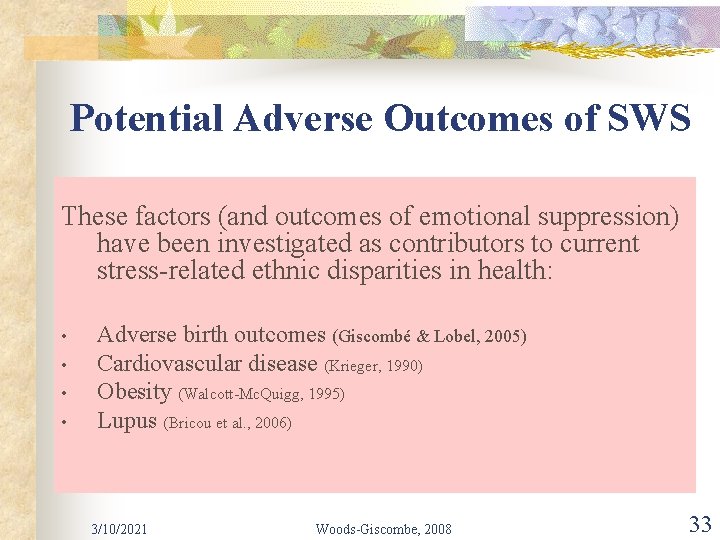
Potential Adverse Outcomes of SWS These factors (and outcomes of emotional suppression) have been investigated as contributors to current stress-related ethnic disparities in health: • • Adverse birth outcomes (Giscombé & Lobel, 2005) Cardiovascular disease (Krieger, 1990) Obesity (Walcott-Mc. Quigg, 1995) Lupus (Bricou et al. , 2006) 3/10/2021 Woods-Giscombe, 2008 33
Goals of SWS Research • Synthesize and extend what is known about the phenomenon of stress, strength, and emotional suppression in African American women. • Provide a formal, comprehensive framework that can be used to: Ø Ø 3/10/2021 Understand how SWS may contribute to adverse health conditions Develop interventions to enhance health in this population Woods-Giscombe, 2008 34
Goals of SWS Research • Synthesize and extend what is known about the phenomenon of stress, strength, and emotional suppression in African American women. • Provide a formal, comprehensive framework that can be used to: Ø Ø 3/10/2021 Understand how SWS may contribute to adverse health conditions Develop interventions to enhance health in this population Woods-Giscombe, 2008 35
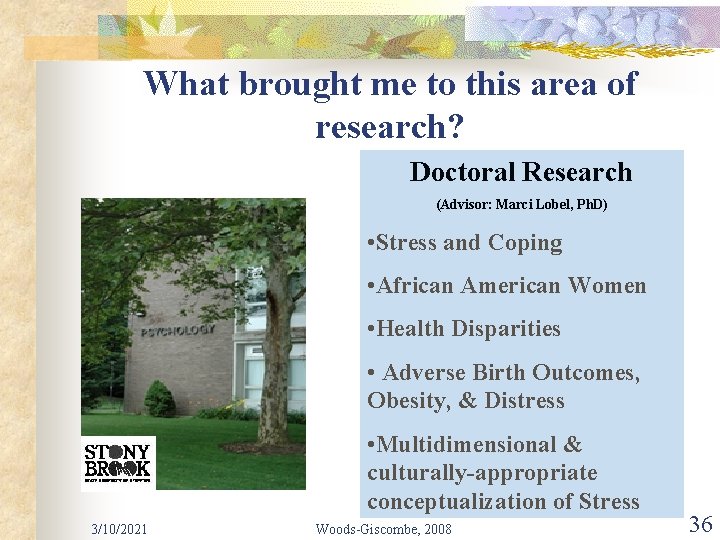
What brought me to this area of research? Doctoral Research (Advisor: Marci Lobel, Ph. D) • Stress and Coping • African American Women • Health Disparities • Adverse Birth Outcomes, Obesity, & Distress • Multidimensional & culturally-appropriate conceptualization of Stress 3/10/2021 Woods-Giscombe, 2008 36
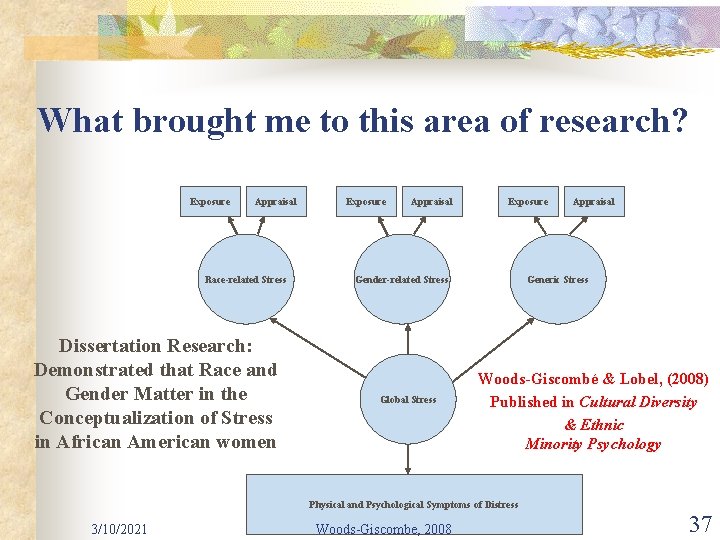
What brought me to this area of research? Exposure Appraisal Race-related Stress Dissertation Research: Demonstrated that Race and Gender Matter in the Conceptualization of Stress in African American women Exposure Appraisal Exposure Gender-related Stress Global Stress Appraisal Generic Stress Woods-Giscombé & Lobel, (2008) Published in Cultural Diversity & Ethnic Minority Psychology Physical and Psychological Symptoms of Distress 3/10/2021 Woods-Giscombe, 2008 37
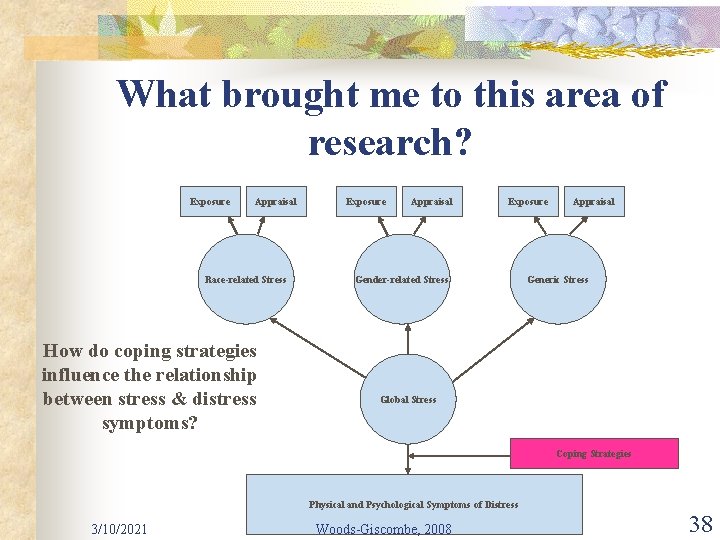
What brought me to this area of research? Exposure Appraisal Race-related Stress How do coping strategies influence the relationship between stress & distress symptoms? Exposure Appraisal Exposure Gender-related Stress Appraisal Generic Stress Global Stress Coping Strategies Physical and Psychological Symptoms of Distress 3/10/2021 Woods-Giscombe, 2008 38
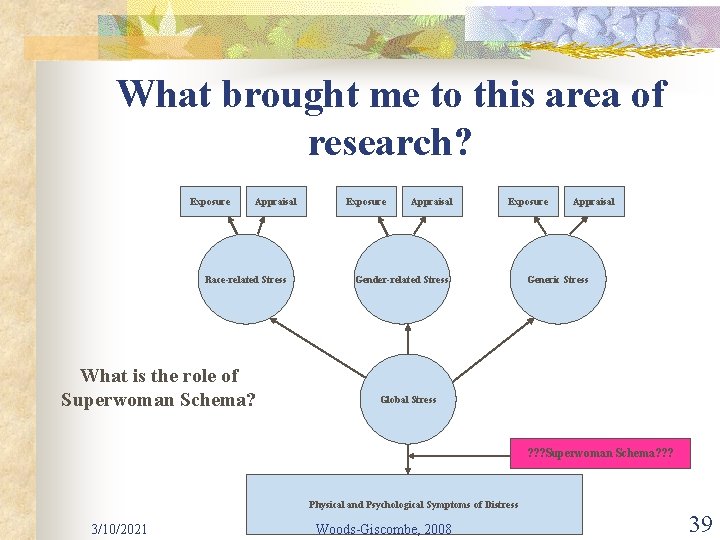
What brought me to this area of research? Exposure Appraisal Race-related Stress What is the role of Superwoman Schema? Exposure Appraisal Exposure Gender-related Stress Appraisal Generic Stress Global Stress ? ? ? Superwoman Schema? ? ? Physical and Psychological Symptoms of Distress 3/10/2021 Woods-Giscombe, 2008 39
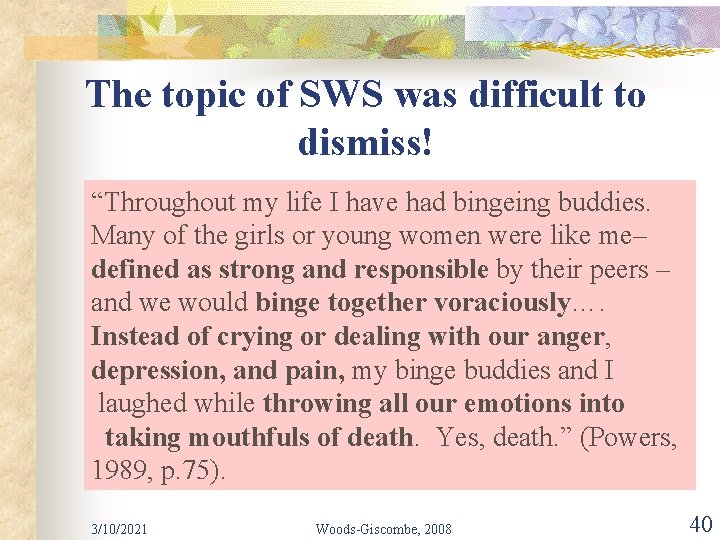
The topic of SWS was difficult to dismiss! “Throughout my life I have had bingeing buddies. Many of the girls or young women were like me– defined as strong and responsible by their peers – and we would binge together voraciously…. Instead of crying or dealing with our anger, depression, and pain, my binge buddies and I laughed while throwing all our emotions into taking mouthfuls of death. Yes, death. ” (Powers, 1989, p. 75). 3/10/2021 Woods-Giscombe, 2008 40
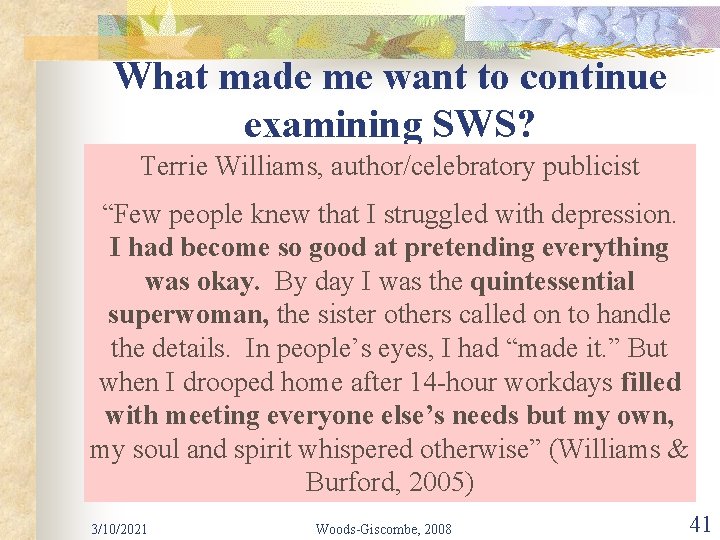
What made me want to continue examining SWS? Terrie Williams, author/celebratory publicist “Few people knew that I struggled with depression. I had become so good at pretending everything was okay. By day I was the quintessential superwoman, the sister others called on to handle the details. In people’s eyes, I had “made it. ” But when I drooped home after 14 -hour workdays filled with meeting everyone else’s needs but my own, my soul and spirit whispered otherwise” (Williams & Burford, 2005) 3/10/2021 Woods-Giscombe, 2008 41
What made me want to continue examining SWS? Terrie Williams, author/celebratory publicist “We live in a society that is already inclined to think less of us, so once we make it into the big league, the last thing we want is to show chink in the armor. The myth of the Invincible Sister leaves us little room to show weakness. As a result, I hid my battle with depression for years…” (Williams & Burford, 2005) 3/10/2021 Woods-Giscombe, 2008 42
SWS Research Objectives: What will my research contribute? • Identify critical components and important contextual elements of Stress, Strength and Suppression (SWS) in order to extend existing theory and develop a more comprehensive conceptualization of SWS. 3/10/2021 Woods-Giscombe, 2008 43
SWS Research Objectives: What do I hope contribute? • Identify critical components and important contextual elements of Stress, Strength, and Suppression (SWS) in order to extend existing theory and develop a more comprehensive conceptualization of SWS. • Identify concepts and preliminary items that will be used in the development of a better instrument to measure this phenomenon. 3/10/2021 Woods-Giscombe, 2008 44
SWS Research Objectives: What do I hope contribute? • Identify critical components and important contextual elements of SWS in order to extend existing theory and develop a more comprehensive conceptualization of SWS. • Identify concepts and preliminary items that will be used in the development of an instrument to measure this phenomenon. • Examine empirical associations between SWS and outcomes related to health and well-being. 3/10/2021 Woods-Giscombe, 2008 45

Funding for Pilot Research & Training in Qualitative Methods UNC-Chapel Hill School of Nursing: NINR P 20 NR 8369 3/10/2021 Woods-Giscombe, 2008 46
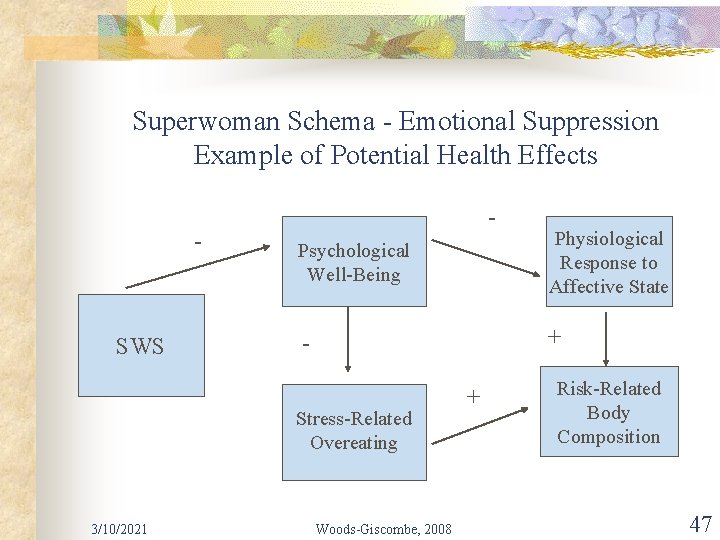
Superwoman Schema - Emotional Suppression Example of Potential Health Effects - SWS Psychological Well-Being Physiological Response to Affective State - + Stress-Related Overeating 3/10/2021 Woods-Giscombe, 2008 + Risk-Related Body Composition 47
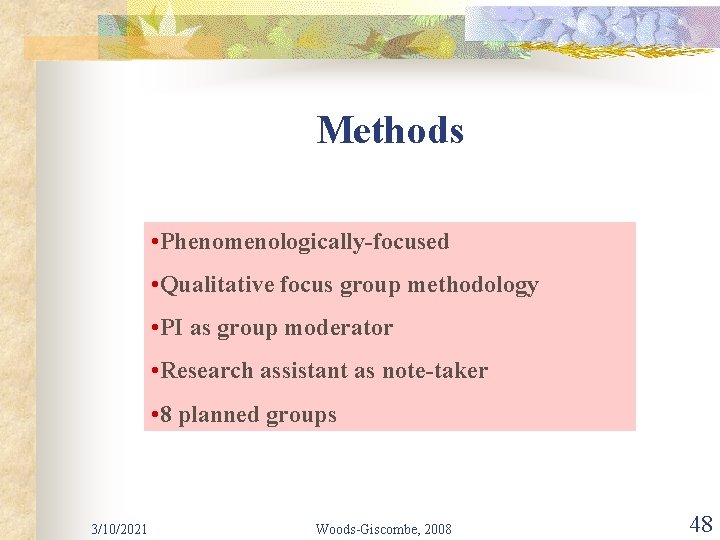
Methods • Phenomenologically-focused • Qualitative focus group methodology • PI as group moderator • Research assistant as note-taker • 8 planned groups 3/10/2021 Woods-Giscombe, 2008 48
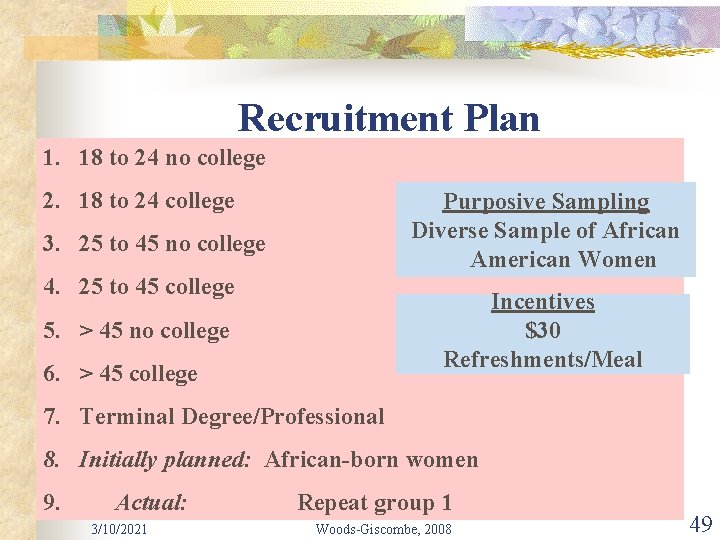
Recruitment Plan 1. 18 to 24 no college 2. 18 to 24 college Purposive Sampling Diverse Sample of African American Women 3. 25 to 45 no college 4. 25 to 45 college Incentives $30 Refreshments/Meal 5. > 45 no college 6. > 45 college 7. Terminal Degree/Professional 8. Initially planned: African-born women 9. Actual: 3/10/2021 Repeat group 1 Woods-Giscombe, 2008 49
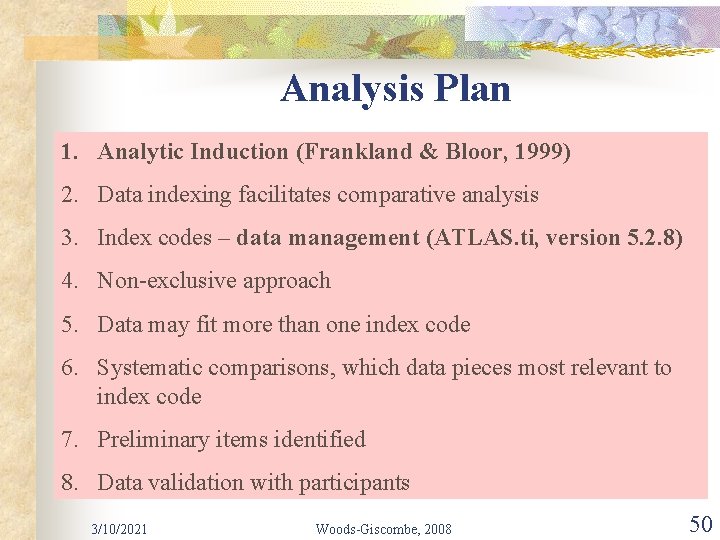
Analysis Plan 1. Analytic Induction (Frankland & Bloor, 1999) 2. Data indexing facilitates comparative analysis 3. Index codes – data management (ATLAS. ti, version 5. 2. 8) 4. Non-exclusive approach 5. Data may fit more than one index code 6. Systematic comparisons, which data pieces most relevant to index code 7. Preliminary items identified 8. Data validation with participants 3/10/2021 Woods-Giscombe, 2008 50
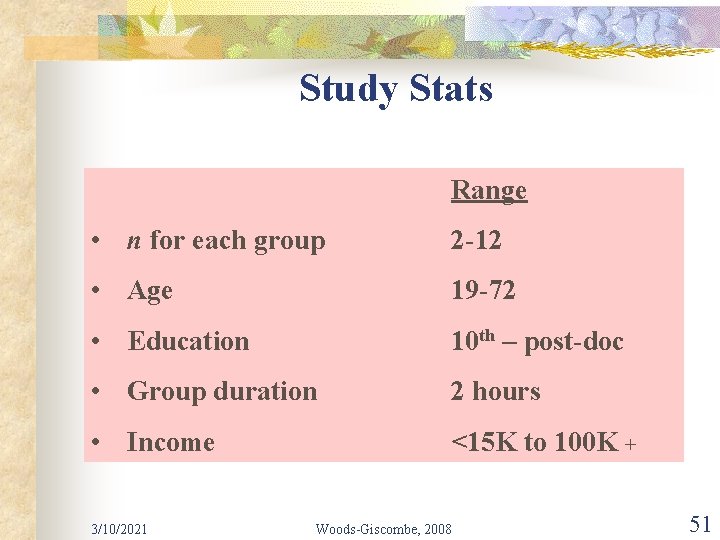
Study Stats Range • n for each group 2 -12 • Age 19 -72 • Education 10 th – post-doc • Group duration 2 hours • Income <15 K to 100 K + 3/10/2021 Woods-Giscombe, 2008 51
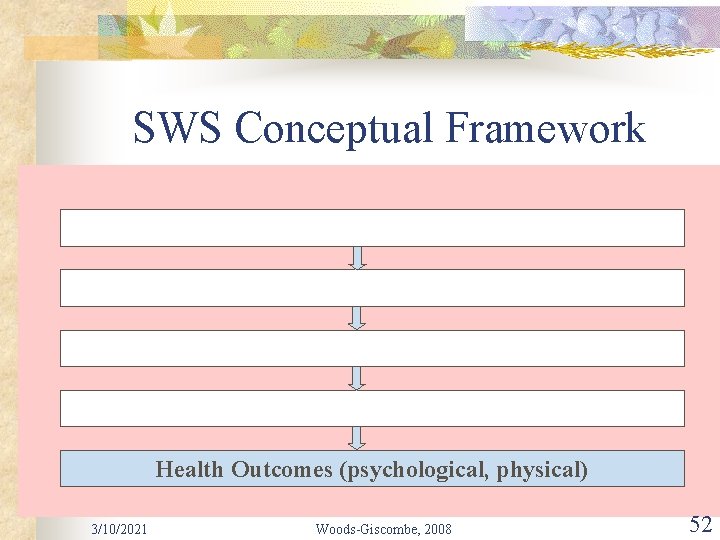
SWS Conceptual Framework Health Outcomes (psychological, physical) 3/10/2021 Woods-Giscombe, 2008 52
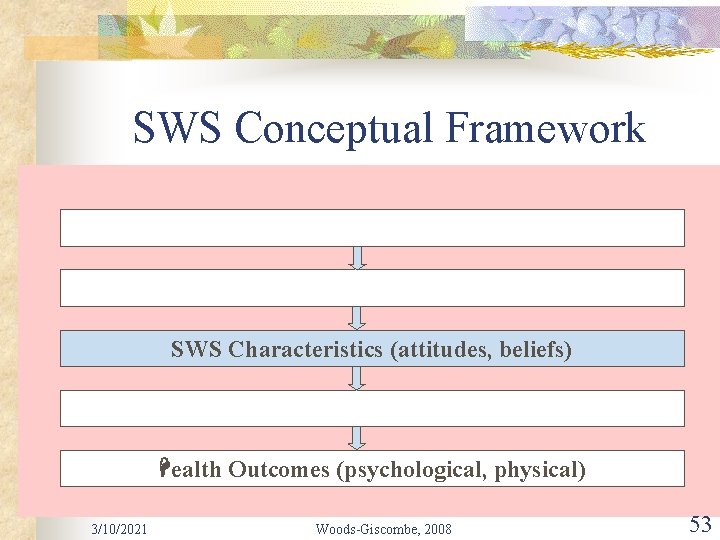
SWS Conceptual Framework SWS Characteristics (attitudes, beliefs) Health Outcomes (psychological, physical) 3/10/2021 Woods-Giscombe, 2008 53
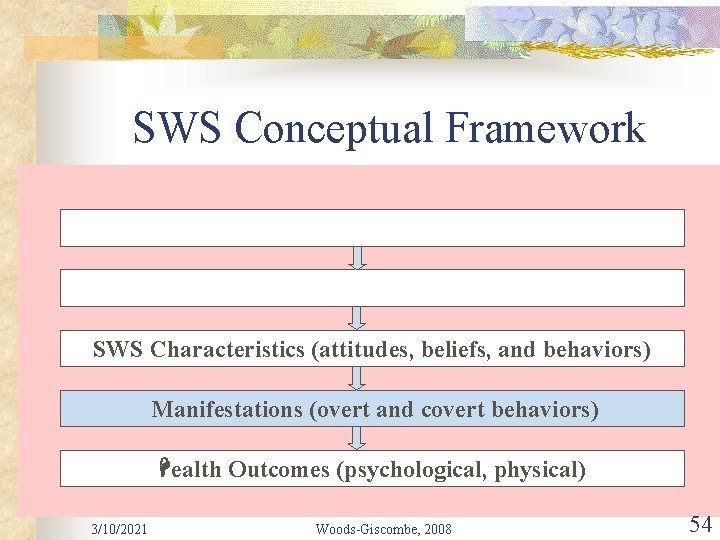
SWS Conceptual Framework SWS Characteristics (attitudes, beliefs, and behaviors) Manifestations (overt and covert behaviors) Health Outcomes (psychological, physical) 3/10/2021 Woods-Giscombe, 2008 54
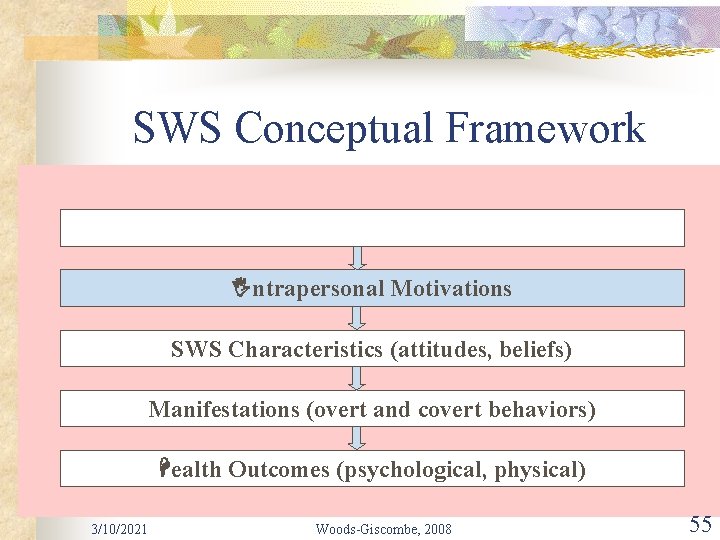
SWS Conceptual Framework Intrapersonal Motivations SWS Characteristics (attitudes, beliefs) Manifestations (overt and covert behaviors) Health Outcomes (psychological, physical) 3/10/2021 Woods-Giscombe, 2008 55
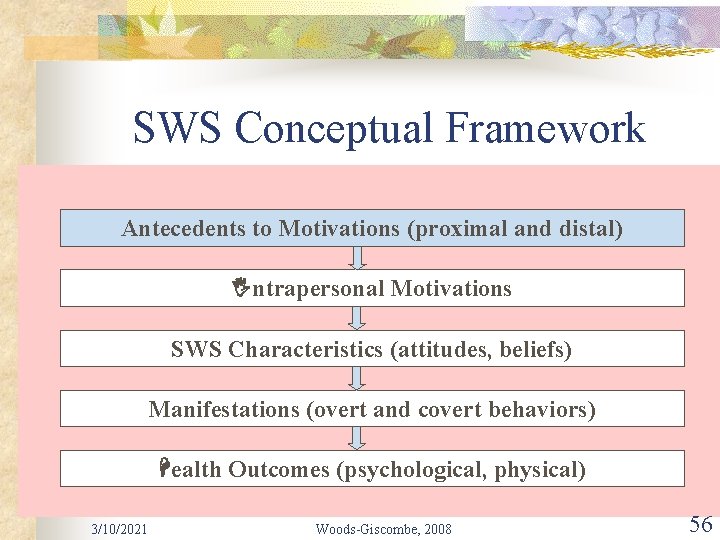
SWS Conceptual Framework Antecedents to Motivations (proximal and distal) Intrapersonal Motivations SWS Characteristics (attitudes, beliefs) Manifestations (overt and covert behaviors) Health Outcomes (psychological, physical) 3/10/2021 Woods-Giscombe, 2008 56
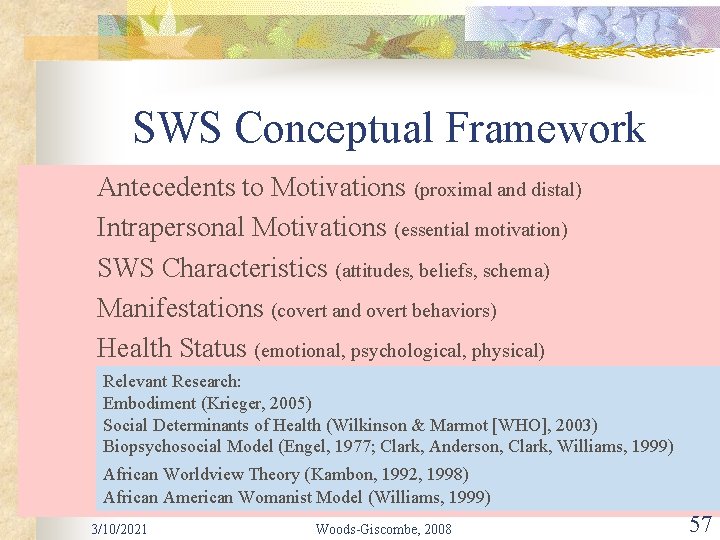
SWS Conceptual Framework Antecedents to Motivations (proximal and distal) Intrapersonal Motivations (essential motivation) SWS Characteristics (attitudes, beliefs, schema) Manifestations (covert and overt behaviors) Health Status (emotional, psychological, physical) Relevant Research: Embodiment (Krieger, 2005) Social Determinants of Health (Wilkinson & Marmot [WHO], 2003) Biopsychosocial Model (Engel, 1977; Clark, Anderson, Clark, Williams, 1999) African Worldview Theory (Kambon, 1992, 1998) African American Womanist Model (Williams, 1999) 3/10/2021 Woods-Giscombe, 2008 57
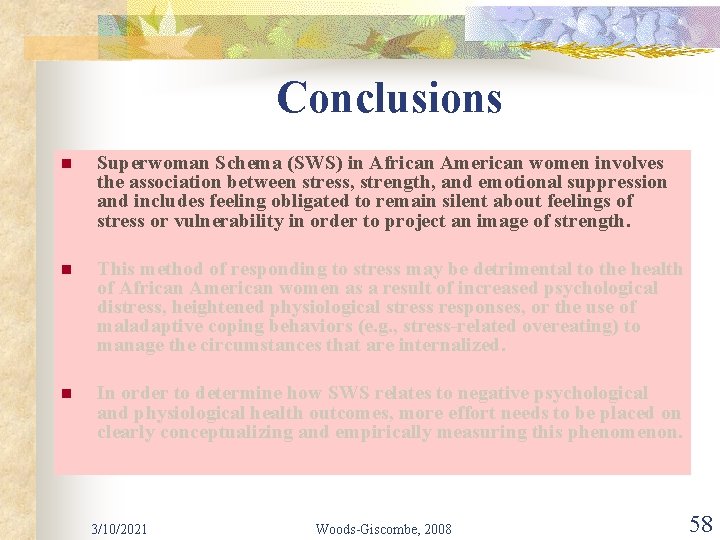
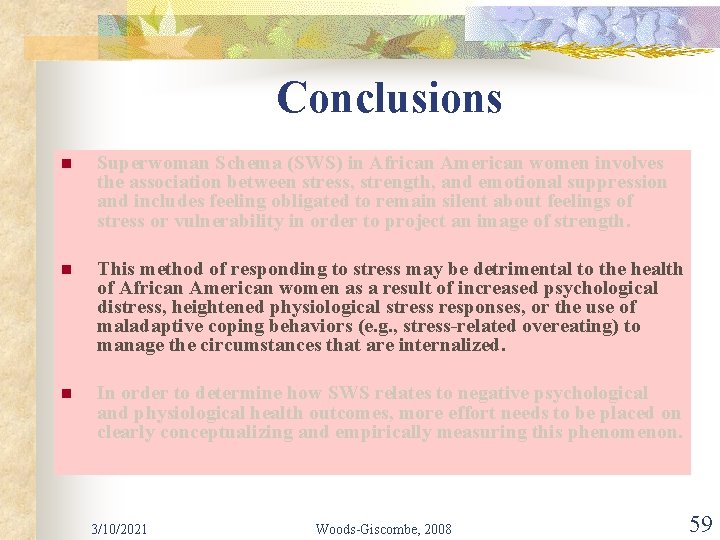
Conclusions n Superwoman Schema (SWS) in African American women involves the association between stress, strength, and emotional suppression and includes feeling obligated to remain silent about feelings of stress or vulnerability in order to project an image of strength. n This method of responding to stress may be detrimental to the health of African American women as a result of increased psychological distress, heightened physiological stress responses, or the use of maladaptive coping behaviors (e. g. , stress-related overeating) to manage the circumstances that are internalized. n In order to determine how SWS relates to negative psychological and physiological health outcomes, more effort needs to be placed on clearly conceptualizing and empirically measuring this phenomenon. 3/10/2021 Woods-Giscombe, 2008 58
Conclusions n Superwoman Schema (SWS) in African American women involves the association between stress, strength, and emotional suppression and includes feeling obligated to remain silent about feelings of stress or vulnerability in order to project an image of strength. n This method of responding to stress may be detrimental to the health of African American women as a result of increased psychological distress, heightened physiological stress responses, or the use of maladaptive coping behaviors (e. g. , stress-related overeating) to manage the circumstances that are internalized. n In order to determine how SWS relates to negative psychological and physiological health outcomes, more effort needs to be placed on clearly conceptualizing and empirically measuring this phenomenon. 3/10/2021 Woods-Giscombe, 2008 59
Conclusions n Superwoman Schema (SWS) in African American women involves the association between stress, strength, and emotional suppression and includes feeling obligated to remain silent about feelings of stress or vulnerability in order to project an image of strength. n This method of responding to stress may be detrimental to the health of African American women as a result of increased psychological distress, heightened physiological stress responses, or the use of maladaptive coping behaviors (e. g. , stress-related overeating) to manage the circumstances that are internalized. n In order to determine how SWS relates to negative psychological and physiological health outcomes, more effort needs to be placed on clearly conceptualizing and empirically measuring this phenomenon. 3/10/2021 Woods-Giscombe, 2008 60
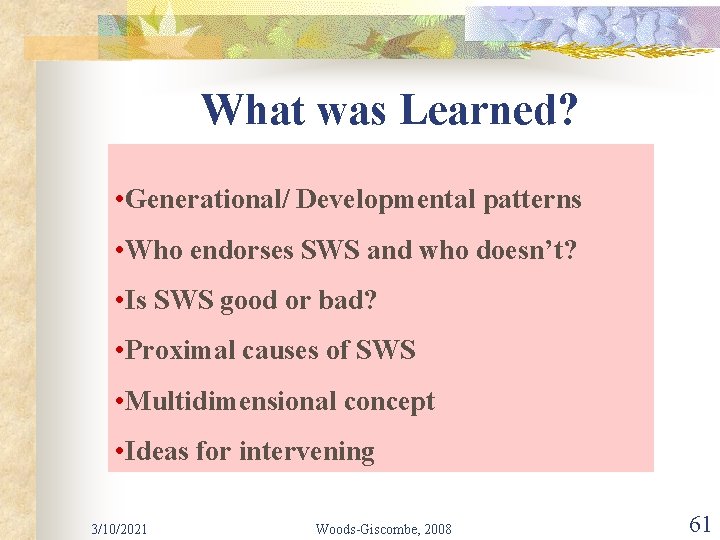
What was Learned? • Generational/ Developmental patterns • Who endorses SWS and who doesn’t? • Is SWS good or bad? • Proximal causes of SWS • Multidimensional concept • Ideas for intervening 3/10/2021 Woods-Giscombe, 2008 61
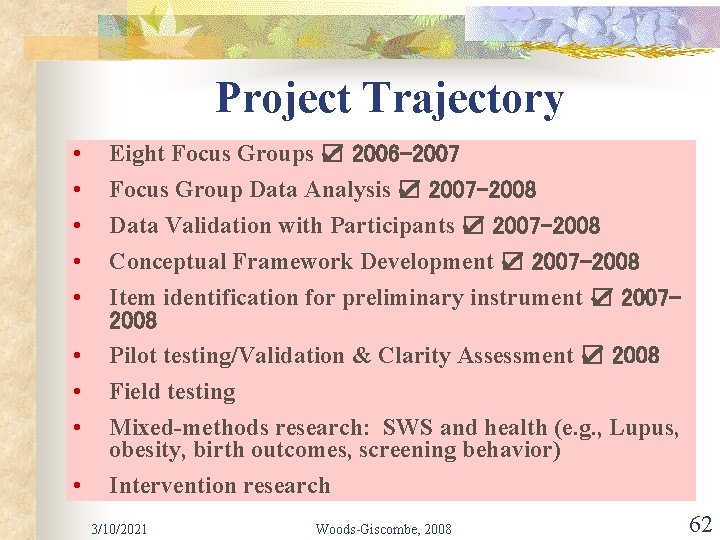
Project Trajectory • • • Eight Focus Groups ☑ 2006 -2007 Focus Group Data Analysis ☑ 2007 -2008 Data Validation with Participants ☑ 2007 -2008 Conceptual Framework Development ☑ 2007 -2008 Item identification for preliminary instrument ☑ 20072008 Pilot testing/Validation & Clarity Assessment ☑ 2008 Field testing Mixed-methods research: SWS and health (e. g. , Lupus, obesity, birth outcomes, screening behavior) Intervention research 3/10/2021 Woods-Giscombe, 2008 62
Caveats/ Things to consider 1. 2. 3. 4. Marjorie Hansen Shalvitz The Superwoman Syndrome (1984) The Superwoman Syndrome: A comparison of the “heroine” in Denmark and the UK (Newell, 1996) Alice Hochschild: “The Second Shift” Michelle Justic: “Eishet Chayil and the Jewish Superwoman Syndrome” 3/10/2021 Woods-Giscombe, 2008 63
Caveats/ Things to consider • People attracted to the study were experiencing stress • Avoid Overgeneralization: SWS is not applicable to ALL African American Women 3/10/2021 Woods-Giscombe, 2008 64
Acknowledgements: § SAMHSA/ANA MFP § UNC Center for Health Disparities Research § UNC Research Support Center §Participants § Odum Institute for Research in Social Science §Teneka Steed, RA §Shalette Woods, RA § BBL §Research Mentors (Drs. Debra Barksdale, Linda Beeber, Mary Lynn, Merle Mishel, Margaret Miles, Joyce Roland, and Margarete Sandelowski) § New Visions of Africa Restaurant § Stanford L. Warren Library § Recruitment Sites • Franklin Square Transcriptions Funding: SAMHSA/ANA MFP Postdoctoral Fellowship UNC Center on Innovation in Health Disparity Research NINR Grant P 20 NR 8369 NINR Grant T 32 NR 007091 3/10/2021 Woods-Giscombe, 2008 65
Thank You!! Questions? ? ? 3/10/2021 Woods-Giscombe, 2008 66
Thank you for your interest in this research! • The previous slides were selected from Dr. Cheryl Woods-Giscombé’s paper presentation at the 2008 National Black Nurses Association Annual Conference held in Las Vegas, Nevada. • Specific study results and participant quotations have been removed, but will be included in a paper that will soon be published to illuminate a more comprehensive version of this research. • Please contact Dr. Cheryl Woods-Giscombé if you would like more specific information about this study or its findings at Cheryl. Giscombe@unc. edu or 919 -966 -0455. • If you would like to cite material from the presentation, please use the following reference: Woods-Giscombé, C. L. (2008, August). Superwoman schema and emotional suppression: Implications for physical and mental well-being of African American women. Paper presented at the National Black Nurses Association Annual Conference, Las Vegas, Nevada. 3/10/2021 Woods-Giscombe, 2008 67
Contact Dr. Woods-Giscombé Cheryl. Giscombe@unc. edu 919 -966 -0455 Cheryl L. Woods-Giscombé, Ph. D, RN CIHDR Pilot Investigator, SAMSHA-ANA MFP Postdoctoral Fellow The University of North Carolina at Chapel Hill, School of Nursing 3/10/2021 Woods-Giscombe, 2008 68
- Slides: 68