
Supervision of offenders The Key to a Safe
- Slides: 19
Supervision of offenders: The Key to a Safe and Secure Jail Inmate Behavior Management
Instructional Goal: � To provide the knowledge, skills, and abilities to supervise inmates.
Performance Objectives: � Upon Completion the student will be able to …. Identify the importance of an Inmate Behavior Management Plan �A. �B. Explain the importance of being fair, firm, and consistent with inmates �
Performance Objectives (cont. ): State the necessity of corrective discipline inside a correctional setting �A. �B. List �C. undesirable traits of inmate supervision Pass a written test with a minimum score of 80%
Importance of an Inmate Behavior Management Plan �An Inmate Behavior Management Plan is based upon two major areas: podular direct supervision and inmate classification.
The inmate behavior management plan consists of six essential elements � Assessing the risks and needs of each inmate at various points during his or her detention. � Assigning inmates to housing. � Meeting inmates’ basic needs. � Defining and conveying expectations for inmate behavior. � Supervising inmates. � Keeping inmates occupied with productive activities.
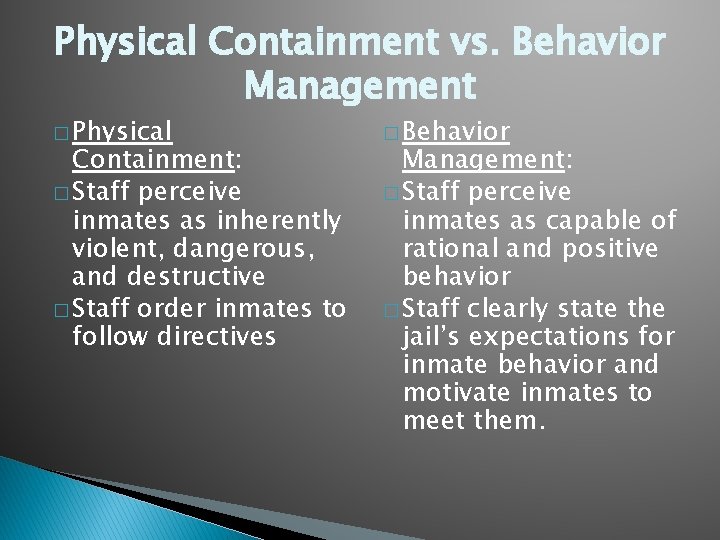
Inmate Behavior Management (cont. ) �: It is important to recognize that correctional officer’s focus be redirected from the notion of their job being “physical containment” to behavior management. � The following chart illustrates examples of the redirected focus.
Physical Containment vs. Behavior Management � Physical Containment: � Staff perceive inmates as inherently violent, dangerous, and destructive � Staff order inmates to follow directives � Behavior Management: � Staff perceive inmates as capable of rational and positive behavior � Staff clearly state the jail’s expectations for inmate behavior and motivate inmates to meet them.
Being Fair, Firm and Consistent with Inmates � An objective inmate classification system, regardless of the type of supervision/facility model, provides for equity, fairness, and consistency in managing the general inmate population. � In principle, all inmates should be classified by the same objective criteria supported by specific policies and procedures, including designated housing areas, decision guidelines, and program eligibility criteria.
Being Fair, Firm and Consistent with Inmates (cont. ) � This provides reasoning to support the decision making process and eliminates arbitrary decisions. � For example, the various security level classifications should define and determine an appropriate range of eligibility for certain programs, privileges (e. g. , day release or trustee positions for minimum-security inmates, etc. ).
Being Fair, Firm and Consistent with Inmates (cont. ) �A necessary component for this application of classification is a regular periodic review of an inmate's current security level classification. � This provides structure for monitoring and tracking inmate behavior, and allows for the inmate to work his way to a lower security level (i. e. , increased eligibility for programs, housing, special privileges), or, conversely, to higher security levels (i. e. , restricted housing, etc. ) as a result of behavioral problems.
Necessity of Corrective Discipline � Inmate discipline should achieve several goals. Making inmate conduct conform to a standard of behavior that ensures a safe and orderly living environment. Instilling respect for authority. Teaching values and respectful behavior (in a group of people who, by definition, have not displayed good values and behavior) that inmates may continue to use once they reenter the community.
Necessity of Corrective Discipline (cont. ) � Keeping in mind the goals of disciplinary actions, there are three aspects of discipline essential to an effective inmate disciplinary program. 1. There should be a written set of rules defining expected inmate behavior and procedures for handling misconduct. Most institutions have a misconduct code— a list of offenses that are subject to punishment in the correctional setting. An adjunct of that list of offenses should concern the types of sanctions that may be imposed if the rules are broken.
Necessity of Corrective Discipline (cont. ) 2. The rules for discipline must be communicated carefully and thoroughly. All staff members must be taught how the inmate disciplinary program works, in general and specific terms, because every employee may be involved (as a witness, or reporting official, or in some other capacity) in the disciplinary system. Inmates must also be given the details of the system. They must know the kind of responsible behavior that is expected of them, add they should learn the penalties for misbehavior. All staff and inmates should be given a written statement of the policy.
Necessity of Corrective Discipline (cont. ) The disciplinary policy must specify clearly how inmates will be notified of suspected misconduct, how sanctions will be imposed, and what their rights to be heard are (along with their rights to appeal, if any). 3.
Undesirable Traits of Inmate Supervision � The following are traits correctional officers should not have. Prejudices: You cannot allow personal prejudice to interfere with job performance. These prejudices include ethnic, religious, racial, sex, and crime committed
Undesirable Traits of Inmate Supervision (cont. ) Fear of Inmates: At times new officers can be intimidated by the correctional setting. Inmates will always pick up on this and try to continue that intimidation. Once inmates establish your fear of them it will become very difficult to effectively control a group of inmates
Undesirable Traits of Inmate Supervision (cont. ) Fraternization with Inmates: Inmates will often attempt to get close to in order to set you up or gain favors from you. If this is allowed to happen it may ultimately lead you to termination of employment.
Undesirable Traits of Inmate Supervision (cont. ) Failure to take Disciplinary Action: Officers must be willing to hold individual inmates accountable for meeting behavioral expectations. You must continually be aware of inappropriate behavior, and choose the most effective method in addressing the behavior. Failure to take corrective action or show fear will cause a loss of credibility and respect in a unit.