
Supervision in Organizations Chapter 12 Appraising Employee Performance

- Slides: 24
Supervision in Organizations Chapter 12 Appraising Employee Performance 12– 1
11– 2
Learning Outcomes After reading this chapter, I will be able to: 1. Describe the purposes of the performance appraisal. 2. Identify the performance appraisal process 3. Explain the different types of measurement tools 4. Distinguish human errors that can distort performance appraisal ratings. 5. Describe key legal concerns with performance appraisals. 12– 3
Performance Appraisal defined…. • Performance Appraisal: ØA tool that reviews past job performance, emphasizing positive accomplishments as well as deficiencies, as a means for helping employees improve future performance. • Purposes: Ø Feedback Ø Raises Ø Development Ø Documentation (Termination) 12– 4
Appraisal Process 1. Establish performance appraisal standards 2. Mutually set measurable goals 3. Measure actual performance AND…. 12 -5
Appraisal Process cont… 4. Compare actual with standard 5. Discuss appraisal with employee 6. Corrective action Ø Basic Ø Immediate 12 -6
Measurement Tools • Focus of the measure ØTrait, behavior, or outcome • Type of judgment required ØRelative, absolute, or outcome 12 -6
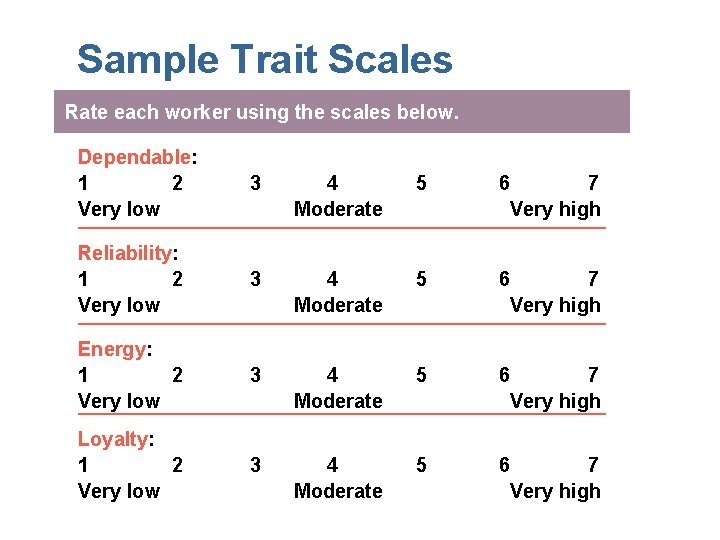
Focus: Trait, Behavior, & Outcome • Trait Ø An appraisal tool that asks a supervisor to make judgments about worker characteristics that tend to be consistent and enduring. Ex. Dependable, confident, loyal • Behavior Ø An appraisal tool that asks managers to assess a worker’s behaviors. Ø Ex. Average number of sales calls • Outcome Ø An appraisal tool that asks managers to assess the results achieved by workers. Ø Ex. Overall sales volume, new accounts 12 -8
Sample Trait Scales Rate each worker using the scales below. Dependable: 1 2 Very low 3 4 Moderate 5 6 7 Very high Reliability: 1 2 Very low 3 4 Moderate 5 6 7 Very high Energy: 1 2 Very low 3 4 Moderate 5 6 7 Very high Loyalty: 1 2 Very low 3 4 Moderate 5 6 7 Very high
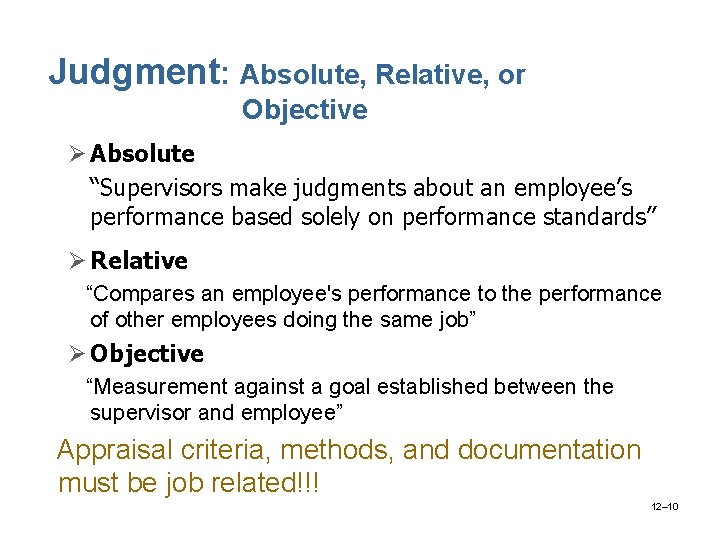
Judgment: Absolute, Relative, or Objective Ø Absolute “Supervisors make judgments about an employee’s performance based solely on performance standards” Ø Relative “Compares an employee's performance to the performance of other employees doing the same job” Ø Objective “Measurement against a goal established between the supervisor and employee” Appraisal criteria, methods, and documentation must be job related!!! 12– 10
Absolute Standard Approaches • Essay • Critical incident • Checklist • Adjective rating scale 11
Absolute: ESSAYS • Simplest Approach Ø Write a narrative describing the v Strengths v Weaknesses v Potential v Suggestions for improvement • Results reflect the ability of the writers 12 -12
Absolute: CRITICAL INCIDENT • Essay about what was most effective or ineffective in a key job situation • Focus on behavior, not personality • Time-consuming 12 -13
Absolute: CHECKLIST • Yes or No • Predefined behaviors or qualities • Items may be irrelevant 12 -14
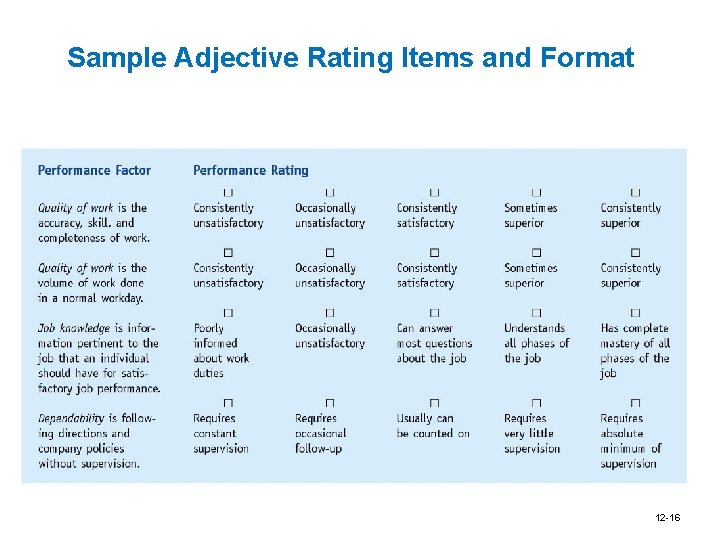
Absolute: ADJECTIVE RATING SCALE • Oldest & most popular approach • Factors present Ø Job knowledge Ø Cooperation Ø Quality and quantity of work • 5 to 10 points on a continuum 12 -15
Sample Adjective Rating Items and Format 12 -16
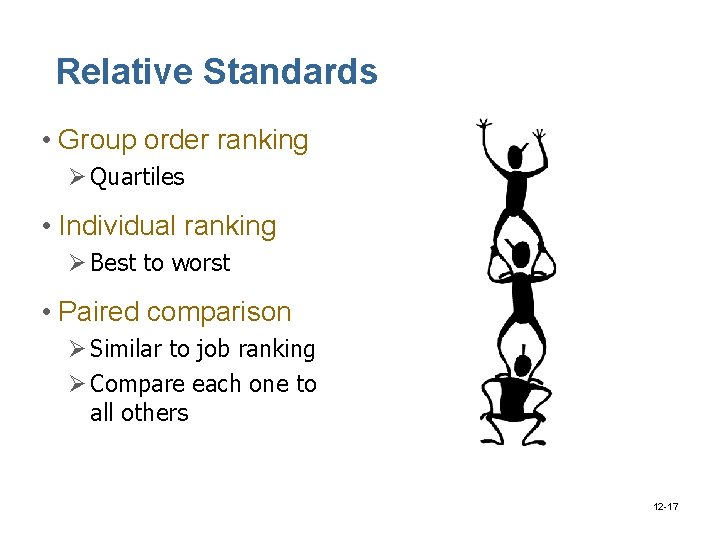
Relative Standards • Group order ranking Ø Quartiles • Individual ranking Ø Best to worst • Paired comparison Ø Similar to job ranking Ø Compare each one to all others 12 -17
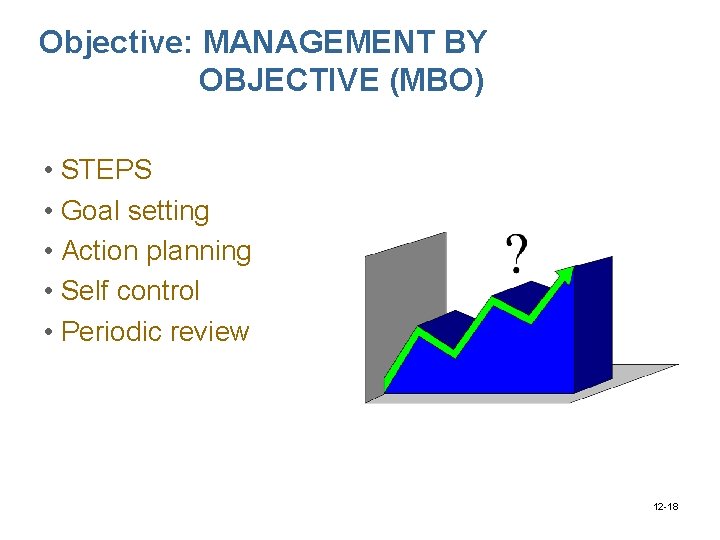
Objective: MANAGEMENT BY OBJECTIVE (MBO) • STEPS • Goal setting • Action planning • Self control • Periodic review 12 -18
Objective: MBO ISSUES • Advantages Ø Results oriented Ø Commitment • Problems Ø Trust needed • Satisfaction Ø Time-consuming Ø Important to follow-up Ø Frustration builder 12 -19
Human Errors & Appraisals • Halo Effect Ø Tendency to rate employee high or low on all factors • Similarity Ø Giving special consideration to qualities that appraisers perceive in themselves • Recency Ø Gives greater importance to job behaviors near the end of the measurement period • Central tendency Ø The reluctance to assign extreme ratings 12 -20
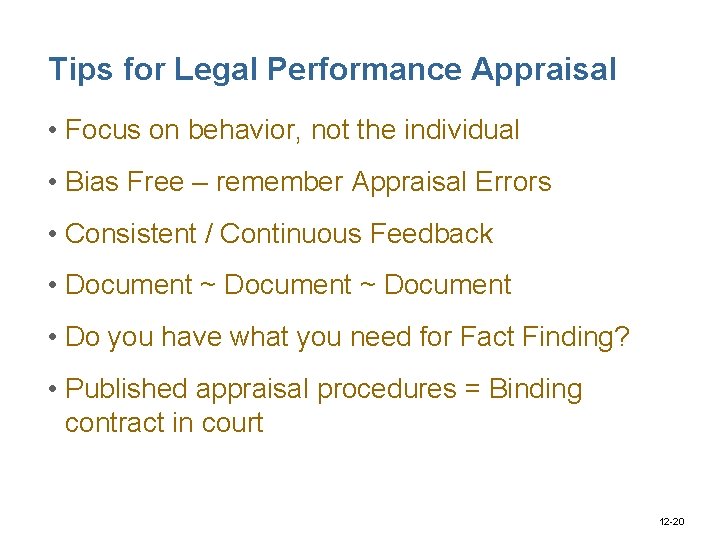
Tips for Legal Performance Appraisal • Focus on behavior, not the individual • Bias Free – remember Appraisal Errors • Consistent / Continuous Feedback • Document ~ Document • Do you have what you need for Fact Finding? • Published appraisal procedures = Binding contract in court 12 -20
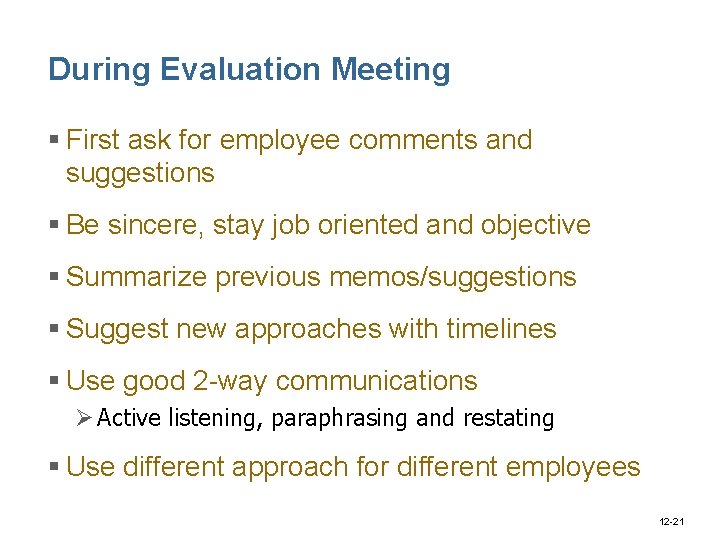
During Evaluation Meeting § First ask for employee comments and suggestions § Be sincere, stay job oriented and objective § Summarize previous memos/suggestions § Suggest new approaches with timelines § Use good 2 -way communications Ø Active listening, paraphrasing and restating § Use different approach for different employees 12 -21
After Evaluation Meeting § Finalize Form - Add your comments and signature § Give to employee for comments and signature § Give copy to supervisor for review § Give copy to employee § Send signed original to Human Resources for employee file § Set date for planning meeting for next year 12 -22
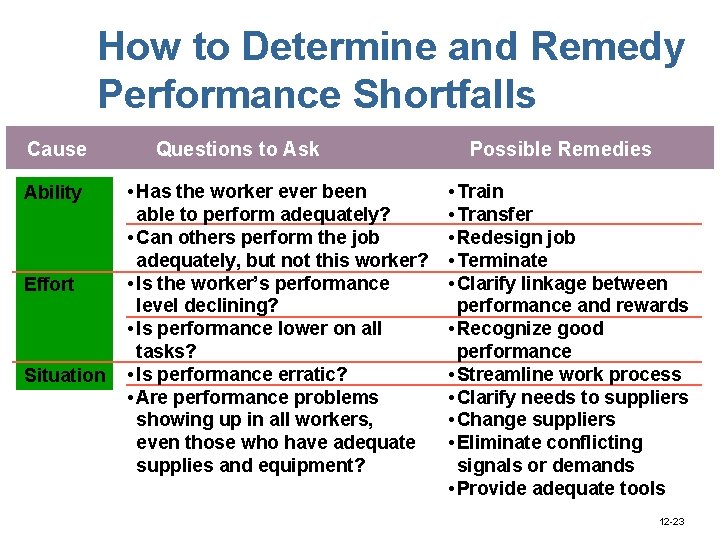
How to Determine and Remedy Performance Shortfalls Cause Ability Effort Situation Questions to Ask • Has the worker ever been able to perform adequately? • Can others perform the job adequately, but not this worker? • Is the worker’s performance level declining? • Is performance lower on all tasks? • Is performance erratic? • Are performance problems showing up in all workers, even those who have adequate supplies and equipment? Possible Remedies • Train • Transfer • Redesign job • Terminate • Clarify linkage between performance and rewards • Recognize good performance • Streamline work process • Clarify needs to suppliers • Change suppliers • Eliminate conflicting signals or demands • Provide adequate tools 12 -23