
Supervised Learning of Edges and Object Boundaries Piotr
Supervised Learning of Edges and Object Boundaries Piotr Dollár Zhuowen Tu Serge Belongie
The problem
Outline • • I. III. IV. Motivation Problem formulation Learning architecture (BEL) Results
Outline • I. Motivation – Why edges? – Why not edges? – Why learning? • • • II. Problem formulation III. Learning architecture (BEL) IV. Results
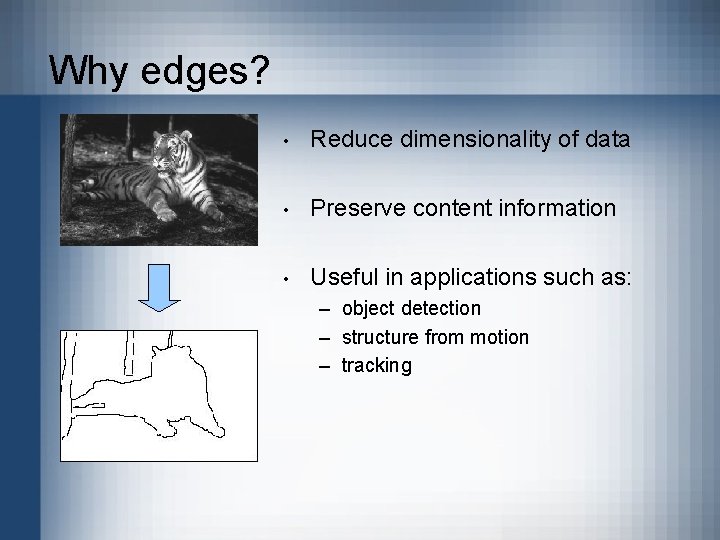
Why edges? • Reduce dimensionality of data • Preserve content information • Useful in applications such as: – object detection – structure from motion – tracking

Why not edges? But, not that useful, why? Difficulties: 1. Modeling assumptions 2. Parameters 3. Multiple sources of information (brightness, color, texture, …) 4. Real world conditions Is edge detection even well defined?
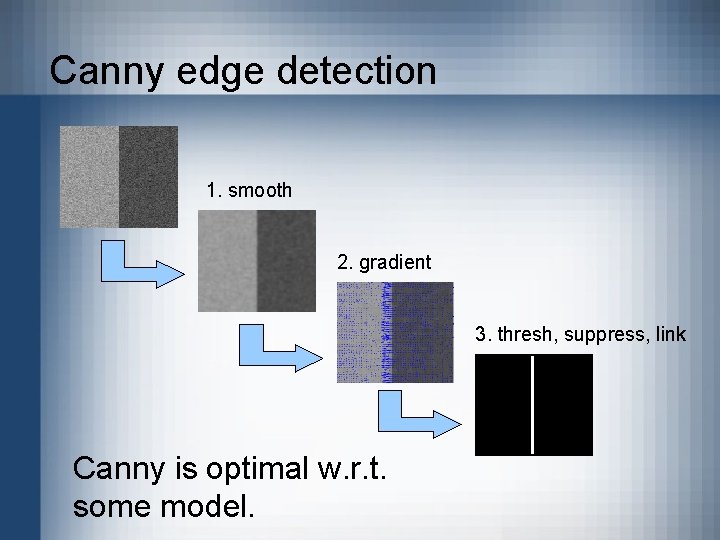
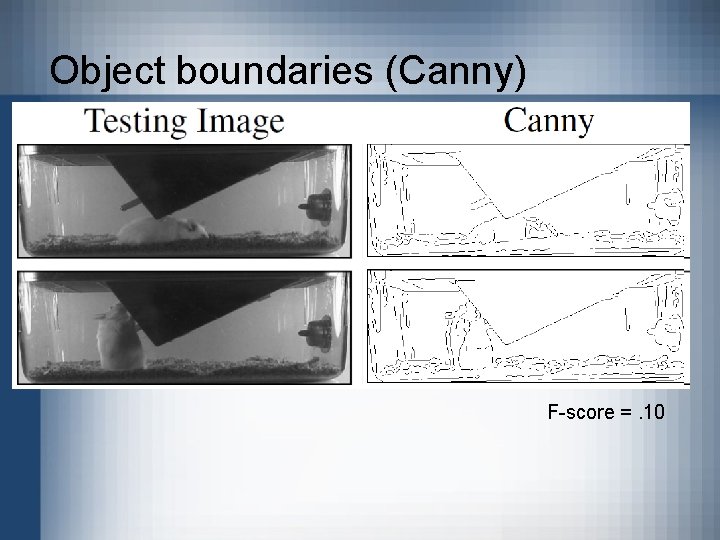
Canny edge detection 1. smooth 2. gradient 3. thresh, suppress, link Canny is optimal w. r. t. some model.
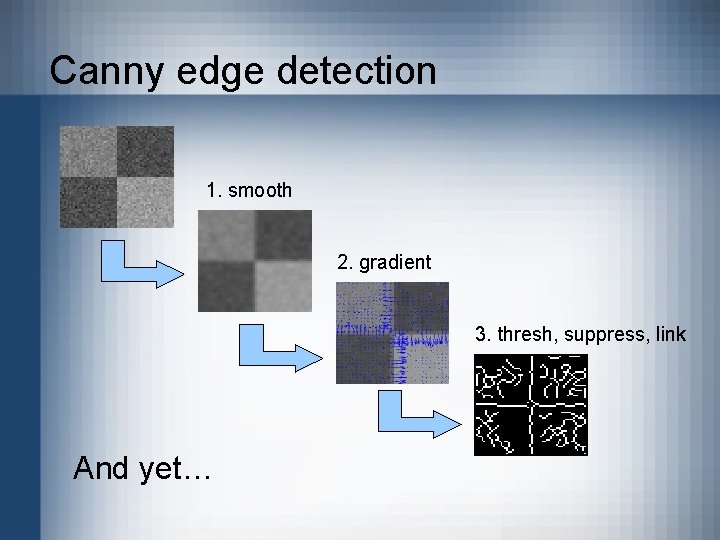
Canny edge detection 1. smooth 2. gradient 3. thresh, suppress, link And yet…
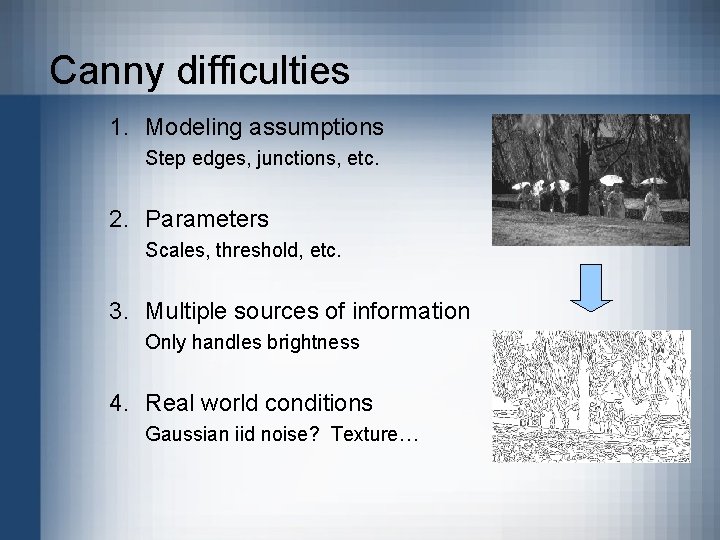
Canny difficulties 1. Modeling assumptions Step edges, junctions, etc. 2. Parameters Scales, threshold, etc. 3. Multiple sources of information Only handles brightness 4. Real world conditions Gaussian iid noise? Texture…
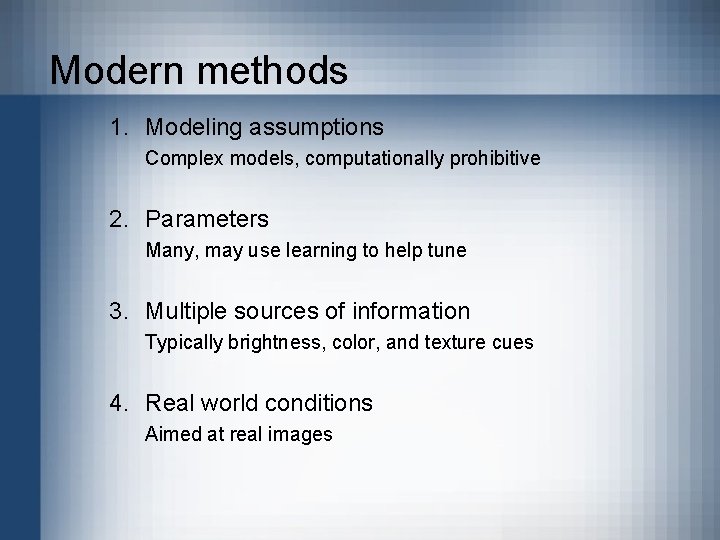
Modern methods 1. Modeling assumptions Complex models, computationally prohibitive 2. Parameters Many, may use learning to help tune 3. Multiple sources of information Typically brightness, color, and texture cues 4. Real world conditions Aimed at real images
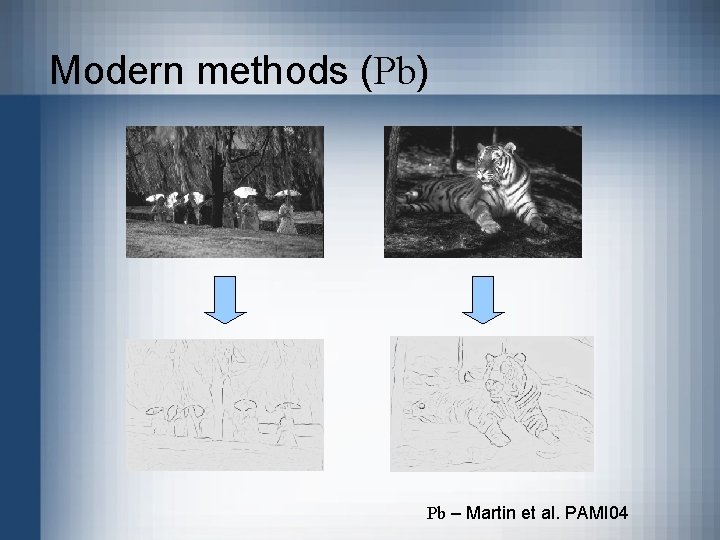
Modern methods (Pb) Pb – Martin et al. PAMI 04
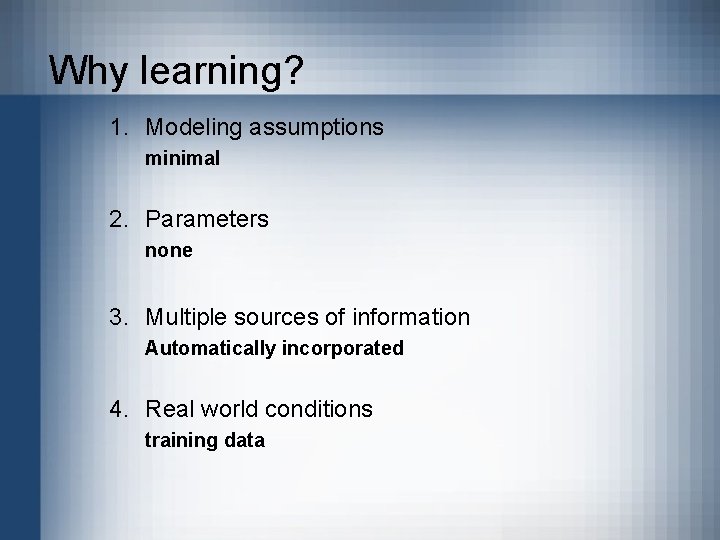
Why learning? 1. Modeling assumptions minimal 2. Parameters none 3. Multiple sources of information Automatically incorporated 4. Real world conditions training data
Outline • • I. III. IV. Motivation Problem formulation Learning architecture (BEL) Results
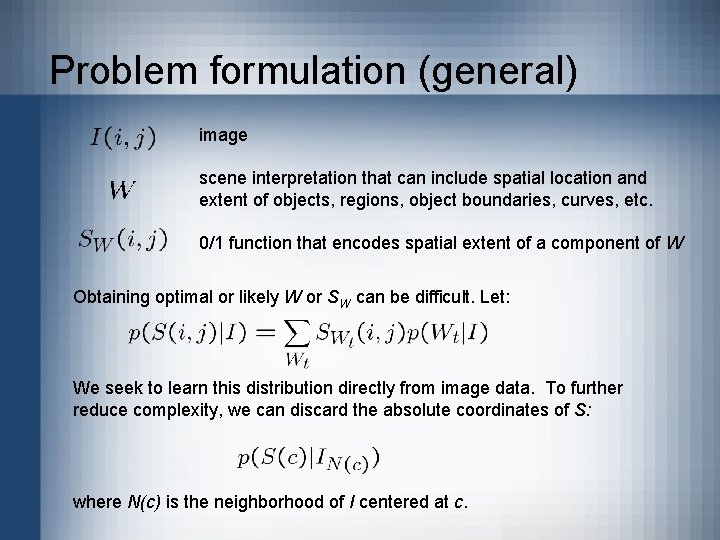
Problem formulation (general) image scene interpretation that can include spatial location and extent of objects, regions, object boundaries, curves, etc. 0/1 function that encodes spatial extent of a component of W Obtaining optimal or likely W or SW can be difficult. Let: We seek to learn this distribution directly from image data. To further reduce complexity, we can discard the absolute coordinates of S: where N(c) is the neighborhood of I centered at c.
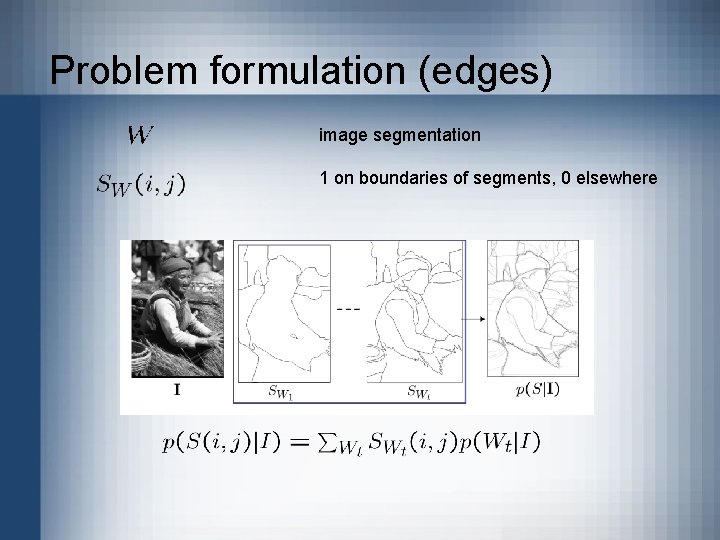
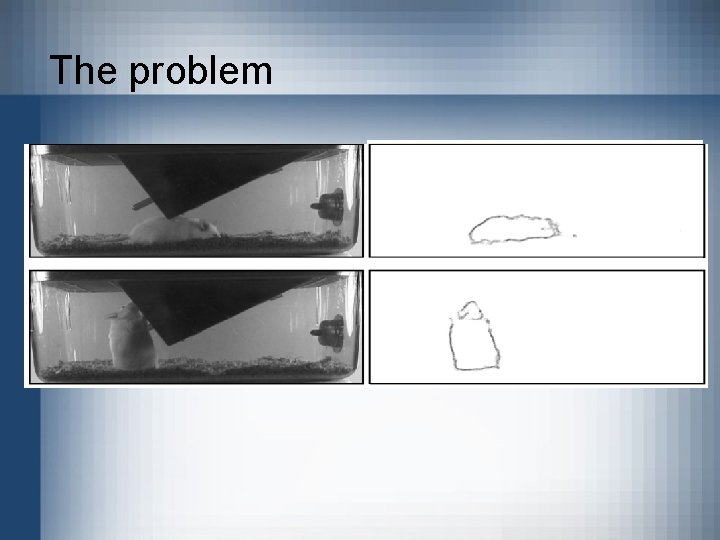
Problem formulation (edges) image segmentation 1 on boundaries of segments, 0 elsewhere
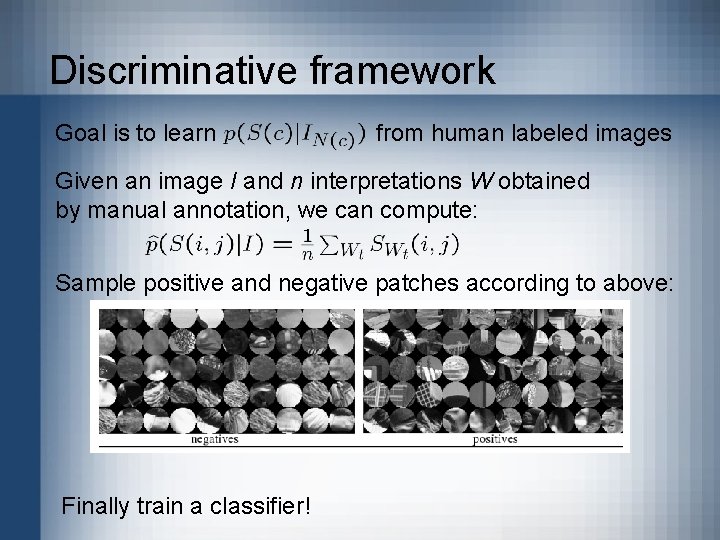
Discriminative framework Goal is to learn from human labeled images Given an image I and n interpretations W obtained by manual annotation, we can compute: Sample positive and negative patches according to above: Finally train a classifier!
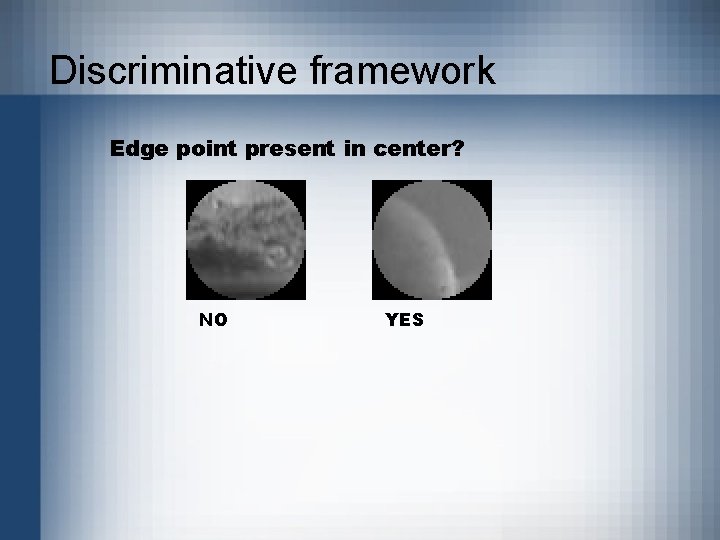
Discriminative framework Edge point present in center? NO YES
Outline • • I. III. IV. Motivation Problem formulation Learning architecture (BEL) Results
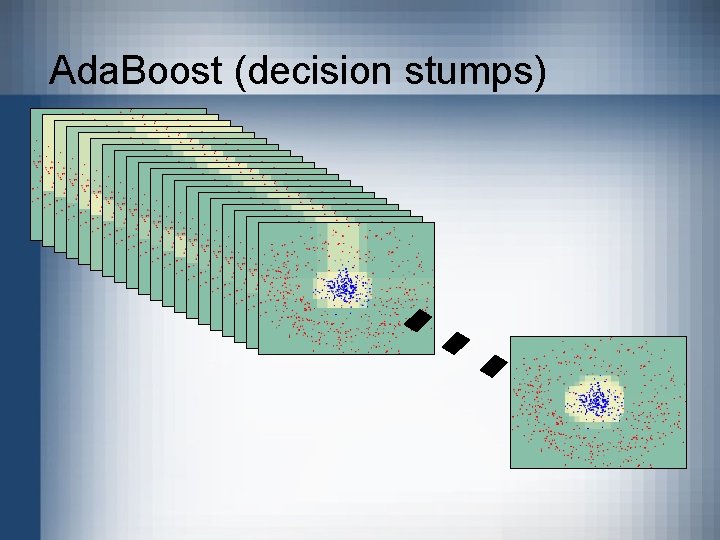
Learning architecture • Large training set O(108) – but correlated – very variable data • Want generic, efficient features – applicability to any domain – fast computation essential • Boosting a natural choice
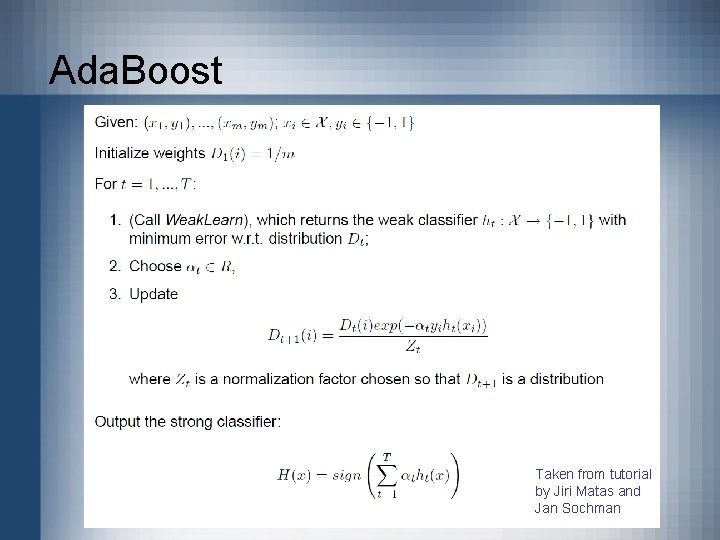
Ada. Boost Taken from tutorial by Jiri Matas and Jan Sochman
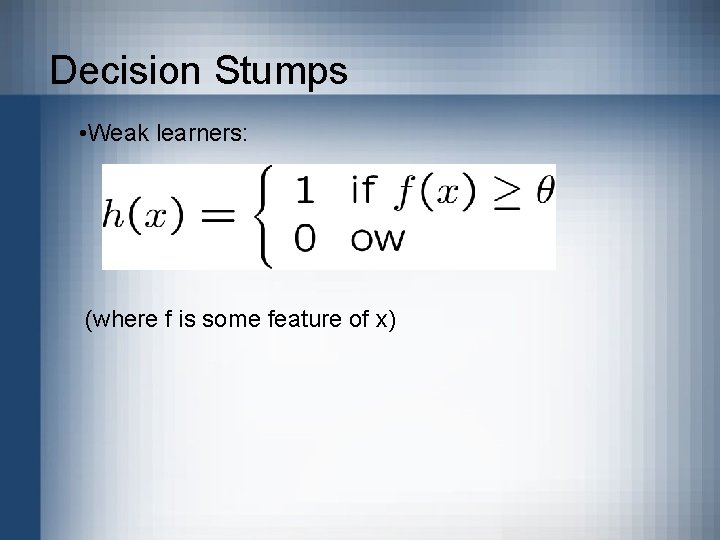
Decision Stumps • Weak learners: (where f is some feature of x)
Ada. Boost (decision stumps)
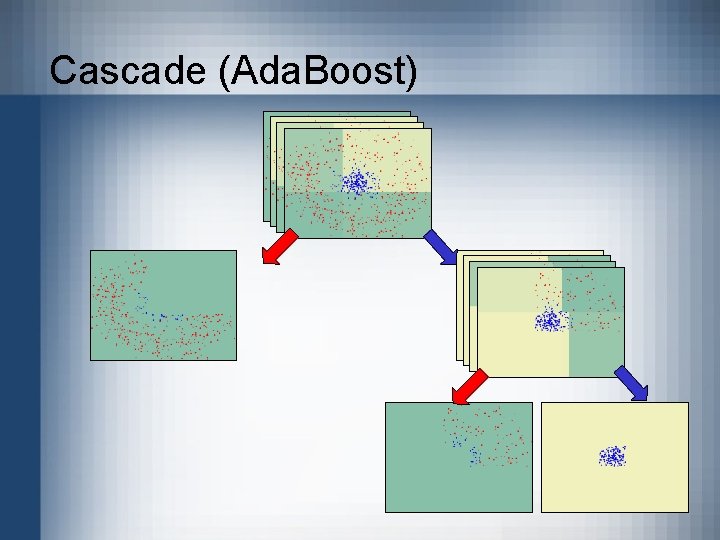
Cascaded classifiers • Minimize computation during testing • Especially useful for skewed prior • Viola-Jones face/pedestrian detection
Cascade (Ada. Boost)
Probabilistic boosting trees • Expected amount of computation decreases significantly • Once a mistake is made, it cannot be undone • Cascade also made problem easier! Ideally, splitting data creates two sub-problems each much easier than original…
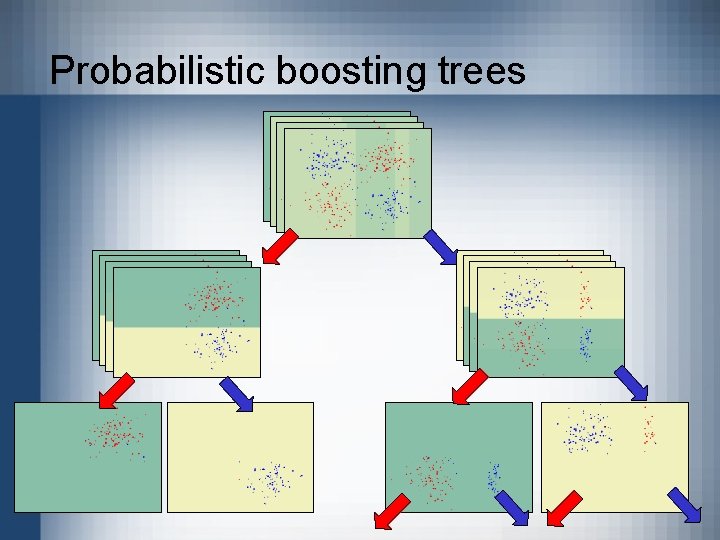
Probabilistic boosting trees
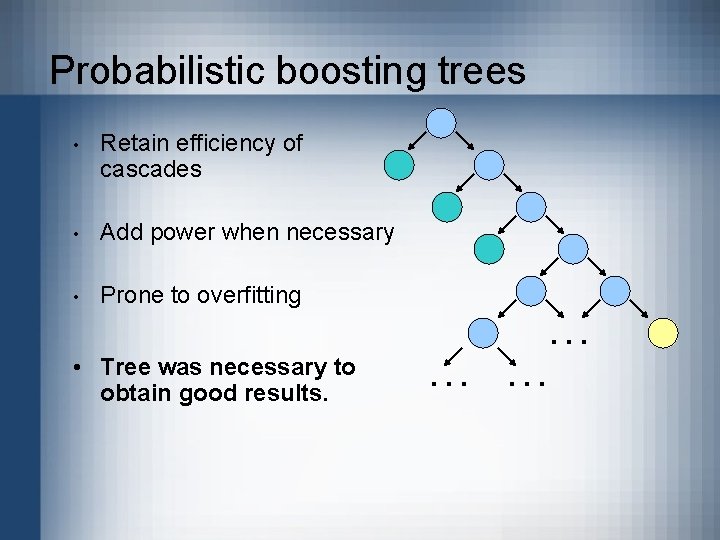
Probabilistic boosting trees • Retain efficiency of cascades • Add power when necessary • Prone to overfitting • Tree was necessary to obtain good results. … … …
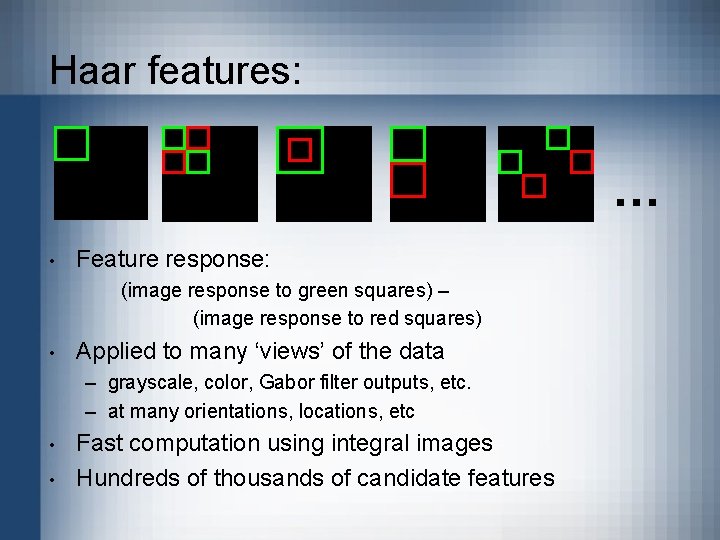
Haar features: … • Feature response: (image response to green squares) – (image response to red squares) • Applied to many ‘views’ of the data – grayscale, color, Gabor filter outputs, etc. – at many orientations, locations, etc • • Fast computation using integral images Hundreds of thousands of candidate features
Outline • • I. III. IV. – – Motivation Problem formulation Learning architecture (BEL) Results Gestalt laws Natural images Road detection Object Boundaries
Results • Boosted edge learning (BEL) • Compare to method with best known performance (Pb), and also to Canny • Comparison not quite fair… Pb – Martin et al. PAMI 04

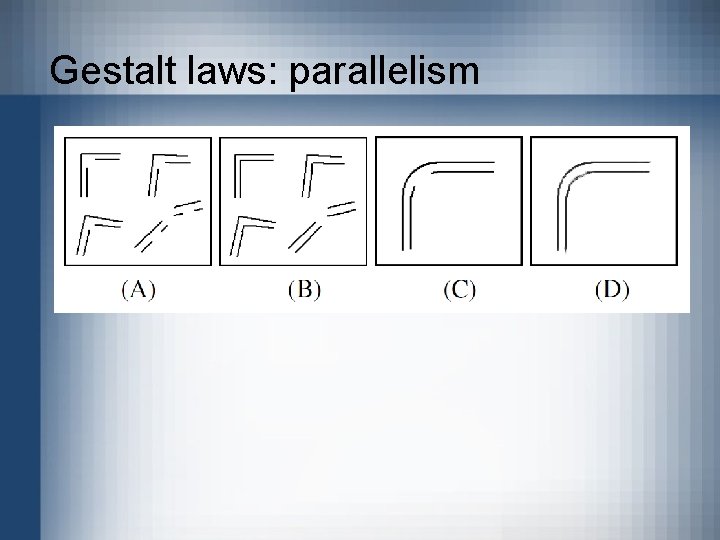
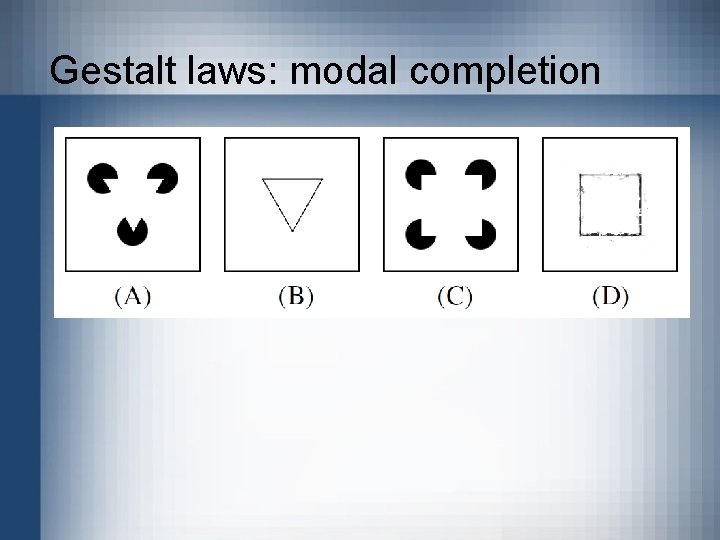
Gestalt laws • Gestalt laws of perceptual organization – Symmetry, closure, parallelism, etc. – Govern how component parts are organized into overall patterns • The “hard” part of edge detection • What can and cannot be achieved in our framework?
Analogies A: B : : C : ?
Gestalt laws: parallelism
Gestalt laws: modal completion
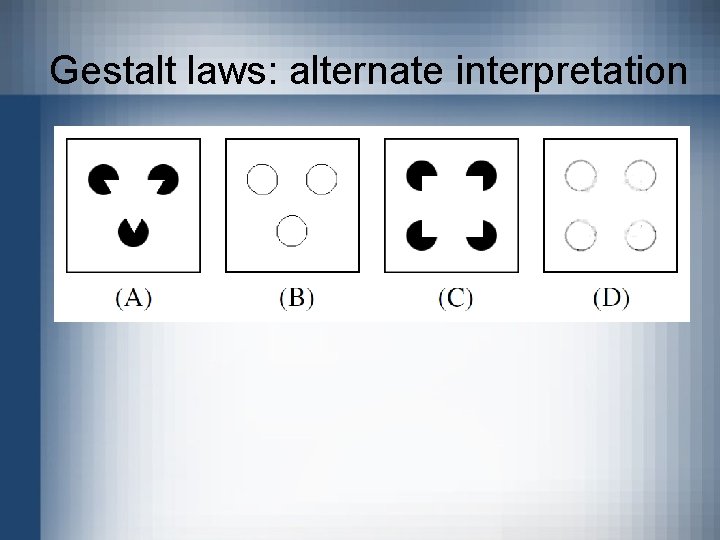
Gestalt laws: alternate interpretation
Outline • • I. III. IV. – – Motivation Problem formulation Learning architecture (BEL) Results Gestalt laws Natural images Road detection Object Boundaries
Natural Images • Berkeley Segmentation Dataset and Benchmark – Standard dataset for edge detection with 300 manually annotated images – Modern benchmark for comparing edge detection algorithms • Notes: – Edge detection in natural images is hard – Possibly ill-defined problem – Evil but necessary comparison
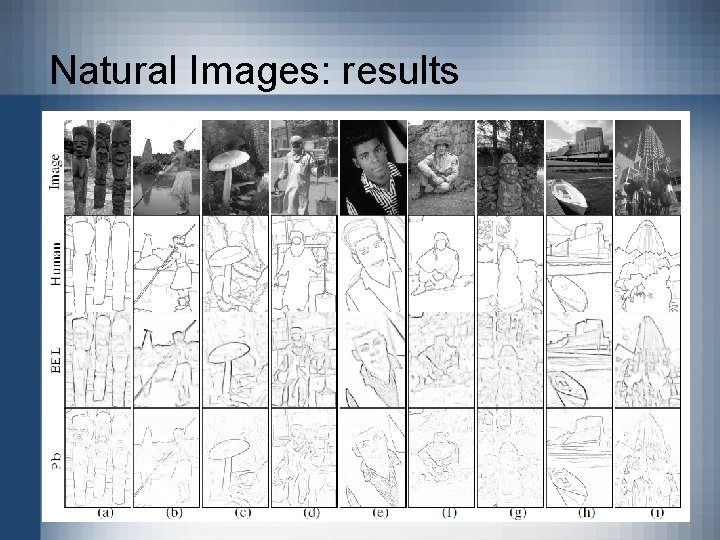
Natural Images: results
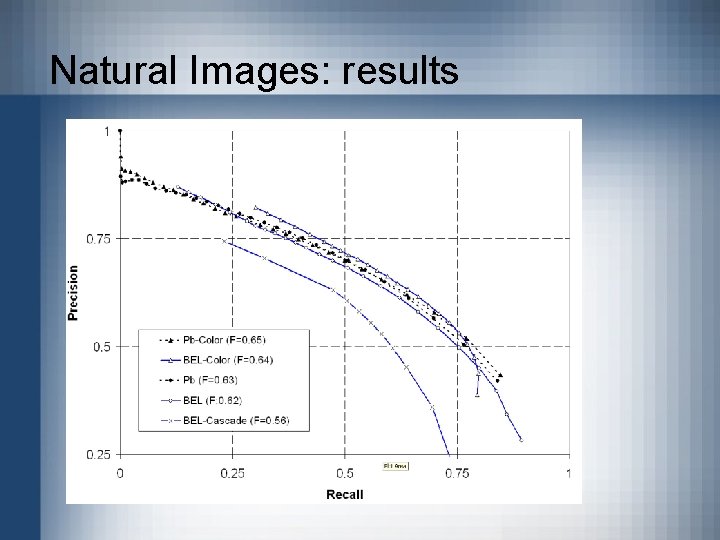
Natural Images: results
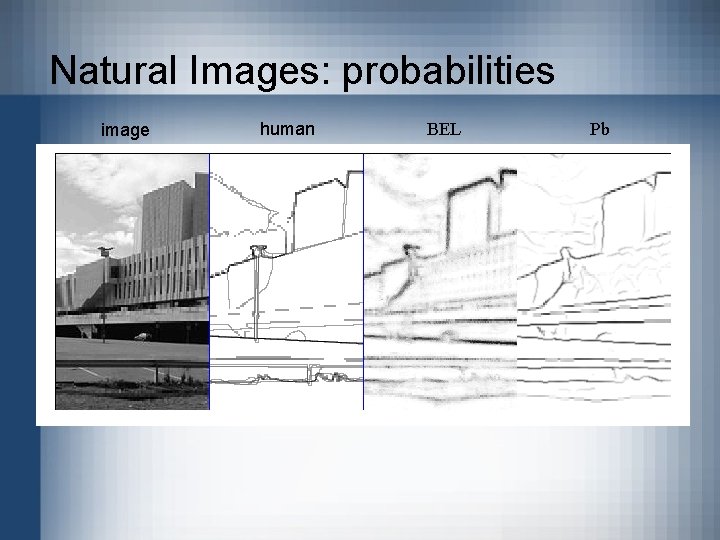
Natural Images: probabilities image human BEL Pb
Outline • • I. III. IV. – – Motivation Problem formulation Learning architecture (BEL) Results Gestalt laws Natural images Road detection Object Boundaries
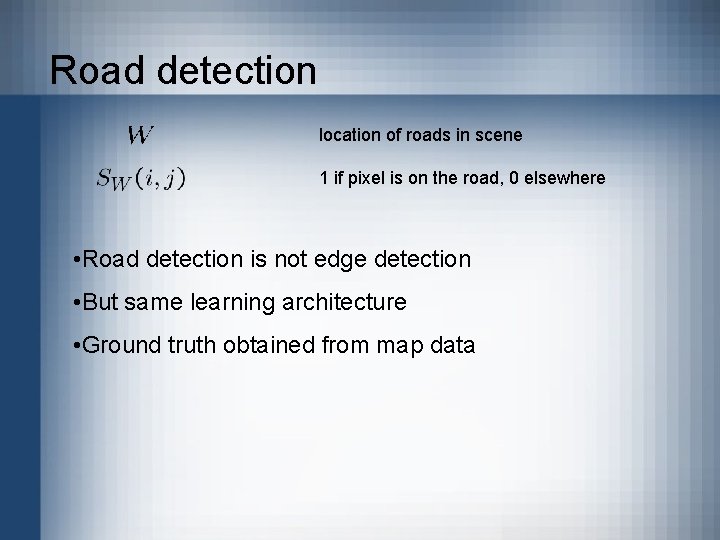
Road detection location of roads in scene 1 if pixel is on the road, 0 elsewhere • Road detection is not edge detection • But same learning architecture • Ground truth obtained from map data
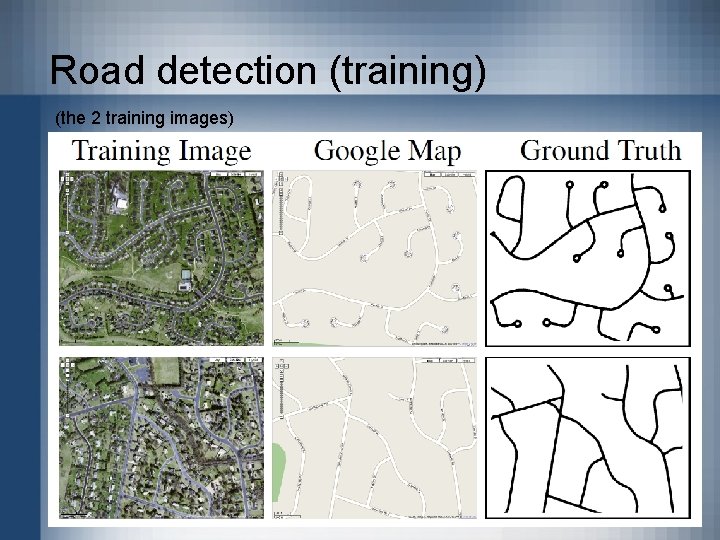
Road detection (training) (the 2 training images)
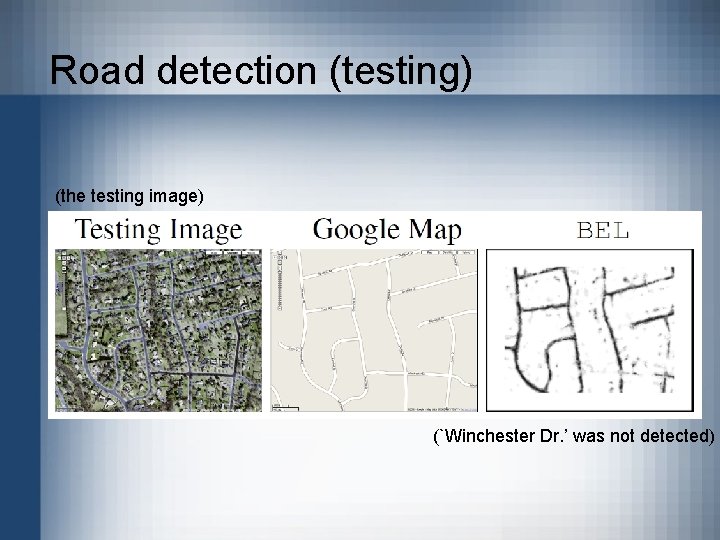
Road detection (testing) (the testing image) (`Winchester Dr. ’ was not detected)
Outline • • I. III. IV. – – Motivation Problem formulation Learning architecture (BEL) Results Gestalt laws Natural images Road detection Object Boundaries
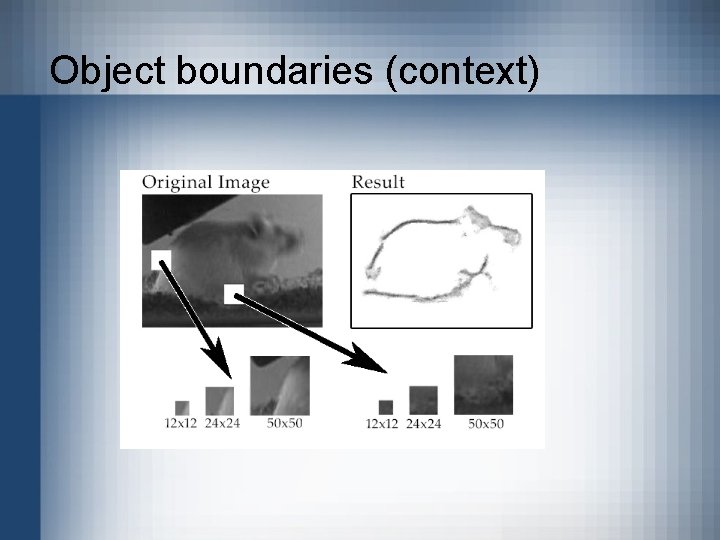
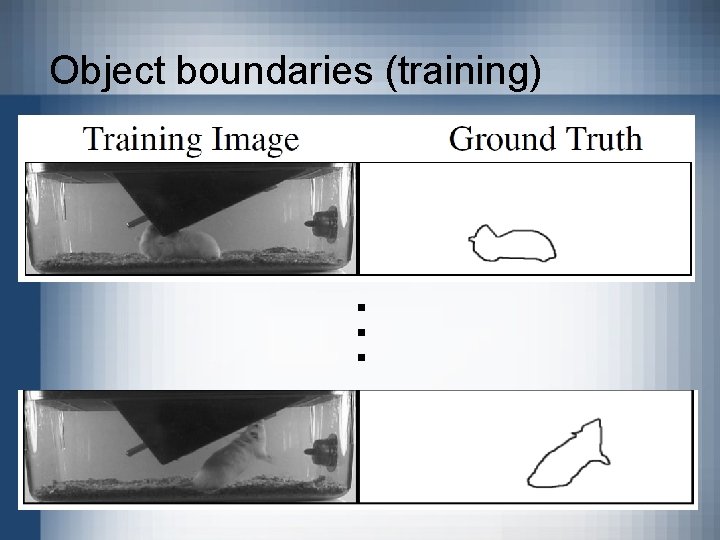
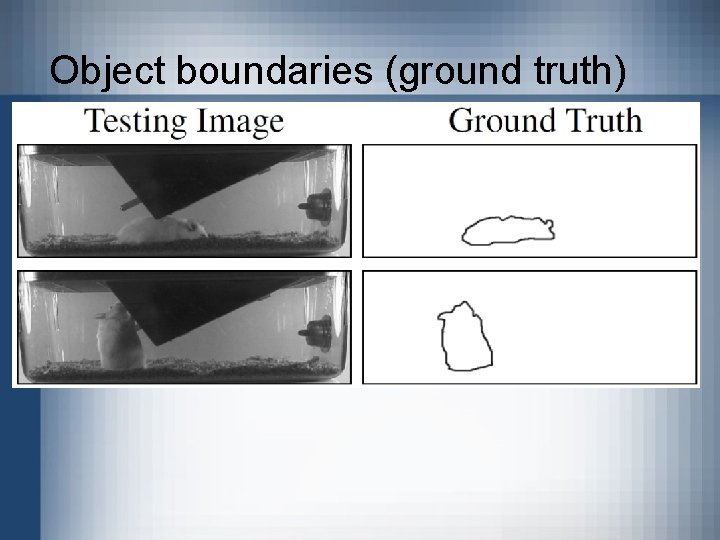
Object boundaries location and extent of object of interest 1 on boundaries of object, 0 elsewhere • Must tune to specific ‘type’ of edge • Algorithms that model edges not applicable • Potentially most useful application
Object boundaries (context)
Object boundaries (training) …
Object boundaries (ground truth)
Object boundaries (Canny) F-score =. 10
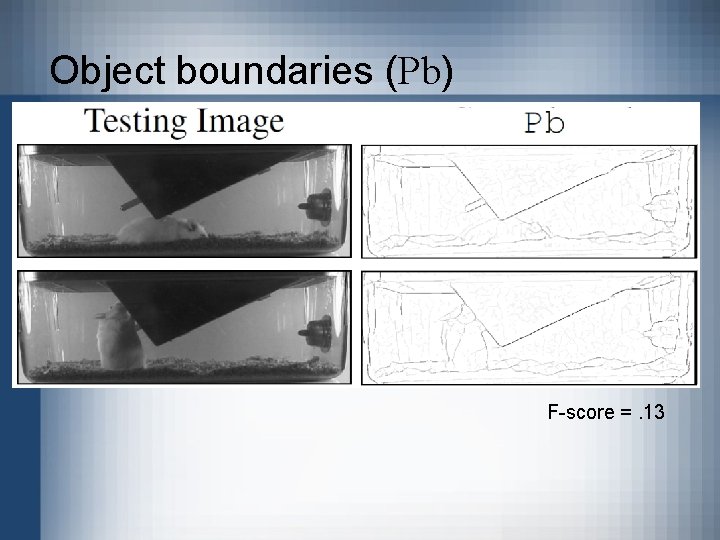
Object boundaries (Pb) F-score =. 13
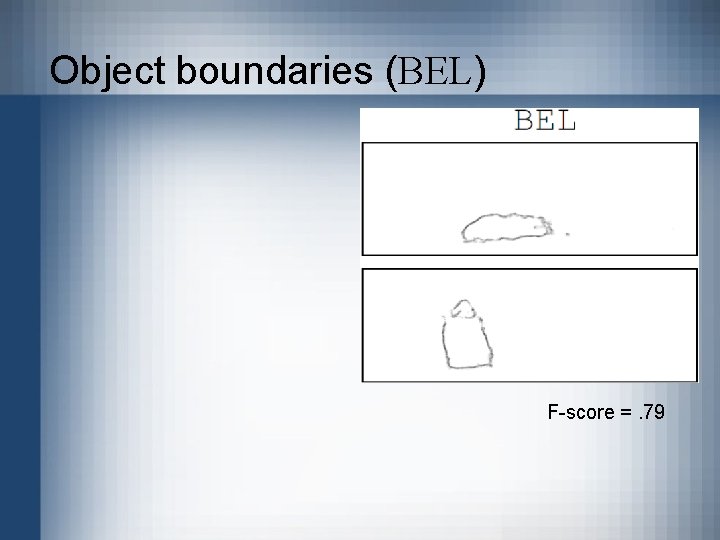
Object boundaries (BEL) F-score =. 79
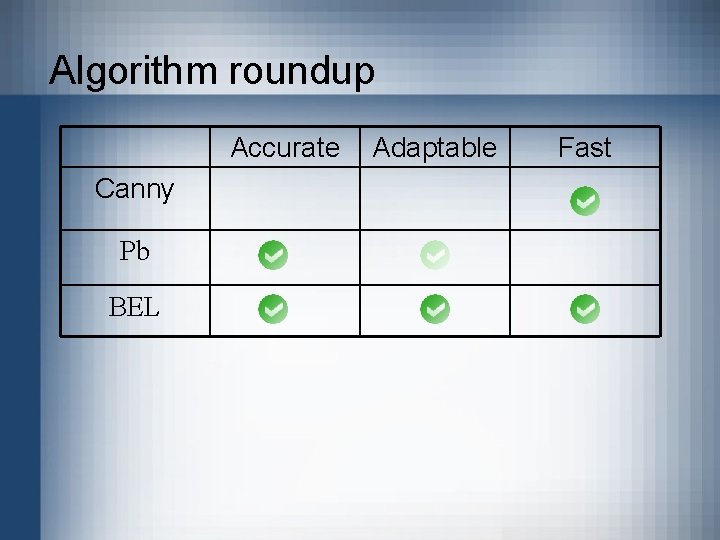
Algorithm roundup Accurate Canny Pb BEL Adaptable Fast
Summary • Define edges only in terms of labeled data, minimal modeling assumptions • Minimize human effort in adapting algorithm to particular domain • Fast, affordable edge detection for the masses!
Thank you!
- Slides: 55