
Supervised Learning Bias and Variance Ayal Gussow 1
Supervised Learning: Bias and Variance Ayal Gussow 1
Today’s Outline 1) Evaluating our models 2) Balancing bias and variance 3) How to fit hyperparameters 4) Homework 2

Evaluating our Model • We need a way to assess how well we are doing • Tune our algorithm. • Report how well we are doing to a client, journal, etc.
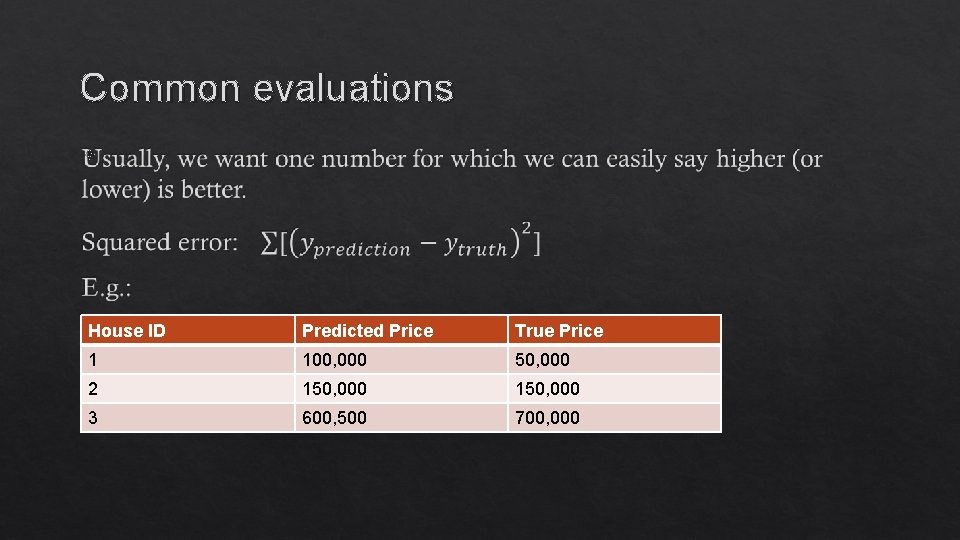
Common evaluations House ID Predicted Price True Price 1 100, 000 50, 000 2 150, 000 3 600, 500 700, 000
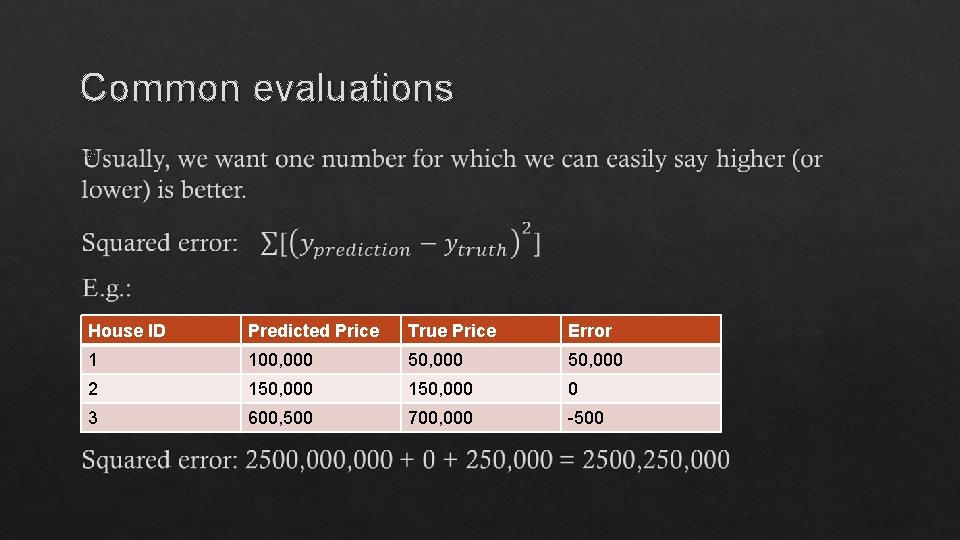
Common evaluations House ID Predicted Price True Price Error 1 100, 000 50, 000 2 150, 000 0 3 600, 500 700, 000 -500
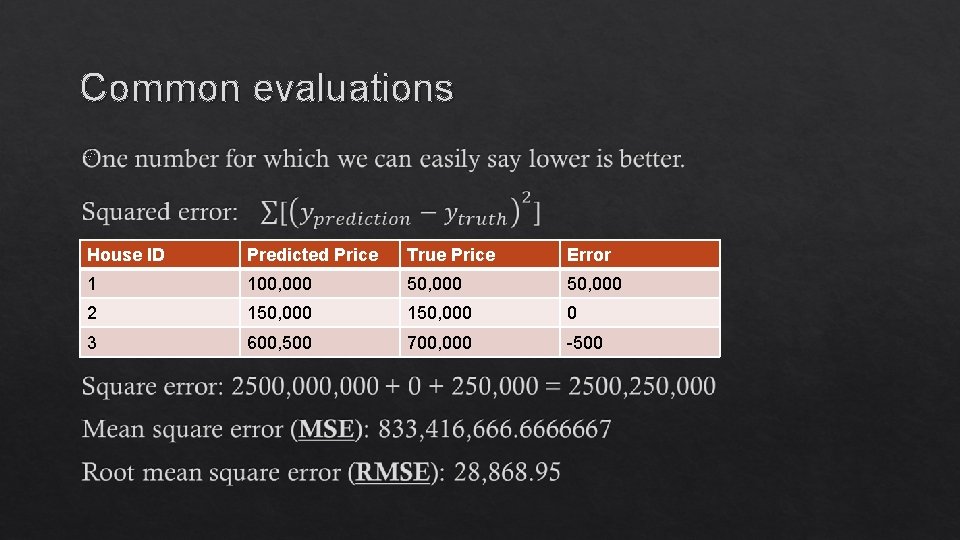
Common evaluations House ID Predicted Price True Price Error 1 100, 000 50, 000 2 150, 000 0 3 600, 500 700, 000 -500
Common evaluations We’ll talk about evaluations for classification in next class, but you’re probably familiar with some: • ROC AUC • PR-AUC
Common evaluations How you evaluate is subjective. • Human level? (radiologist example) • Some semi-arbitrary cutoff (e. g. 50 K deviation from house prices) • More complex needs, specific to your situation (perhaps you’d prefer to underestimate the chance of a false positive? ) This decision is subjective and will affect your model and outcomes.

Ames Dataset of houses in Ames, Iowa with 79 features per house, including: - Square footage - Number of bathrooms - Number of fireplaces - etc Price
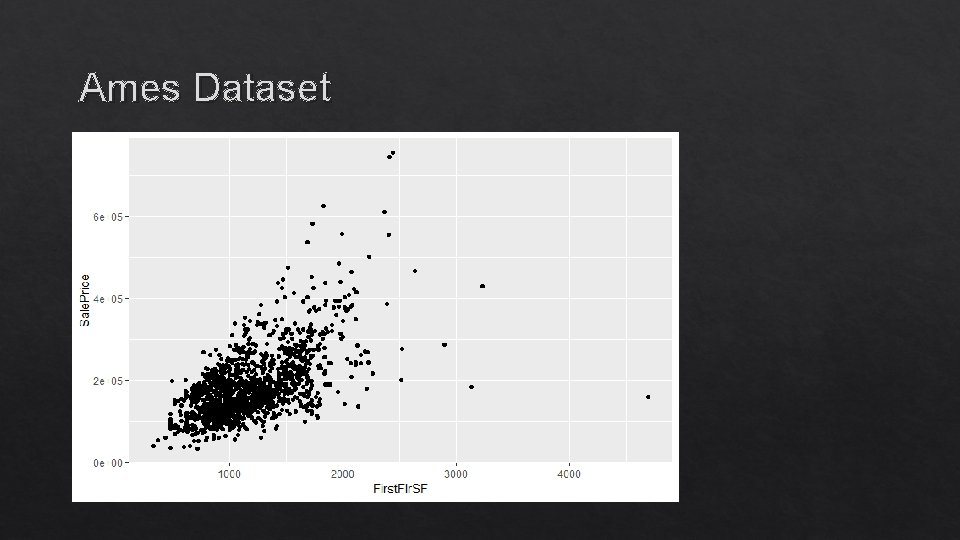
Ames Dataset

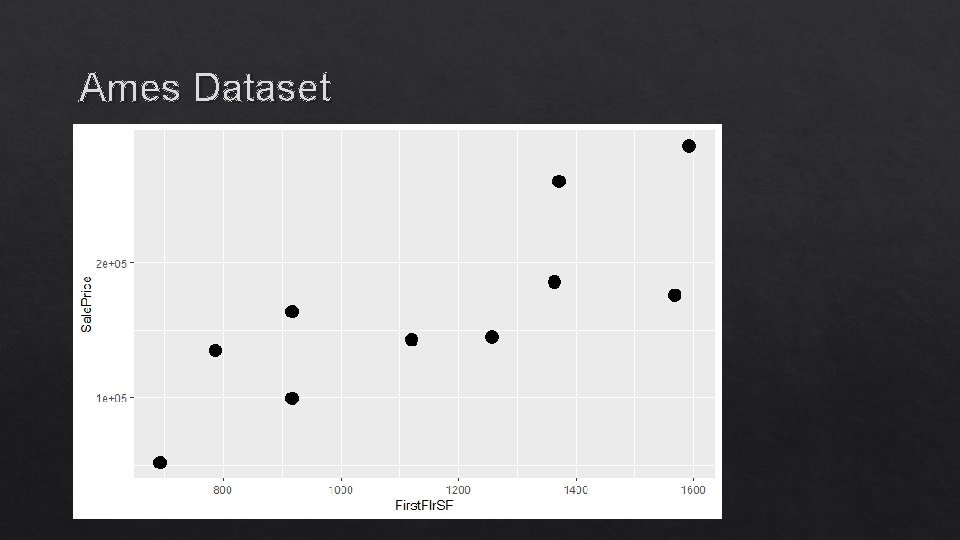
Ames Dataset of houses in Ames, Iowa. Subset to 10 houses. Features: - Square footage of first floor Predict: Price
Ames Dataset
Linear Regression 13
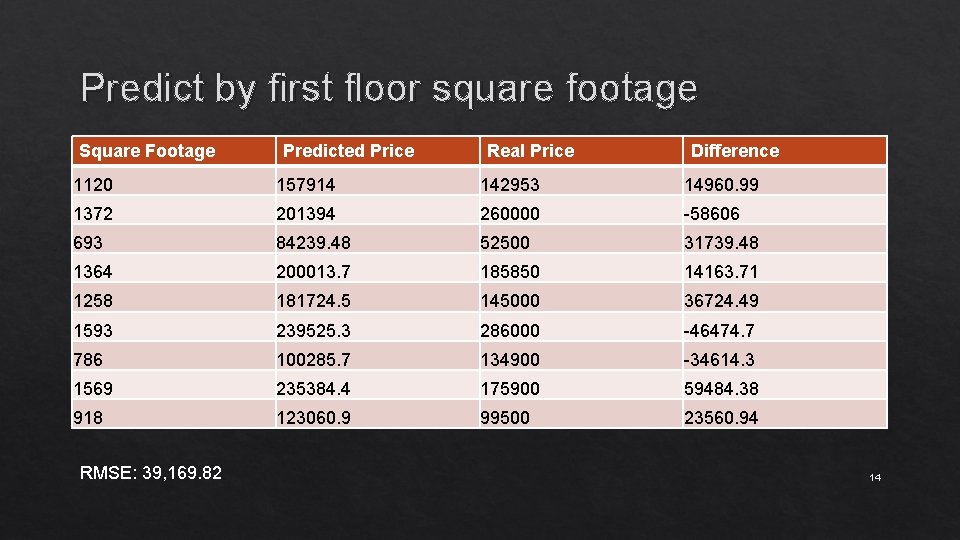
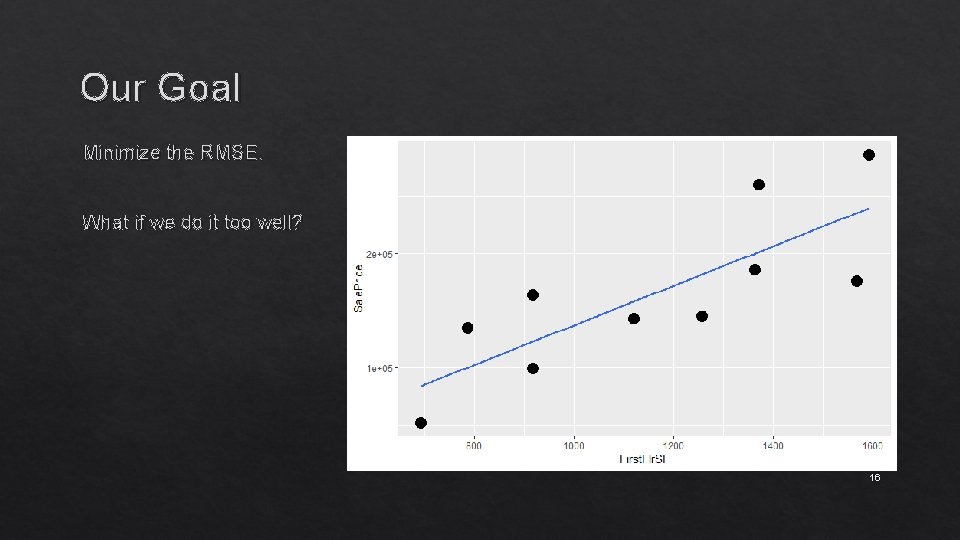
Predict by first floor square footage Square Footage Predicted Price Real Price Difference 1120 157914 142953 14960. 99 1372 201394 260000 -58606 693 84239. 48 52500 31739. 48 1364 200013. 7 185850 14163. 71 1258 181724. 5 145000 36724. 49 1593 239525. 3 286000 -46474. 7 786 100285. 7 134900 -34614. 3 1569 235384. 4 175900 59484. 38 918 123060. 9 99500 23560. 94 RMSE: 39, 169. 82 14
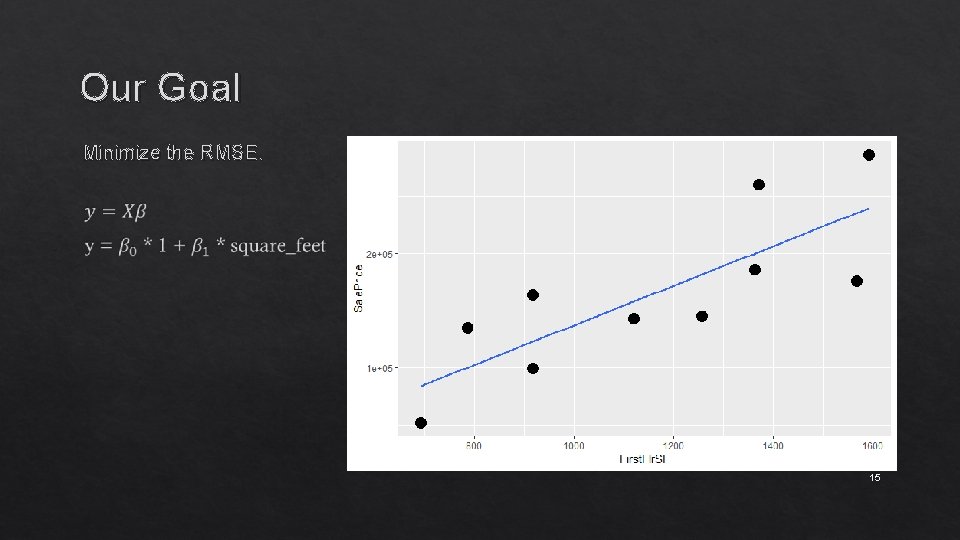
Our Goal Minimize the RMSE. 15
Our Goal Minimize the RMSE. What if we do it too well? 16
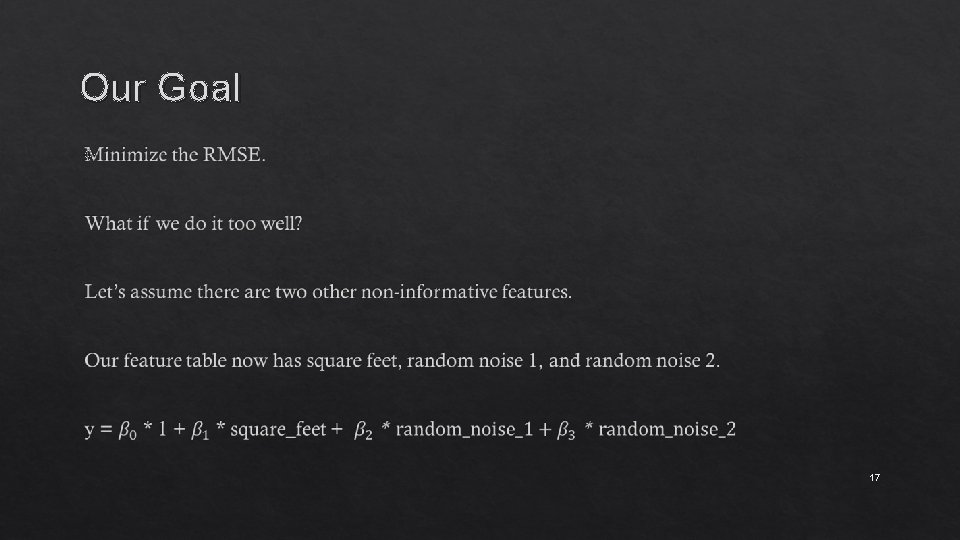
Our Goal 17
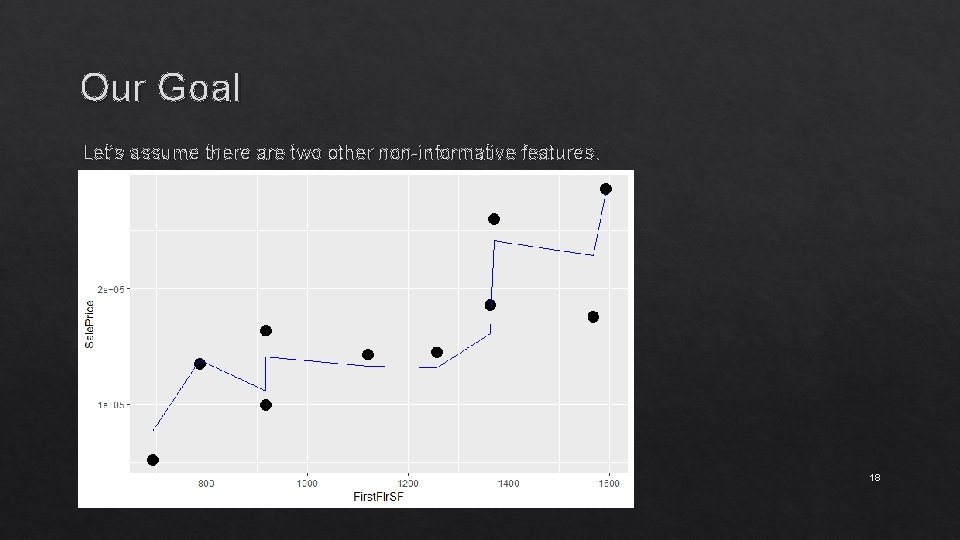
Our Goal Let’s assume there are two other non-informative features. 18
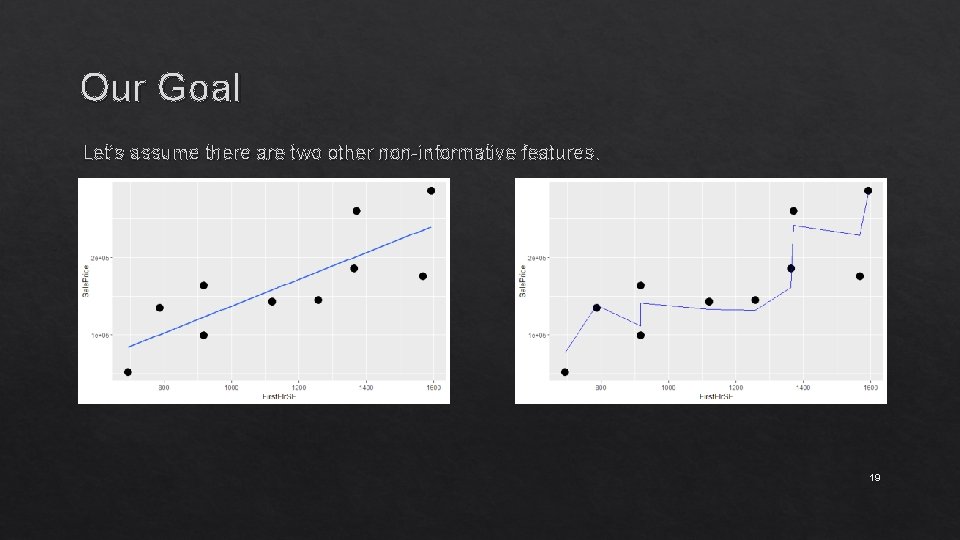
Our Goal Let’s assume there are two other non-informative features. 19
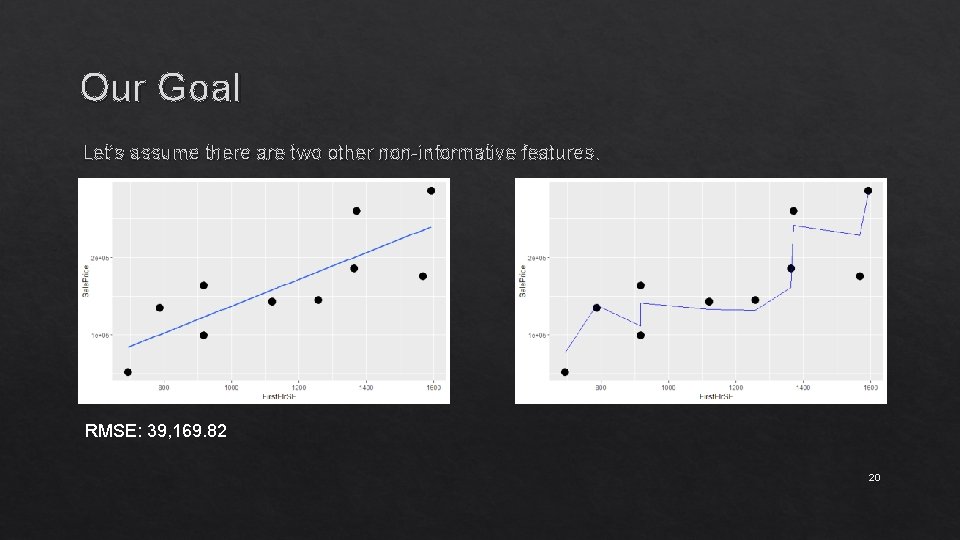
Our Goal Let’s assume there are two other non-informative features. RMSE: 39, 169. 82 20
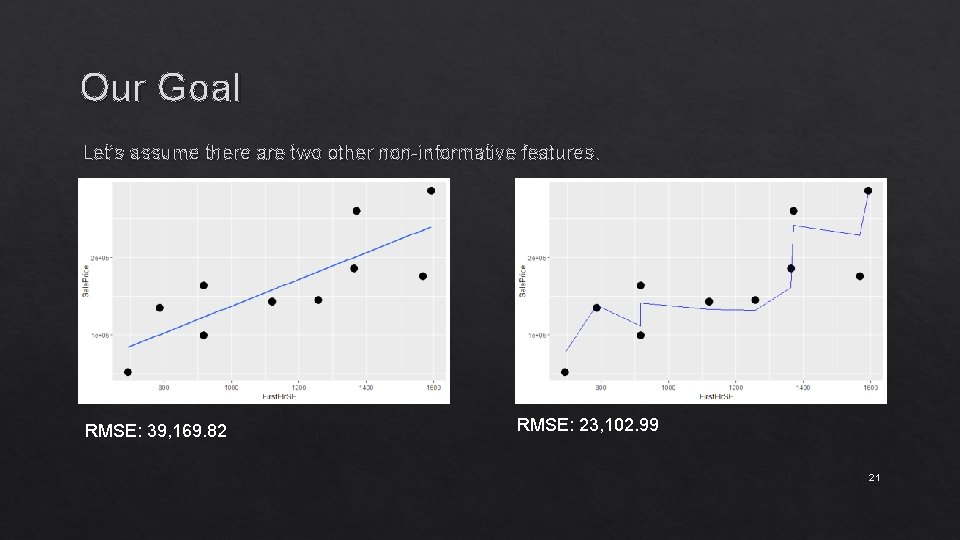
Our Goal Let’s assume there are two other non-informative features. RMSE: 39, 169. 82 RMSE: 23, 102. 99 21
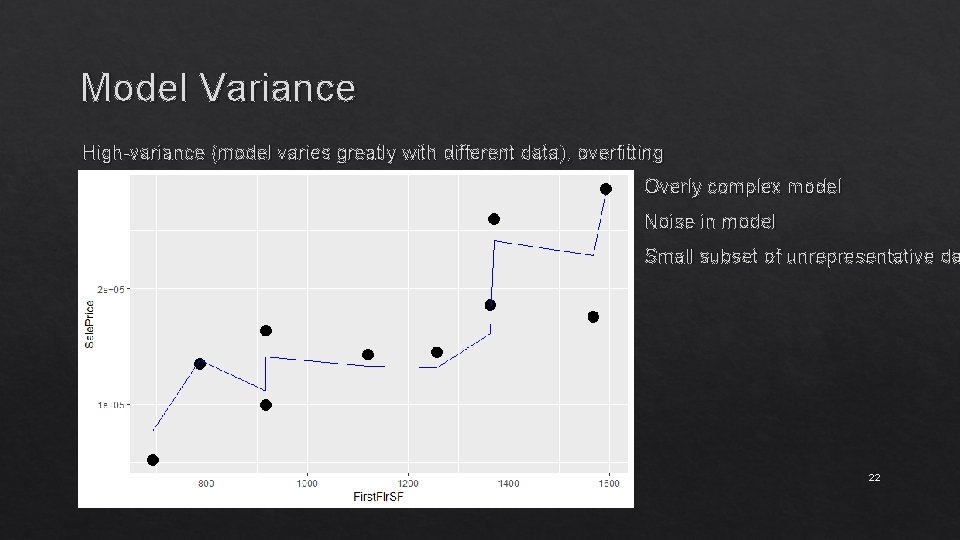
Model Variance High-variance (model varies greatly with different data), overfitting Overly complex model Noise in model Small subset of unrepresentative da 22
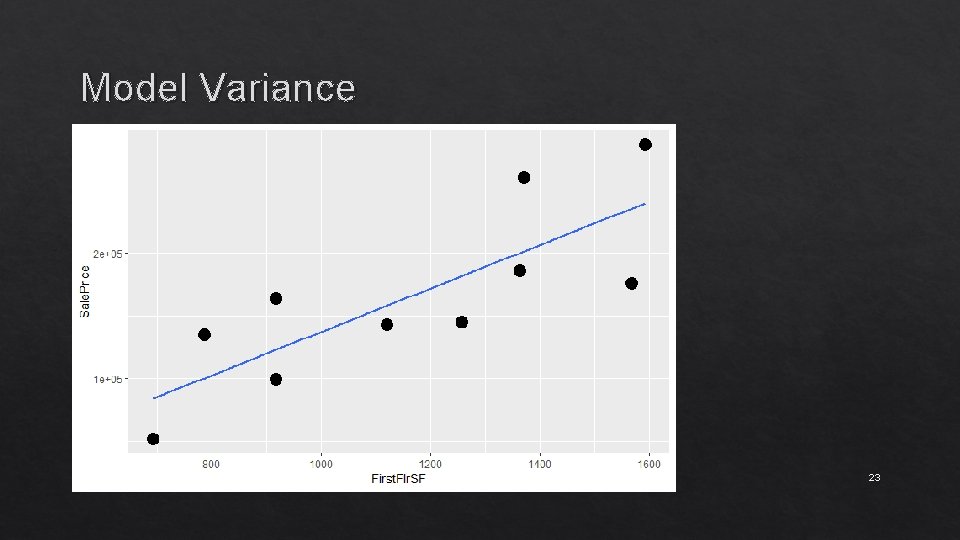
Model Variance 23
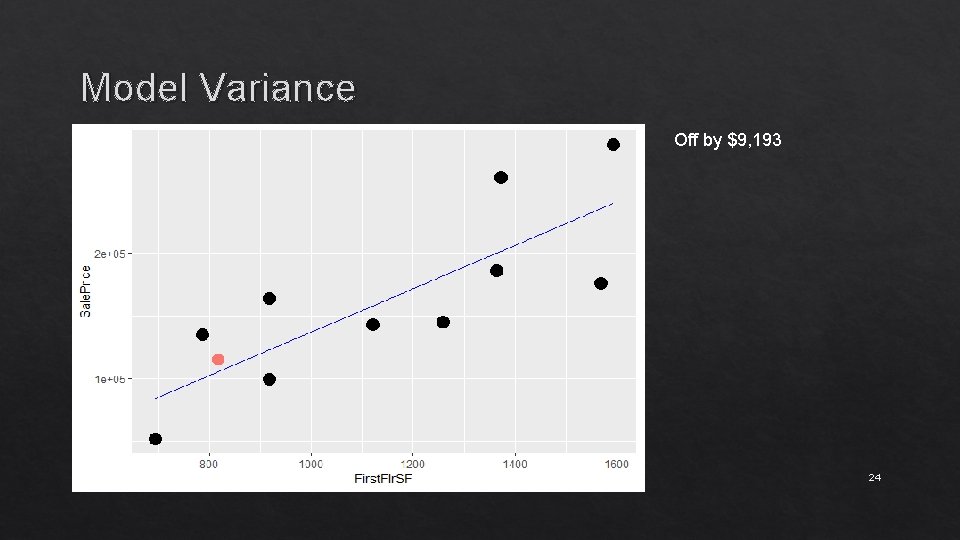
Model Variance Off by $9, 193 24
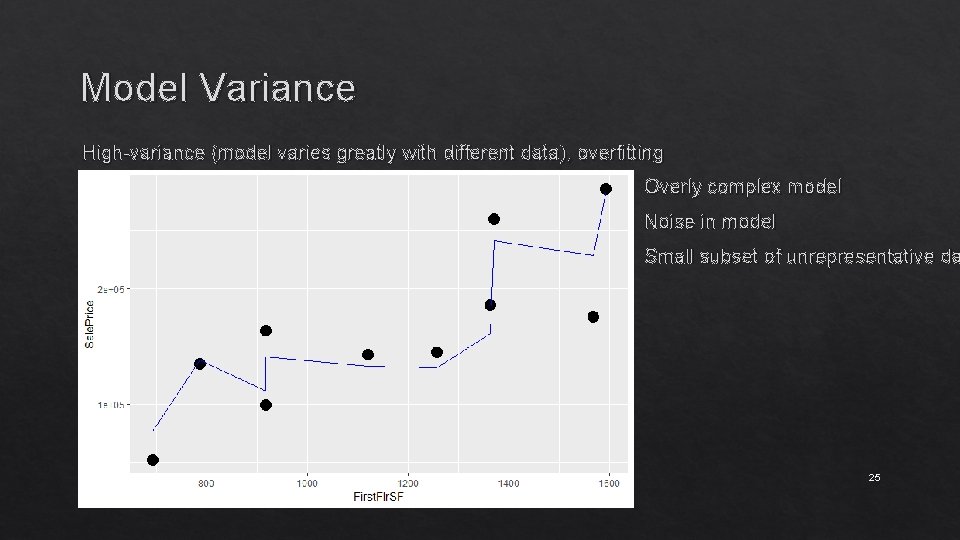
Model Variance High-variance (model varies greatly with different data), overfitting Overly complex model Noise in model Small subset of unrepresentative da 25

Model Variance High-variance (model varies greatly with different data), overfitting Off by $31, 608 26
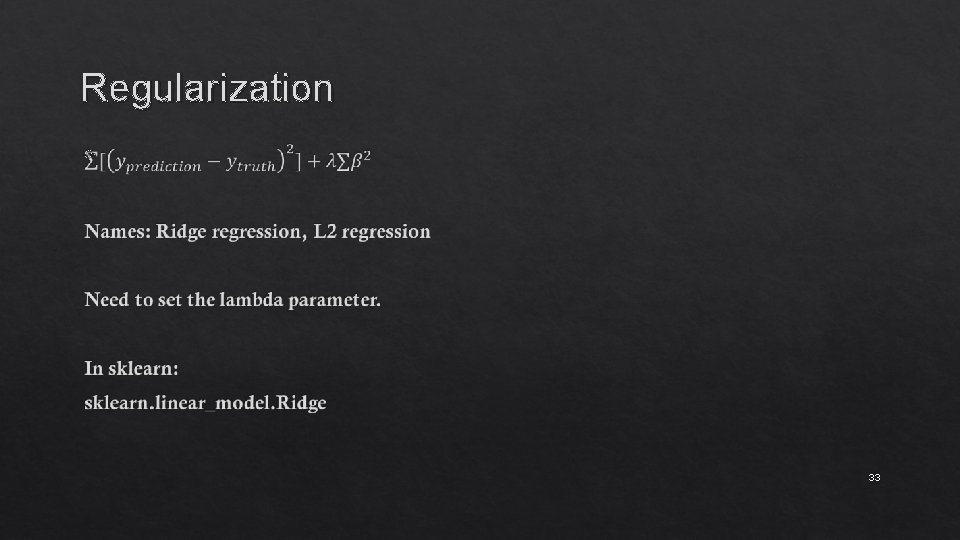
Model Variance High-variance models don’t generalize well. How to combat it? 1) More data. 2) Simpler models. 1) E. g. Linear regression vs Decision Tree 2) Manually select features, more features leads to a more complex model. 3) Regularization. Penalize model for giving too much weight to a given feature. 4) Cross-validation. Assessment of how well the model generalizes. 27

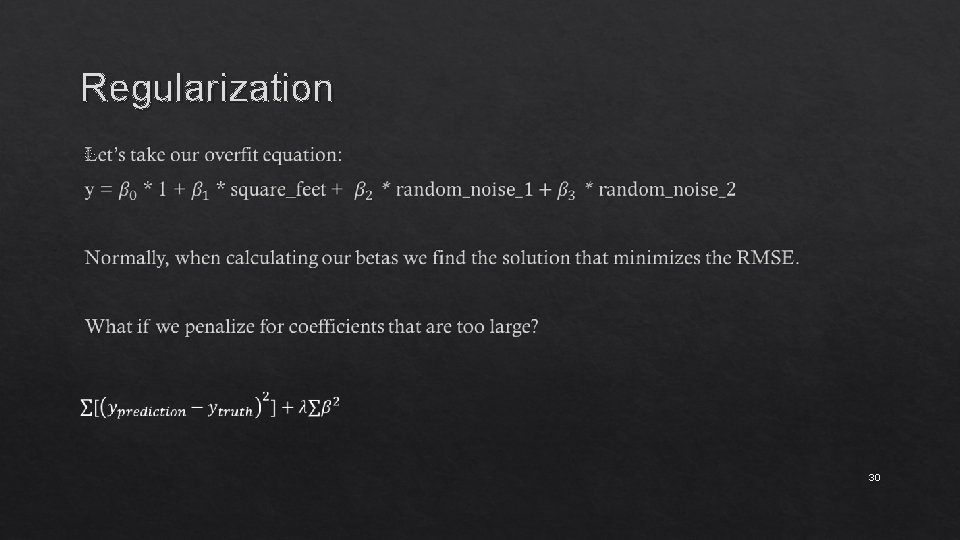
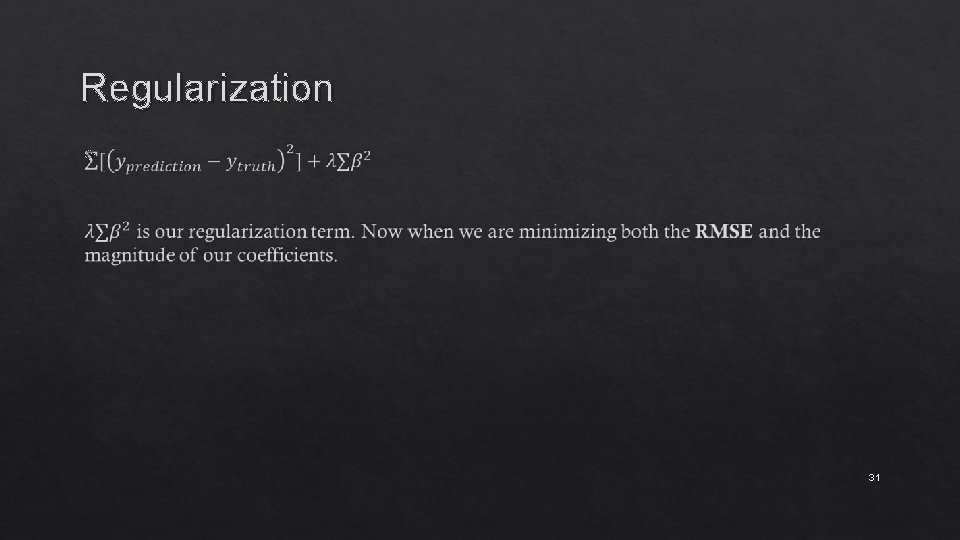
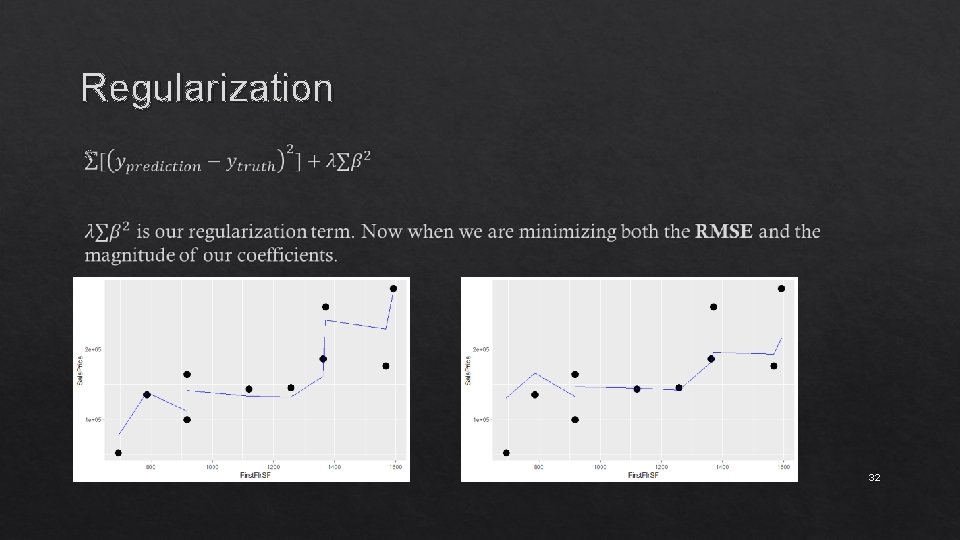
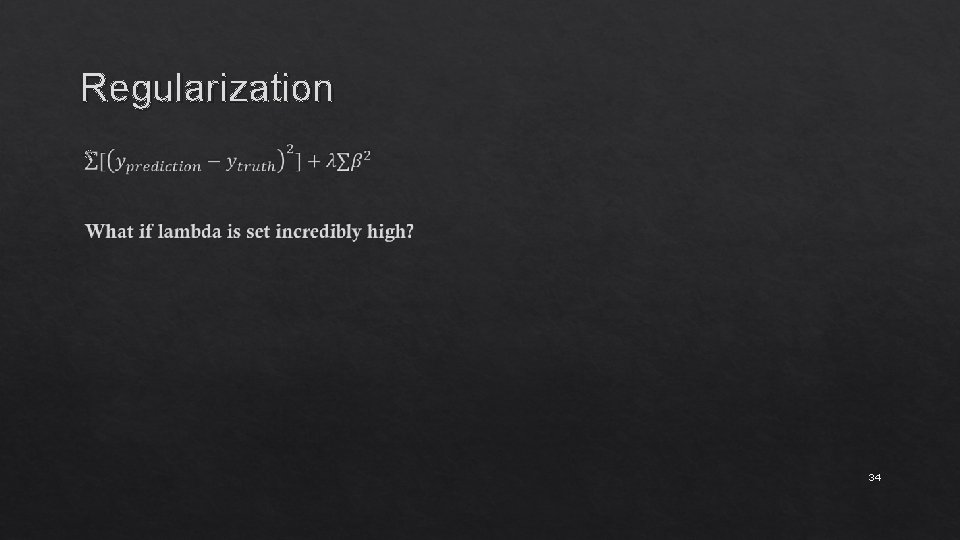
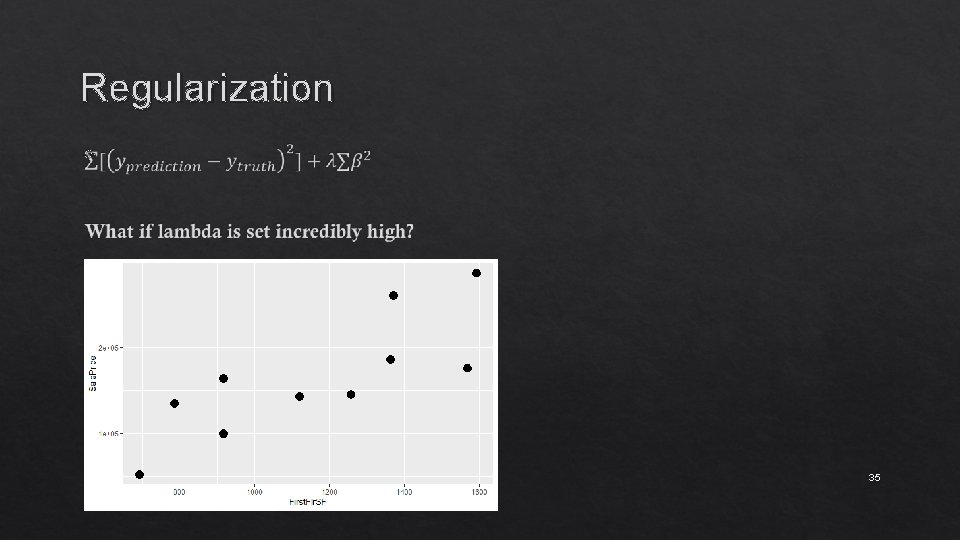
Regularization Basic goal: Lower model complexity and prevent overfitting. This can be done by minimizing the our coefficients. 28
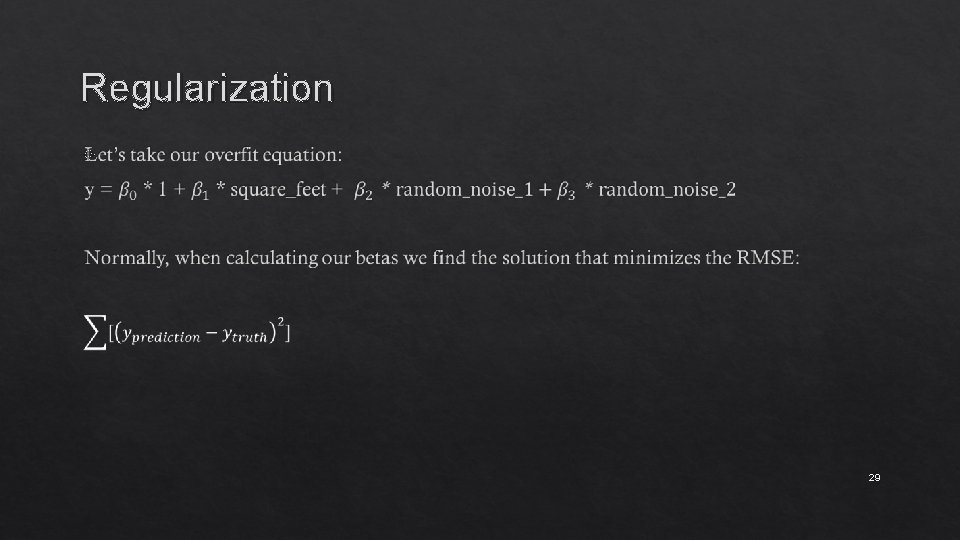
Regularization 29
Regularization 30
Regularization 31
Regularization 32
Regularization 33
Regularization 34
Regularization 35
High Bias High bias, underfitting 36
High Bias vs High Variance High Bias, underfitting High Variance, overfitting 37
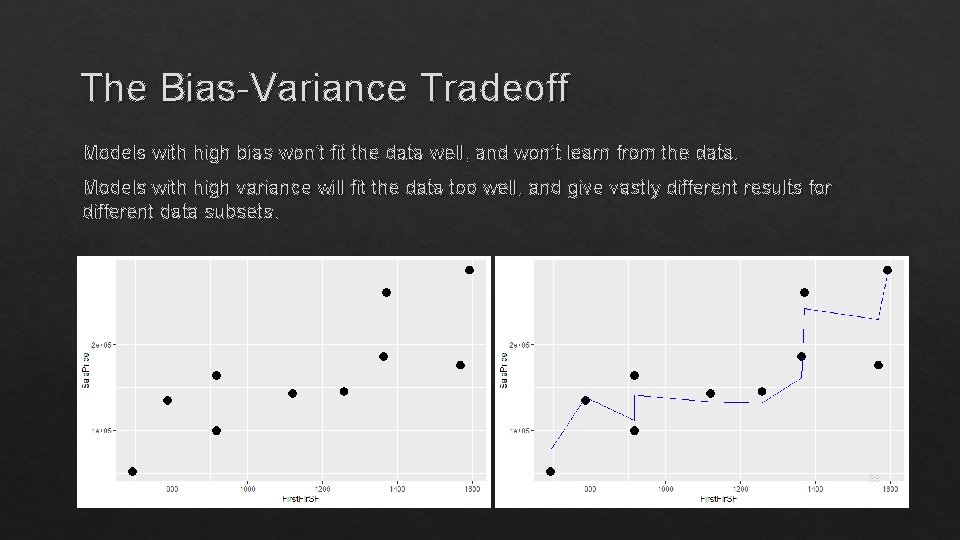
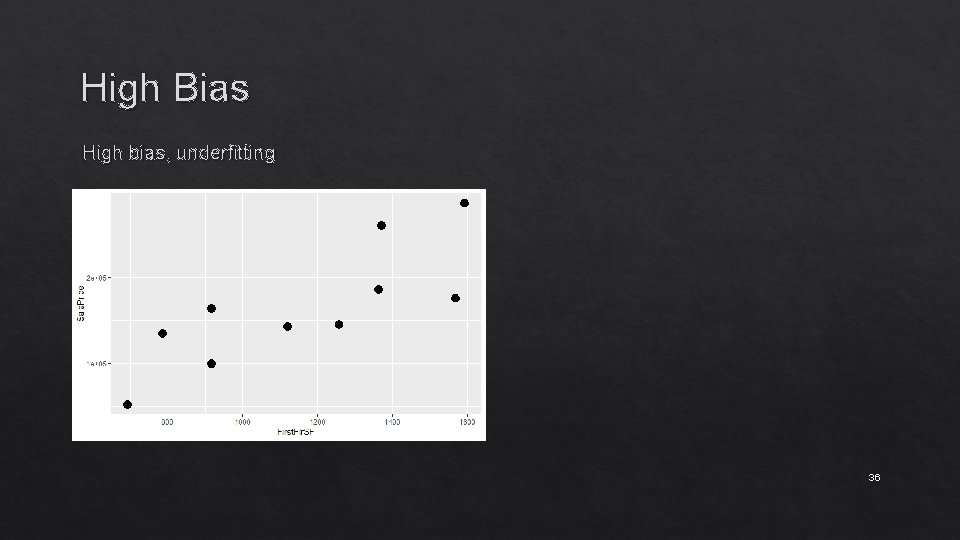
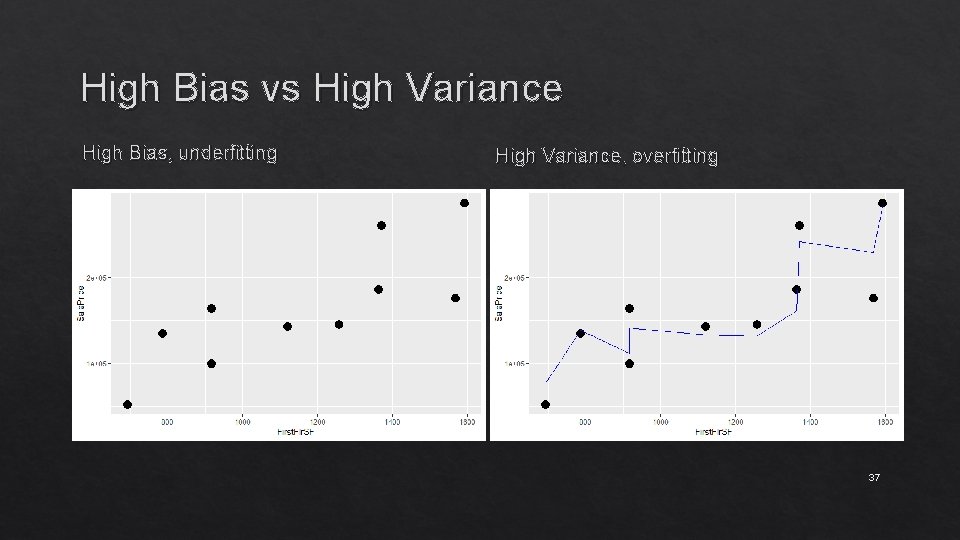
The Bias-Variance Tradeoff Models with high bias won’t fit the data well, and won’t learn from the data. Models with high variance will fit the data too well, and give vastly different results for different data subsets. 38
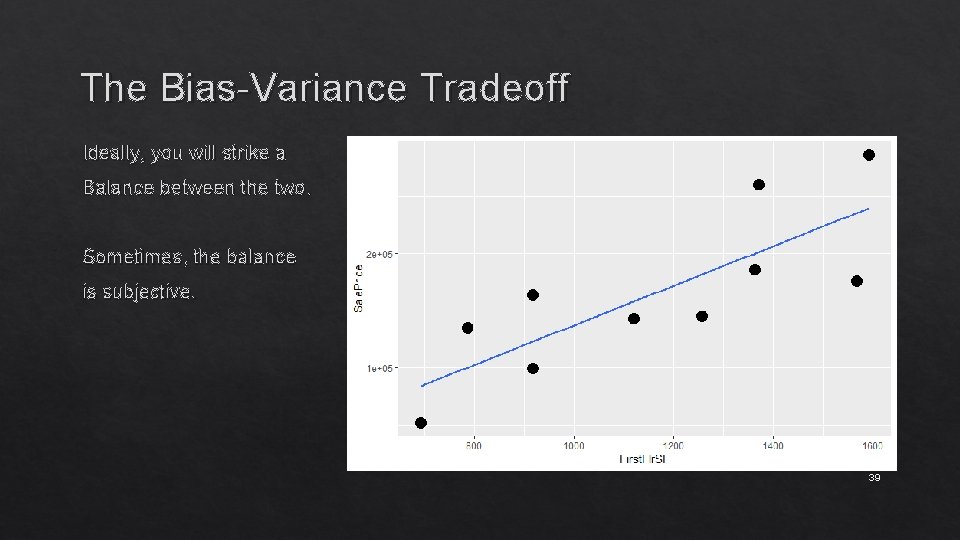
The Bias-Variance Tradeoff Ideally, you will strike a Balance between the two. Sometimes, the balance is subjective. 39
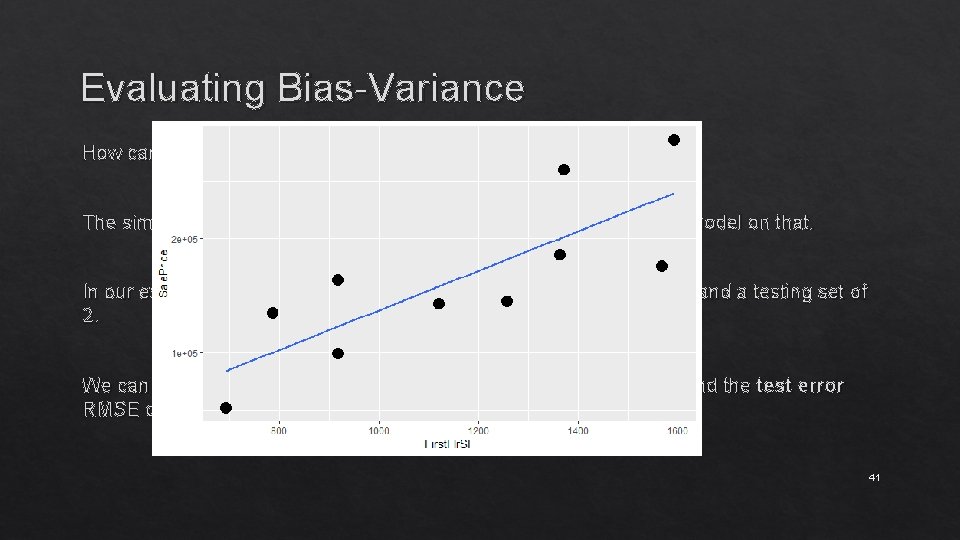
Evaluating Bias-Variance How can you evaluate how well your model generalizes? The simplest way: holdout a percentage of data (~20%) and test the model on that. In our example of n=10, we could split the data into a training set of 8 and a testing set of 2. We can then calculate the training error (RMSE of the training set) and the test error RMSE of test set. 40
Evaluating Bias-Variance How can you evaluate how well your model generalizes? The simplest way: holdout a percentage of data (~20%) and test the model on that. In our example of n=10, we could split the data into a training set of 8 and a testing set of 2. We can then calculate the training error (RMSE of the training set) and the test error RMSE of test set. 41
Evaluating Bias-Variance The simplest way: holdout a percentage of data (~20%) and test the model on that. Issues: 1) The two that we holdout may not be representative. 2) Can we afford to ignore two datapoints? 42
Evaluating Bias-Variance Cross-validation. 1) Leave. POut. 2) KFold. 3) Stratified. KFold. 43
Evaluating Bias-Variance Cross-validation. Using cross-validation you can use the average metric as your assessment, and also see the distribution. 44
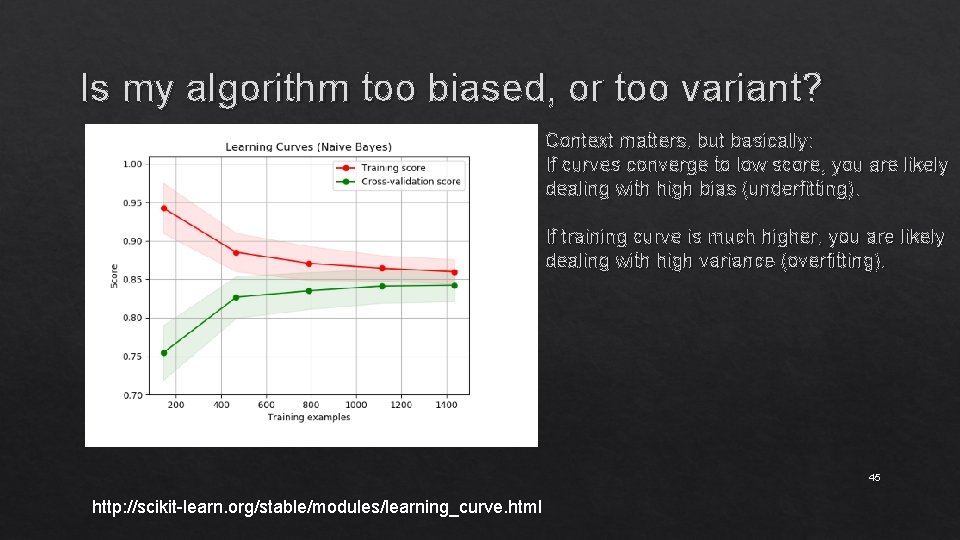
Is my algorithm too biased, or too variant? Context matters, but basically: If curves converge to low score, you are likely dealing with high bias (underfitting). If training curve is much higher, you are likely dealing with high variance (overfitting). 45 http: //scikit-learn. org/stable/modules/learning_curve. html
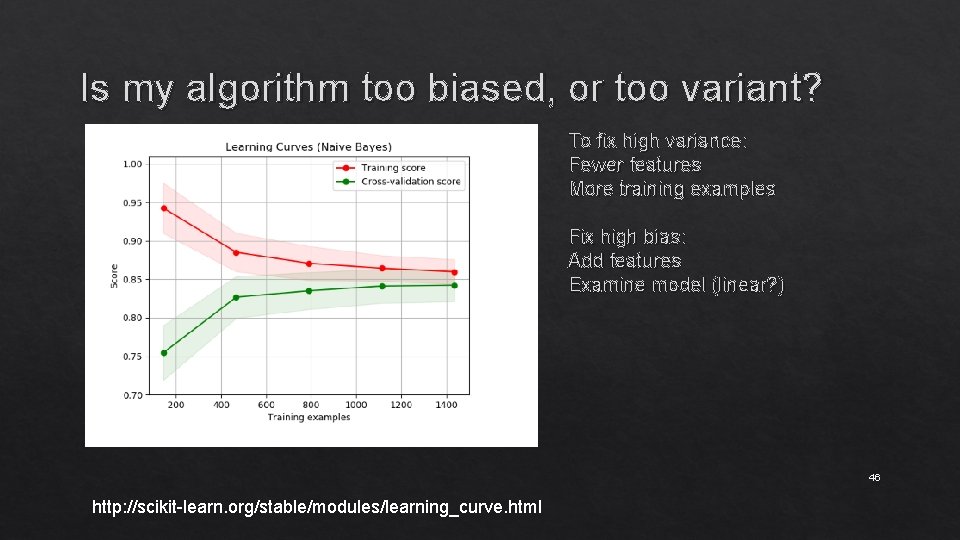
Is my algorithm too biased, or too variant? To fix high variance: Fewer features More training examples Fix high bias: Add features Examine model (linear? ) 46 http: //scikit-learn. org/stable/modules/learning_curve. html
Selecting Hyperparameters What are hyperparameters? Model parameters, such as: 1) Lambda (in regularized linear regression) 2) n_trees, max_depth (in Random Forest) Some models have multiple parameters to set. 47
Selecting Hyperparameters How do we decide what to set a hyperparameter to? Say, n_trees and max_depth. Option 1: We can choose hyperparameters ourselves (based on knowledge of domain). E. g. “I think around 1, 000 trees should work with a max_depth of 50. ” 48
Selecting Hyperparameters How do we decide what to set a hyperparameter to? Say, n_trees and max_depth. Option 1: We can choose hyperparameters ourselves (based on knowledge of domain). Option 2: We can do a search across a preset parameter space. Sklearn: Grid. Search. CV. E. g. “Somewhere between 100 to 10, 000 trees should work, and a max_depth of 10 to 200. Let’s try all possible combinations / a random subset / evolutionary choice of options”. 49
Selecting Hyperparameters Envision the following: 1) You have a set of data for housing prices predictions. 2) You decide to use a random forest model. 3) You choose an n_trees parameter and find that your CV RMSE is $30, 000. 4) You manually play with the n_trees parameter (or you use a method like Grid. Search. CV). 5) You find that the optimal n_trees is 1057, with a CV RMSE of $300. 6) You report your model with an RMSE of $300. 50
Selecting Hyperparameters Model is now overfit to hyperparameters and your assessment is overly optimistic. Extra reading: http: //jmlr. csail. mit. edu/papers/volume 11/cawley 10 a. pdf 51
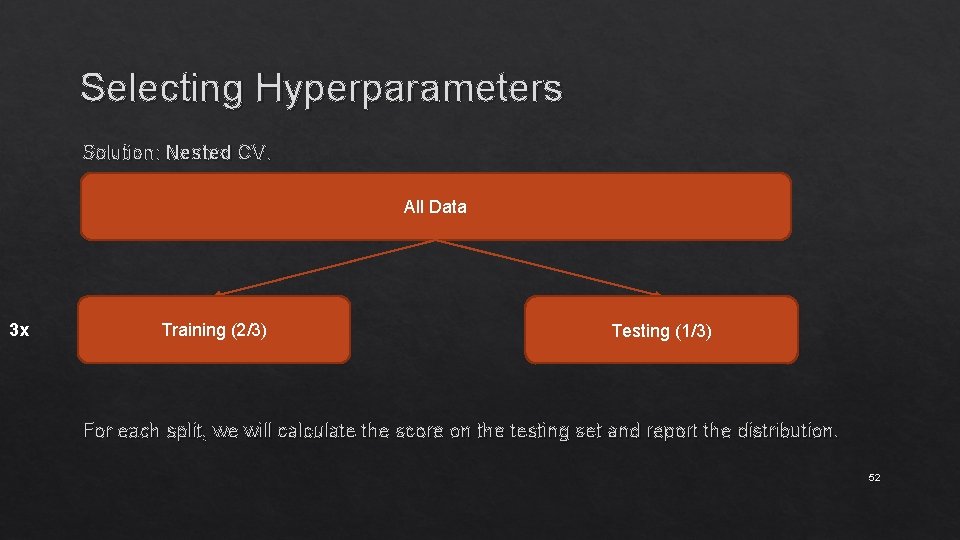
Selecting Hyperparameters Solution: Nested CV. All Data 3 x Training (2/3) Testing (1/3) For each split, we will calculate the score on the testing set and report the distribution. 52
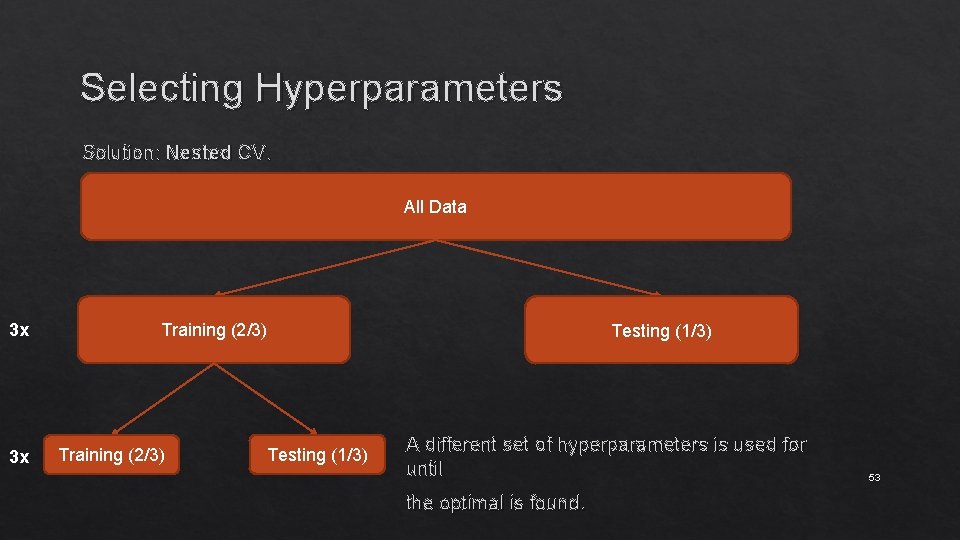
Selecting Hyperparameters Solution: Nested CV. All Data 3 x 3 x Training (2/3) Testing (1/3) A different set of hyperparameters is used for until the optimal is found. 53
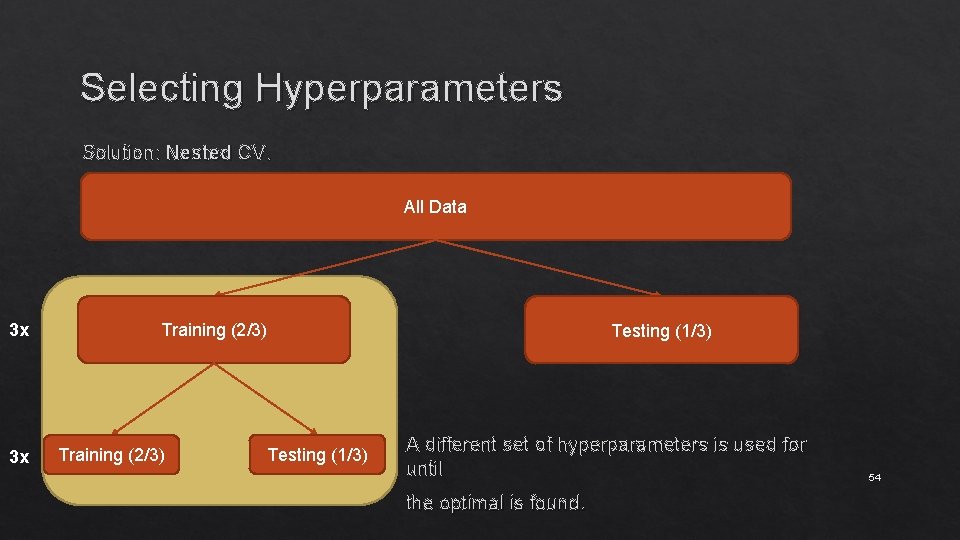
Selecting Hyperparameters Solution: Nested CV. All Data 3 x 3 x Training (2/3) Testing (1/3) A different set of hyperparameters is used for until the optimal is found. 54
- Slides: 54