
Supersymmetry nonrenormalization theorem from a computer and the




- Slides: 61
Supersymmetry non-renormalization theorem from a computer and the Ad. S/CFT correspondence 総研大D 2 本多正純 Ref : ar. Xiv: 1011. 3904 [hep-lat] 1106. xxxx [hep-th] 伊敷吾郎氏 ( CQUe. ST ) , Sang-Woo Kim氏 ( 大阪大 ) , 西村淳氏 ( KEK&総研大 ) , 土屋麻人氏 ( 静岡大 ) との共同研究に基づく。 KEK String Advanced Lecture 2011. 5. 25
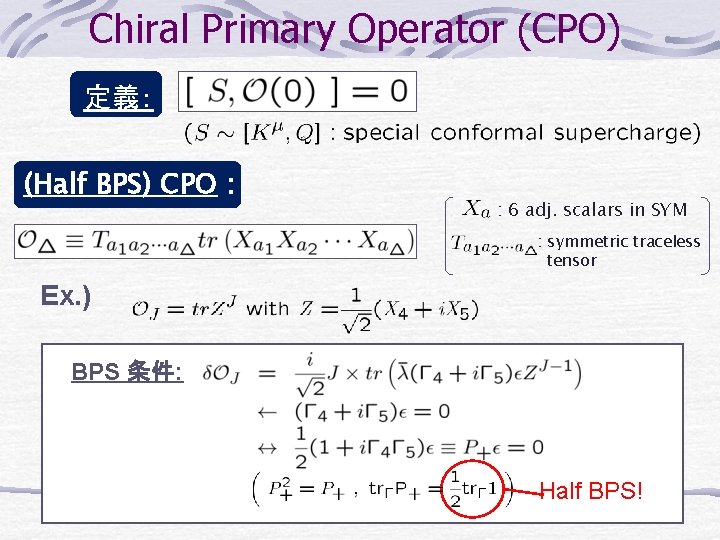
Chiral Primary Operator (CPO) 定義: (Half BPS) CPO : : 6 adj. scalars in SYM : symmetric traceless tensor Ex. ) BPS 条件: Half BPS!
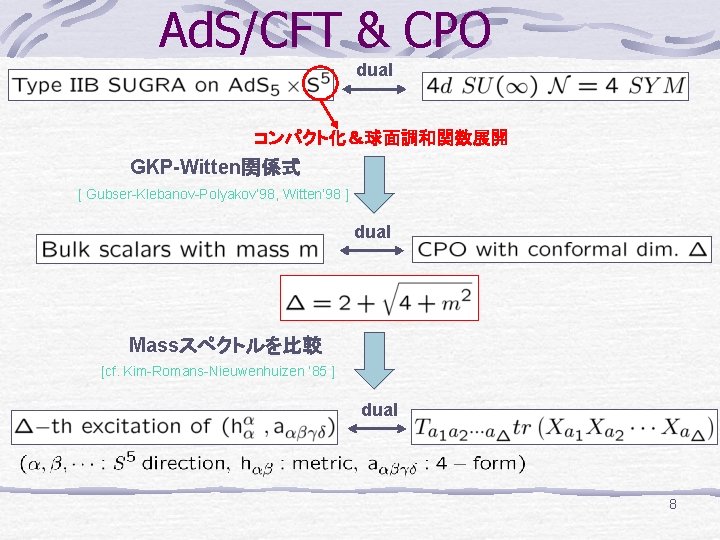
Ad. S/CFT & CPO dual コンパクト化&球面調和関数展開 GKP-Witten関係式 [ Gubser-Klebanov-Polyakov’ 98, Witten’ 98 ] dual Massスペクトルを比較 [cf. Kim-Romans-Nieuwenhuizen ’ 85 ] dual 8
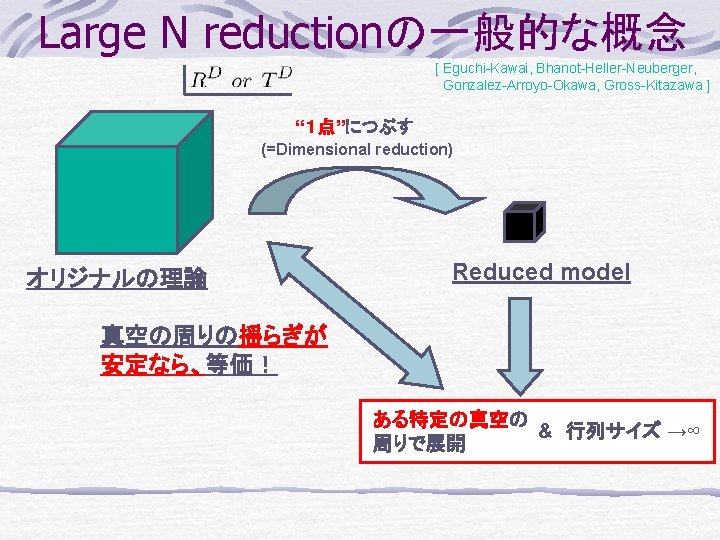
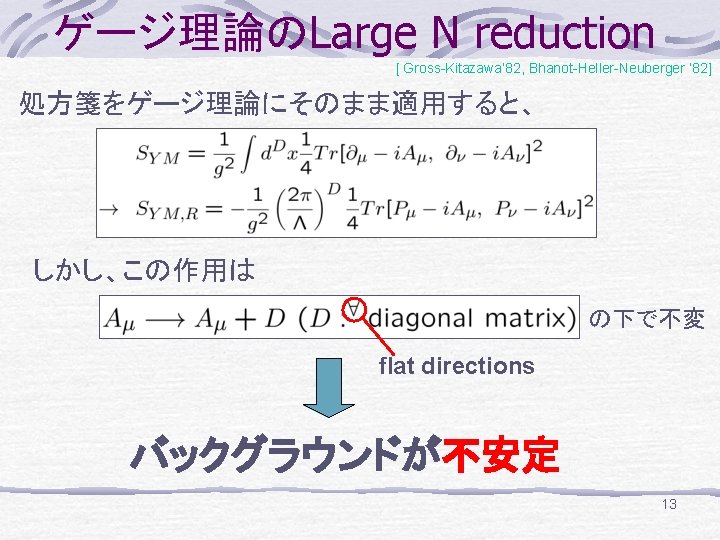
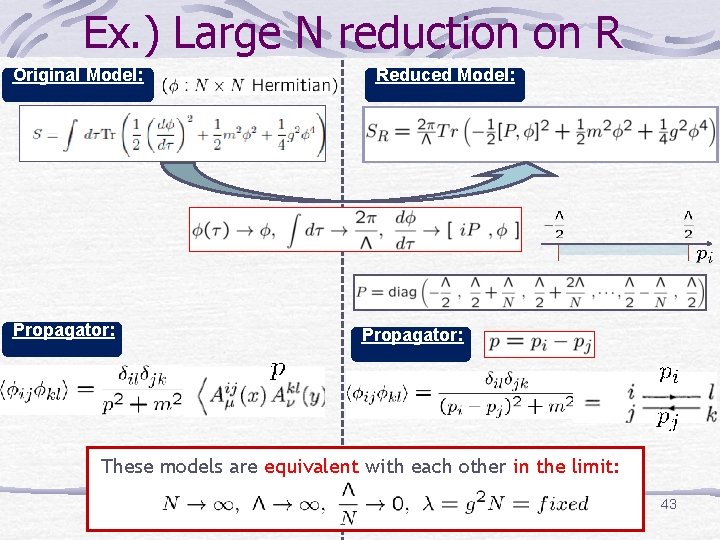
Large N reductionの一般的な概念 [ Eguchi-Kawai, Bhanot-Heller-Neuberger, Gonzalez-Arroyo-Okawa, Gross-Kitazawa ] “1点”につぶす (=Dimensional reduction) オリジナルの理論 Reduced model 真空の周りの揺らぎが 安定なら、等価! ある特定の真空の & 行列サイズ →∞ 周りで展開
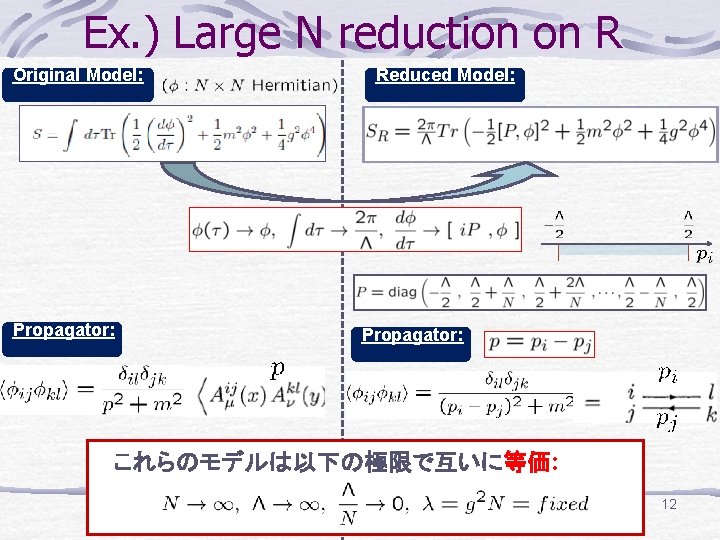
Ex. ) Large N reduction on R Original Model: Propagator: Reduced Model: Propagator: これらのモデルは以下の極限で互いに等価: 12
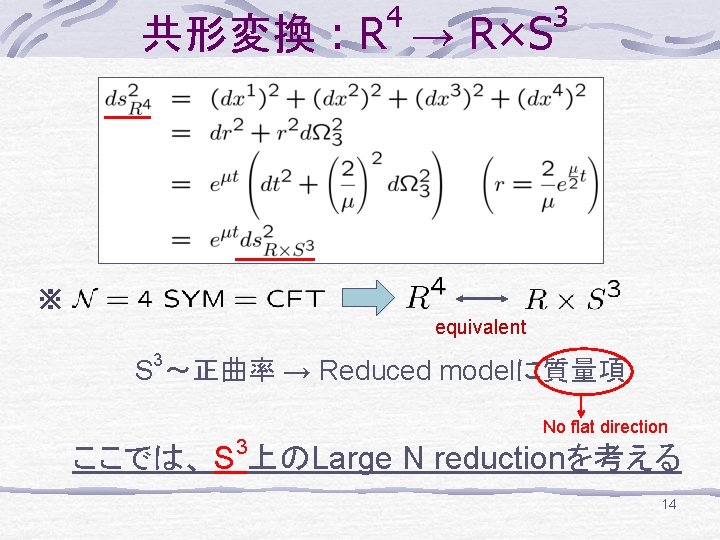
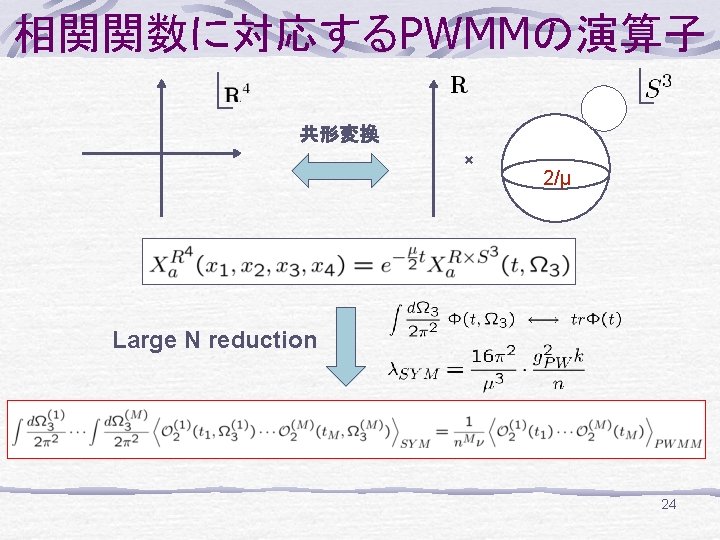
4 共形変換 : R → R×S 3 ※ equivalent 3 S ~正曲率 → Reduced modelに質量項 3 No flat direction ここでは、 S 上のLarge N reductionを考える 14
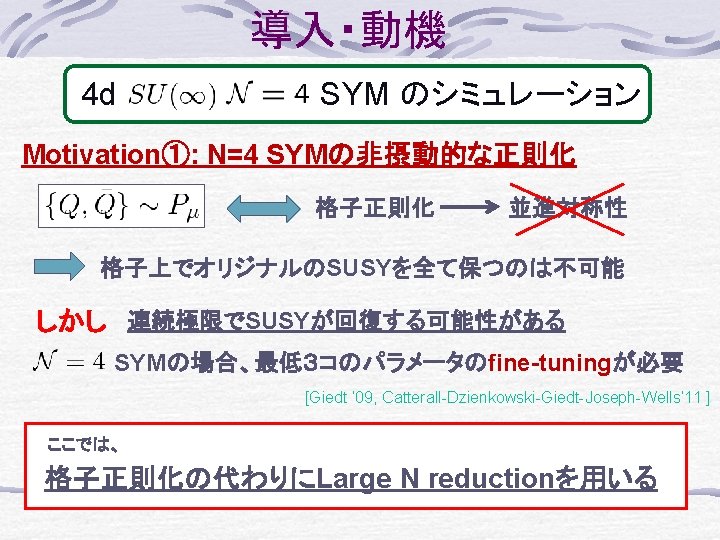
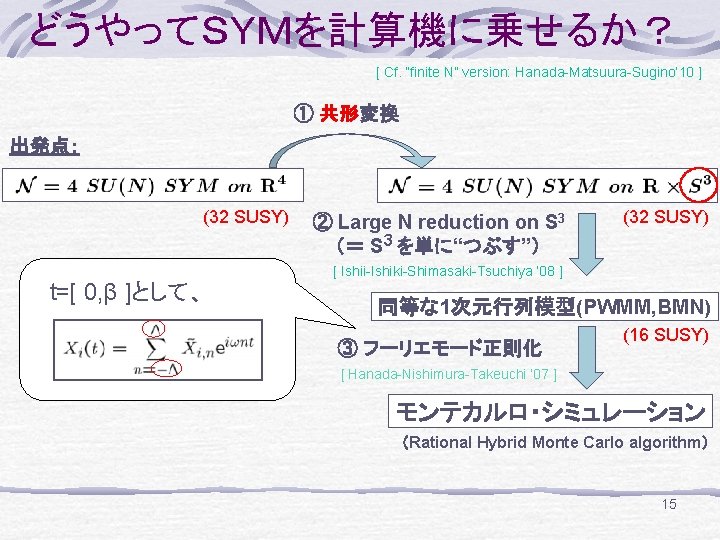
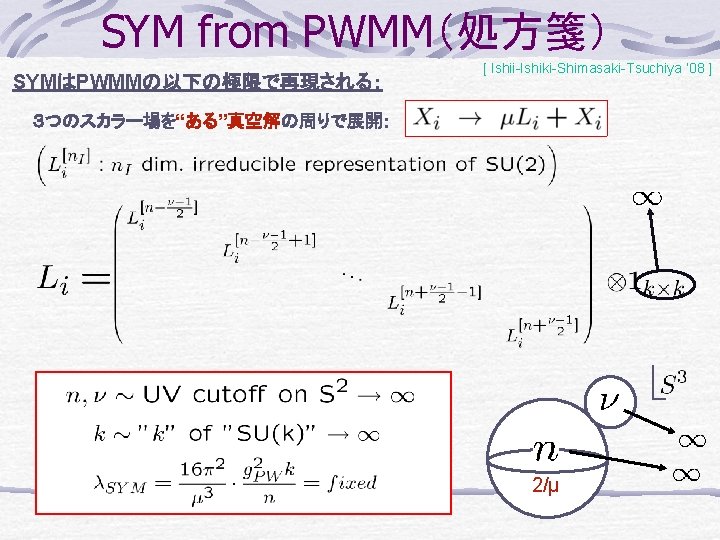
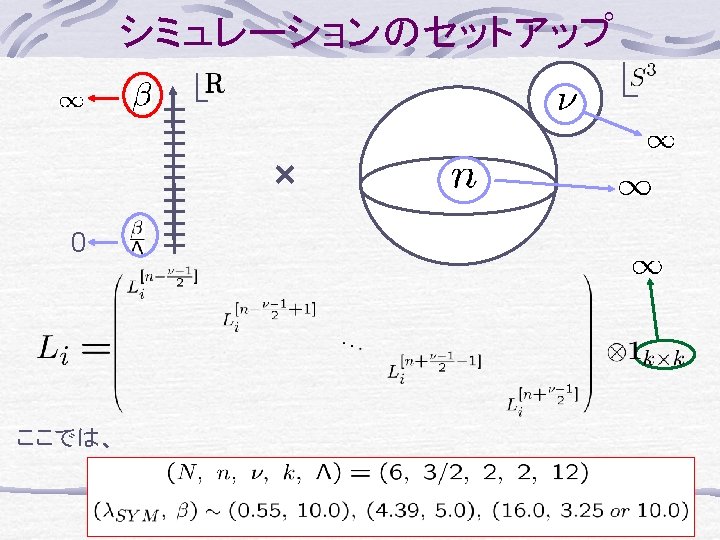
どうやってSYMを計算機に乗せるか? [ Cf. “finite N” version: Hanada-Matsuura-Sugino’ 10 ] ① 共形変換 出発点: (32 SUSY) t=[ 0, β ]として、 ② Large N reduction on S 3 (= S 3 を単に“つぶす”) (32 SUSY) [ Ishii-Ishiki-Shimasaki-Tsuchiya ’ 08 ] 同等な 1次元行列模型(PWMM, BMN) ③ フーリエモード正則化 (16 SUSY) [ Hanada-Nishimura-Takeuchi ’ 07 ] モンテカルロ・シミュレーション (Rational Hybrid Monte Carlo algorithm) 15
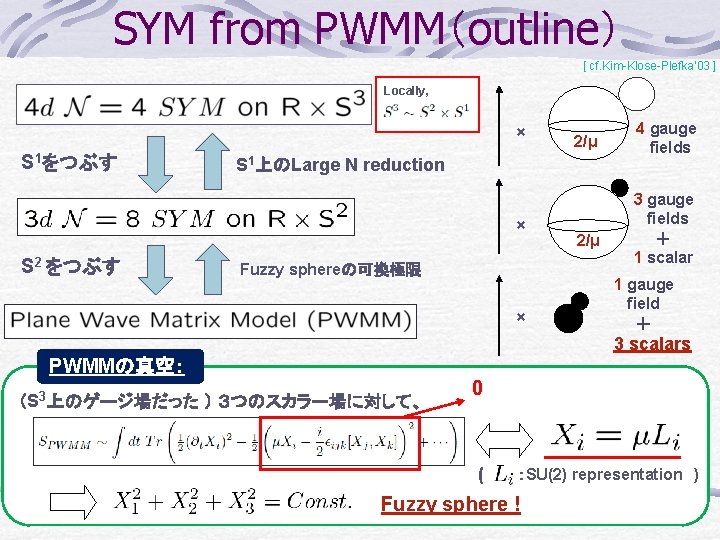
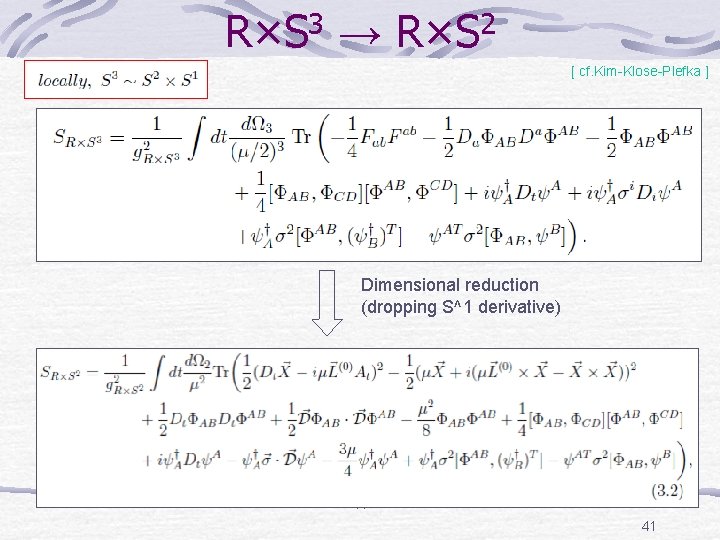
SYM from PWMM(outline) [ cf. Kim-Klose-Plefka’ 03 ] Locally, × S 1をつぶす S 1上のLarge N reduction × S 2 をつぶす 2/μ Fuzzy sphereの可換極限 × 2/μ 4 gauge fields 3 gauge fields + 1 scalar 1 gauge field + 3 scalars PWMMの真空: (S 3上のゲージ場だった ) 3つのスカラー場に対して、 0 ( :SU(2) representation ) Fuzzy sphere !
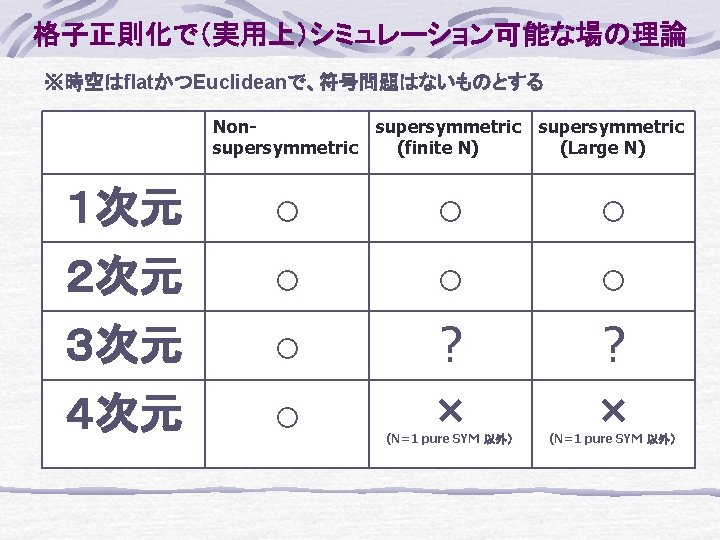
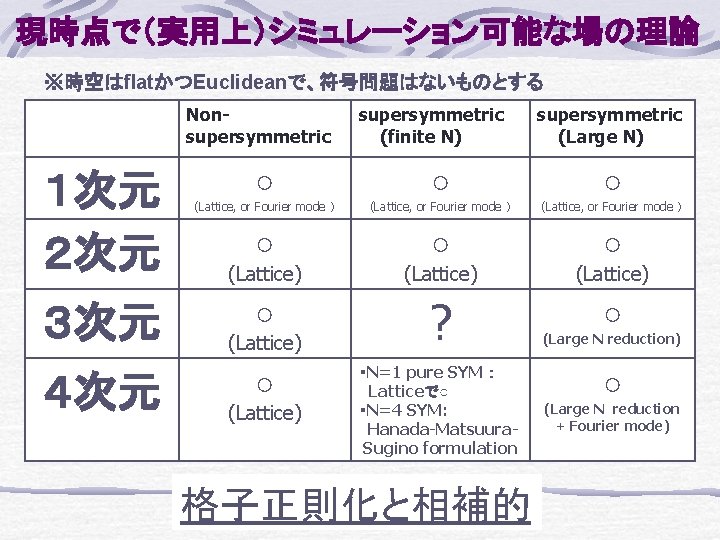
現時点で(実用上)シミュレーション可能な場の理論 ※時空はflatかつEuclideanで、符号問題はないものとする Nonsupersymmetric 1次元 2次元 3次元 4次元 ○ supersymmetric (finite N) ○ supersymmetric (Large N) ○ (Lattice, or Fourier mode ) ○ ○ ○ (Lattice) ○ ? ○ ○ ・N=1 pure SYM : Latticeで○ ・N=4 SYM: Hanada-Matsuura. Sugino formulation (Lattice) 格子正則化と相補的 (Large N reduction) ○ (Large N reduction + Fourier mode)
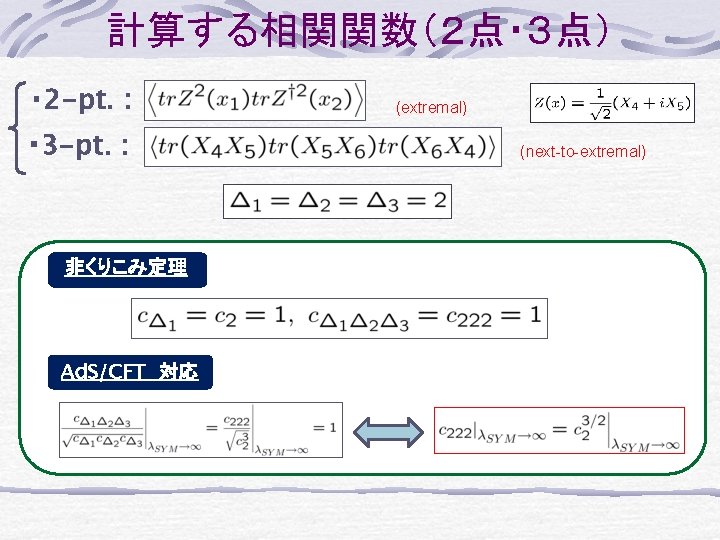
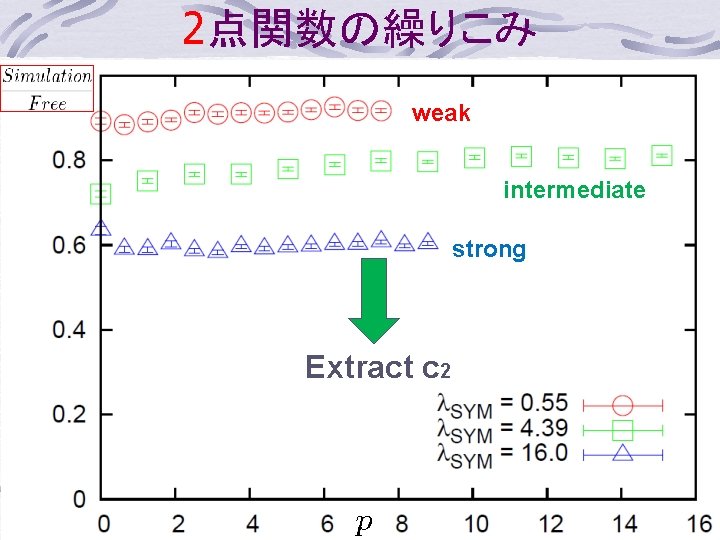
2点関数の繰りこみ weak intermediate strong Extract c 2
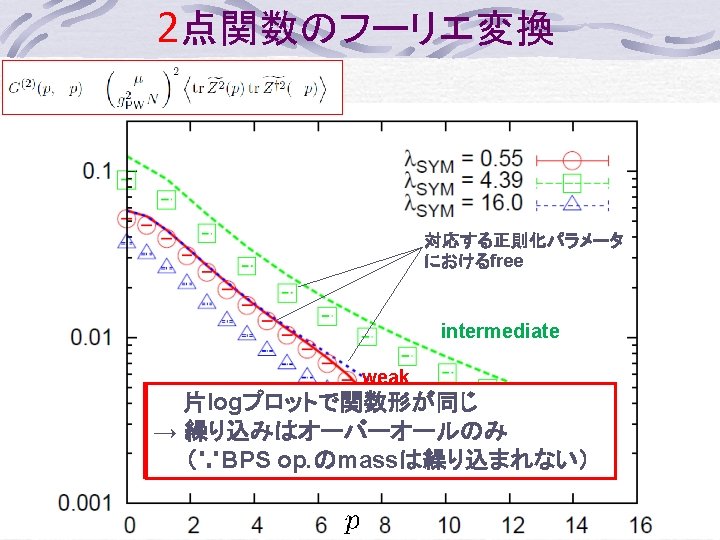
2点関数のフーリエ変換 intermediate weak strong
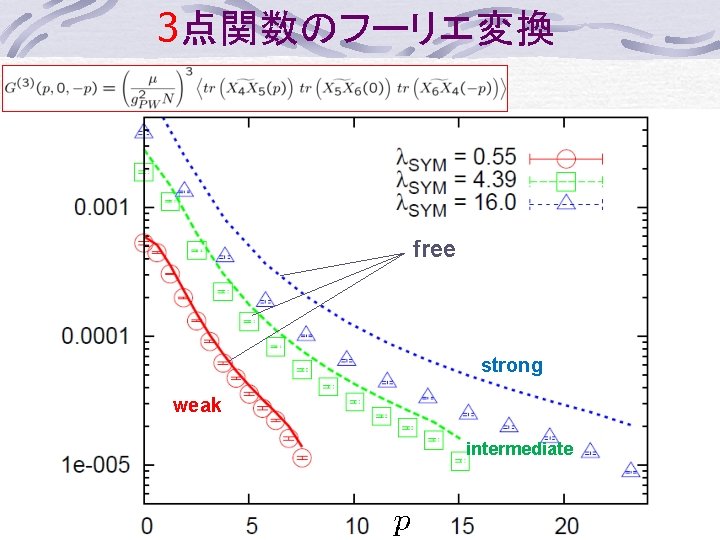
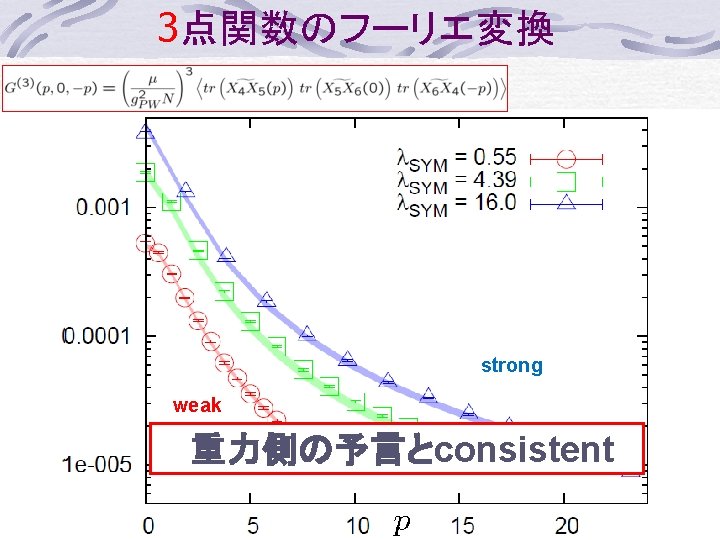
3点関数のフーリエ変換 free strong weak intermediate
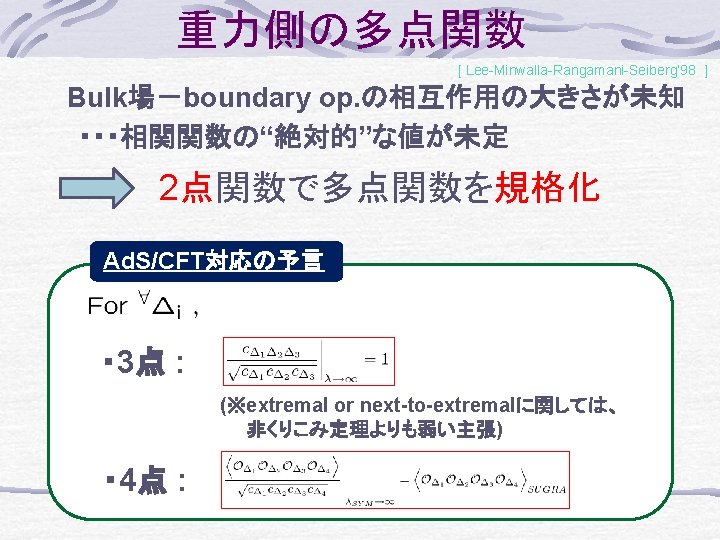
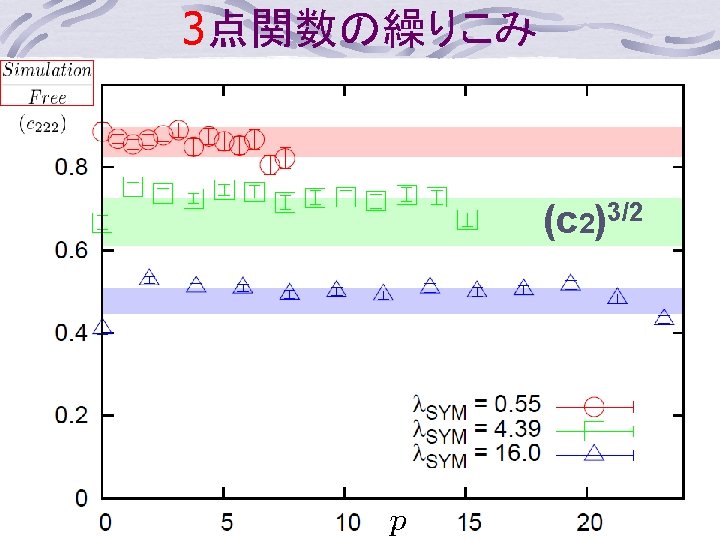
3点関数の繰りこみ weak intermediate (c 2)3/2 strong (c 2)3/2と比較
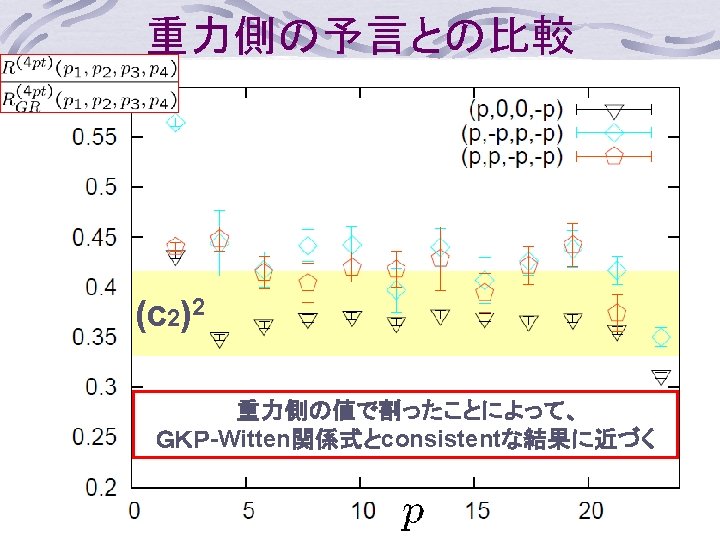
3点関数のフーリエ変換 strong weak intermediate 重力側の予言とconsistent
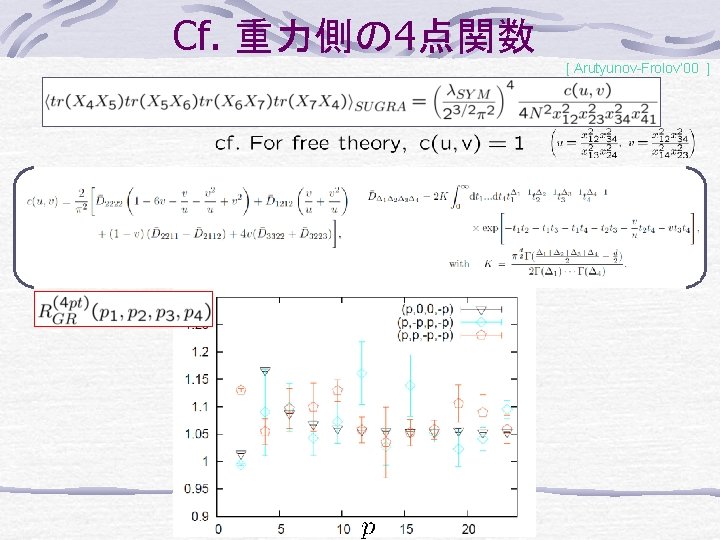
Cf. 重力側の 4点関数 [ Arutyunov-Frolov’ 00 ]
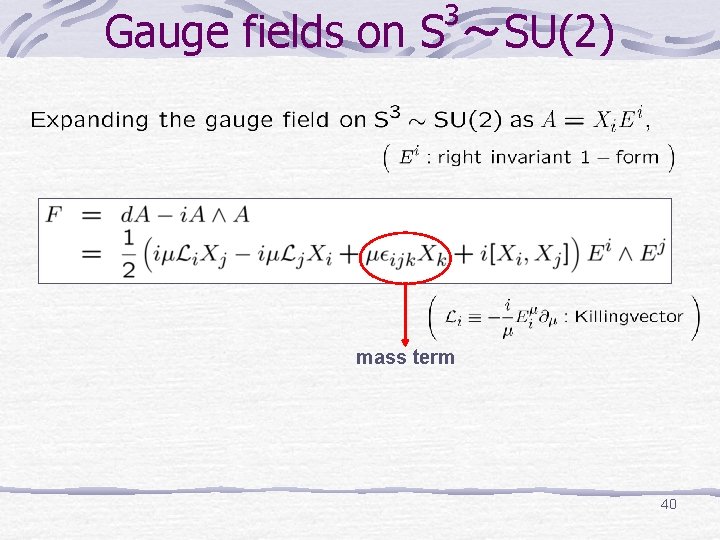
3 Gauge fields on S ~SU(2) mass term 40
R×S 3 → R×S 2 [ cf. Kim-Klose-Plefka ] Dimensional reduction (dropping S^1 derivative) 41 41
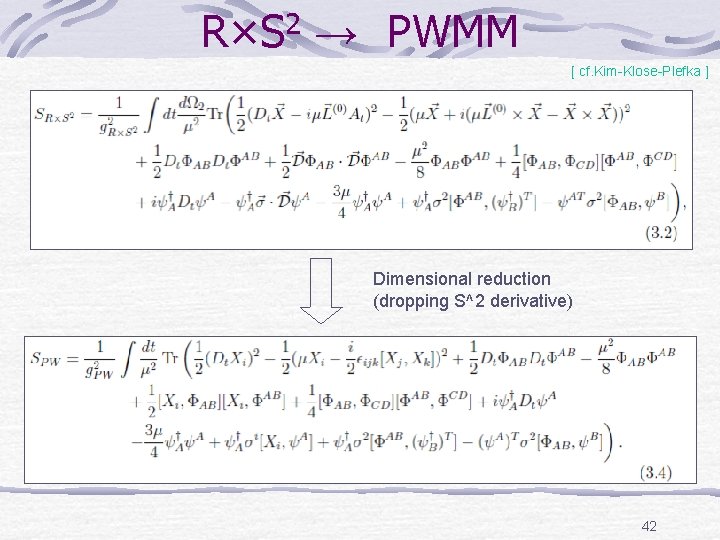
R×S 2 → PWMM [ cf. Kim-Klose-Plefka ] Dimensional reduction (dropping S^2 derivative) 42
Ex. ) Large N reduction on R Original Model: Propagator: Reduced Model: Propagator: These models are equivalent with each other in the limit: 43
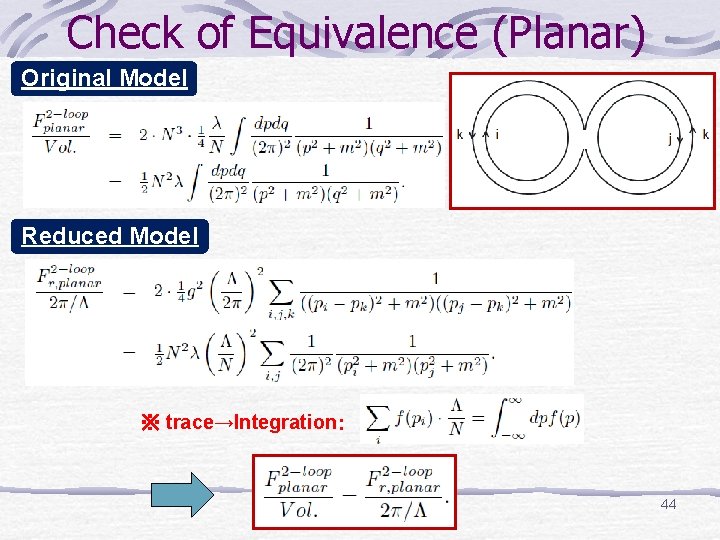
Check of Equivalence (Planar) Original Model Reduced Model ※ trace→Integration: 44
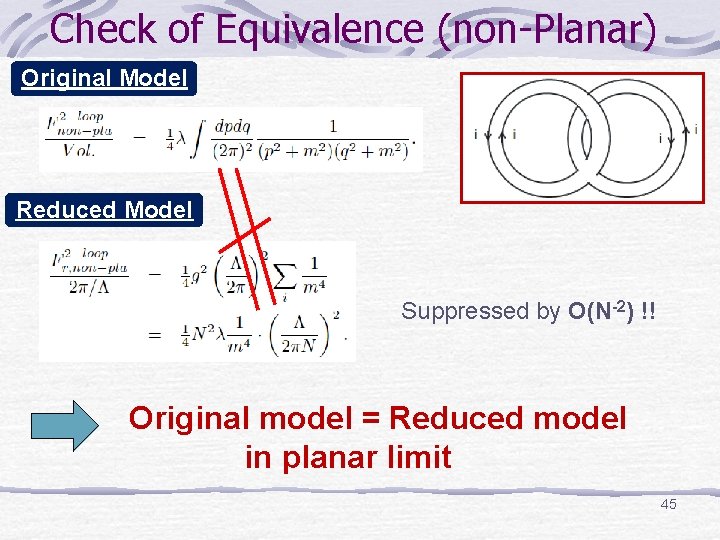
Check of Equivalence (non-Planar) Original Model Reduced Model Suppressed by O(N-2) !! Original model = Reduced model in planar limit 45
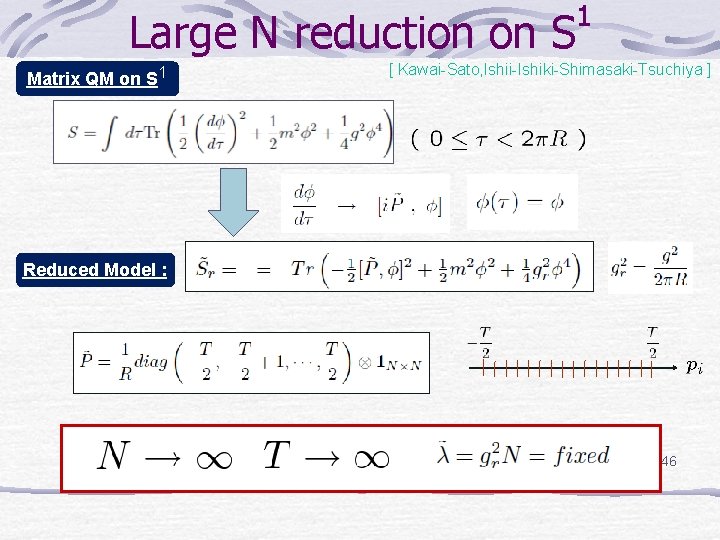
Large N reduction on S Matrix QM on S 1 1 [ Kawai-Sato, Ishii-Ishiki-Shimasaki-Tsuchiya ] Reduced Model : 46
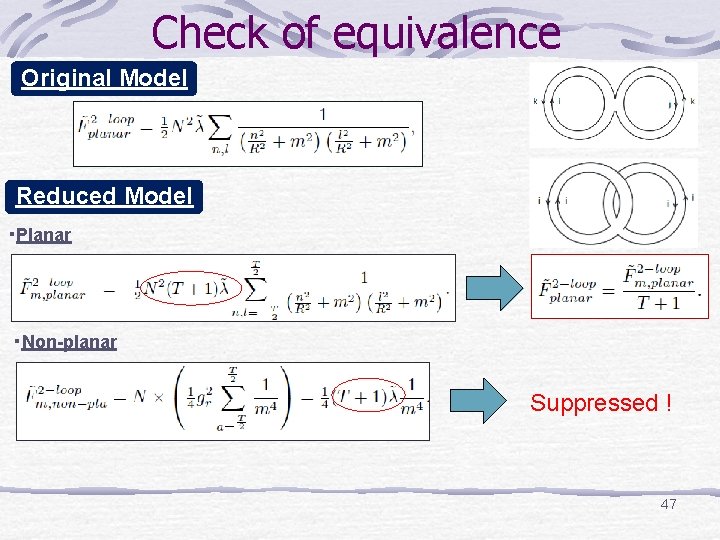
Check of equivalence Original Model Reduced Model ・Planar ・Non-planar Suppressed ! 47
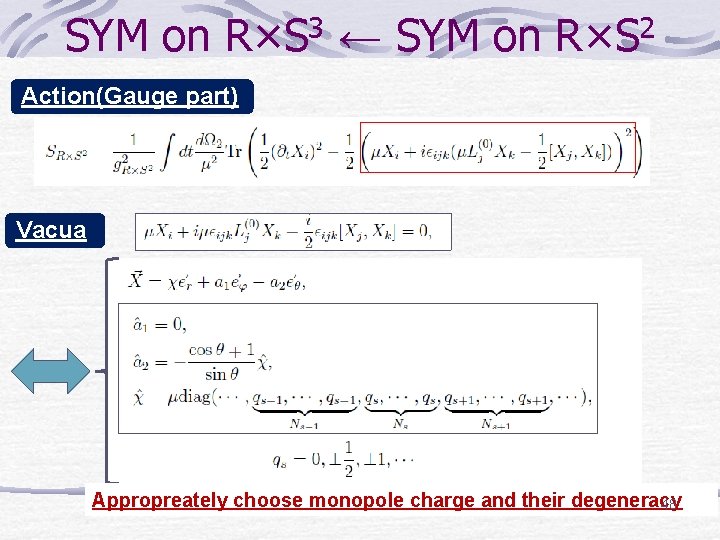
SYM on R×S 3 ← SYM on R×S 2 Action(Gauge part) Vacua Appropreately choose monopole charge and their degeneracy 48
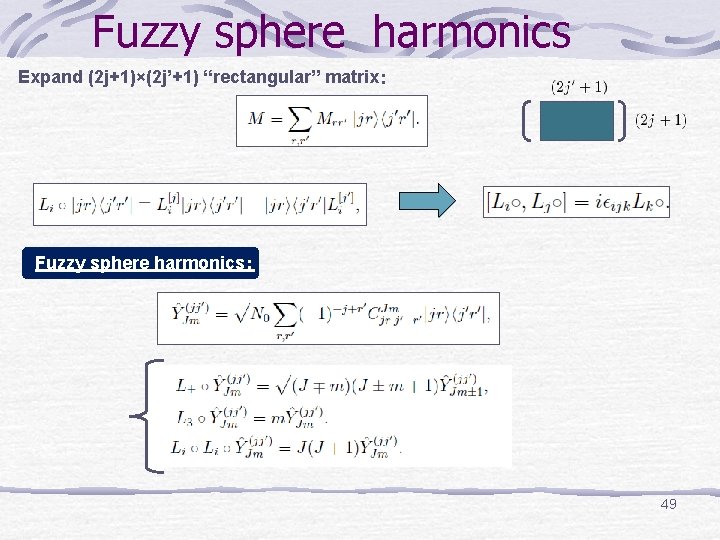
Fuzzy sphere harmonics Expand (2 j+1)×(2 j’+1) “rectangular” matrix: Fuzzy sphere harmonics: 49
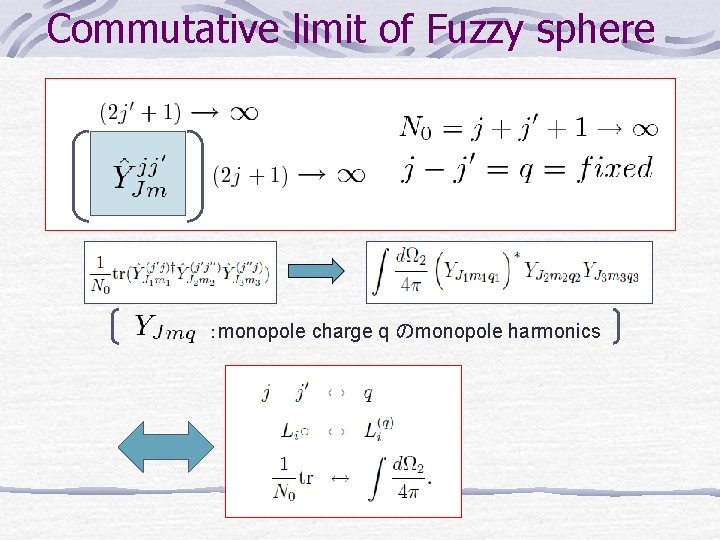
Commutative limit of Fuzzy sphere :monopole charge q のmonopole harmonics
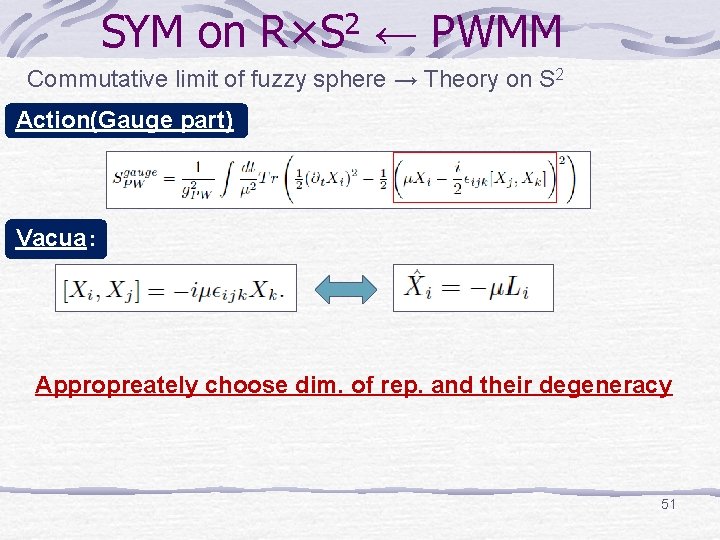
SYM on R×S 2 ← PWMM Commutative limit of fuzzy sphere → Theory on S 2 Action(Gauge part) Vacua: Appropreately choose dim. of rep. and their degeneracy 51
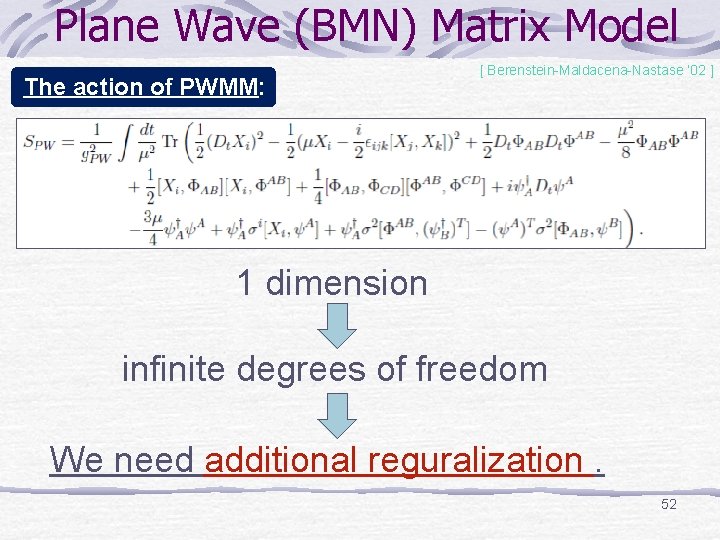
Plane Wave (BMN) Matrix Model The action of PWMM: [ Berenstein-Maldacena-Nastase ’ 02 ] 1 dimension infinite degrees of freedom We need additional reguralization. 52
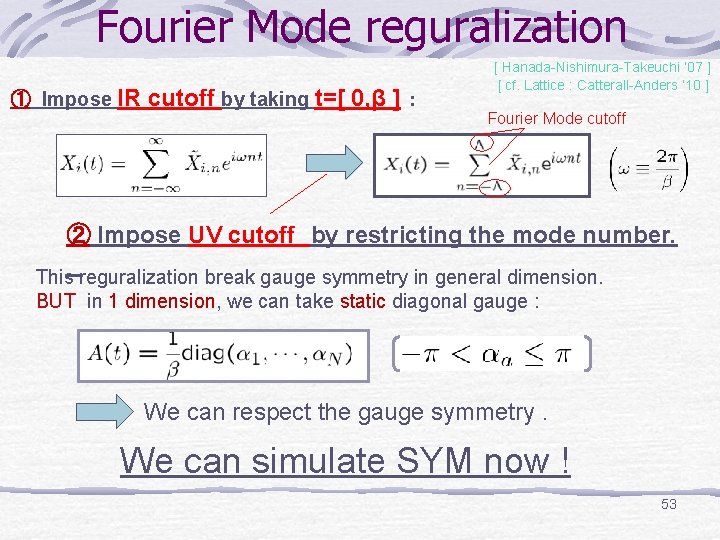
Fourier Mode reguralization ① Impose IR cutoff by taking t=[ 0, β ] : [ Hanada-Nishimura-Takeuchi ’ 07 ] [ cf. Lattice : Catterall-Anders ’ 10 ] Fourier Mode cutoff ② Impose UV cutoff by restricting the mode number. This reguralization break gauge symmetry in general dimension. BUT in 1 dimension, we can take static diagonal gauge : We can respect the gauge symmetry. We can simulate SYM now ! 53
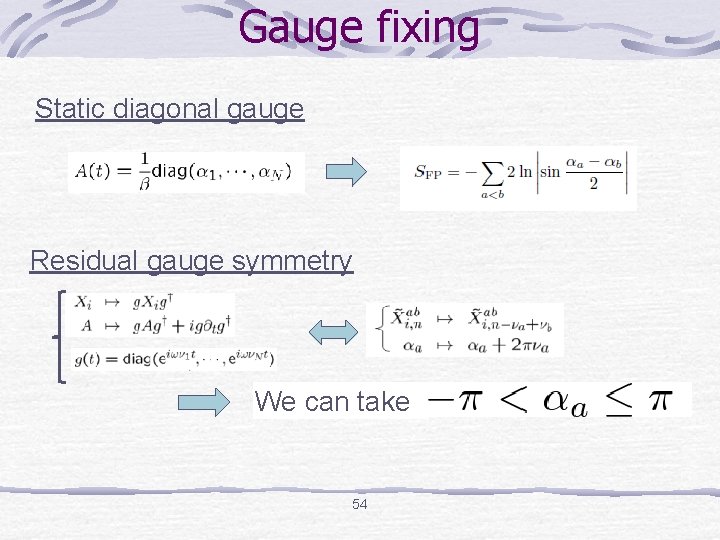
Gauge fixing Static diagonal gauge Residual gauge symmetry We can take 54
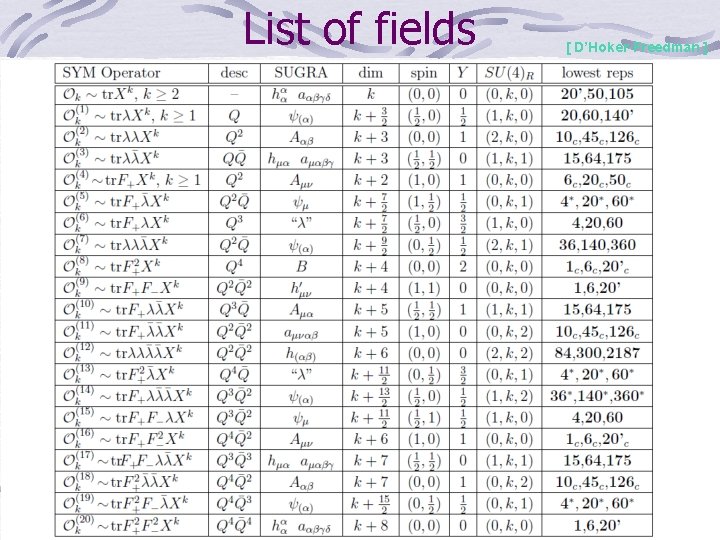
List of fields [ D’Hoker-Freedman ] 56
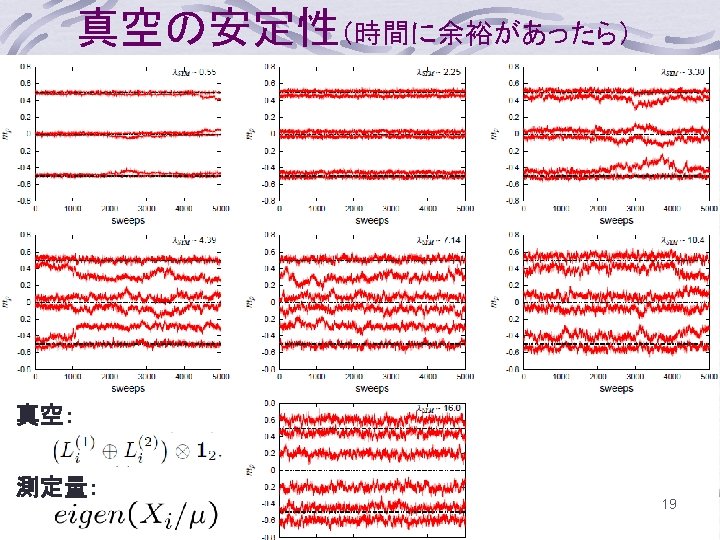
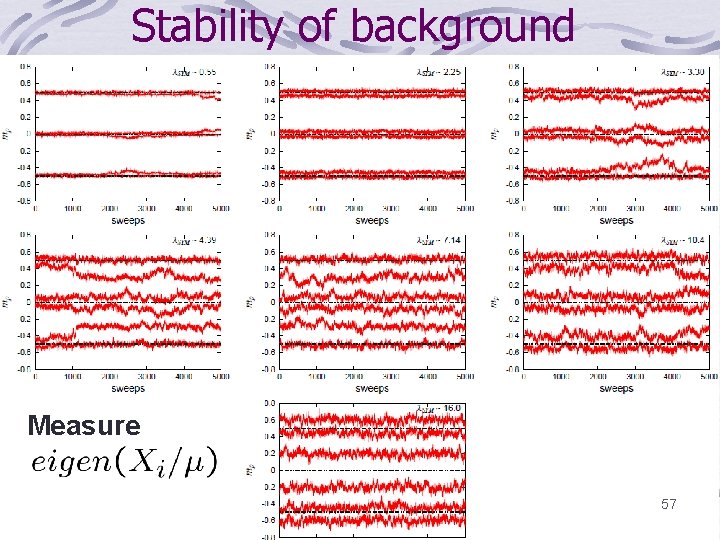
Stability of background Measure 57
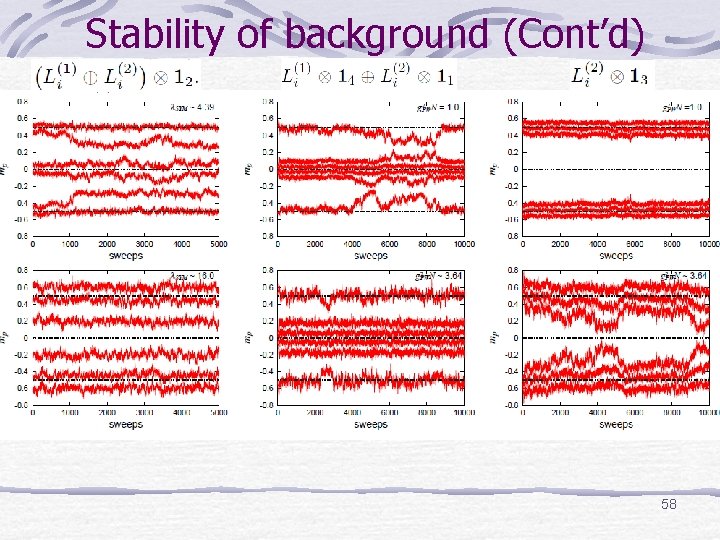
Stability of background (Cont’d) 58
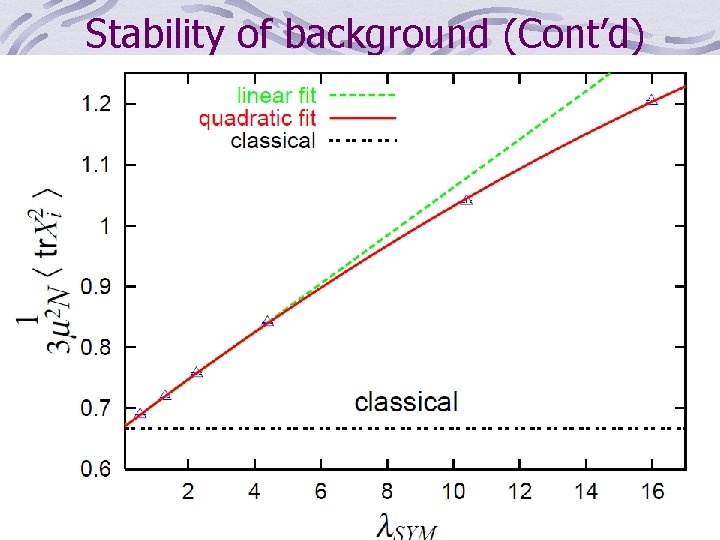
Stability of background (Cont’d) 59
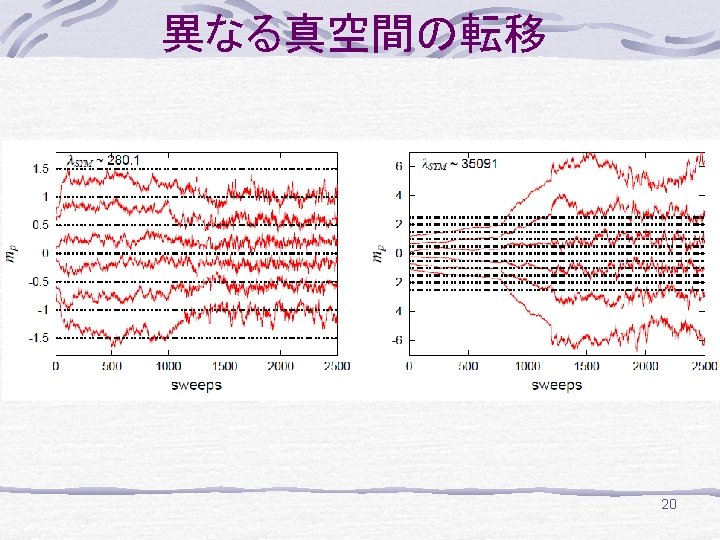
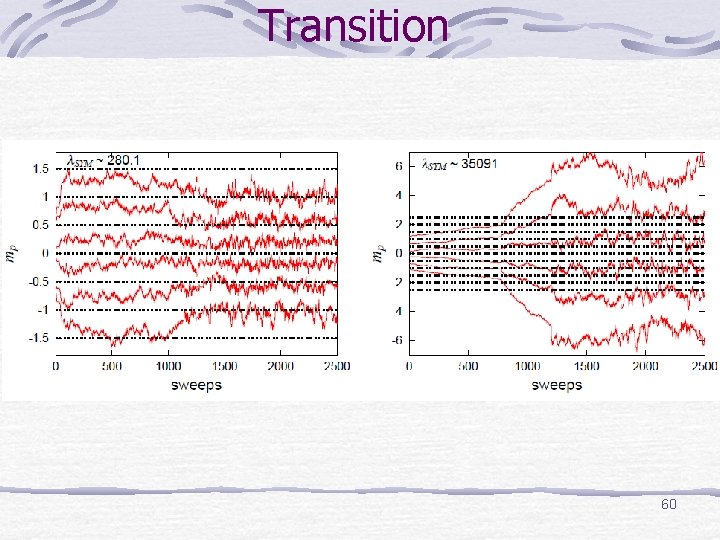
Transition 60
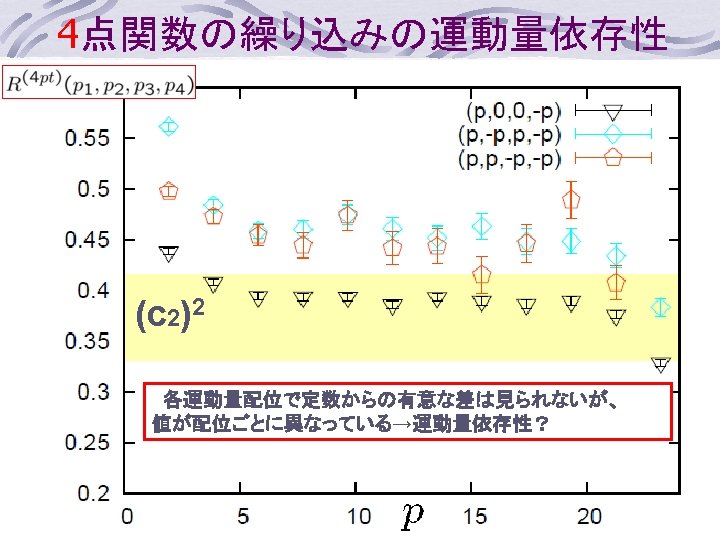
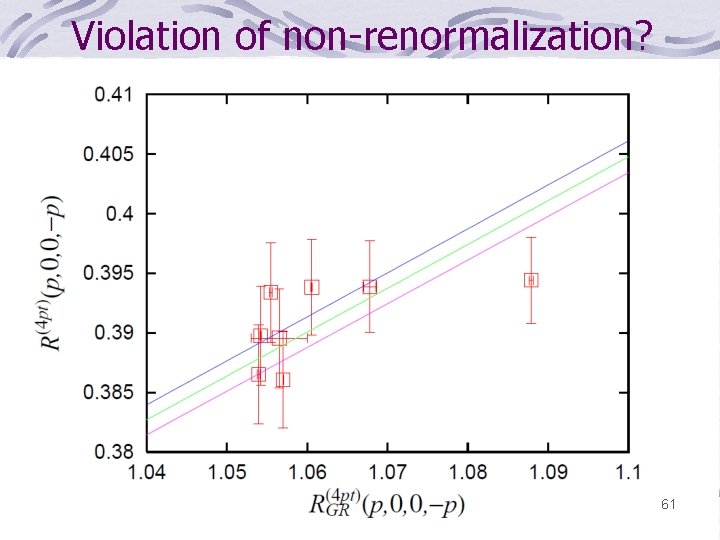
Violation of non-renormalization? 61