
Supersymmetric dark matter implications for colliders and astroparticle

- Slides: 51
Supersymmetric dark matter: implications for colliders and astroparticle G. Bélanger LAPTH-Annecy
PLAN l Evidence for dark matter Cosmology and SUSY dark matter l SUSY dark matter at colliders l l • Constraining models • SUSY signal and determination of parameters Direct/Indirect detection • DM signal and complementarity to collider searches l Final remarks
Evidence for dark matter l l Most of the matter in the universe cannot be detected from the light emitted (dark matter) Presence of dark matter is inferred from motion of astronomical objects • • l If we measure velocities in some region there has to be enough mass for gravity to hold objects together The amount of mass needed is more than luminous mass • • The galactic scale Scale of galaxy clusters Dark matter is required to amplify the small fluctuations in Cosmic Microwave background to form the large scale structure in the universe today • Cosmological scales
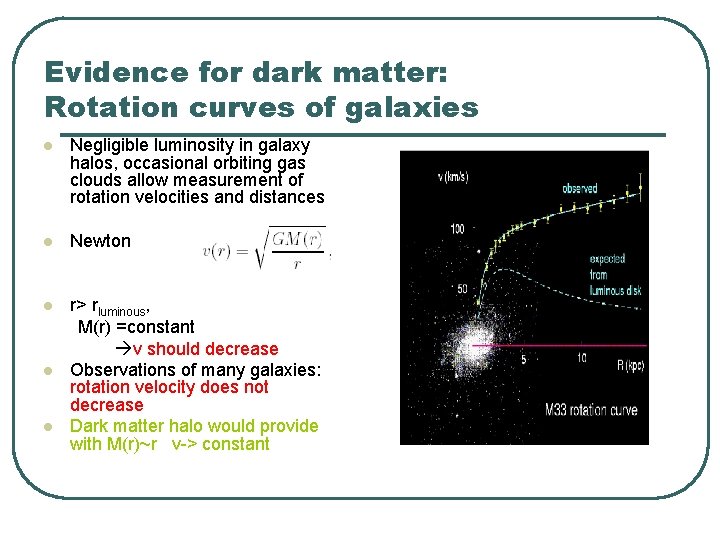
Evidence for dark matter: Rotation curves of galaxies l Negligible luminosity in galaxy halos, occasional orbiting gas clouds allow measurement of rotation velocities and distances l Newton l r> rluminous, M(r) =constant v should decrease Observations of many galaxies: rotation velocity does not decrease Dark matter halo would provide with M(r)~r v-> constant l l
Galaxy clusters l 1933: Zwicky got first evidence of dark matter in galaxy clusters l Confirmed by many observations on galaxy clusters • • Determine total mass required to provide self-gravity necessary to stop system from flying apart Mass/Light ratio 200 -300 (two orders of magnitude more than in solar system)
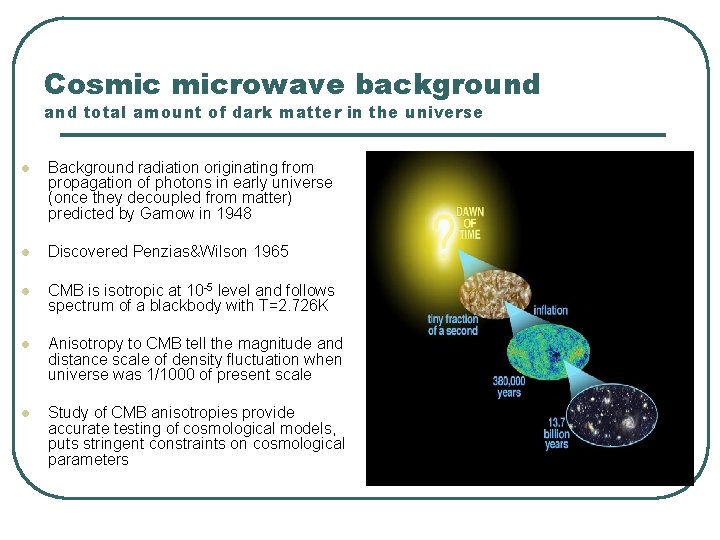
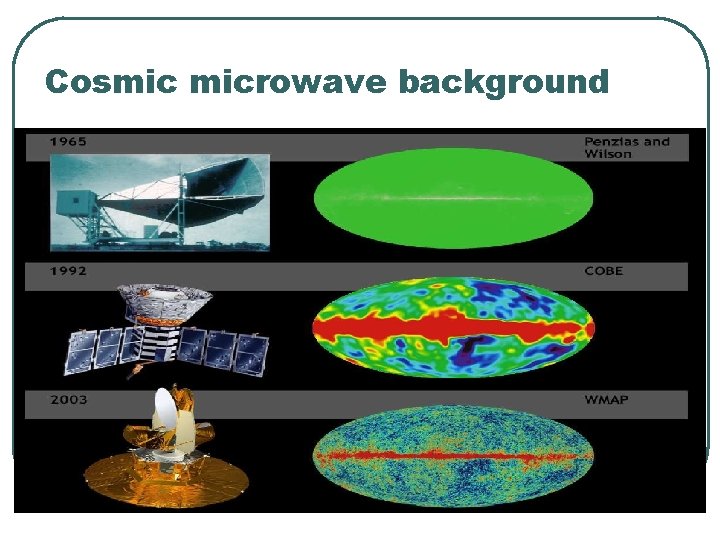
Cosmic microwave background and total amount of dark matter in the universe l Background radiation originating from propagation of photons in early universe (once they decoupled from matter) predicted by Gamow in 1948 l Discovered Penzias&Wilson 1965 l CMB is isotropic at 10 -5 level and follows spectrum of a blackbody with T=2. 726 K l Anisotropy to CMB tell the magnitude and distance scale of density fluctuation when universe was 1/1000 of present scale l Study of CMB anisotropies provide accurate testing of cosmological models, puts stringent constraints on cosmological parameters
Cosmic microwave background
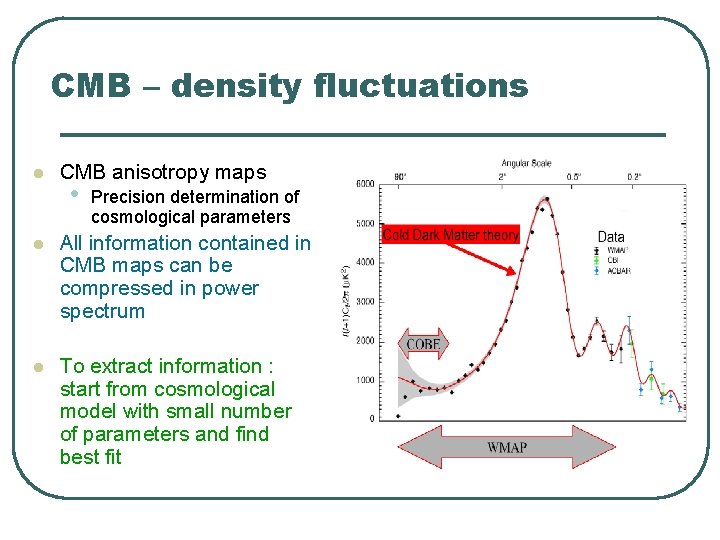
CMB – density fluctuations l CMB anisotropy maps • Precision determination of cosmological parameters l All information contained in CMB maps can be compressed in power spectrum l To extract information : start from cosmological model with small number of parameters and find best fit
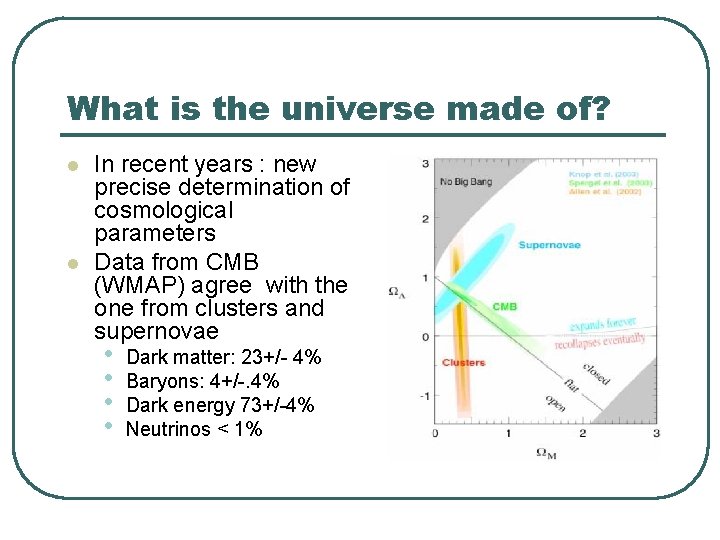
What is the universe made of? l l In recent years : new precise determination of cosmological parameters Data from CMB (WMAP) agree with the one from clusters and supernovae • • Dark matter: 23+/- 4% Baryons: 4+/-. 4% Dark energy 73+/-4% Neutrinos < 1%
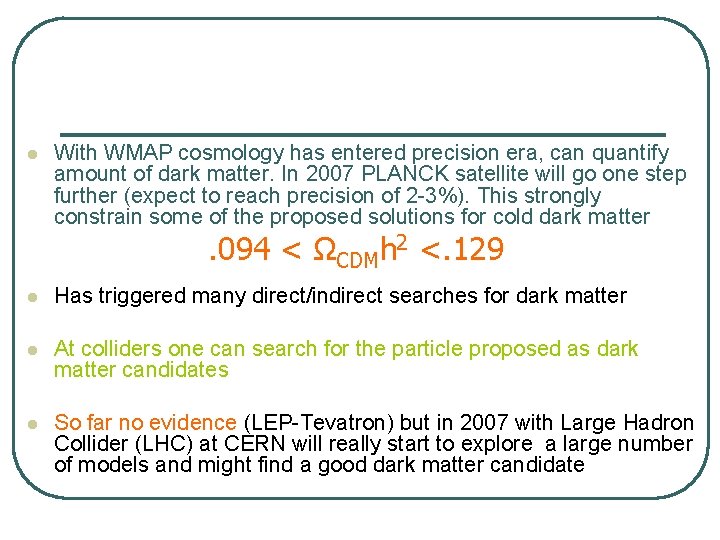
l With WMAP cosmology has entered precision era, can quantify amount of dark matter. In 2007 PLANCK satellite will go one step further (expect to reach precision of 2 -3%). This strongly constrain some of the proposed solutions for cold dark matter. 094 < ΩCDMh 2 <. 129 l Has triggered many direct/indirect searches for dark matter l At colliders one can search for the particle proposed as dark matter candidates l So far no evidence (LEP-Tevatron) but in 2007 with Large Hadron Collider (LHC) at CERN will really start to explore a large number of models and might find a good dark matter candidate
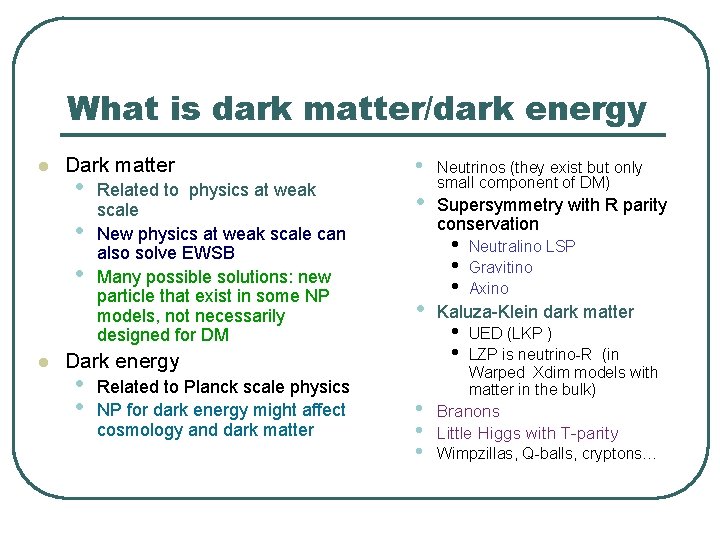
What is dark matter/dark energy l Dark matter • • • l Related to physics at weak scale New physics at weak scale can also solve EWSB Many possible solutions: new particle that exist in some NP models, not necessarily designed for DM • • • Dark energy • • Related to Planck scale physics NP for dark energy might affect cosmology and dark matter • • • Neutrinos (they exist but only small component of DM) Supersymmetry with R parity conservation • • • Neutralino LSP Gravitino Axino Kaluza-Klein dark matter • • UED (LKP ) LZP is neutrino-R (in Warped Xdim models with matter in the bulk) Branons Little Higgs with T-parity Wimpzillas, Q-balls, cryptons…
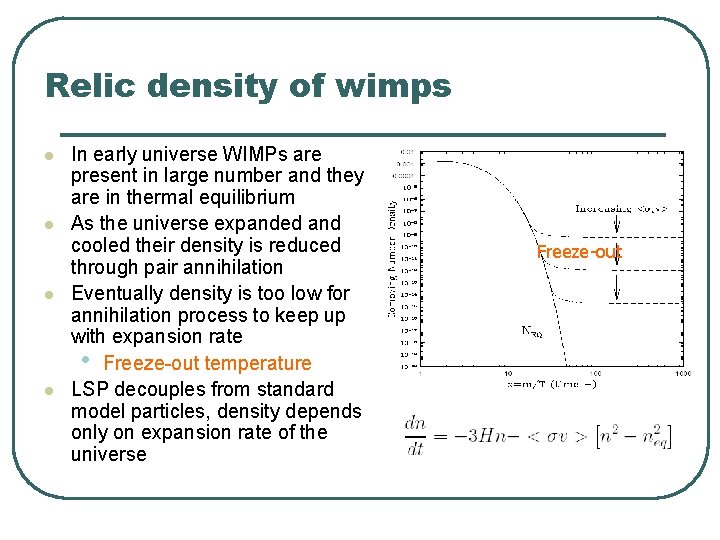
Relic density of wimps l l In early universe WIMPs are present in large number and they are in thermal equilibrium As the universe expanded and cooled their density is reduced through pair annihilation Eventually density is too low for annihilation process to keep up with expansion rate • Freeze-out temperature LSP decouples from standard model particles, density depends only on expansion rate of the universe Freeze-out
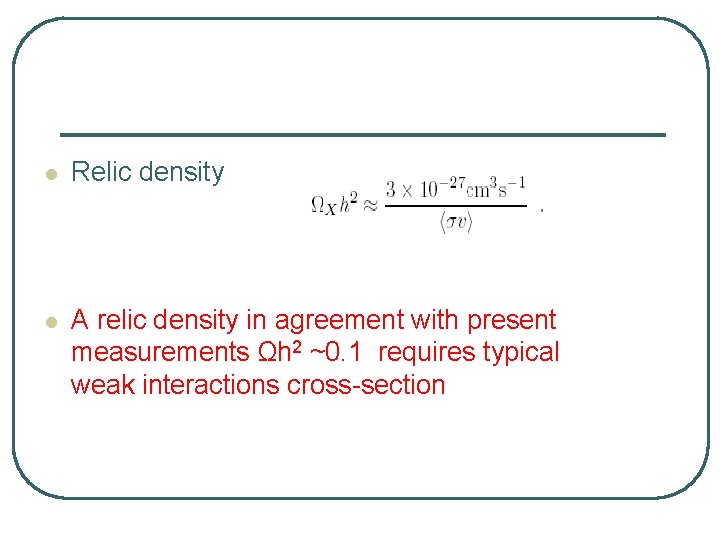
l Relic density l A relic density in agreement with present measurements Ωh 2 ~0. 1 requires typical weak interactions cross-section
Dark matter : cosmo/astro/pp l l l Wimps have roughly right value for relic density Neutralinos are wimps but not all SUSY models are acceptable Precise measurement of relic density constrain models • Direct/Indirect detection : search for dark matter establish that new particle is dark matter constrain models Colliders : which model for NP/ confront cosmology • • l Generic class of SUSY models that are OK LHC: discovery of new physics, dark matter candidate and/or new particles ILC: extend discovery potential of LHC How well this can be done strongly depends on model for NP
Supersymmetry l Motivation: unifying matter (fermions) and interactions (mediated by bosons) • l Prediction: new particles supersymmetric partners of all known fermions and bosons • l l Symmetry that relates fermions and bosons Not discovered yet Hierarchy problem • • Electroweak scale (100 Ge. V) << Planck scale SUSY particles (~Te. V) to stabilize Higgs mass against radiative corrections should be within reach of LHC Unification of couplings
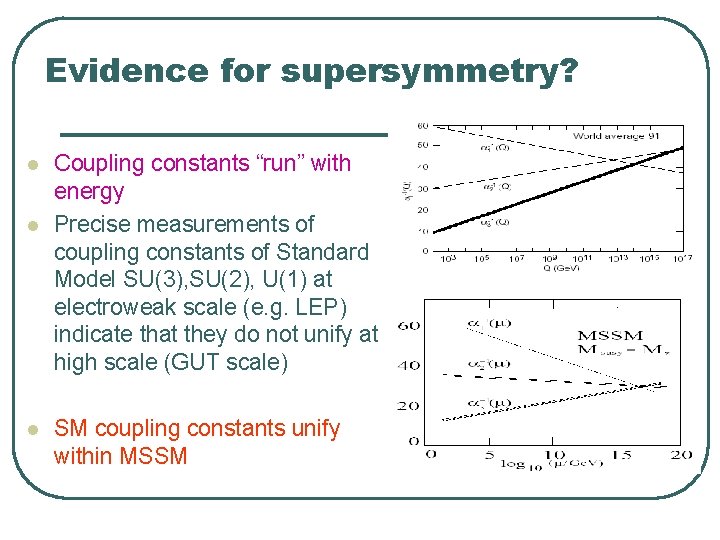
Evidence for supersymmetry? l l l Coupling constants “run” with energy Precise measurements of coupling constants of Standard Model SU(3), SU(2), U(1) at electroweak scale (e. g. LEP) indicate that they do not unify at high scale (GUT scale) SM coupling constants unify within MSSM
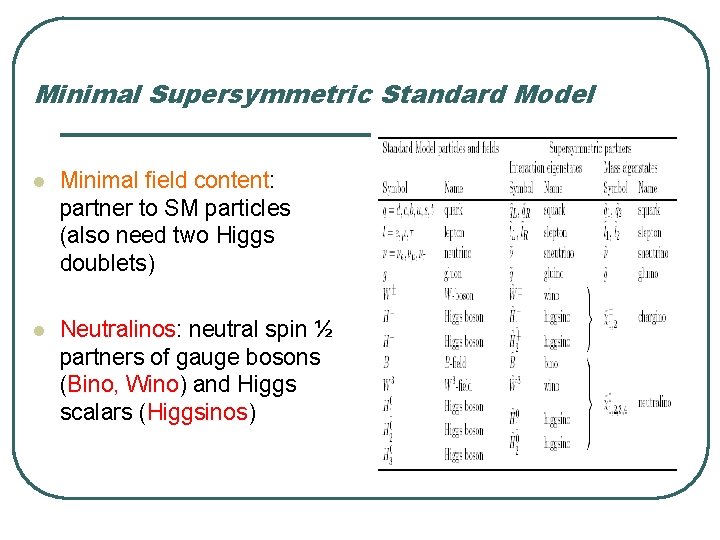
Minimal Supersymmetric Standard Model l Minimal field content: partner to SM particles (also need two Higgs doublets) l Neutralinos: neutral spin ½ partners of gauge bosons (Bino, Wino) and Higgs scalars (Higgsinos)
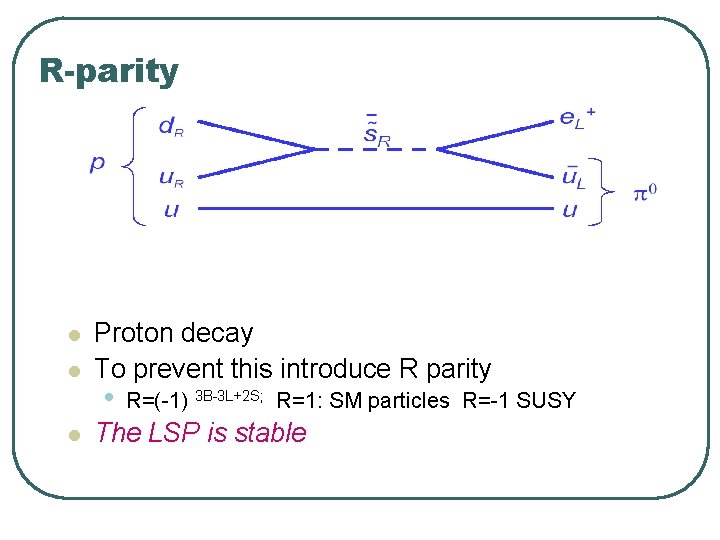
R-parity l l l Proton decay To prevent this introduce R parity • R=(-1) 3 B-3 L+2 S; R=1: SM particles R=-1 SUSY The LSP is stable
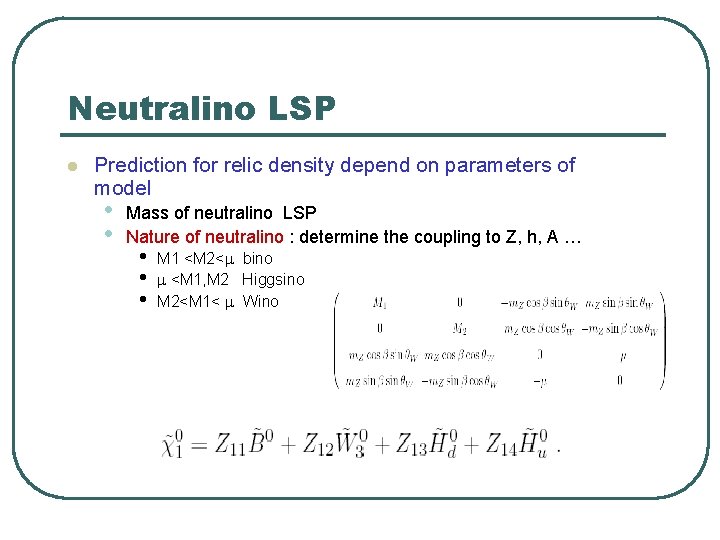
Neutralino LSP l Prediction for relic density depend on parameters of model • • Mass of neutralino LSP Nature of neutralino : determine the coupling to Z, h, A … • • • M 1 <M 2< bino <M 1, M 2 Higgsino M 2<M 1< Wino
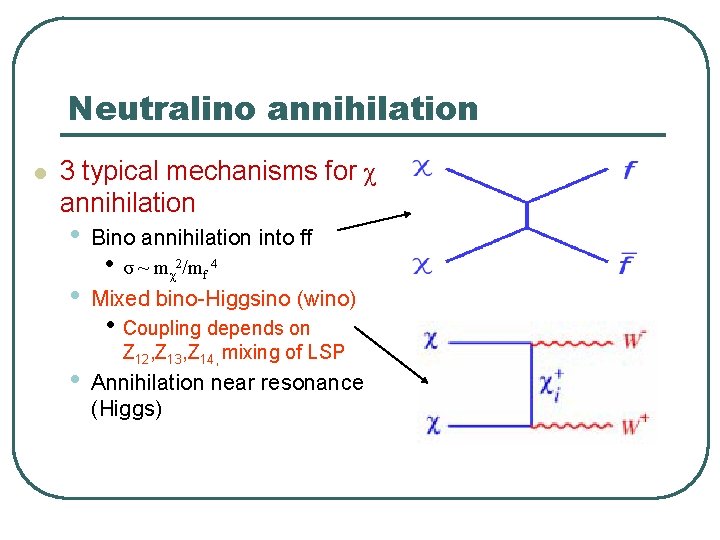
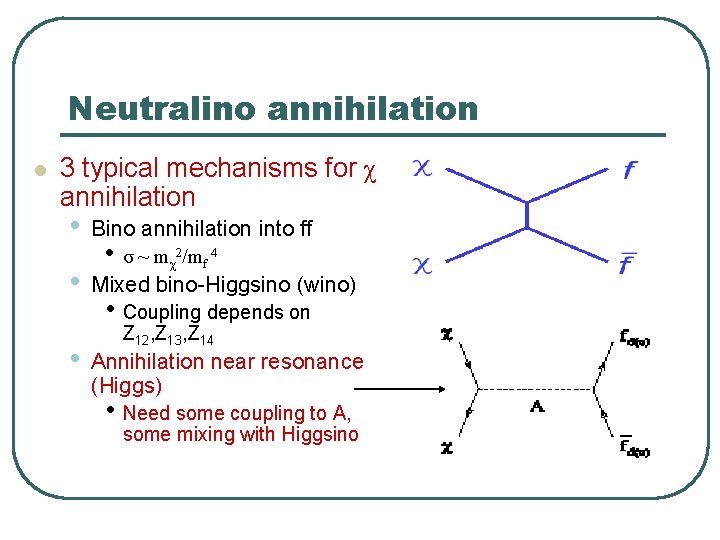
Neutralino annihilation l 3 typical mechanisms for χ annihilation • Bino annihilation into ff • Mixed bino-Higgsino (wino) • • σ ~ mχ2/mf 4 • Coupling depends on Z 12, Z 13, Z 14, mixing of LSP Annihilation near resonance (Higgs)
Neutralino annihilation l 3 typical mechanisms for χ annihilation • Bino annihilation into ff • Mixed bino-Higgsino (wino) • • σ ~ mχ2/mf 4 • Coupling depends on Z 12, Z 13, Z 14 Annihilation near resonance (Higgs) • Need some coupling to A, some mixing with Higgsino
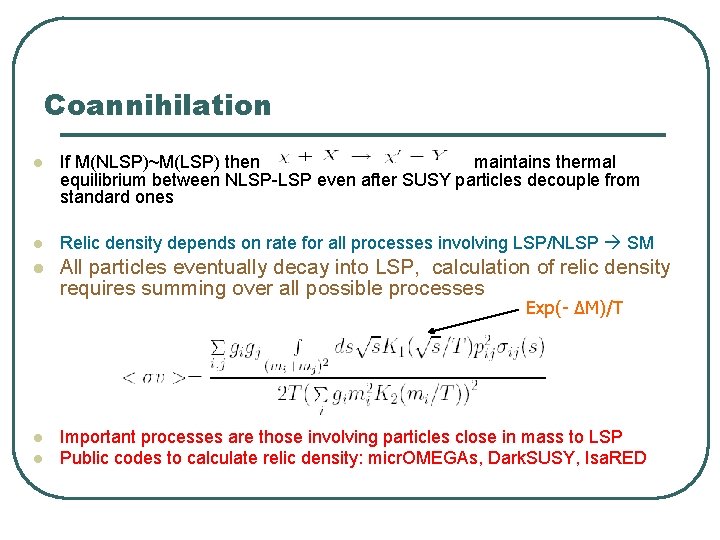
Coannihilation l If M(NLSP)~M(LSP) then maintains thermal equilibrium between NLSP-LSP even after SUSY particles decouple from standard ones l Relic density depends on rate for all processes involving LSP/NLSP SM l All particles eventually decay into LSP, calculation of relic density requires summing over all possible processes Exp(- ΔM)/T l l Important processes are those involving particles close in mass to LSP Public codes to calculate relic density: micr. OMEGAs, Dark. SUSY, Isa. RED
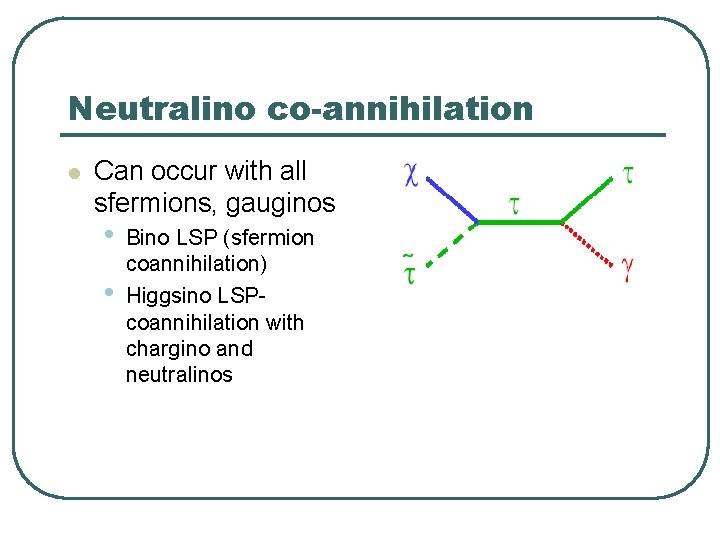
Neutralino co-annihilation l Can occur with all sfermions, gauginos • • Bino LSP (sfermion coannihilation) Higgsino LSPcoannihilation with chargino and neutralinos
l What happens in generic SUSY models, does one gets the right value for the relic density? • m. SUGRA (only 5 parameters) • M 0, M 1/2, tan β, A 0, • Other models MSSM (at least 19 parameters)
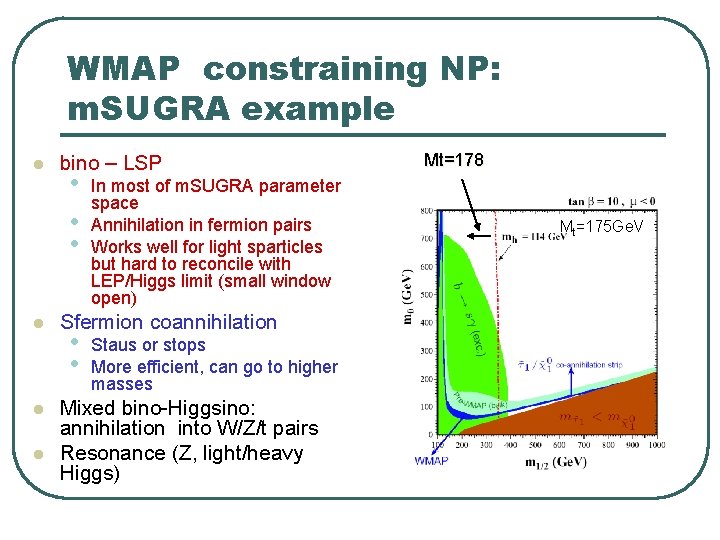
WMAP constraining NP: m. SUGRA example l l bino – LSP • • • In most of m. SUGRA parameter space Annihilation in fermion pairs Works well for light sparticles but hard to reconcile with LEP/Higgs limit (small window open) Sfermion coannihilation • • Staus or stops More efficient, can go to higher masses Mixed bino-Higgsino: annihilation into W/Z/t pairs Resonance (Z, light/heavy Higgs) Mt=178 Mt=175 Ge. V
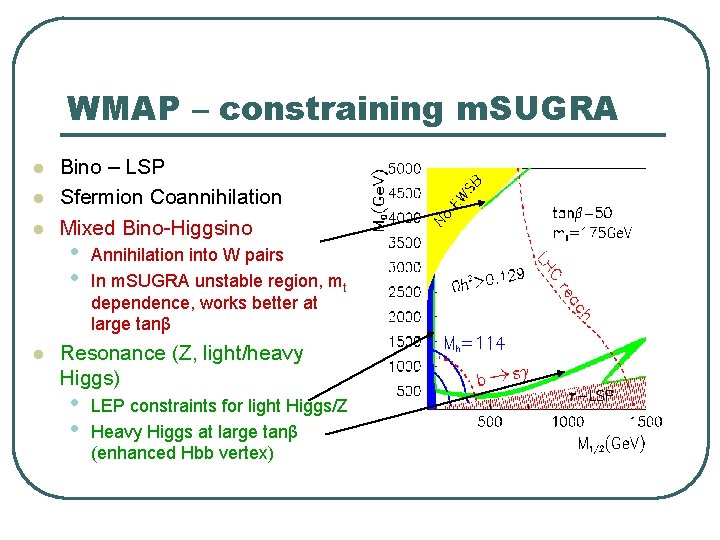
WMAP – constraining m. SUGRA l l Bino – LSP Sfermion Coannihilation Mixed Bino-Higgsino • • Annihilation into W pairs In m. SUGRA unstable region, mt dependence, works better at large tanβ Resonance (Z, light/heavy Higgs) • • LEP constraints for light Higgs/Z Heavy Higgs at large tanβ (enhanced Hbb vertex)
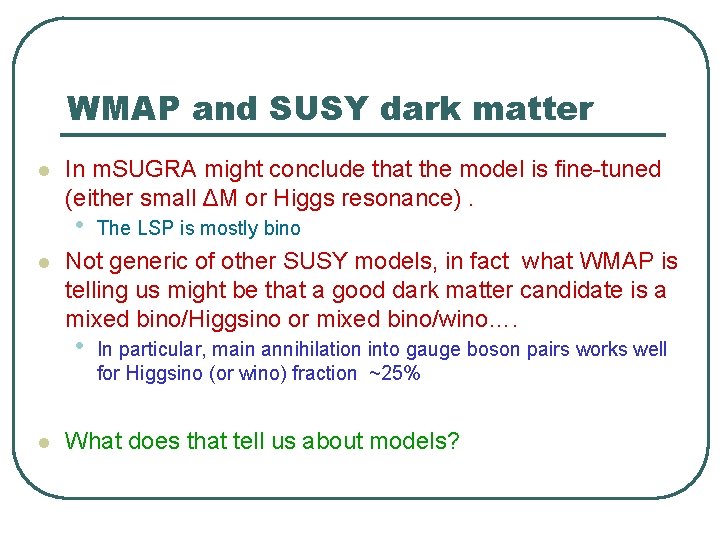
WMAP and SUSY dark matter l In m. SUGRA might conclude that the model is fine-tuned (either small ΔM or Higgs resonance). • l Not generic of other SUSY models, in fact what WMAP is telling us might be that a good dark matter candidate is a mixed bino/Higgsino or mixed bino/wino…. • l The LSP is mostly bino In particular, main annihilation into gauge boson pairs works well for Higgsino (or wino) fraction ~25% What does that tell us about models?
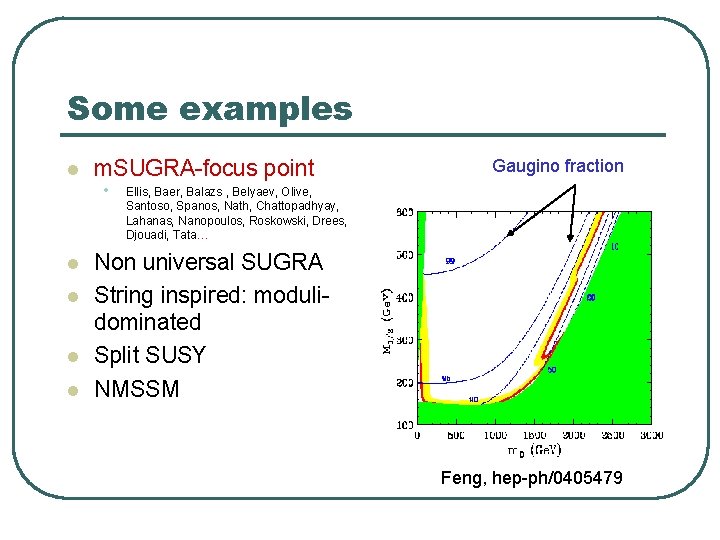
Some examples l l l m. SUGRA-focus point • Gaugino fraction Ellis, Baer, Balazs , Belyaev, Olive, Santoso, Spanos, Nath, Chattopadhyay, Lahanas, Nanopoulos, Roskowski, Drees, Djouadi, Tata… Non universal SUGRA String inspired: modulidominated Split SUSY NMSSM Feng, hep-ph/0405479
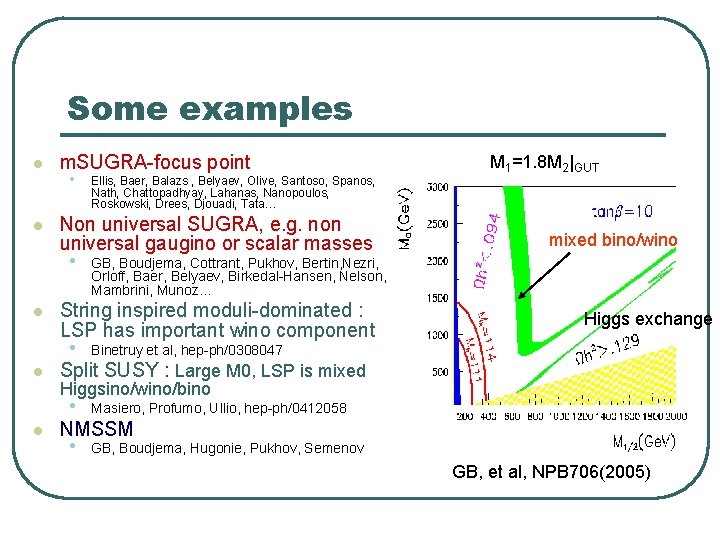
Some examples l l m. SUGRA-focus point • Non universal SUGRA, e. g. non universal gaugino or scalar masses • l Higgs exchange Binetruy et al, hep-ph/0308047 Split SUSY : Large M 0, LSP is mixed Higgsino/wino/bino • l mixed bino/wino GB, Boudjema, Cottrant, Pukhov, Bertin, Nezri, Orloff, Baer, Belyaev, Birkedal-Hansen, Nelson, Mambrini, Munoz… String inspired moduli-dominated : LSP has important wino component • l Ellis, Baer, Balazs , Belyaev, Olive, Santoso, Spanos, Nath, Chattopadhyay, Lahanas, Nanopoulos, Roskowski, Drees, Djouadi, Tata… M 1=1. 8 M 2|GUT Masiero, Profumo, Ullio, hep-ph/0412058 NMSSM • GB, Boudjema, Hugonie, Pukhov, Semenov GB, et al, NPB 706(2005)
PLAN l Evidence for dark matter Cosmology and SUSY dark matter l SUSY dark matter at colliders l l • Constraining models • SUSY signal and determination of parameters Direct/Indirect detection • Dark matter signal and complementarity to collider searches l Final remarks
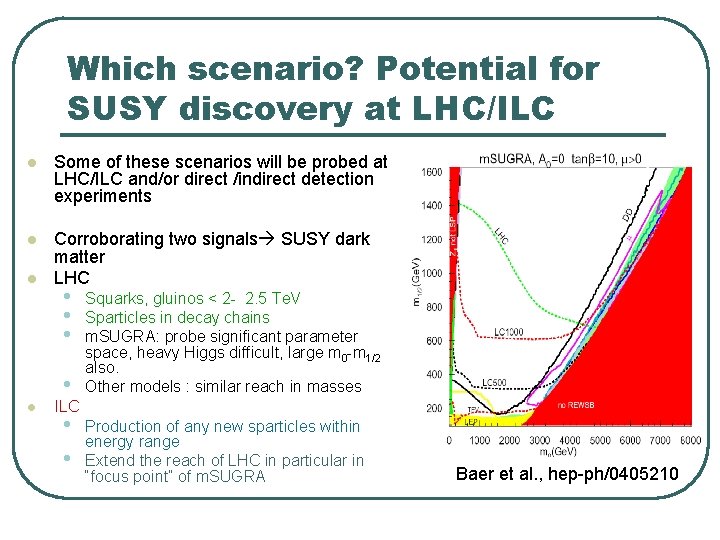
Which scenario? Potential for SUSY discovery at LHC/ILC l Some of these scenarios will be probed at LHC/ILC and/or direct /indirect detection experiments l Corroborating two signals SUSY dark matter LHC l • • l Squarks, gluinos < 2 - 2. 5 Te. V Sparticles in decay chains m. SUGRA: probe significant parameter space, heavy Higgs difficult, large m 0 -m 1/2 also. Other models : similar reach in masses ILC • • Production of any new sparticles within energy range Extend the reach of LHC in particular in “focus point” of m. SUGRA Baer et al. , hep-ph/0405210
Probing cosmology using collider information l Within the context of a given model can one make precise predictions for the relic density at the level of WMAP(10%) and even PLANCK (3%) (2007) therefore test the underlying cosmological model. • • l Assume discovery SUSY, precision from LHC? Precision from ILC? Answer depends strongly on underlying NP scenario, many parameters enter computation of relic density, only a handful of relevant ones for each scenario – work is going on in North America, Asia and Europe both for LHC and ILC • Moroi, Bambade, Richard, Zhang, Martyn, Tovey, Polesello, Lari, D. Zerwas, Allanach, Belanger, Boudjema, Pukhov, Battaglia, Birkedal, Gray, Matchev, Alexander, Fields, Hertz, Jones, Meyraiban, Pivarski, Peskin, Dutta, Kamon, Arnowitt, Khotilovith…
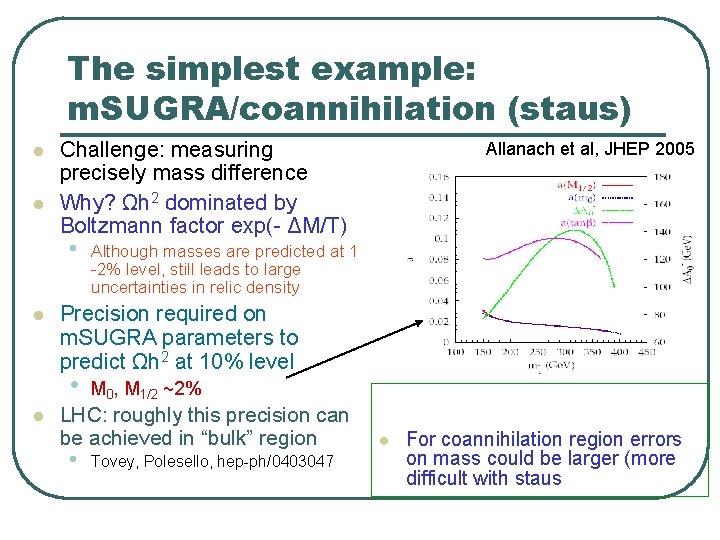
The simplest example: m. SUGRA/coannihilation (staus) l l Challenge: measuring precisely mass difference Why? Ωh 2 dominated by Boltzmann factor exp(- ΔM/T) • l Although masses are predicted at 1 -2% level, still leads to large uncertainties in relic density Precision required on m. SUGRA parameters to predict Ωh 2 at 10% level • l Allanach et al, JHEP 2005 M 0, M 1/2 ~2% LHC: roughly this precision can be achieved in “bulk” region • Tovey, Polesello, hep-ph/0403047 l For coannihilation region errors on mass could be larger (more difficult with staus
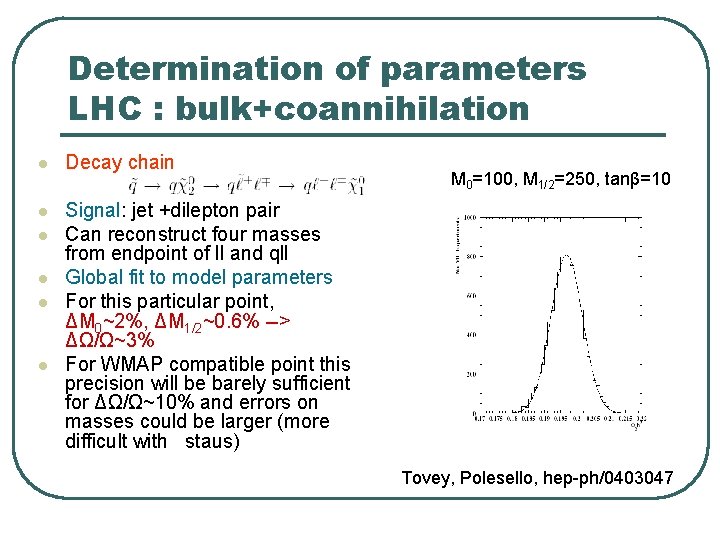
Determination of parameters LHC : bulk+coannihilation l Decay chain l Signal: jet +dilepton pair Can reconstruct four masses from endpoint of ll and qll Global fit to model parameters For this particular point, ΔM 0~2%, ΔM 1/2~0. 6% --> ΔΩ/Ω~3% For WMAP compatible point this precision will be barely sufficient for ΔΩ/Ω~10% and errors on masses could be larger (more difficult with staus) l l M 0=100, M 1/2=250, tanβ=10 Tovey, Polesello, hep-ph/0403047
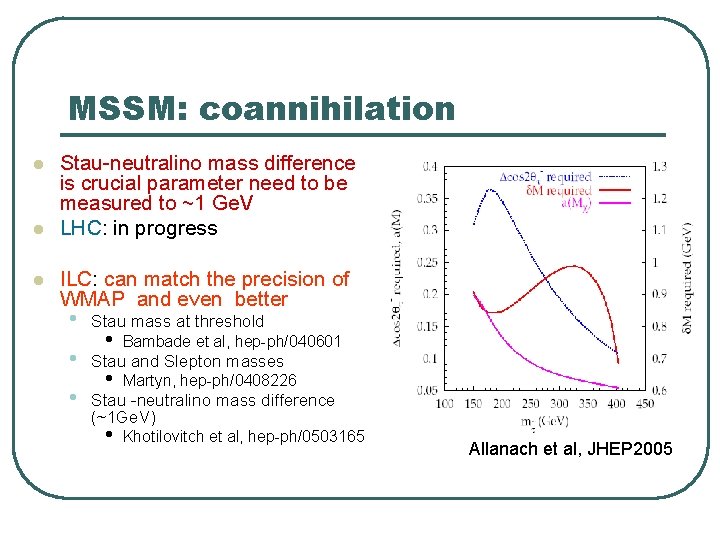
MSSM: coannihilation l l l Stau-neutralino mass difference is crucial parameter need to be measured to ~1 Ge. V LHC: in progress ILC: can match the precision of WMAP and even better • Stau mass at threshold • Stau and Slepton masses • Stau -neutralino mass difference (~1 Ge. V) • Bambade et al, hep-ph/040601 • Martyn, hep-ph/0408226 • Khotilovitch et al, hep-ph/0503165 Allanach et al, JHEP 2005
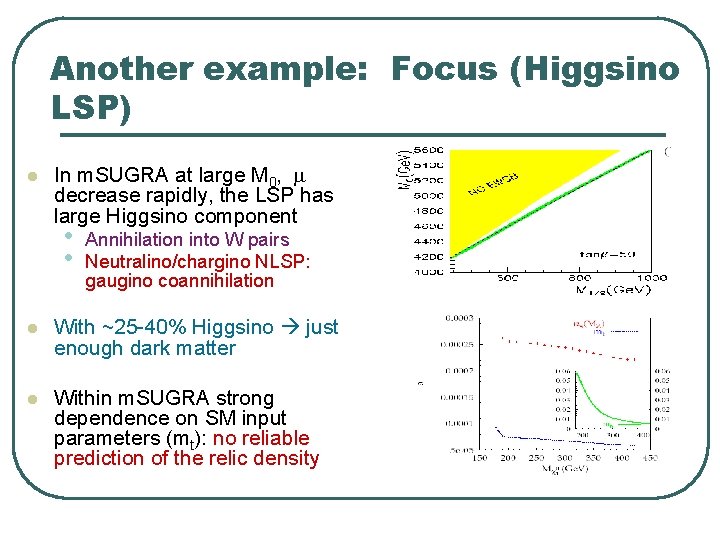
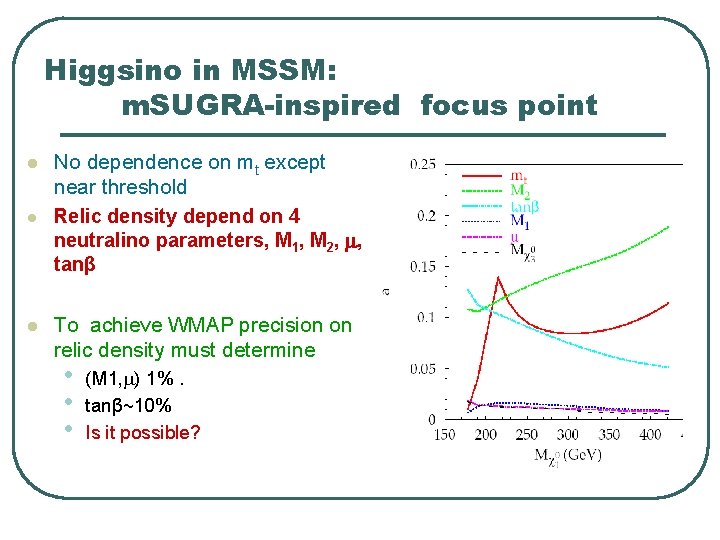
Another example: Focus (Higgsino LSP) l In m. SUGRA at large M 0, decrease rapidly, the LSP has large Higgsino component • • Annihilation into W pairs Neutralino/chargino NLSP: gaugino coannihilation l With ~25 -40% Higgsino just enough dark matter l Within m. SUGRA strong dependence on SM input parameters (mt): no reliable prediction of the relic density
Higgsino in MSSM: m. SUGRA-inspired focus point l l l No dependence on mt except near threshold Relic density depend on 4 neutralino parameters, M 1, M 2, , tanβ To achieve WMAP precision on relic density must determine • • • (M 1, ) 1%. tanβ~10% Is it possible?
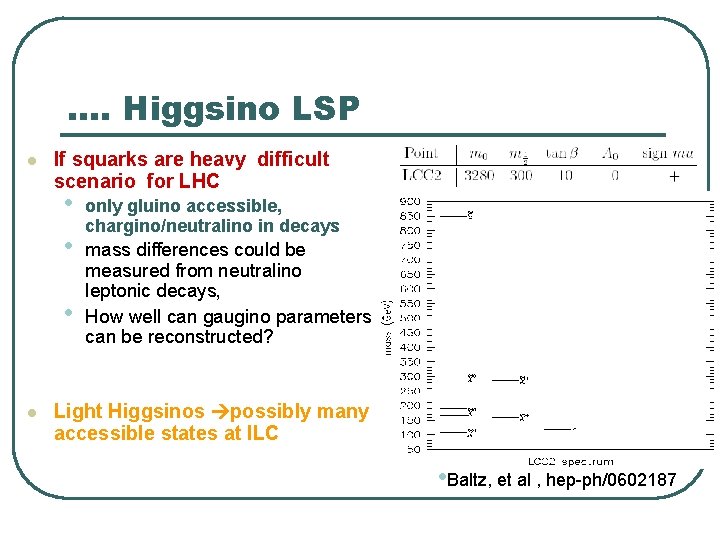
…. Higgsino LSP l If squarks are heavy difficult scenario for LHC • • • l only gluino accessible, chargino/neutralino in decays mass differences could be measured from neutralino leptonic decays, How well can gaugino parameters can be reconstructed? Light Higgsinos possibly many accessible states at ILC • Baltz, et al , hep-ph/0602187
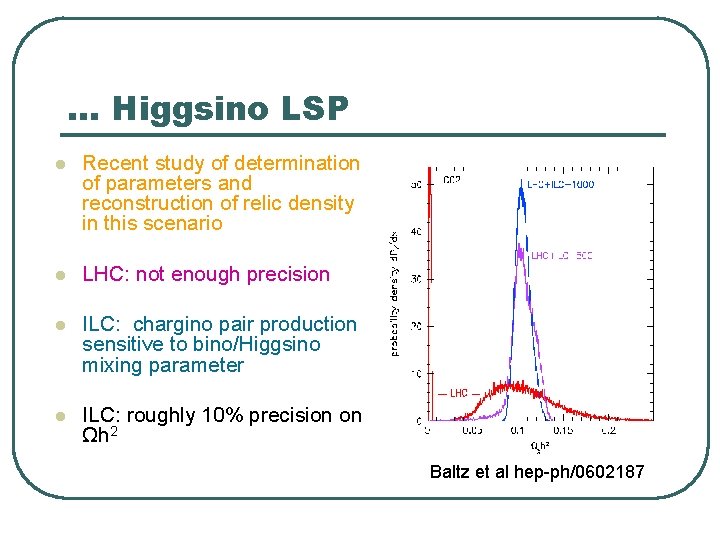
… Higgsino LSP l Recent study of determination of parameters and reconstruction of relic density in this scenario l LHC: not enough precision l ILC: chargino pair production sensitive to bino/Higgsino mixing parameter l ILC: roughly 10% precision on Ωh 2 Baltz et al hep-ph/0602187
Colliders and relic density l For neutralino LSP, in favourable scenarios LHC will give precise information on the parameters of MSSM and this will allow to refine the predictions for relic density of neutralinos. l In other scenarios, will have to wait for ILC @Te. V l What about precise predictions for direct/indirect detection?
Direct/indirect detection l l l Indirect/direct detection can find (some hints from Egret, Hess. . ) signal for dark matter Many experiments under way, more are planned • • Direct: CDMS, Edelweiss, Dama, Cresst, Zeplin Xenon, Genius, Picasso… Indirect: Hess, Veritas, Glast, HEAT, Pamela, AMS, Amanda, Icecube, Antares … Can check if compatible with some SUSY or other scenario Complementarity with LHC/ILC: • • • Establishing that there is dark matter Probing SUSY dark matter candidates LHC: good signal if light squarks/gluinos, direct/indirect detection good signal for (mixed bino/Higgsino LSP) Assuming some signals are discovered: corroborating information from colliders/astroparticle • Also tests of assumptions about dark matter distribution in the halo…
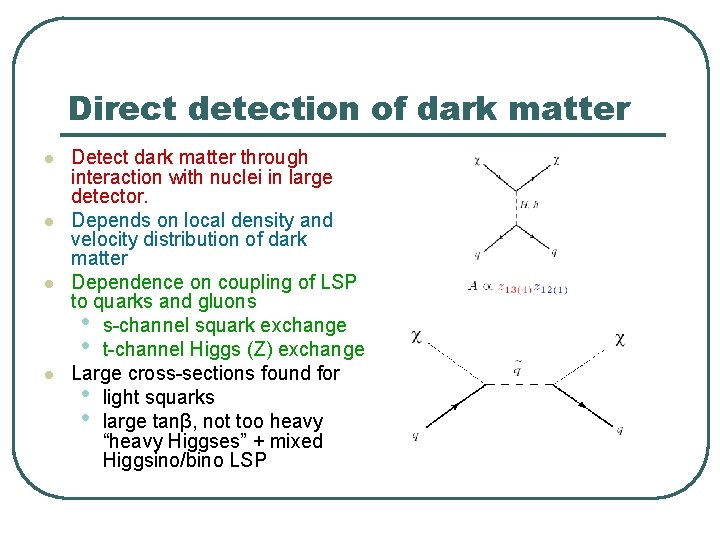
Direct detection of dark matter l l Detect dark matter through interaction with nuclei in large detector. Depends on local density and velocity distribution of dark matter Dependence on coupling of LSP to quarks and gluons • s-channel squark exchange • t-channel Higgs (Z) exchange Large cross-sections found for • light squarks • large tanβ, not too heavy “heavy Higgses” + mixed Higgsino/bino LSP
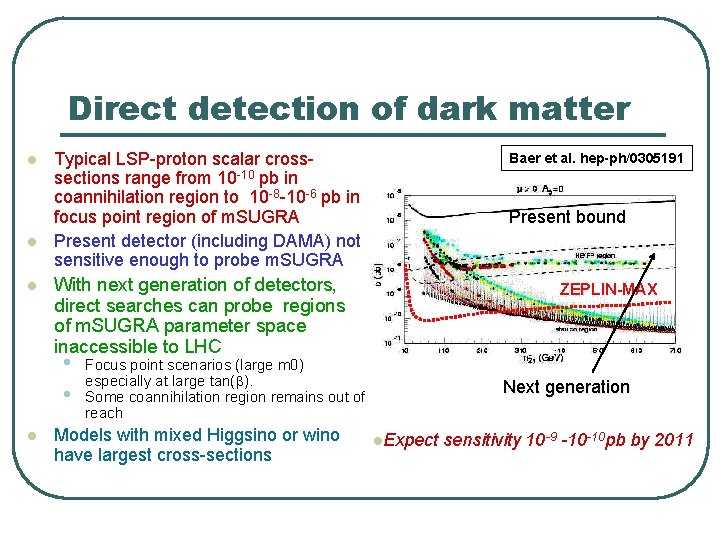
Direct detection of dark matter l l l Typical LSP-proton scalar crosssections range from 10 -10 pb in coannihilation region to 10 -8 -10 -6 pb in focus point region of m. SUGRA Present detector (including DAMA) not sensitive enough to probe m. SUGRA Present bound With next generation of detectors, direct searches can probe regions of m. SUGRA parameter space inaccessible to LHC • • l Baer et al. hep-ph/0305191 ZEPLIN-MAX Focus point scenarios (large m 0) especially at large tan( ). Some coannihilation region remains out of reach Models with mixed Higgsino or wino have largest cross-sections Next generation l. Expect sensitivity 10 -9 -10 -10 pb by 2011
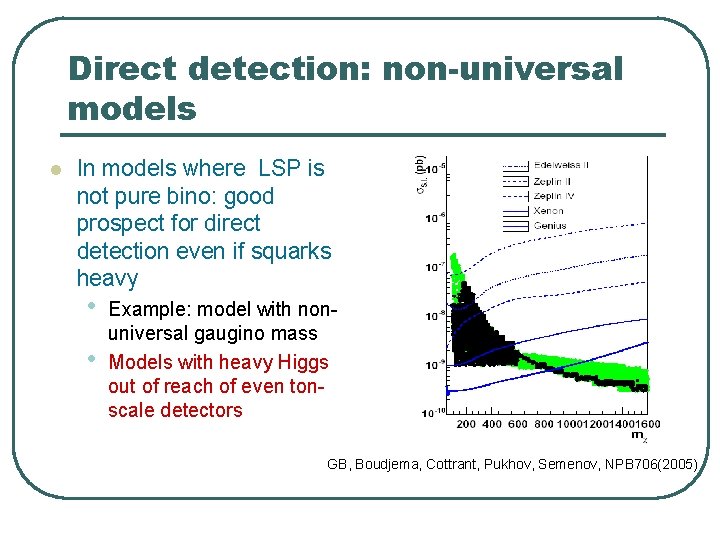
Direct detection: non-universal models l In models where LSP is not pure bino: good prospect for direct detection even if squarks heavy • • Example: model with nonuniversal gaugino mass Models with heavy Higgs out of reach of even tonscale detectors GB, Boudjema, Cottrant, Pukhov, Semenov, NPB 706(2005)
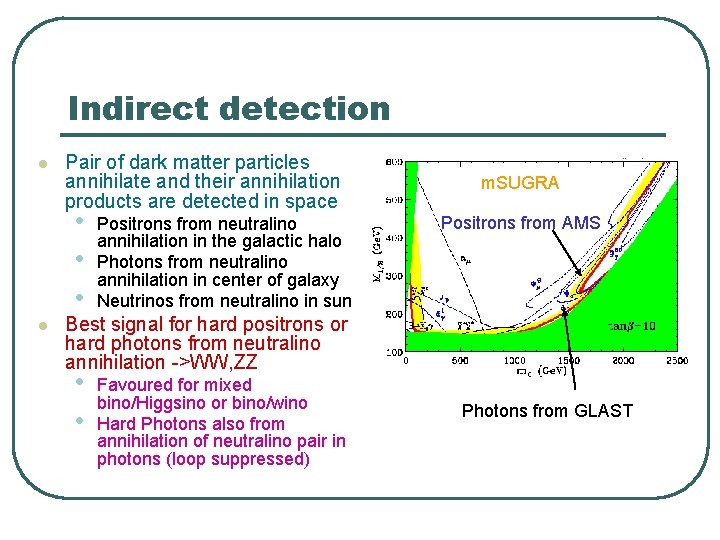
Indirect detection l l Pair of dark matter particles annihilate and their annihilation products are detected in space • • • Positrons from neutralino annihilation in the galactic halo Photons from neutralino annihilation in center of galaxy Neutrinos from neutralino in sun • • Favoured for mixed bino/Higgsino or bino/wino Hard Photons also from annihilation of neutralino pair in photons (loop suppressed) m. SUGRA Positrons from AMS Best signal for hard positrons or hard photons from neutralino annihilation ->WW, ZZ Photons from GLAST
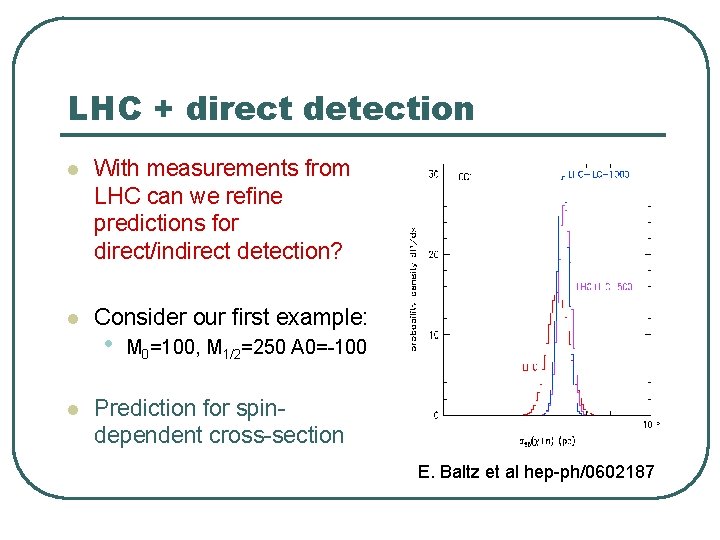
LHC + direct detection l With measurements from LHC can we refine predictions for direct/indirect detection? l Consider our first example: l • M 0=100, M 1/2=250 A 0=-100 Prediction for spindependent cross-section E. Baltz et al hep-ph/0602187
Final remarks
Other DM candidates: KK l l UED • • Minimal UED: LKP is B (1), partner of hypercharge gauge boson s-channel annihilation of LKP (gauge boson) typically more efficient than that of neutralino Compatibility with WMAP means rather heavy LKP Within LHC range, relevant for > Te. V linear collider Warped Xtra-Dim (Randall-Sundrum) • • • GUT model with matter in the bulk Solving baryon number violation in GUT models stable Kaluza-Klein particle Example based on SO(10) with Z 3 symmetry: LZP is KK righthanded neutrino • Agashe, Servant, hep-ph/0403143
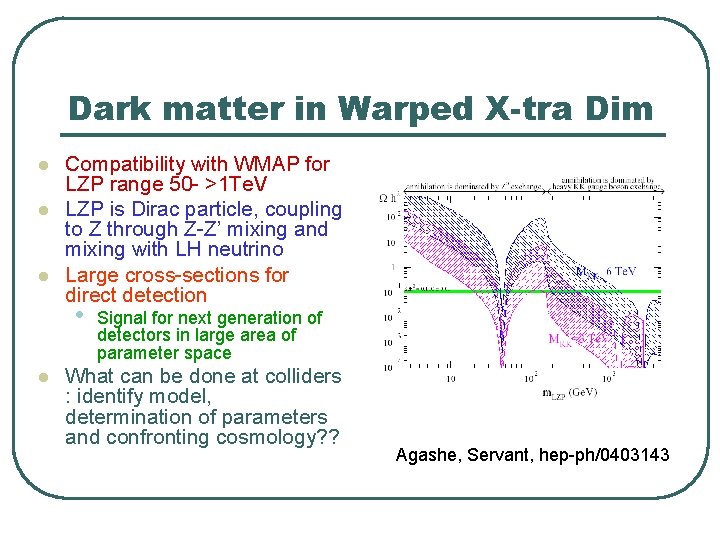
Dark matter in Warped X-tra Dim l l l Compatibility with WMAP for LZP range 50 - >1 Te. V LZP is Dirac particle, coupling to Z through Z-Z’ mixing and mixing with LH neutrino Large cross-sections for direct detection • l Signal for next generation of detectors in large area of parameter space What can be done at colliders : identify model, determination of parameters and confronting cosmology? ? Agashe, Servant, hep-ph/0403143
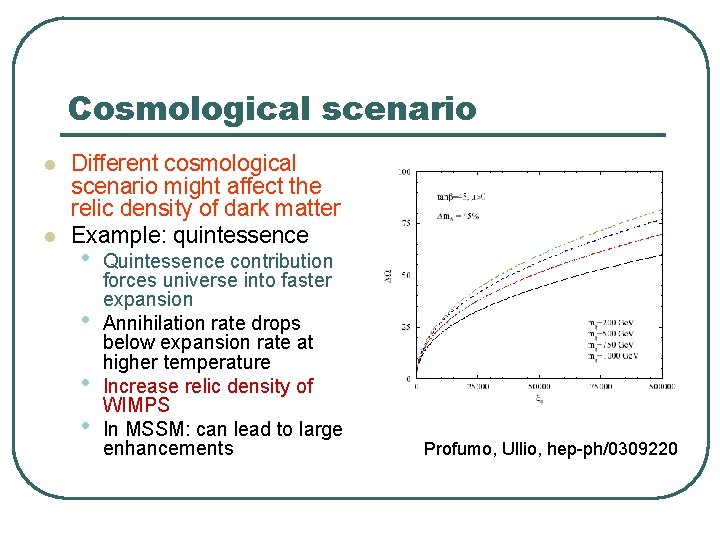
Cosmological scenario l l Different cosmological scenario might affect the relic density of dark matter Example: quintessence • • Quintessence contribution forces universe into faster expansion Annihilation rate drops below expansion rate at higher temperature Increase relic density of WIMPS In MSSM: can lead to large enhancements Profumo, Ullio, hep-ph/0309220
Conclusions l Cosmology provides accurate determination of properties of dark matter l l LHC has good opportunities to discover new physics In some favourable scenarios LHC might be able to make precise enough measurement to give accurate prediction of relic density of dark matter –confront cosmology Complementarity astroparticle/colliders l Expect lots exciting results soon l