
Superstition as Science Konrad TalmontKaminski UMCS KLI Firstfooting

- Slides: 32
Superstition as Science Konrad Talmont-Kaminski UMCS & KLI
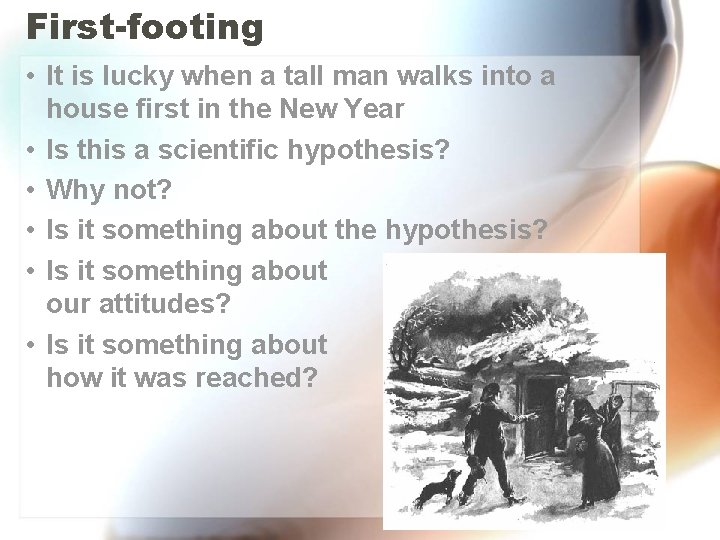
First-footing • It is lucky when a tall man walks into a house first in the New Year • Is this a scientific hypothesis? • Why not? • Is it something about the hypothesis? • Is it something about our attitudes? • Is it something about how it was reached?
Outline • • Elements of superstitions Superstition, magic & religion 3 different views of superstition Superstition as science What is the difference? Empirical limits Conclusions
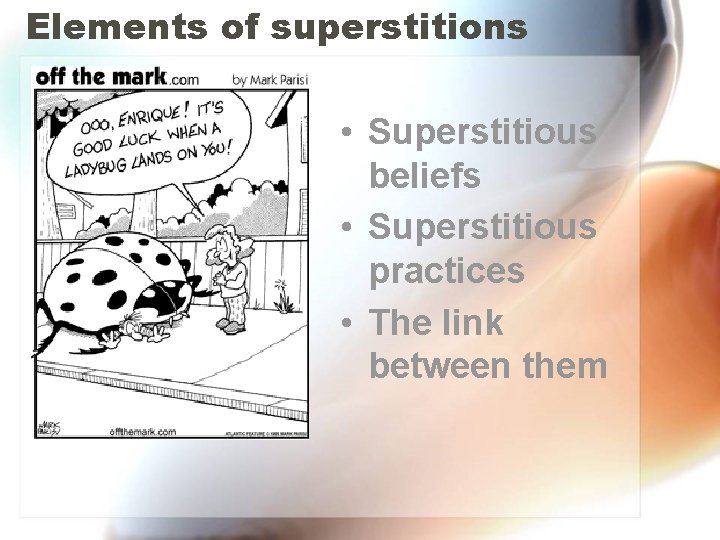
Elements of superstitions • Superstitious beliefs • Superstitious practices • The link between them
Elements of a superstition • Superstitious belief – ‘Action’ • Crossing fingers • Can be just an event – Friday 13 th – ‘Effect’ • Potentially desirable or undesirable event – Connection • Causation/conjuration or prediction/divination – Explanation • Luck • No natural explanation • Supernatural explanation
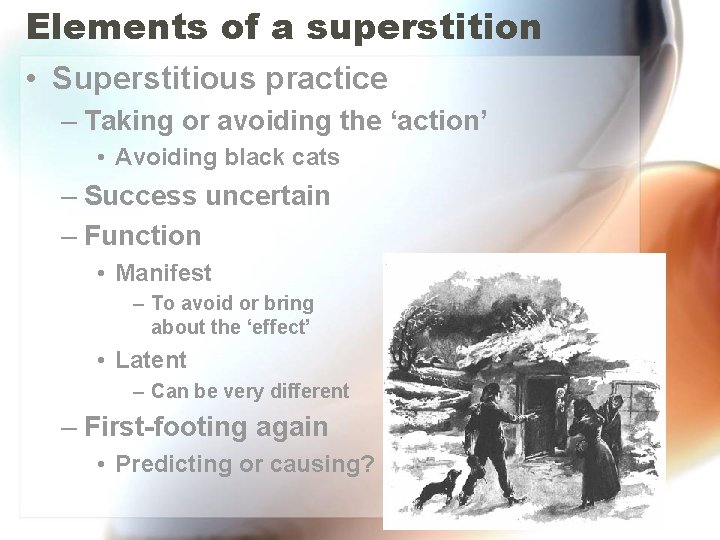
Elements of a superstition • Superstitious practice – Taking or avoiding the ‘action’ • Avoiding black cats – Success uncertain – Function • Manifest – To avoid or bring about the ‘effect’ • Latent – Can be very different – First-footing again • Predicting or causing?
Elements of a superstition • The link between beliefs and practices – Generally problematic – Focussing on practices • Skinner’s behaviourism • Beliefs secondary – Focussing on beliefs • Superstition satisfying internal needs • Practices secondary
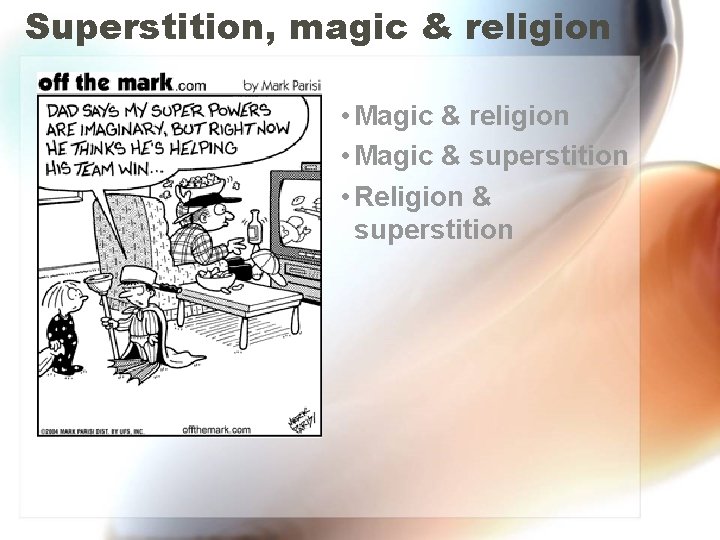
Superstition, magic & religion • Magic & superstition • Religion & superstition
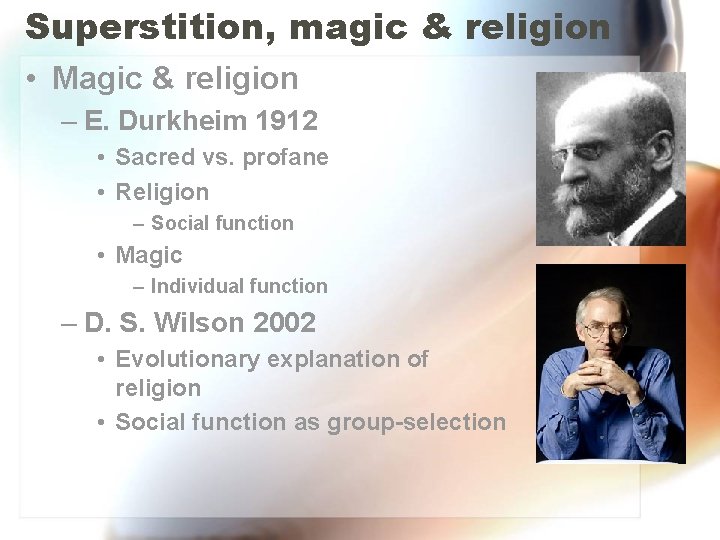
Superstition, magic & religion • Magic & religion – E. Durkheim 1912 • Sacred vs. profane • Religion – Social function • Magic – Individual function – D. S. Wilson 2002 • Evolutionary explanation of religion • Social function as group-selection
Superstition, magic & religion • Magic & superstition – Magic • Traditional societies – Superstition • Modern society – Relation? • Different phenomena • Same phenomenon / different contexts – Education and superstition (Jahoda 1969) – Jumper example
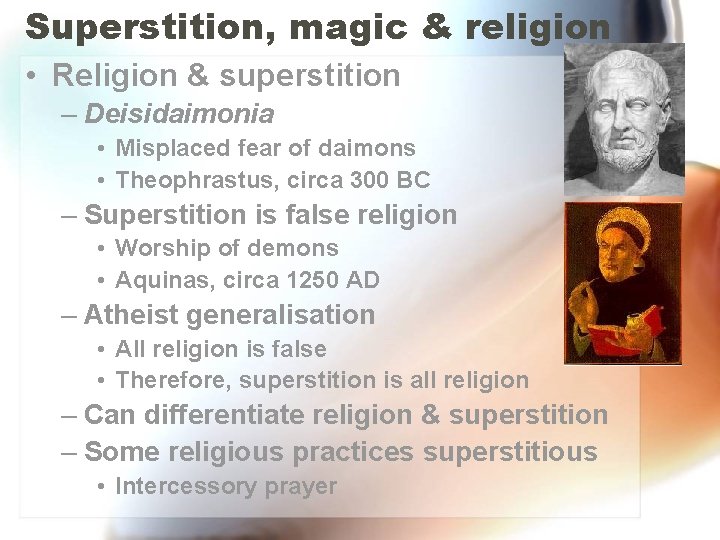
Superstition, magic & religion • Religion & superstition – Deisidaimonia • Misplaced fear of daimons • Theophrastus, circa 300 BC – Superstition is false religion • Worship of demons • Aquinas, circa 1250 AD – Atheist generalisation • All religion is false • Therefore, superstition is all religion – Can differentiate religion & superstition – Some religious practices superstitious • Intercessory prayer
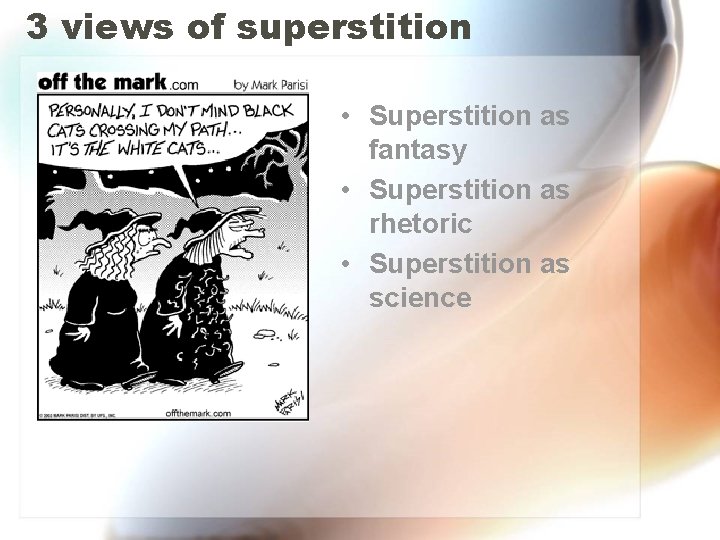
3 views of superstition • Superstition as fantasy • Superstition as rhetoric • Superstition as science
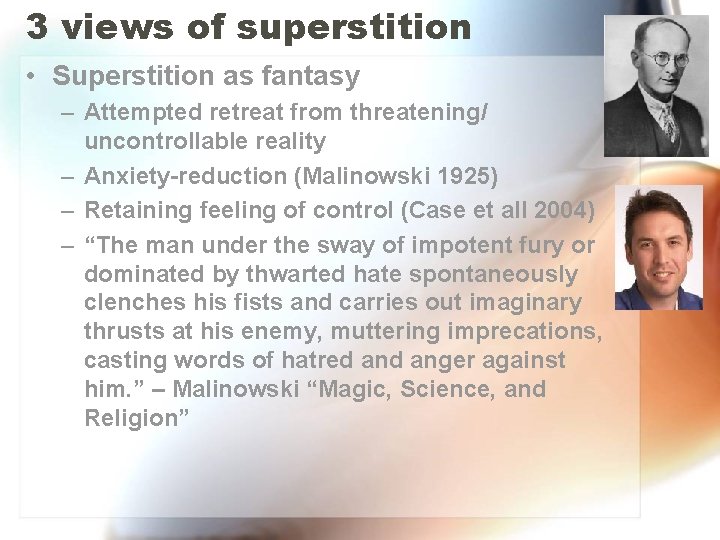
3 views of superstition • Superstition as fantasy – Attempted retreat from threatening/ uncontrollable reality – Anxiety-reduction (Malinowski 1925) – Retaining feeling of control (Case et all 2004) – “The man under the sway of impotent fury or dominated by thwarted hate spontaneously clenches his fists and carries out imaginary thrusts at his enemy, muttering imprecations, casting words of hatred anger against him. ” – Malinowski “Magic, Science, and Religion”
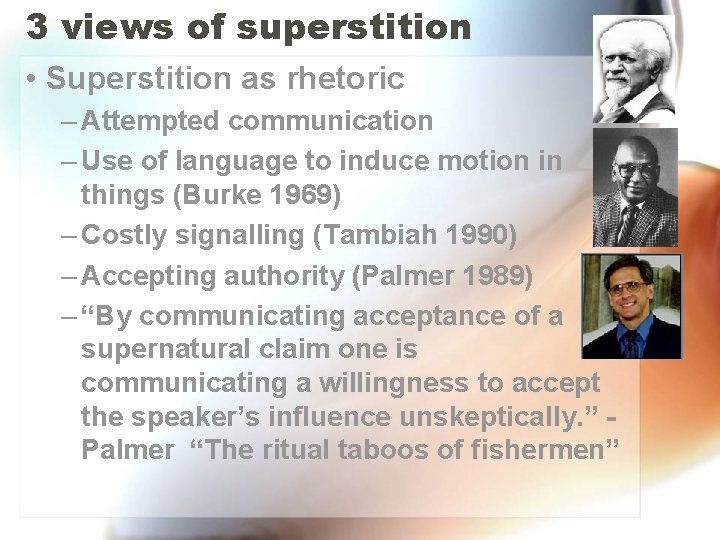
3 views of superstition • Superstition as rhetoric – Attempted communication – Use of language to induce motion in things (Burke 1969) – Costly signalling (Tambiah 1990) – Accepting authority (Palmer 1989) – “By communicating acceptance of a supernatural claim one is communicating a willingness to accept the speaker’s influence unskeptically. ” Palmer “The ritual taboos of fishermen”
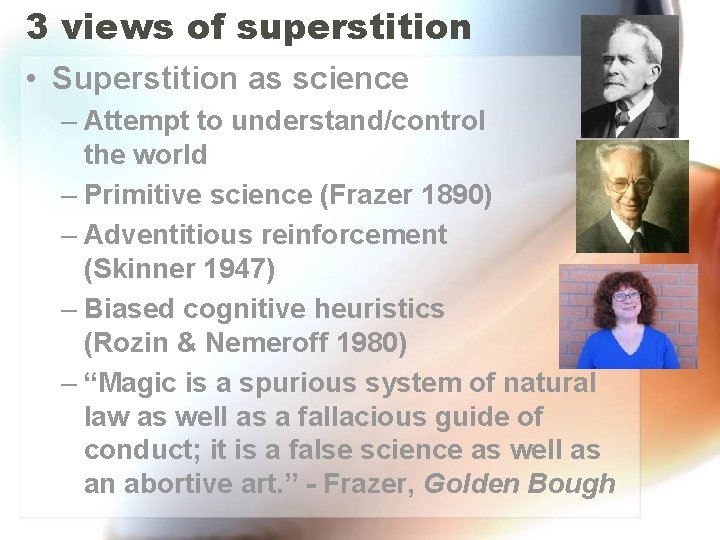
3 views of superstition • Superstition as science – Attempt to understand/control the world – Primitive science (Frazer 1890) – Adventitious reinforcement (Skinner 1947) – Biased cognitive heuristics (Rozin & Nemeroff 1980) – “Magic is a spurious system of natural law as well as a fallacious guide of conduct; it is a false science as well as an abortive art. ” - Frazer, Golden Bough
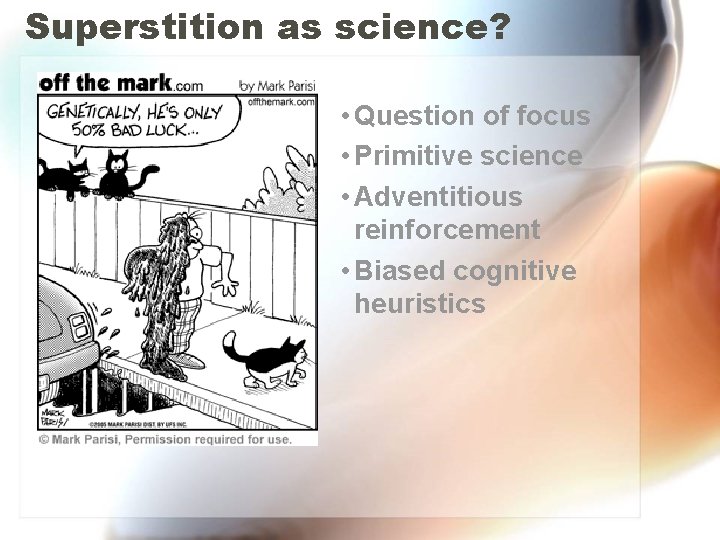
Superstition as science? • Question of focus • Primitive science • Adventitious reinforcement • Biased cognitive heuristics
Superstition as science? • Question of focus – Superstitious beliefs vs. scientific beliefs – Superstitious methods vs. scientific methods • Both options incomplete – Would ‘superstitious’ beliefs be scientific if arrived at scientifically? – Could they be arrived at scientifically? – Is there such a thing as ‘magical thinking’? – Or is it that thinking sometimes leads to magical beliefs?
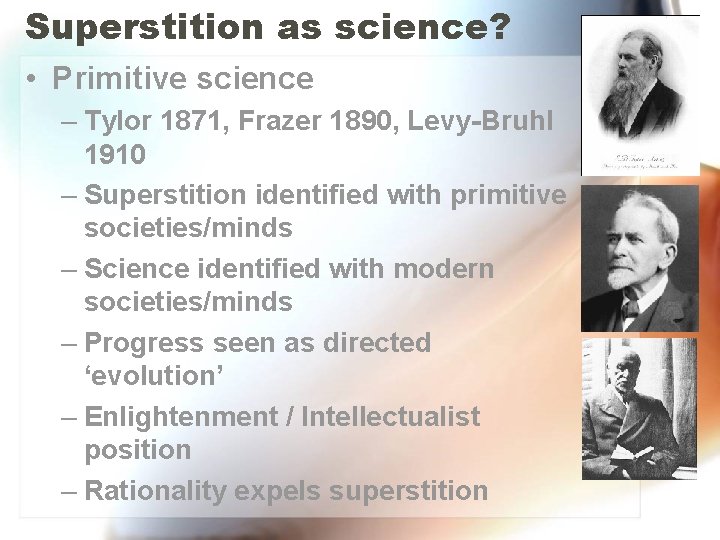
Superstition as science? • Primitive science – Tylor 1871, Frazer 1890, Levy-Bruhl 1910 – Superstition identified with primitive societies/minds – Science identified with modern societies/minds – Progress seen as directed ‘evolution’ – Enlightenment / Intellectualist position – Rationality expels superstition
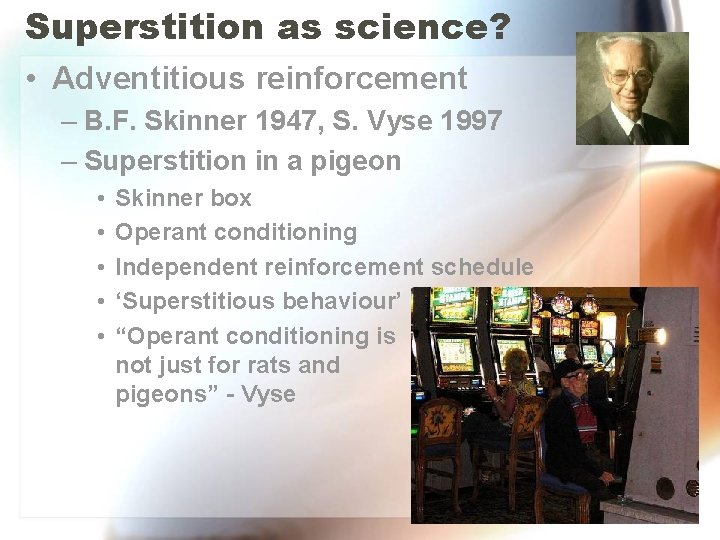
Superstition as science? • Adventitious reinforcement – B. F. Skinner 1947, S. Vyse 1997 – Superstition in a pigeon • • • Skinner box Operant conditioning Independent reinforcement schedule ‘Superstitious behaviour’ “Operant conditioning is not just for rats and pigeons” - Vyse
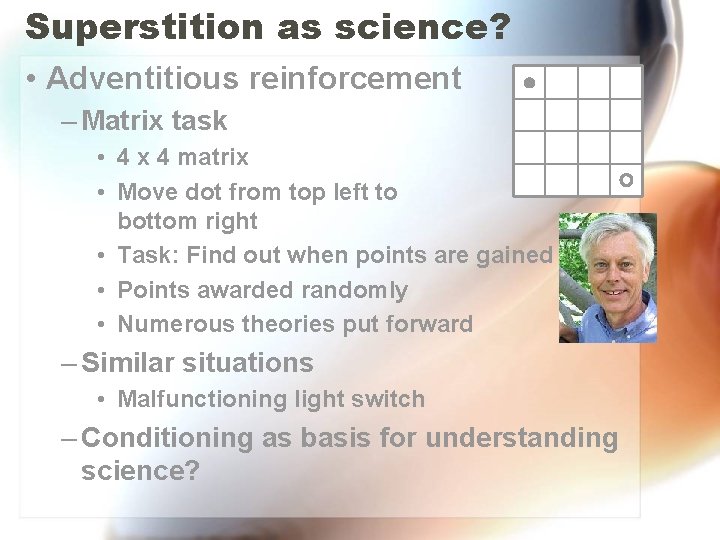
Superstition as science? • Adventitious reinforcement – Matrix task • 4 x 4 matrix • Move dot from top left to bottom right • Task: Find out when points are gained • Points awarded randomly • Numerous theories put forward – Similar situations • Malfunctioning light switch – Conditioning as basis for understanding science?
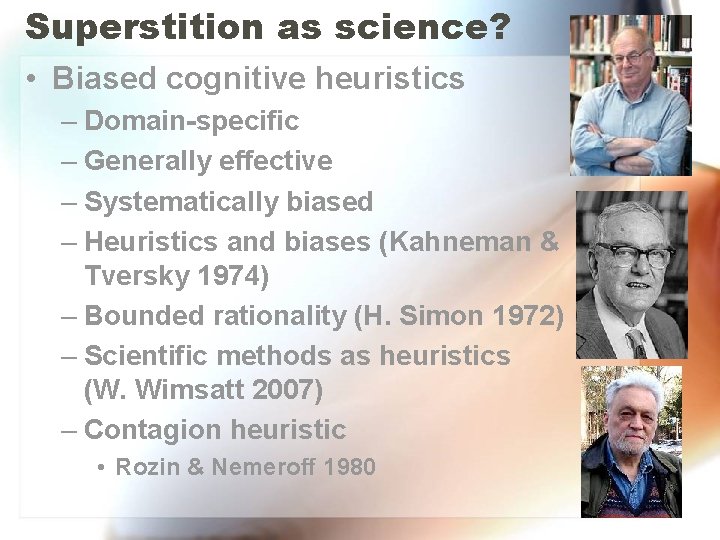
Superstition as science? • Biased cognitive heuristics – Domain-specific – Generally effective – Systematically biased – Heuristics and biases (Kahneman & Tversky 1974) – Bounded rationality (H. Simon 1972) – Scientific methods as heuristics (W. Wimsatt 2007) – Contagion heuristic • Rozin & Nemeroff 1980
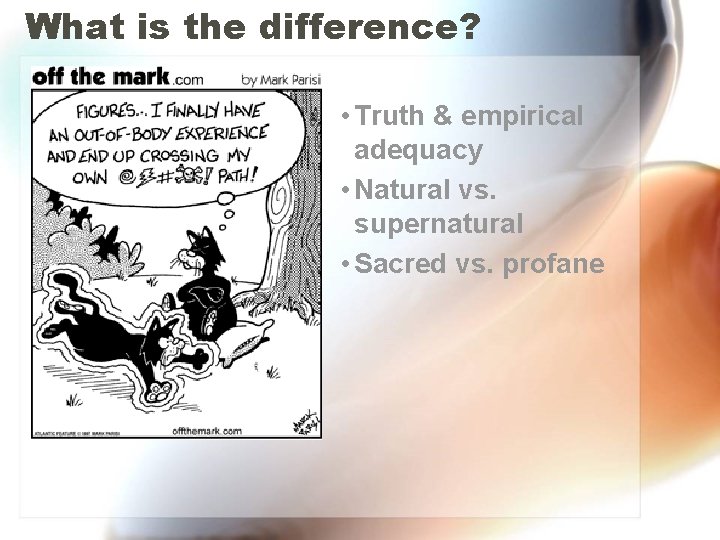
What is the difference? • Truth & empirical adequacy • Natural vs. supernatural • Sacred vs. profane
What is the difference? • Truth & empirical adequacy – Superstitions as false causal beliefs • Often used definition • Many false causal beliefs, some scientific – Superstitions not just false but (known to be) empirically inadequate • Scientific beliefs rejected due to empirical inadequacy • Can not equate Newton’s physics with his astrology – Is ‘onto something’ – But superstitious beliefs ‘look different’
What is the difference? • Natural vs. supernatural – Superstitions as supernatural claims – Problems • • Vague concept Circularity? Distinction much later than category Correlation between superstitious and pseudoscientific beliefs • Succubi become aliens • Post hoc explanations – Is ‘onto something’
What is the difference? • Sacred vs. profane – Durkheim – Explaining a cognitive category in terms of a social phenomenon? – Is ‘onto something’ – But, again, superstitions ‘look different’
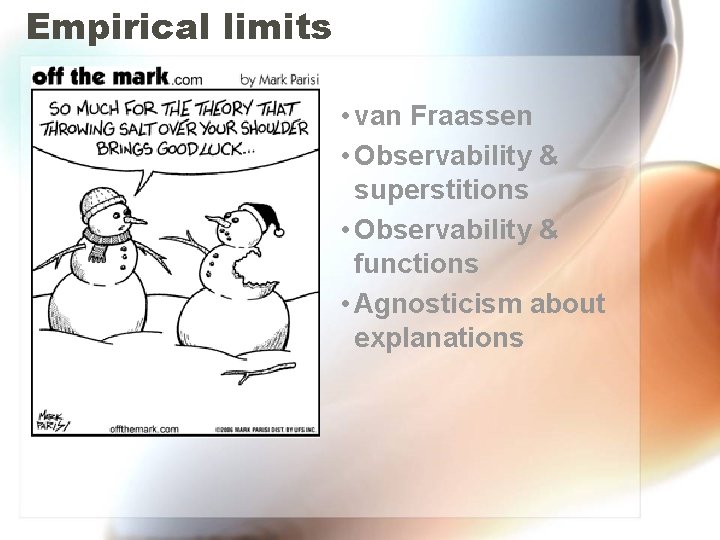
Empirical limits • van Fraassen • Observability & superstitions • Observability & functions • Agnosticism about explanations
Empirical limits • B. van Fraassen – The Scientific Image 1980 – Limits of observability • • Actual empirical limitations Ability to discern small objects Limits change over time Agnosticism about unobservable claims • Challenging scientific attitudes – Observable/detectable distinction • Distinction generally rejected • Is anything unobservable? • Significance of social attitudes
Empirical limits • Observability & superstitions • How observable are superstitious claims? – Connections between ‘actions’ and ‘events’ • Observable as correlations – Explanations for the connections • The claims hard to observe • Attitudes object to observation • Render superstitious explanations effectively unobservable • ‘Superempirical’ rather than supernatural
Empirical limits • Observability and functions • Manifest and latent function – Manifest function requires observability – Religious connections unobservable • Latent (social) function more important – In superstitions only explanations unobservable – Scientists aim to make explanations observable – A vital difference
Empirical limits • Agnosticism about explanations • Scientific explanations? – Scientists take realist view of explanations – Pursue evidence for their truth – Agnosticism not justified • Superstitious explanations – Explanations in practically untestable terms – Testing of explanations discouraged – Agnosticism is not enough • Agnosticism about explanations is not scientific
Conclusions • Similarities –Methods: Use of heuristics –Beliefs: Often hard to test explanations put forward • Differences –Methods: Development of new heuristics –Beliefs: A realist attitude to explanations leading to pursuit of testing
Thank you konrad@talmont. com http: //deisidaimon. wordpress. com