
SuperResolution Measurement of XRay Mirrors Scientific Achievement Advanced
- Slides: 1
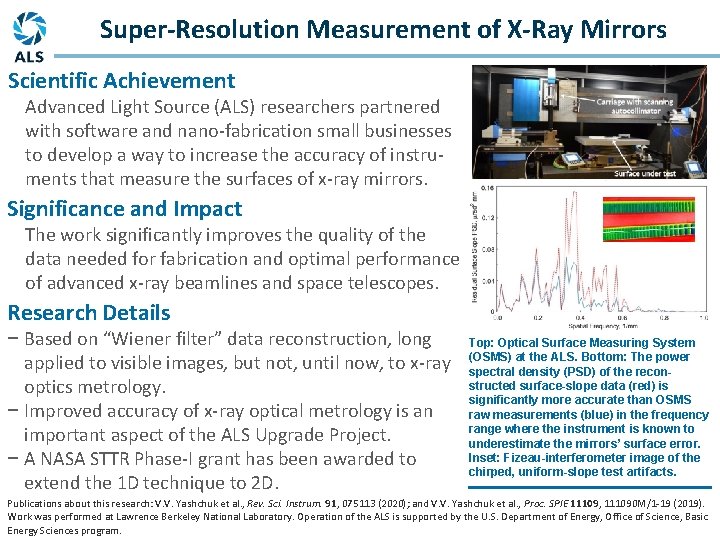
Super-Resolution Measurement of X-Ray Mirrors Scientific Achievement Advanced Light Source (ALS) researchers partnered with software and nano-fabrication small businesses to develop a way to increase the accuracy of instruments that measure the surfaces of x-ray mirrors. Significance and Impact The work significantly improves the quality of the data needed for fabrication and optimal performance of advanced x-ray beamlines and space telescopes. Research Details − Based on “Wiener filter” data reconstruction, long applied to visible images, but not, until now, to x-ray optics metrology. − Improved accuracy of x-ray optical metrology is an important aspect of the ALS Upgrade Project. − A NASA STTR Phase-I grant has been awarded to extend the 1 D technique to 2 D. Top: Optical Surface Measuring System (OSMS) at the ALS. Bottom: The power spectral density (PSD) of the reconstructed surface-slope data (red) is significantly more accurate than OSMS raw measurements (blue) in the frequency range where the instrument is known to underestimate the mirrors’ surface error. Inset: Fizeau-interferometer image of the chirped, uniform-slope test artifacts. Publications about this research: V. V. Yashchuk et al. , Rev. Sci. Instrum. 91, 075113 (2020); and V. V. Yashchuk et al. , Proc. SPIE 11109, 111090 M/1 -19 (2019). Work was performed at Lawrence Berkeley National Laboratory. Operation of the ALS is supported by the U. S. Department of Energy, Office of Science, Basic Energy Sciences program.