
Superradiance Amplification and Lasing of Terahertz Radiation in
![THz Apmplification in Plasmonic Nanocavities =1 ps =0. 1 ps Re[ Gr(ω)]<0 Re[ Gr(ω)]>0](https://slidetodoc.com/presentation_image_h/296fa684dc30473aa78faab34ffe736e/image-13.jpg "THz Apmplification in Plasmonic Nanocavities =1 ps =0. 1 ps Re[ Gr(ω)]<0 Re[ Gr(ω)]>0")

- Slides: 16
Superradiance, Amplification, and Lasing of Terahertz Radiation in an Array of Graphene Plasmonic Nanocavities V. V. Popov, 1 O. V. Polischuk, 1 A. R. Davoyan, 1 V. Ryzhii, 2 T. Otsuji, 2 and M. S. Shur 3 1 Kotelnikov Institute of Radio Engineering and Electronics (Saratov Branch), Saratov 410019, Russia 2 Research Institute for Electrical Communication, Tohoku University, Sendai 980 -8577, Japan 3 Department of Electrical, Computer, and Systems Engineering, Rensselaer Polytechnic Institute, Troy, New York 12180, USA
Outline Ø Optical conductivity of pumped graphene Ø Terahertz photonics vs terahertz plasmonics Ø Array of graphene nanocavities - electromagnetic approach Ø Terahertz amplification and plasmonic lasing condition Ø Confinement and superradiance of plasmon modes Ø Conclusions
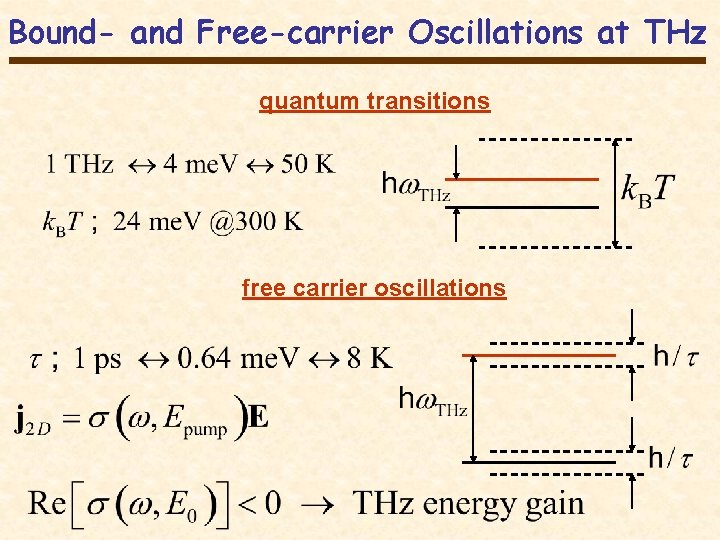
Bound- and Free-carrier Oscillations at THz quantum transitions free carrier oscillations
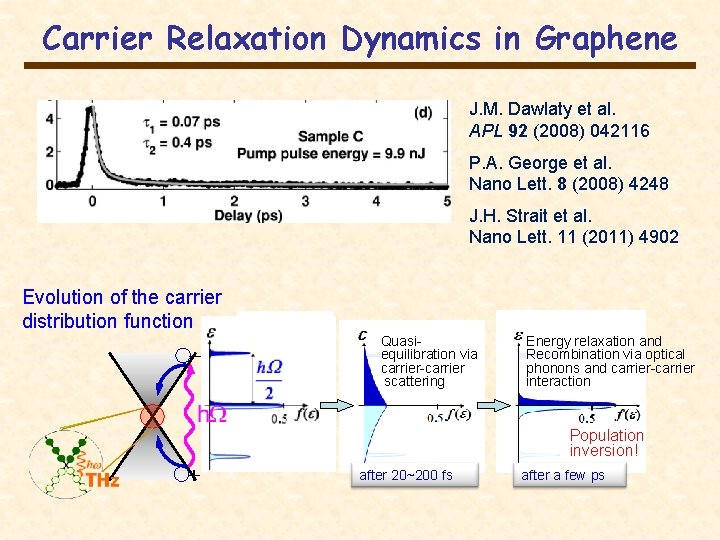
Carrier Relaxation Dynamics in Graphene J. M. Dawlaty et al. APL 92 (2008) 042116 P. A. George et al. Nano Lett. 8 (2008) 4248 J. H. Strait et al. Nano Lett. 11 (2011) 4902 Evolution of the carrier distribution function - Quasiequilibration via carrier-carrier scattering Energy relaxation and Recombination via optical phonons and carrier-carrier interaction Population inversion! + after 20~200 fs after a few ps
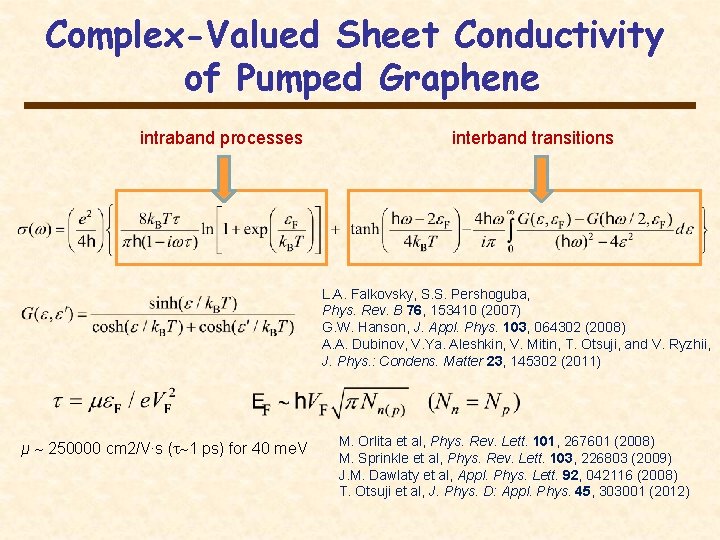
Complex-Valued Sheet Conductivity of Pumped Graphene intraband processes interband transitions L. A. Falkovsky, S. S. Pershoguba, Phys. Rev. B 76, 153410 (2007) G. W. Hanson, J. Appl. Phys. 103, 064302 (2008) A. A. Dubinov, V. Ya. Aleshkin, V. Mitin, T. Otsuji, and V. Ryzhii, J. Phys. : Condens. Matter 23, 145302 (2011) μ 250000 cm 2/V∙s ( 1 ps) for 40 me. V M. Orlita et al, Phys. Rev. Lett. 101, 267601 (2008) M. Sprinkle et al, Phys. Rev. Lett. 103, 226803 (2009) J. M. Dawlaty et al, Appl. Phys. Lett. 92, 042116 (2008) T. Otsuji et al, J. Phys. D: Appl. Phys. 45, 303001 (2012)
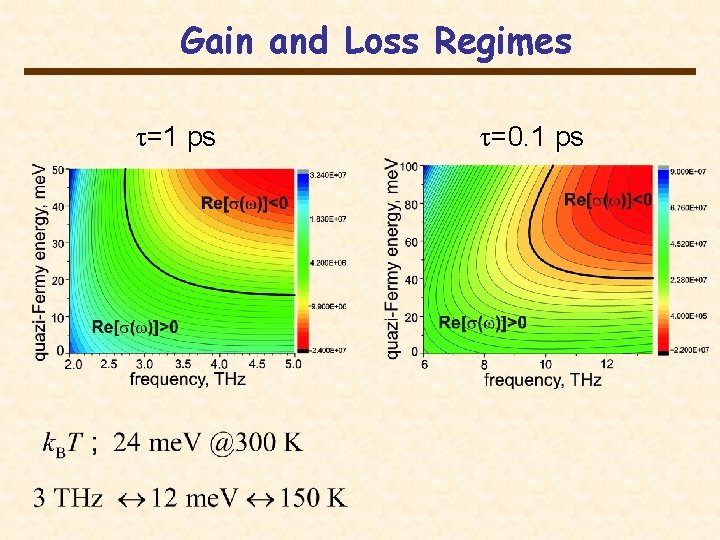
Gain and Loss Regimes =1 ps =0. 1 ps
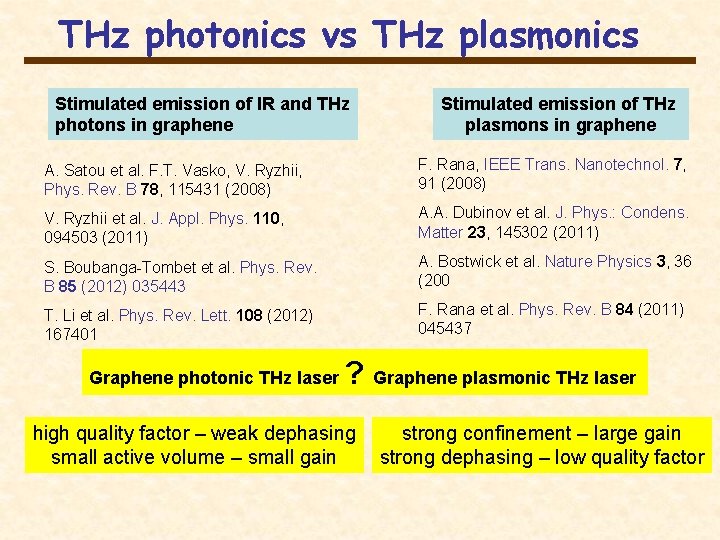
THz photonics vs THz plasmonics Stimulated emission of IR and THz photons in graphene Stimulated emission of THz plasmons in graphene A. Satou et al. F. T. Vasko, V. Ryzhii, Phys. Rev. B 78, 115431 (2008) F. Rana, IEEE Trans. Nanotechnol. 7, 91 (2008) V. Ryzhii et al. J. Appl. Phys. 110, 094503 (2011) A. A. Dubinov et al. J. Phys. : Condens. Matter 23, 145302 (2011) S. Boubanga-Tombet et al. Phys. Rev. B 85 (2012) 035443 A. Bostwick et al. Nature Physics 3, 36 (200 T. Li et al. Phys. Rev. Lett. 108 (2012) 167401 F. Rana et al. Phys. Rev. B 84 (2011) 045437 Graphene photonic THz laser ? Graphene plasmonic THz laser high quality factor – weak dephasing small active volume – small gain strong confinement – large gain strong dephasing – low quality factor
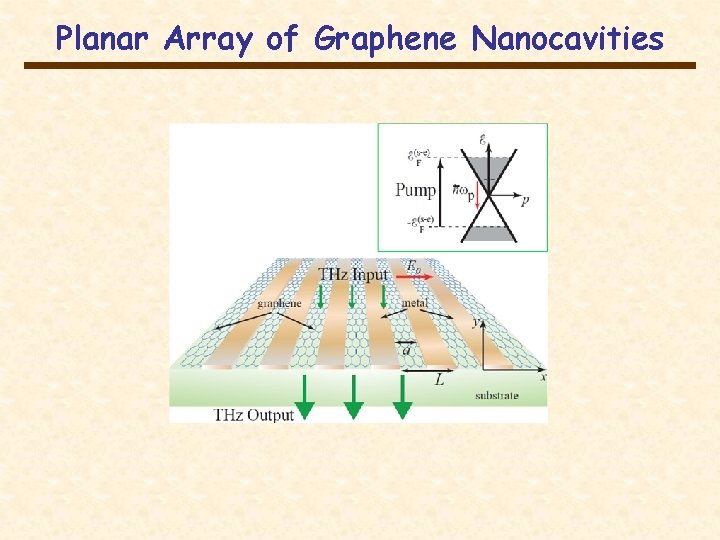
Planar Array of Graphene Nanocavities
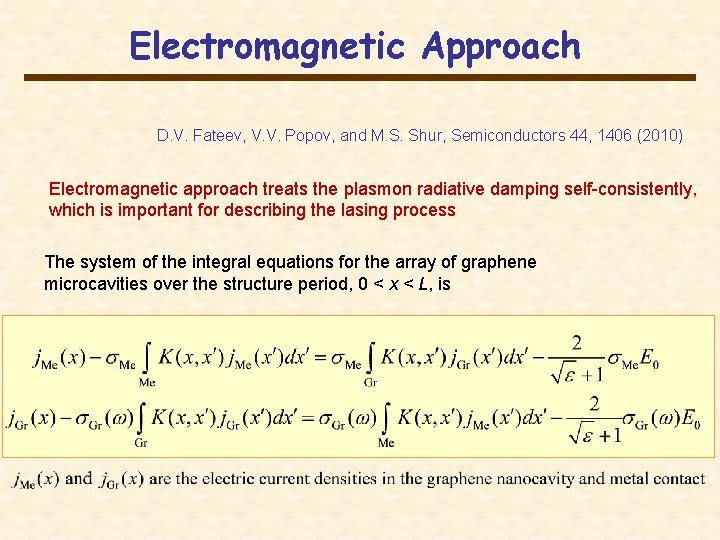
Electromagnetic Approach D. V. Fateev, V. V. Popov, and M. S. Shur, Semiconductors 44, 1406 (2010) Electromagnetic approach treats the plasmon radiative damping self-consistently, which is important for describing the lasing process The system of the integral equations for the array of graphene microcavities over the structure period, 0 < x < L, is
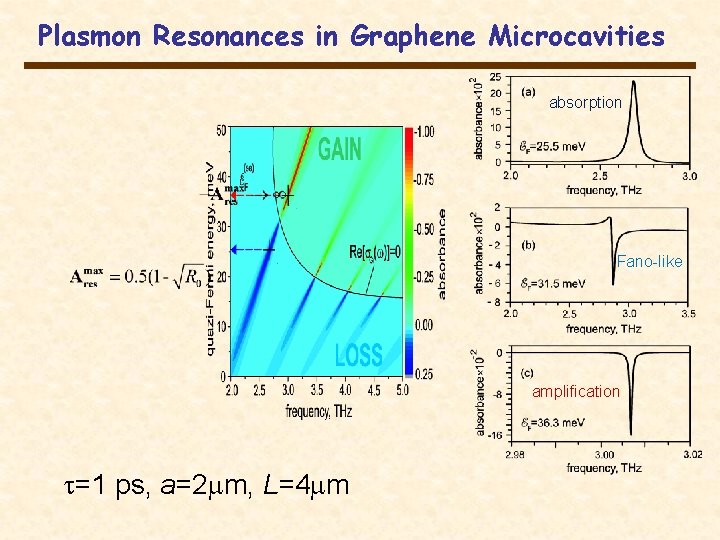
Plasmon Resonances in Graphene Microcavities absorption Fano-like amplification =1 ps, a=2 m, L=4 m
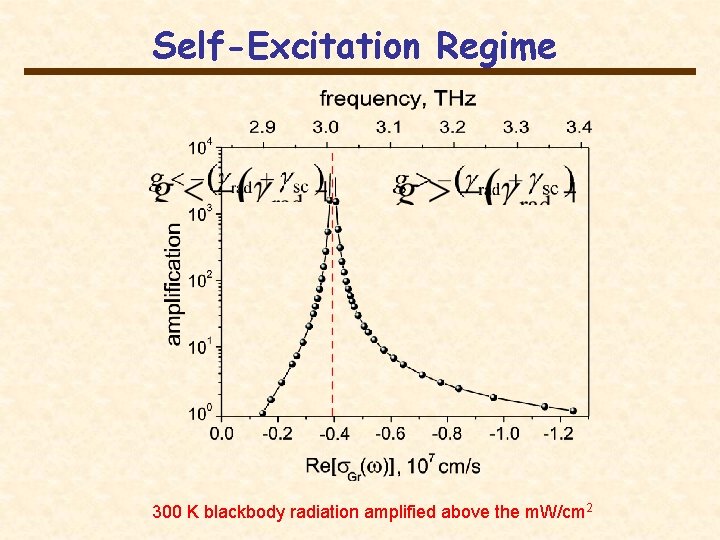
Self-Excitation Regime 300 K blackbody radiation amplified above the m. W/cm 2
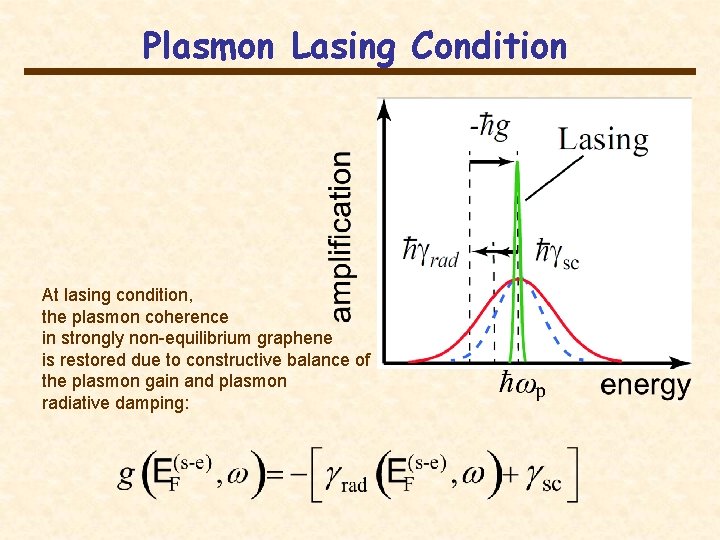
Plasmon Lasing Condition At lasing condition, the plasmon coherence in strongly non-equilibrium graphene is restored due to constructive balance of the plasmon gain and plasmon radiative damping:
THz Apmplification in Plasmonic Nanocavities =1 ps =0. 1 ps Re[ Gr(ω)]<0 Re[ Gr(ω)]>0 a=200 nm, L=400 nm
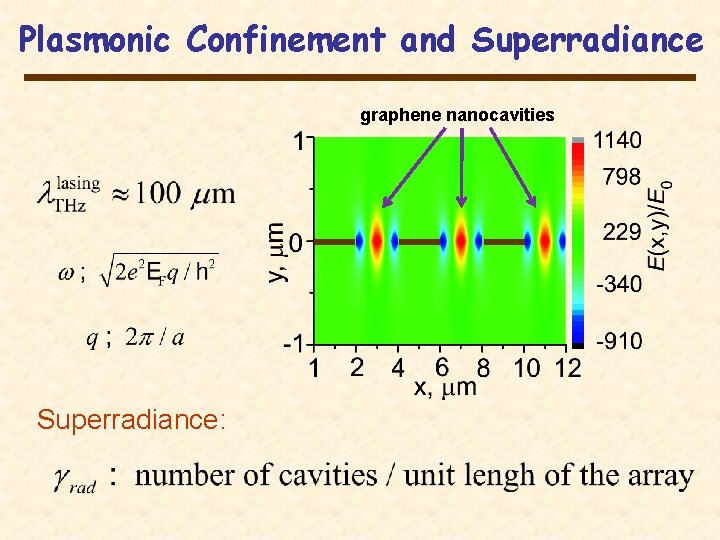
Plasmonic Confinement and Superradiance graphene nanocavities Superradiance:
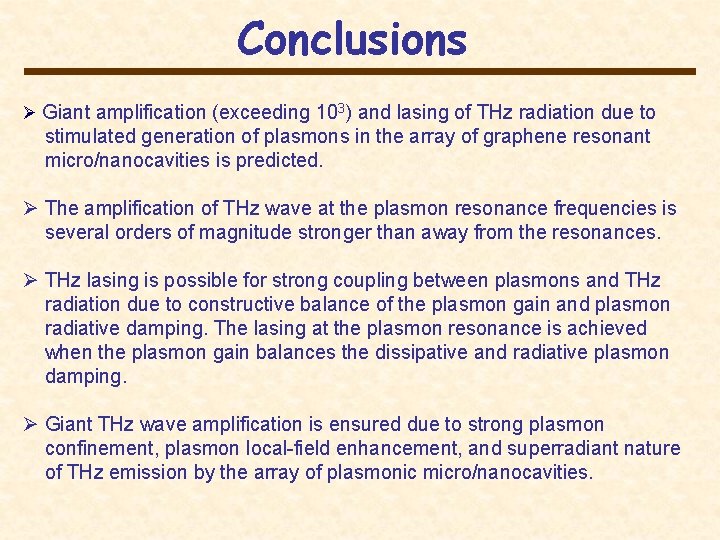
Conclusions Ø Giant amplification (exceeding 103) and lasing of THz radiation due to stimulated generation of plasmons in the array of graphene resonant micro/nanocavities is predicted. Ø The amplification of THz wave at the plasmon resonance frequencies is several orders of magnitude stronger than away from the resonances. Ø THz lasing is possible for strong coupling between plasmons and THz radiation due to constructive balance of the plasmon gain and plasmon radiative damping. The lasing at the plasmon resonance is achieved when the plasmon gain balances the dissipative and radiative plasmon damping. Ø Giant THz wave amplification is ensured due to strong plasmon confinement, plasmon local-field enhancement, and superradiant nature of THz emission by the array of plasmonic micro/nanocavities.