
Supernova Collision with Interstellar Molecular Cloud Researchers Shervin
- Slides: 1
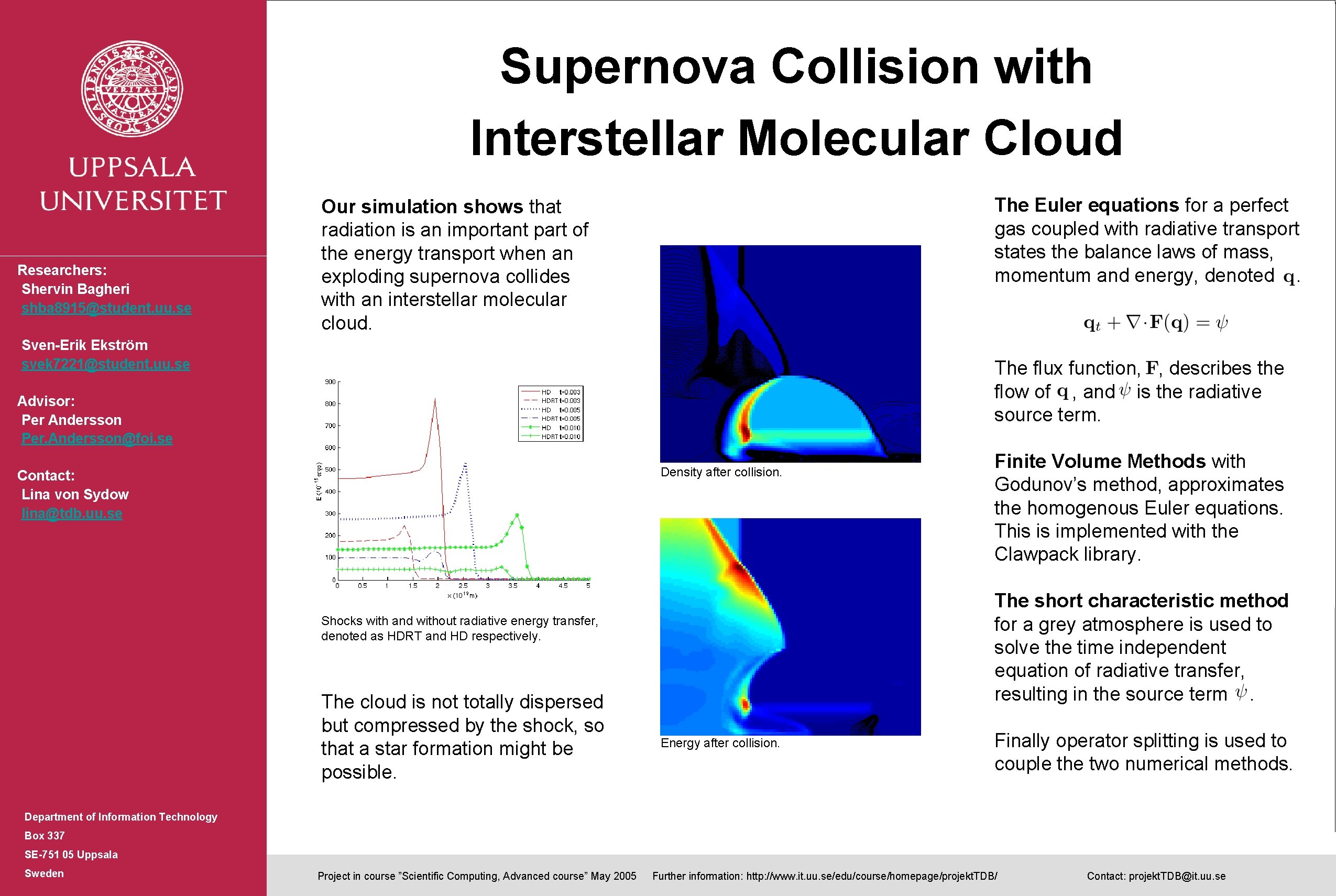
Supernova Collision with Interstellar Molecular Cloud Researchers: Shervin Bagheri shba 8915@student. uu. se The Euler equations for a perfect gas coupled with radiative transport states the balance laws of mass, momentum and energy, denoted. Our simulation shows that radiation is an important part of the energy transport when an exploding supernova collides with an interstellar molecular cloud. Sven-Erik Ekström svek 7221@student. uu. se The flux function, , describes the flow of , and is the radiative source term. Advisor: Per Andersson Per. Andersson@foi. se Density after collision. Contact: Lina von Sydow lina@tdb. uu. se The short characteristic method for a grey atmosphere is used to solve the time independent equation of radiative transfer, resulting in the source term. Shocks with and without radiative energy transfer, denoted as HDRT and HD respectively. The cloud is not totally dispersed but compressed by the shock, so that a star formation might be possible. Finite Volume Methods with Godunov’s method, approximates the homogenous Euler equations. This is implemented with the Clawpack library. Energy after collision. Finally operator splitting is used to couple the two numerical methods. Department of Information Technology Box 337 SE-751 05 Uppsala Sweden Project in course ”Scientific Computing, Advanced course” May 2005 Further information: http: //www. it. uu. se/edu/course/homepage/projekt. TDB/ Contact: projekt. TDB@it. uu. se