
Superlayer Cross Section Frontend Enclosure Wire End Input
- Slides: 10
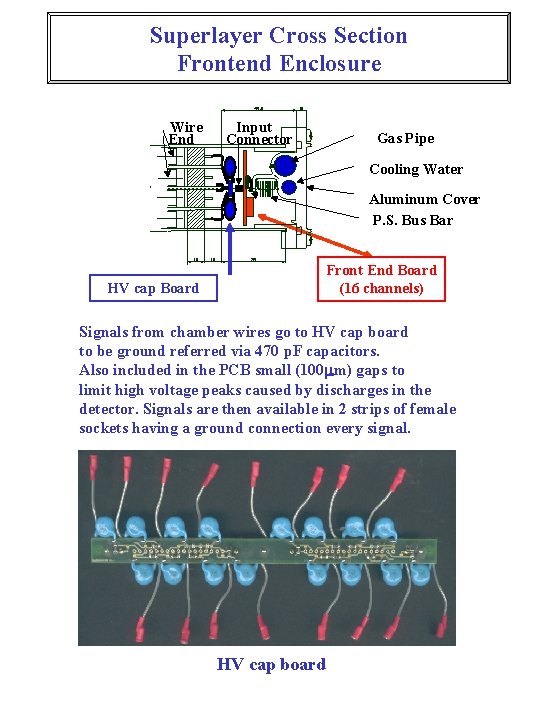
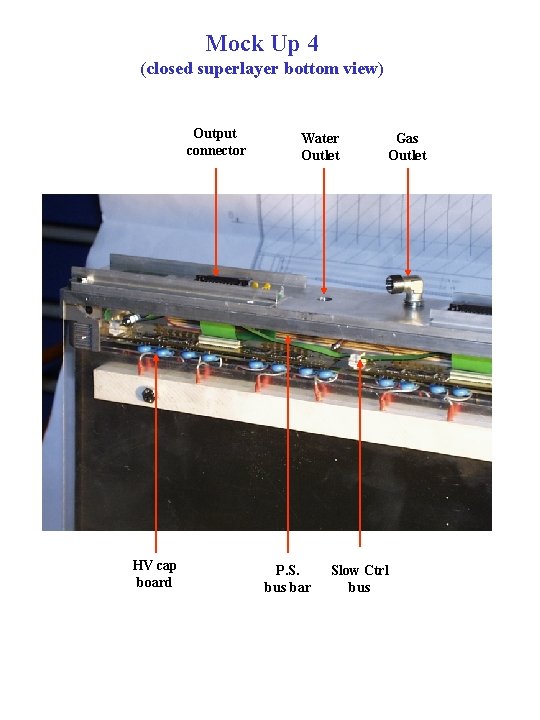
Superlayer Cross Section Frontend Enclosure Wire End Input Connector Gas Pipe Cooling Water Aluminum Cover P. S. Bus Bar HV cap Board Front End Board (16 channels) Signals from chamber wires go to HV cap board to be ground referred via 470 p. F capacitors. Also included in the PCB small (100 m) gaps to limit high voltage peaks caused by discharges in the detector. Signals are then available in 2 strips of female sockets having a ground connection every signal. HV cap board
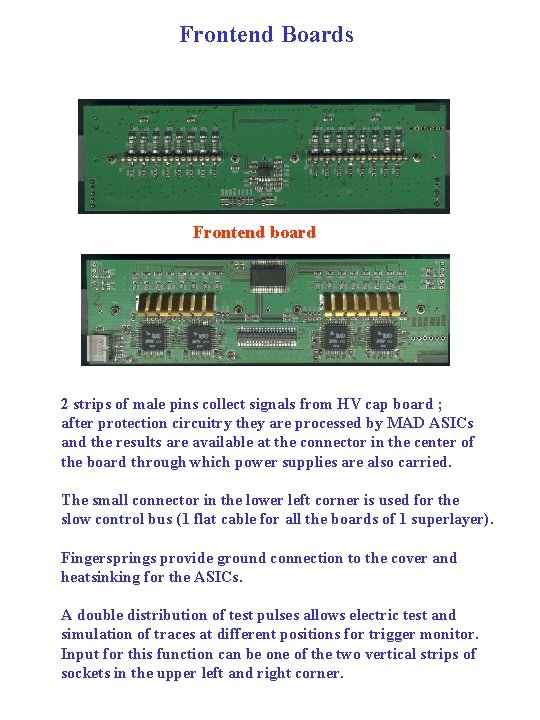
Frontend Boards Frontend board 2 strips of male pins collect signals from HV cap board ; after protection circuitry they are processed by MAD ASICs and the results are available at the connector in the center of the board through which power supplies are also carried. The small connector in the lower left corner is used for the slow control bus (1 flat cable for all the boards of 1 superlayer). Fingersprings provide ground connection to the cover and heatsinking for the ASICs. A double distribution of test pulses allows electric test and simulation of traces at different positions for trigger monitor. Input for this function can be one of the two vertical strips of sockets in the upper left and right corner.
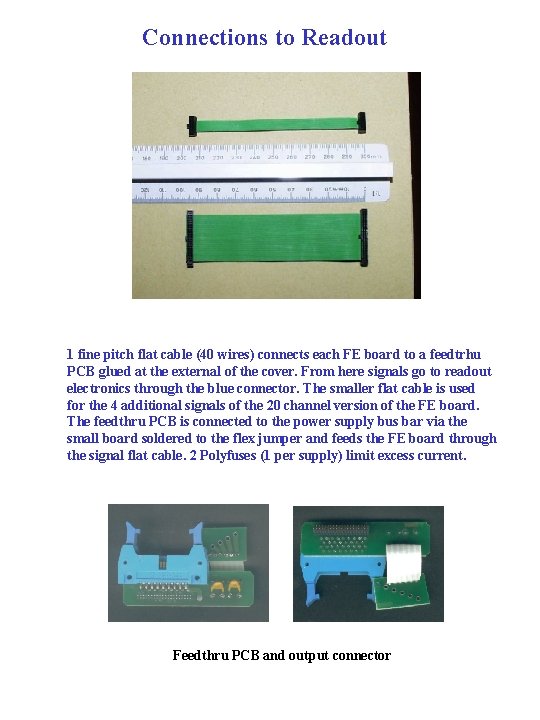
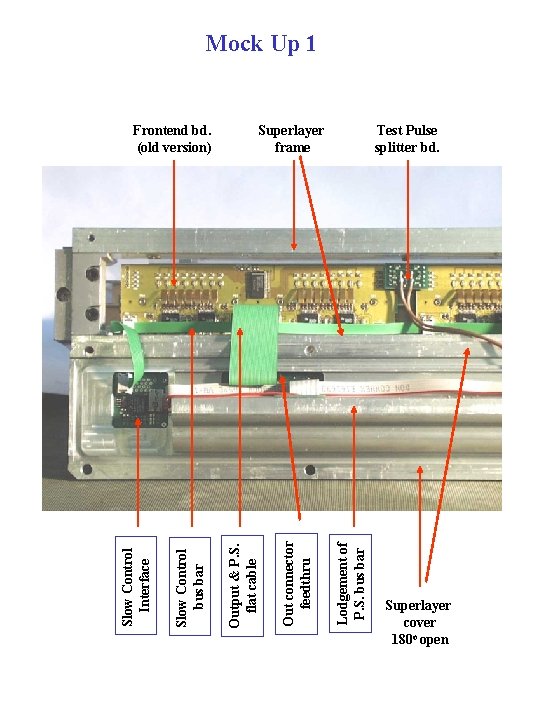
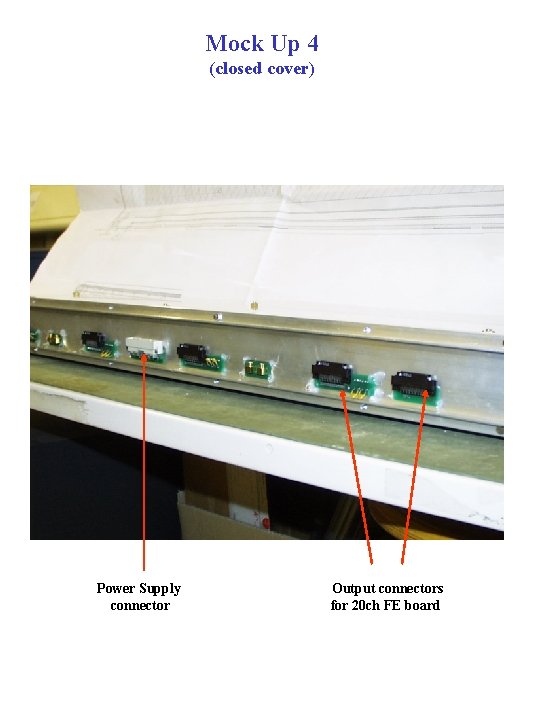
Connections to Readout 1 fine pitch flat cable (40 wires) connects each FE board to a feedtrhu PCB glued at the external of the cover. From here signals go to readout electronics through the blue connector. The smaller flat cable is used for the 4 additional signals of the 20 channel version of the FE board. The feedthru PCB is connected to the power supply bus bar via the small board soldered to the flex jumper and feeds the FE board through the signal flat cable. 2 Polyfuses (1 per supply) limit excess current. Feedthru PCB and output connector
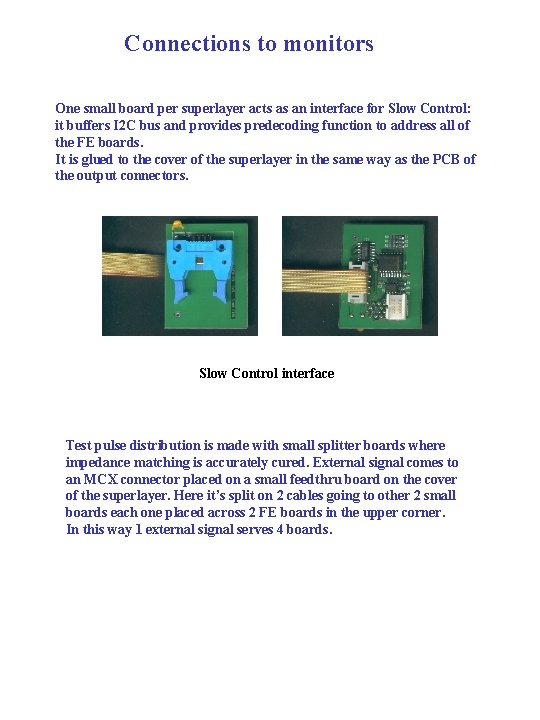
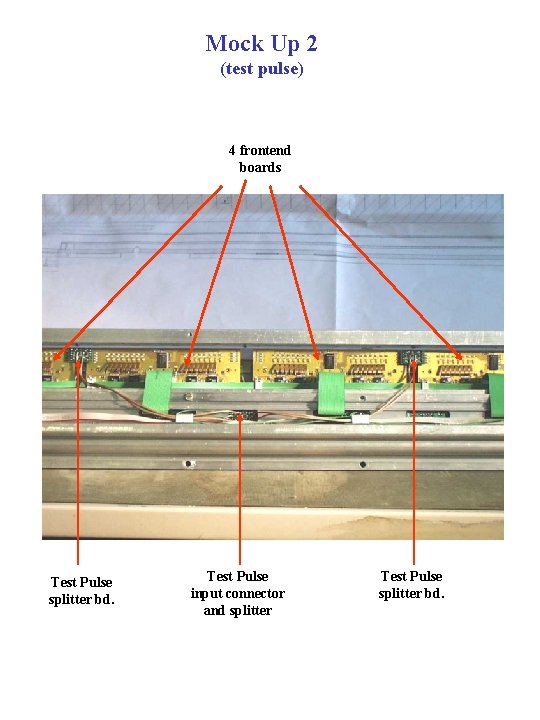
Connections to monitors One small board per superlayer acts as an interface for Slow Control: it buffers I 2 C bus and provides predecoding function to address all of the FE boards. It is glued to the cover of the superlayer in the same way as the PCB of the output connectors. Slow Control interface Test pulse distribution is made with small splitter boards where impedance matching is accurately cured. External signal comes to an MCX connector placed on a small feedthru board on the cover of the superlayer. Here it’s split on 2 cables going to other 2 small boards each one placed across 2 FE boards in the upper corner. In this way 1 external signal serves 4 boards.
Lodgement of P. S. bus bar Out connector feedthru Frontend bd. (old version) Output & P. S. flat cable Slow Control bus bar Slow Control Interface Mock Up 1 Superlayer frame Test Pulse splitter bd. Superlayer cover 180 o open
Mock Up 2 (test pulse) 4 frontend boards Test Pulse splitter bd. Test Pulse input connector and splitter Test Pulse splitter bd.
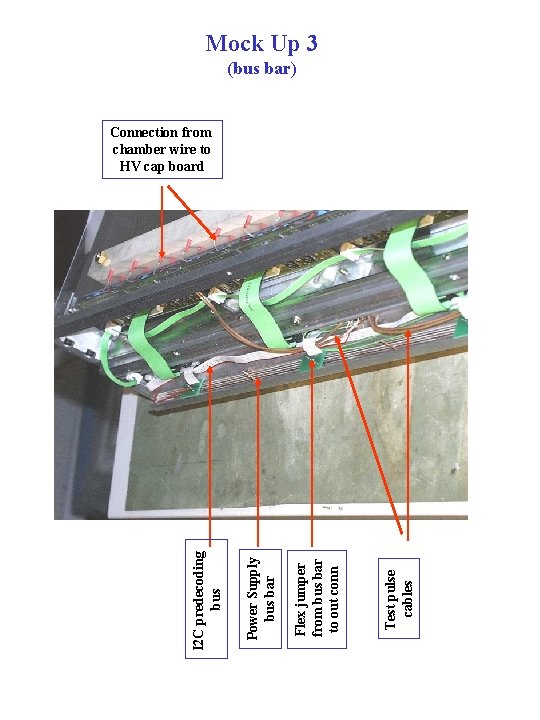
Test pulse cables Flex jumper from bus bar to out conn Power Supply bus bar I 2 C predecoding bus Mock Up 3 (bus bar) Connection from chamber wire to HV cap board
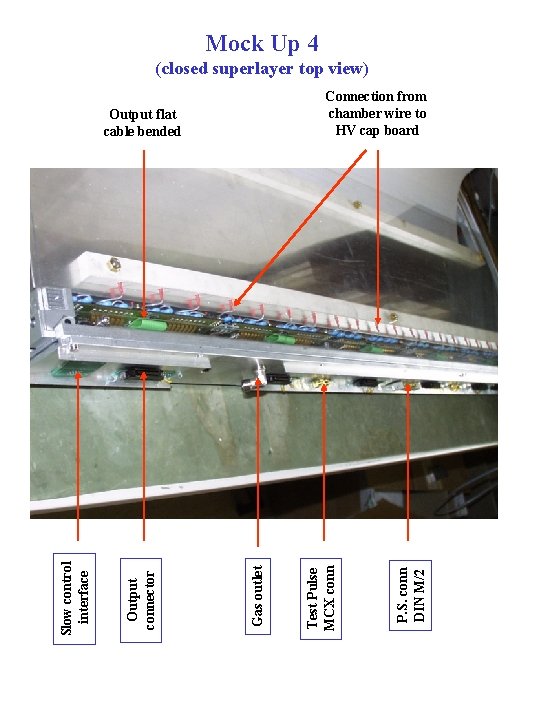
Mock Up 4 (closed superlayer top view) P. S. conn DIN M/2 Gas outlet Output connector Slow control interface Output flat cable bended Test Pulse MCX conn Connection from chamber wire to HV cap board
Mock Up 4 (closed superlayer bottom view) Output connector HV cap board Water Outlet P. S. bus bar Gas Outlet Slow Ctrl bus
Mock Up 4 (closed cover) Power Supply connector Output connectors for 20 ch FE board