
Superintendent of Documents Classification Scheme Reedited by the
Superintendent of Documents Classification Scheme Re-edited by the Collection Management Group
Introduction � It is the job of the Librarian to make information accessible to the public. � Librarians accomplish this goal by determining similarities between items and shelving them in the appropriate collection. � The tool that Librarians use in order to meet this goal is called a Classification System.
Introduction � There are several different Classification Systems currently in use in the Alexander Library. � This presentation will help you to understand how the Superintendent of Documents system or Su. Docs.
Introduction � The Su. Docs system is one of many different systems used in the classification of Government Publications. �A clear understanding of how the Su. Docs system works is an important step in working with Government Publications. � This tutorial will aid you in understanding the Su. Docs system.
Su. Docs Classification
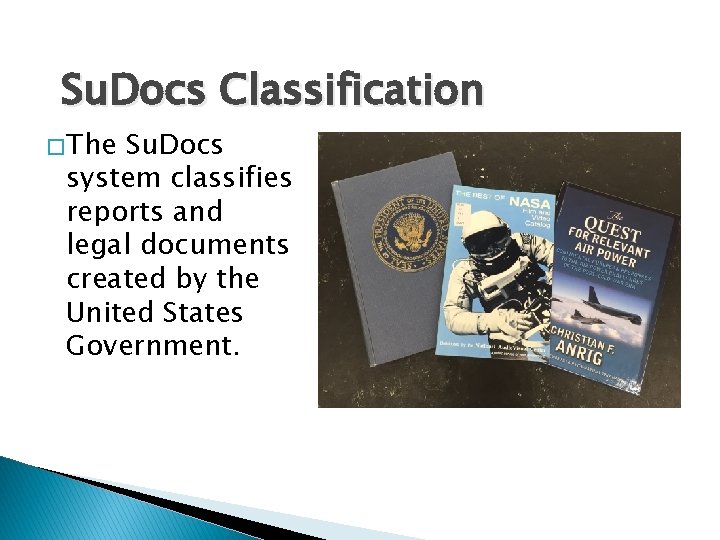
Su. Docs Classification � The Su. Docs system classifies reports and legal documents created by the United States Government.
Su. Docs Classification � The Su. Docs system accomplishes this by using numbers and letters to identify the issuing agency, type of publication and the individual item number of a particular document. � We call this combination of letters and numbers a Call Number.
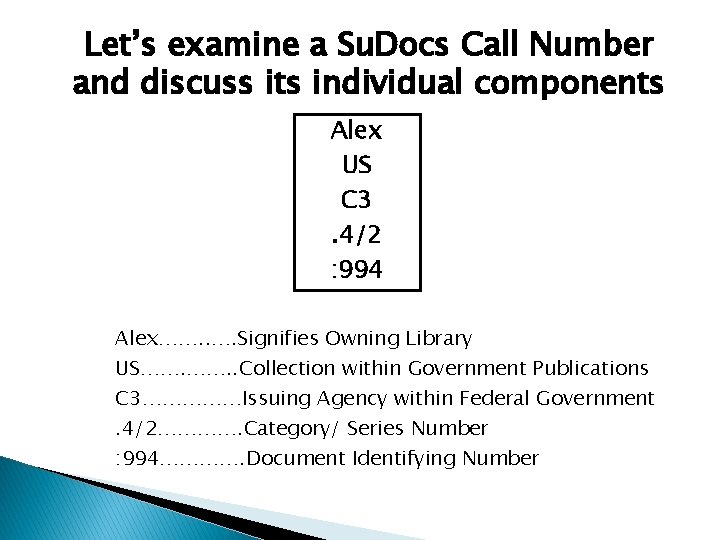
Let’s examine a Su. Docs Call Number and discuss its individual components Alex US C 3. 4/2 : 994 Alex……. . …. Signifies Owning Library US……. . Collection within Government Publications C 3……………Issuing Agency within Federal Government. 4/2…………. Category/ Series Number : 994…………. Document Identifying Number
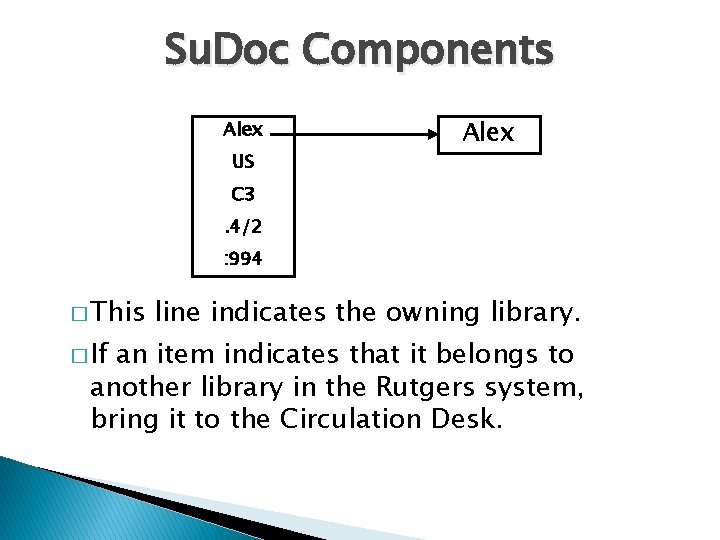
Su. Doc Components Alex US Alex C 3. 4/2 : 994 � This � If line indicates the owning library. an item indicates that it belongs to another library in the Rutgers system, bring it to the Circulation Desk.
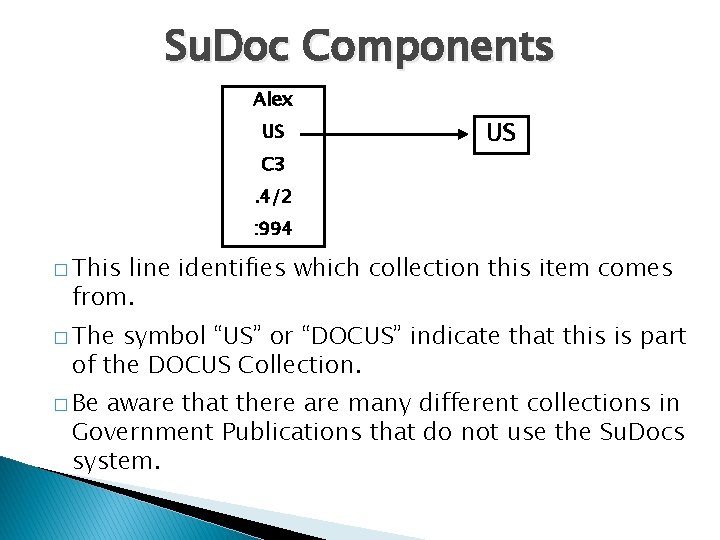
Su. Doc Components Alex US C 3 US . 4/2 : 994 � This line identifies which collection this item comes from. � The symbol “US” or “DOCUS” indicate that this is part of the DOCUS Collection. � Be aware that there are many different collections in Government Publications that do not use the Su. Docs system.
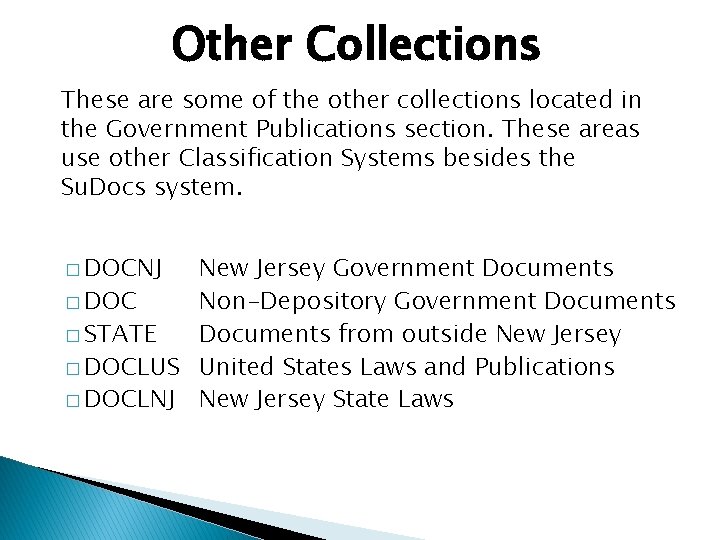
Other Collections These are some of the other collections located in the Government Publications section. These areas use other Classification Systems besides the Su. Docs system. � DOCNJ New Jersey Government Documents � DOC Non-Depository Government Documents � STATE Documents from outside New Jersey � DOCLUS United States Laws and Publications � DOCLNJ New Jersey State Laws
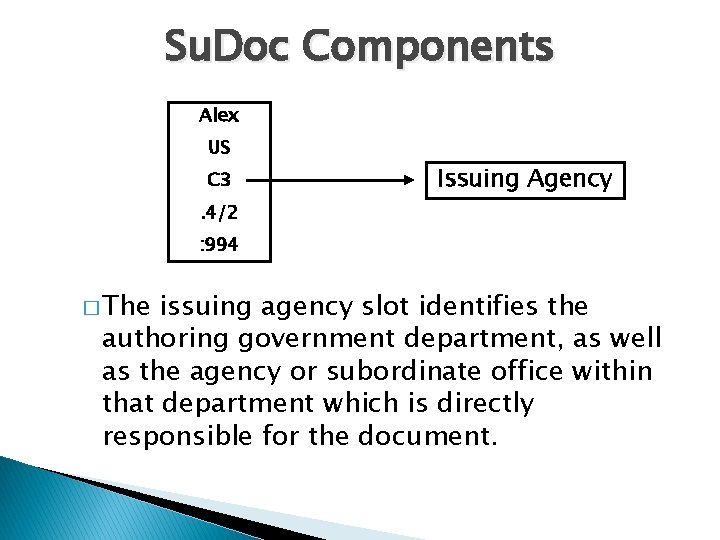
Su. Doc Components Alex US C 3 Issuing Agency . 4/2 : 994 � The issuing agency slot identifies the authoring government department, as well as the agency or subordinate office within that department which is directly responsible for the document.
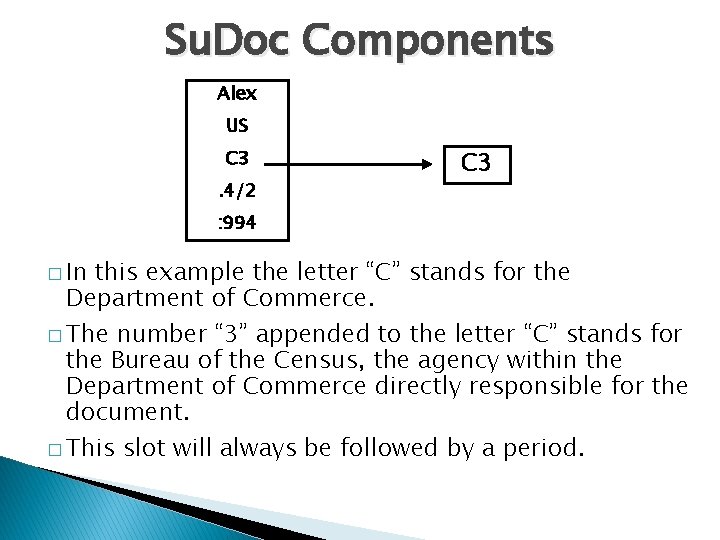
Su. Doc Components Alex US C 3. 4/2 C 3 : 994 � In this example the letter “C” stands for the Department of Commerce. � The number “ 3” appended to the letter “C” stands for the Bureau of the Census, the agency within the Department of Commerce directly responsible for the document. � This slot will always be followed by a period.
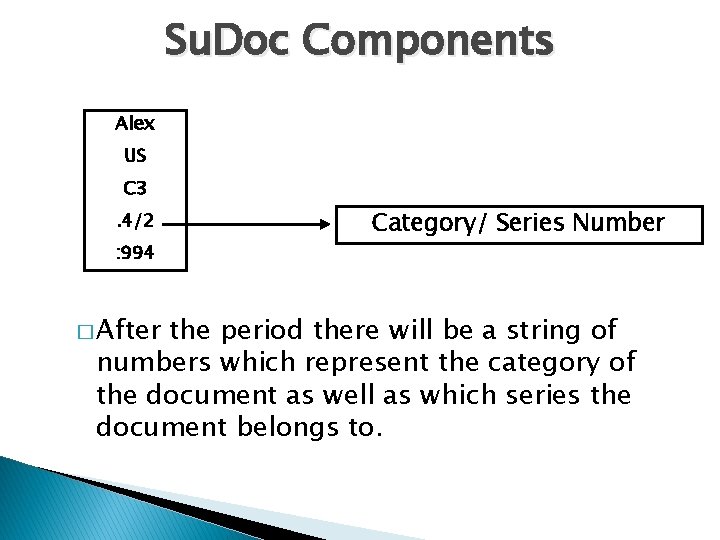
Su. Doc Components Alex US C 3. 4/2 : 994 � After Category/ Series Number the period there will be a string of numbers which represent the category of the document as well as which series the document belongs to.
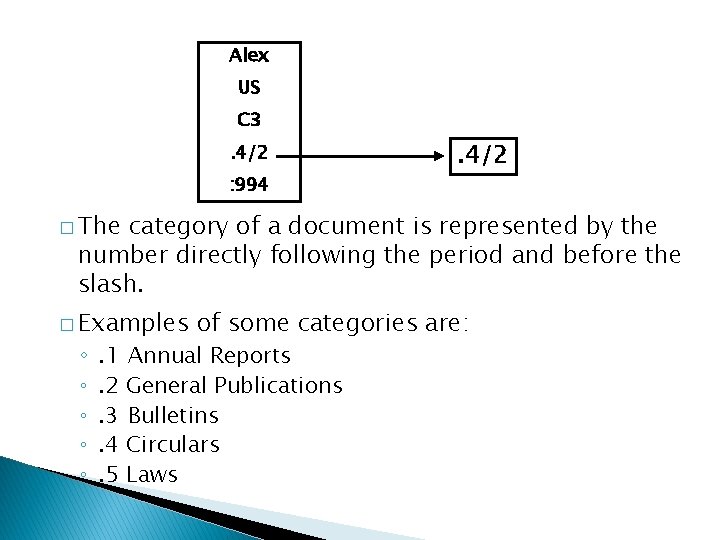
Alex US C 3. 4/2 : 994 . 4/2 � The category of a document is represented by the number directly following the period and before the slash. � Examples of some categories are: ◦. 1 Annual Reports ◦ ◦ . 2. 3. 4. 5 General Publications Bulletins Circulars Laws
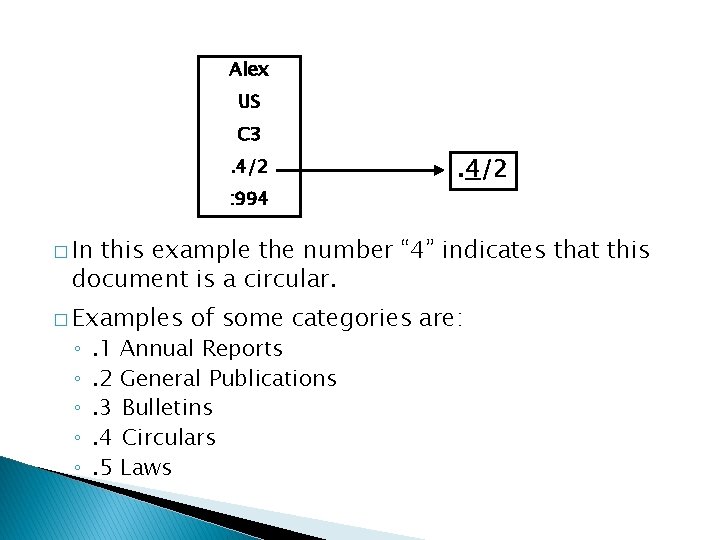
Alex US C 3. 4/2 : 994 . 4/2 � In this example the number “ 4” indicates that this document is a circular. � Examples ◦ ◦ ◦ . 1. 2. 3. 4. 5 of some categories are: Annual Reports General Publications Bulletins Circulars Laws
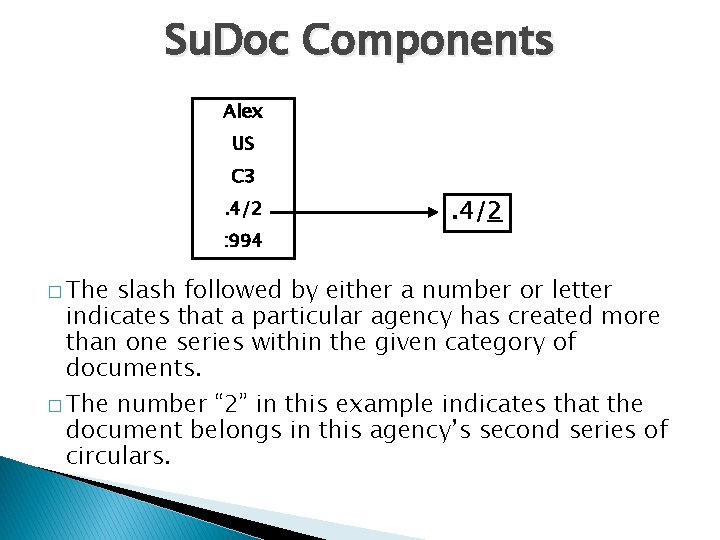
Su. Doc Components Alex US C 3. 4/2 : 994 � The . 4/2 slash followed by either a number or letter indicates that a particular agency has created more than one series within the given category of documents. � The number “ 2” in this example indicates that the document belongs in this agency’s second series of circulars.
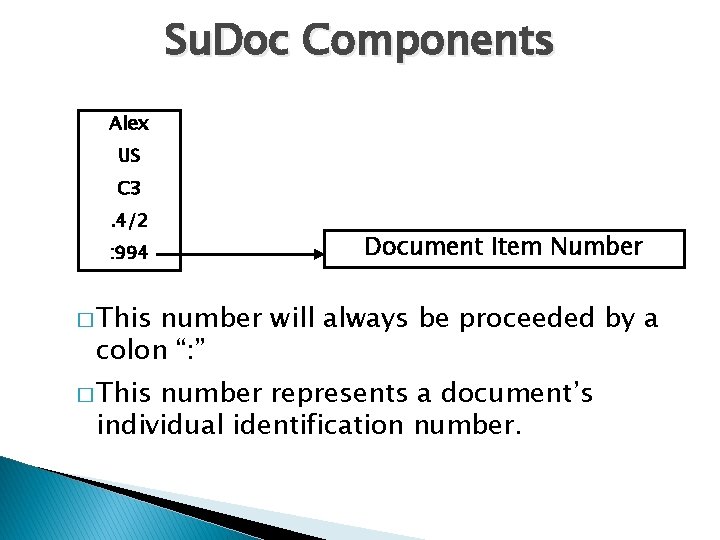
Su. Doc Components Alex US C 3. 4/2 : 994 Document Item Number � This number will always be proceeded by a colon “: ” � This number represents a document’s individual identification number.
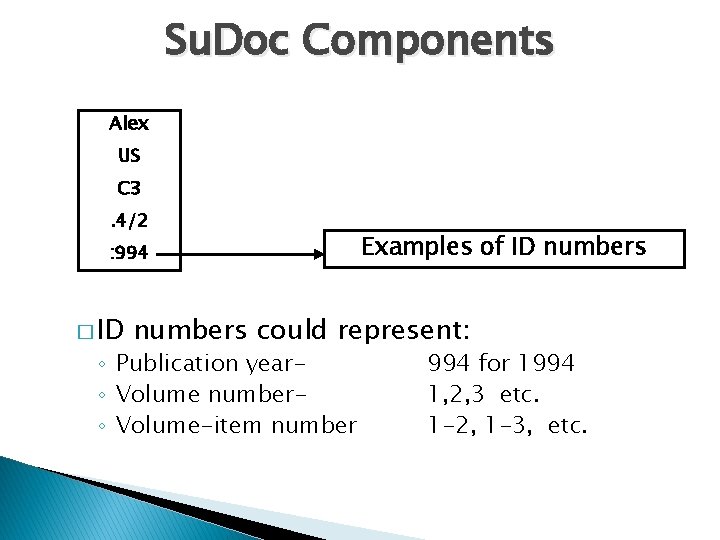
Su. Doc Components Alex US C 3. 4/2 : 994 � ID Examples of ID numbers could represent: ◦ Publication year◦ Volume number◦ Volume-item number 994 for 1994 1, 2, 3 etc. 1 -2, 1 -3, etc.
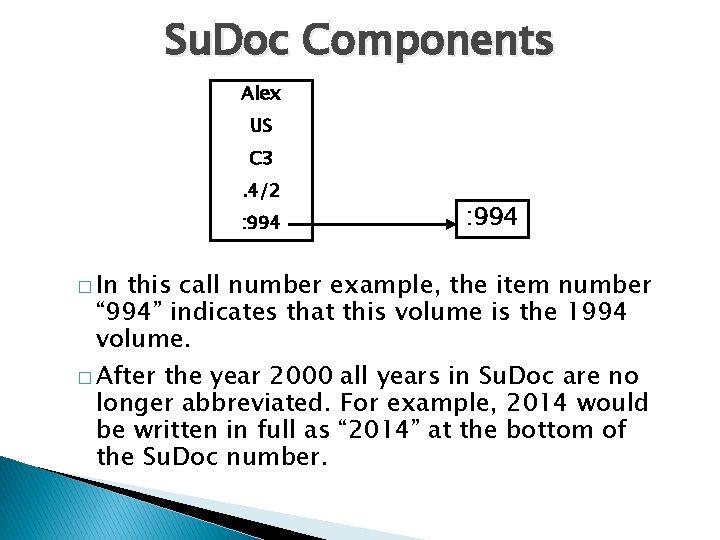
Su. Doc Components Alex US C 3. 4/2 : 994 � In : 994 this call number example, the item number “ 994” indicates that this volume is the 1994 volume. � After the year 2000 all years in Su. Doc are no longer abbreviated. For example, 2014 would be written in full as “ 2014” at the bottom of the Su. Doc number.

So what’s really important to know?
So what’s really important to know? � Understandably, no one can memorize what all of the various letters and numbers stand for. � What we do ask is that you understand why certain items are shelved in their respective locations.
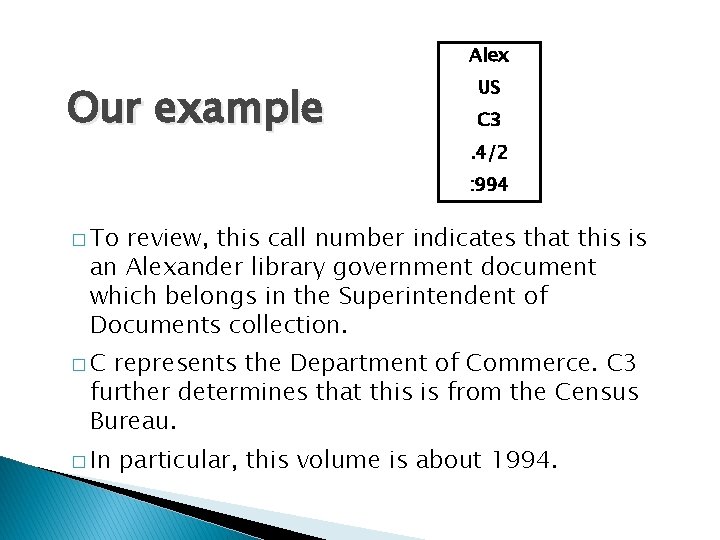
Alex Our example US C 3. 4/2 : 994 � To review, this call number indicates that this is an Alexander library government document which belongs in the Superintendent of Documents collection. �C represents the Department of Commerce. C 3 further determines that this is from the Census Bureau. � In particular, this volume is about 1994.
Shelving in the Su. Docs collection
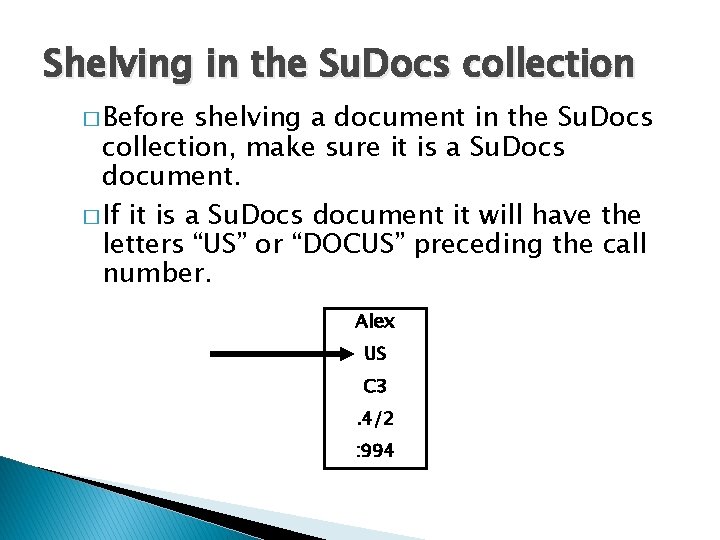
Shelving in the Su. Docs collection � Before shelving a document in the Su. Docs collection, make sure it is a Su. Docs document. � If it is a Su. Docs document it will have the letters “US” or “DOCUS” preceding the call number. Alex US C 3. 4/2 : 994
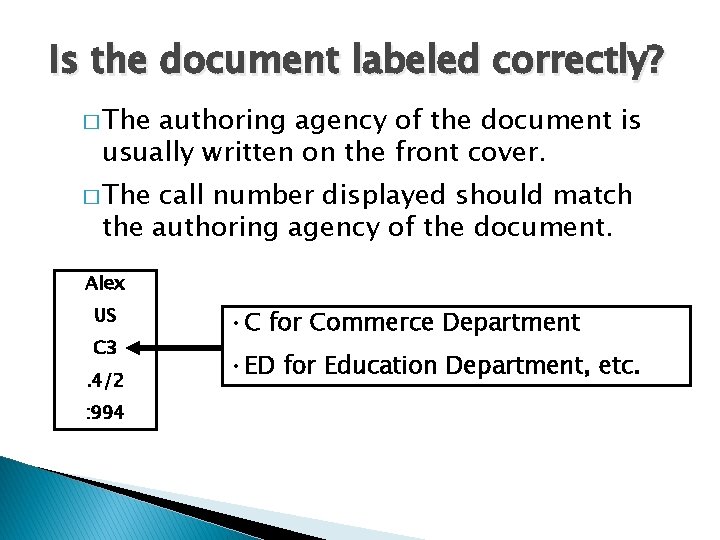
Is the document labeled correctly? � The authoring agency of the document is usually written on the front cover. � The call number displayed should match the authoring agency of the document. Alex US C 3. 4/2 : 994 • C for Commerce Department • ED for Education Department, etc.
If the call number does not match the authoring agency, bring the document to a Collection Management staff member.
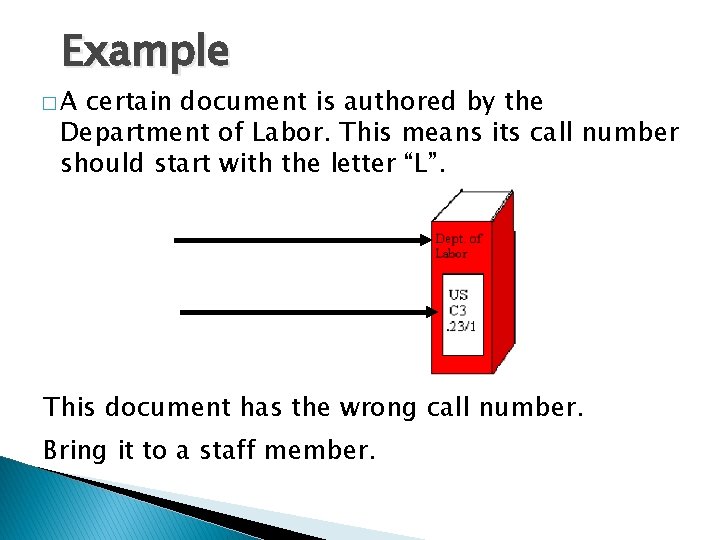
Example �A certain document is authored by the Department of Labor. This means its call number should start with the letter “L”. This document has the wrong call number. Bring it to a staff member.
Order of Importance � When shelving in Su. Docs remember the following: ◦ Nothing comes before Something ◦ Letters get shelved before numbers ◦ Numbers are always treated as whole numbers ◦ Punctuation marks such as periods, slashes, and colons indicate a new series designation ◦ Dates after a slash are filed before numbers after a slash.
Order of Importance � When shelving always compare documents in order of hierarchical importance. � Remember, different hierarchical levels are separated by punctuation marks.
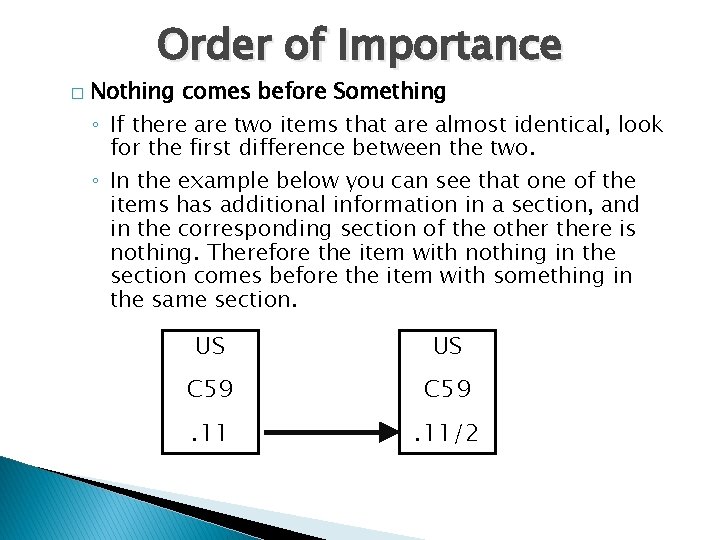
Order of Importance � Nothing comes before Something ◦ If there are two items that are almost identical, look for the first difference between the two. ◦ In the example below you can see that one of the items has additional information in a section, and in the corresponding section of the othere is nothing. Therefore the item with nothing in the section comes before the item with something in the same section. US US C 59 . 11/2
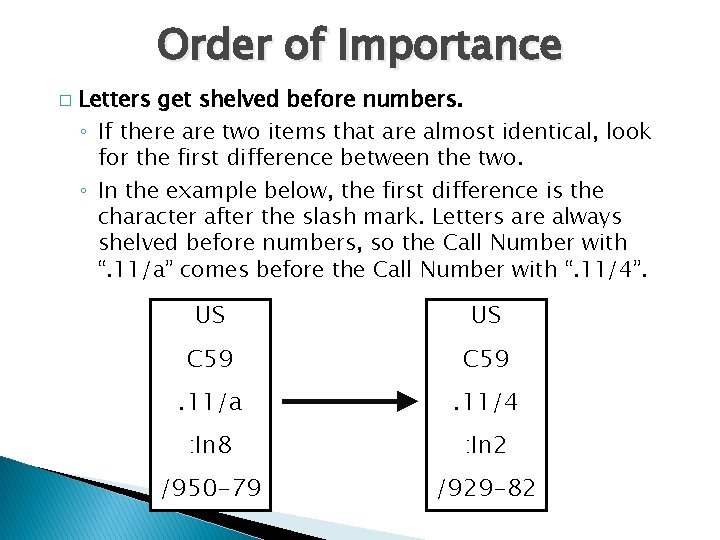
Order of Importance � Letters get shelved before numbers. ◦ If there are two items that are almost identical, look for the first difference between the two. ◦ In the example below, the first difference is the character after the slash mark. Letters are always shelved before numbers, so the Call Number with “. 11/a” comes before the Call Number with “. 11/4”. US US C 59 . 11/a . 11/4 : In 8 : In 2 /950 -79 /929 -82
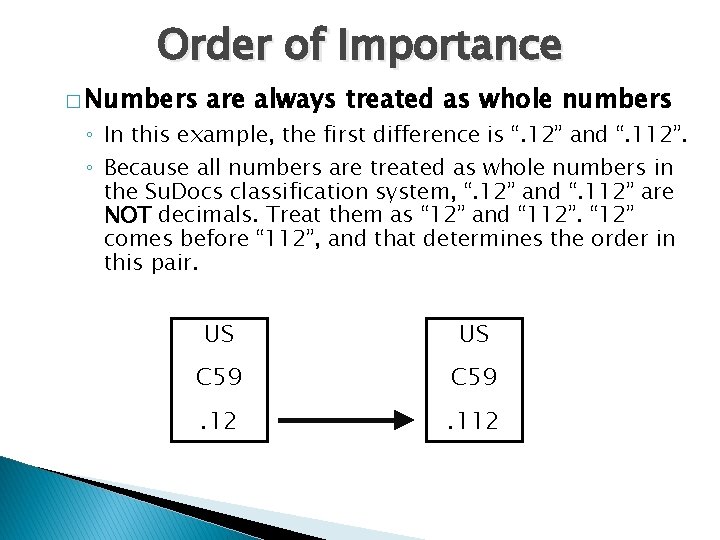
Order of Importance � Numbers are always treated as whole numbers ◦ In this example, the first difference is “. 12” and “. 112”. ◦ Because all numbers are treated as whole numbers in the Su. Docs classification system, “. 12” and “. 112” are NOT decimals. Treat them as “ 12” and “ 112”. “ 12” comes before “ 112”, and that determines the order in this pair. US US C 59 . 12 . 112
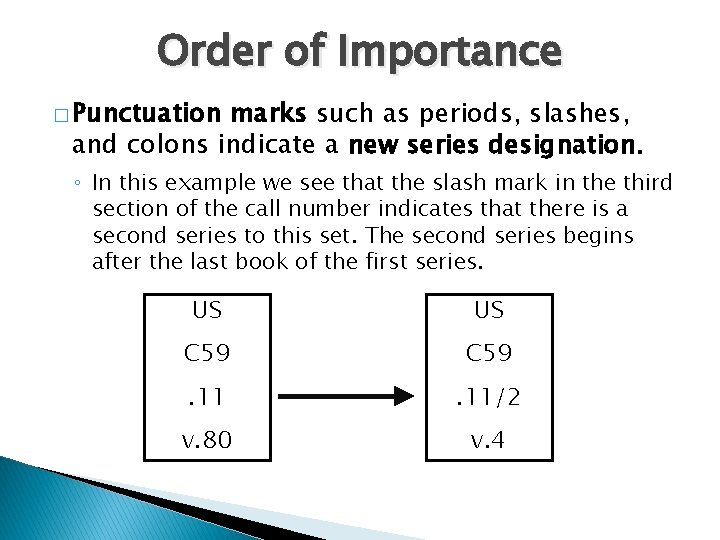
Order of Importance � Punctuation marks such as periods, slashes, and colons indicate a new series designation. ◦ In this example we see that the slash mark in the third section of the call number indicates that there is a second series to this set. The second series begins after the last book of the first series. US US C 59 . 11/2 v. 80 v. 4
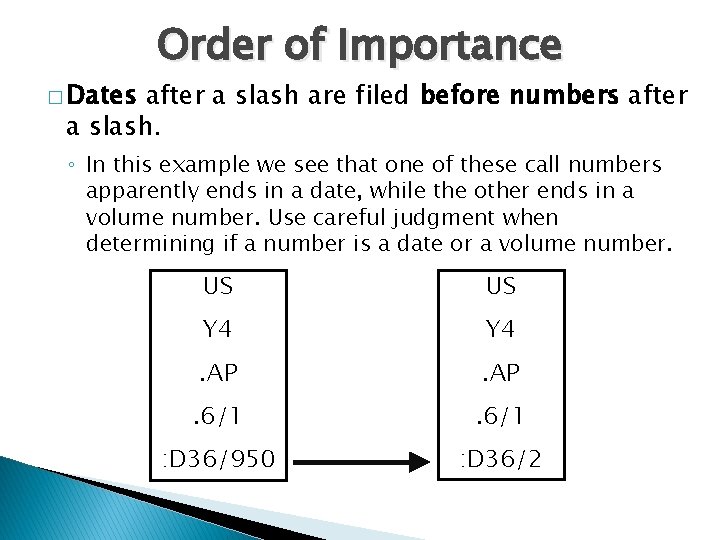
� Dates Order of Importance after a slash are filed before numbers after a slash. ◦ In this example we see that one of these call numbers apparently ends in a date, while the other ends in a volume number. Use careful judgment when determining if a number is a date or a volume number. US US Y 4 . AP . 6/1 : D 36/950 : D 36/2
Final Examples for shelving � When shelving in any collection, look for the first difference in call numbers to determine which Su. Doc number should come first. The following are examples of two sets of call numbers and demonstrate how to work through a call number from top to bottom.
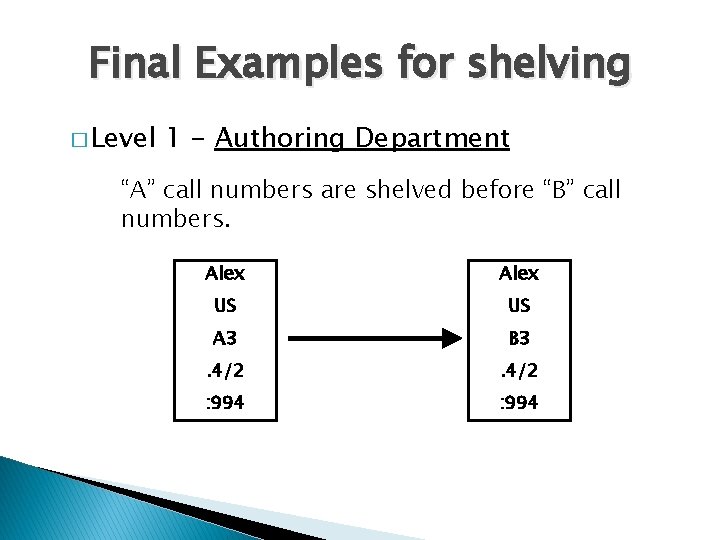
Final Examples for shelving � Level 1 - Authoring Department “A” call numbers are shelved before “B” call numbers. Alex US US A 3 B 3 . 4/2 : 994
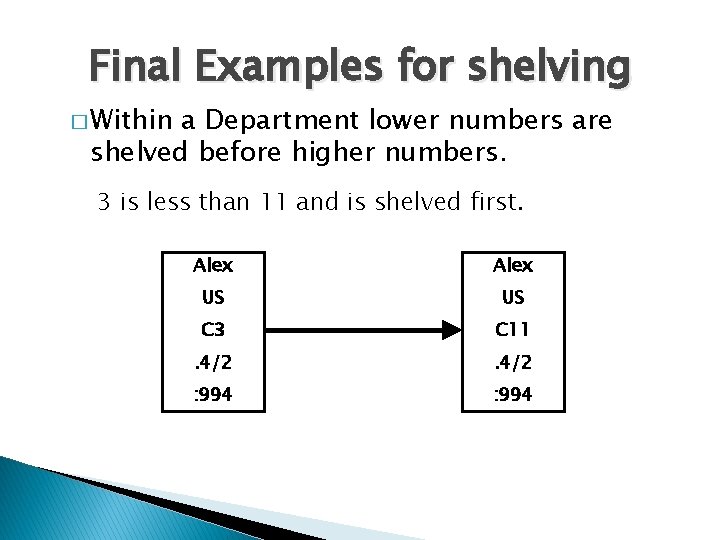
Final Examples for shelving � Within a Department lower numbers are shelved before higher numbers. 3 is less than 11 and is shelved first. Alex US US C 3 C 11 . 4/2 : 994
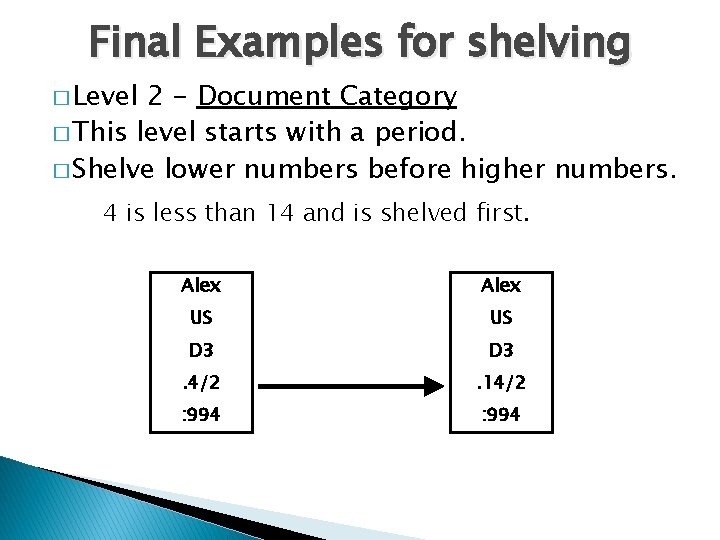
Final Examples for shelving � Level 2 - Document Category � This level starts with a period. � Shelve lower numbers before higher numbers. 4 is less than 14 and is shelved first. Alex US US D 3 . 4/2 . 14/2 : 994
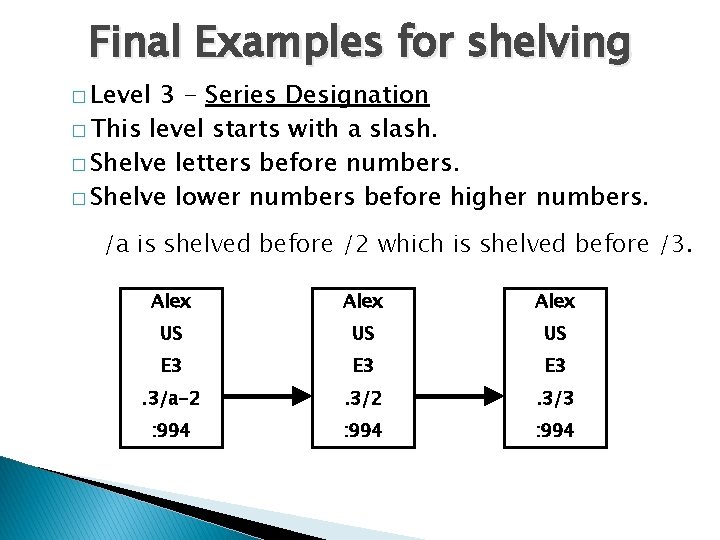
Final Examples for shelving � Level 3 - Series Designation � This level starts with a slash. � Shelve letters before numbers. � Shelve lower numbers before higher numbers. /a is shelved before /2 which is shelved before /3. Alex US US US E 3 E 3 . 3/a-2 . 3/3 : 994
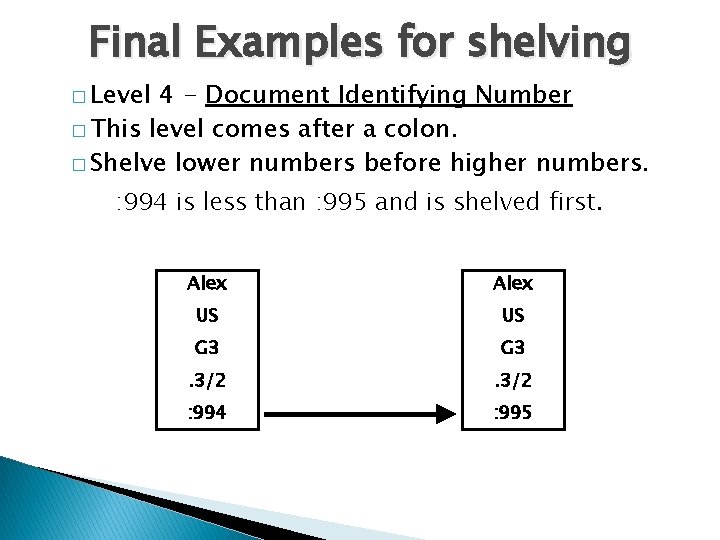
Final Examples for shelving � Level 4 - Document Identifying Number � This level comes after a colon. � Shelve lower numbers before higher numbers. : 994 is less than : 995 and is shelved first. Alex US US G 3 . 3/2 : 994 : 995
Congratulations � You have completed the Superintendent of Documents Classification System online training program.
- Slides: 42