
Superfluidity in Liquid Helium 1 Boiling Points The
Superfluidity in Liquid Helium 1
Boiling Points • The two helium isotopes have the lowest boiling points of all known substances: 3. 2 K for 3 He and 4. 2 K for 4 He. • Both isotopes apparently remain liquid down to absolute zero. To solidify helium, a pressure of about 25 atmospheres is required. • Lack of a solid phase for helium at all temperatures & at atmospheric pressure is due to two factors: 1. The low atomic mass. 2. The extremely weak forces between atoms (Van der Waals Forces) • The low atomic mass means a high zero-point energy. This can be understood from the uncertainty principle. 2
Zero-point Energy • The uncertainty in momentum of a particle in a cavity with characteristic dimension R is p h/R. • So it’s zero-point energy is: E 0 ( p)2/2 m or E 0 h 2/2 m. R 2. • This large zero-point energy must be added to the potential energy of the liquid to give the liquid’s total energy. 3
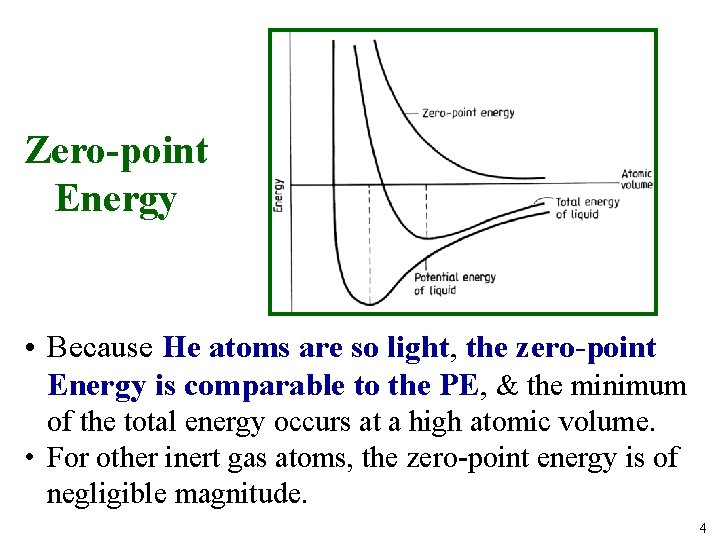
Zero-point Energy • Because He atoms are so light, the zero-point Energy is comparable to the PE, & the minimum of the total energy occurs at a high atomic volume. • For other inert gas atoms, the zero-point energy is of negligible magnitude. 4
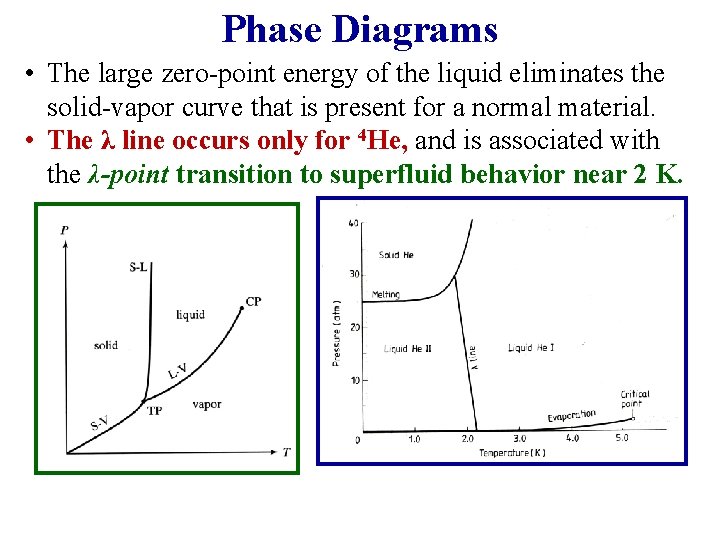
Phase Diagrams • The large zero-point energy of the liquid eliminates the solid-vapor curve that is present for a normal material. • The λ line occurs only for 4 He, and is associated with the λ-point transition to superfluid behavior near 2 K.
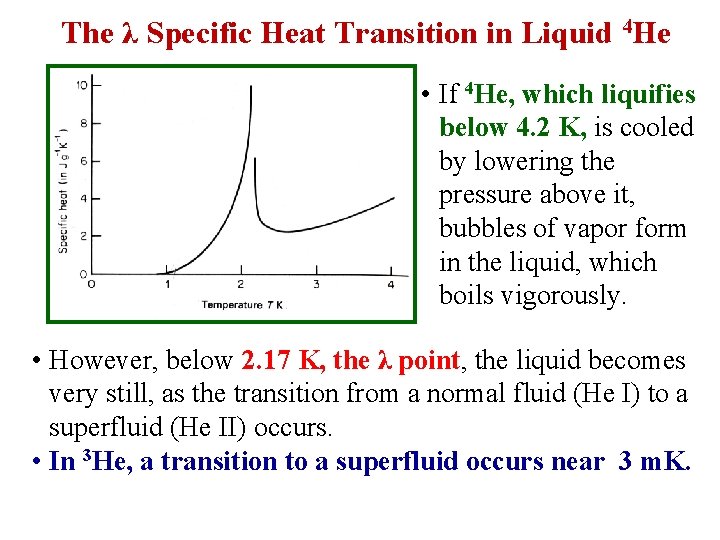
The λ Specific Heat Transition in Liquid 4 He • If 4 He, which liquifies below 4. 2 K, is cooled by lowering the pressure above it, bubbles of vapor form in the liquid, which boils vigorously. • However, below 2. 17 K, the λ point, the liquid becomes very still, as the transition from a normal fluid (He I) to a superfluid (He II) occurs. • In 3 He, a transition to a superfluid occurs near 3 m. K.
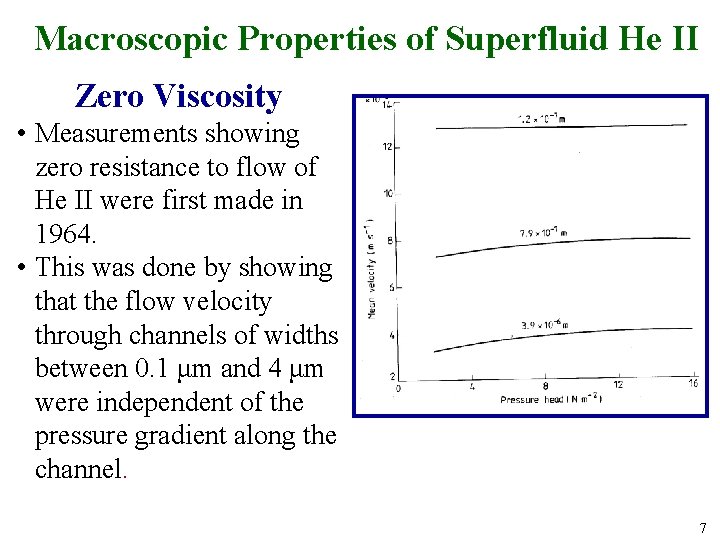
Macroscopic Properties of Superfluid He II Zero Viscosity • Measurements showing zero resistance to flow of He II were first made in 1964. • This was done by showing that the flow velocity through channels of widths between 0. 1 μm and 4 μm were independent of the pressure gradient along the channel. 7
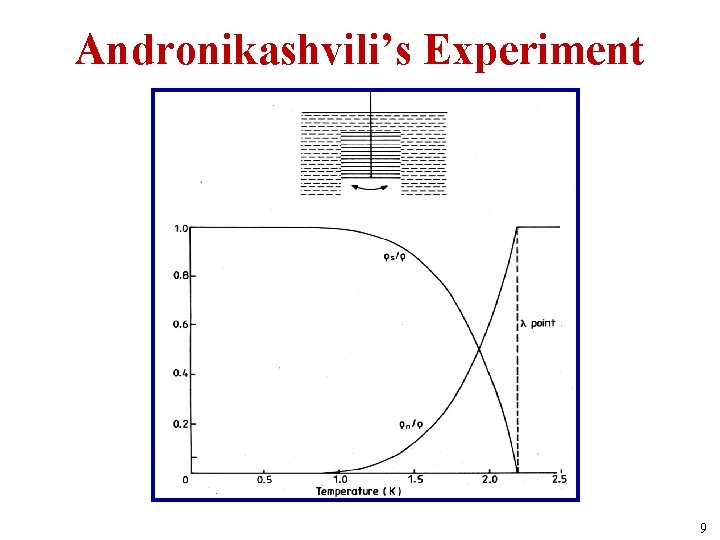
Two-fluid Model of He II Zero viscosity • Experiments showed an apparent contradiction, that He II was both viscous & non-viscous at the same time. • This result was the source of the two-fluid model of He II, introduced by Tisza in 1938. • This is a quantum effect; the liquid does not consist of two distinct fluids, one normal and the other a superfluid. • In Andronikashvili’s 1946 experiment, a series of equally spaced metal disks, suspended by a torsion fibre, were made to oscillate in liquid He. • The results confirmed that He II consists of a normal viscous fluid of density ρn and a superfluid of density ρs, and allowed the ratios ρs/ρ and ρn/ρ to be measured as functions of temperature, where ρ = ρn + ρs. 8
Andronikashvili’s Experiment 9
Macroscopic Properties of Superfluid He II Infinite thermal conductivity • This makes it impossible to establish a temperature gradient in a bulk liquid. In a normal liquid, bubbles are formed when the local temperature in a small region in the body of the liquid is higher than the surface temperature. Unusually thick adsorption film • The unusual flow properties of He II result in the covering of the exposed surface of a partially immersed object being covered with a film about 30 nm (or 100 atomic layers) thick, near the surface, and decreasing with height. 10
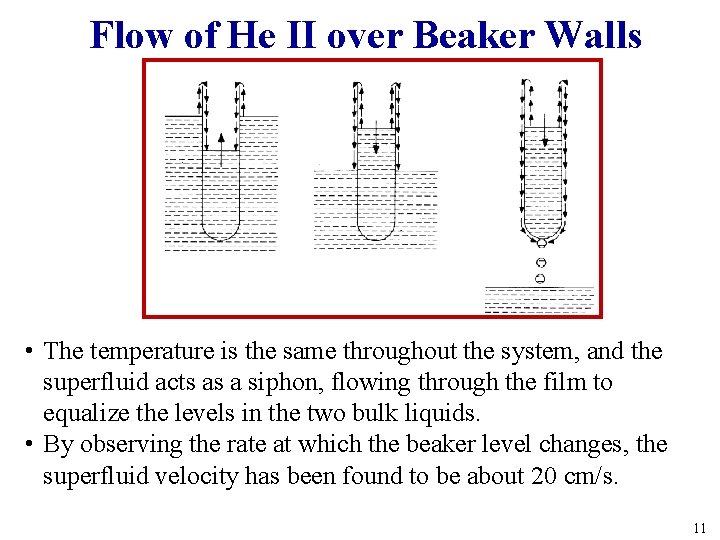
Flow of He II over Beaker Walls • The temperature is the same throughout the system, and the superfluid acts as a siphon, flowing through the film to equalize the levels in the two bulk liquids. • By observing the rate at which the beaker level changes, the superfluid velocity has been found to be about 20 cm/s. 11
Thermomechanical Effect • If a temperature gradient is set up between two bulk volumes connected by a superleak, through which only the superfluid can flow, the superfluid flows to the higher temperature side, in order to reduce the temperature gradient. • This is an example of thermomechanical effect. It shows that heat transfer and mass transfer cannot be separated in He II. 12
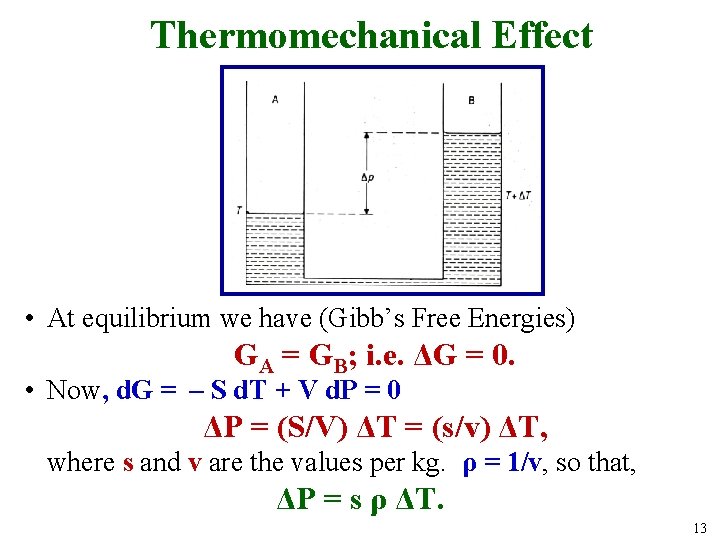
Thermomechanical Effect • At equilibrium we have (Gibb’s Free Energies) GA = GB; i. e. ΔG = 0. • Now, d. G = – S d. T + V d. P = 0 ΔP = (S/V) ΔT = (s/v) ΔT, where s and v are the values per kg. ρ = 1/v, so that, ΔP = s ρ ΔT. 13
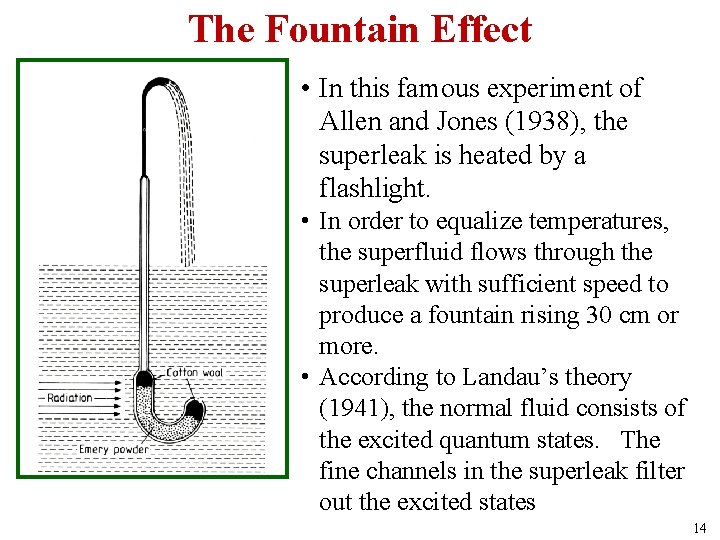
The Fountain Effect • In this famous experiment of Allen and Jones (1938), the superleak is heated by a flashlight. • In order to equalize temperatures, the superfluid flows through the superleak with sufficient speed to produce a fountain rising 30 cm or more. • According to Landau’s theory (1941), the normal fluid consists of the excited quantum states. The fine channels in the superleak filter out the excited states 14
- Slides: 14