
Supercritical Fluid Extraction Outline History Theory and Background
Supercritical Fluid Extraction
Outline � History � Theory and Background � Advantages � Disadvantages � Applications � Conclusions
History � � � � First reported as high-pressure gas chromatography (HPGC) before HPLC in 1962. 1966 first use of supercritical CO 2 as mobile phase Used a UV absorption detector with a quartz cell equipped with a gas-liquid separator 1968 - used a SFC system with a mechanical backpressure regulator that could control pressure independent of flow rate. Basic prototype of modern packed column SFC. 1970 - development allowed pressure programming, gave a gradient. Overshadowed by development of HPLC in late 60’s and 70’s. 1980’s led to commercialization of SFC instruments ◦ Open tubular columns-more like GC ◦ Packed columns-more like LC. ◦ Developed chiral separations � � 1990’s- use of SFC as preparative separation 2000’s- demands for ”green chemistry” has led to more interest in SFE ◦ Advances in column and mobile phase chemistry allowed separations of more polar molecules 1
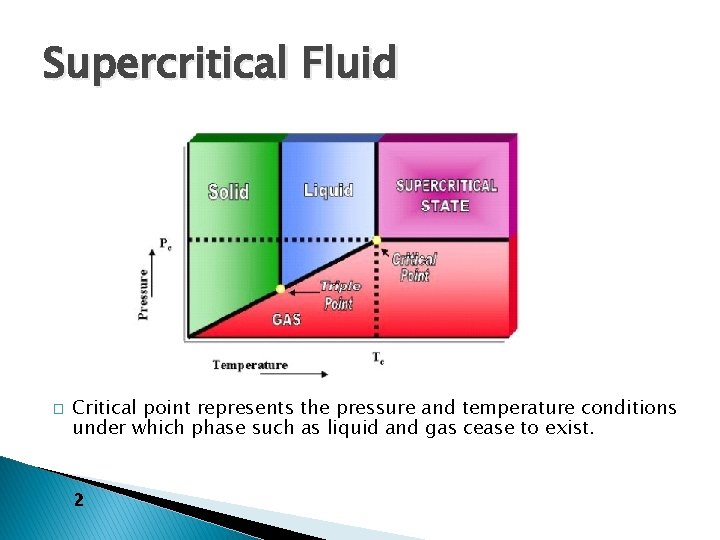
Supercritical Fluid � Critical point represents the pressure and temperature conditions under which phase such as liquid and gas cease to exist. 2
Supercritical Fluid Characteristics �Has density and solvent power similar to that of a liquid solvent but the viscosity and diffusivity of the same order of magnitude as gases �SCF moves like a gas and dissolves substrates similar to a liquid 2, 3
Supercritical Fluid Extraction The separation of chemicals which are mixed with a supercritical fluid to form a mobile phase which is subjected to pressures and temperatures near or above the critical point for the purpose of enhancing the mobile phase solvating power. Typically, CO 2 is used as the supercritical fluid. CO 2 is first in vapor form then compressed into a liquid prior to becoming supercritical, where extraction occurs. Supercritical CO 2: � Critical temperature = 30. 9˚C � Critical pressure = 73. 8 bar � Critical density = 0. 467 gm/ml 2
Modifiers � Co-solvents that are added to CO 2 to enhance extraction efficiency � Usually 1 to 10% of methanol or ethanol is added to expand the extraction range to include more polar lipids � Organic modifiers can increase the complexity of the experimental model that determines SCF extraction parameters 2, 4

SFE Apparatus � The necessary apparatus for a SFE setup is simple. Figure depicts the basic elements of a SFE instrument, which is composed of a reservoir of supercritical fluid, a pressure tuning injection unit, two pumps (to take the components in the mobile phase in and to send them out of the extraction cell), and a collection chamber. 5
Static Mode � Equilibrium state between the solute and the solvent is achieved before any sample is taken out to analyze the solubility. � Static method carries out the equilibrium process in many ways that include recirculation of the solvent, agitation by the magnetic stirrer, or simply trapping the solvent in the equilibrium cell for some time � In the static extraction experiment, there are two distinct steps in the process: 1. 2. 3, 5 The mobile phase fills the extraction cell and interacts with the sample. The second pump is opened and the extracted substances are taken out at once.
Dynamic extraction mode � In dynamic extraction, the second pump sending the materials out to the collection chamber is always open during the extraction process. � Thus, the mobile phase reaches the extraction cell and extracts components in order to take them out consistently. 5
Characteristics of SCF � Density: the ratio of the mass of an object to its volume � Solubility: the maximum amount of a substance that will dissolve in a given amount of solvent at a given temperature to form a stable solution � Viscosity: the resistance of a liquid to flow � Diffusivity: the ability of a molecule to mix with a substance by random molecular motion
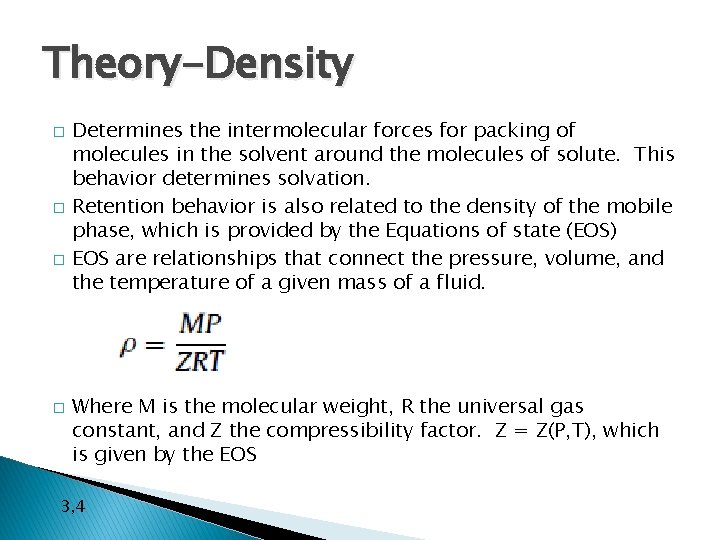
Theory-Density � � Determines the intermolecular forces for packing of molecules in the solvent around the molecules of solute. This behavior determines solvation. Retention behavior is also related to the density of the mobile phase, which is provided by the Equations of state (EOS) EOS are relationships that connect the pressure, volume, and the temperature of a given mass of a fluid. Where M is the molecular weight, R the universal gas constant, and Z the compressibility factor. Z = Z(P, T), which is given by the EOS 3, 4
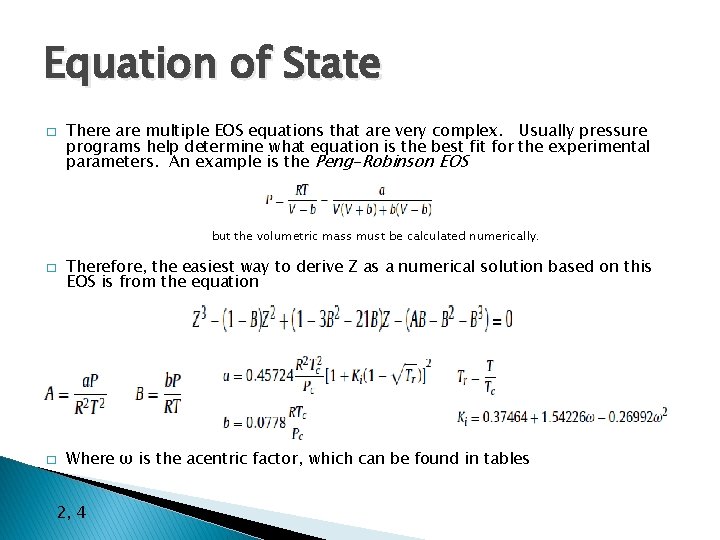
Equation of State � There are multiple EOS equations that are very complex. Usually pressure programs help determine what equation is the best fit for the experimental parameters. An example is the Peng-Robinson EOS but the volumetric mass must be calculated numerically. � � Therefore, the easiest way to derive Z as a numerical solution based on this EOS is from the equation Where ω is the acentric factor, which can be found in tables 2, 4
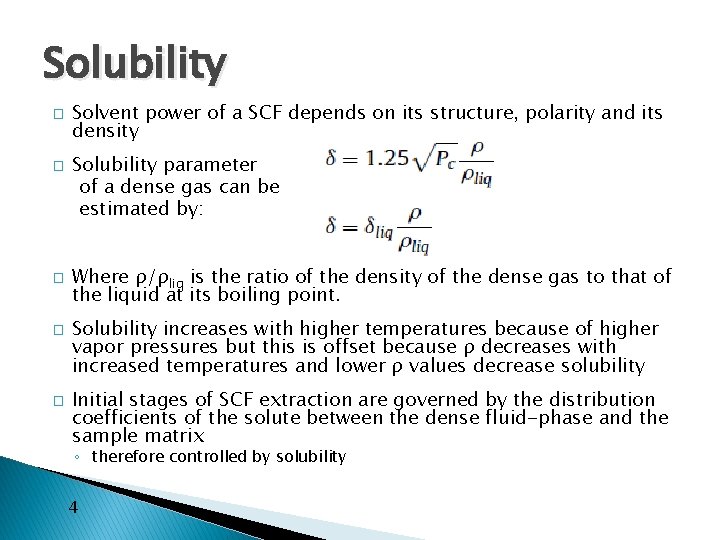
Solubility � � � Solvent power of a SCF depends on its structure, polarity and its density Solubility parameter of a dense gas can be estimated by: Where ρ/ρliq is the ratio of the density of the dense gas to that of the liquid at its boiling point. Solubility increases with higher temperatures because of higher vapor pressures but this is offset because ρ decreases with increased temperatures and lower ρ values decrease solubility Initial stages of SCF extraction are governed by the distribution coefficients of the solute between the dense fluid-phase and the sample matrix ◦ therefore controlled by solubility 4
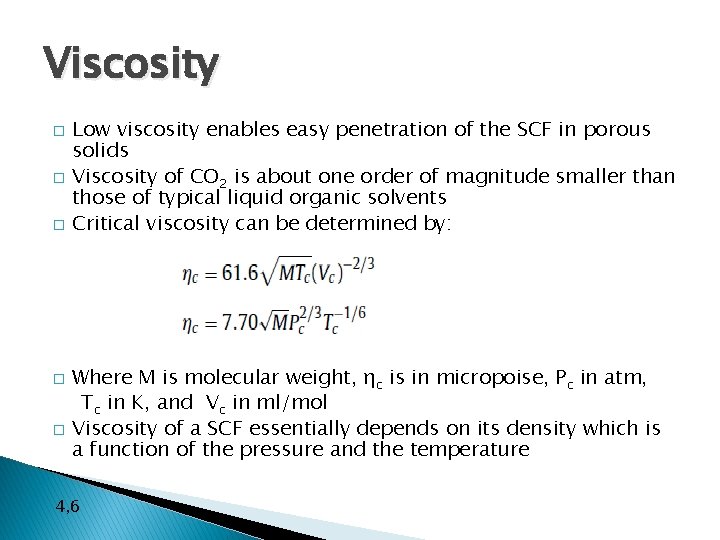
Viscosity � � � Low viscosity enables easy penetration of the SCF in porous solids Viscosity of CO 2 is about one order of magnitude smaller than those of typical liquid organic solvents Critical viscosity can be determined by: Where M is molecular weight, ηc is in micropoise, Pc in atm, Tc in K, and Vc in ml/mol Viscosity of a SCF essentially depends on its density which is a function of the pressure and the temperature 4, 6
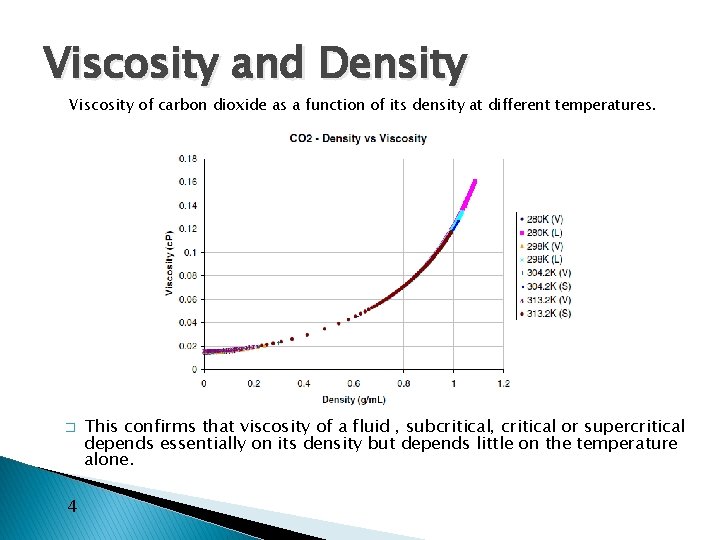
Viscosity and Density Viscosity of carbon dioxide as a function of its density at different temperatures. � 4 This confirms that viscosity of a fluid , subcritical, critical or supercritical depends essentially on its density but depends little on the temperature alone.
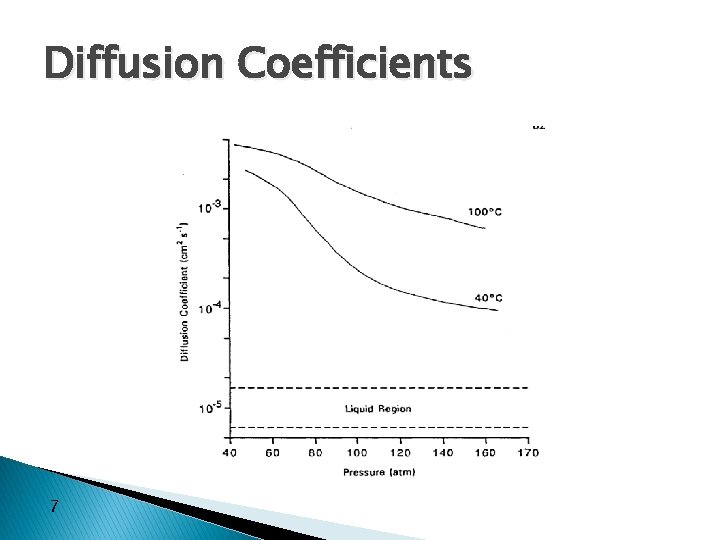
Diffusivity � SC CO 2 has values that are more typical of gases than those of the liquid state � Increased diffusivity of an SCF as compared to those of liquid, results in high mass transfer rates � Self-diffusion coefficient of SC CO 2 is 1 -2 orders of magnitude greater than those of dissolved substances in the usual solvents � Later stages of SCF extraction are governed by diffusion-controlled process ◦ therefore controlled by mass transfer 3, 7
Diffusion Coefficients 7
Sample Matrix Influences � Particle size and shape � Surface area and porosity � Moisture content � Changes in morphology � Sample size � Extractable levels 2
Advantages � � � � � “Green Chemistry” Can use MS, FID, UV (particularly PDA in packed columns), ESLD Can use gradients of CO 2, modifiers, density, pressure, temperature With modifiers, can analyze a wide range of analytes Can be used for analytical and preparative separations All three parameters-pressure, temperature, modifier contentcan independently or cooperatively control retention CO 2 is cheap, non-toxic, non-flammable, transmits in the UV, readily available, and a gas at room temperature Much less use of organic solvents-good for EPA and storage/disposal of such solvents CO 2 use as a solvent protects lipid samples against oxidative degradation. 1 -2, 8 -10
Disadvantages Cost-both of equipment and training to operate machine � Programming required to optimize results � Equipment must be able to handle very high pressures/temperatures � Cannot use refractive index detection because of high back pressure required by SFE � Polar analytes are comparatively difficult to separate than non-polar analytes unless a modifier is used, making the process less “green” � Due to temperature/pressure/”green” requirement limits, CO 2 is the only really practical supercritical fluid solvent � SFE is not generally selective enough to isolate specific analytes from the matrix without further cleanup/resolution from co-extracted species � 1 -2, 8 -10
Applications � Chiral separations most successful application in SFE (including analyte and preparative separations, has been around longest) � Extraction of caffeine from coffee beans, tea leaves � Metals recovery from solids/liquids � Food toxicology and ecotoxicology � Solvent removal and new drug delivery formulations (used as an anti-solvent) � Natural pesticides � De-nicotinization of tobacco � Food preservatives � Herbal medicines � Isolation of natural products 2, 8 -10
Applications (1) � Supercritical leaves oil � Advantages: CO 2 extraction of Eucalyptus ◦ Extracted a wide range of components-not only volatile oils but high molecular weight compounds. ◦ 1, 8 -cineole (primary desired extract) content was 46. 19% ◦ Extraction only took 60 minutes, compared to Soxhlet (8 hours) or hydrodistillation (5 hours) ◦ Did not have degradation of water sensitive compounds in oil due to partial hydrolysis ◦ No solvent residue present in finished product 8
Applications (2) SFE CO 2 extraction of bioactive compounds from microalgae and volatile oils from aromatic plants � Advantages: � � It is possible to obtain pure oil fraction on the second column while trapping waxes on first column � Extraction of bioactive compounds and volatile oils done without use of organic solvents � Microalga had 72 g/kg hydrocarbons extracted without contamination by chlorophyll � These hydrocarbons can replace paraffinic and natural waxes in production of masks for cosmetic industry-free of toxic solvents � 70% of carotenoid content extracted, used as food colorant � Composition of extracted volatile oils from pennyroyal yielded 80% pulegone (used as flavoring agent, in perfumery, and aromatherapy. Similar to peppermint and camphor) and 9% menthone (related to menthol), � Extraction of compounds from Satureja montana L. (winter savory) had 15 fold higher amounts of thymoquinone (vs. extraction done with hydrodistillation). Thymoquinone has anticancer, antioxidant and antiinflammatory properties, as well as a neuroprotective effect against Alzheimer’s disease. 9
Application (3) � SFE of heavy metals from sand sewage sludge � Advantages: ◦ Lack of solvents = environmentally acceptable ◦ Morphology and structure matrix is retained ◦ Use of a chelating agent (Acetyl acetonate -dissolves in CO 2) allowed removal of Cu, Cr, Ni, Pb and Zn ◦ In comparison with traditional methods (BCR, Tessier, etc) it is much faster ◦ Avoids analytical difficulties that are encountered with sequential extraction methods ◦ Uses less harsh conditions than Sb. WE ◦ One extraction removes 30 -50% metals present 10
Conclusions � SFE is a relatively “green” process, little to no solvent in final products � CO 2 can be recycled and reused � In comparison to hydrodistilation and Soxhlet extraction, SFE takes less time to extract desired compounds with less use of organic solvents. � Adjustments of pressure/temperature/modifiers can help select for specific analytes � To more fully develop SFE as a general use tool; it needs to be cheaper, be able to be more automated, have general lab instrumentation interface � International Symposium on Supercritical Fluids (ISSF) held every three years-next held in San Francisco in May 2015
References 1. Saito, M. J. Bio. Sci. Bioeng. 2013, 115, 590 2. Sairam, P. et al. Asian J. Res. Pharm. Sci. 2012, 2, 112 3. Mantell, C. , Casas, L. and et al. 2013. Supercritical Fluid Extraction. In Separation and Purification Technologies in Biorefineries ; Ramaswamy, S. , Ed. ; John Wiley & Sons. 2013; pp 79 -98. 4. Guiochon, G. , Tarafder, A. , J. Chrom. A. 2011. 1218, 1037 5. Rice University. Basic Principles of Supercritical Fluid Chromatography and Supercritical Fluid Extraction. http: //oer. equella. com/ (accessed. December 1 2014). 6. Voutsas, Epaminondas. Supercritical Fluid Extraction. In Food Engineering Handbook: Food Process Engineering; Varzaka, T. , Tzia, C. , Ed. ; CRC Press: Florida, 2014; pp 287 -318 7. King, J. In Analytical Supercritical Fluid Chromatography and Extraction, Proceedings of Chromatography Conferences, Inc. ; Lee. M. , Markides, K. Ed. Provo, Utah, 1990; pp 313362. 8. Zhao, S. Dongke, Z. Separ. Purific. Tech. 2014, 133, 443 9. Palavra, A. M. F. et al. J. Supercrit. Fluids. 2011, 60, 21 10. Yabalak, E. Gizir, A. M. J. Serb. Chem. Soc. 2013, 78, 1013 11. Fornari, T. et al. , J. Chrom. A. 2012, 1250, 34
- Slides: 27