
Supercontinuum Light Generation in Nano and MicroStructured Fibers
Supercontinuum Light Generation in Nano- and Micro-Structured Fibers Mustafa Yorulmaz Bilkent University Physics Department 1/9/2007 Bilkent University, Physics Department 1
Outline n Fiber Nonlinearities: q q n Self Phase Modulation (SPM) q n q History Examples Simulation Methodology: Split-step Fourier Method q n Phase modulation due to intensity dependence of refractive index Supercontinuum Light Generation in Microstructured Fibers q n Third order susceptibility Intensity dependence of refraction Numerical solution of pulse propagation inside a fiber Results 1/9/2007 Bilkent University, Physics Department 2
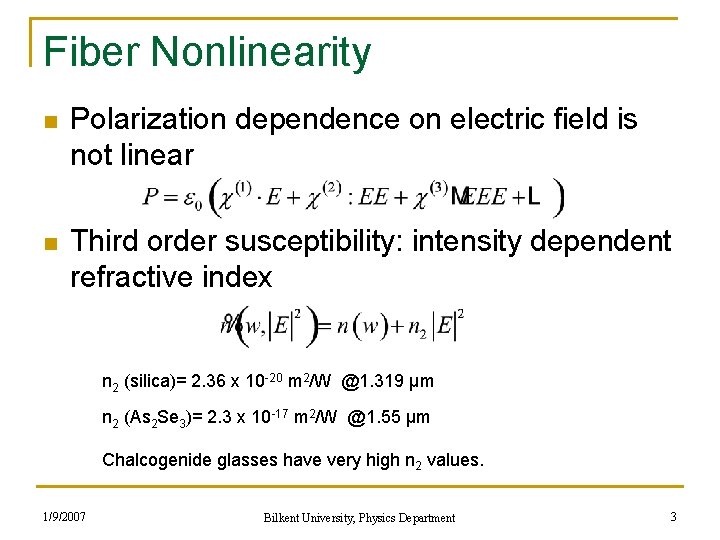
Fiber Nonlinearity n Polarization dependence on electric field is not linear n Third order susceptibility: intensity dependent refractive index n 2 (silica)= 2. 36 x 10 -20 m 2/W @1. 319 µm n 2 (As 2 Se 3)= 2. 3 x 10 -17 m 2/W @1. 55 µm Chalcogenide glasses have very high n 2 values. 1/9/2007 Bilkent University, Physics Department 3
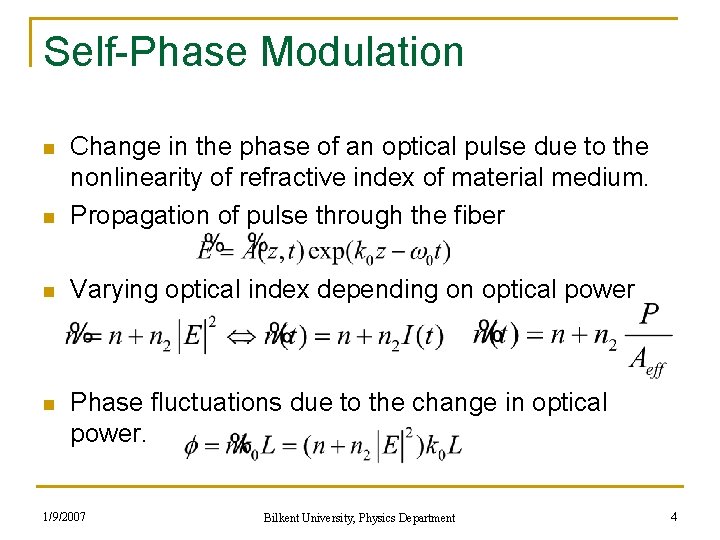
Self-Phase Modulation n Change in the phase of an optical pulse due to the nonlinearity of refractive index of material medium. Propagation of pulse through the fiber n Varying optical index depending on optical power n Phase fluctuations due to the change in optical power. n 1/9/2007 Bilkent University, Physics Department 4
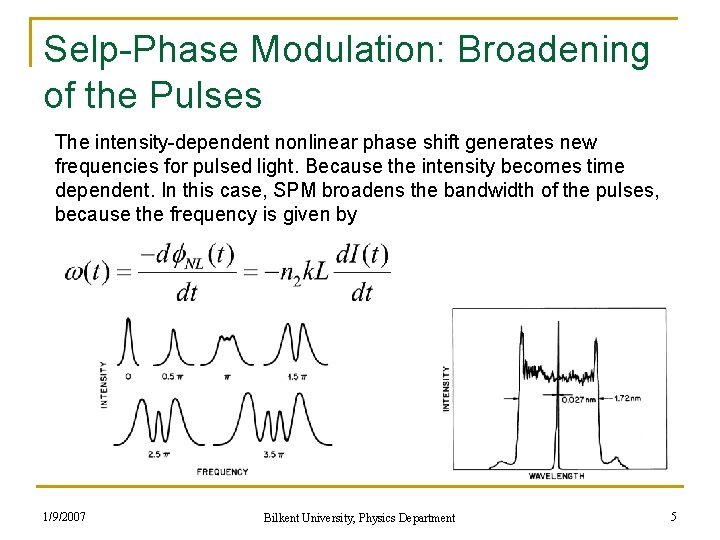
Selp-Phase Modulation: Broadening of the Pulses The intensity-dependent nonlinear phase shift generates new frequencies for pulsed light. Because the intensity becomes time dependent. In this case, SPM broadens the bandwidth of the pulses, because the frequency is given by 1/9/2007 Bilkent University, Physics Department 5

Supercontinuum Light Generation in Microstructured Fibers n Supercontinuum light generation is a result of complicated combinations of nonlinear optical effects. It is characterized by the dramatic spectral broadening of intense light pulses propagating through a nonlinear material. n It was first demonstrated by Ranka et al. n air–silica microstructure fiber. Optical spectrum of the continuum generated in a 75 -cm section of microstructure fiber. 1/9/2007 Bilkent University, Physics Department 6
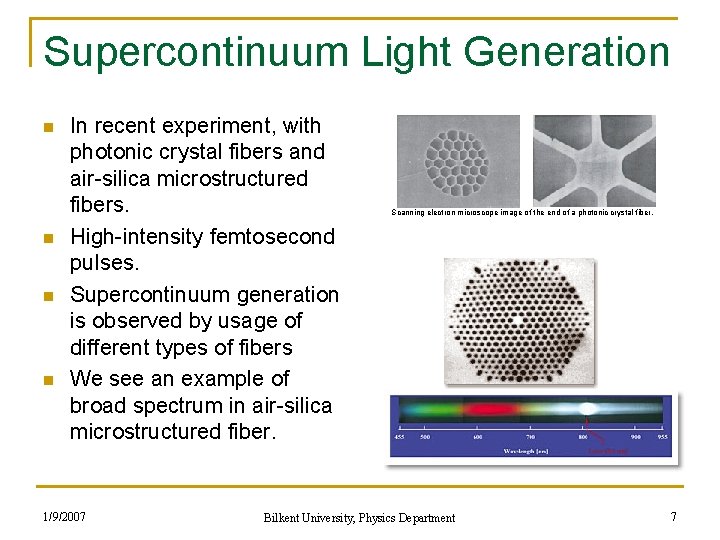
Supercontinuum Light Generation n n In recent experiment, with photonic crystal fibers and air-silica microstructured fibers. High-intensity femtosecond pulses. Supercontinuum generation is observed by usage of different types of fibers We see an example of broad spectrum in air-silica microstructured fiber. 1/9/2007 Scanning electron microscope image of the end of a photonic crystal fiber. Bilkent University, Physics Department 7
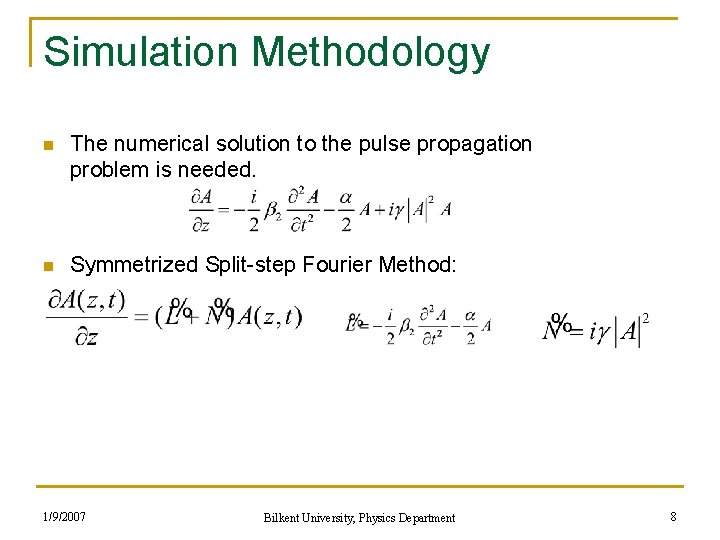
Simulation Methodology n The numerical solution to the pulse propagation problem is needed. n Symmetrized Split-step Fourier Method: 1/9/2007 Bilkent University, Physics Department 8
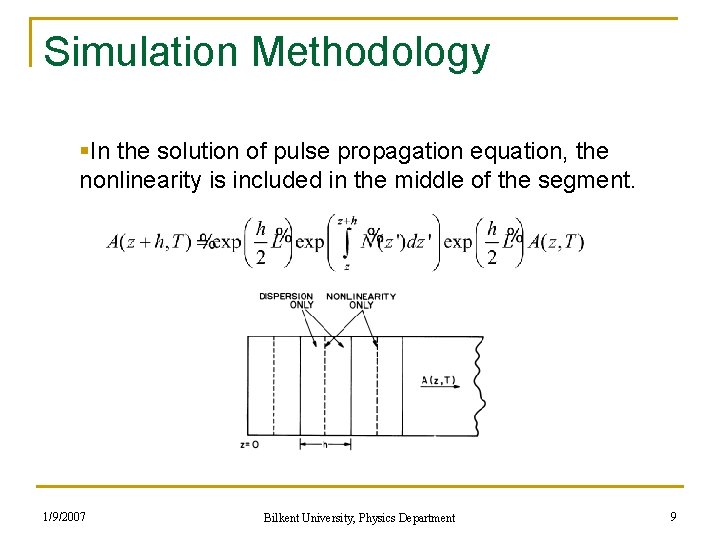
Simulation Methodology §In the solution of pulse propagation equation, the nonlinearity is included in the middle of the segment. 1/9/2007 Bilkent University, Physics Department 9
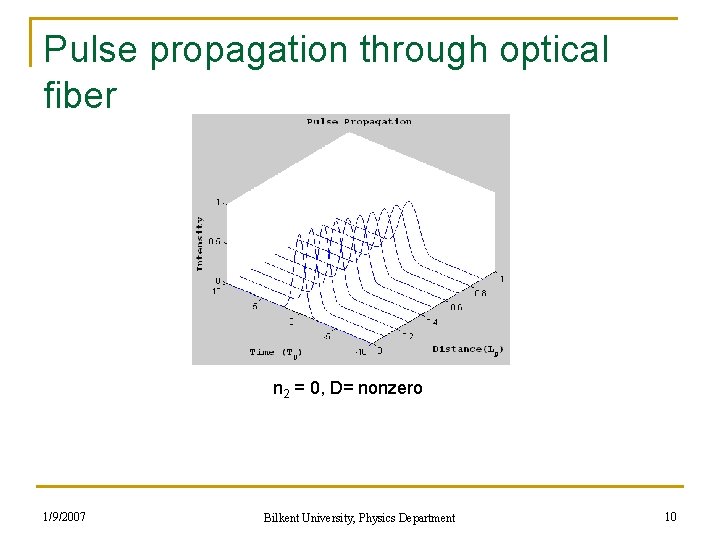
Pulse propagation through optical fiber n 2 = 0, D= nonzero 1/9/2007 Bilkent University, Physics Department 10
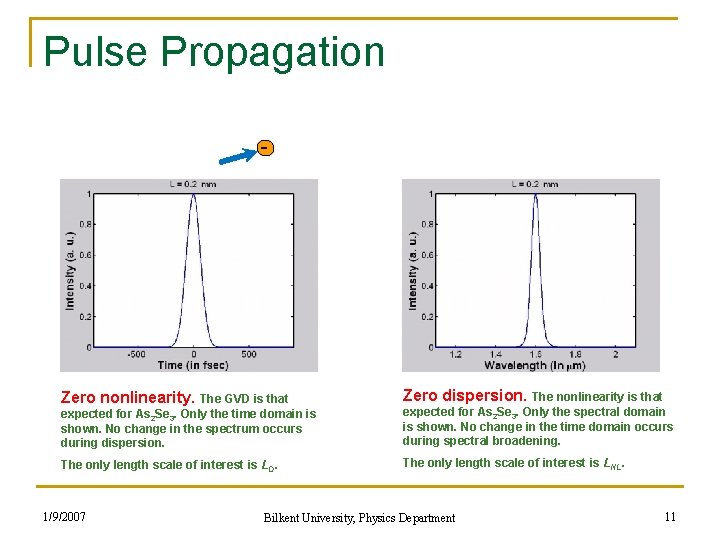
Pulse Propagation Zero nonlinearity. The GVD is that Zero dispersion. The nonlinearity is that expected for As 2 Se 3. Only the time domain is shown. No change in the spectrum occurs during dispersion. expected for As 2 Se 3. Only the spectral domain is shown. No change in the time domain occurs during spectral broadening. The only length scale of interest is LD. The only length scale of interest is LNL. 1/9/2007 Bilkent University, Physics Department 11

THANK YOU 1/9/2007 Bilkent University, Physics Department 12
- Slides: 12