
Superconductors for the FCC in a 10 year
- Slides: 35
Superconductors for the FCC in a 10 year perspective – a view from the February 2015 LT/HFSW (Low Temperature High Field Superconductor Workshop) David Larbalestier ASC-NHMFL-FSU With special thanks to Mike Sumption (OSU), Venkat Selvamanickam (Tc. SUH), Danko van der Laan (ACT), Yibing Huang and Mike Field (OST) and my colleagues at FSU, especially Peter Lee, Jianyi Jiang, Ulf Trociewitz and Eric Hellstrom and the LTSW session chairs Arup Ghosh, Dave Sutter, Bruce Strauss, Ken Marken, Dan Dietderich and Lance Cooley)
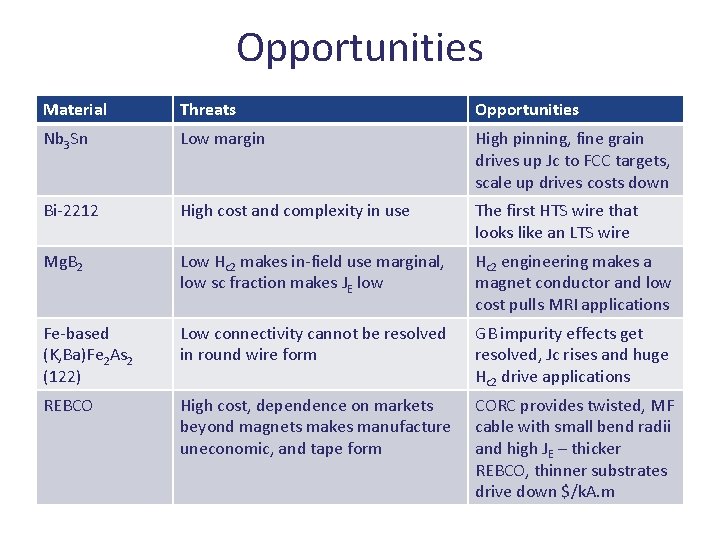
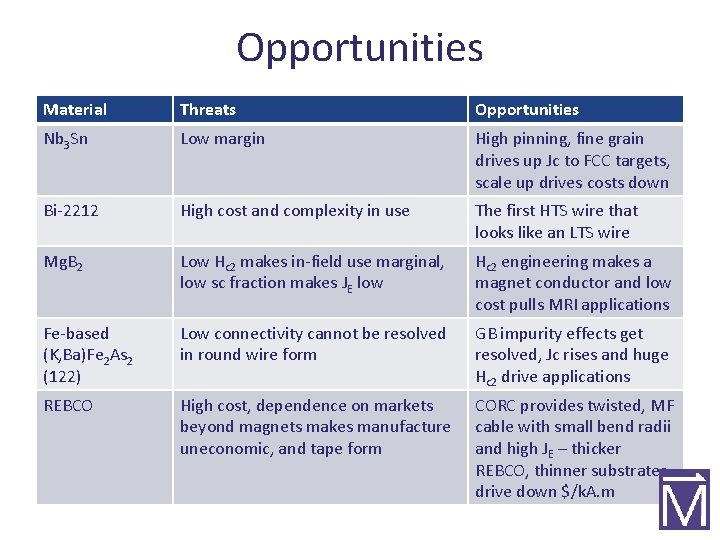
Opportunities Material Threats Opportunities Nb 3 Sn Low margin High pinning, fine grain drives up Jc to FCC targets, scale up drives costs down Bi-2212 High cost and complexity in use The first HTS wire that looks like an LTS wire Mg. B 2 Low Hc 2 makes in-field use marginal, low sc fraction makes JE low Hc 2 engineering makes a magnet conductor and low cost pulls MRI applications Fe-based (K, Ba)Fe 2 As 2 (122) Low connectivity cannot be resolved in round wire form GB impurity effects get resolved, Jc rises and huge Hc 2 drive applications REBCO High cost, dependence on markets beyond magnets makes manufacture uneconomic, and tape form CORC provides twisted, MF cable with small bend radii and high JE – thicker REBCO, thinner substrates drive down $/k. A. m
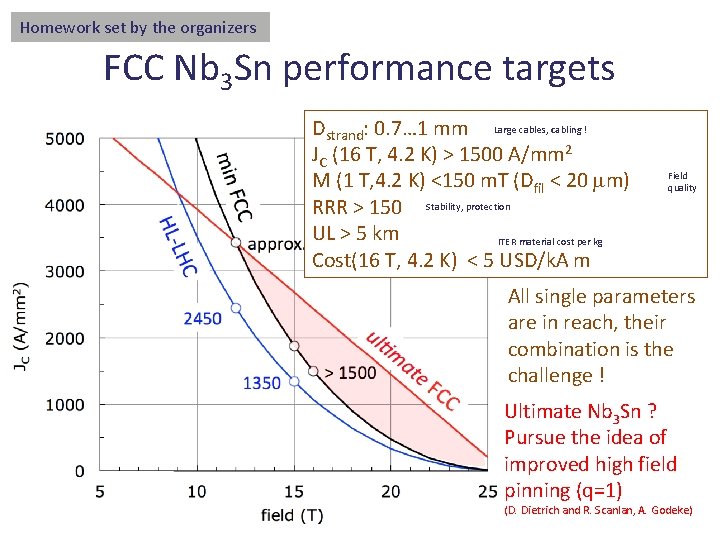
Homework set by the organizers FCC Nb 3 Sn performance targets Dstrand: 0. 7… 1 mm Large cables, cabling ! JC (16 T, 4. 2 K) > 1500 A/mm 2 M (1 T, 4. 2 K) <150 m. T (Dfil < 20 m) RRR > 150 Stability, protection UL > 5 km ITER material cost per kg Cost(16 T, 4. 2 K) < 5 USD/k. A m Field quality All single parameters are in reach, their combination is the challenge ! Ultimate Nb 3 Sn ? Pursue the idea of improved high field pinning (q=1) (D. Dietrich and R. Scanlan, A. Godeke)
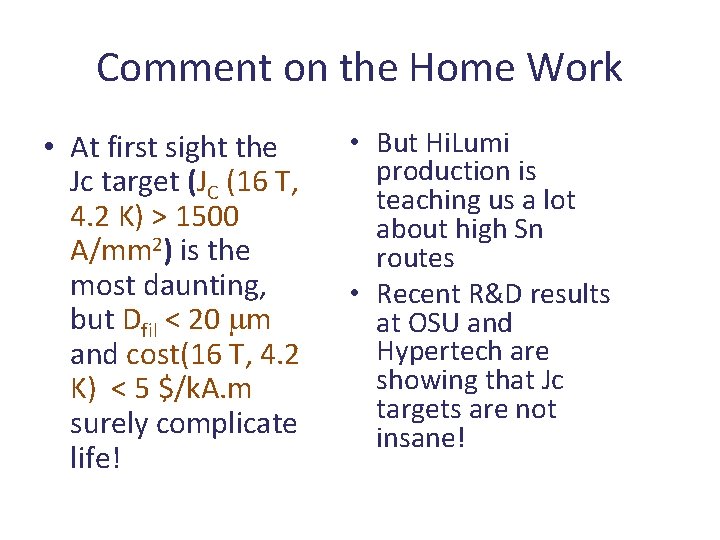
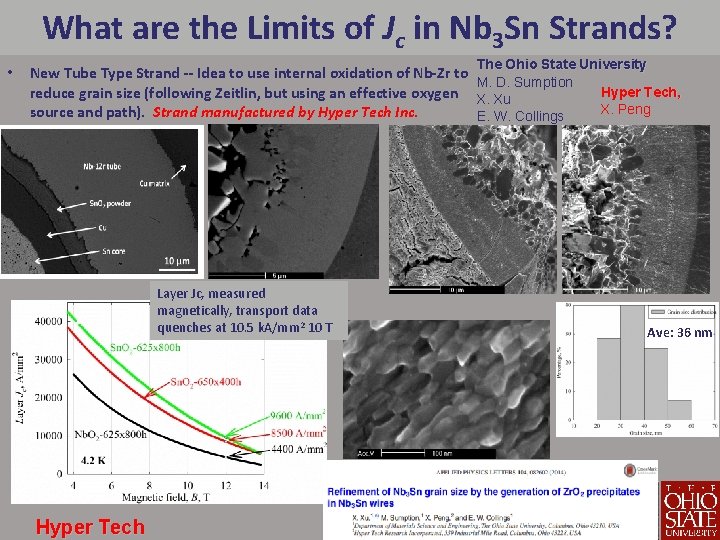
Comment on the Home Work • At first sight the Jc target (JC (16 T, 4. 2 K) > 1500 A/mm 2) is the most daunting, but Dfil < 20 m and cost(16 T, 4. 2 K) < 5 $/k. A. m surely complicate life! • But Hi. Lumi production is teaching us a lot about high Sn routes • Recent R&D results at OSU and Hypertech are showing that Jc targets are not insane!
What are the Limits of Jc in Nb 3 Sn Strands? • 5 The Ohio State University New Tube Type Strand -- Idea to use internal oxidation of Nb-Zr to M. D. Sumption reduce grain size (following Zeitlin, but using an effective oxygen X. Xu source and path). Strand manufactured by Hyper Tech Inc. E. W. Collings Layer Jc, measured magnetically, transport data quenches at 10. 5 k. A/mm 2 10 T Hyper Tech, X. Peng Ave: 36 nm
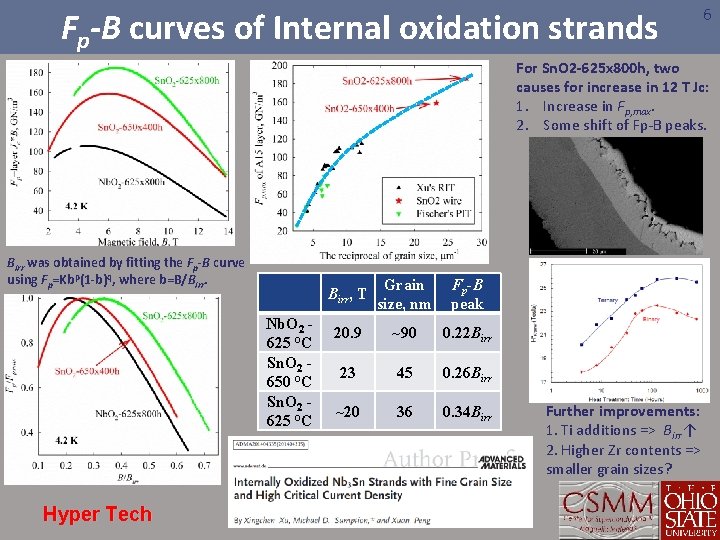
Fp-B curves of Internal oxidation strands 6 For Sn. O 2 -625 x 800 h, two causes for increase in 12 T Jc: 1. Increase in Fp, max. 2. Some shift of Fp-B peaks. Birr was obtained by fitting the Fp-B curve using Fp=Kbp(1 -b)q, where b=B/Birr. Nb. O 2 625 °C Sn. O 2 650 °C Sn. O 2 625 °C Hyper Tech Birr, T Grain size, nm Fp-B peak 20. 9 ~90 0. 22 Birr 23 45 0. 26 Birr ~20 36 0. 34 Birr Further improvements: 1. Ti additions => Birr↑ 2. Higher Zr contents => smaller grain sizes?
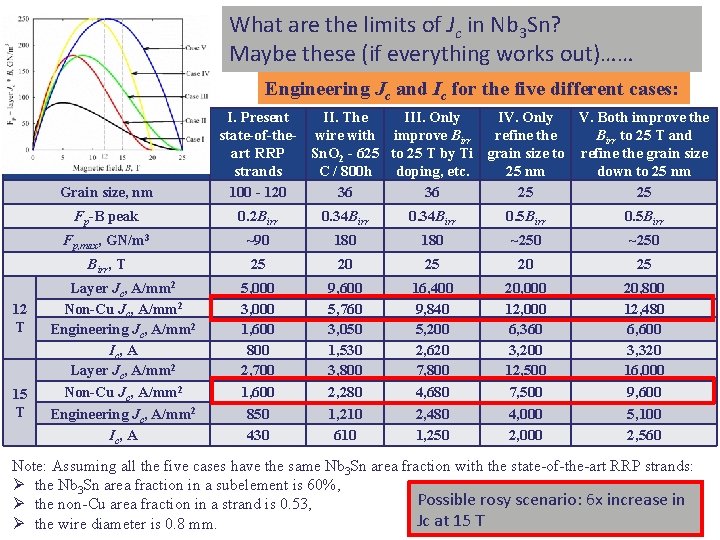
What are the limits of Jc in Nb 3 Sn? Maybe these (if everything works out)…… Engineering Jc and Ic for the five different cases: Grain size, nm 12 T 15 T I. Present II. The III. Only IV. Only V. Both improve the state-of-the- wire with improve Birr refine the Birr to 25 T and art RRP Sn. O 2 - 625 to 25 T by Ti grain size to refine the grain size strands C / 800 h doping, etc. 25 nm down to 25 nm 100 - 120 36 36 25 25 Fp-B peak 0. 2 Birr 0. 34 Birr 0. 5 Birr Fp, max, GN/m 3 ~90 180 ~250 Birr, T 25 20 25 5, 000 3, 000 1, 600 800 2, 700 1, 600 850 430 9, 600 5, 760 3, 050 1, 530 3, 800 2, 280 1, 210 610 16, 400 9, 840 5, 200 2, 620 7, 800 4, 680 2, 480 1, 250 20, 000 12, 000 6, 360 3, 200 12, 500 7, 500 4, 000 20, 800 12, 480 6, 600 3, 320 16, 000 9, 600 5, 100 2, 560 Layer Jc, A/mm 2 Non-Cu Jc, A/mm 2 Engineering Jc, A/mm 2 Ic, A Note: Assuming all the five cases have the same Nb 3 Sn area fraction with the state-of-the-art RRP strands: Ø the Nb 3 Sn area fraction in a subelement is 60%, Possible rosy scenario: 6 x increase in Ø the non-Cu area fraction in a strand is 0. 53, Jc at 15 T Ø the wire diameter is 0. 8 mm.
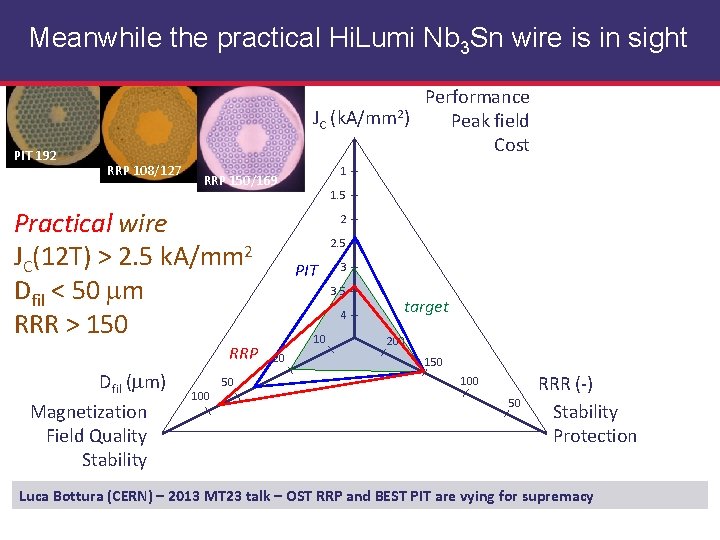
Meanwhile the practical Hi. Lumi Nb 3 Sn wire is in sight PIT 192 Performance JC (k. A/mm 2) Peak field Cost RRP 108/127 Practical wire JC(12 T) > 2. 5 k. A/mm 2 Dfil < 50 m RRR > 150 RRP Dfil ( m) Magnetization Field Quality Stability 1 RRP 150/169 100 50 1. 5 2 2. 5 PIT 3 3. 5 4 10 20 target 200 150 100 50 RRR (-) Stability Protection Luca Bottura (CERN) – 2013 MT 23 talk – OST RRP and BEST PIT are vying for supremacy
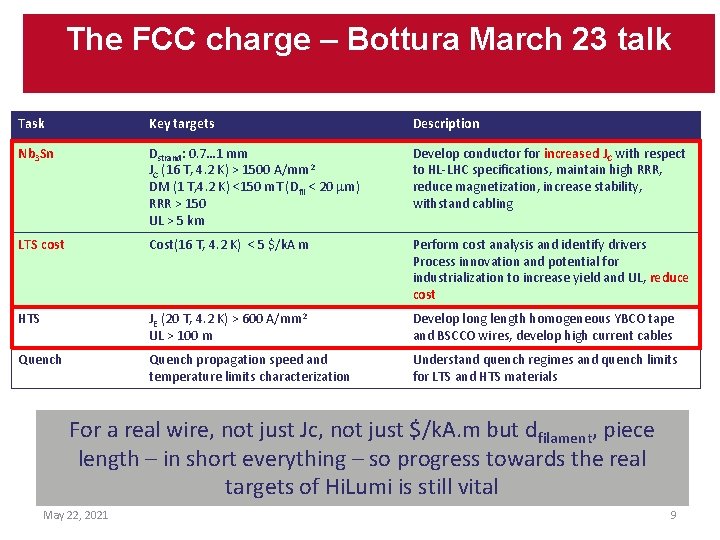
Enabling Technology: The FCC charge Accelerator – Bottura March 23 talk High Field Magnets Task Key targets Description Nb 3 Sn Dstrand: 0. 7… 1 mm JC (16 T, 4. 2 K) > 1500 A/mm 2 DM (1 T, 4. 2 K) <150 m. T (Dfil < 20 m) RRR > 150 UL > 5 km Develop conductor for increased JC with respect to HL-LHC specifications, maintain high RRR, reduce magnetization, increase stability, withstand cabling LTS cost Cost(16 T, 4. 2 K) < 5 $/k. A m Perform cost analysis and identify drivers Process innovation and potential for industrialization to increase yield and UL, reduce cost HTS JE (20 T, 4. 2 K) > 600 A/mm 2 UL > 100 m Develop long length homogeneous YBCO tape and BSCCO wires, develop high current cables Quench propagation speed and temperature limits characterization Understand quench regimes and quench limits for LTS and HTS materials For a real wire, not just Jc, not just $/k. A. m but dfilament, piece length – in short everything – so progress towards the real targets of Hi. Lumi is still vital May 22, 2021 9
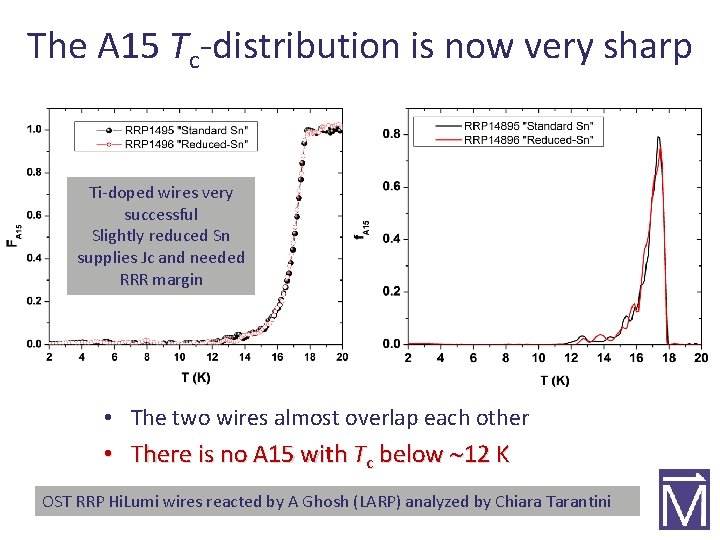
The A 15 Tc-distribution is now very sharp Ti-doped wires very successful Slightly reduced Sn supplies Jc and needed RRR margin • The two wires almost overlap each other • There is no A 15 with Tc below 12 K OST RRP Hi. Lumi wires reacted by A Ghosh (LARP) analyzed by Chiara Tarantini 10
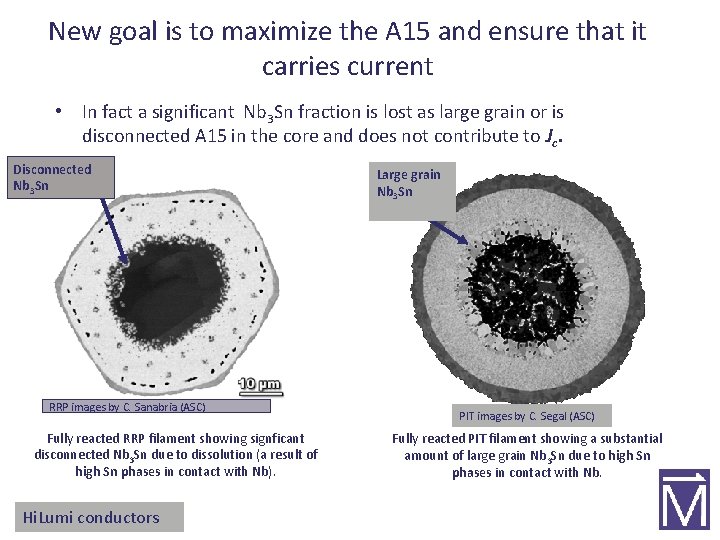
New goal is to maximize the A 15 and ensure that it carries current • In fact a significant Nb 3 Sn fraction is lost as large grain or is disconnected A 15 in the core and does not contribute to Jc. Disconnected Nb 3 Sn RRP images by C. Sanabria (ASC) Fully reacted RRP filament showing signficant disconnected Nb 3 Sn due to dissolution (a result of high Sn phases in contact with Nb). Hi. Lumi conductors Large grain Nb 3 Sn PIT images by C. Segal (ASC) Fully reacted PIT filament showing a substantial amount of large grain Nb 3 Sn due to high Sn phases in contact with Nb.
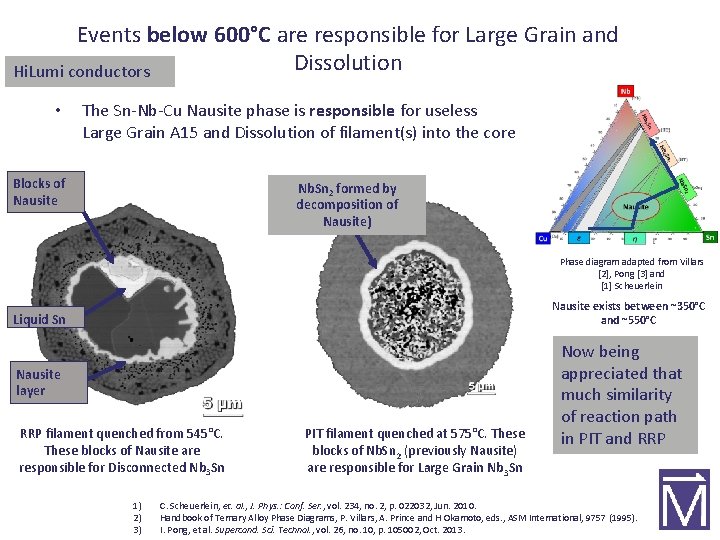
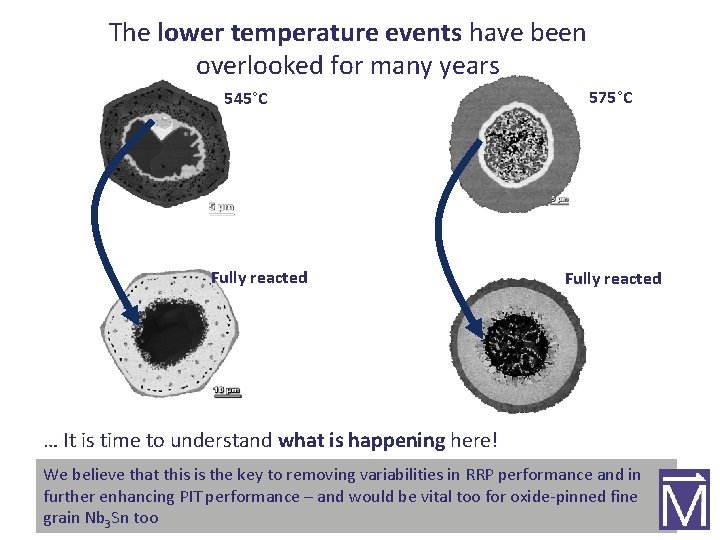
Events below 600°C are responsible for Large Grain and Dissolution Hi. Lumi conductors • The Sn-Nb-Cu Nausite phase is responsible for useless Large Grain A 15 and Dissolution of filament(s) into the core Blocks of Nausite Nb. Sn 2 formed by decomposition of Nausite) Phase diagram adapted from Villars [2], Pong [3] and [1] Scheuerlein Nausite exists between ~350°C and ~550°C Liquid Sn Nausite layer RRP filament quenched from 545°C. These blocks of Nausite are responsible for Disconnected Nb 3 Sn 1) 2) 3) PIT filament quenched at 575°C. These blocks of Nb. Sn 2 (previously Nausite) are responsible for Large Grain Nb 3 Sn Now being appreciated that much similarity of reaction path in PIT and RRP C. Scheuerlein, et. al. , J. Phys. : Conf. Ser. , vol. 234, no. 2, p. 022032, Jun. 2010. Handbook of Ternary Alloy Phase Diagrams, P. Villars, A. Prince and H Okamoto, eds. , ASM International, 9757 (1995). I. Pong, et al. Supercond. Sci. Technol. , vol. 26, no. 10, p. 105002, Oct. 2013.
The lower temperature events have been overlooked for many years 545°C Fully reacted 575°C Fully reacted … It is time to understand what is happening here! We believe that this is the key to removing variabilities in RRP performance and in further enhancing PIT performance – and would be vital too for oxide-pinned fine grain Nb 3 Sn too
My view of Nb 3 Sn Still work to do – even though Hi. Lumi performance seems to be asymptotic Today’s action is on manufacturing variables – they are forcing us to confront what we do not yet understand They are also the route to lower $/k. A. m The reaction pathway(s) are still poorly understood (Pong, Lee and Sanabria session 3 LTSW) A new POP of small grain size and oxide pinning has been provided by OSU (Xu and Sumption) Potential for 6 x increase of Jc at 15 T But is it fabricable in FM form? Definitely interesting work. Does even 6 x Jc provide enough stability margin for 16 T dipoles (no increase in DT)?
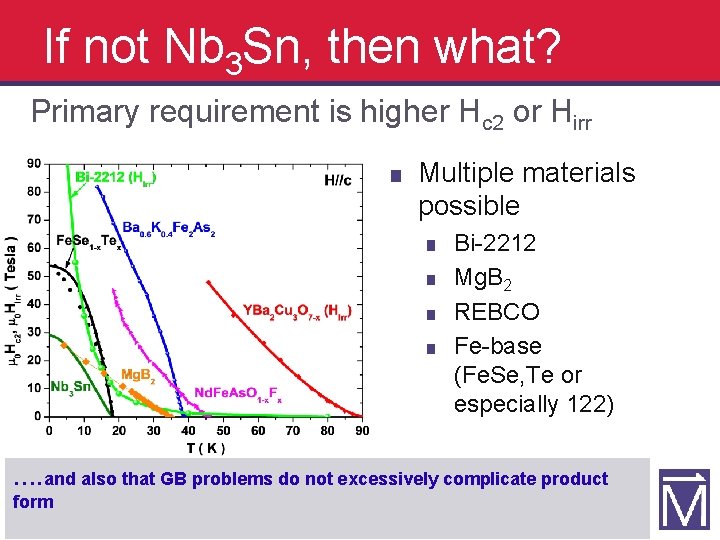
If not Nb 3 Sn, then what? Primary requirement is higher Hc 2 or Hirr Multiple materials possible Bi-2212 Mg. B 2 REBCO Fe-base (Fe. Se, Te or especially 122) …. and also that GB problems do not excessively complicate product form
The GB problem • All low carrier density materials (HTS cuprates and Fe-based superconductors) suffer from some blocking of current at GBs – Higher doping levels raise the carrier density and allow higher Jc – YBCO and Bi-2223 were the first HTS materials to become conductors – neither allows much overdoping – Bi-2212 optimizes in a lower Tc, overdoped state – Fe-based superconductors seem to show same behavior as cuprates but to a less marked degree
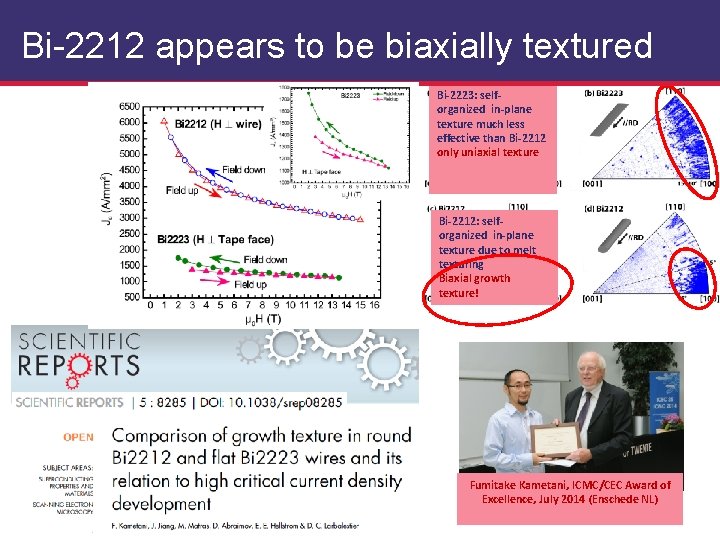
Bi-2212 appears to be biaxially textured Bi-2223: selforganized in-plane texture much less effective than Bi-2212 only uniaxial texture Bi-2212: selforganized in-plane texture due to melt texturing Biaxial growth texture! Fumitake Kametani, ICMC/CEC Award of Excellence, July 2014 (Enschede NL)
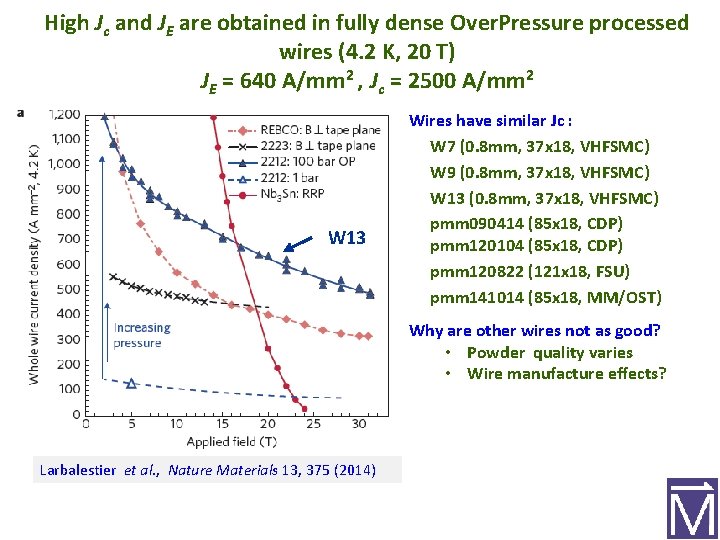
High Jc and JE are obtained in fully dense Over. Pressure processed wires (4. 2 K, 20 T) JE = 640 A/mm 2 , Jc = 2500 A/mm 2 W 13 Wires have similar Jc : W 7 (0. 8 mm, 37 x 18, VHFSMC) W 9 (0. 8 mm, 37 x 18, VHFSMC) W 13 (0. 8 mm, 37 x 18, VHFSMC) pmm 090414 (85 x 18, CDP) pmm 120104 (85 x 18, CDP) pmm 120822 (121 x 18, FSU) pmm 141014 (85 x 18, MM/OST) Why are other wires not as good? • Powder quality varies • Wire manufacture effects? Larbalestier et al. , Nature Materials 13, 375 (2014)
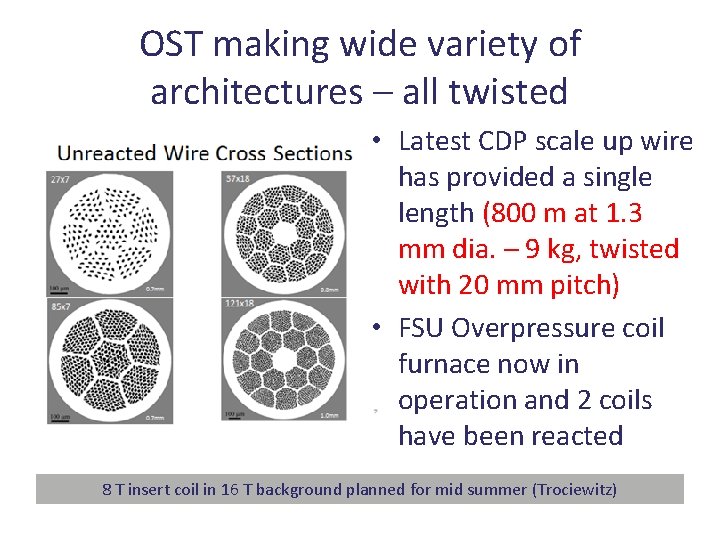
OST making wide variety of architectures – all twisted • Latest CDP scale up wire has provided a single length (800 m at 1. 3 mm dia. – 9 kg, twisted with 20 mm pitch) • FSU Overpressure coil furnace now in operation and 2 coils have been reacted 8 T insert coil in 16 T background planned for mid summer (Trociewitz)
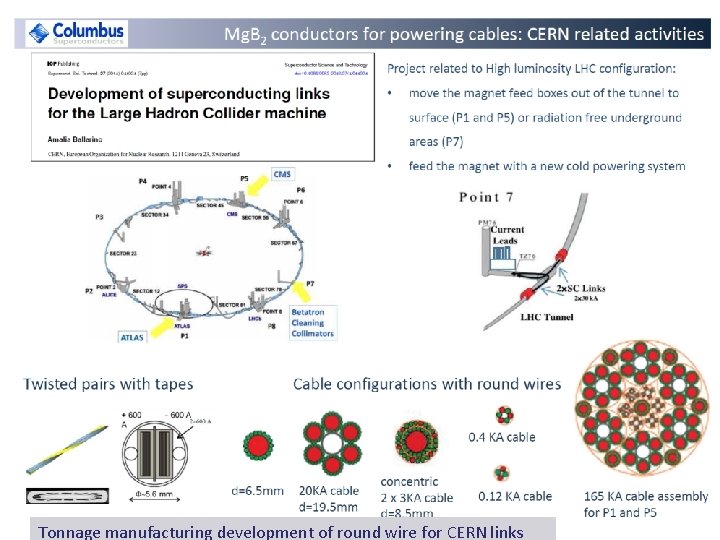
Tonnage manufacturing development of round wire for CERN links
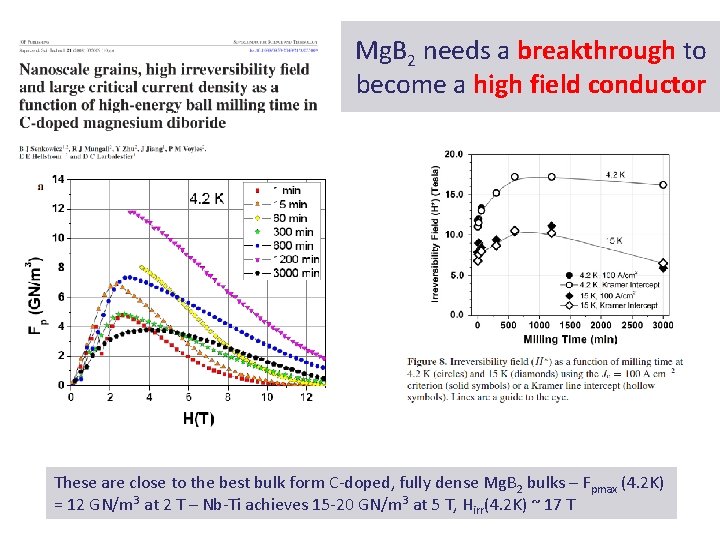
Mg. B 2 needs a breakthrough to become a high field conductor These are close to the best bulk form C-doped, fully dense Mg. B 2 bulks – Fpmax (4. 2 K) = 12 GN/m 3 at 2 T – Nb-Ti achieves 15 -20 GN/m 3 at 5 T, Hirr(4. 2 K) ~ 17 T
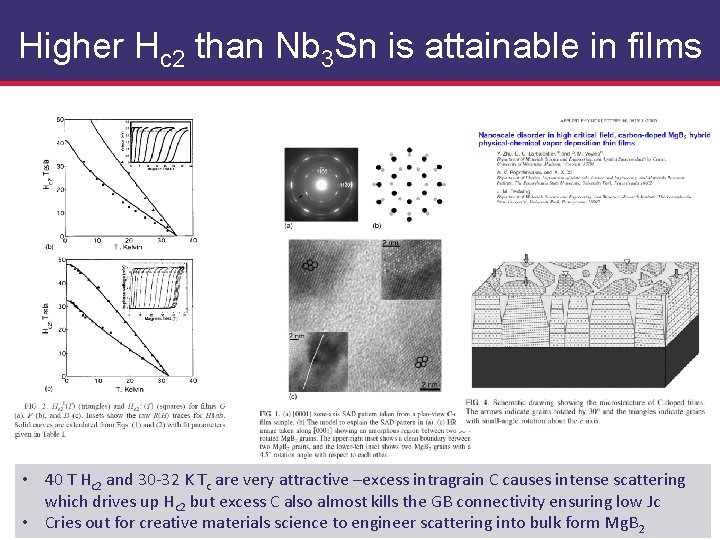
Higher Hc 2 than Nb 3 Sn is attainable in films • 40 T Hc 2 and 30 -32 K Tc are very attractive –excess intragrain C causes intense scattering which drives up Hc 2 but excess C also almost kills the GB connectivity ensuring low Jc • Cries out for creative materials science to engineer scattering into bulk form Mg. B 2
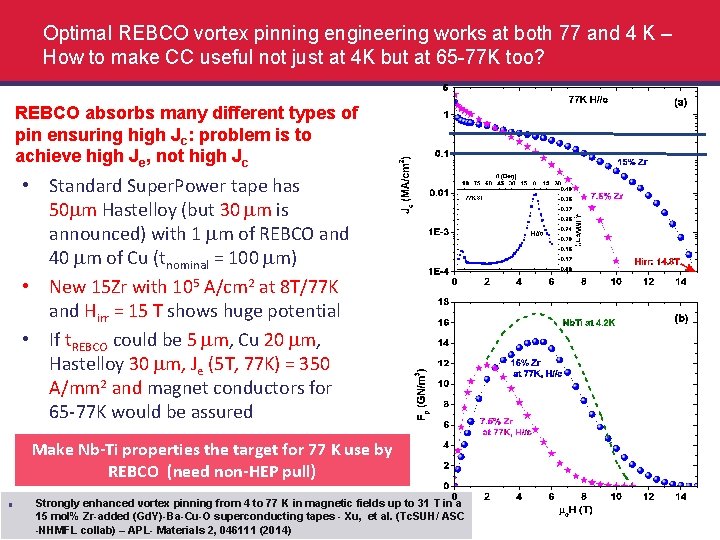
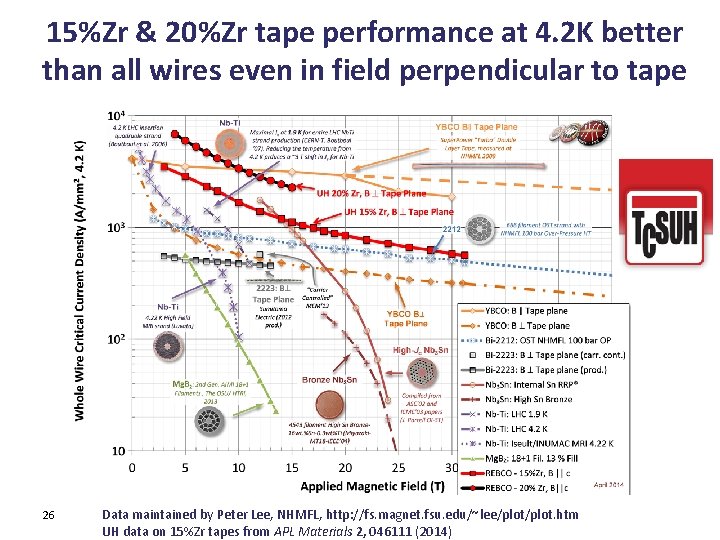
Optimal REBCO vortex pinning engineering works at both 77 and 4 K – How to make CC useful not just at 4 K but at 65 -77 K too? REBCO absorbs many different types of pin ensuring high Jc: problem is to achieve high Je, not high Jc • Standard Super. Power tape has 50 m Hastelloy (but 30 m is announced) with 1 m of REBCO and 40 m of Cu (tnominal = 100 m) • New 15 Zr with 105 A/cm 2 at 8 T/77 K and Hirr = 15 T shows huge potential • If t. REBCO could be 5 m, Cu 20 m, Hastelloy 30 m, Je (5 T, 77 K) = 350 A/mm 2 and magnet conductors for 65 -77 K would be assured Make Nb-Ti properties the target for 77 K use by REBCO (need non-HEP pull) Strongly enhanced vortex pinning from 4 to 77 K in magnetic fields up to 31 T in a 15 mol% Zr-added (Gd. Y)-Ba-Cu-O superconducting tapes - Xu, et al. (Tc. SUH/ ASC -NHMFL collab) – APL- Materials 2, 046111 (2014)
REBCO for HEP magnets in CORC form? Greater uniformity, longer length, and (much) lower cost Jc is quite high enough to get big magnets into trouble at 4 K Much longer lengths Delivery on the same scale as manufacture is the path to reduced cost………. <$10/k. A-m Much thicker films (3 -5 m) would allow 5 -15 T technology at 65 -77 K by allowing Jeng > 103 A/mm 2 at 5 -15 T – this could allow REBCO to take over magnet technology from Nb-Ti (cost $2 -5/k. A-m) by 65 -77 K operation Selva and Danko talks on Tuesday at LTSW
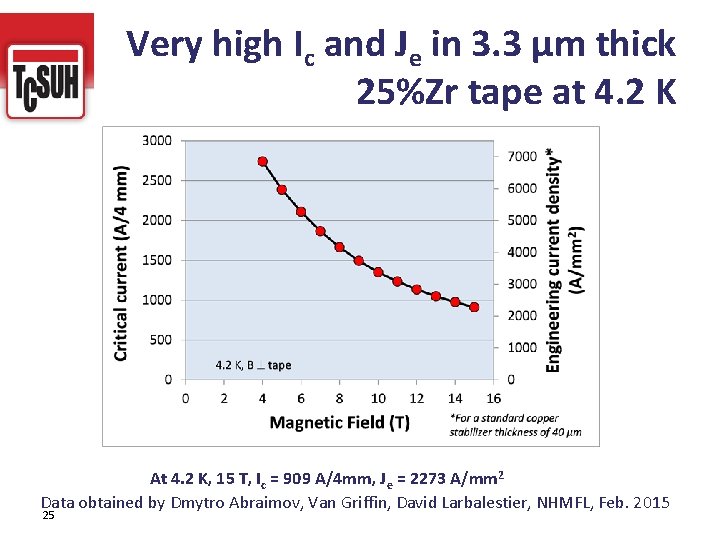
Very high Ic and Je in 3. 3 µm thick 25%Zr tape at 4. 2 K At 4. 2 K, 15 T, Ic = 909 A/4 mm, Je = 2273 A/mm 2 Data obtained by Dmytro Abraimov, Van Griffin, David Larbalestier, NHMFL, Feb. 2015 25
15%Zr & 20%Zr tape performance at 4. 2 K better than all wires even in field perpendicular to tape 26 Data maintained by Peter Lee, NHMFL, http: //fs. magnet. fsu. edu/~lee/plot. htm UH data on 15%Zr tapes from APL Materials 2, 046111 (2014)
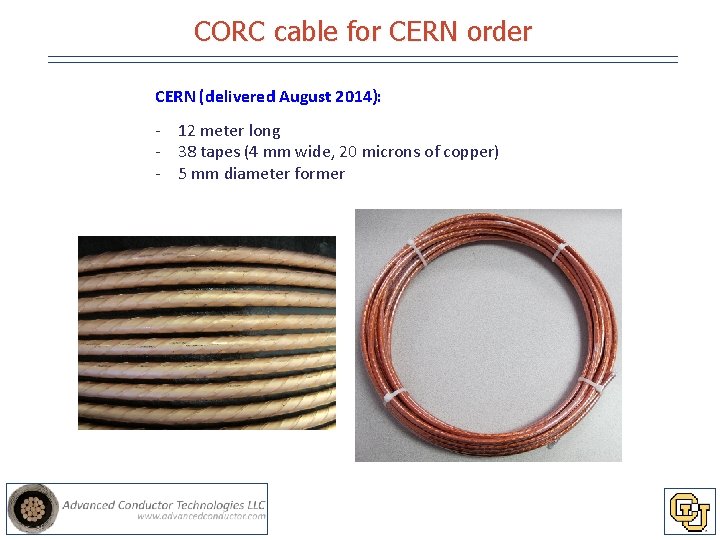
CORC cable for CERN order CERN (delivered August 2014): - 12 meter long - 38 tapes (4 mm wide, 20 microns of copper) - 5 mm diameter former
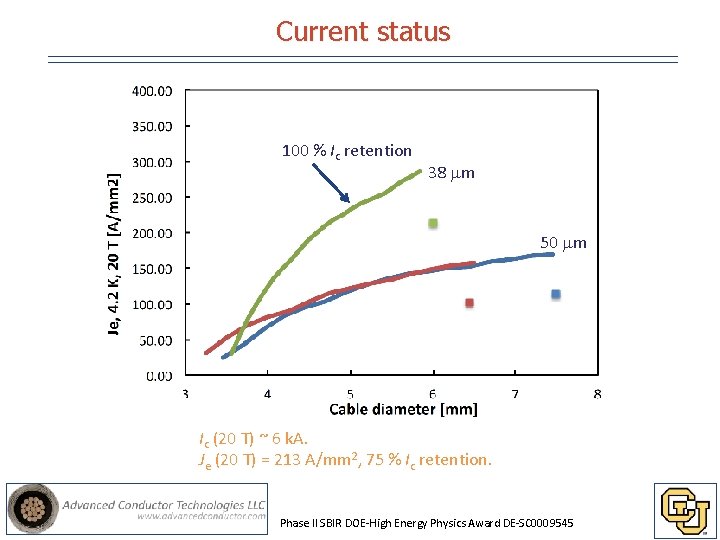
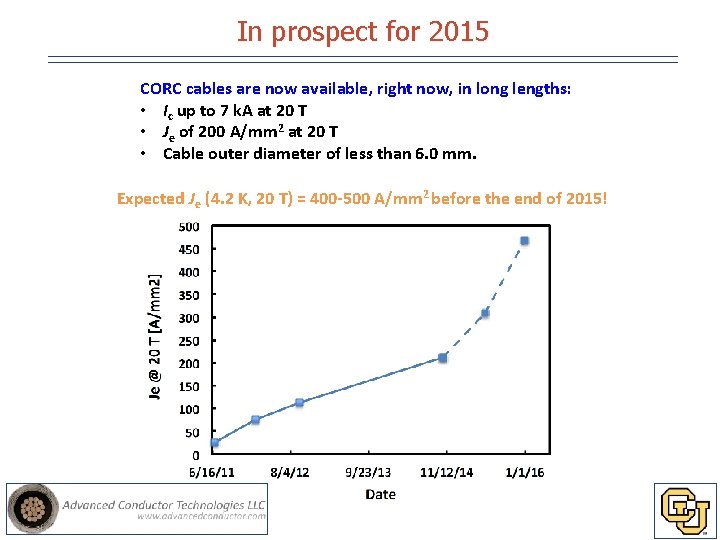
Current status 100 % Ic retention 38 m 50 m Ic (20 T) ~ 6 k. A. Je (20 T) = 213 A/mm 2, 75 % Ic retention. Phase II SBIR DOE-High Energy Physics Award DE-SC 0009545
In prospect for 2015 CORC cables are now available, right now, in long lengths: • Ic up to 7 k. A at 20 T • Je of 200 A/mm 2 at 20 T • Cable outer diameter of less than 6. 0 mm. Expected Je (4. 2 K, 20 T) = 400 -500 A/mm 2 before the end of 2015!
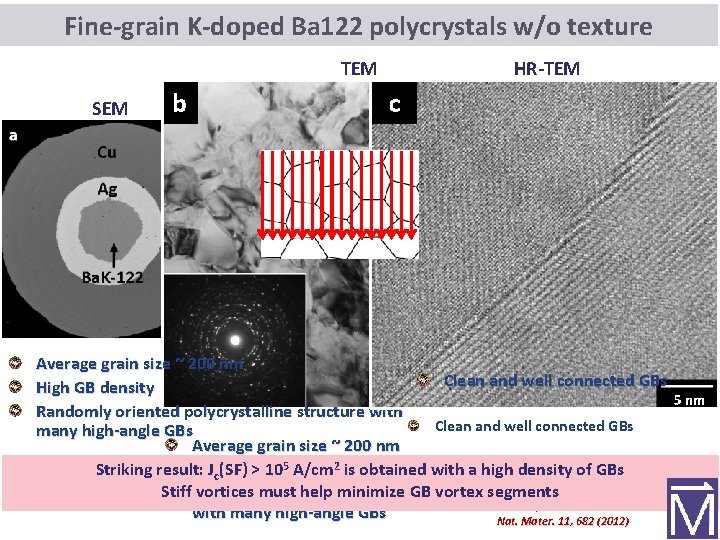
Fine-grain K-doped Ba 122 polycrystals w/o texture TEM SEM TEM HR-TEM Average grain size ~ 200 nm Clean and well connected GBs High GB density Randomly oriented polycrystalline structure with Clean and well connected GBs many high-angle GBs Average grain size ~ 200 nm High GB>density Striking result: Jc(SF) 105 A/cm 2 is obtained with a high density of GBs Stiff. Randomly vortices must help minimize GB vortex segments oriented polycrystalline structure J. Weiss, C. Tarantini et al. with many high-angle GBs Nat. Mater. 11, 682 (2012)
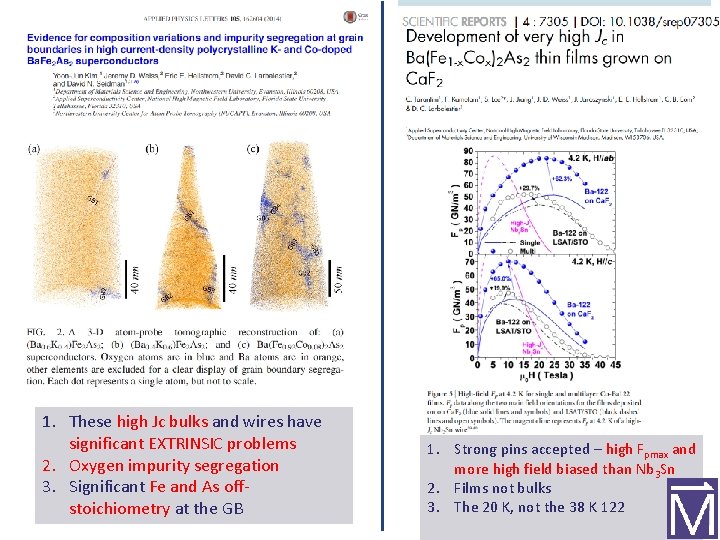
1. These high Jc bulks and wires have significant EXTRINSIC problems 2. Oxygen impurity segregation 3. Significant Fe and As offstoichiometry at the GB 1. Strong pins accepted – high Fpmax and more high field biased than Nb 3 Sn 2. Films not bulks 3. The 20 K, not the 38 K 122
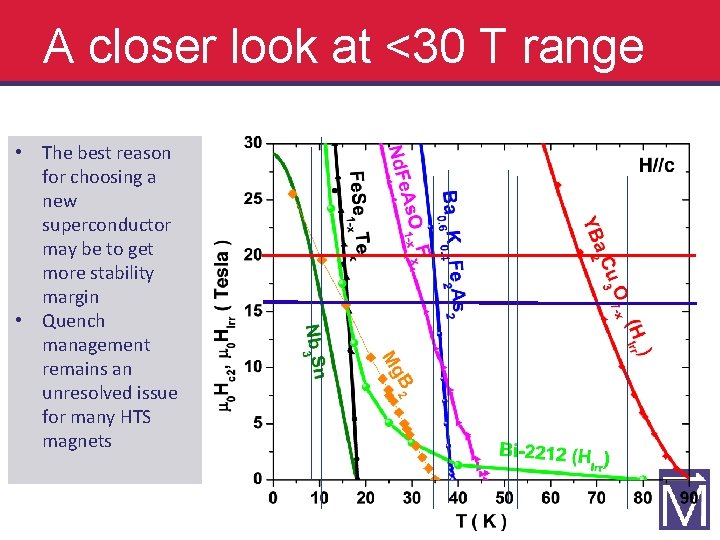
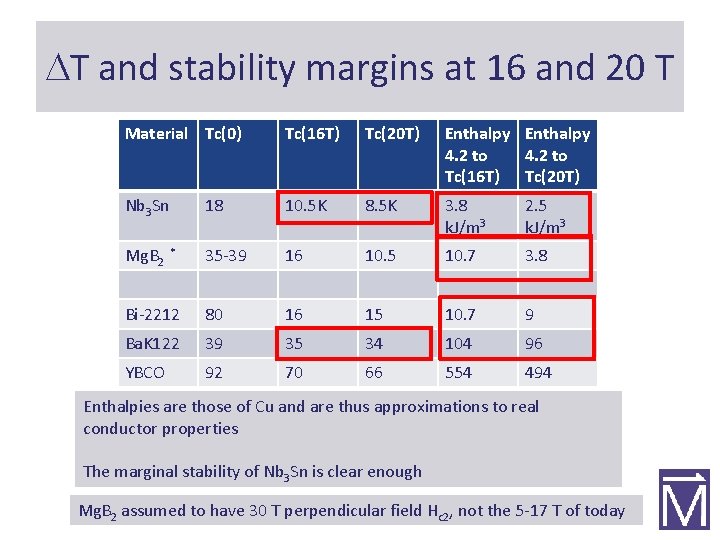
A closer look at <30 T range • The best reason for choosing a new superconductor may be to get more stability margin • Quench management remains an unresolved issue for many HTS magnets
DT and stability margins at 16 and 20 T Material Tc(0) Tc(16 T) Tc(20 T) Enthalpy 4. 2 to Tc(16 T) Tc(20 T) Nb 3 Sn 18 10. 5 K 8. 5 K 3. 8 k. J/m 3 2. 5 k. J/m 3 Mg. B 2 * 35 -39 16 10. 5 10. 7 3. 8 Bi-2212 80 16 15 10. 7 9 Ba. K 122 39 35 34 104 96 YBCO 92 70 66 554 494 Enthalpies are those of Cu and are thus approximations to real conductor properties The marginal stability of Nb 3 Sn is clear enough Mg. B 2 assumed to have 30 T perpendicular field Hc 2, not the 5 -17 T of today
Opportunities Material Threats Opportunities Nb 3 Sn Low margin High pinning, fine grain drives up Jc to FCC targets, scale up drives costs down Bi-2212 High cost and complexity in use The first HTS wire that looks like an LTS wire Mg. B 2 Low Hc 2 makes in-field use marginal, low sc fraction makes JE low Hc 2 engineering makes a magnet conductor and low cost pulls MRI applications Fe-based (K, Ba)Fe 2 As 2 (122) Low connectivity cannot be resolved in round wire form GB impurity effects get resolved, Jc rises and huge Hc 2 drive applications REBCO High cost, dependence on markets beyond magnets makes manufacture uneconomic, and tape form CORC provides twisted, MF cable with small bend radii and high JE – thicker REBCO, thinner substrates drive down $/k. A. m
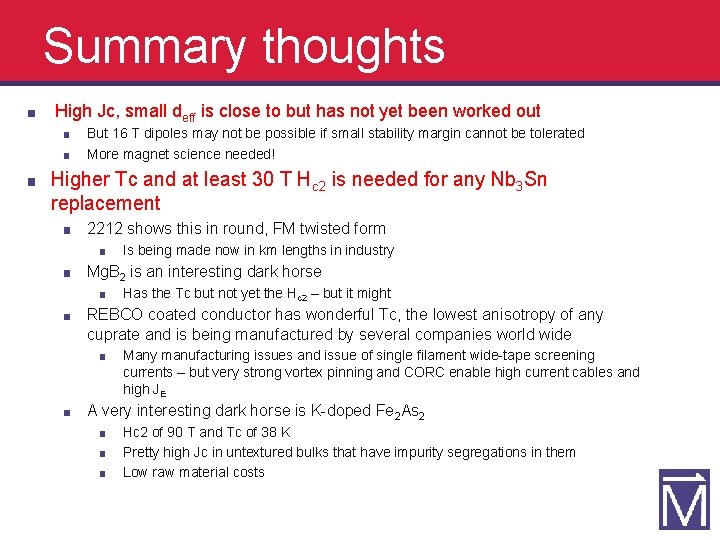
Summary thoughts High Jc, small deff is close to but has not yet been worked out But 16 T dipoles may not be possible if small stability margin cannot be tolerated More magnet science needed! Higher Tc and at least 30 T Hc 2 is needed for any Nb 3 Sn replacement 2212 shows this in round, FM twisted form Is being made now in km lengths in industry Mg. B 2 is an interesting dark horse Has the Tc but not yet the Hc 2 – but it might REBCO coated conductor has wonderful Tc, the lowest anisotropy of any cuprate and is being manufactured by several companies world wide Many manufacturing issues and issue of single filament wide-tape screening currents – but very strong vortex pinning and CORC enable high current cables and high JE A very interesting dark horse is K-doped Fe 2 As 2 Hc 2 of 90 T and Tc of 38 K Pretty high Jc in untextured bulks that have impurity segregations in them Low raw material costs