
Superconducting Undulator SCU Development at ANL Efim Gluskin
- Slides: 39
Superconducting Undulator (SCU) Development at ANL Efim Gluskin on behalf of the APS/ANL team Superconducting Undulator R&D Review Jan. 31, 2014
Outline Developments of the APS superconducting undulator SCU design and performance - cryogenic design and performance - magnetic measurements and SCU performance - integration at the APS storage ring - reliability and spectral performance Future developments R&D for the LCLS-II SCU prototype 2 SCU R&D Review, Jan. 31, 2014
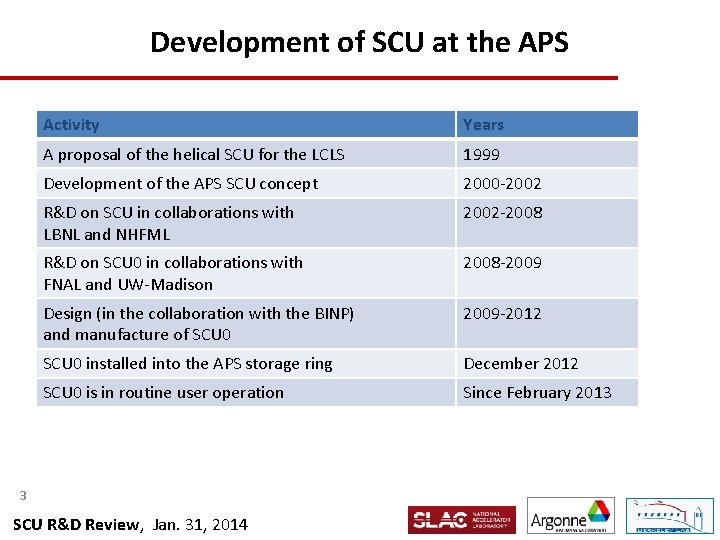
Development of SCU at the APS Activity Years A proposal of the helical SCU for the LCLS 1999 Development of the APS SCU concept 2000 -2002 R&D on SCU in collaborations with LBNL and NHFML 2002 -2008 R&D on SCU 0 in collaborations with FNAL and UW-Madison 2008 -2009 Design (in the collaboration with the BINP) and manufacture of SCU 0 2009 -2012 SCU 0 installed into the APS storage ring December 2012 SCU 0 is in routine user operation Since February 2013 3 SCU R&D Review, Jan. 31, 2014
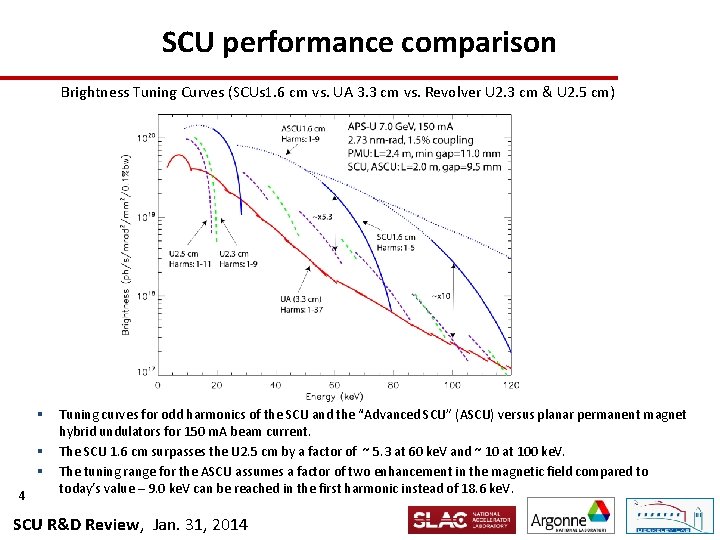
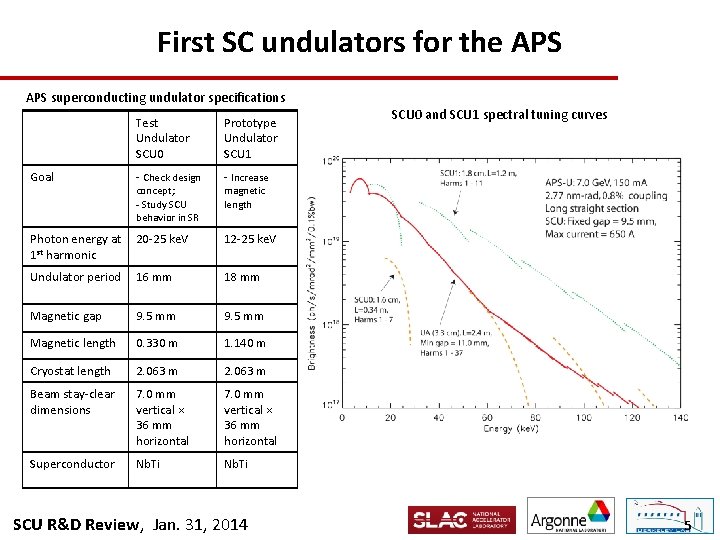
SCU performance comparison Brightness Tuning Curves (SCUs 1. 6 cm vs. UA 3. 3 cm vs. Revolver U 2. 3 cm & U 2. 5 cm) § § § 4 Tuning curves for odd harmonics of the SCU and the “Advanced SCU” (ASCU) versus planar permanent magnet hybrid undulators for 150 m. A beam current. The SCU 1. 6 cm surpasses the U 2. 5 cm by a factor of ~ 5. 3 at 60 ke. V and ~ 10 at 100 ke. V. The tuning range for the ASCU assumes a factor of two enhancement in the magnetic field compared to today’s value – 9. 0 ke. V can be reached in the first harmonic instead of 18. 6 ke. V. SCU R&D Review, Jan. 31, 2014
First SC undulators for the APS superconducting undulator specifications Goal Test Undulator SCU 0 Prototype Undulator SCU 1 - Check design - Increase concept; - Study SCU behavior in SR SCU 0 and SCU 1 spectral tuning curves magnetic length Photon energy at 20 -25 ke. V 1 st harmonic 12 -25 ke. V Undulator period 16 mm 18 mm Magnetic gap 9. 5 mm Magnetic length 0. 330 m 1. 140 m Cryostat length 2. 063 m Beam stay-clear dimensions 7. 0 mm vertical × 36 mm horizontal Superconductor Nb. Ti SCU R&D Review, Jan. 31, 2014 5
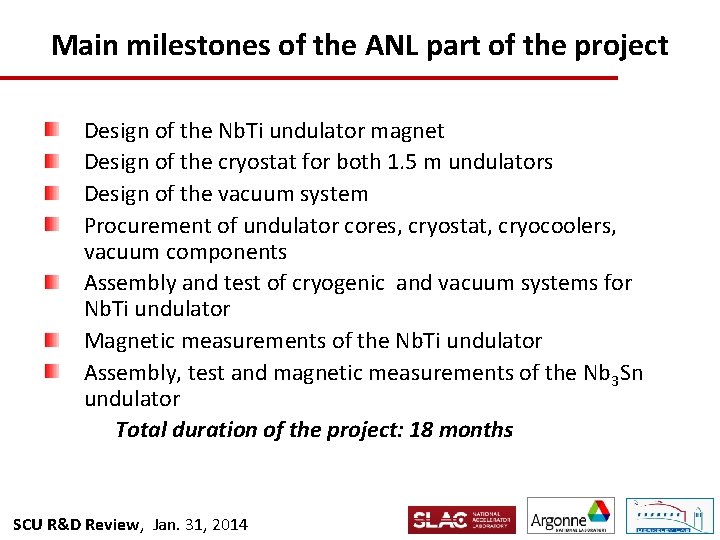
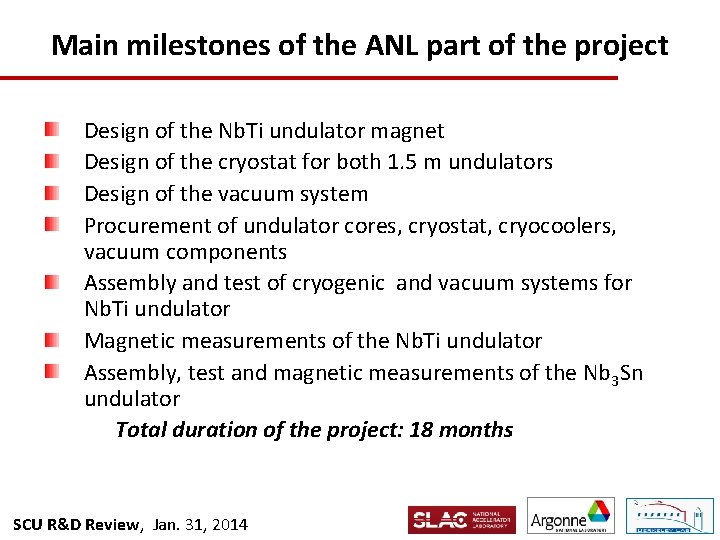
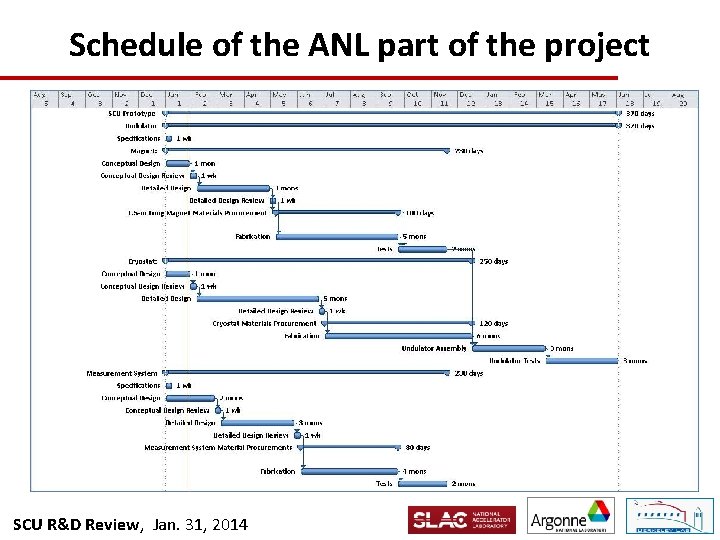
Main milestones of the ANL part of the project Design of the Nb. Ti undulator magnet Design of the cryostat for both 1. 5 m undulators Design of the vacuum system Procurement of undulator cores, cryostat, cryocoolers, vacuum components Assembly and test of cryogenic and vacuum systems for Nb. Ti undulator Magnetic measurements of the Nb. Ti undulator Assembly, test and magnetic measurements of the Nb 3 Sn undulator Total duration of the project: 18 months SCU R&D Review, Jan. 31, 2014
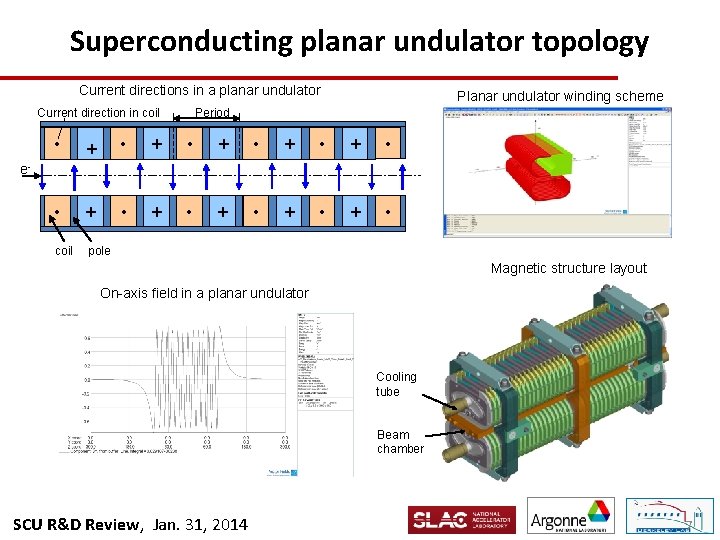
Superconducting planar undulator topology Current directions in a planar undulator Current direction in coil Planar undulator winding scheme Period • + • + • + • coil pole e- Magnetic structure layout On-axis field in a planar undulator Cooling tube Beam chamber SCU R&D Review, Jan. 31, 2014 7
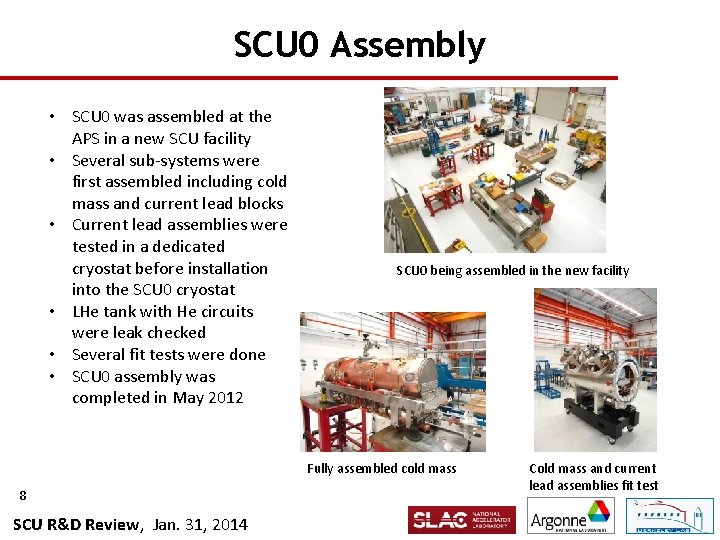
SCU 0 Assembly • SCU 0 was assembled at the APS in a new SCU facility • Several sub-systems were first assembled including cold mass and current lead blocks • Current lead assemblies were tested in a dedicated cryostat before installation into the SCU 0 cryostat • LHe tank with He circuits were leak checked • Several fit tests were done • SCU 0 assembly was completed in May 2012 SCU 0 being assembled in the new facility Fully assembled cold mass 8 SCU R&D Review, Jan. 31, 2014 Cold mass and current lead assemblies fit test
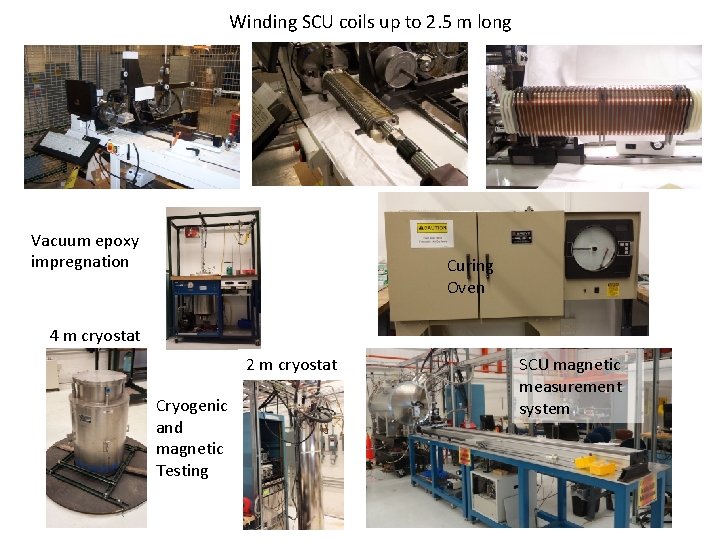
Winding SCU coils up to 2. 5 m long Vacuum epoxy impregnation Curing Oven 4 m cryostat 2 m cryostat Cryogenic and magnetic Testing SCU magnetic measurement system
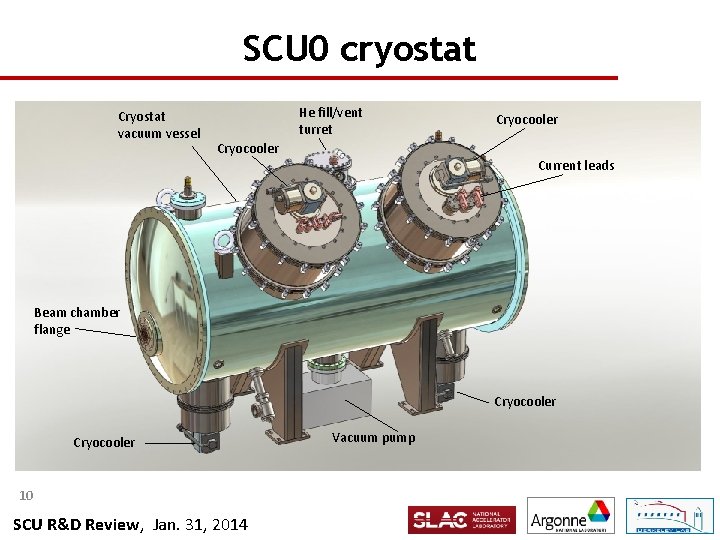
SCU 0 cryostat Cryostat vacuum vessel He fill/vent turret Cryocooler Current leads Beam chamber flange Cryocooler 10 SCU R&D Review, Jan. 31, 2014 Vacuum pump
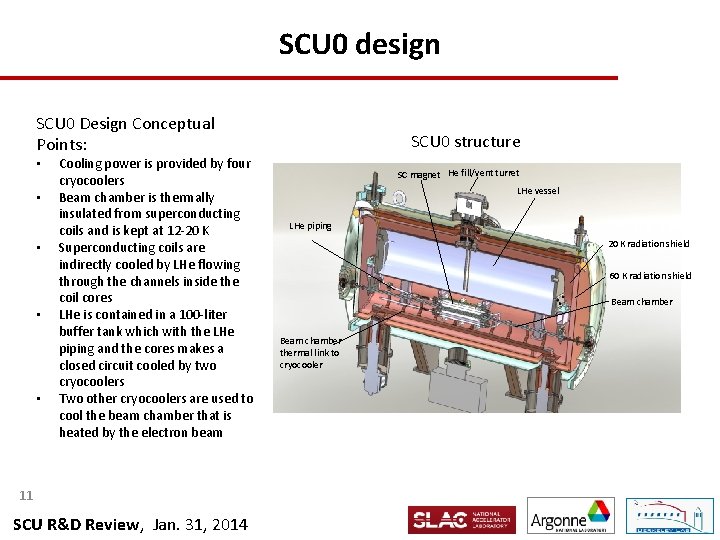
SCU 0 design SCU 0 Design Conceptual Points: • • • Cooling power is provided by four cryocoolers Beam chamber is thermally insulated from superconducting coils and is kept at 12 -20 K Superconducting coils are indirectly cooled by LHe flowing through the channels inside the coil cores LHe is contained in a 100 -liter buffer tank which with the LHe piping and the cores makes a closed circuit cooled by two cryocoolers Two other cryocoolers are used to cool the beam chamber that is heated by the electron beam 11 SCU R&D Review, Jan. 31, 2014 SCU 0 structure SC magnet He fill/vent turret LHe vessel LHe piping 20 K radiation shield 60 K radiation shield Beam chamber thermal link to cryocooler
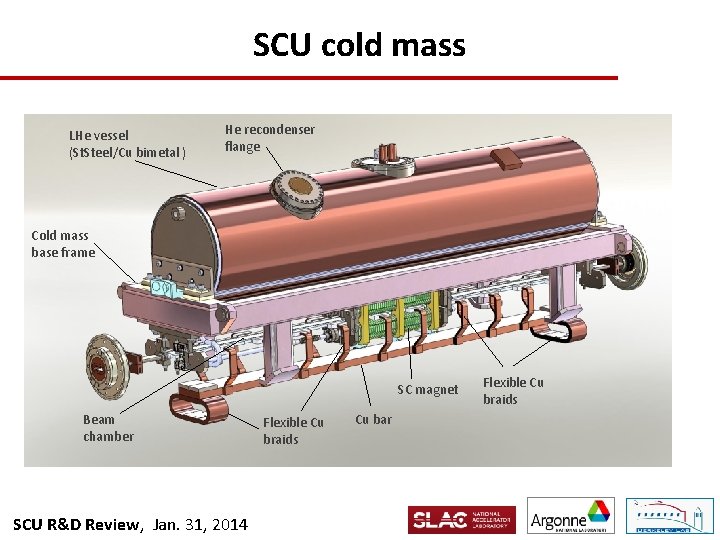
SCU cold mass LHe vessel (St. Steel/Cu bimetal ) He recondenser flange Cold mass base frame SC magnet Beam chamber SCU R&D Review, Jan. 31, 2014 Flexible Cu braids Cu bar Flexible Cu braids
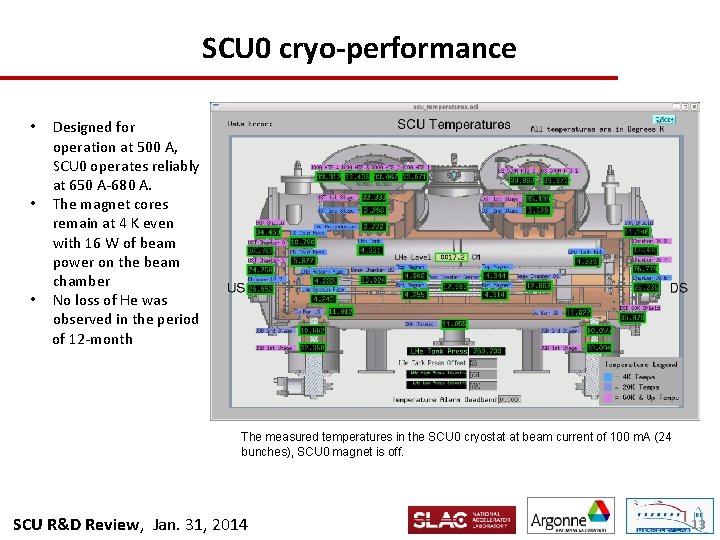
SCU 0 cryo-performance Designed for operation at 500 A, SCU 0 operates reliably at 650 A-680 A. • The magnet cores remain at 4 K even with 16 W of beam power on the beam chamber • No loss of He was observed in the period of 12 -month • The measured temperatures in the SCU 0 cryostat at beam current of 100 m. A (24 bunches), SCU 0 magnet is off. SCU R&D Review, Jan. 31, 2014 13
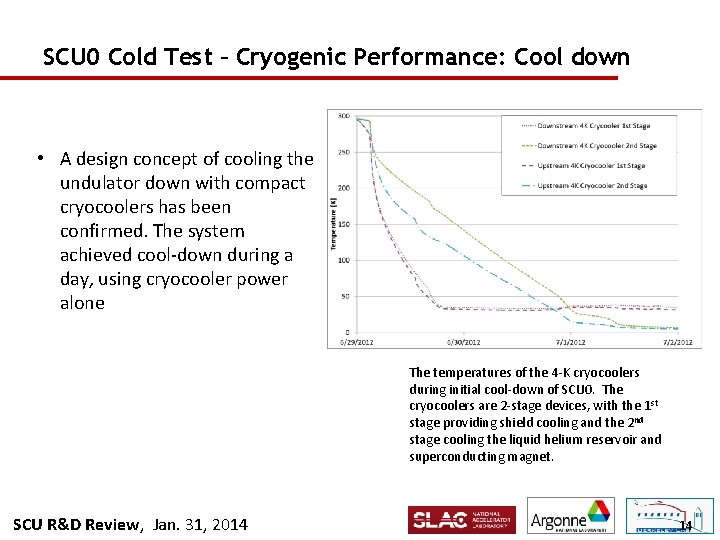
SCU 0 Cold Test – Cryogenic Performance: Cool down • A design concept of cooling the undulator down with compact cryocoolers has been confirmed. The system achieved cool-down during a day, using cryocooler power alone The temperatures of the 4 -K cryocoolers during initial cool-down of SCU 0. The cryocoolers are 2 -stage devices, with the 1 st stage providing shield cooling and the 2 nd stage cooling the liquid helium reservoir and superconducting magnet. SCU R&D Review, Jan. 31, 2014 14
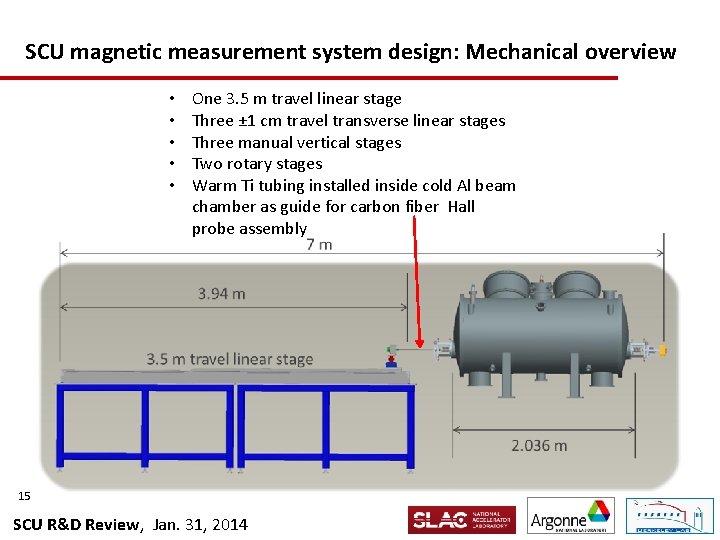
SCU magnetic measurement system design: Mechanical overview • • • One 3. 5 m travel linear stage Three ± 1 cm travel transverse linear stages Three manual vertical stages Two rotary stages Warm Ti tubing installed inside cold Al beam chamber as guide for carbon fiber Hall probe assembly 15 SCU R&D Review, Jan. 31, 2014
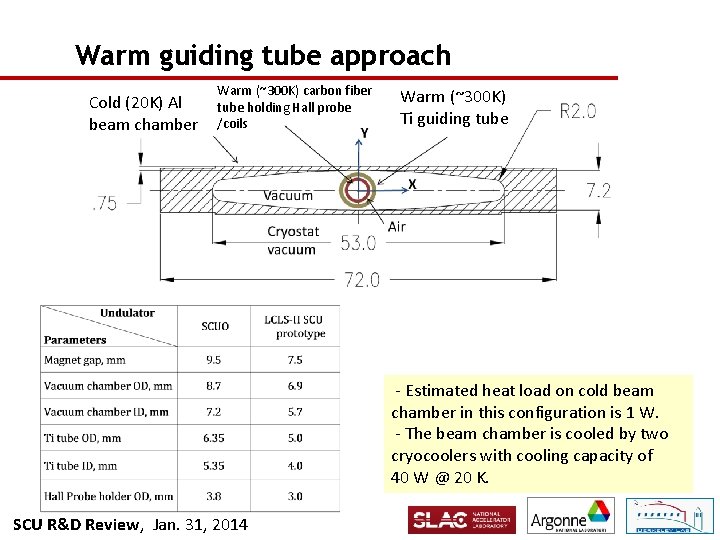
Warm guiding tube approach Cold (20 K) Al beam chamber Warm (~300 K) carbon fiber tube holding Hall probe /coils Warm (~300 K) Ti guiding tube - Estimated heat load on cold beam chamber in this configuration is 1 W. - The beam chamber is cooled by two cryocoolers with cooling capacity of 40 W @ 20 K. SCU R&D Review, Jan. 31, 2014
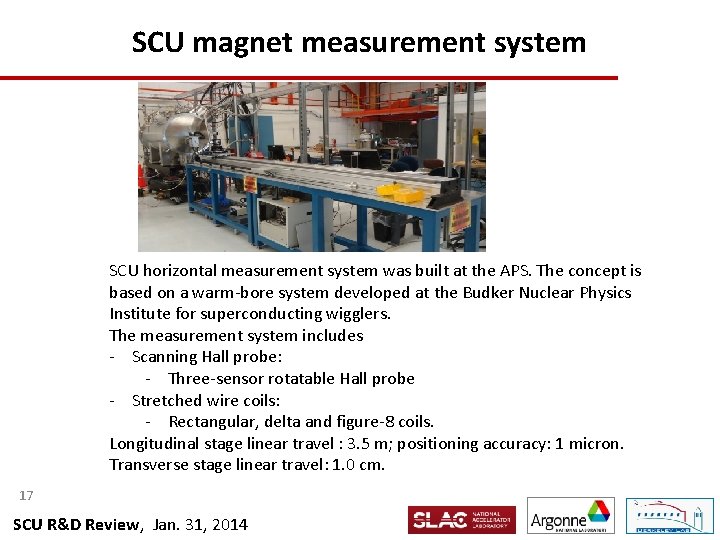
SCU magnet measurement system SCU horizontal measurement system was built at the APS. The concept is based on a warm-bore system developed at the Budker Nuclear Physics Institute for superconducting wigglers. The measurement system includes - Scanning Hall probe: - Three-sensor rotatable Hall probe - Stretched wire coils: - Rectangular, delta and figure-8 coils. Longitudinal stage linear travel : 3. 5 m; positioning accuracy: 1 micron. Transverse stage linear travel: 1. 0 cm. 17 SCU R&D Review, Jan. 31, 2014
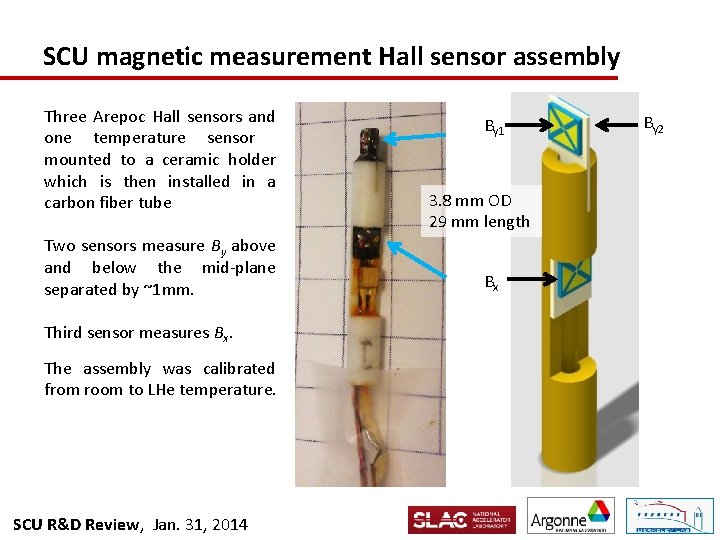
SCU magnetic measurement Hall sensor assembly Three Arepoc Hall sensors and one temperature sensor mounted to a ceramic holder which is then installed in a carbon fiber tube Two sensors measure By above and below the mid-plane separated by ~1 mm. Third sensor measures Bx. The assembly was calibrated from room to LHe temperature. SCU R&D Review, Jan. 31, 2014 By 1 3. 8 mm OD 29 mm length Bx By 2
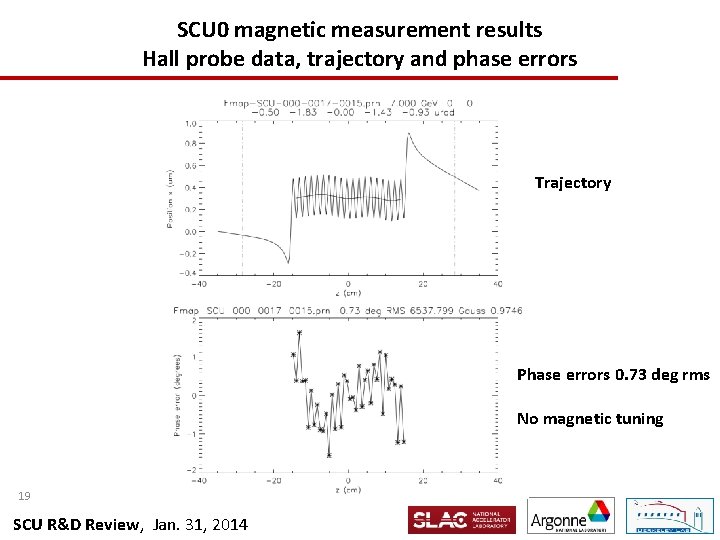
SCU 0 magnetic measurement results Hall probe data, trajectory and phase errors Trajectory Phase errors 0. 73 deg rms No magnetic tuning 19 SCU R&D Review, Jan. 31, 2014
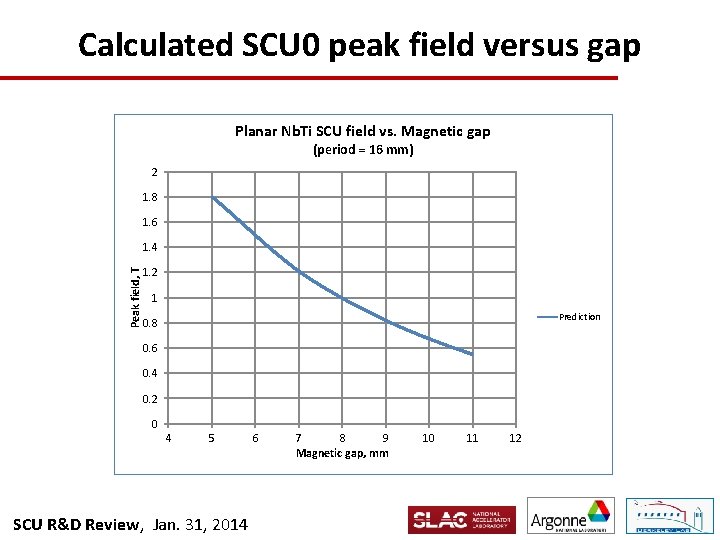
Calculated SCU 0 peak field versus gap Planar Nb. Ti SCU field vs. Magnetic gap (period = 16 mm) 2 1. 8 1. 6 Peak field, T 1. 4 1. 2 1 Prediction 0. 8 0. 6 0. 4 0. 2 0 4 5 SCU R&D Review, Jan. 31, 2014 6 7 8 9 Magnetic gap, mm 10 11 12
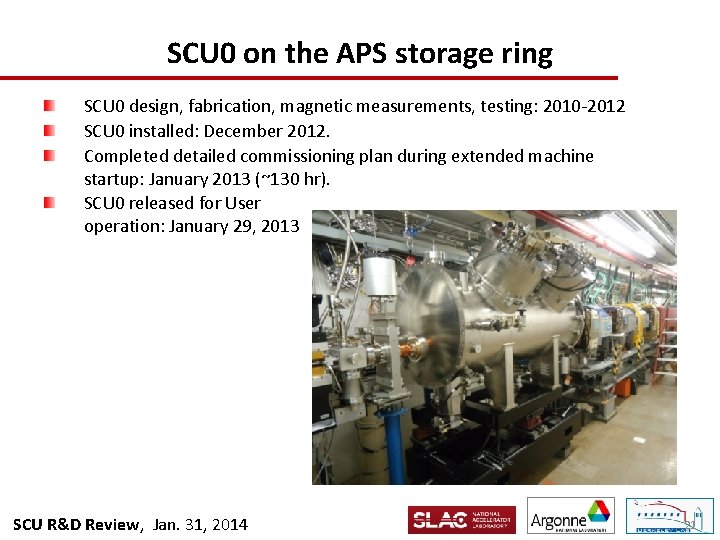
SCU 0 on the APS storage ring SCU 0 design, fabrication, magnetic measurements, testing: 2010 -2012 SCU 0 installed: December 2012. Completed detailed commissioning plan during extended machine startup: January 2013 (~130 hr). SCU 0 released for User operation: January 29, 2013 SCU R&D Review, Jan. 31, 2014 21
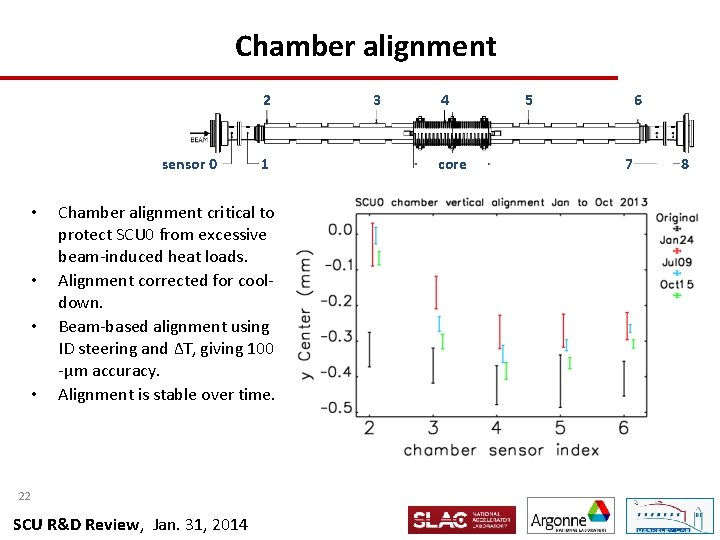
Chamber alignment 2 sensor 0 • • 1 Chamber alignment critical to protect SCU 0 from excessive beam-induced heat loads. Alignment corrected for cooldown. Beam-based alignment using ID steering and ΔT, giving 100 -μm accuracy. Alignment is stable over time. 22 SCU R&D Review, Jan. 31, 2014 3 4 core 5 6 7 8
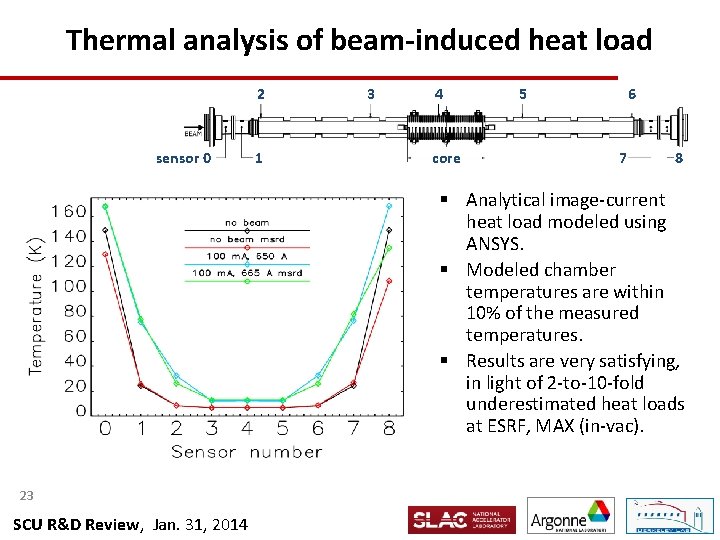
Thermal analysis of beam-induced heat load 2 sensor 0 1 3 4 core 5 6 7 8 § Analytical image-current heat load modeled using ANSYS. § Modeled chamber temperatures are within 10% of the measured temperatures. § Results are very satisfying, in light of 2 -to-10 -fold underestimated heat loads at ESRF, MAX (in-vac). 23 SCU R&D Review, Jan. 31, 2014
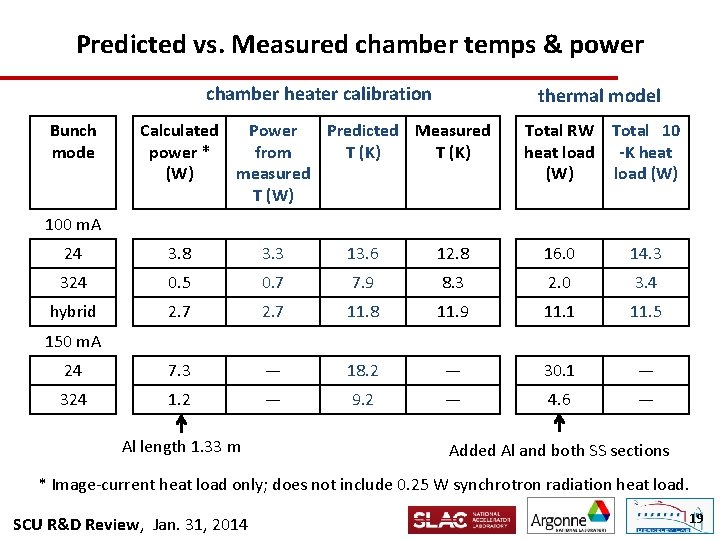
Predicted vs. Measured chamber temps & power Bunch mode chamber heater calibration thermal model Calculated Power Predicted Measured power * from T (K) (W) measured T (W) Total RW Total 10 heat load -K heat (W) load (W) 100 m. A 24 3. 8 3. 3 13. 6 12. 8 16. 0 14. 3 324 0. 5 0. 7 7. 9 8. 3 2. 0 3. 4 hybrid 2. 7 11. 8 11. 9 11. 1 11. 5 24 7. 3 ― 18. 2 ― 30. 1 ― 324 1. 2 ― 9. 2 ― 4. 6 ― 150 m. A Al length 1. 33 m Added Al and both SS sections * Image-current heat load only; does not include 0. 25 W synchrotron radiation heat load. SCU R&D Review, Jan. 31, 2014 19
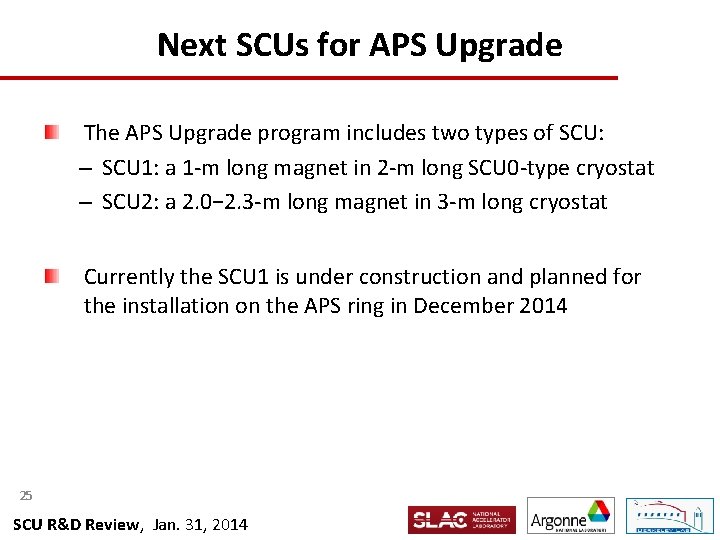
Next SCUs for APS Upgrade The APS Upgrade program includes two types of SCU: – SCU 1: a 1 -m long magnet in 2 -m long SCU 0 -type cryostat – SCU 2: a 2. 0− 2. 3 -m long magnet in 3 -m long cryostat Currently the SCU 1 is under construction and planned for the installation on the APS ring in December 2014 25 SCU R&D Review, Jan. 31, 2014
Main milestones of the ANL part of the project Design of the Nb. Ti undulator magnet Design of the cryostat for both 1. 5 m undulators Design of the vacuum system Procurement of undulator cores, cryostat, cryocoolers, vacuum components Assembly and test of cryogenic and vacuum systems for Nb. Ti undulator Magnetic measurements of the Nb. Ti undulator Assembly, test and magnetic measurements of the Nb 3 Sn undulator Total duration of the project: 18 months SCU R&D Review, Jan. 31, 2014
Schedule of the ANL part of the project SCU R&D Review, Jan. 31, 2014
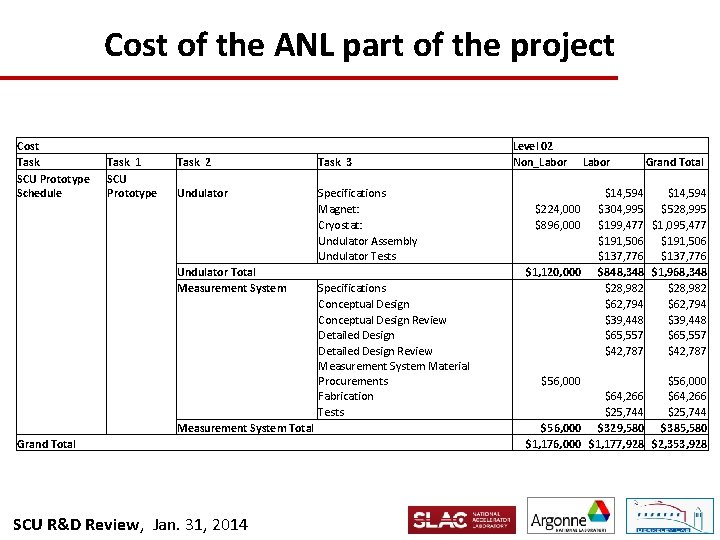
Cost of the ANL part of the project Cost Task SCU Prototype Schedule Task 1 SCU Prototype Task 2 Task 3 Level 02 Non_Labor Undulator Total Measurement System Grand Total Specifications Magnet: Cryostat: Undulator Assembly Undulator Tests Specifications Conceptual Design Review Detailed Design Review Measurement System Material Procurements Fabrication Tests Measurement System Total SCU R&D Review, Jan. 31, 2014 $224, 000 $896, 000 $1, 120, 000 Labor $14, 594 $304, 995 $528, 995 $199, 477 $1, 095, 477 $191, 506 $137, 776 $848, 348 $1, 968, 348 $28, 982 $62, 794 $39, 448 $65, 557 $42, 787 $56, 000 Grand Total $64, 266 $25, 744 $56, 000 $329, 580 $1, 176, 000 $1, 177, 928 $56, 000 $64, 266 $25, 744 $385, 580 $2, 353, 928
Summary APS has developed, implemented and extensively tested robust cryogenic design for a planar SCU. The design employs closed loop LHe system. APS has developed and implemented magnetic measurement system that permits to characterize SCUs with the state-of-the-art accuracy and reproducibility. APS has successfully integrated SCU magnet, vacuum system and cryostat in the APS storage ring. SCUO has demonstrated superb operational record through one year of user operations Developed SCU technology is ready to be applied for the future generation of radiation sources 29 SCU R&D Review, Jan. 31, 2014
Back up slides SCU R&D Review, Jan. 31, 2014
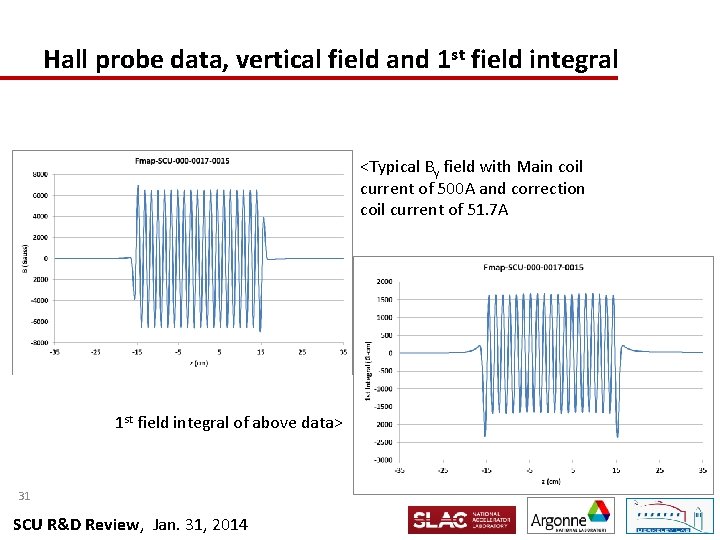
Hall probe data, vertical field and 1 st field integral <Typical By field with Main coil current of 500 A and correction coil current of 51. 7 A 1 st field integral of above data> 31 SCU R&D Review, Jan. 31, 2014
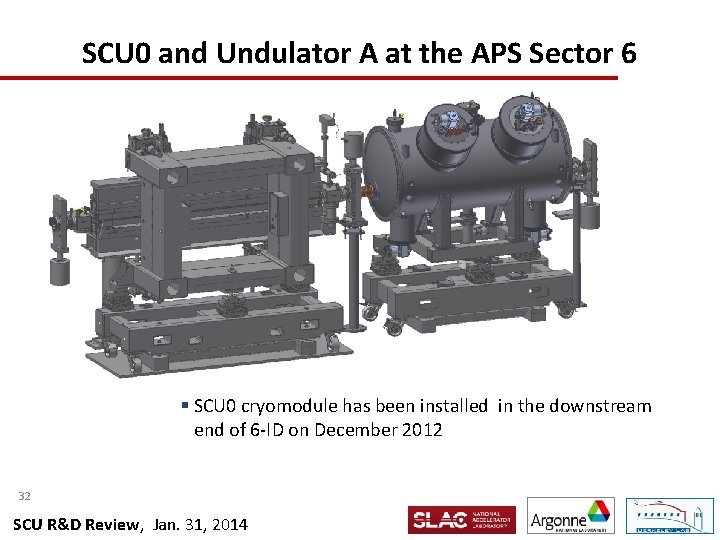
SCU 0 and Undulator A at the APS Sector 6 § SCU 0 cryomodule has been installed in the downstream end of 6 -ID on December 2012 32 SCU R&D Review, Jan. 31, 2014
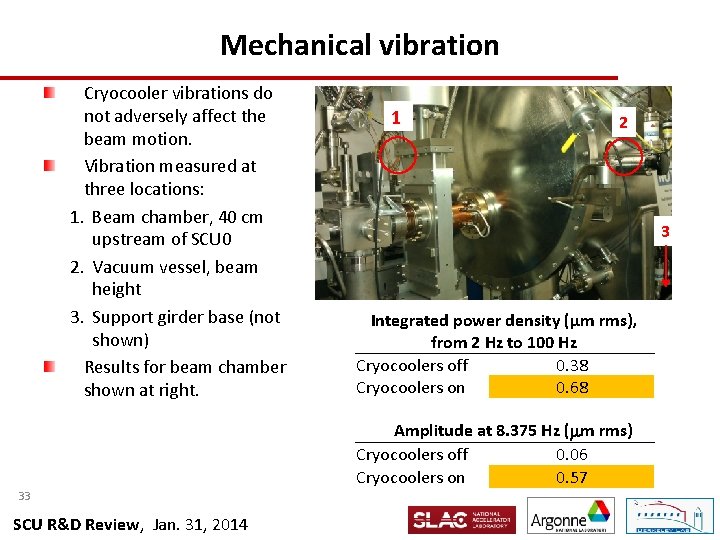
Mechanical vibration Cryocooler vibrations do not adversely affect the beam motion. Vibration measured at three locations: 1. Beam chamber, 40 cm upstream of SCU 0 2. Vacuum vessel, beam height 3. Support girder base (not shown) Results for beam chamber shown at right. 1 2 3 Integrated power density (μm rms), from 2 Hz to 100 Hz Cryocoolers off 0. 38 Cryocoolers on 0. 68 Amplitude at 8. 375 Hz (mm rms) Cryocoolers off 0. 06 Cryocoolers on 0. 57 33 SCU R&D Review, Jan. 31, 2014
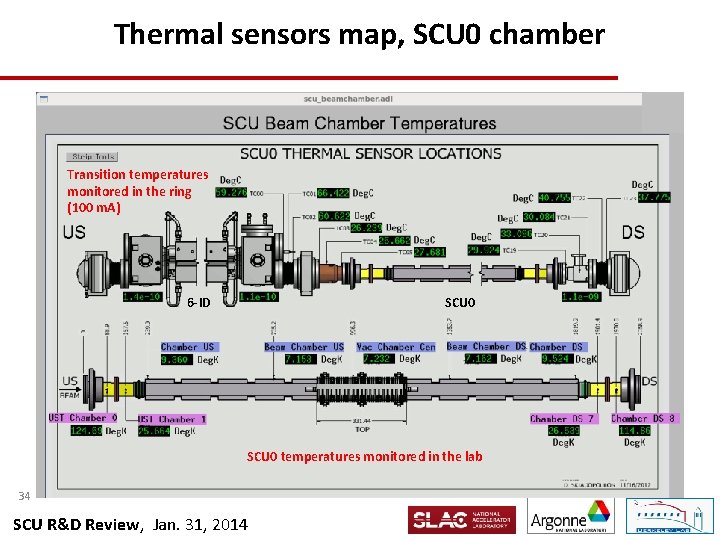
Thermal sensors map, SCU 0 chamber Transition temperatures monitored in the ring (100 m. A) 6 -ID SCU 0 temperatures monitored in the lab 34 SCU R&D Review, Jan. 31, 2014
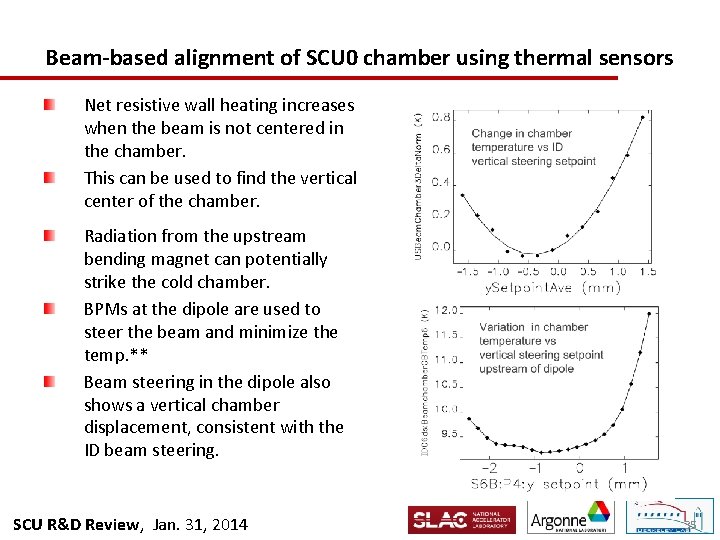
Beam-based alignment of SCU 0 chamber using thermal sensors Net resistive wall heating increases when the beam is not centered in the chamber. This can be used to find the vertical center of the chamber. Radiation from the upstream bending magnet can potentially strike the cold chamber. BPMs at the dipole are used to steer the beam and minimize the temp. ** Beam steering in the dipole also shows a vertical chamber displacement, consistent with the ID beam steering. SCU R&D Review, Jan. 31, 2014 35
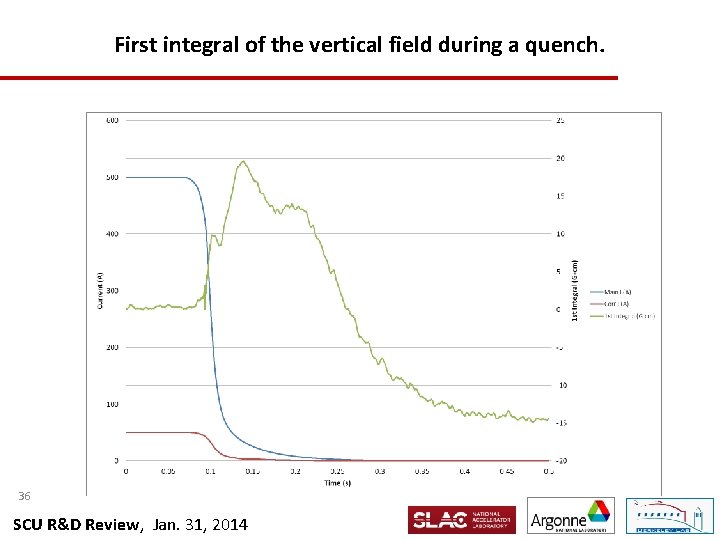
First integral of the vertical field during a quench. 36 SCU R&D Review, Jan. 31, 2014
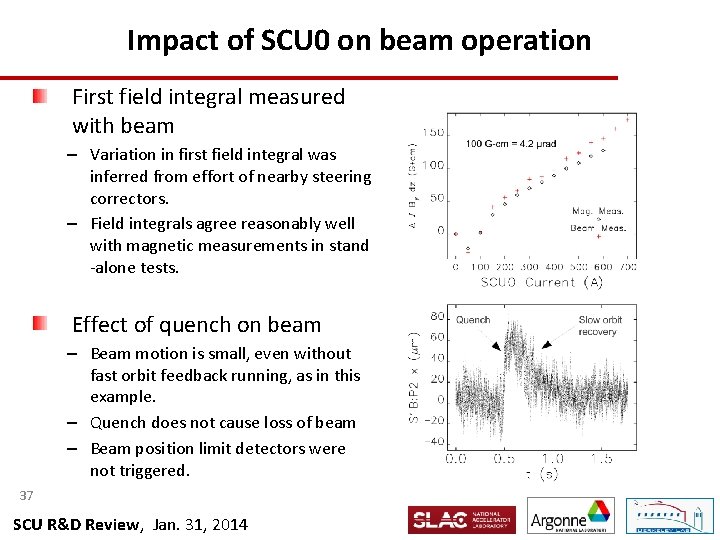
Impact of SCU 0 on beam operation First field integral measured with beam – Variation in first field integral was inferred from effort of nearby steering correctors. – Field integrals agree reasonably well with magnetic measurements in stand -alone tests. Effect of quench on beam – Beam motion is small, even without fast orbit feedback running, as in this example. – Quench does not cause loss of beam – Beam position limit detectors were not triggered. 37 SCU R&D Review, Jan. 31, 2014
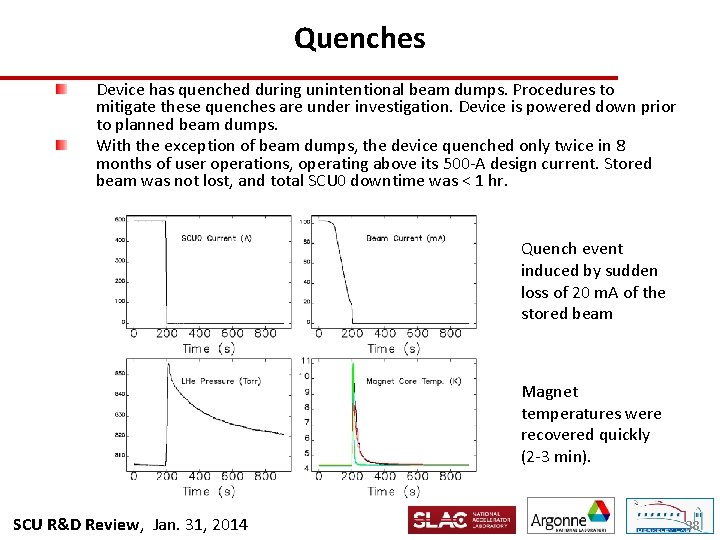
Quenches Device has quenched during unintentional beam dumps. Procedures to mitigate these quenches are under investigation. Device is powered down prior to planned beam dumps. With the exception of beam dumps, the device quenched only twice in 8 months of user operations, operating above its 500 -A design current. Stored beam was not lost, and total SCU 0 downtime was < 1 hr. Quench event induced by sudden loss of 20 m. A of the stored beam Magnet temperatures were recovered quickly (2 -3 min). SCU R&D Review, Jan. 31, 2014 38
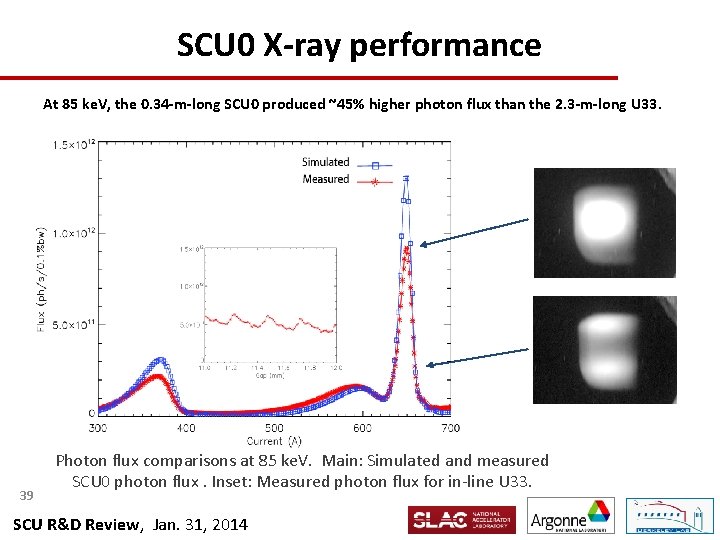
SCU 0 X-ray performance At 85 ke. V, the 0. 34 -m-long SCU 0 produced ~45% higher photon flux than the 2. 3 -m-long U 33. 39 Photon flux comparisons at 85 ke. V. Main: Simulated and measured SCU 0 photon flux. Inset: Measured photon flux for in-line U 33. SCU R&D Review, Jan. 31, 2014