
Superconducting RF Cavities for Particle Accelerators An Introduction
![RF Superconductivity Hc(T)=Hc(0)·[1 -(T/Tc)2] • Superconducting electrons are paired in a coherent quantum state,](https://slidetodoc.com/presentation_image_h2/6589e182ab5d72885260a6aac31b0eec/image-6.jpg "RF Superconductivity Hc(T)=Hc(0)·[1 -(T/Tc)2] • Superconducting electrons are paired in a coherent quantum state,")
- Slides: 23
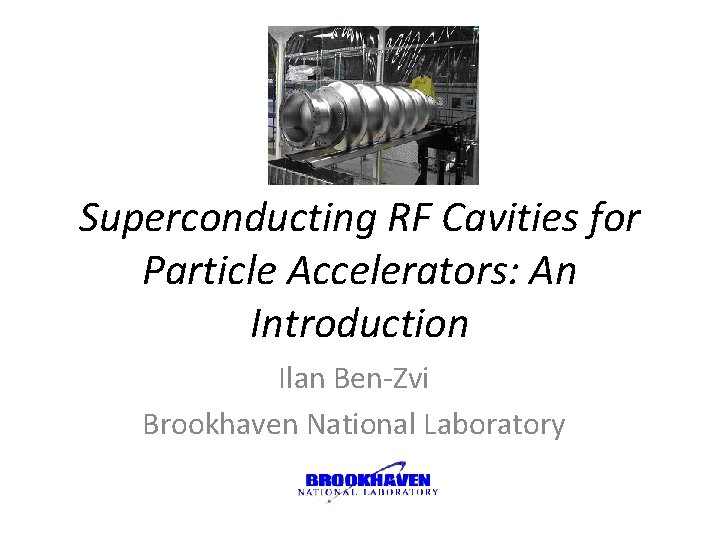
Superconducting RF Cavities for Particle Accelerators: An Introduction Ilan Ben-Zvi Brookhaven National Laboratory
In a word: • Superconducting RF (SRF) provides efficient, high-gradient accelerators at high duty-factor. • SRF accelerator cavities are a success story. • Large variety of SRF cavities, depending on: – Type of accelerator – Particle velocity – Current and Duty factor – Gradient – Acceleration or deflecting mode
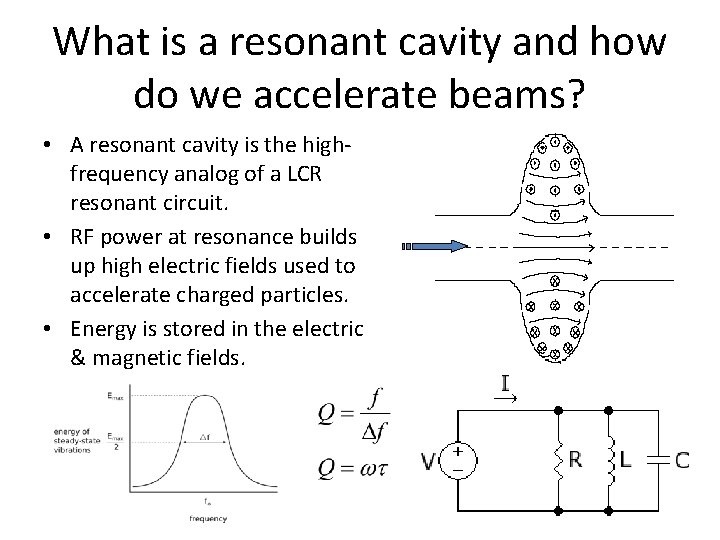
What is a resonant cavity and how do we accelerate beams? • A resonant cavity is the highfrequency analog of a LCR resonant circuit. • RF power at resonance builds up high electric fields used to accelerate charged particles. • Energy is stored in the electric & magnetic fields.
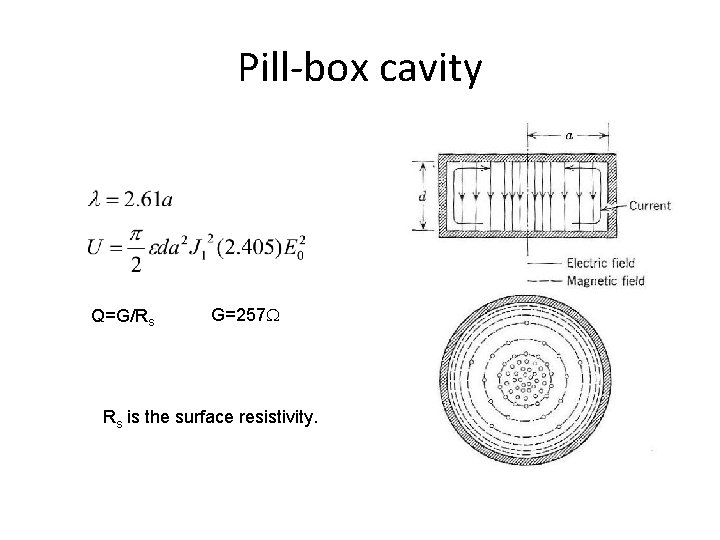
Pill-box cavity Q=G/Rs G=257 Rs is the surface resistivity.
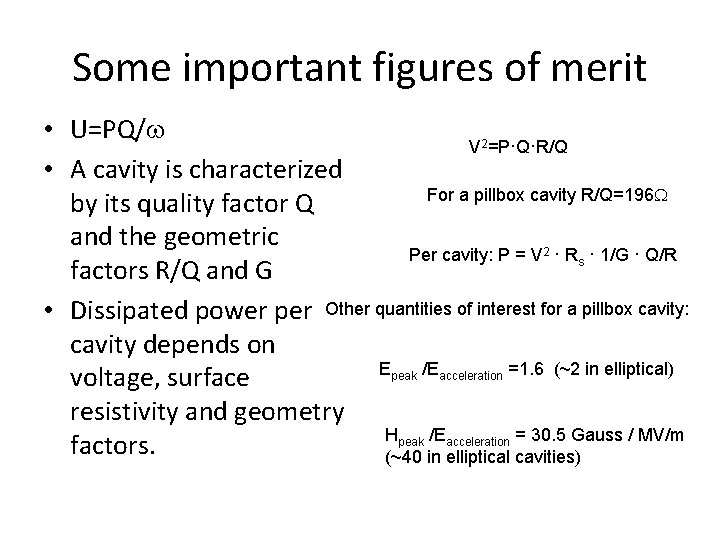
Some important figures of merit • U=PQ/ V 2=P·Q·R/Q • A cavity is characterized For a pillbox cavity R/Q=196 by its quality factor Q and the geometric Per cavity: P = V 2 · Rs · 1/G · Q/R factors R/Q and G • Dissipated power per Other quantities of interest for a pillbox cavity: cavity depends on Epeak /Eacceleration =1. 6 (~2 in elliptical) voltage, surface resistivity and geometry Hpeak /Eacceleration = 30. 5 Gauss / MV/m factors. (~40 in elliptical cavities)
RF Superconductivity Hc(T)=Hc(0)·[1 -(T/Tc)2] • Superconducting electrons are paired in a coherent quantum state, for DC resistivity disappears bellow the critical field. For copper • In RF, there is the BCS = 5. 8· 107 -1 m-1 so at resistivity, arising from 1. 5 GHz, Rs = 10 m the unpaired electrons. For superconducting niobium Rs = RBCS + Rresidul and at 1. 8 K, 1. 5 GHz, RBCS = 6 n Rresidual ~ 1 to 10 n
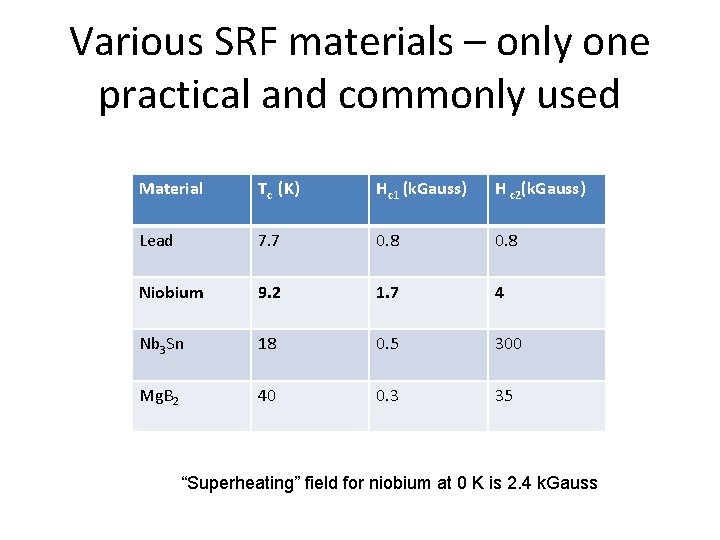
Various SRF materials – only one practical and commonly used Material Tc (K) Hc 1 (k. Gauss) H c 2(k. Gauss) Lead 7. 7 0. 8 Niobium 9. 2 1. 7 4 Nb 3 Sn 18 0. 5 300 Mg. B 2 40 0. 3 35 “Superheating” field for niobium at 0 K is 2. 4 k. Gauss
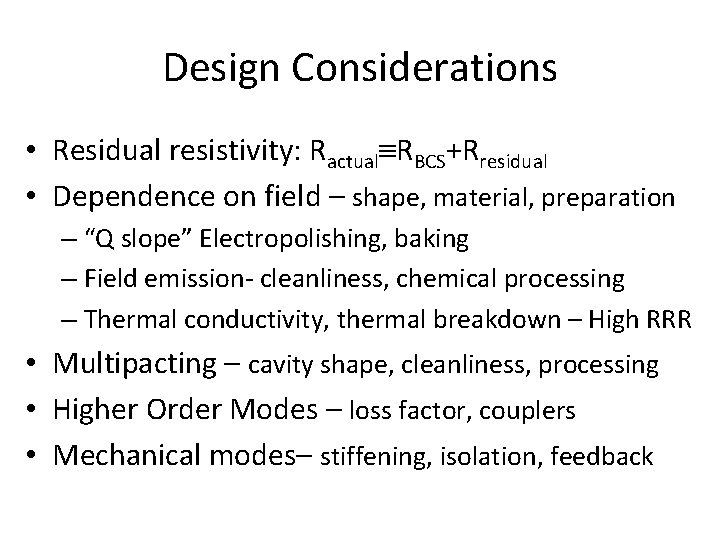
Design Considerations • Residual resistivity: Ractual RBCS+Rresidual • Dependence on field – shape, material, preparation – “Q slope” Electropolishing, baking – Field emission- cleanliness, chemical processing – Thermal conductivity, thermal breakdown – High RRR • Multipacting – cavity shape, cleanliness, processing • Higher Order Modes – loss factor, couplers • Mechanical modes– stiffening, isolation, feedback
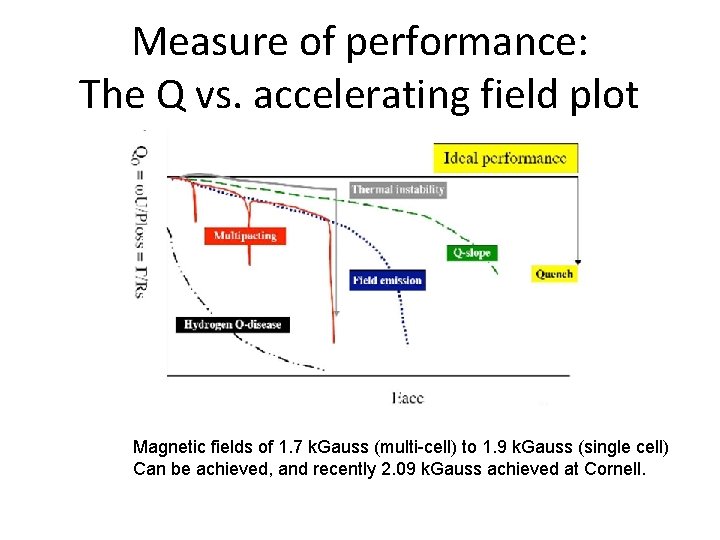
Measure of performance: The Q vs. accelerating field plot Magnetic fields of 1. 7 k. Gauss (multi-cell) to 1. 9 k. Gauss (single cell) Can be achieved, and recently 2. 09 k. Gauss achieved at Cornell.
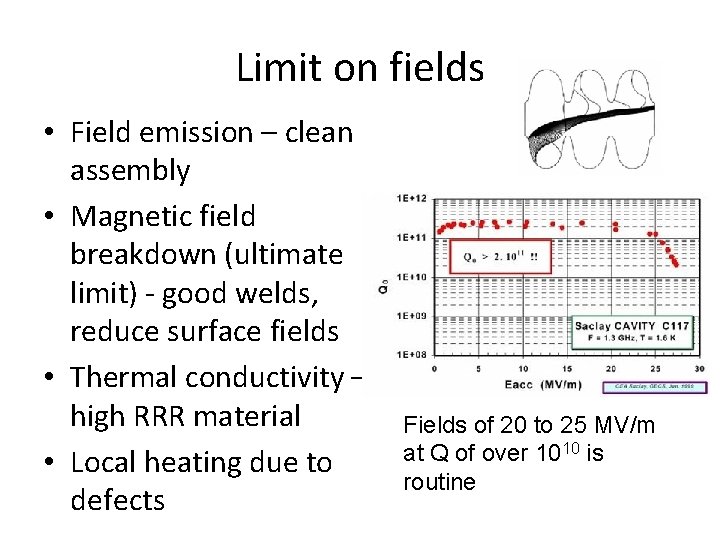
Limit on fields • Field emission – clean assembly • Magnetic field breakdown (ultimate limit) - good welds, reduce surface fields • Thermal conductivity – high RRR material • Local heating due to defects Fields of 20 to 25 MV/m at Q of over 1010 is routine
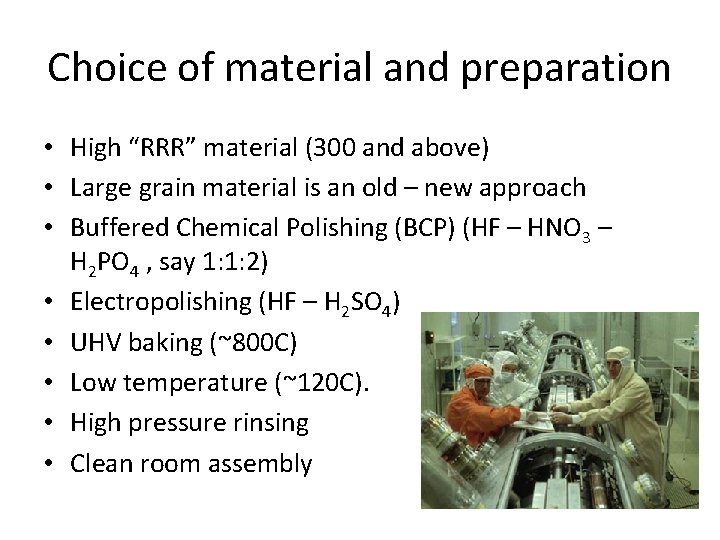
Choice of material and preparation • High “RRR” material (300 and above) • Large grain material is an old – new approach • Buffered Chemical Polishing (BCP) (HF – HNO 3 – H 2 PO 4 , say 1: 1: 2) • Electropolishing (HF – H 2 SO 4) • UHV baking (~800 C) • Low temperature (~120 C). • High pressure rinsing • Clean room assembly
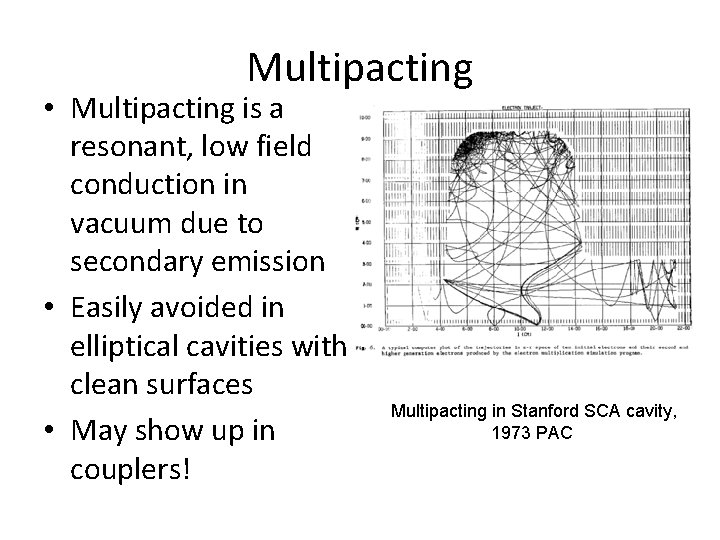
Multipacting • Multipacting is a resonant, low field conduction in vacuum due to secondary emission • Easily avoided in elliptical cavities with clean surfaces • May show up in couplers! Multipacting in Stanford SCA cavity, 1973 PAC
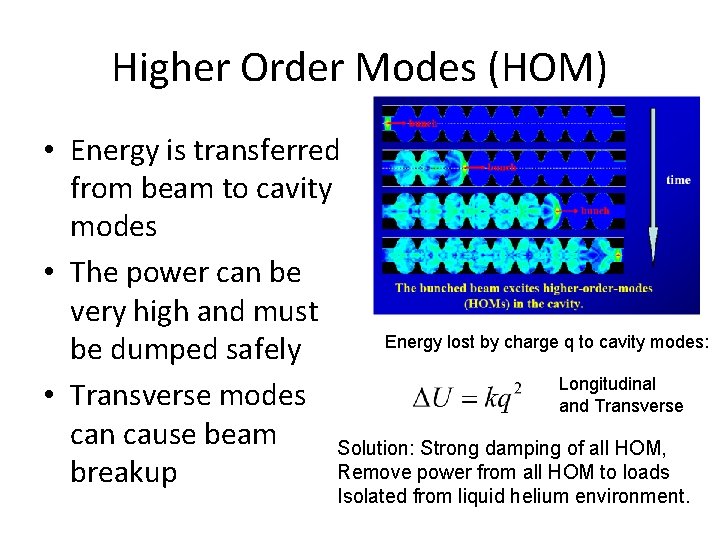
Higher Order Modes (HOM) • Energy is transferred from beam to cavity modes • The power can be very high and must Energy lost by charge q to cavity modes: be dumped safely Longitudinal • Transverse modes and Transverse can cause beam Solution: Strong damping of all HOM, Remove power from all HOM to loads breakup Isolated from liquid helium environment.
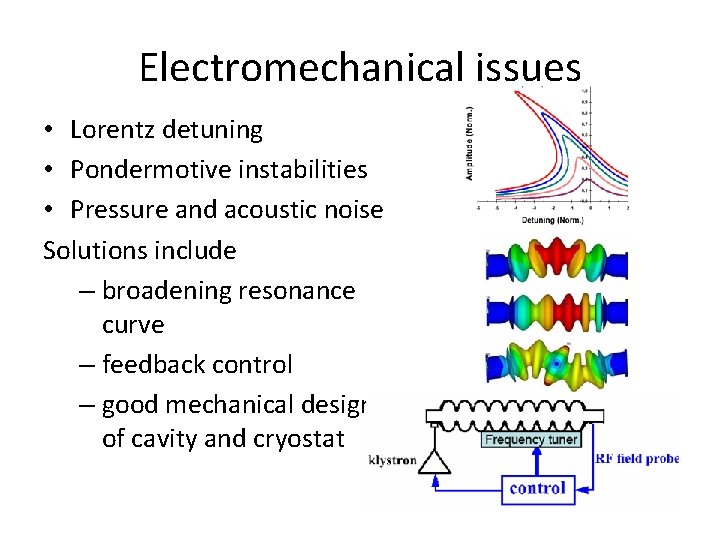
Electromechanical issues • Lorentz detuning • Pondermotive instabilities • Pressure and acoustic noise Solutions include – broadening resonance curve – feedback control – good mechanical design of cavity and cryostat
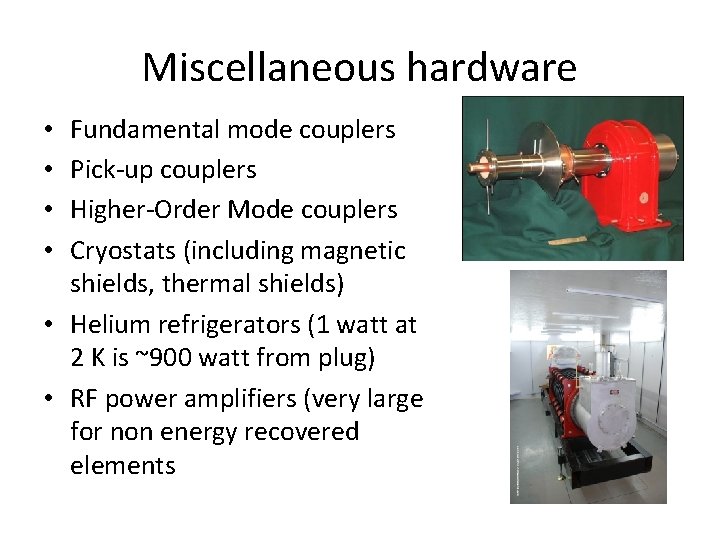
Miscellaneous hardware Fundamental mode couplers Pick-up couplers Higher-Order Mode couplers Cryostats (including magnetic shields, thermal shields) • Helium refrigerators (1 watt at 2 K is ~900 watt from plug) • RF power amplifiers (very large for non energy recovered elements • •
Some Examples • • • Low velocity High acceleration gradient Particle deflection High current / Storage rings High current / Energy Recovery Linac RF electron gun
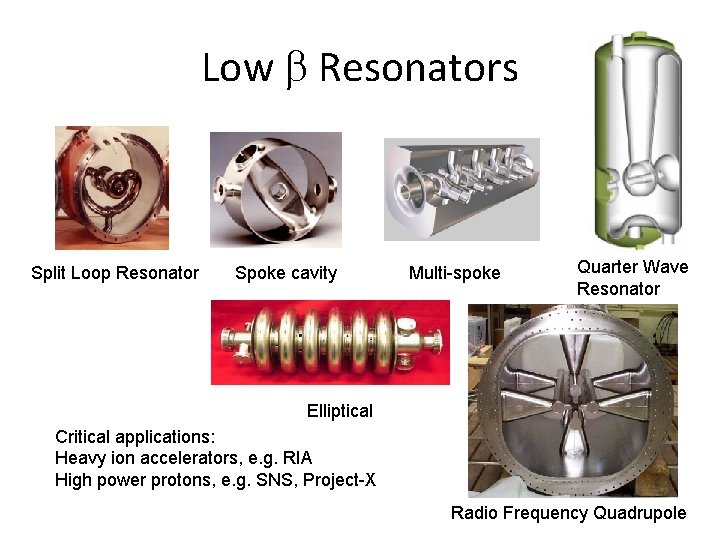
Low Resonators Split Loop Resonator Spoke cavity Multi-spoke Quarter Wave Resonator Elliptical Critical applications: Heavy ion accelerators, e. g. RIA High power protons, e. g. SNS, Project-X Radio Frequency Quadrupole
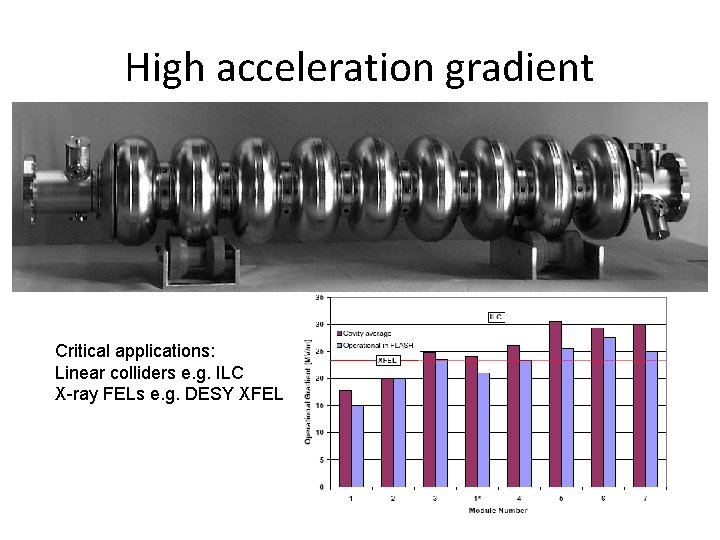
High acceleration gradient Critical applications: Linear colliders e. g. ILC X-ray FELs e. g. DESY XFEL
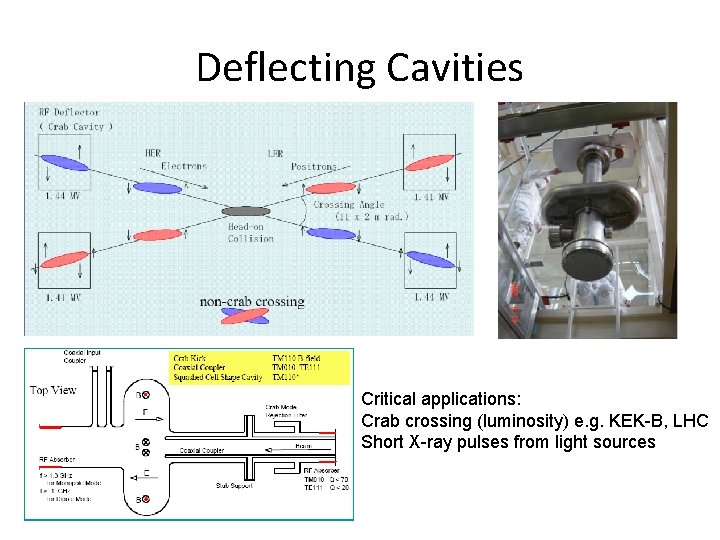
Deflecting Cavities Critical applications: Crab crossing (luminosity) e. g. KEK-B, LHC Short X-ray pulses from light sources
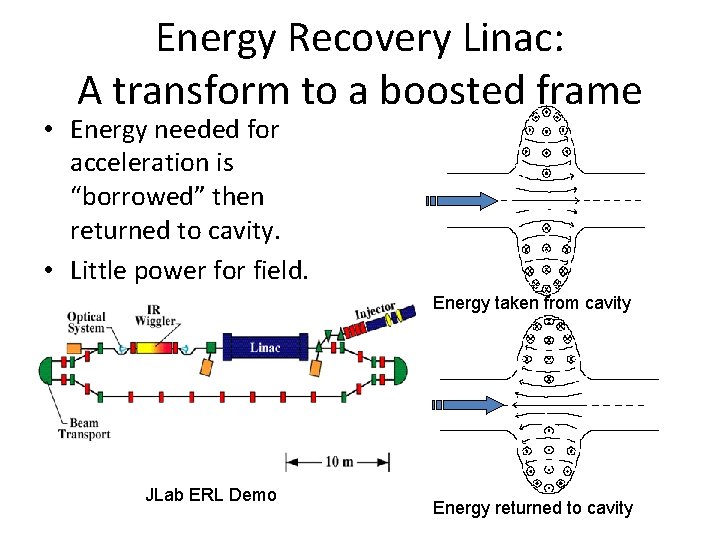
Energy Recovery Linac: A transform to a boosted frame • Energy needed for acceleration is “borrowed” then returned to cavity. • Little power for field. Energy taken from cavity JLab ERL Demo Energy returned to cavity
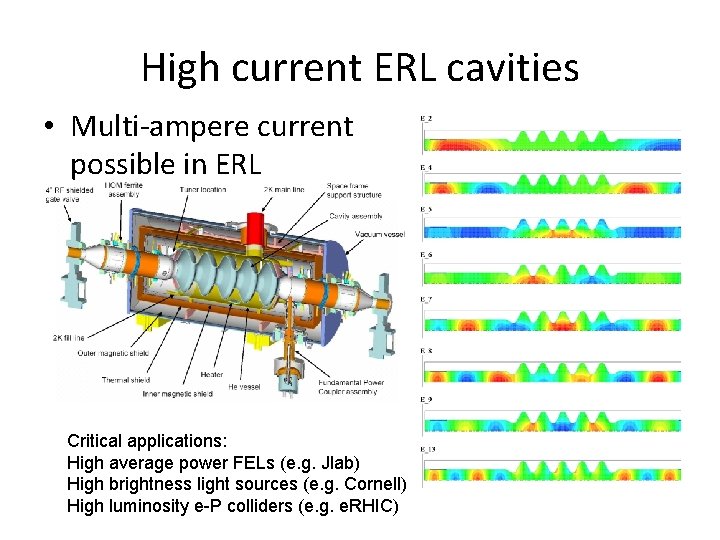
High current ERL cavities • Multi-ampere current possible in ERL Critical applications: High average power FELs (e. g. Jlab) High brightness light sources (e. g. Cornell) High luminosity e-P colliders (e. g. e. RHIC)
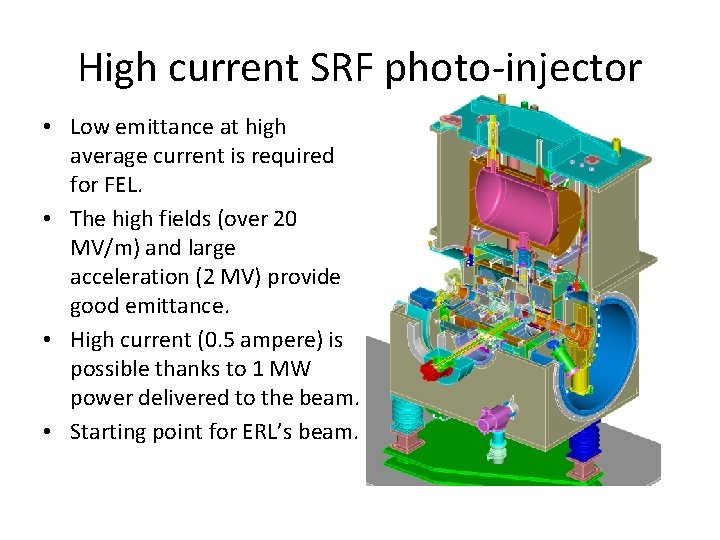
High current SRF photo-injector • Low emittance at high average current is required for FEL. • The high fields (over 20 MV/m) and large acceleration (2 MV) provide good emittance. • High current (0. 5 ampere) is possible thanks to 1 MW power delivered to the beam. • Starting point for ERL’s beam.
Summary • SRF cavities serve in a large variety of purposes with many shapes. • The future of particle accelerators is in SRF acceleration elements – light sources, colliders, linacs, ERLs and more. • While there is a lot of confidence in the technology, there is still a lot of science to be done.