
Superconducting Magnet Division High Field Hybrid Design Ramesh
Superconducting Magnet Division High Field Hybrid Design Ramesh Gupta June 15, 2015 High Field Hybrid Design -Ramesh Gupta ICFA Mini-Workshop on High Field SC Magnets for pp Colliders June 14 -17, 2015 1

Superconducting Magnet Division Overview • HTS/LTS hybrid designs for high field (>20 T) dipole • Techniques for obtaining a good field quality in hybrid dipoles built with HTS tape • HTS coil and hybrid magnet R&D at BNL • Summary High Field Hybrid Design -Ramesh Gupta ICFA Mini-Workshop on High Field SC Magnets for pp Colliders June 14 -17, 2015 2
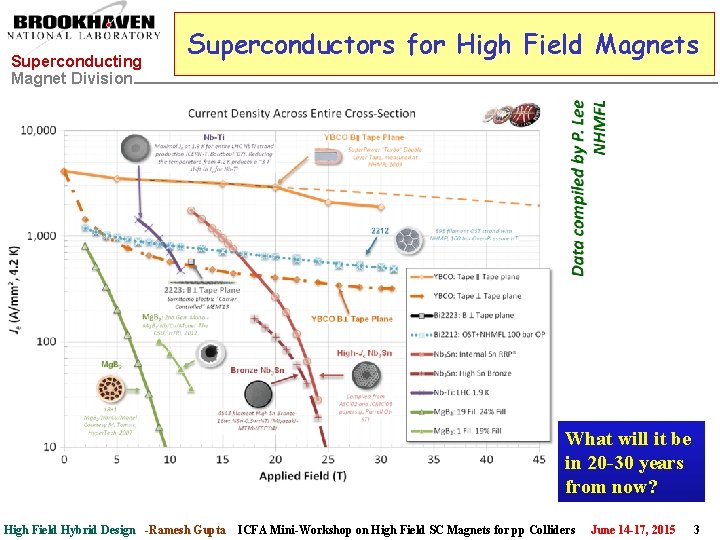
Superconducting Magnet Division Superconductors for High Field Magnets What will it be in 20 -30 years from now? High Field Hybrid Design -Ramesh Gupta ICFA Mini-Workshop on High Field SC Magnets for pp Colliders June 14 -17, 2015 3
Superconducting Magnet Division Superconductor & Magnet Technologies for 15 T and 20 T Dipole Designs • A 15 T central field means >16 T peak field on the conductor and a 20 T central field means ~22 T peak field on the conductor. • For ~15% margin, this translates to ~19 T peak field on the conductor for 15 T and ~25 T for a 20 T machine dipole. • This means “Nb 3 Sn only” option is good to 15 -16 T maximum. • For a 20 T design, use of HTS as High Field Superconductor (HFS) is necessary, at least in the high field regions. High Field Hybrid Design -Ramesh Gupta ICFA Mini-Workshop on High Field SC Magnets for pp Colliders June 14 -17, 2015 4

Superconducting Magnet Division HTS/LTS High Field (>20 T) Hybrid Dipole Hybrid Design: q HTS in high field region Ø contributing the final 4 -8 T field q LTS (Nb 3 Sn/Nb. Ti) in lower field region Ø to reduce overall magnet cost Cross-section for Bo = 21 T Common Coil / Block Dipole High Field Hybrid Design -Ramesh Gupta ICFA Mini-Workshop on High Field SC Magnets for pp Colliders June 14 -17, 2015 5
Superconducting Magnet Division HTS Conductor Options in a High Field (>20 T) Hybrid Dipole Bi 2212 § Advantages: Round wire, Rutherford cable § Challenges: Limited production & long term economic viability, Degradation in performance under large stresses Re. BCO § Advantages: Larger production from multiple vendors, § Can tolerate large stresses as in high field magnets § Challenges: Tape form could cause large magnetization, Lower current without new or complex cable Focus of this presentation: Possibility of making Re. BCO based hybrid magnets more attractive Ø Both in performance, and in cost … Ø As such magnet designs allow both “React & Wind” and “Wind & React” High Field Hybrid Design -Ramesh Gupta ICFA Mini-Workshop on High Field SC Magnets for pp Colliders June 14 -17, 2015 6
Superconducting Magnet Division Magnet Design and Technology • Simple racetrack design coil designs are chosen for lower cost and superior technical performance • Conductor friendly designs are chosen to allow use of both “React & Wind” and “Wind & React” technologies • React & Wind technology is preferred to allow more choices on coil components and magnet construction High Field Hybrid Design -Ramesh Gupta ICFA Mini-Workshop on High Field SC Magnets for pp Colliders June 14 -17, 2015 7
Superconducting Magnet Division Advantages of React & Wind Approach • In the “React & Wind” approach, the coil and associated structures are not subjected to the high temperature reaction. This allows one to use a variety of insulation and other materials in coil modules. » In “Wind & React”, one is limited in choosing insulating material, etc. since the entire coil package goes through reaction. • The “React & Wind” approach appears to be more adaptable for building production magnets in industry by extending most of present manufacturing techniques. Once the proper tooling is developed and the cable is reacted, most remaining steps in industrial production of magnets remain nearly the same in both Nb-Ti and Nb 3 Sn magnets. • Since no specific component of “React & Wind” approach appears to be length dependent, demonstration of a particular design and/or technique in a short magnet, should be applicable in a long magnet in most cases. High Field Hybrid Design -Ramesh Gupta ICFA Mini-Workshop on High Field SC Magnets for pp Colliders June 14 -17, 2015 8
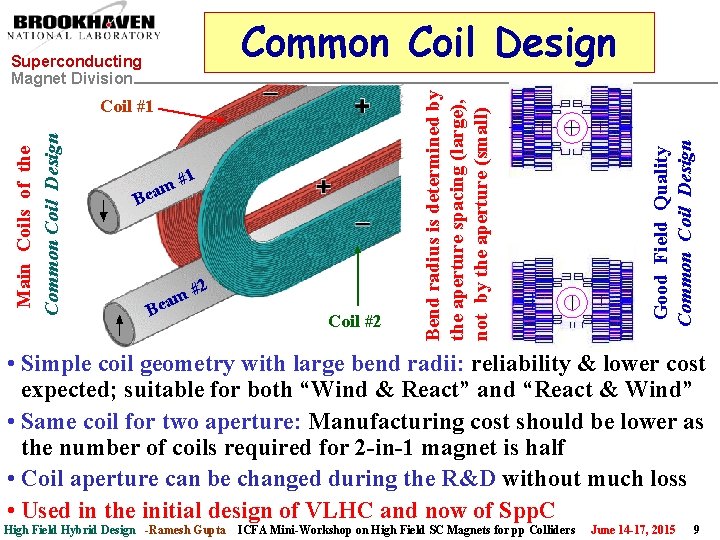
1 # m a Be 2 m# a e B Coil #2 Good Field Quality Common Coil Design Main Coils of the Common Coil Design Coil #1 Bend radius is determined by the aperture spacing (large), not by the aperture (small) Common Coil Design Superconducting Magnet Division • Simple coil geometry with large bend radii: reliability & lower cost expected; suitable for both “Wind & React” and “React & Wind” • Same coil for two aperture: Manufacturing cost should be lower as the number of coils required for 2 -in-1 magnet is half • Coil aperture can be changed during the R&D without much loss • Used in the initial design of VLHC and now of Spp. C High Field Hybrid Design -Ramesh Gupta ICFA Mini-Workshop on High Field SC Magnets for pp Colliders June 14 -17, 2015 9
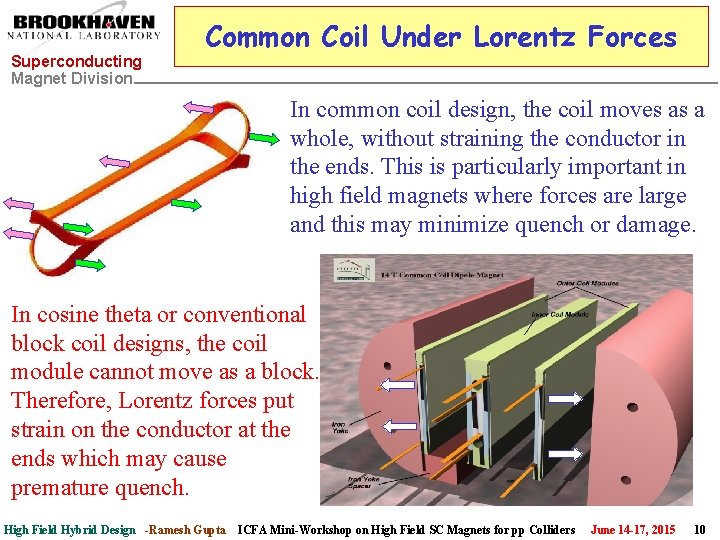
Superconducting Magnet Division Common Coil Under Lorentz Forces In common coil design, the coil moves as a whole, without straining the conductor in the ends. This is particularly important in high field magnets where forces are large and this may minimize quench or damage. In cosine theta or conventional block coil designs, the coil module cannot move as a block. Therefore, Lorentz forces put strain on the conductor at the ends which may cause premature quench. High Field Hybrid Design -Ramesh Gupta ICFA Mini-Workshop on High Field SC Magnets for pp Colliders June 14 -17, 2015 10
Superconducting Magnet Division Optimized Magnetic Design Good field quality designs developed for: Ø Geometric harmonics Ø Saturation-induced harmonics Ø End harmonics Optimized design included in backup slides (work presented earlier at Magnet Technology and Applied Superconducting Conference) Ø Persistent current-induced harmonics: next few slides High Field Hybrid Design -Ramesh Gupta ICFA Mini-Workshop on High Field SC Magnets for pp Colliders June 14 -17, 2015 11
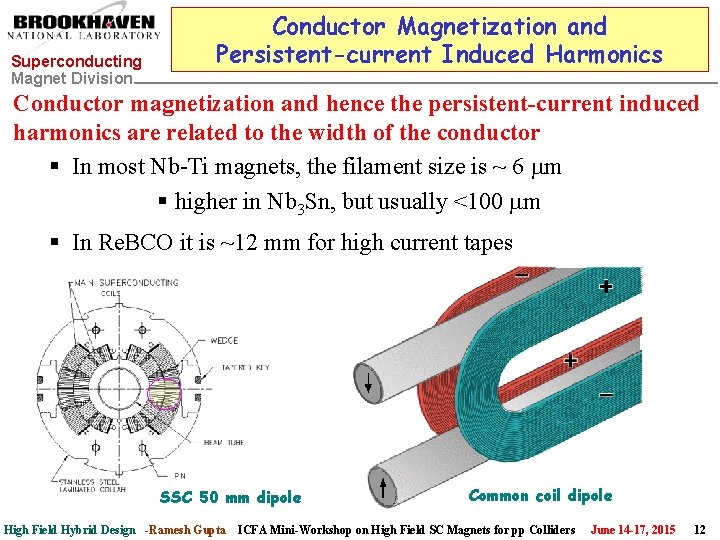
Superconducting Magnet Division Conductor Magnetization and Persistent-current Induced Harmonics Conductor magnetization and hence the persistent-current induced harmonics are related to the width of the conductor § In most Nb-Ti magnets, the filament size is ~ 6 mm § higher in Nb 3 Sn, but usually <100 mm § In Re. BCO it is ~12 mm for high current tapes SSC 50 mm dipole Common coil dipole High Field Hybrid Design -Ramesh Gupta ICFA Mini-Workshop on High Field SC Magnets for pp Colliders June 14 -17, 2015 12
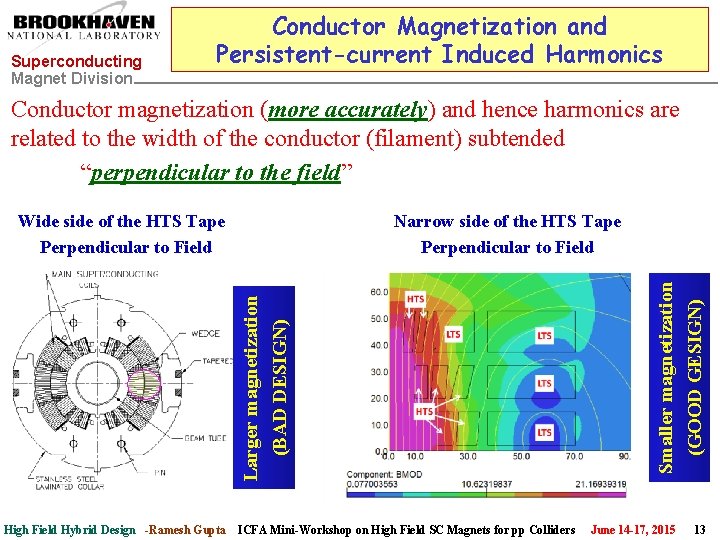
Superconducting Magnet Division Conductor Magnetization and Persistent-current Induced Harmonics Conductor magnetization (more accurately) and hence harmonics are related to the width of the conductor (filament) subtended “perpendicular to the field” Wide side of the HTS Tape Perpendicular to Field High Field Hybrid Design -Ramesh Gupta ICFA Mini-Workshop on High Field SC Magnets for pp Colliders Smaller magnetization (GOOD GESIGN) Larger magnetization (BAD DESIGN) Narrow side of the HTS Tape Perpendicular to Field June 14 -17, 2015 13
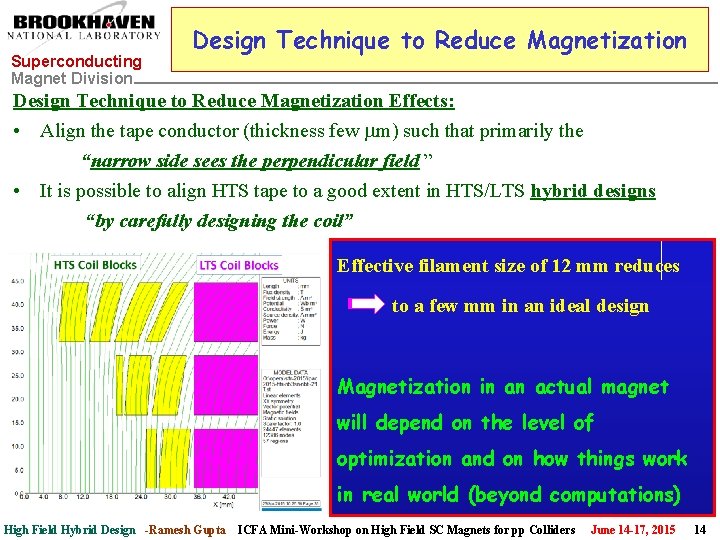
Superconducting Magnet Division Design Technique to Reduce Magnetization Effects: • Align the tape conductor (thickness few mm) such that primarily the “narrow side sees the perpendicular field ” • It is possible to align HTS tape to a good extent in HTS/LTS hybrid designs “by carefully designing the coil” Effective filament size of 12 mm reduces to a few mm in an ideal design Magnetization in an actual magnet will depend on the level of optimization and on how things work in real world (beyond computations) High Field Hybrid Design -Ramesh Gupta ICFA Mini-Workshop on High Field SC Magnets for pp Colliders June 14 -17, 2015 14
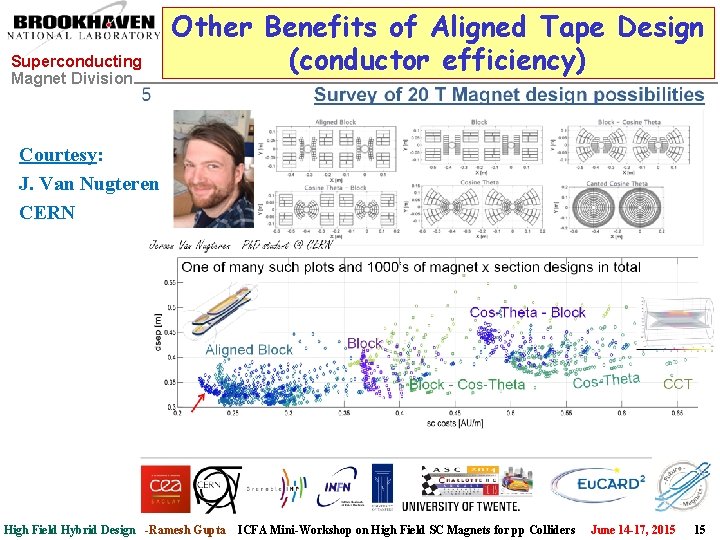
Superconducting Magnet Division Other Benefits of Aligned Tape Design (conductor efficiency) Courtesy: J. Van Nugteren CERN High Field Hybrid Design -Ramesh Gupta ICFA Mini-Workshop on High Field SC Magnets for pp Colliders June 14 -17, 2015 15
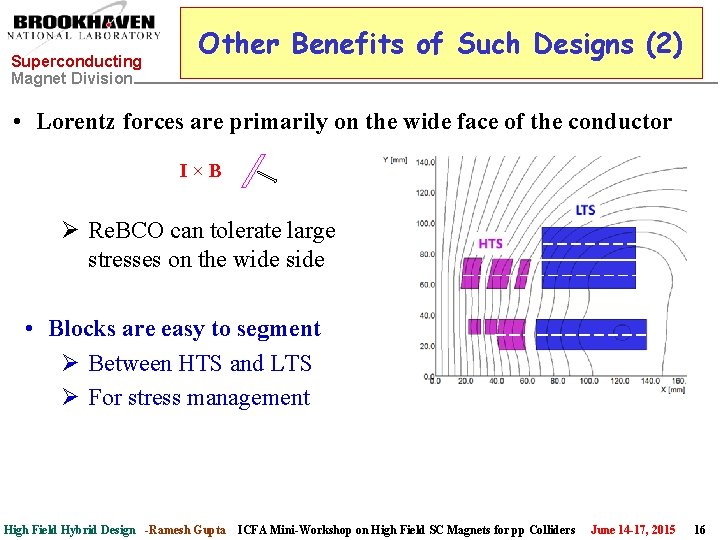
Superconducting Magnet Division Other Benefits of Such Designs (2) • Lorentz forces are primarily on the wide face of the conductor I×B Ø Re. BCO can tolerate large stresses on the wide side • Blocks are easy to segment Ø Between HTS and LTS Ø For stress management High Field Hybrid Design -Ramesh Gupta ICFA Mini-Workshop on High Field SC Magnets for pp Colliders June 14 -17, 2015 16
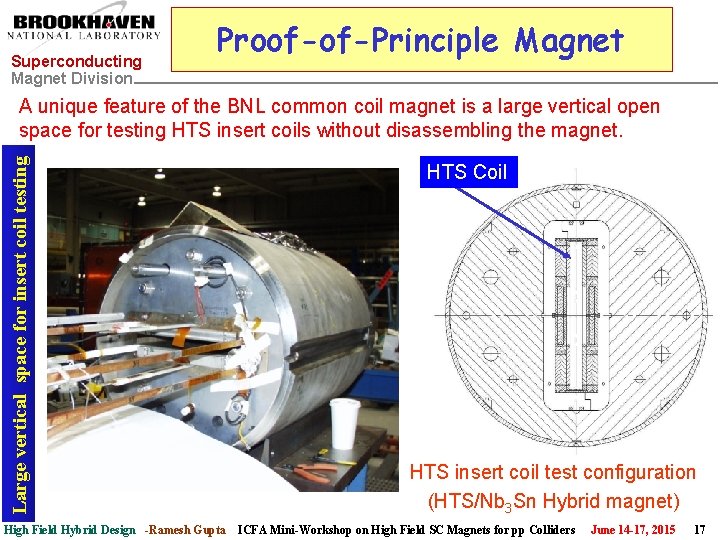
Superconducting Magnet Division Proof-of-Principle Magnet Large vertical space for insert coil testing A unique feature of the BNL common coil magnet is a large vertical open space for testing HTS insert coils without disassembling the magnet. HTS Coil HTS insert coil test configuration (HTS/Nb 3 Sn Hybrid magnet) High Field Hybrid Design -Ramesh Gupta ICFA Mini-Workshop on High Field SC Magnets for pp Colliders June 14 -17, 2015 17
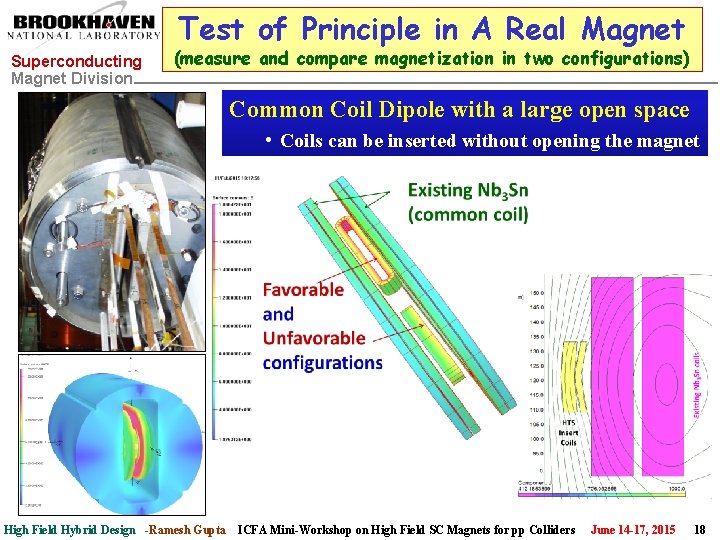
Test of Principle in A Real Magnet Superconducting Magnet Division (measure and compare magnetization in two configurations) Common Coil Dipole with a large open space • Coils can be inserted without opening the magnet High Field Hybrid Design -Ramesh Gupta ICFA Mini-Workshop on High Field SC Magnets for pp Colliders June 14 -17, 2015 18
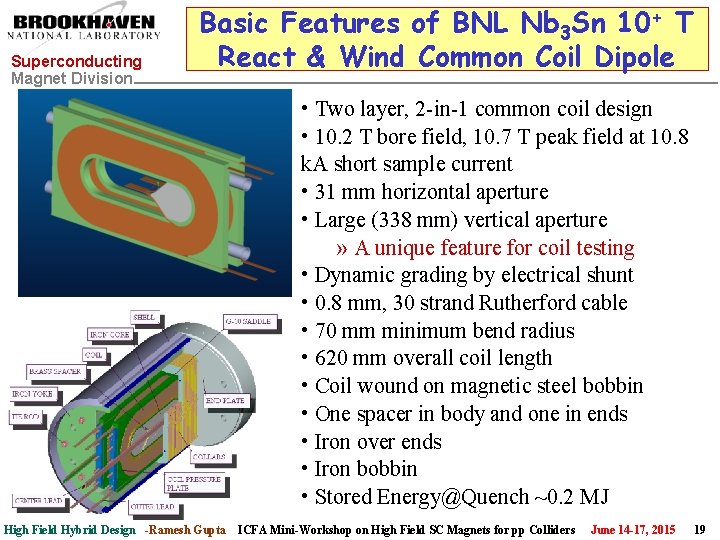
Superconducting Magnet Division Basic Features of BNL Nb 3 Sn 10+ T React & Wind Common Coil Dipole • Two layer, 2 -in-1 common coil design • 10. 2 T bore field, 10. 7 T peak field at 10. 8 k. A short sample current • 31 mm horizontal aperture • Large (338 mm) vertical aperture » A unique feature for coil testing • Dynamic grading by electrical shunt • 0. 8 mm, 30 strand Rutherford cable • 70 mm minimum bend radius • 620 mm overall coil length • Coil wound on magnetic steel bobbin • One spacer in body and one in ends • Iron over ends • Iron bobbin • Stored Energy@Quench ~0. 2 MJ High Field Hybrid Design -Ramesh Gupta ICFA Mini-Workshop on High Field SC Magnets for pp Colliders June 14 -17, 2015 19
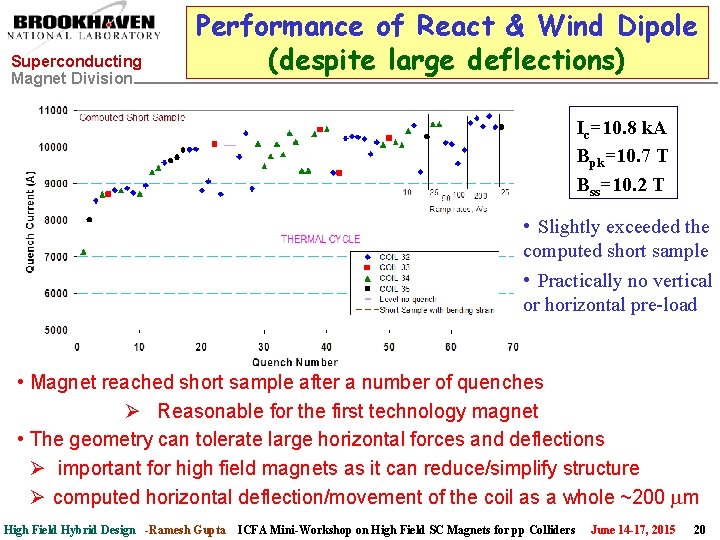
Superconducting Magnet Division Performance of React & Wind Dipole (despite large deflections) Ic=10. 8 k. A Bpk=10. 7 T Bss=10. 2 T • Slightly exceeded the computed short sample • Practically no vertical or horizontal pre-load • Magnet reached short sample after a number of quenches Ø Reasonable for the first technology magnet • The geometry can tolerate large horizontal forces and deflections Ø important for high field magnets as it can reduce/simplify structure Ø computed horizontal deflection/movement of the coil as a whole ~200 mm High Field Hybrid Design -Ramesh Gupta ICFA Mini-Workshop on High Field SC Magnets for pp Colliders June 14 -17, 2015 20
Superconducting Magnet Division SUMMARY • Initial/conceptual designs of high field hybrid magnet presented. React & Wind technology is attractive for Re. BCO/Nb 3 Sn/Nb. Ti hybrid magnegts. • It is possible develop high field hybrid magnet designs such that the persistent current-induced harmonics become manageable, overcoming a major technical issue with the Re. BCO tape. Proofof-Principle magnet is being built. • Requirements of expensive conductor are significantly reduced because of the field orientation (previous design work at CERN). • Conductor (HTS) cost may determine the viability of 20 T dipoles for high energy proton-proton collider. Fraction of the field from HTS will depend on the relative cost of conductor. High Field Hybrid Design -Ramesh Gupta ICFA Mini-Workshop on High Field SC Magnets for pp Colliders June 14 -17, 2015 21
Superconducting Magnet Division Backup Slides High Field Hybrid Design -Ramesh Gupta ICFA Mini-Workshop on High Field SC Magnets for pp Colliders June 14 -17, 2015 22
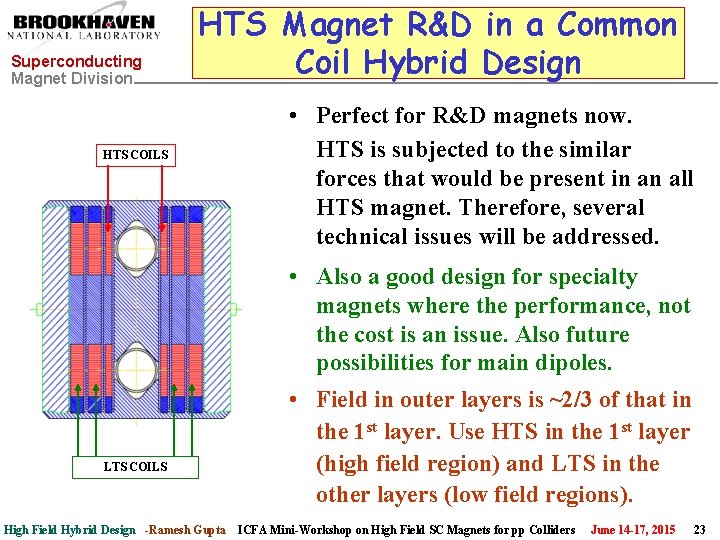
Superconducting Magnet Division HTS COILS HTS Magnet R&D in a Common Coil Hybrid Design • Perfect for R&D magnets now. HTS is subjected to the similar forces that would be present in an all HTS magnet. Therefore, several technical issues will be addressed. • Also a good design for specialty magnets where the performance, not the cost is an issue. Also future possibilities for main dipoles. LTS COILS • Field in outer layers is ~2/3 of that in the 1 st layer. Use HTS in the 1 st layer (high field region) and LTS in the other layers (low field regions). High Field Hybrid Design -Ramesh Gupta ICFA Mini-Workshop on High Field SC Magnets for pp Colliders June 14 -17, 2015 23
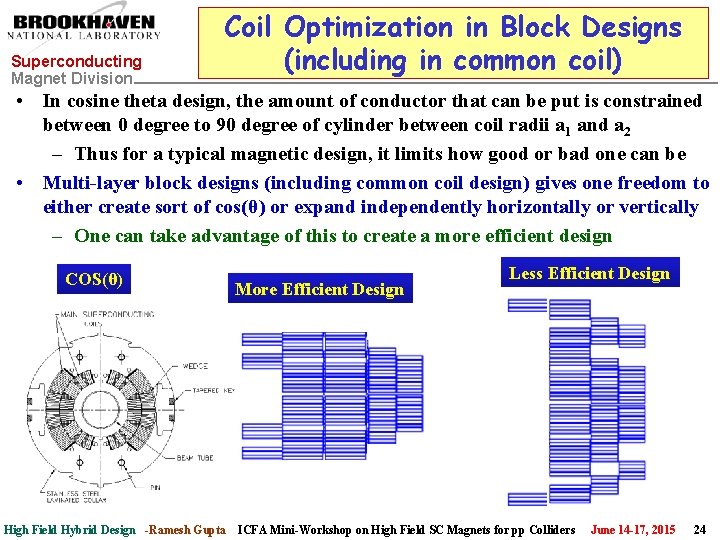
Superconducting Magnet Division Coil Optimization in Block Designs (including in common coil) • In cosine theta design, the amount of conductor that can be put is constrained between 0 degree to 90 degree of cylinder between coil radii a 1 and a 2 – Thus for a typical magnetic design, it limits how good or bad one can be • Multi-layer block designs (including common coil design) gives one freedom to either create sort of cos(θ) or expand independently horizontally or vertically – One can take advantage of this to create a more efficient design COS(θ) More Efficient Design Less Efficient Design High Field Hybrid Design -Ramesh Gupta ICFA Mini-Workshop on High Field SC Magnets for pp Colliders June 14 -17, 2015 24
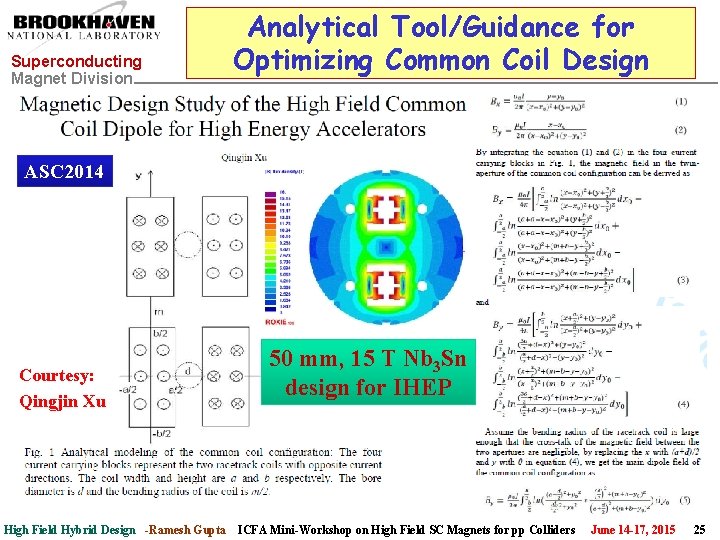
Superconducting Magnet Division Analytical Tool/Guidance for Optimizing Common Coil Design ASC 2014 Courtesy: Qingjin Xu 50 mm, 15 T Nb 3 Sn design for IHEP High Field Hybrid Design -Ramesh Gupta ICFA Mini-Workshop on High Field SC Magnets for pp Colliders June 14 -17, 2015 25
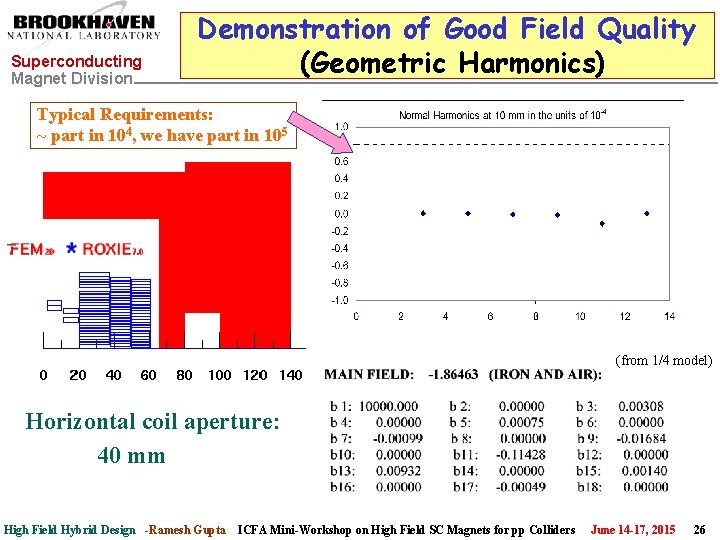
Superconducting Magnet Division Demonstration of Good Field Quality (Geometric Harmonics) Typical Requirements: ~ part in 104, we have part in 105 (from 1/4 model) Horizontal coil aperture: 40 mm High Field Hybrid Design -Ramesh Gupta ICFA Mini-Workshop on High Field SC Magnets for pp Colliders June 14 -17, 2015 26
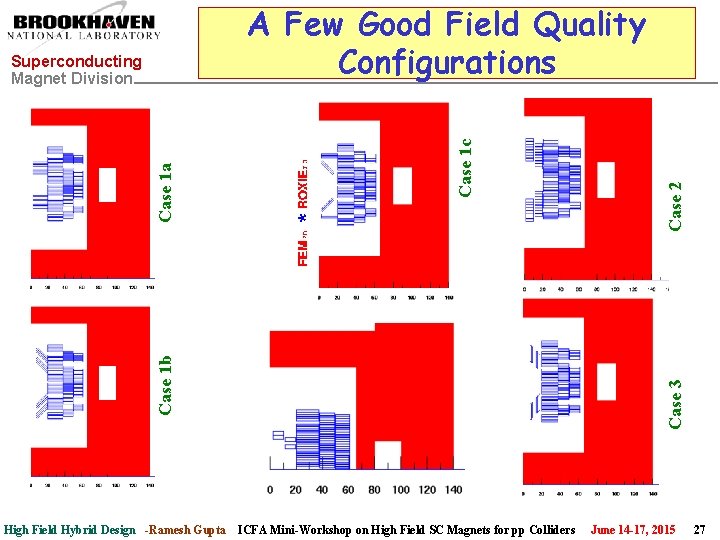
High Field Hybrid Design -Ramesh Gupta ICFA Mini-Workshop on High Field SC Magnets for pp Colliders Case 2 Case 3 Case 1 b Case 1 a Superconducting Magnet Division Case 1 c A Few Good Field Quality Configurations June 14 -17, 2015 27
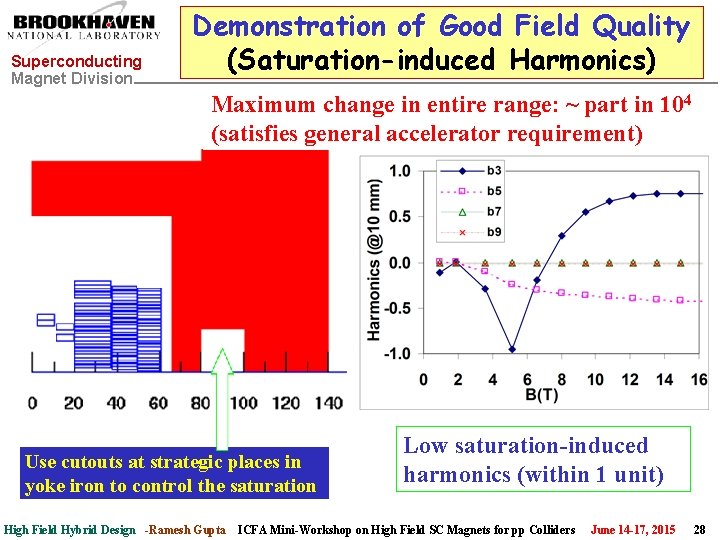
Superconducting Magnet Division Demonstration of Good Field Quality (Saturation-induced Harmonics) Maximum change in entire range: ~ part in 104 (satisfies general accelerator requirement) Use cutouts at strategic places in yoke iron to control the saturation Low saturation-induced harmonics (within 1 unit) High Field Hybrid Design -Ramesh Gupta ICFA Mini-Workshop on High Field SC Magnets for pp Colliders June 14 -17, 2015 28
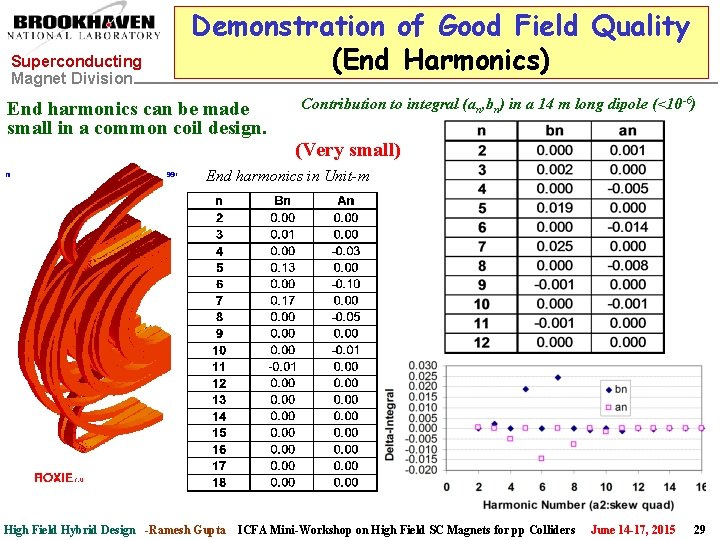
Superconducting Magnet Division Demonstration of Good Field Quality (End Harmonics) End harmonics can be made small in a common coil design. Contribution to integral (an, bn) in a 14 m long dipole (<10 -6) (Very small) End harmonics in Unit-m High Field Hybrid Design -Ramesh Gupta ICFA Mini-Workshop on High Field SC Magnets for pp Colliders June 14 -17, 2015 29
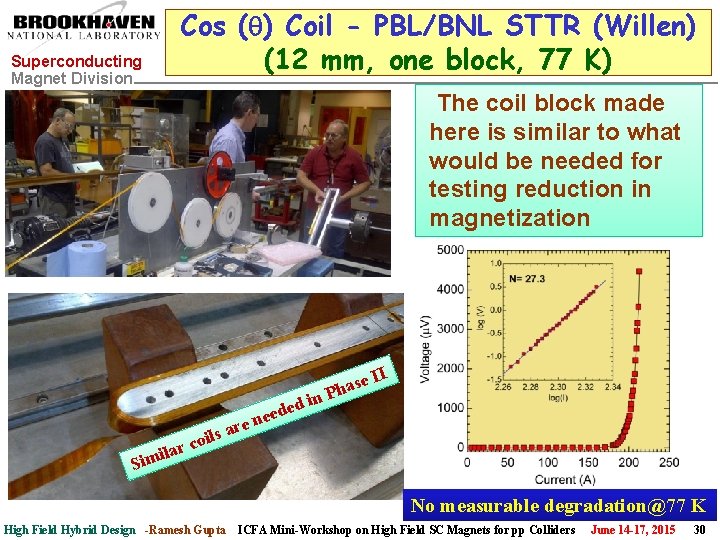
Superconducting Magnet Division Cos (q) Coil - PBL/BNL STTR (Willen) (12 mm, one block, 77 K) The coil block made here is similar to what would be needed for testing reduction in magnetization ase h P n oils c r mila II i d e e ne ar Si No measurable degradation@77 K High Field Hybrid Design -Ramesh Gupta ICFA Mini-Workshop on High Field SC Magnets for pp Colliders June 14 -17, 2015 30
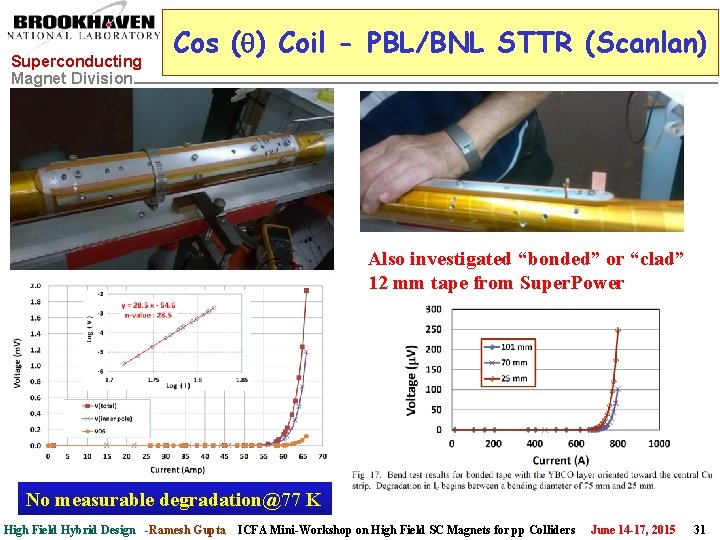
Superconducting Magnet Division Cos (q) Coil - PBL/BNL STTR (Scanlan) Also investigated “bonded” or “clad” 12 mm tape from Super. Power No measurable degradation@77 K High Field Hybrid Design -Ramesh Gupta ICFA Mini-Workshop on High Field SC Magnets for pp Colliders June 14 -17, 2015 31
- Slides: 31