
Superconducting Magnet Division A Collaboration Framework To Advance
Superconducting Magnet Division A Collaboration Framework To Advance High-Temperature Superconducting Magnets For Accelerator Facilities U. S. -Japan Science and Technology Cooperation Program in High Energy Physics Ramesh Gupta November 19, 2019 To Advance High-Temperature Superconducting Magnets For Accelerator Facilities-R. Gupta/SMD 11/19/191
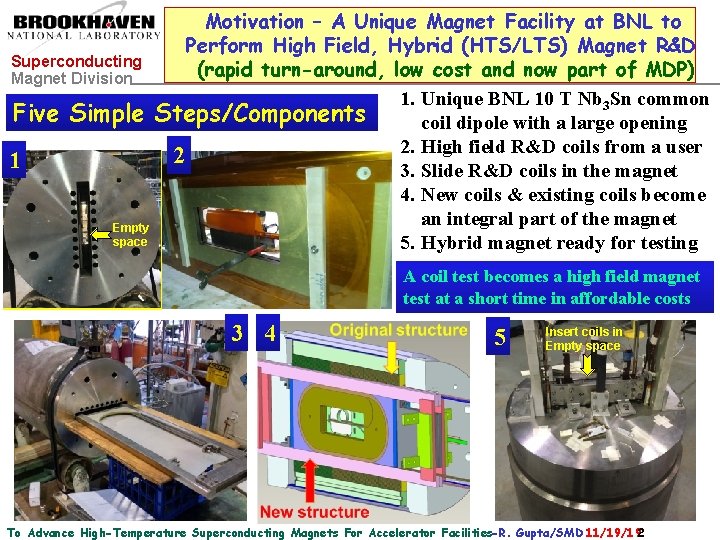
Motivation – A Unique Magnet Facility at BNL to Perform High Field, Hybrid (HTS/LTS) Magnet R&D Superconducting (rapid turn-around, low cost and now part of MDP) Magnet Division 1. Unique BNL 10 T Nb 3 Sn common Five Simple Steps/Components coil dipole with a large opening 2. High field R&D coils from a user 2 1 3. Slide R&D coils in the magnet 4. New coils & existing coils become an integral part of the magnet Empty space 5. Hybrid magnet ready for testing A coil test becomes a high field magnet test at a short time in affordable costs 3 4 5 Insert coils in Empty space To Advance High-Temperature Superconducting Magnets For Accelerator Facilities-R. Gupta/SMD 11/19/192

Earlier HTS/LTS Hybrid Dipole Test (new HTS insert coils with existing Nb 3 Sn magnet coil) Superconducting Magnet Division HTS Coil Current (A) 1000 Test performed under SBIR: 800 600 Quench Studies Magnetization Studies q HTS coils were ramped to quench, just like LTS coils q HTS coils had no training, no degradation despite a number of quenches 400 200 0 0. 0 2. 0 4. 0 6. 0 8. 0 10. 0 Hybrid Dipole Field (T) Reported at MT 25 To Advance High-Temperature Superconducting Magnets For Accelerator Facilities-R. Gupta/SMD 11/19/193
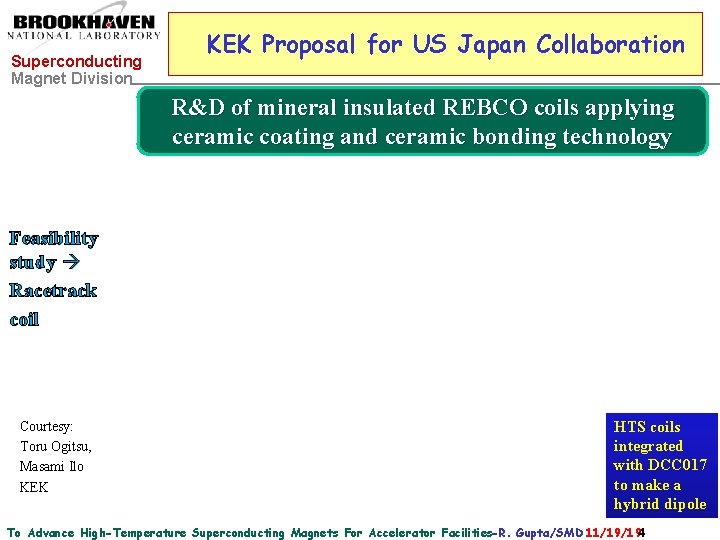
Superconducting Magnet Division KEK Proposal for US Japan Collaboration R&D of mineral insulated REBCO coils applying ceramic coating and ceramic bonding technology Feasibility study Racetrack coil Courtesy: Toru Ogitsu, Masami Ilo KEK HTS coils integrated with DCC 017 to make a hybrid dipole To Advance High-Temperature Superconducting Magnets For Accelerator Facilities-R. Gupta/SMD 11/19/194
Superconducting Magnet Division Overall Plan • There is an existing US-Japan collaboration with LBL from the US side and KEK being the lead lab from the Japanese side with the title “A Collaboration Framework To Advance High-Temperature Superconducting Magnets For Accelerator Facilities”. LBL applied for $180 k and received $80 k • The title certainly fits with what we are proposing to do. As such, work to be performed at LBL and BNL are essentially independent • KEK would like to add BNL within the existing framework for this year. However, it seems to be open to what to do next year • Therefore, this year proposal will be a joint proposal with LBL being the lead lab. Current agreement is that LBL and BNL will each put a budget of $180 k. The actual award amount will be divided 50 -50 with scope readjusted, if needed. • This year BNL award will be used to guide KEK for making coil and support structure that fits inside the magnet DCC 017, to give guidance to KEK on quench protection and to do preparatory work at BNL to facilitate this testing year after To Advance High-Temperature Superconducting Magnets For Accelerator Facilities-R. Gupta/SMD 11/19/195
Superconducting Magnet Division Next few slides are those presented by Toru Ogitsu outlining the broad agreement between the four institutions in a Blue. Jeans meeting More discussion on the BNL tasks in a slide that follows them To Advance High-Temperature Superconducting Magnets For Accelerator Facilities-R. Gupta/SMD 11/19/196
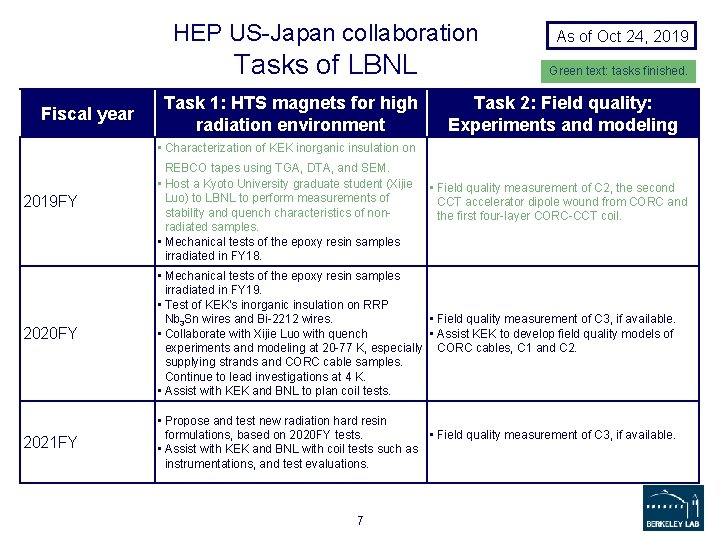
HEP US-Japan collaboration Tasks of LBNL Fiscal year Task 1: HTS magnets for high radiation environment As of Oct 24, 2019 Green text: tasks finished. Task 2: Field quality: Experiments and modeling • Characterization of KEK inorganic insulation on 2019 FY REBCO tapes using TGA, DTA, and SEM. • Host a Kyoto University graduate student (Xijie Luo) to LBNL to perform measurements of stability and quench characteristics of nonradiated samples. • Mechanical tests of the epoxy resin samples irradiated in FY 18. • Field quality measurement of C 2, the second CCT accelerator dipole wound from CORC and the first four-layer CORC-CCT coil. 2020 FY • Mechanical tests of the epoxy resin samples irradiated in FY 19. • Test of KEK’s inorganic insulation on RRP Nb 3 Sn wires and Bi-2212 wires. • Field quality measurement of C 3, if available. • Collaborate with Xijie Luo with quench • Assist KEK to develop field quality models of experiments and modeling at 20 -77 K, especially CORC cables, C 1 and C 2. supplying strands and CORC cable samples. Continue to lead investigations at 4 K. • Assist with KEK and BNL to plan coil tests. 2021 FY • Propose and test new radiation hard resin formulations, based on 2020 FY tests. • Field quality measurement of C 3, if available. • Assist with KEK and BNL with coil tests such as instrumentations, and test evaluations. 7
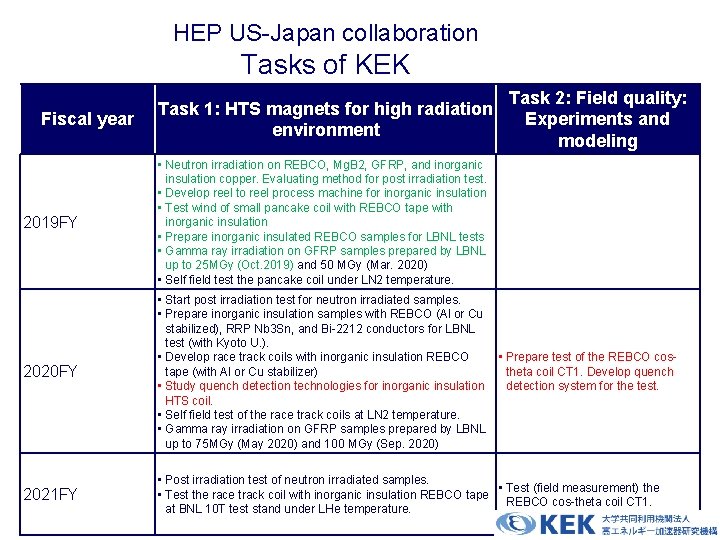
HEP US-Japan collaboration Tasks of KEK Fiscal year Task 1: HTS magnets for high radiation environment Task 2: Field quality: Experiments and modeling 2019 FY • Neutron irradiation on REBCO, Mg. B 2, GFRP, and inorganic insulation copper. Evaluating method for post irradiation test. • Develop reel to reel process machine for inorganic insulation • Test wind of small pancake coil with REBCO tape with inorganic insulation • Prepare inorganic insulated REBCO samples for LBNL tests • Gamma ray irradiation on GFRP samples prepared by LBNL up to 25 MGy (Oct. 2019) and 50 MGy (Mar. 2020) • Self field test the pancake coil under LN 2 temperature. 2020 FY • Start post irradiation test for neutron irradiated samples. • Prepare inorganic insulation samples with REBCO (Al or Cu stabilized), RRP Nb 3 Sn, and Bi-2212 conductors for LBNL test (with Kyoto U. ). • Develop race track coils with inorganic insulation REBCO tape (with Al or Cu stabilizer) • Study quench detection technologies for inorganic insulation HTS coil. • Self field test of the race track coils at LN 2 temperature. • Gamma ray irradiation on GFRP samples prepared by LBNL up to 75 MGy (May 2020) and 100 MGy (Sep. 2020) 2021 FY • Post irradiation test of neutron irradiated samples. • Test (field measurement) the • Test the race track coil with inorganic insulation REBCO tape REBCO cos-theta coil CT 1. at BNL 10 T test stand under LHe temperature. 8 • Prepare test of the REBCO costheta coil CT 1. Develop quench detection system for the test.
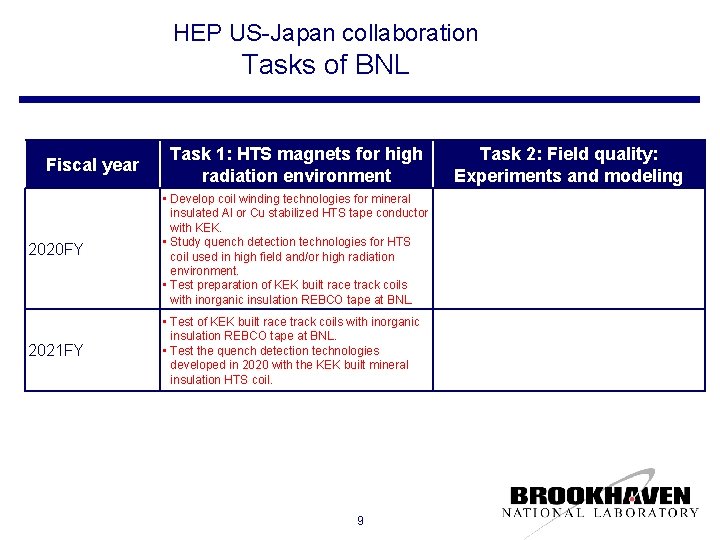
HEP US-Japan collaboration Tasks of BNL Fiscal year Task 1: HTS magnets for high radiation environment 2020 FY • Develop coil winding technologies for mineral insulated Al or Cu stabilized HTS tape conductor with KEK. • Study quench detection technologies for HTS coil used in high field and/or high radiation environment. • Test preparation of KEK built race track coils with inorganic insulation REBCO tape at BNL. 2021 FY • Test of KEK built race track coils with inorganic insulation REBCO tape at BNL. • Test the quench detection technologies developed in 2020 with the KEK built mineral insulation HTS coil. 9 Task 2: Field quality: Experiments and modeling
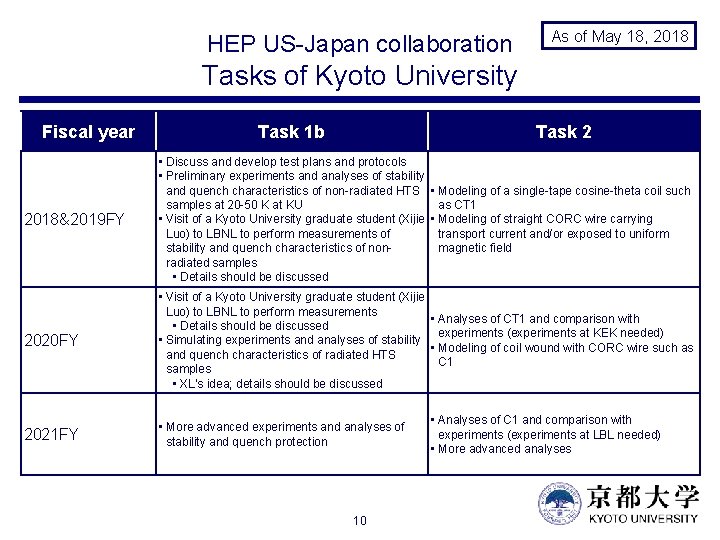
HEP US-Japan collaboration As of May 18, 2018 Tasks of Kyoto University Fiscal year Task 1 b Task 2 2018&2019 FY • Discuss and develop test plans and protocols • Preliminary experiments and analyses of stability and quench characteristics of non-radiated HTS • Modeling of a single-tape cosine-theta coil such samples at 20 -50 K at KU as CT 1 • Visit of a Kyoto University graduate student (Xijie • Modeling of straight CORC wire carrying Luo) to LBNL to perform measurements of transport current and/or exposed to uniform stability and quench characteristics of nonmagnetic field radiated samples • Details should be discussed 2020 FY • Visit of a Kyoto University graduate student (Xijie Luo) to LBNL to perform measurements • Analyses of CT 1 and comparison with • Details should be discussed experiments (experiments at KEK needed) • Simulating experiments and analyses of stability • Modeling of coil wound with CORC wire such as and quench characteristics of radiated HTS C 1 samples • XL’s idea; details should be discussed 2021 FY • More advanced experiments and analyses of stability and quench protection 10 • Analyses of C 1 and comparison with experiments (experiments at LBL needed) • More advanced analyses
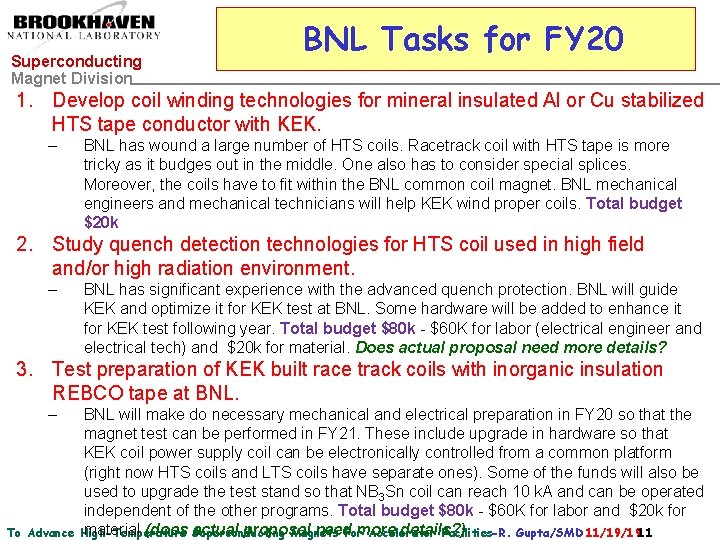
Superconducting Magnet Division BNL Tasks for FY 20 1. Develop coil winding technologies for mineral insulated Al or Cu stabilized HTS tape conductor with KEK. – BNL has wound a large number of HTS coils. Racetrack coil with HTS tape is more tricky as it budges out in the middle. One also has to consider special splices. Moreover, the coils have to fit within the BNL common coil magnet. BNL mechanical engineers and mechanical technicians will help KEK wind proper coils. Total budget $20 k 2. Study quench detection technologies for HTS coil used in high field and/or high radiation environment. – BNL has significant experience with the advanced quench protection. BNL will guide KEK and optimize it for KEK test at BNL. Some hardware will be added to enhance it for KEK test following year. Total budget $80 k - $60 K for labor (electrical engineer and electrical tech) and $20 k for material. Does actual proposal need more details? 3. Test preparation of KEK built race track coils with inorganic insulation REBCO tape at BNL. – To Advance BNL will make do necessary mechanical and electrical preparation in FY 20 so that the magnet test can be performed in FY 21. These include upgrade in hardware so that KEK coil power supply coil can be electronically controlled from a common platform (right now HTS coils and LTS coils have separate ones). Some of the funds will also be used to upgrade the test stand so that NB 3 Sn coil can reach 10 k. A and can be operated independent of the other programs. Total budget $80 k - $60 K for labor and $20 k for material (does actual proposal need more details? ) High-Temperature Superconducting Magnets For Accelerator Facilities-R. Gupta/SMD 11/19/1911
Superconducting Magnet Division Questions? Guidance!!! To Advance High-Temperature Superconducting Magnets For Accelerator Facilities-R. Gupta/SMD 11/19/1912
Superconducting Magnet Division Backup Slides To Advance High-Temperature Superconducting Magnets For Accelerator Facilities-R. Gupta/SMD 11/19/1913
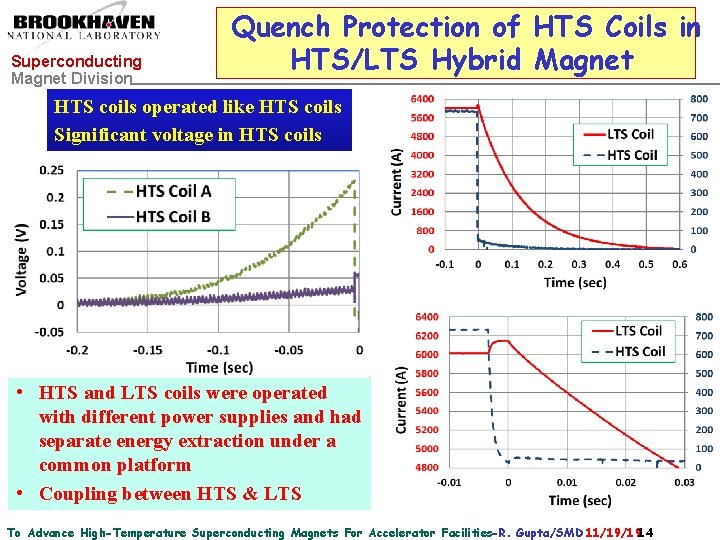
Superconducting Magnet Division Quench Protection of HTS Coils in HTS/LTS Hybrid Magnet HTS coils operated like HTS coils Significant voltage in HTS coils • HTS and LTS coils were operated with different power supplies and had separate energy extraction under a common platform • Coupling between HTS & LTS To Advance High-Temperature Superconducting Magnets For Accelerator Facilities-R. Gupta/SMD 11/19/1914
Superconducting Magnet Division Future Upgrades Current setup is for • Insert coil/cable up to 4. 5 k. A for any background field up to 10 T • Insert coil/cable up 10 k. A, if in series with common coil Future upgrades planned for • Insert coil/cable to 7. 5 k. A for any background field up to 10 T • Insert coil/cable up to 15 k. A, if in series with common coil with added shunt allowing variation in current in insert coil/cable • Transformer inside cryostat allowing up to 100 k. A for cable test with any background up to 10 T • Use existing shunt between inner and outer layers of Nb 3 Sn coils to push field from 10 T to 11 T To Advance High-Temperature Superconducting Magnets For Accelerator Facilities-R. Gupta/SMD 11/19/1915
- Slides: 15