
Superconducting LHC Magnets characteristics and qualification in SM
- Slides: 29
Superconducting LHC Magnets characteristics and qualification in SM 18 test station Marco Buzio (AT/MTM) Contents 1. 2. 3. 4. Introduction: overview of LHC magnet system Superconducting cables and magnets The LHC cryodipoles Cryogenic testing in SM 18 4. 1 Power tests 4. 2 Field quality Superconducting LHC Magnets – Characteristics and Qualification in SM 18 Test Station LHC Seminar for CERN Guides, 6 th May 2004 , marco. buzio@cern. ch 1/29
Acknowledgements This talk gives some highlights on the work done by many people in the AT and TS department over many years. Special thanks to: L Bottura, V Chohan, A Masi, JG Perez, P Pugnat, S Sanfilippo, A Siemko, N Smirnov, W Venturini Delsolaro (AT/MTM) M Pojer, L Rossi, D Tommasini (AT/MAS) J Axensalva, JP Lamboy, B Vuillerme, L Herblin (AT/ACR) Superconducting LHC Magnets – Characteristics and Qualification in SM 18 Test Station LHC Seminar for CERN Guides, 6 th May 2004 , marco. buzio@cern. ch 2/29
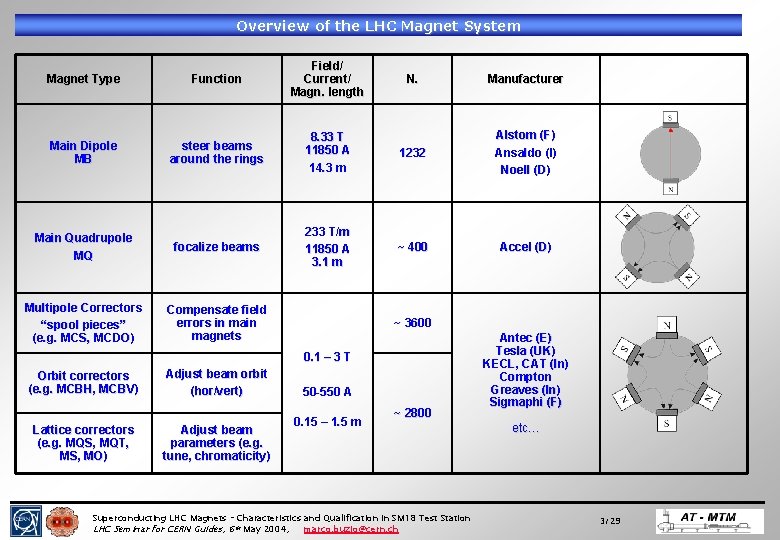
Overview of the LHC Magnet System Magnet Type Function Field/ Current/ Magn. length Main Dipole MB steer beams around the rings Main Quadrupole MQ focalize beams Multipole Correctors “spool pieces” (e. g. MCS, MCDO) Compensate field errors in magnets N. Manufacturer 8. 33 T 11850 A 14. 3 m 1232 Alstom (F) Ansaldo (I) Noell (D) 233 T/m 11850 A 3. 1 m ~ 400 Accel (D) ~ 3600 0. 1 – 3 T Orbit correctors (e. g. MCBH, MCBV) Lattice correctors (e. g. MQS, MQT, MS, MO) Adjust beam orbit (hor/vert) Adjust beam parameters (e. g. tune, chromaticity) 50 -550 A 0. 15 – 1. 5 m ~ 2800 Superconducting LHC Magnets – Characteristics and Qualification in SM 18 Test Station LHC Seminar for CERN Guides, 6 th May 2004 , marco. buzio@cern. ch Antec (E) Tesla (UK) KECL, CAT (In) Compton Greaves (In) Sigmaphi (F) etc… 3/29
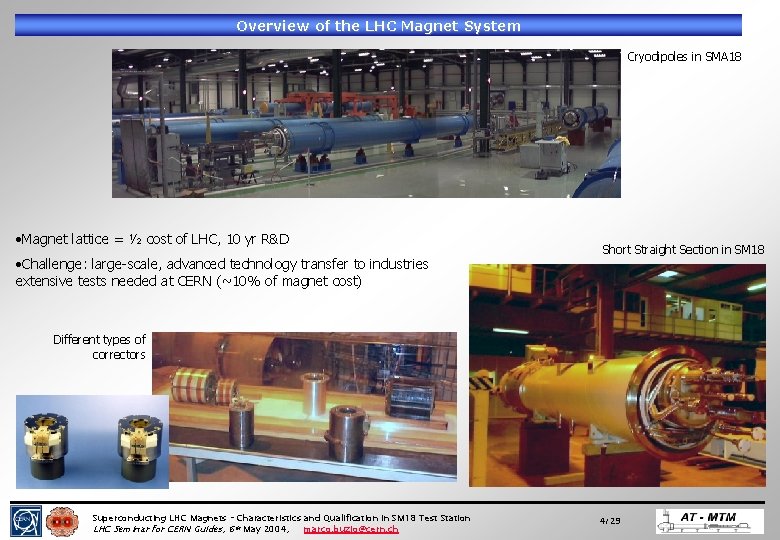
Overview of the LHC Magnet System Cryodipoles in SMA 18 • Magnet lattice = ½ cost of LHC, 10 yr R&D • Challenge: large-scale, advanced technology transfer to industries extensive tests needed at CERN (~10% of magnet cost) Short Straight Section in SM 18 Different types of correctors Superconducting LHC Magnets – Characteristics and Qualification in SM 18 Test Station LHC Seminar for CERN Guides, 6 th May 2004 , marco. buzio@cern. ch 4/29
Status • Baseline includes cold tests for all main magnets, details to be finalized • 1 octant of dipole cold masses delivered, ~120 cold tested (only two rejected) • 6 Short Straight Sections assembled and tested • cold test rate expected to ramp up from 8 to 14 magnets/week as soon as all 12 benches completed (Q 3 2004) • first dipole installation tests foreseen in June • End of cold test phase expected Q 3 2006. Superconducting LHC Magnets – Characteristics and Qualification in SM 18 Test Station LHC Seminar for CERN Guides, 6 th May 2004 , marco. buzio@cern. ch 5/29
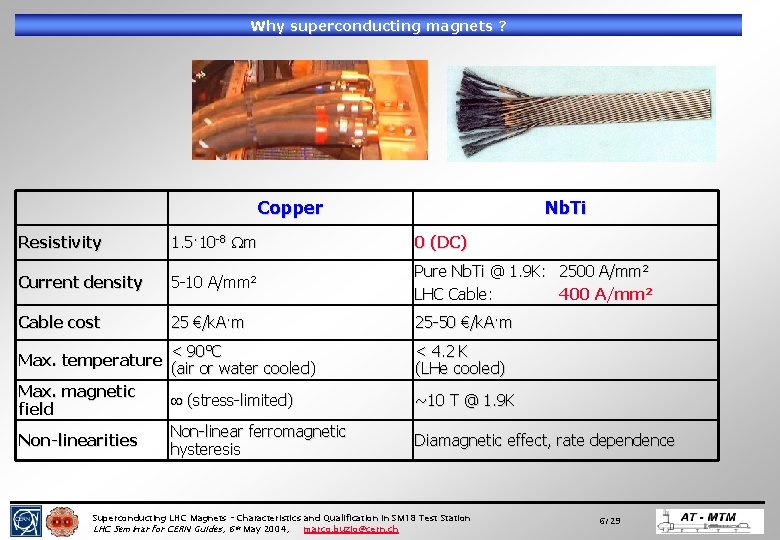
Why superconducting magnets ? Copper Nb. Ti Resistivity 1. 5· 10 -8 m 0 (DC) Current density 5 -10 A/mm² Pure Nb. Ti @ 1. 9 K: 2500 A/mm² LHC Cable: 400 A/mm² Cable cost 25 €/k. A·m 25 -50 €/k. A·m < 90°C Max. temperature (air or water cooled) Max. magnetic (stress-limited) field Non-linear ferromagnetic Non-linearities hysteresis < 4. 2 K (LHe cooled) ~10 T @ 1. 9 K Diamagnetic effect, rate dependence Superconducting LHC Magnets – Characteristics and Qualification in SM 18 Test Station LHC Seminar for CERN Guides, 6 th May 2004 , marco. buzio@cern. ch 6/29
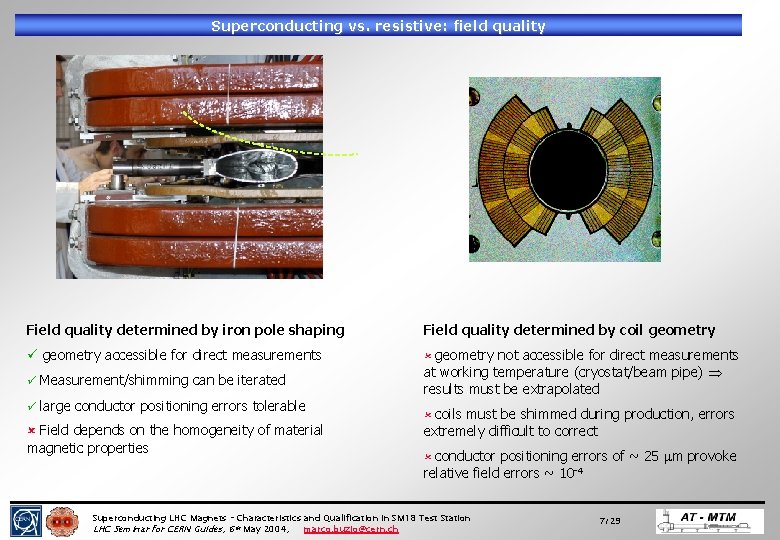
Superconducting vs. resistive: field quality Field quality determined by iron pole shaping Field quality determined by coil geometry accessible for direct measurements geometry not accessible for direct measurements Measurement/shimming can be iterated large conductor positioning errors tolerable Field depends on the homogeneity of material magnetic properties at working temperature (cryostat/beam pipe) results must be extrapolated coils must be shimmed during production, errors extremely difficult to correct conductor positioning errors of ~ 25 mm provoke relative field errors ~ 10 -4 Superconducting LHC Magnets – Characteristics and Qualification in SM 18 Test Station LHC Seminar for CERN Guides, 6 th May 2004 , marco. buzio@cern. ch 7/29
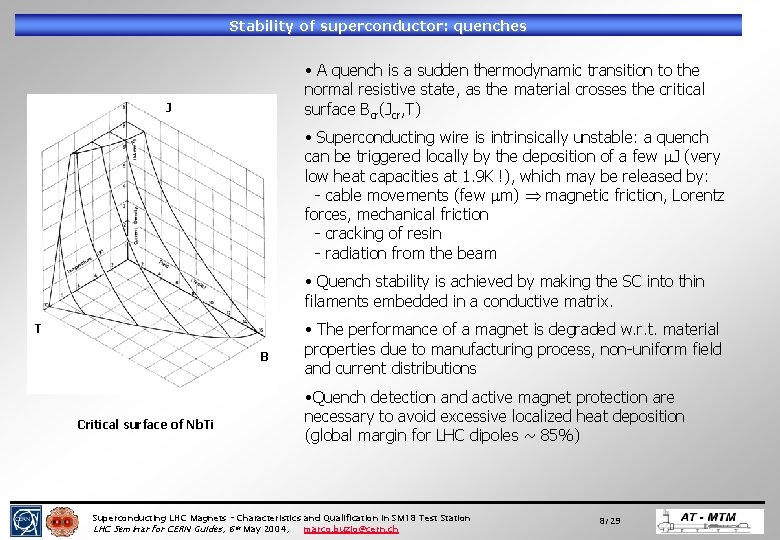
Stability of superconductor: quenches • A quench is a sudden thermodynamic transition to the normal resistive state, as the material crosses the critical surface Bcr(Jcr, T) J • Superconducting wire is intrinsically unstable: a quench can be triggered locally by the deposition of a few m. J (very low heat capacities at 1. 9 K !), which may be released by: - cable movements (few mm) magnetic friction, Lorentz forces, mechanical friction - cracking of resin - radiation from the beam • Quench stability is achieved by making the SC into thin filaments embedded in a conductive matrix. T B Critical surface of Nb. Ti • The performance of a magnet is degraded w. r. t. material properties due to manufacturing process, non-uniform field and current distributions • Quench detection and active magnet protection are necessary to avoid excessive localized heat deposition (global margin for LHC dipoles ~ 85%) Superconducting LHC Magnets – Characteristics and Qualification in SM 18 Test Station LHC Seminar for CERN Guides, 6 th May 2004 , marco. buzio@cern. ch 8/29
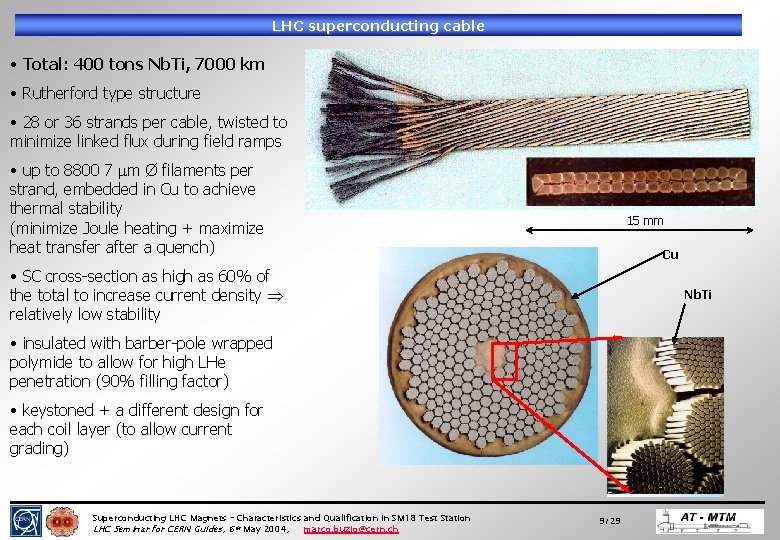
LHC superconducting cable • Total: 400 tons Nb. Ti, 7000 km • Rutherford type structure • 28 or 36 strands per cable, twisted to minimize linked flux during field ramps • up to 8800 7 mm Ø filaments per strand, embedded in Cu to achieve thermal stability (minimize Joule heating + maximize heat transfer after a quench) 15 mm Cu • SC cross-section as high as 60% of the total to increase current density relatively low stability Nb. Ti • insulated with barber-pole wrapped polymide to allow for high LHe penetration (90% filling factor) • keystoned + a different design for each coil layer (to allow current grading) Superconducting LHC Magnets – Characteristics and Qualification in SM 18 Test Station LHC Seminar for CERN Guides, 6 th May 2004 , marco. buzio@cern. ch 9/29
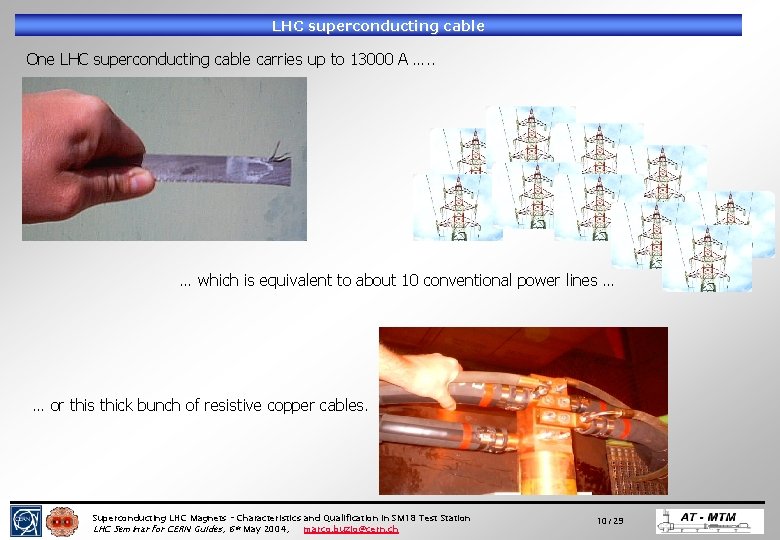
LHC superconducting cable One LHC superconducting cable carries up to 13000 A …. . … which is equivalent to about 10 conventional power lines … … or this thick bunch of resistive copper cables. Superconducting LHC Magnets – Characteristics and Qualification in SM 18 Test Station LHC Seminar for CERN Guides, 6 th May 2004 , marco. buzio@cern. ch 10/29
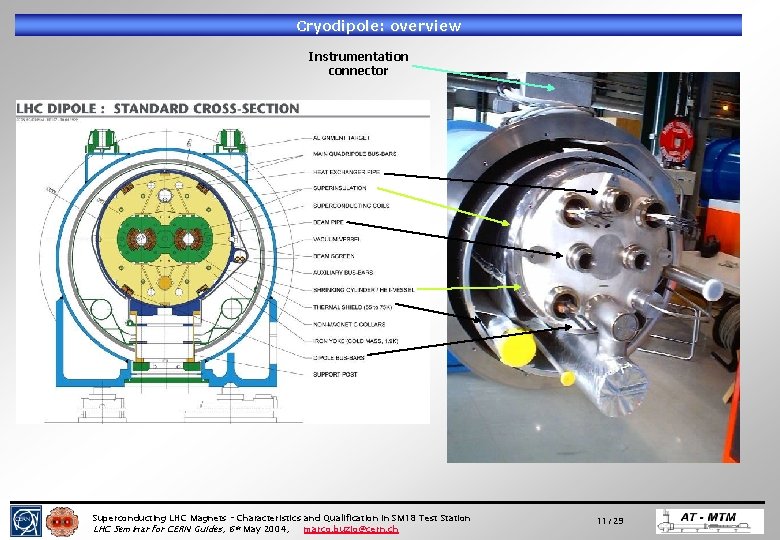
Cryodipole: overview Instrumentation connector Superconducting LHC Magnets – Characteristics and Qualification in SM 18 Test Station LHC Seminar for CERN Guides, 6 th May 2004 , marco. buzio@cern. ch 11/29
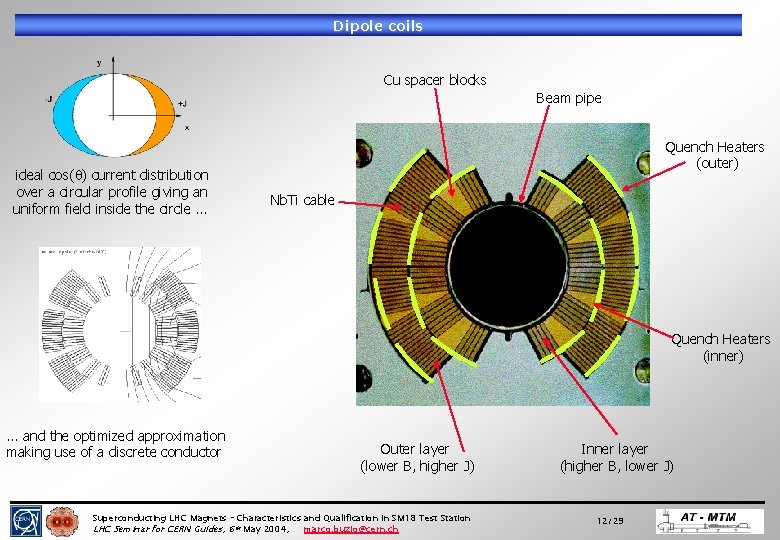
Dipole coils Cu spacer blocks Beam pipe ideal cos(q) current distribution over a circular profile giving an uniform field inside the circle … Quench Heaters (outer) Nb. Ti cable Quench Heaters (inner) … and the optimized approximation making use of a discrete conductor Outer layer (lower B, higher J) Superconducting LHC Magnets – Characteristics and Qualification in SM 18 Test Station LHC Seminar for CERN Guides, 6 th May 2004 , marco. buzio@cern. ch Inner layer (higher B, lower J) 12/29
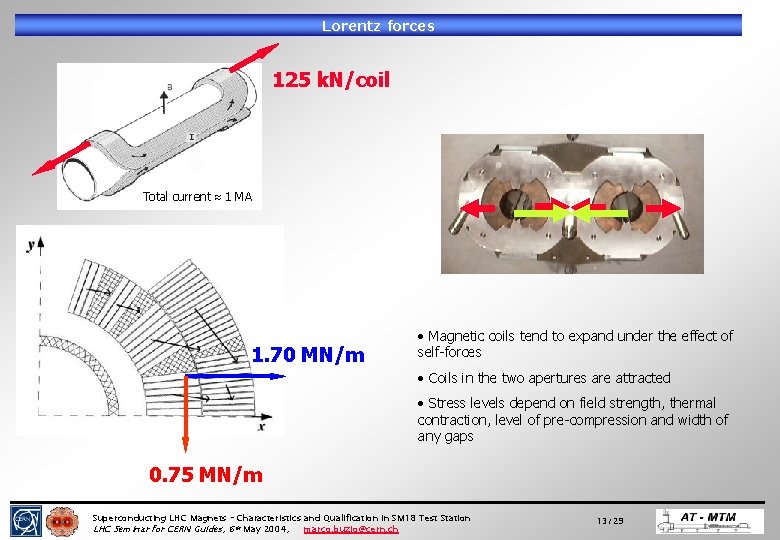
Lorentz forces 125 k. N/coil Total current 1 MA 1. 70 MN/m • Magnetic coils tend to expand under the effect of self-forces • Coils in the two apertures are attracted • Stress levels depend on field strength, thermal contraction, level of pre-compression and width of any gaps 0. 75 MN/m Superconducting LHC Magnets – Characteristics and Qualification in SM 18 Test Station LHC Seminar for CERN Guides, 6 th May 2004 , marco. buzio@cern. ch 13/29
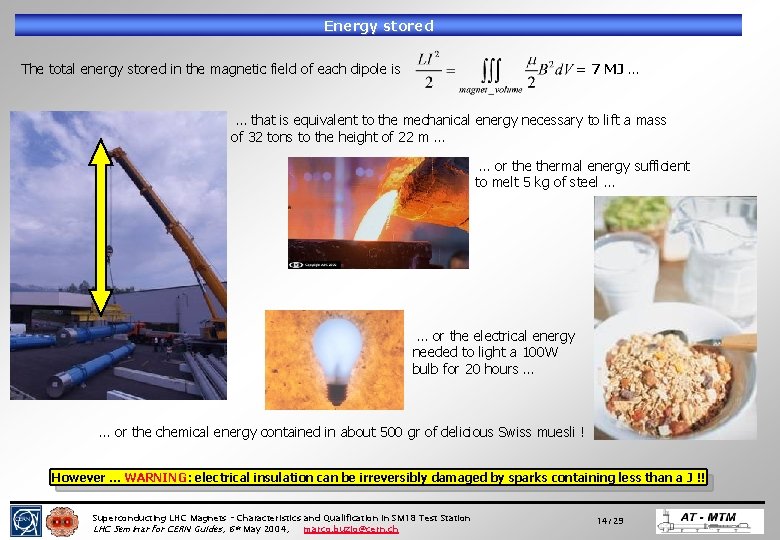
Energy stored The total energy stored in the magnetic field of each dipole is = 7 MJ … … that is equivalent to the mechanical energy necessary to lift a mass of 32 tons to the height of 22 m … … or thermal energy sufficient to melt 5 kg of steel … … or the electrical energy needed to light a 100 W bulb for 20 hours … … or the chemical energy contained in about 500 gr of delicious Swiss muesli ! However … WARNING: electrical insulation can be irreversibly damaged by sparks containing less than a J !! Superconducting LHC Magnets – Characteristics and Qualification in SM 18 Test Station LHC Seminar for CERN Guides, 6 th May 2004 , marco. buzio@cern. ch 14/29
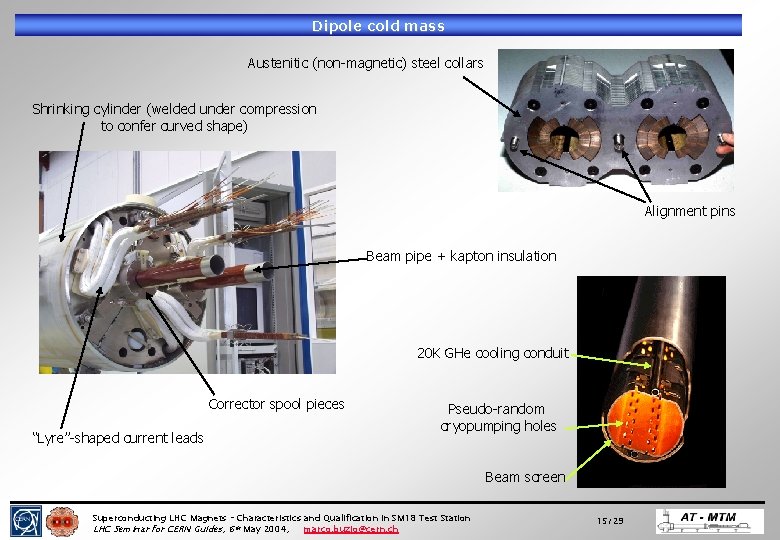
Dipole cold mass Austenitic (non-magnetic) steel collars Shrinking cylinder (welded under compression to confer curved shape) Alignment pins Beam pipe + kapton insulation 20 K GHe cooling conduit Corrector spool pieces “Lyre”-shaped current leads Pseudo-random cryopumping holes Beam screen Superconducting LHC Magnets – Characteristics and Qualification in SM 18 Test Station LHC Seminar for CERN Guides, 6 th May 2004 , marco. buzio@cern. ch 15/29
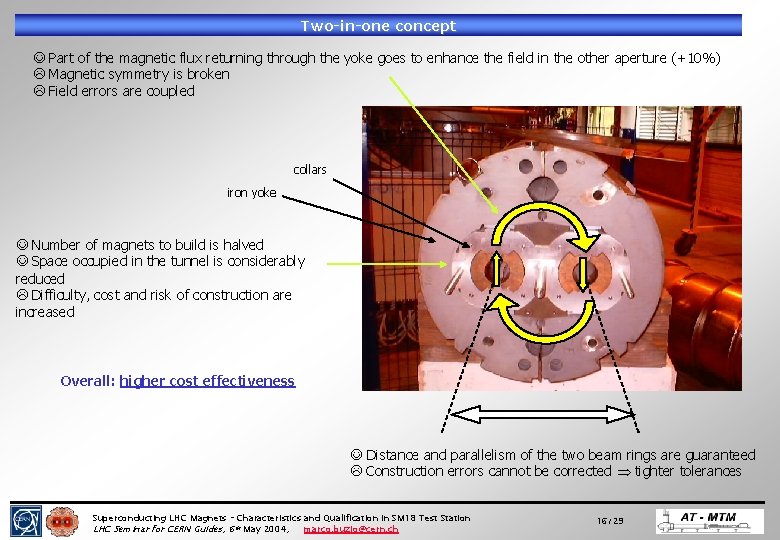
Two-in-one concept Part of the magnetic flux returning through the yoke goes to enhance the field in the other aperture (+10%) Magnetic symmetry is broken Field errors are coupled collars iron yoke Number of magnets to build is halved Space occupied in the tunnel is considerably reduced Difficulty, cost and risk of construction are increased Overall: higher cost effectiveness Distance and parallelism of the two beam rings are guaranteed Construction errors cannot be corrected tighter tolerances Superconducting LHC Magnets – Characteristics and Qualification in SM 18 Test Station LHC Seminar for CERN Guides, 6 th May 2004 , marco. buzio@cern. ch 16/29
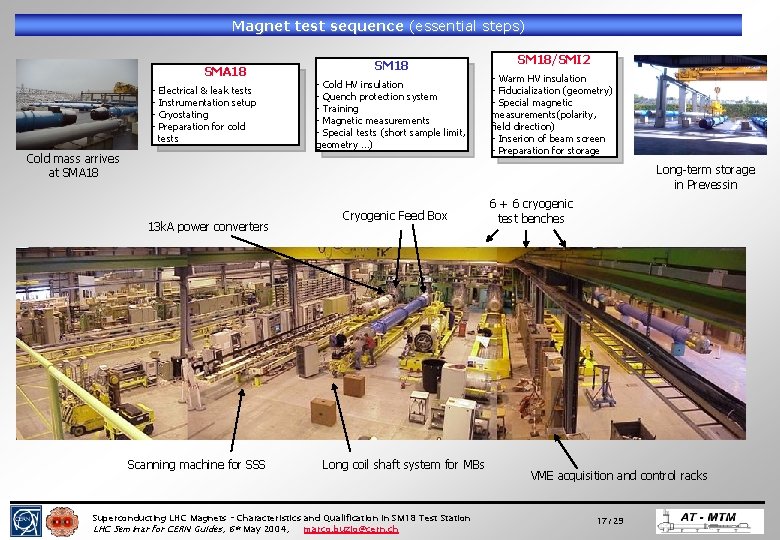
Magnet test sequence (essential steps) SMA 18 - Electrical & leak tests - Instrumentation setup - Cryostating - Preparation for cold tests SM 18 - Cold HV insulation - Quench protection system - Training - Magnetic measurements - Special tests (short sample limit, geometry …) Cold mass arrives at SMA 18 SM 18/SMI 2 - Warm HV insulation - Fiducialization (geometry) - Special magnetic measurements(polarity, field direction) - Inserion of beam screen - Preparation for storage Long-term storage in Prevessin 13 k. A power converters Scanning machine for SSS Cryogenic Feed Box Long coil shaft system for MBs Superconducting LHC Magnets – Characteristics and Qualification in SM 18 Test Station LHC Seminar for CERN Guides, 6 th May 2004 , marco. buzio@cern. ch 6 + 6 cryogenic test benches VME acquisition and control racks 17/29
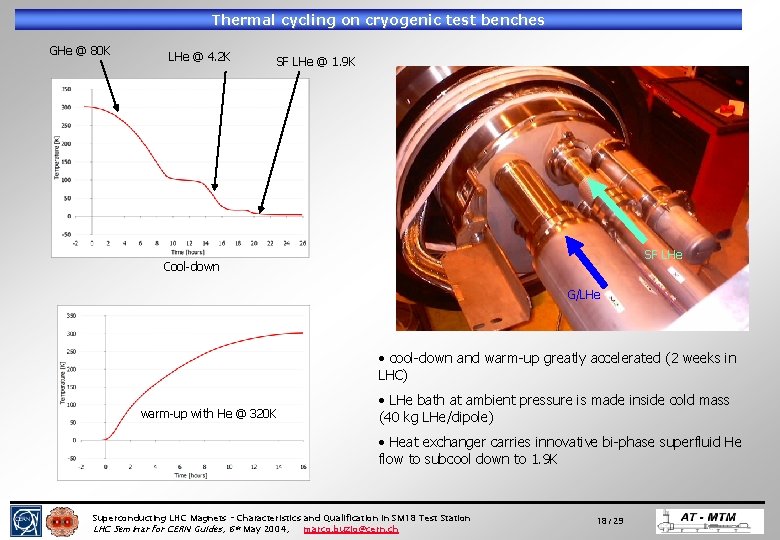
Thermal cycling on cryogenic test benches GHe @ 80 K LHe @ 4. 2 K SF LHe @ 1. 9 K SF LHe Cool-down G/LHe • cool-down and warm-up greatly accelerated (2 weeks in LHC) warm-up with He @ 320 K • LHe bath at ambient pressure is made inside cold mass (40 kg LHe/dipole) • Heat exchanger carries innovative bi-phase superfluid He flow to subcool down to 1. 9 K Superconducting LHC Magnets – Characteristics and Qualification in SM 18 Test Station LHC Seminar for CERN Guides, 6 th May 2004 , marco. buzio@cern. ch 18/29
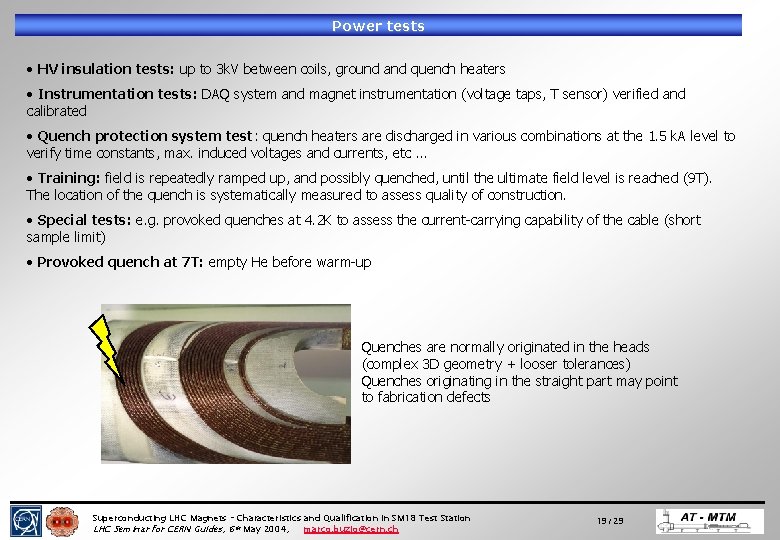
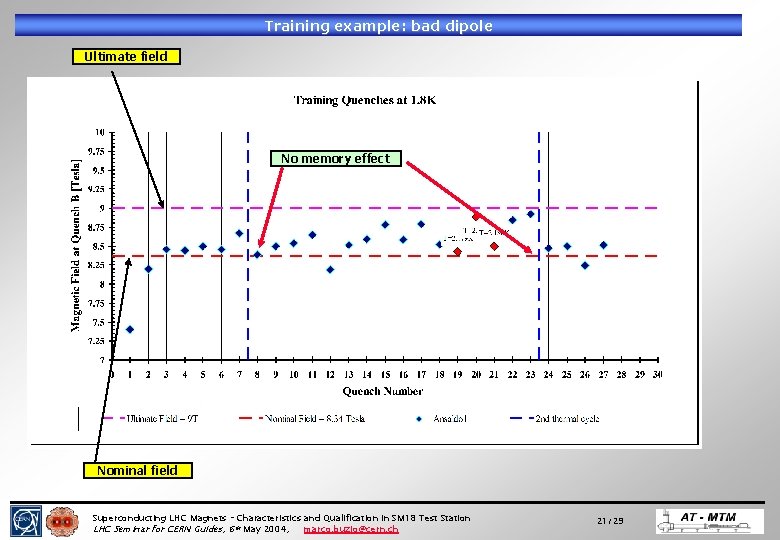
Power tests • HV insulation tests: up to 3 k. V between coils, ground and quench heaters • Instrumentation tests: DAQ system and magnet instrumentation (voltage taps, T sensor) verified and calibrated • Quench protection system test: quench heaters are discharged in various combinations at the 1. 5 k. A level to verify time constants, max. induced voltages and currents, etc … • Training: field is repeatedly ramped up, and possibly quenched, until the ultimate field level is reached (9 T). The location of the quench is systematically measured to assess quality of construction. • Special tests: e. g. provoked quenches at 4. 2 K to assess the current-carrying capability of the cable (short sample limit) • Provoked quench at 7 T: empty He before warm-up Quenches are normally originated in the heads (complex 3 D geometry + looser tolerances) Quenches originating in the straight part may point to fabrication defects Superconducting LHC Magnets – Characteristics and Qualification in SM 18 Test Station LHC Seminar for CERN Guides, 6 th May 2004 , marco. buzio@cern. ch 19/29
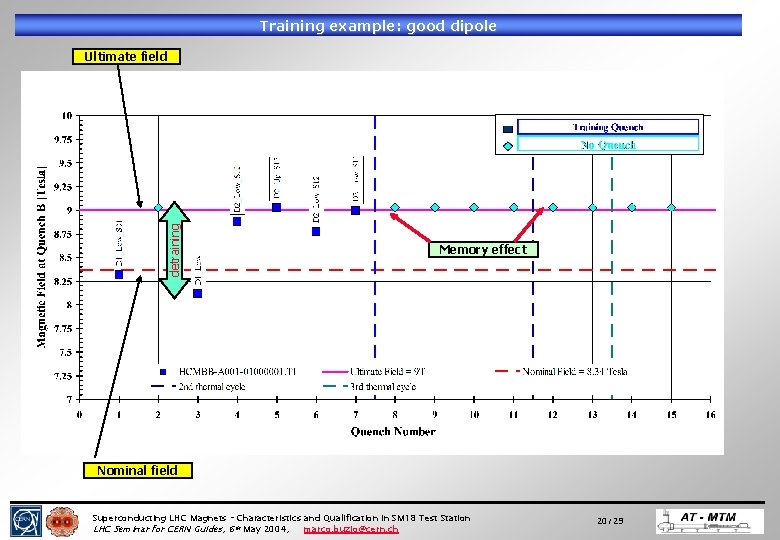
Training example: good dipole detraining Ultimate field Memory effect Nominal field Superconducting LHC Magnets – Characteristics and Qualification in SM 18 Test Station LHC Seminar for CERN Guides, 6 th May 2004 , marco. buzio@cern. ch 20/29
Training example: bad dipole Ultimate field No memory effect Nominal field Superconducting LHC Magnets – Characteristics and Qualification in SM 18 Test Station LHC Seminar for CERN Guides, 6 th May 2004 , marco. buzio@cern. ch 21/29
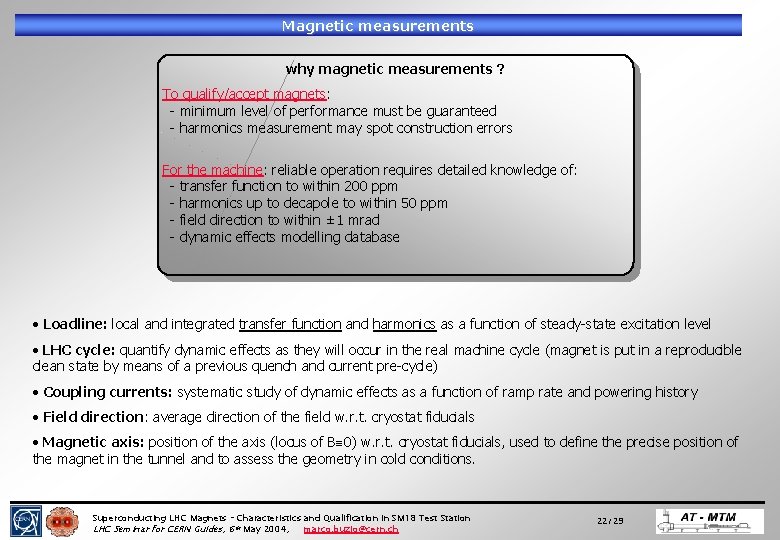
Magnetic measurements why magnetic measurements ? To qualify/accept magnets: - minimum level of performance must be guaranteed - harmonics measurement may spot construction errors For the machine: reliable operation requires detailed knowledge of: - transfer function to within 200 ppm - harmonics up to decapole to within 50 ppm - field direction to within ± 1 mrad - dynamic effects modelling database • Loadline: local and integrated transfer function and harmonics as a function of steady-state excitation level • LHC cycle: quantify dynamic effects as they will occur in the real machine cycle (magnet is put in a reproducible clean state by means of a previous quench and current pre-cycle) • Coupling currents: systematic study of dynamic effects as a function of ramp rate and powering history • Field direction: average direction of the field w. r. t. cryostat fiducials • Magnetic axis: position of the axis (locus of B 0) w. r. t. cryostat fiducials, used to define the precise position of the magnet in the tunnel and to assess the geometry in cold conditions. Superconducting LHC Magnets – Characteristics and Qualification in SM 18 Test Station LHC Seminar for CERN Guides, 6 th May 2004 , marco. buzio@cern. ch 22/29
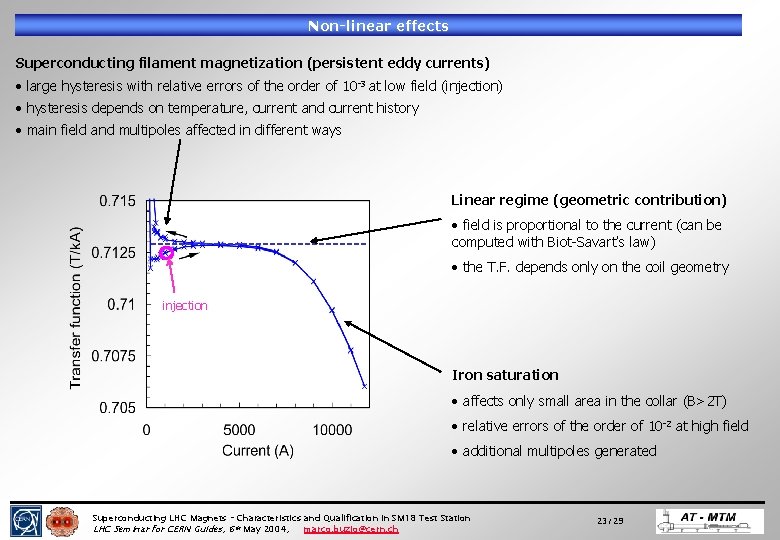
Non-linear effects Superconducting filament magnetization (persistent eddy currents) • large hysteresis with relative errors of the order of 10 -3 at low field (injection) • hysteresis depends on temperature, current and current history • main field and multipoles affected in different ways Linear regime (geometric contribution) • field is proportional to the current (can be computed with Biot-Savart’s law) • the T. F. depends only on the coil geometry injection Iron saturation • affects only small area in the collar (B>2 T) • relative errors of the order of 10 -2 at high field • additional multipoles generated Superconducting LHC Magnets – Characteristics and Qualification in SM 18 Test Station LHC Seminar for CERN Guides, 6 th May 2004 , marco. buzio@cern. ch 23/29
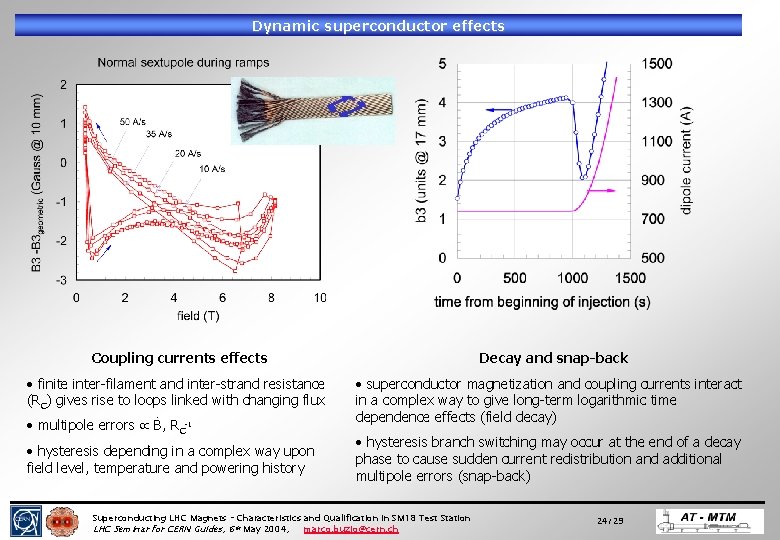
Dynamic superconductor effects Coupling currents effects • finite inter-filament and inter-strand resistance (RC) gives rise to loops linked with changing flux • multipole errors Ḃ, RC-1 • hysteresis depending in a complex way upon field level, temperature and powering history Decay and snap-back • superconductor magnetization and coupling currents interact in a complex way to give long-term logarithmic time dependence effects (field decay) • hysteresis branch switching may occur at the end of a decay phase to cause sudden current redistribution and additional multipole errors (snap-back) Superconducting LHC Magnets – Characteristics and Qualification in SM 18 Test Station LHC Seminar for CERN Guides, 6 th May 2004 , marco. buzio@cern. ch 24/29
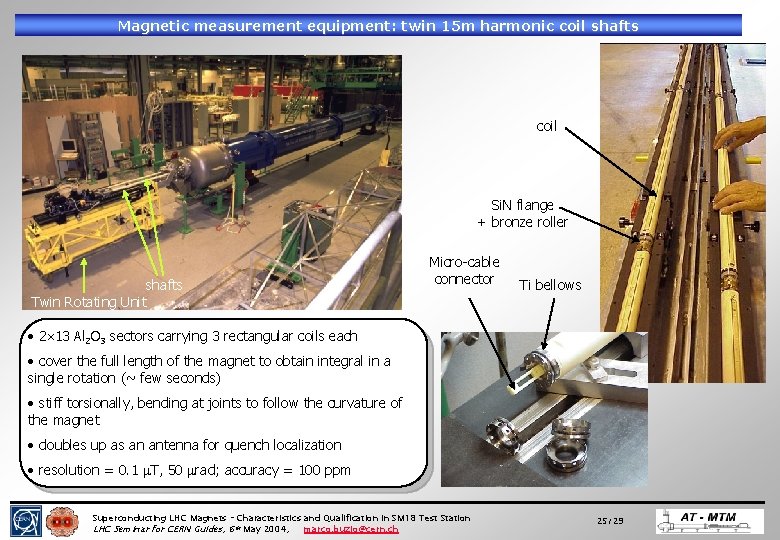
Magnetic measurement equipment: twin 15 m harmonic coil shafts coil Si. N flange + bronze roller shafts Twin Rotating Unit Micro-cable connector Ti bellows • 2 13 Al 2 O 3 sectors carrying 3 rectangular coils each • cover the full length of the magnet to obtain integral in a single rotation (~ few seconds) • stiff torsionally, bending at joints to follow the curvature of the magnet • doubles up as an antenna for quench localization • resolution = 0. 1 m. T, 50 mrad; accuracy = 100 ppm Superconducting LHC Magnets – Characteristics and Qualification in SM 18 Test Station LHC Seminar for CERN Guides, 6 th May 2004 , marco. buzio@cern. ch 25/29
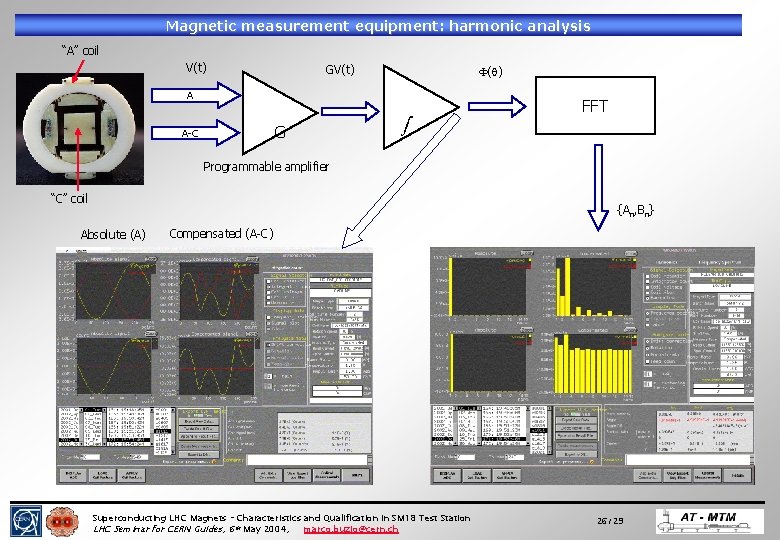
Magnetic measurement equipment: harmonic analysis “A” coil V(t) GV(t) F(q) A G A-C FFT Programmable amplifier “C” coil {An, Bn} Absolute (A) Compensated (A-C) Superconducting LHC Magnets – Characteristics and Qualification in SM 18 Test Station LHC Seminar for CERN Guides, 6 th May 2004 , marco. buzio@cern. ch 26/29
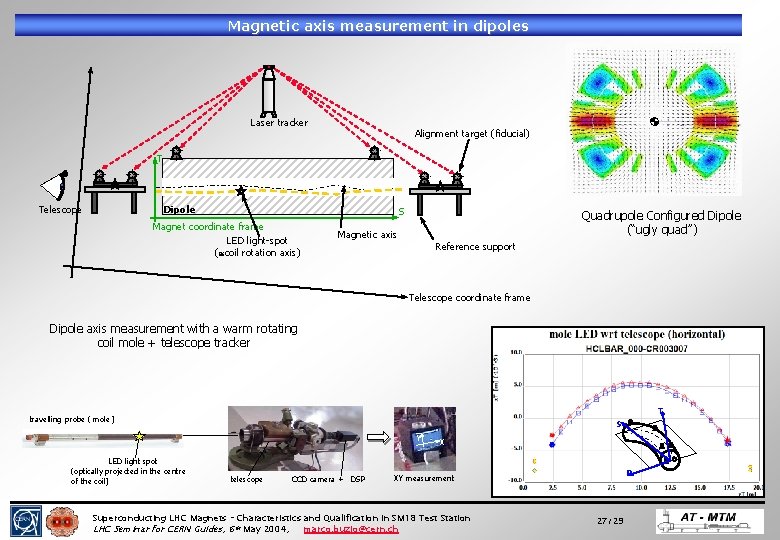
Magnetic axis measurement in dipoles Laser tracker Alignment target (fiducial) T Telescope Dipole S Magnet coordinate frame LED light-spot ( coil rotation axis) Quadrupole Configured Dipole (“ugly quad”) Magnetic axis Reference support Telescope coordinate frame Dipole axis measurement with a warm rotating coil mole + telescope tracker T travelling probe ( mole ) S Y LED light spot (optically projected in the centre of the coil) telescope CCD camera + DSP X R XY measurement Superconducting LHC Magnets – Characteristics and Qualification in SM 18 Test Station LHC Seminar for CERN Guides, 6 th May 2004 , marco. buzio@cern. ch 27/29
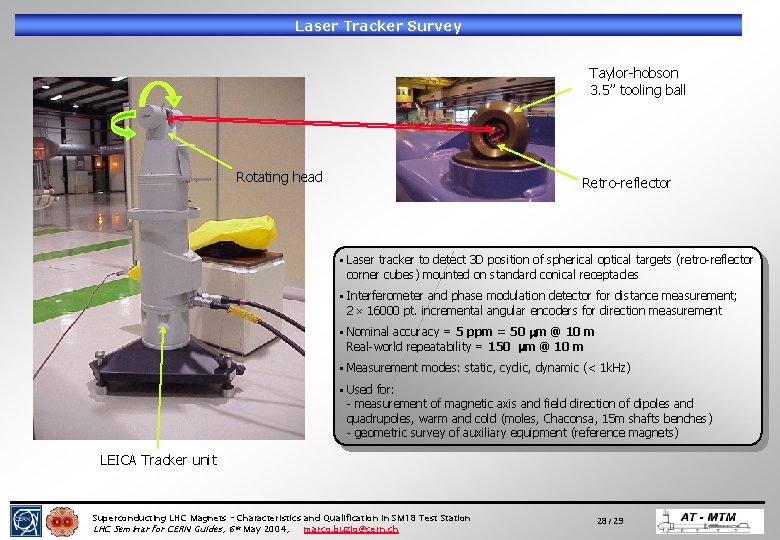
Laser Tracker Survey Taylor-hobson 3. 5’’ tooling ball Rotating head Retro-reflector • Laser tracker to detect 3 D position of spherical optical targets (retro-reflector corner cubes) mounted on standard conical receptacles • Interferometer and phase modulation detector for distance measurement; 2 16000 pt. incremental angular encoders for direction measurement • Nominal accuracy = 5 ppm = 50 mm @ 10 m Real-world repeatability = 150 mm @ 10 m • Measurement modes: static, cyclic, dynamic (< 1 k. Hz) • Used for: - measurement of magnetic axis and field direction of dipoles and quadrupoles, warm and cold (moles, Chaconsa, 15 m shafts benches) - geometric survey of auxiliary equipment (reference magnets) LEICA Tracker unit Superconducting LHC Magnets – Characteristics and Qualification in SM 18 Test Station LHC Seminar for CERN Guides, 6 th May 2004 , marco. buzio@cern. ch 28/29
References L Rossi, Superconducting magnets for the LHC main lattice, Presented at: 18 th International Conference on Magnet Technology MT 18 , Iwate, Japan , 20 - 24 Oct 2003 M Allitt, R Wolf et al; Status of the Production of the LHC Superconducting Corrector Magnets Presented at: 18 th International Conference on Magnet Technology MT 18 , Iwate, Japan , 20 - 24 Oct 2003 L Rossi, Superconducting Cable and Magnets for the Large Hadron Collider Presented at: 6 th European Conference on Applied Superconductivity EUCAS 2003 , Sorrento, Napoli, Italy , 14 - 18 Sep 2003 W Scandale, E Todesco et al, Influence of Superconducting Cable Dimensions on Field Harmonics in the LHC Main Dipole, LHC Project Report 693 CERN Accelerator School on Superconductivity in Particle Accelerators, Hamburg 1995, CERN Yellow Report 96 -03 The Large Hadron Collider – Conceptual Design, Report CERN/AC/95 -05 Superconducting LHC Magnets – Characteristics and Qualification in SM 18 Test Station LHC Seminar for CERN Guides, 6 th May 2004 , marco. buzio@cern. ch 29/29