
Super Tau Charm Lattice ST 204955 Pantaleo Raimondi



- Slides: 20
Super Tau Charm Lattice ST 20_49/55 Pantaleo Raimondi La Biodola, May 27 -2013
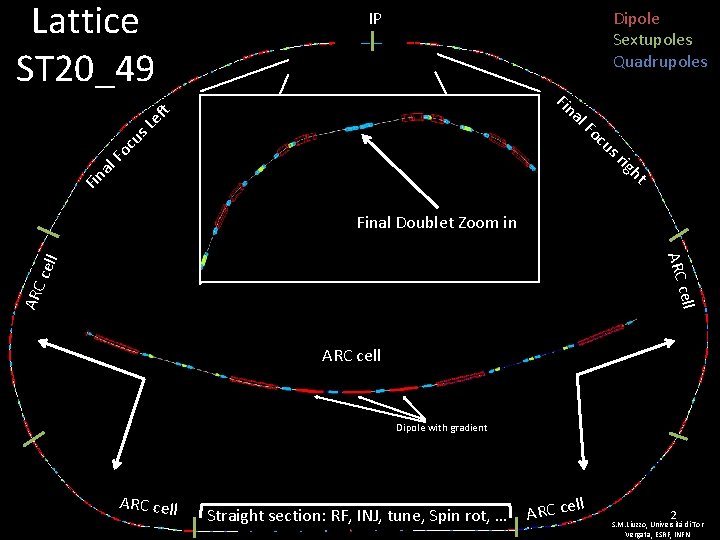
Dipole Sextupoles Quadrupoles IP Fin al Fo c us Le ft Lattice ST 20_49 cu sr igh t Final Doublet Zoom in cell ARC ARC cell Dipole with gradient ARC cell Straight section: RF, INJ, tune, Spin rot, … ARC ce ll 2 S. M. Liuzzo, Università di Tor Vergata, ESRF, INFN
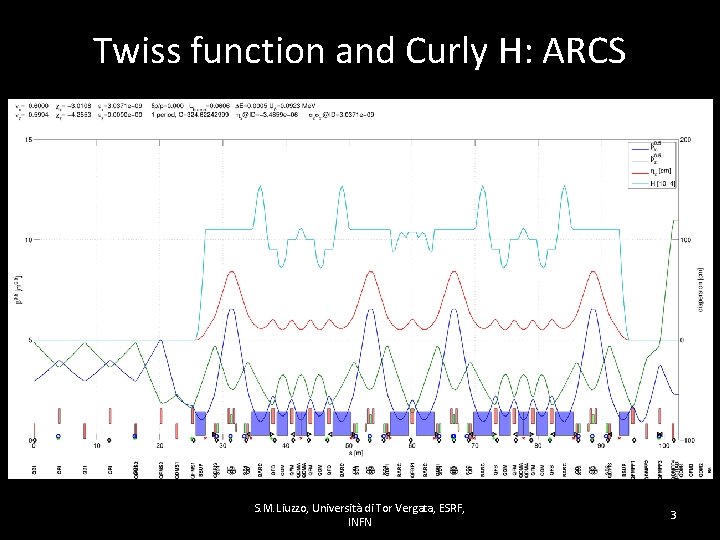
Twiss function and Curly H: ARCS S. M. Liuzzo, Università di Tor Vergata, ESRF, INFN 3
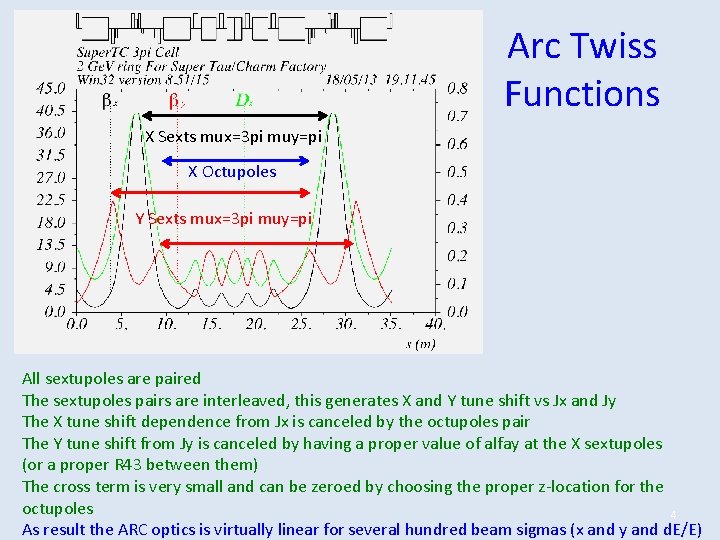
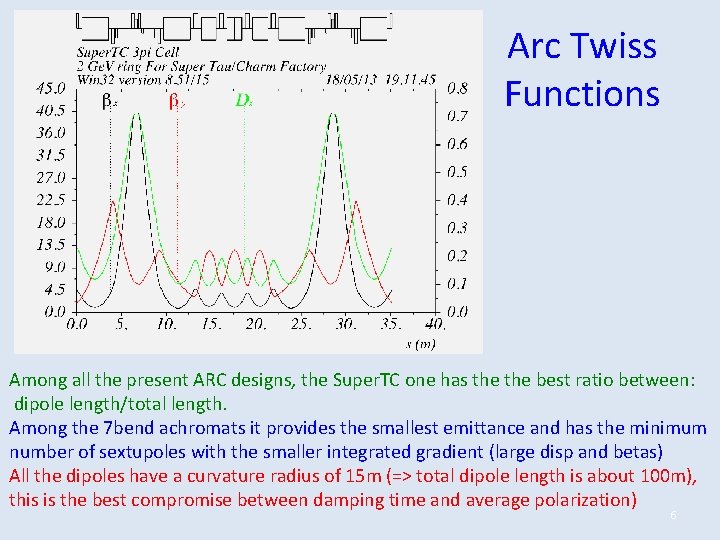
Arc Twiss Functions X Sexts mux=3 pi muy=pi X Octupoles Y Sexts mux=3 pi muy=pi All sextupoles are paired The sextupoles pairs are interleaved, this generates X and Y tune shift vs Jx and Jy The X tune shift dependence from Jx is canceled by the octupoles pair The Y tune shift from Jy is canceled by having a proper value of alfay at the X sextupoles (or a proper R 43 between them) The cross term is very small and can be zeroed by choosing the proper z-location for the octupoles 4 As result the ARC optics is virtually linear for several hundred beam sigmas (x and y and d. E/E)
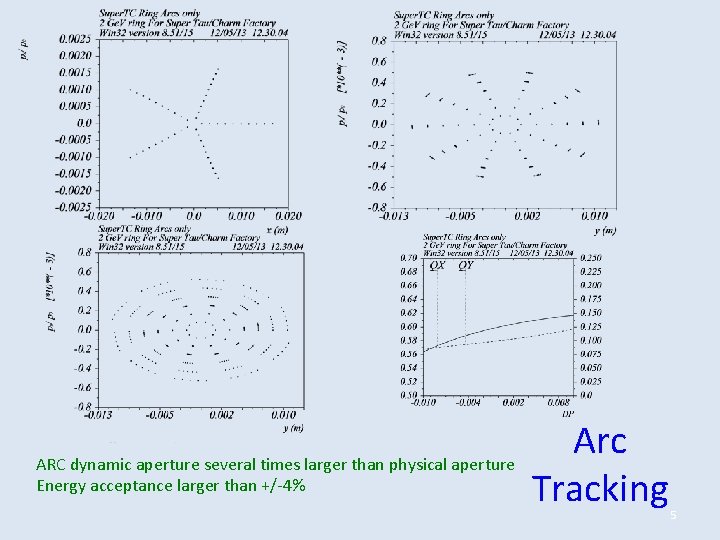
ARC dynamic aperture several times larger than physical aperture Energy acceptance larger than +/-4% Arc Tracking 5
Arc Twiss Functions Among all the present ARC designs, the Super. TC one has the best ratio between: dipole length/total length. Among the 7 bend achromats it provides the smallest emittance and has the minimum number of sextupoles with the smaller integrated gradient (large disp and betas) All the dipoles have a curvature radius of 15 m (=> total dipole length is about 100 m), this is the best compromise between damping time and average polarization) 6
Twiss function and Curly H: Final Focus S. M. Liuzzo, Università di Tor Vergata, ESRF, INFN 7
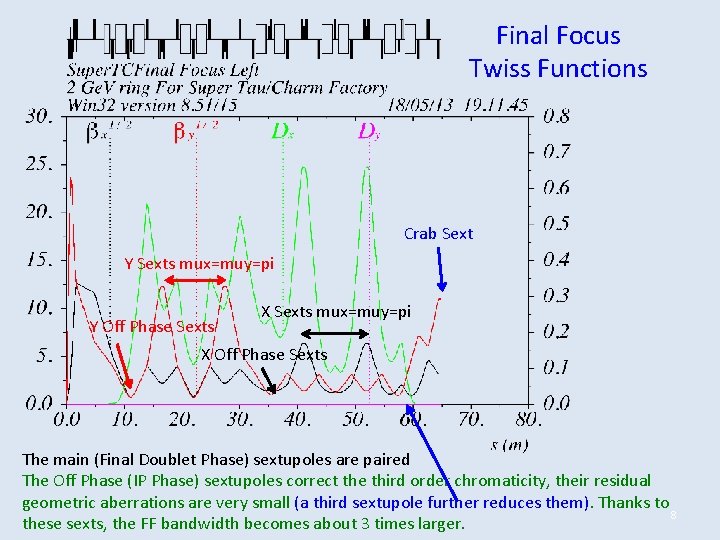
Final Focus Twiss Functions Crab Sext Y Sexts mux=muy=pi Y Off Phase Sexts X Sexts mux=muy=pi X Off Phase Sexts The main (Final Doublet Phase) sextupoles are paired The Off Phase (IP Phase) sextupoles correct the third order chromaticity, their residual geometric aberrations are very small (a third sextupole further reduces them). Thanks to 8 these sexts, the FF bandwidth becomes about 3 times larger.
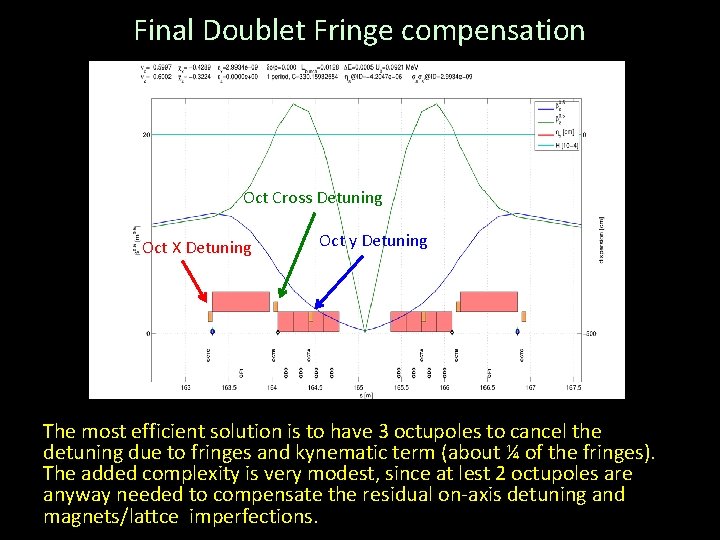
Final Doublet Twiss function The FD are very long and weak in order to minimize the effect of the fringe fields. 3 Octupoles per side (focusing: D-F-D) do locally cancel the tune shifts dependences from Jx/Jy (including the cross term), originated by the fringes and the kynematic terms in the IP area (details on next talk) 9
The Final Focus optic is a scaled down version of the Super. B one. The geometric constraints for the polarization are not necessary. The dipoles have fields very close (between 80 -100%) to the ARC ones in order to maximize the polarization (exact match not possible). The length of the dipoles is as long as possible to maximize the dispersion across the sextupoles. Further lengthening of the dipoles increases the FF Curl-H and its contribution to the overall emittance. The ARC emittance is about 2. 4 nm, including the FF the overall Ring emittance goes up to 2. 8 nm ( version st 20_55) 10
The straight sections opposite to the Final Focus will be modified in order to accommodate the injection section and the Siberian Snake. The ARC sextupoles can easily cope with the additional chromaticity. There is more than enough drift spaces left for the RF. Further drift spaces are available in the FF matching section (for Fbck, diag, etc. ) The vertical separation (necessary on the opposite side of the IP) can be made in different ways. The possibility of tilting sligthly the two rings (like in the Super. B) seems the easiest at the moment. The Basic Layout, the number and characteristics (size, field, etc) of the magnets are not going to change much when going to the TDR phase. The present lattice allows us a good estimate of the cost and performances of the Super. TC project 11
Minimization of the Dynamic Aperture reduction due to Fringe Fields and Crab Sextupoles in the Super Tau/Charm Pantaleo Raimondi La Biodola, May 27 -2013
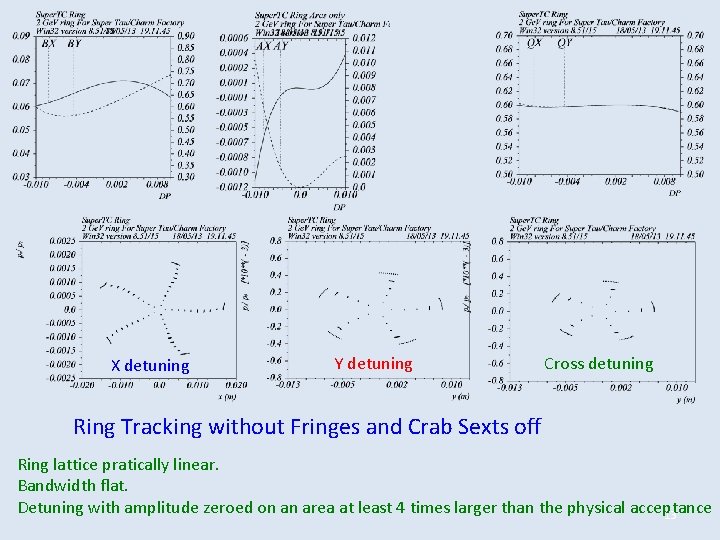
X detuning Y detuning Cross detuning Ring Tracking without Fringes and Crab Sexts off Ring lattice pratically linear. Bandwidth flat. Detuning with amplitude zeroed on an area at least 4 times larger than the physical acceptance 13
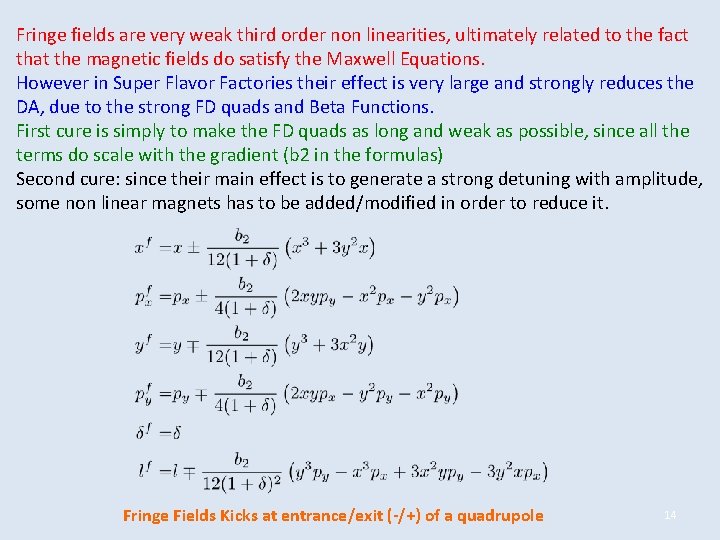
Fringe fields are very weak third order non linearities, ultimately related to the fact that the magnetic fields do satisfy the Maxwell Equations. However in Super Flavor Factories their effect is very large and strongly reduces the DA, due to the strong FD quads and Beta Functions. First cure is simply to make the FD quads as long and weak as possible, since all the terms do scale with the gradient (b 2 in the formulas) Second cure: since their main effect is to generate a strong detuning with amplitude, some non linear magnets has to be added/modified in order to reduce it. Fringe Fields Kicks at entrance/exit (-/+) of a quadrupole 14
Final Doublet Fringe compensation Oct Cross Detuning Oct X Detuning Oct y Detuning The most efficient solution is to have 3 octupoles to cancel the detuning due to fringes and kynematic term (about ¼ of the fringes). The added complexity is very modest, since at lest 2 octupoles are anyway needed to compensate the residual on-axis detuning and magnets/lattce imperfections.
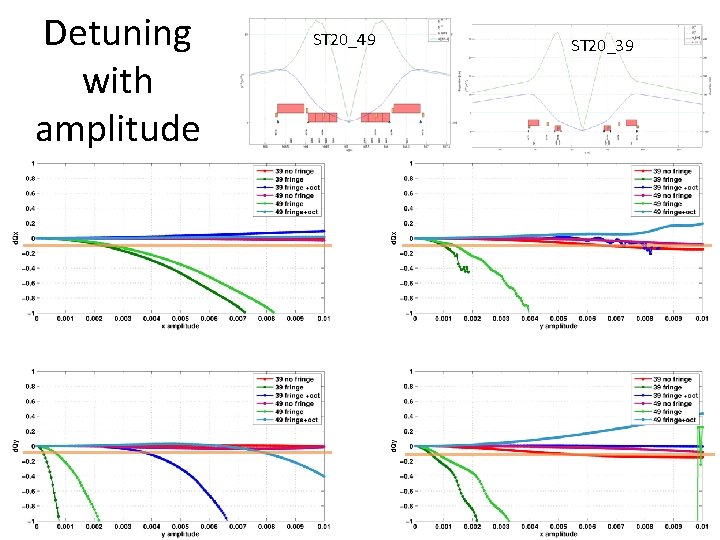
Detuning with amplitude ST 20_49 ST 20_39
The present solution is almost 100% effective in eliminating the DA reduction due to fringes and kynematic. In addition the octupoles can be optimized in order to reduce all the detuning due to lattice errors/imperfections on the real machine. The FD quads have to be very long and weak, this has disadvantages and advantages. Main disadvantage is that the IR becomes very busy. Advantages are: - Easier to make lower gradients and larger aperture magnets - Less SR and lower Critical Energy of the X-Rays E. Paoloni made a very nice first draft of the IR (see logo). More optimization seems possible and several solutions for the FD quads are under study (e. g. Permanent or Super. Conducting) 17
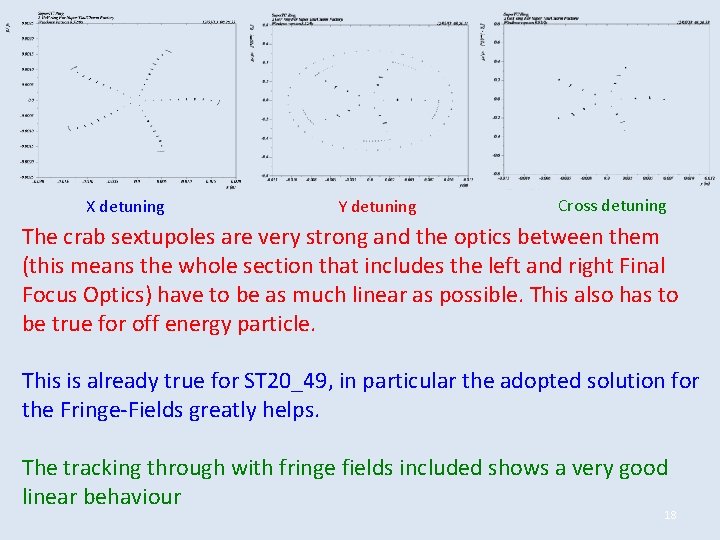
X detuning Y detuning Cross detuning The crab sextupoles are very strong and the optics between them (this means the whole section that includes the left and right Final Focus Optics) have to be as much linear as possible. This also has to be true for off energy particle. This is already true for ST 20_49, in particular the adopted solution for the Fringe-Fields greatly helps. The tracking through with fringe fields included shows a very good linear behaviour 18
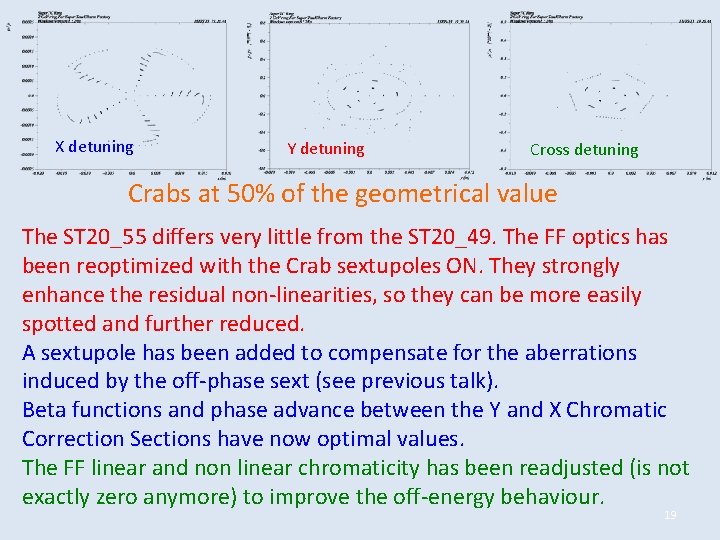
X detuning Y detuning Cross detuning Crabs at 50% of the geometrical value The ST 20_55 differs very little from the ST 20_49. The FF optics has been reoptimized with the Crab sextupoles ON. They strongly enhance the residual non-linearities, so they can be more easily spotted and further reduced. A sextupole has been added to compensate for the aberrations induced by the off-phase sext (see previous talk). Beta functions and phase advance between the Y and X Chromatic Correction Sections have now optimal values. The FF linear and non linear chromaticity has been readjusted (is not exactly zero anymore) to improve the off-energy behaviour. 19
The DA reduction due to the Crabs Sextupoles is still large, but the effect on the lifetime has not yet studied since the optimization (49=>55) is very recent. However the transverse acceptance (at full Crab) is still larger than the physical aperture and the energy acceptance is above +/-1% S. Liuzzo and M. Boscolo will analize and work on it. A further round of optimization (Simone/Eugene/Pavel/Anton etc. ) is needed. My general feeling/impression is that there are enough “tuning knobs” to trim (as done from st 20_49 to st 20_55) to obtain a solution with very good DA at optimal Crab Sexts strength (about 90% of the geometrical value). 20