
Summit Topic Lecture By Anika Mirza and Max

Summit Topic Lecture By: Anika Mirza and Max Hardt
Warm-up Activity Everyone writes a loose outline for a contention - It can be PRO or CON - After the lecture you will improve it based on what you learn - This is just for your learning don’t worry about how good your first idea is
Resolution Resolved: The United States should accede to the United Nations Convention on the Law of the Sea without reservations.
Definitions United States : impacts stem from only OUR action Should: used to indicate obligation, duty, or correctness It’s not WOULD so we aren’t discussing if it would pass through Congress. The resolution examines the desirability of a proposed action Sometimes called a policy resolution. Accede: assent or agree to a demand, request, or treaty. This means a FORMAL signing of the treaty. Shouldn’t be confused with more casual usages of the word accede. Implications: Accession of UNCLOS cannot include any exclusion or modifications of the legal effects of the treaty. “Without Reservations” : We don’t have doubts and are committed to following through on all the articles
United Nations Convention of the Law of the Sea Definition: “The Law of the Sea Treaty, formally known as the Third United Nations Convention on the Law of the Sea, or UNCLOS III, was adopted in 1982. Its purpose is to establish a comprehensive set of rules governing the oceans and to replace previous U. N. Conventions on the Law of the Sea, one in 1958 (UNCLOS I) and another in 1960 (UNCLOS II), that were believed to be inadequate. ” (http: //www. unlawoftheseatreaty. org/) Controversies: Potential confusion with UNCLOS I and II. Implications: All debates should concern the current UNCLOS, especially considering should is the verb of the sentence. Make sure if your opponents are reading old evidence it’s talking about the most recent UNCLOS
Partner Discussion - Turn to your partner and discuss the wording of the resolution - Is there anything you think could be debated in round? - Any questions you have? - Share your questions and observations with the group —throughout the lecture please feel free to ask questions : )
Background Definition: “Sovereignty, though its meanings have varied across history, also has a core meaning, supreme authority within a territory. (Stanford Encyclopedia of Philosophy) Implication: Ownership of natural Resources, Denial of movement, etc. Sovereignty of the Sea Freedom-of-the-Sea Doctrine (1609): jurisdiction over the sea is limited to a narrow strip surrounding the coastline – the rest is free-to-all Dutch philosopher Hugo Grotius wrote the foundation of international legal doctrine regarding the seas and oceans – Mare Liberum, a Latin title that translates to "freedom of the seas". The Grotian concept of "freedom of the sea" was only accepted after a century long debate between Grotius' ideas and John Selden's Made sense given technological limitations in the 17 th century ( inaccessible resources or unknown resources), thus customary international law prioritized freedom of movement.
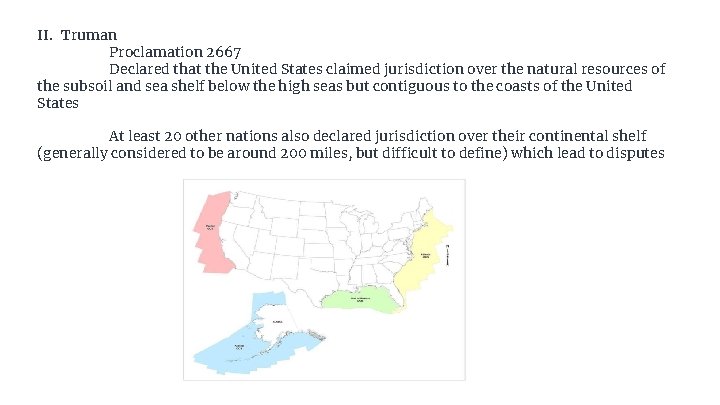
II. Truman Proclamation 2667 Declared that the United States claimed jurisdiction over the natural resources of the subsoil and sea shelf below the high seas but contiguous to the coasts of the United States At least 20 other nations also declared jurisdiction over their continental shelf (generally considered to be around 200 miles, but difficult to define) which lead to disputes
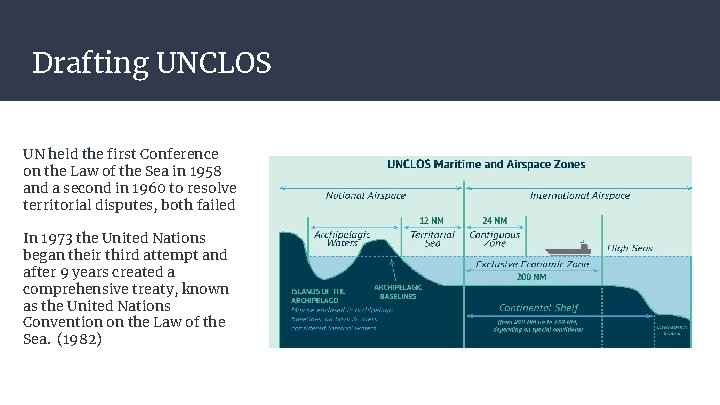
Drafting UNCLOS UN held the first Conference on the Law of the Sea in 1958 and a second in 1960 to resolve territorial disputes, both failed In 1973 the United Nations began their third attempt and after 9 years created a comprehensive treaty, known as the United Nations Convention on the Law of the Sea. (1982)
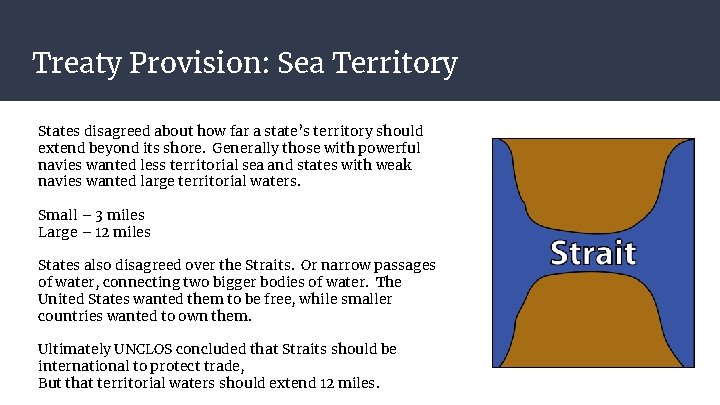
Treaty Provision: Sea Territory States disagreed about how far a state’s territory should extend beyond its shore. Generally those with powerful navies wanted less territorial sea and states with weak navies wanted large territorial waters. Small – 3 miles Large – 12 miles States also disagreed over the Straits. Or narrow passages of water, connecting two bigger bodies of water. The United States wanted them to be free, while smaller countries wanted to own them. Ultimately UNCLOS concluded that Straits should be international to protect trade, But that territorial waters should extend 12 miles.
Exclusive Economic Zone (EEZ) The exclusive economic zone is area beyond territorial water where states have the right to resources 200 miles This covers the vast majority of the earth’s vital hydrocarbons and fishing - 87% of the world’s hydrocarbons In return for rights over the EEZ – States agree to avoid overfishing and to preserve environments Some states continental shelf extend further than 200 – up to 350 but those with smaller continental shelf they still have the 200 miles UNCLOS requires payments for resources found beyond 200 miles—these are called royalities and the U. S. would probably have to pay billions if we joined (https: //www. heritage. org/report/law-the-seatreaty-bad-american-energy-policy? _ga=2. 195128424. 592166009. 1530124120169423055. 1530124120 )
International Seabed Authority (ISA) - Created by UNCLOS International organization established in 1994 to regulate sea mining that is beyond national jurisdiction (this includes most of the world’s oceans) The ISA is headquartered in Kingston, Jam. , and has more than 150 state members including the E. U. This is the organization that collects royalties The assembly establishes budgets, elects a 36 -member council, which serves as the ISA’s executive authority. - The council approves contracts with private corporations and government entities for exploration and mining in specified areas of the international seabed - Some people especially conservatives believe this organization will be hostile towards the U. S. - Some people believe the U. S. should join so we can get more mining rights
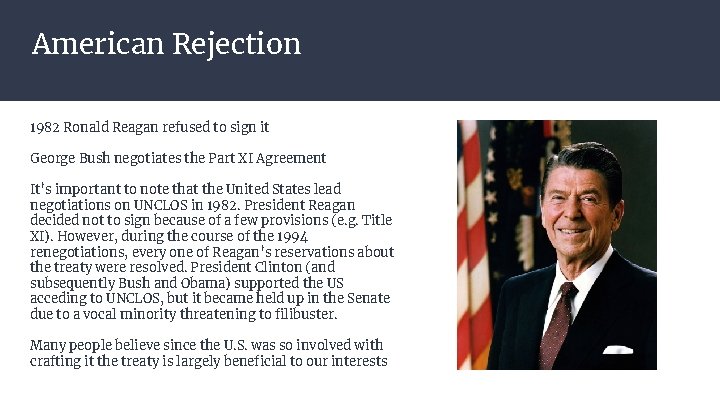
American Rejection 1982 Ronald Reagan refused to sign it George Bush negotiates the Part XI Agreement It’s important to note that the United States lead negotiations on UNCLOS in 1982. President Reagan decided not to sign because of a few provisions (e. g. Title XI). However, during the course of the 1994 renegotiations, every one of Reagan’s reservations about the treaty were resolved. President Clinton (and subsequently Bush and Obama) supported the US acceding to UNCLOS, but it became held up in the Senate due to a vocal minority threatening to filibuster. Many people believe since the U. S. was so involved with crafting it the treaty is largely beneficial to our interests
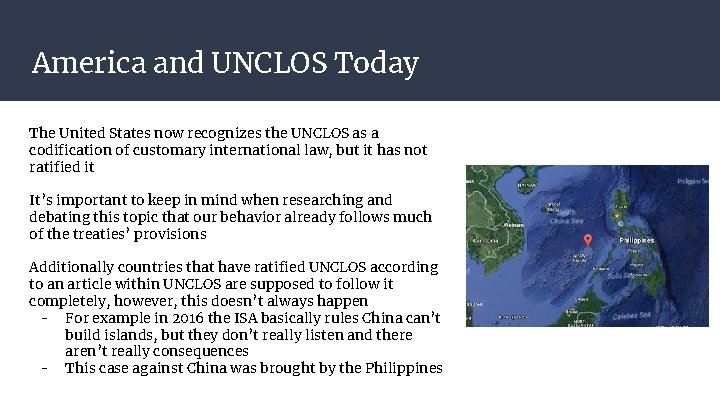
America and UNCLOS Today The United States now recognizes the UNCLOS as a codification of customary international law, but it has not ratified it It’s important to keep in mind when researching and debating this topic that our behavior already follows much of the treaties’ provisions Additionally countries that have ratified UNCLOS according to an article within UNCLOS are supposed to follow it completely, however, this doesn’t always happen - For example in 2016 the ISA basically rules China can’t build islands, but they don’t really listen and there aren’t really consequences - This case against China was brought by the Philippines
Pro Ideas? Discuss with a partner and then we will come together as a group
PRO Arguments - - The royalties collected by the ISA go to developing countries which could help their economies - Problem with this argument is there doesn’t appear to be that much transparency in terms of who the ISA gives money to It’s hypocritical and perceptually bad for us to critique China for not following UNCLOS and building islands when we haven’t even ratified it Multilateral initiatives are important. . . if we work with other countries through UNCLOS they may helps us with things like counter terrorism initiatives or climate change UNCLOS has many environmental regulations signatories have to abide by, which will help stop climate change Our companies will be more likely to drill in the Arctic which is good for our economy

Con Ideas? Discuss with a partner and then we will come together as a group
CON Arguments - China will become more aggressive if we join because they will see UNCLOS as an extension of U. S. hegemony which they hate The ISA will be aggressive towards are interest and we won’t get good mineral mining rights We have to give the ISA a lot of money in royalties which they can give to terrorist affiliated countries or corrupt countries Currently most of our oil companies aren’t drilling in the Arctic because they have no way to resolve disputes with other companies and countries - If we ratify UNCLOS they will start drilling and that’s really bad for the environment - Responses: companies aren’t drilling right now because the price of oil is relatively low ($70 -$80), so it isn’t worth the financial risk
What were your original ideas? How (if at all) did they change after hearing our lecture?
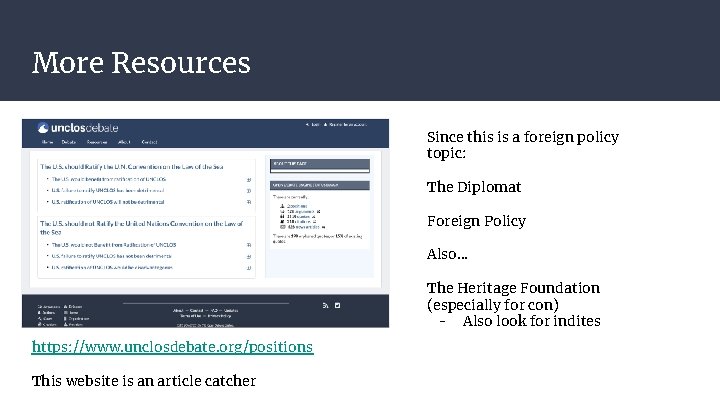
More Resources Since this is a foreign policy topic: The Diplomat Foreign Policy Also. . . The Heritage Foundation (especially for con) - Also look for indites https: //www. unclosdebate. org/positions This website is an article catcher

Thank you!
- Slides: 21