
Summer Project Presentation Presented by Mehmet Eser Advisors
Summer Project Presentation Presented by: Mehmet Eser Advisors : Dr. Bahram Parvin Associate Prof. George Bebis
Introduction w What is morphing ? w In what areas is morphing used ? w What methods are used for morphing for solid shapes? Lawrence Berkeley National Laboratory & UNR Computer Vision Laboratory
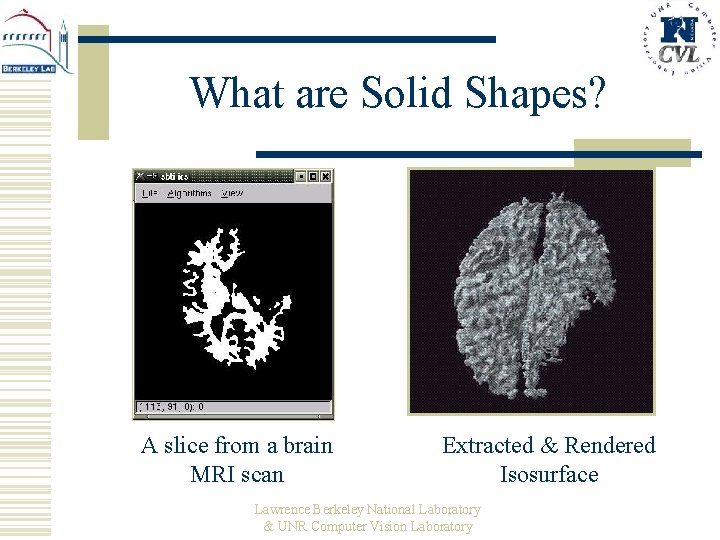
What are Solid Shapes? A slice from a brain MRI scan Extracted & Rendered Isosurface Lawrence Berkeley National Laboratory & UNR Computer Vision Laboratory
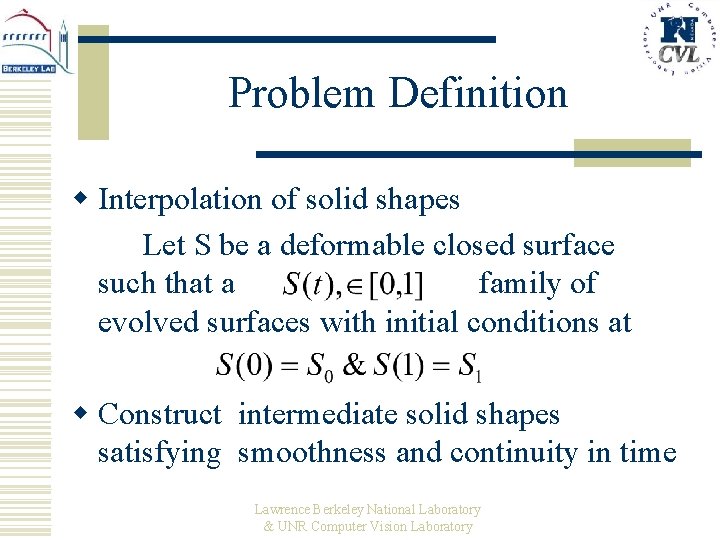
Problem Definition w Interpolation of solid shapes Let S be a deformable closed surface such that a family of evolved surfaces with initial conditions at w Construct intermediate solid shapes satisfying smoothness and continuity in time Lawrence Berkeley National Laboratory & UNR Computer Vision Laboratory
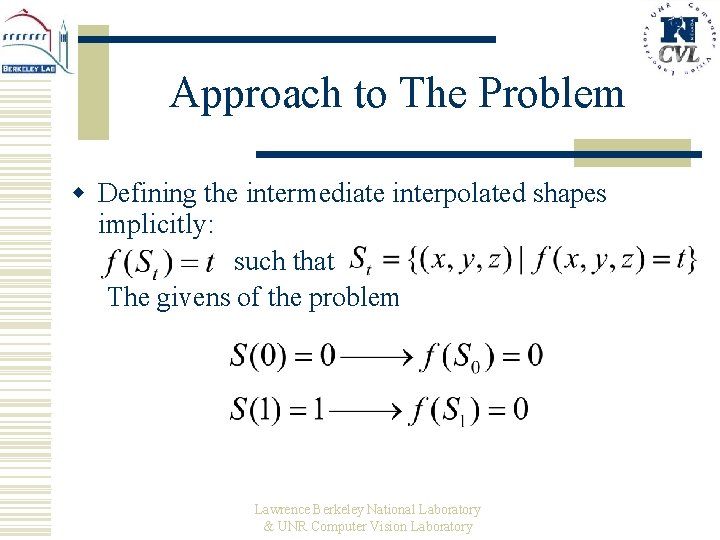
Approach to The Problem w Defining the intermediate interpolated shapes implicitly: such that The givens of the problem Lawrence Berkeley National Laboratory & UNR Computer Vision Laboratory
Regularization Method w A numerical solution method w Applied to the ill-posed problems w The original problem is converted into a wellposed problem by satisfying some smoothness constraint. w A smoothing parameter which controls the tradeoff between an error term and the amount of smoothing (regularization) Lawrence Berkeley National Laboratory & UNR Computer Vision Laboratory
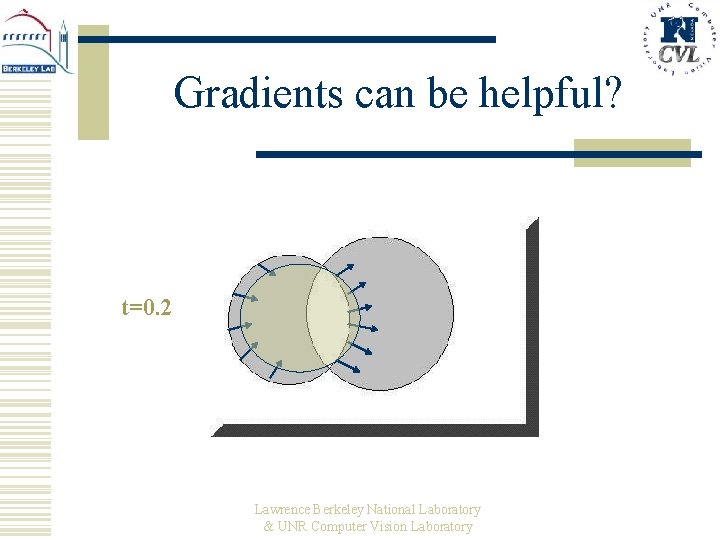
Gradients can be helpful? t=0. 2 Lawrence Berkeley National Laboratory & UNR Computer Vision Laboratory
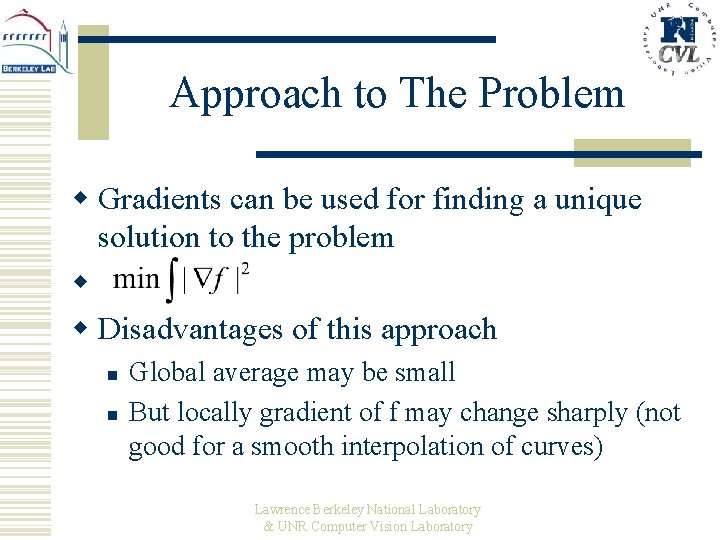
Approach to The Problem w Gradients can be used for finding a unique solution to the problem w w Disadvantages of this approach n n Global average may be small But locally gradient of f may change sharply (not good for a smooth interpolation of curves) Lawrence Berkeley National Laboratory & UNR Computer Vision Laboratory
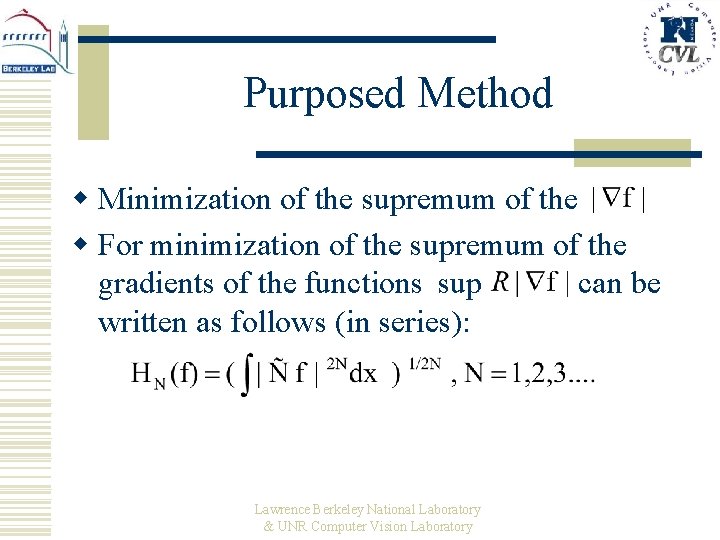
Purposed Method w Minimization of the supremum of the w For minimization of the supremum of the gradients of the functions sup can be written as follows (in series): Lawrence Berkeley National Laboratory & UNR Computer Vision Laboratory
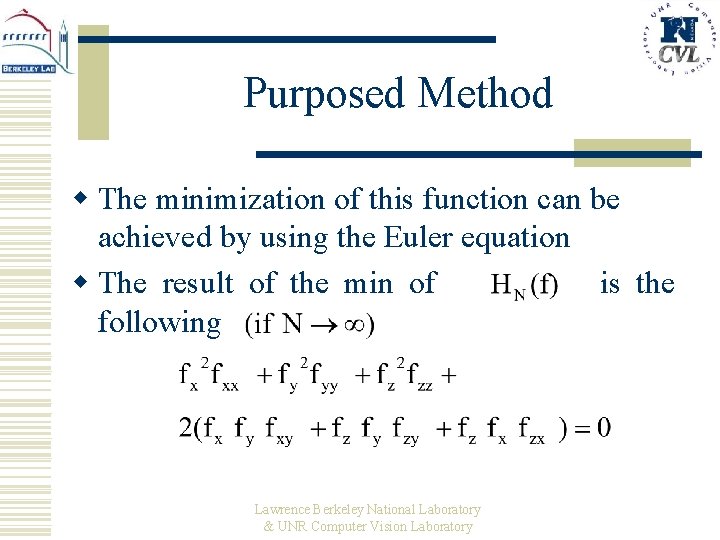
Purposed Method w The minimization of this function can be achieved by using the Euler equation w The result of the min of is the following Lawrence Berkeley National Laboratory & UNR Computer Vision Laboratory
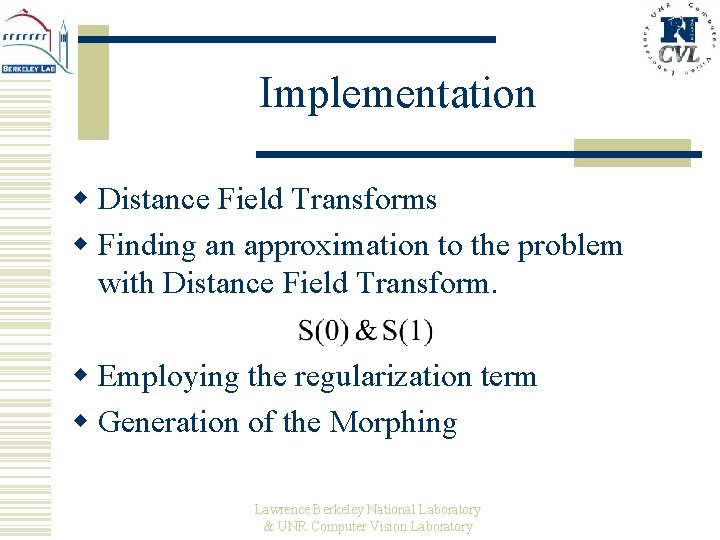
Implementation w Distance Field Transforms w Finding an approximation to the problem with Distance Field Transform. w Employing the regularization term w Generation of the Morphing Lawrence Berkeley National Laboratory & UNR Computer Vision Laboratory
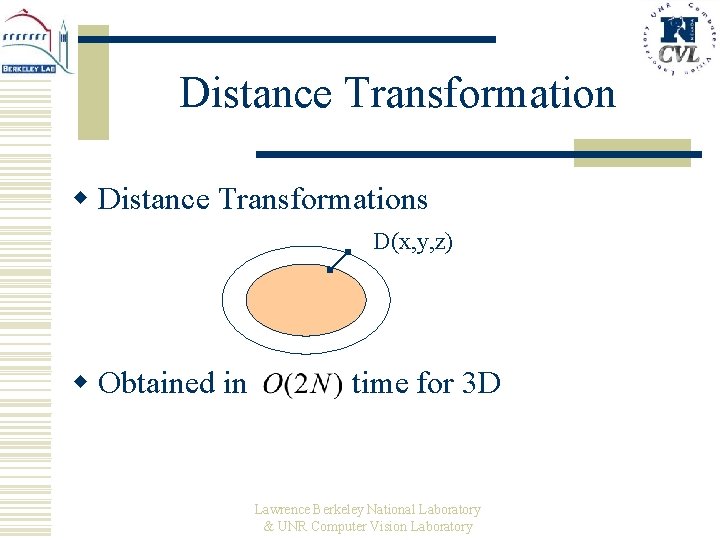
Distance Transformation w Distance Transformations D(x, y, z) w Obtained in time for 3 D Lawrence Berkeley National Laboratory & UNR Computer Vision Laboratory
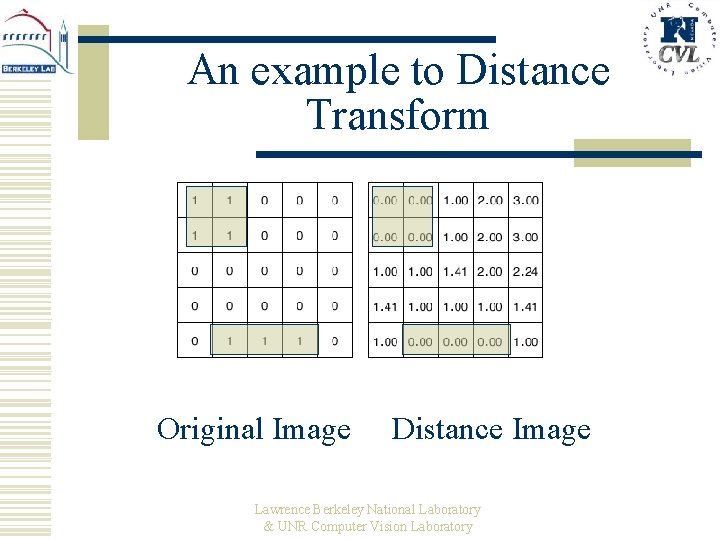
An example to Distance Transform Original Image Distance Image Lawrence Berkeley National Laboratory & UNR Computer Vision Laboratory
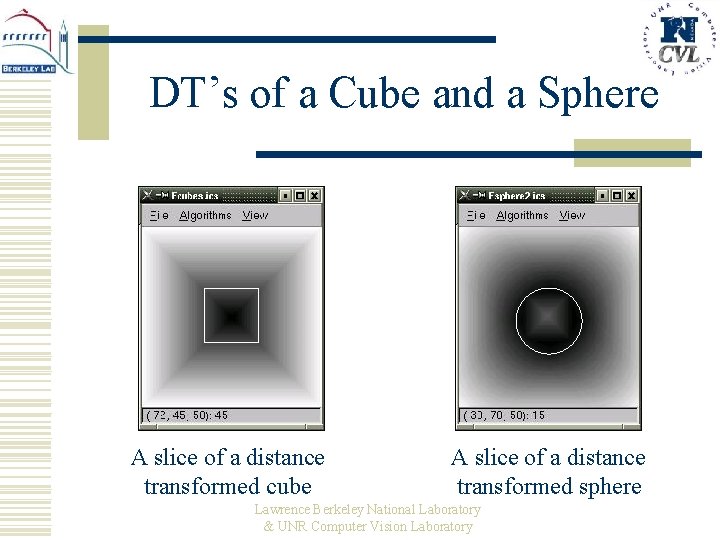
DT’s of a Cube and a Sphere A slice of a distance transformed cube A slice of a distance transformed sphere Lawrence Berkeley National Laboratory & UNR Computer Vision Laboratory
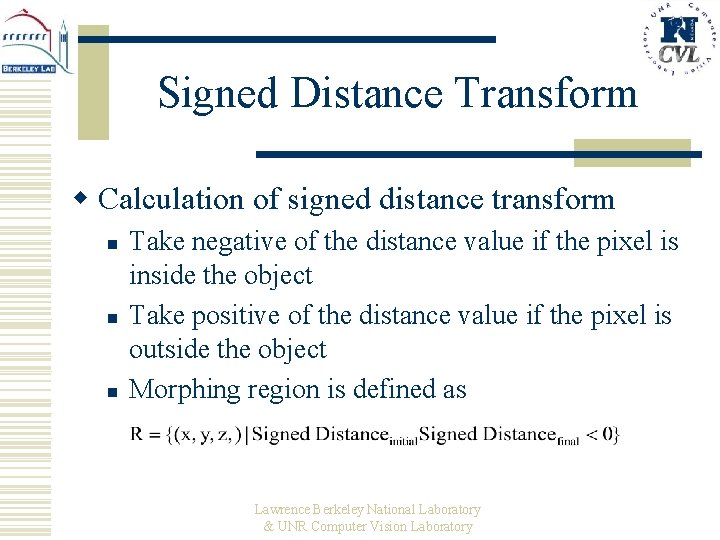
Signed Distance Transform w Calculation of signed distance transform n n n Take negative of the distance value if the pixel is inside the object Take positive of the distance value if the pixel is outside the object Morphing region is defined as Lawrence Berkeley National Laboratory & UNR Computer Vision Laboratory
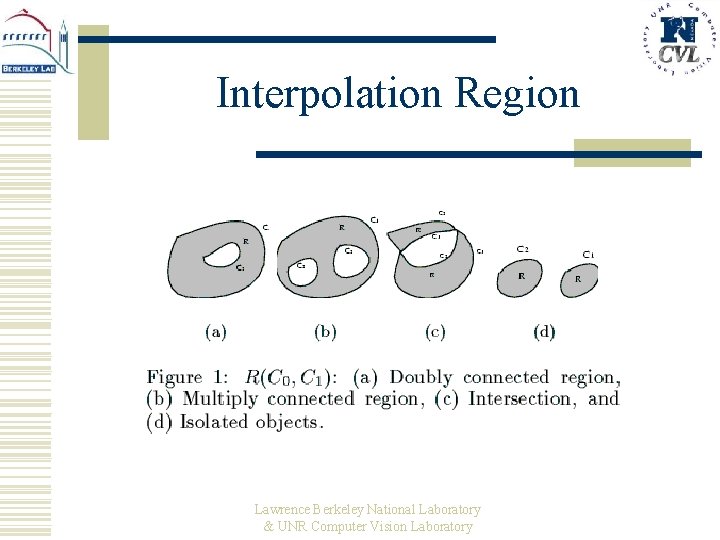
Interpolation Region Lawrence Berkeley National Laboratory & UNR Computer Vision Laboratory
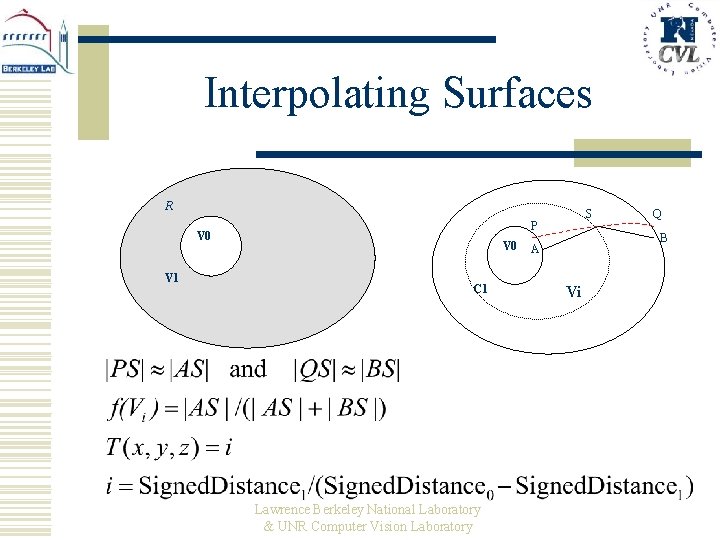
Interpolating Surfaces R V 0 V 1 S P V 0 C 1 Lawrence Berkeley National Laboratory & UNR Computer Vision Laboratory Q B A Vi
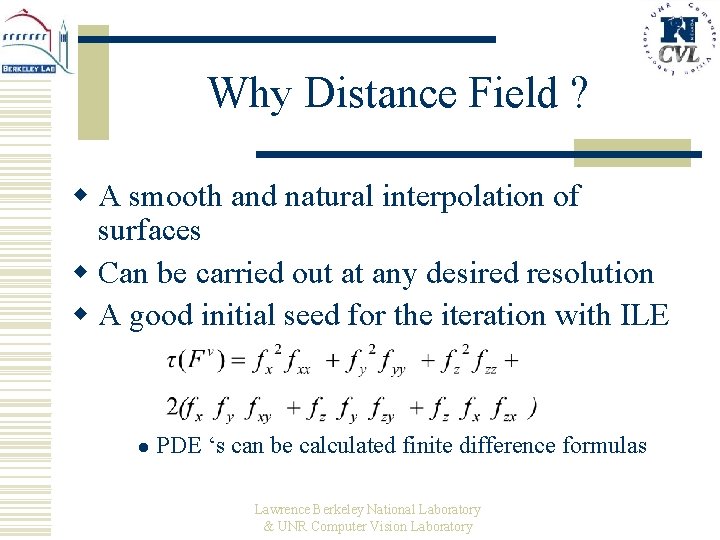
Why Distance Field ? w A smooth and natural interpolation of surfaces w Can be carried out at any desired resolution w A good initial seed for the iteration with ILE l PDE ‘s can be calculated finite difference formulas Lawrence Berkeley National Laboratory & UNR Computer Vision Laboratory
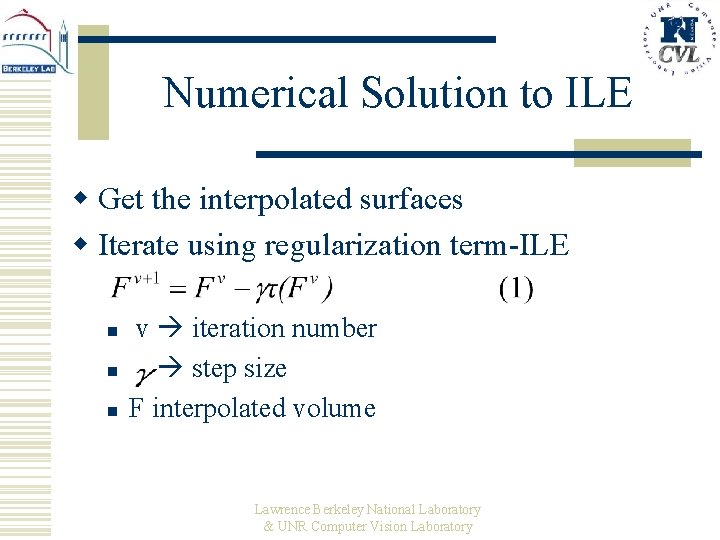
Numerical Solution to ILE w Get the interpolated surfaces w Iterate using regularization term-ILE n n n v iteration number step size F interpolated volume Lawrence Berkeley National Laboratory & UNR Computer Vision Laboratory
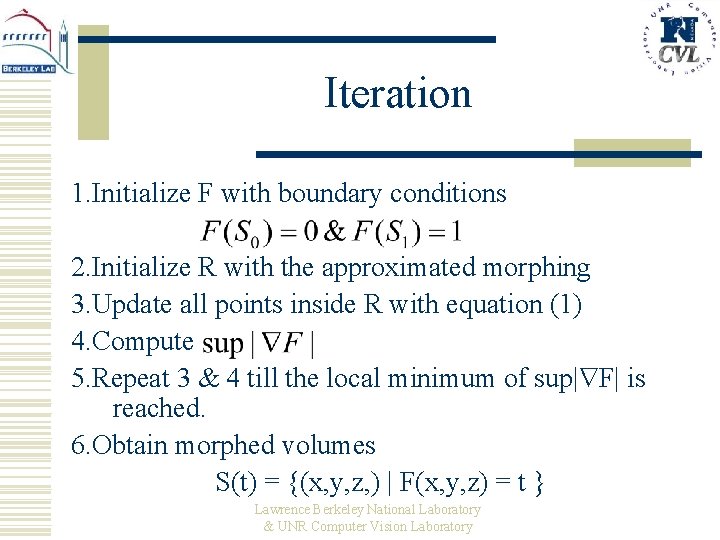
Iteration 1. Initialize F with boundary conditions 2. Initialize R with the approximated morphing 3. Update all points inside R with equation (1) 4. Compute 5. Repeat 3 & 4 till the local minimum of sup| F| is reached. 6. Obtain morphed volumes S(t) = {(x, y, z, ) | F(x, y, z) = t } Lawrence Berkeley National Laboratory & UNR Computer Vision Laboratory
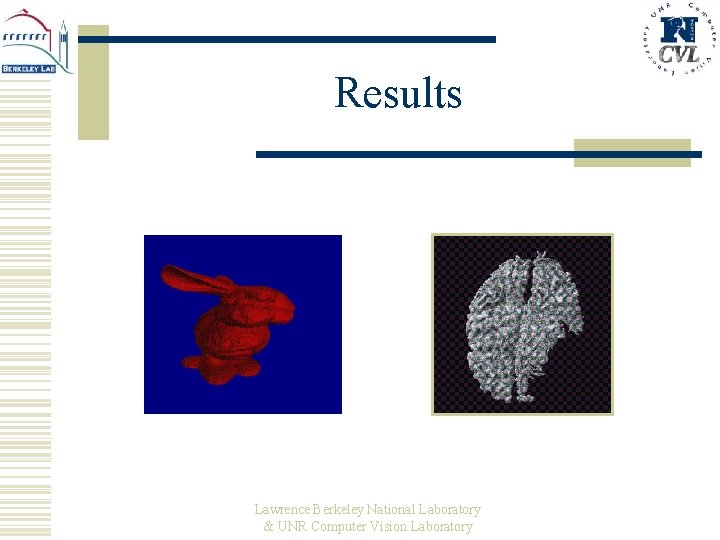
Results Lawrence Berkeley National Laboratory & UNR Computer Vision Laboratory
Special Thanks to National Science Foundation (NFS) UNR Computer Vision Laboratory (Assoc. Prof. George Bebis lead) LBL Vision Group (Dr. Bahram Parvin lead)
- Slides: 22