
Summer Emergencies Pacemakers Quick Trach APRIL 2015 CE

- Slides: 107
Summer Emergencies Pacemakers Quick Trach APRIL 2015 CE CONDELL MEDICAL CENTER EMS SYSTEM SITE CODE: 107200 E-1215 Prepared by: Sharon Hopkins, RN, BSN 1 Revised 4. 16. 15
Objectives Upon successful completion of this module, the EMS provider will be able to: 1. Distinguish the difference between heat cramps, heat exhaustion, and heatstroke. 2. List the steps of assessment for the patient involved in water emergencies. 3. Analyze signs and symptoms to determine the level of allergic reaction a patient is experiencing. 4. Actively participate in review of selected Region X SOP’s as related to the topics presented. 2
Objectives cont’d 5. Review pacemaker rhythms. 6. Actively participate in case scenario discussion. 7. Actively participate at the paramedic level in return demonstration of insertion of the Quick Trach. 8. Actively participate in ventilating a manikin at the appropriate ventilation rate for the situation. 9. Successfully complete the post quiz with a score of 80% or better. 3
Thermoregulation The ability to maintain or regulate a steady body temperature despite changes to the environment Hypothalamus at base of brain regulates temperature You can lose or gain heat from and within the body itself You can lose or gain heat by contact with the external environment The body’s core/normal temperature of deep tissues is normally 370 C or 98. 60 F 4
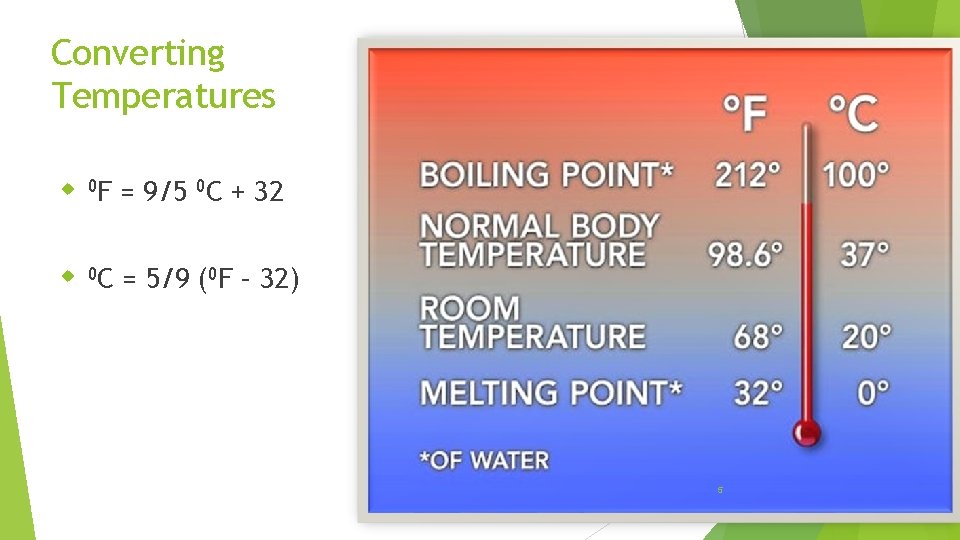
Converting Temperatures 0 F = 9/5 0 C + 32 0 C = 5/9 (0 F – 32) 5
Thermal Gradient The difference in temperature between the environment (also called the ambient temperature) and the body Heat flows from the warmer environment (higher temp) to the cooler environment (lower temp) Wind and relative humidity (percent of water vapor in the air) affect heat gain and loss 6
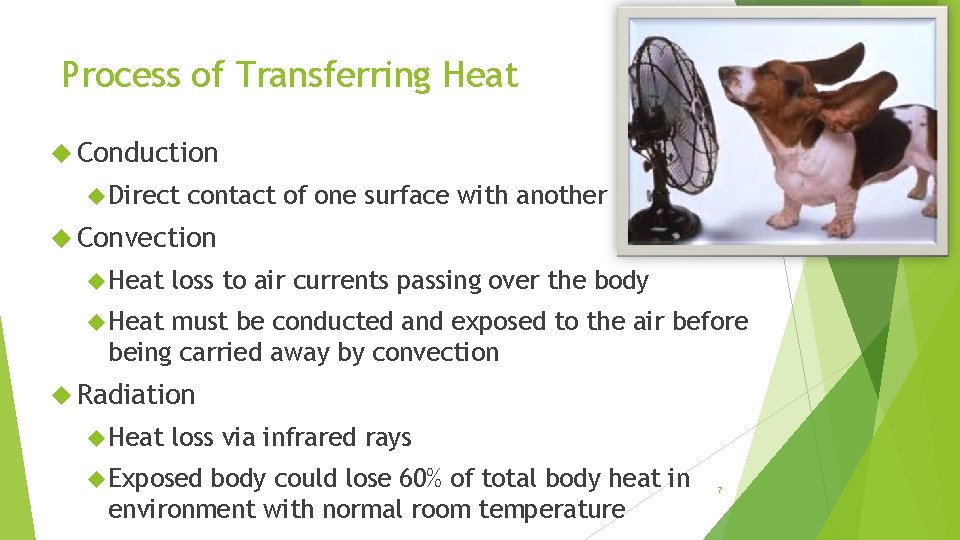
Process of Transferring Heat Conduction Direct contact of one surface with another Convection Heat loss to air currents passing over the body Heat must be conducted and exposed to the air before being carried away by convection Radiation Heat loss via infrared rays Exposed body could lose 60% of total body heat in environment with normal room temperature 7
Transfer of Heat cont’d Evaporation Change Water Heat of a liquid to a vapor or sweat evaporates from skin loss is great via evaporation of fluids from the lungs Normal water loss from the skin and lungs is approximately 600 ml per day 8
Transfer of Heat cont’d Respiration Combines the mechanics of convection, radiation, and evaporation Accounts for a large proportion of heat loss Heat transfers from body to inspired air via convection and radiation Evaporation process in lungs humidifies inspired air During expiration, humidified air released to the environment creating on-going heat loss 9
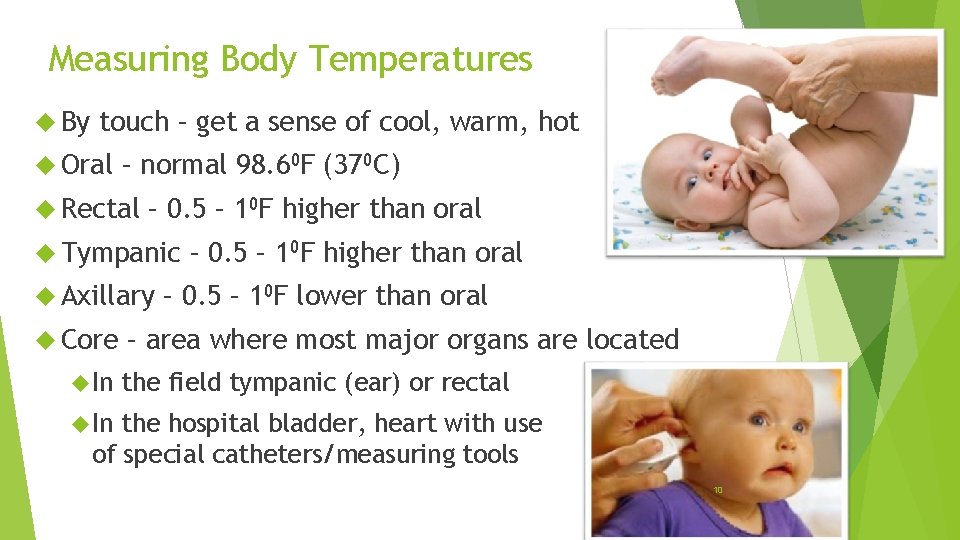
Measuring Body Temperatures By touch – get a sense of cool, warm, hot Oral – normal 98. 60 F (370 C) Rectal – 0. 5 – 10 F higher than oral Tympanic Axillary Core In – 0. 5 – 10 F higher than oral – 0. 5 – 10 F lower than oral – area where most major organs are located the field tympanic (ear) or rectal In the hospital bladder, heart with use of special catheters/measuring tools 10
Homeostasis Process Body of maintaining constant suitable conditions functions within small ranges of “normal” Hypothalamus at base of brain responsible for temperature regulation (i. e. : the “thermostat”) Body constantly compensating to maintain “normal” Core and peripheral temperatures Oxygen Energy levels supplies 11
Homeostasis of Core Temperature Body continually adjusting metabolic rate The rate in which the body consumes energy to maintain function required at the time Energy production = heat production Temperature controlled by dilating or constricting blood vessels Dilation of blood vessels – flushed skin Constriction of blood vessels – pale skin 12
Temperature Control To decrease the body temperature Blood vessels dilate to expose more vessel surface space to the skin Excess heat carried from core to the periphery close to the skin; heat dissipates from skin to environment To increase body temperature Blood vessels constrict to shunt warm blood away from superficial veins near skin and back into deeper veins near the core Shivering heat increases the metabolic rate and generates 13
Risk Factors Impacting Environmental Illness Age Especially Poor very young and elderly general health Fatigue Predisposing medical conditions (i. e. : Diabetes – damages autonomic nervous system & interferes with thermoregulatory input) Certain Level meds – prescription and OTC of acclimatization – adjustment to the environment 14
Factors Influencing Impact of Environmental Challenges Length of exposure Intensity of exposure Environmental Humidity Wind factors – influences evaporation rate – influences convection 15
Heat Emergencies - Hyperthermia Condition involving unusually high body core temperatures Usually involves a transfer of heat from the external environment Could include excessive heat production within the body Could occur with use/abuse of certain medications Malignant hyperthermia is a severe response to use of certain anesthetics 16
Eliminating Excessive Heat Body’s attempt to eliminate excessive heat: ü Diaphoresis – due to sweating mechanism Evaporation process to reduce the temperature ü Increased skin temperature to touch – due to vasodilation Moves more blood volume to the skin surface to induce radiation, conduction, convection ü Flushing due to vasodilation process 17
Heat Cramps / Muscle Cramps Caused by overexertion and dehydration in high temperature situations Sweating Sodium is a response to lower the body temperature (salt) is transported to the skin Water follows sodium Water on skin surface cools body via evaporation 18
Heat Cramps cont’d Loss of electrolytes due to sweating Can cause intermittent skeletal muscle cramping üExtremities üAbdominal muscles Patient generally remains alert and complains of weakness 19
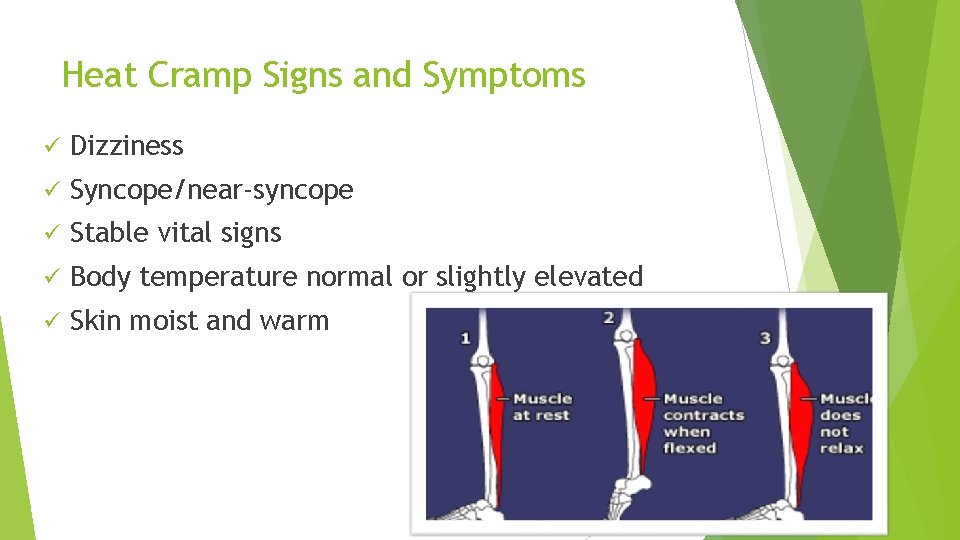
Heat Cramp Signs and Symptoms ü Dizziness ü Syncope/near-syncope ü Stable vital signs ü Body temperature normal or slightly elevated ü Skin moist and warm 20
Treatment Heat Cramps Consider Aim what is making the patient symptomatic your therapy at the source of the problem Remove from the offending environment Remove clothing as necessary to facilitate cooling Patient education goals Cooling techniques Appropriate hydration guidelines 21
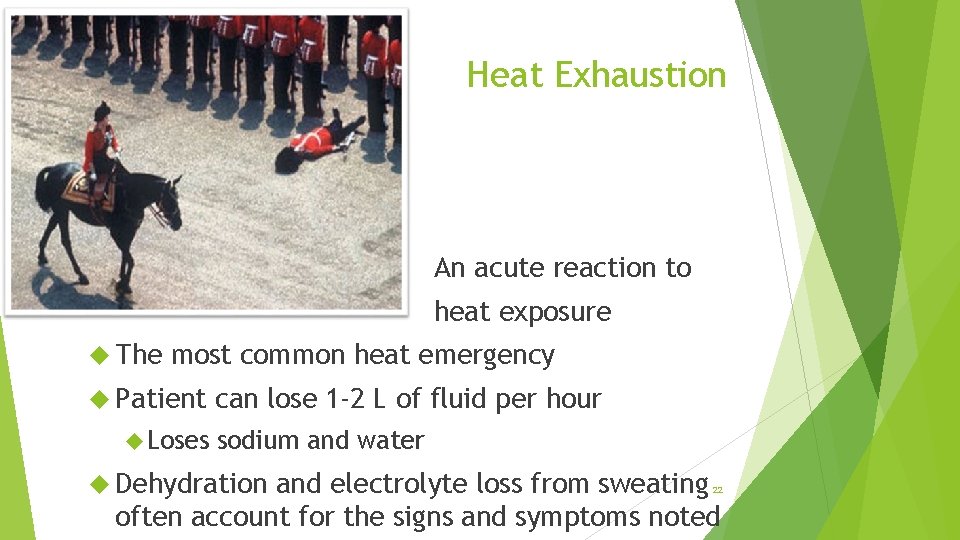
Heat Exhaustion An acute reaction to heat exposure The most common heat emergency Patient Loses can lose 1 -2 L of fluid per hour sodium and water Dehydration and electrolyte loss from sweating often account for the signs and symptoms noted 22
Heat Exhaustion – Body Responses General vasodilation Pooling of blood volume mimics a decrease in blood volume Leads to a decrease in cardiac output History of exposure to a heated environment helps with the diagnosis If treatment is not instituted, the patient may progress to heat stroke 23
Signs and Symptoms Heat Exhaustion Increased body temperature (>37. 80 C / 1000 F) or Cool and clammy with heavy perspiration Rapid and shallow respirations Weak pulse Diarrhea Muscle cramps Weakness May have loss of consciousness 24
Forming Your General Impression History and assessment very important Need clues to determine a working diagnosis to know which treatment plan to institute In the presence of the following CNS signs &/or symptoms consider interventions for heat stroke ü Headache ü Anxiety ü Paresthesia ü Impaired ü Psychosis - pins and needles sensation judgment 25
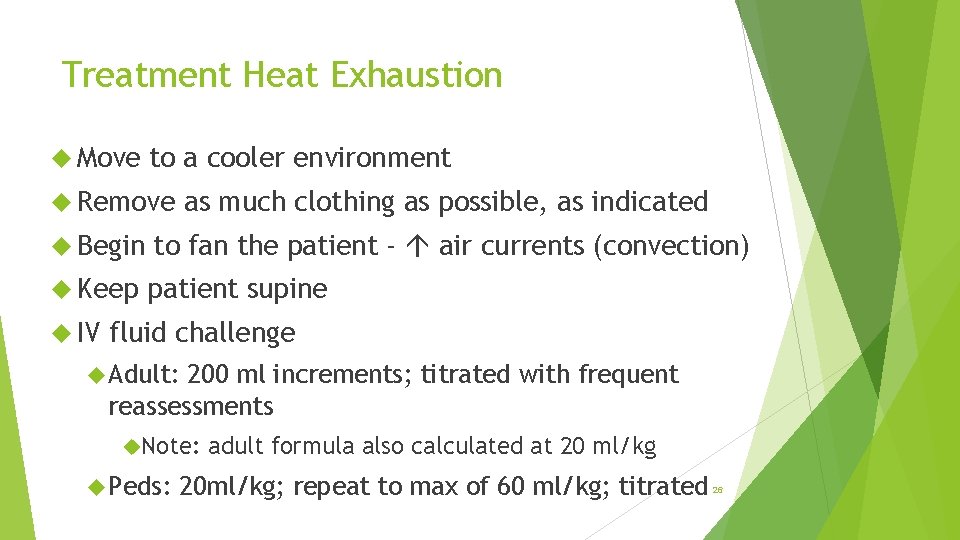
Treatment Heat Exhaustion Move to a cooler environment Remove as much clothing as possible, as indicated Begin to fan the patient - air currents (convection) Keep patient supine IV fluid challenge Adult: 200 ml increments; titrated with frequent reassessments Note: Peds: adult formula also calculated at 20 ml/kg 20 ml/kg; repeat to max of 60 ml/kg; titrated 26
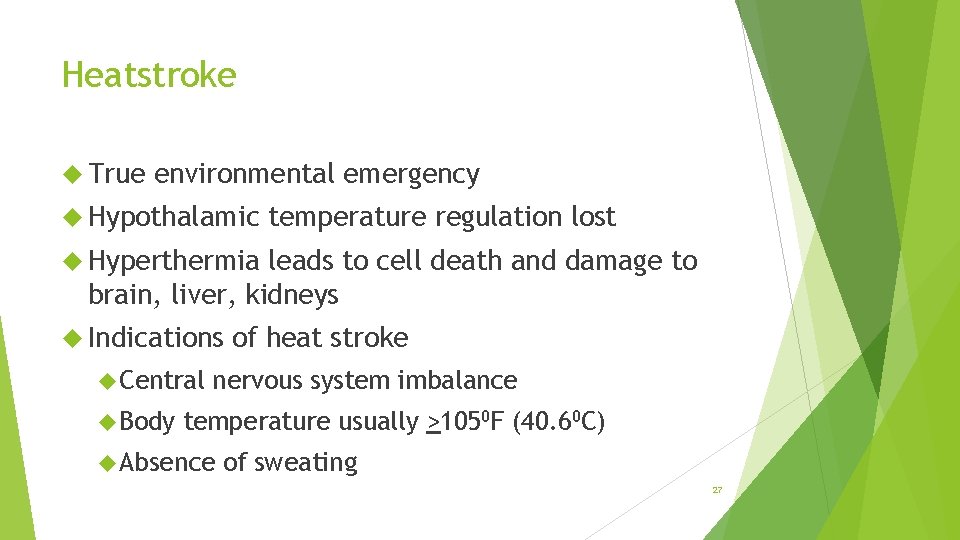
Heatstroke True environmental emergency Hypothalamic temperature regulation lost Hyperthermia leads to cell death and damage to brain, liver, kidneys Indications Central Body of heat stroke nervous system imbalance temperature usually >1050 F (40. 60 C) Absence of sweating 27
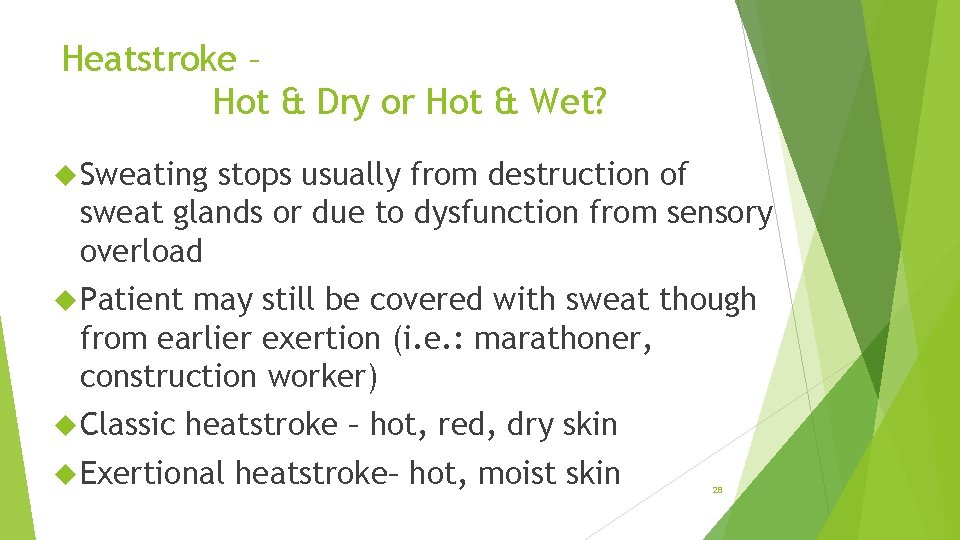
Heatstroke – Hot & Dry or Hot & Wet? Sweating stops usually from destruction of sweat glands or due to dysfunction from sensory overload Patient may still be covered with sweat though from earlier exertion (i. e. : marathoner, construction worker) Classic heatstroke – hot, red, dry skin Exertional heatstroke– hot, moist skin 28
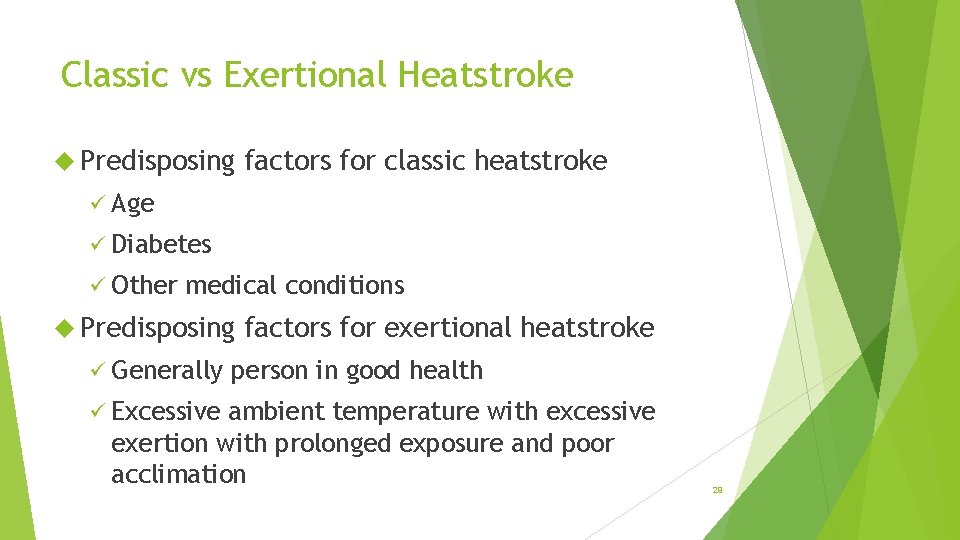
Classic vs Exertional Heatstroke Predisposing factors for classic heatstroke ü Age ü Diabetes ü Other medical conditions Predisposing ü Generally factors for exertional heatstroke person in good health ü Excessive ambient temperature with excessive exertion with prolonged exposure and poor acclimation 29
Exertional Heatstroke – Big Problems Severe From metabolic acidosis excessive lactic acid accumulation Lactic acid develops as by-product during anaerobic metabolism Hyperkalemia – excessive potassium moved from the cell into the bloodstream Released from injured cells or created due to renal failure (poor clearing capability) or development of metabolic acidosis 30
Signs and Symptoms Heatstroke Hot skin that is dry or moist Very high core temperature Deep respirations (blowing off acids) that become shallow, rapid and later slow Rapid, full pulse initially then slow Hypotension Confusion with low or absent diastolic or disorientation or unconsciousness CNS impairment – headache, anxiety, impaired judgment, paresthesia, psychosis Possible seizures 31
Treatment Heat Stroke Move patient to cool environment Remove Fluid unnecessary clothing challenge Adult Peds Rapid 20 ml/kg to a max of 60 ml/kg cooling procedures Douse Fan 200 ml increments (formula 20 ml/kg) towels or sheets with water and place over patient body – increases air current flow (convection) Cold packs to lateral chest wall, groin, axilla, neck, temples, behind knees 32
Shivering Can To raises body core temperature occur in the setting of too rapid of a cooling process stop shivering Adult: Can Peds: Total repeat same dose in 2 minutes titrated to the max Valium 0. 2 mg/kg over 2 minutes Can Total Valium 5 mg IVP/IO over 2 minutes repeat same dose in 15 minutes titrated to the maximum is 10 mg for the adult max for peds is 5 mg (<5 years old) and 10 mg (>5 y/o) 33
Water Emergencies Drowning Respiratory impairment from submersion or immersion in a liquid Outcome Mortality – death Morbidity – developing a medical problem No A morbidity – no problem leading cause of death in children Most drownings occur in freshwater – the swimming pool 34
Sequence of Events of Drowning Submersion Struggle with attempt at breath holding Instinctive Water Apnea inspiratory and swallowing efforts made enters mouth, posterior oropharynx, and stomach causes rise in retained CO 2 levels; decrease in O 2 Hypoxia stimulates trigger to gasp Acidosis is developing Reflexive laryngospasm and bronchospasm occur Minimizes amount of water actually measured in lungs 35
Sequence cont’d Reflex swallowing continues Gastric distension, for vomiting and aspiration Hypotension, bradycardia then death occur Water enters lungs (before laryngospasm or after laryngeal relaxation) Water in airways blocks gas exchange in alveoli Even small amount of water washes away surfactant Atelectasis develops (alveolar collapse) 36
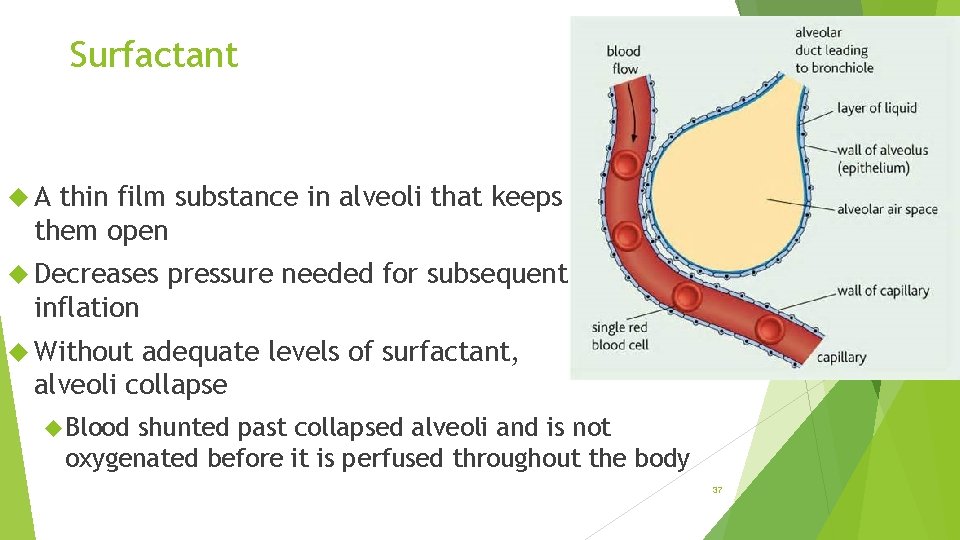
Surfactant A thin film substance in alveoli that keeps them open Decreases pressure needed for subsequent inflation Without adequate levels of surfactant, alveoli collapse Blood shunted past collapsed alveoli and is not oxygenated before it is perfused throughout the body 37
Drowning Outcome Goal determined by degree of anoxia of therapy directed at reversing anoxia Prehospital interventions and treatment is the same regardless of the source of the drowning – freshwater versus saltwater 38
Factors Affecting Survival Cleanliness Length Age of water source of time submerged of victim General health status of victim Positive influence on outcome – immediate recognition of the drowning and initiation of immediate CPR 39
Treatment Near Drowning Routine Spinal medical care precautions Consider CPAP in the adult if indicated If stable (awake, alert, warm and dry, B/P >90 in adult, then transport 40
Treatment Near Drowning cont’d Anticipate need for ventilation support Anticipate vomitus and laryngospasms Suction available for vomitus Positive pressure ventilations (i. e. : BVM) for laryngospasms Many drowning victims may have foaming present Focus on oxygenation and ventilation more than on suctioning Protect the patient from heat loss Remove wet clothing, cover body as much as possible 41
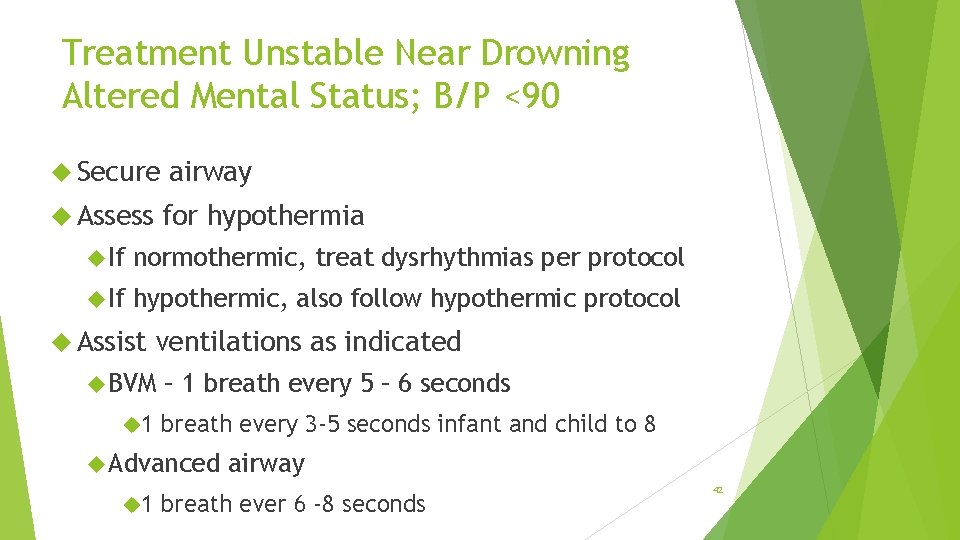
Treatment Unstable Near Drowning Altered Mental Status; B/P <90 Secure Assess airway for hypothermia If normothermic, treat dysrhythmias per protocol If hypothermic, also follow hypothermic protocol Assist ventilations as indicated BVM 1 – 1 breath every 5 – 6 seconds breath every 3 -5 seconds infant and child to 8 Advanced 1 airway breath ever 6 -8 seconds 42
Immune System Responsible The for fighting infection principle system involved in allergic reactions Goal- rid body of offending foreign material (antigen) Components found in blood, bone marrow, and lymphatic system Additional systems affected in immune response Cardiovascular Respiratory Nervous Gastrointestinal 43
Immune Response To destroy or inactivate pathogens, abnormal cells, or foreign molecules Activation of cascade of events triggered by exposure to foreign substance – an antigen Immune system directs attack on foreign substance to deactivate or destroy offending agent There is a chemical attack of antibodies on the invading agent or antigen 44
Immune Response cont’d Primary Initial response (first time) exposure to an antigen Antibodies developed to respond at subsequent exposures Secondary response Release of antibodies, upon recognition of the antigen, to facilitate removal of offending antigen 45
Histamine Potent chemical Principle Goal chemical released in allergic reaction of histamine release Minimize body’s exposure to the antigen ü Bronchoconstriction ü Increased - lung exposure intestinal motility - move antigen thru system ü Vasodilation - remove antigen from circulation ü Increased vascular permeability - remove antigen from circulation 46
Histamine Release – Smooth Muscle Constriction Bronchoconstriction ü Minimizes amount of antigen that can enter the respiratory tract Abdominal ü From cramping increased gastric motility Diarrhea and vomiting ü Attempt to move antigen quickly through the system and eliminate it from the body 47
Histamine Release – Increased Capillary Permeability Third spacing – fluids (plasma) shift from intravascular to interstitial space ü Trying to move offending antigen out of circulatory system ü Angioedema Relative especially of head, neck, face, upper airway hypovolemia Decreased cardiac output Decreased tissue perfusion Impaired Cellular cellular function death 48
Histamine Release – Peripheral Vasodilation Decreased peripheral vascular resistance ü Less tone in blood vessels ü Less efficient circulation of blood ü Decreased preload – amount of blood returning to the heart ü Decreased after-load – the pressure the heart must pump against to move blood ü Blood pressure will drop ü Cardiac output drops 49
Allergic Reaction Exaggerated response by immune system to foreign substance (antigen) Repeated exposure results in much stronger immune response Hypersensitivity Unexpected, exaggerated reaction to an antigen Range from mild skin rashes to more severe systemic reactions throughout many more body systems 50
Anaphylaxis Most severe allergic reaction Usually Rapid occurs when an antigen enters the circulation and wide distribution facilitated through-out the body Most In reactions occur within seconds a few cases there may be a delay over an hour The more severe the reaction, the quicker the onset of signs and symptoms 51
Anaphylaxis Life-threatening emergency requiring prompt recognition and intervention Can develop in seconds; can cause death in minutes after exposure Develops after exposure and sets off biochemical reactions that could lead to shock and death Most common causative agents – injected penicillin and hymenoptera (bee and wasp) stings 52
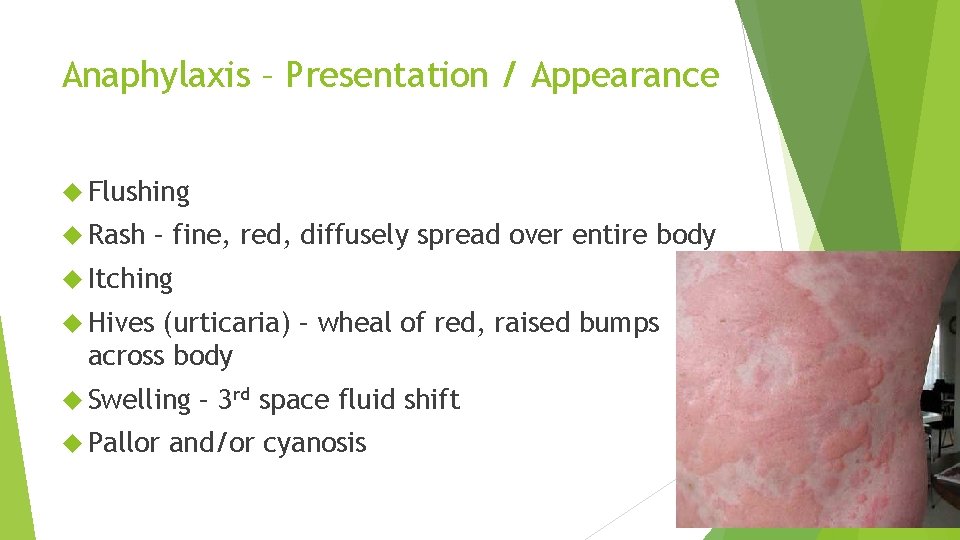
Anaphylaxis – Presentation / Appearance Flushing Rash – fine, red, diffusely spread over entire body Itching Hives (urticaria) – wheal of red, raised bumps across body Swelling Pallor – 3 rd space fluid shift and/or cyanosis 53
Anaphylaxis – Respiratory System Respiratory Sneezing, difficulty with tachypnea coughing – trying to rid offending antigen Wheezing, Laryngeal stridor – bronchoconstriction & edema – 3 rd space fluid shift Laryngospasm – may cause difficulty in being able to speak Bronchospasm Labored breathing; use of accessory muscles 54
Anaphylaxis – Cardiovascular System Vasodilation Increased heart rate – compensation attempt Decreased blood pressure – from capillary leakage, peripheral vasodilation and eventual failure of compensatory mechanisms Development Eventual of acidotic and hypoxic environment fall in cardiac output 55
Anaphylaxis – Nervous System Dizziness Headache Change in level of consciousness Convulsions Tearing 56
Anaphylaxis – Gastrointestinal System Nausea and vomiting – to rid offending antigen Abdominal Diarrhea cramping – hypermotility – to rid offending antigen 57
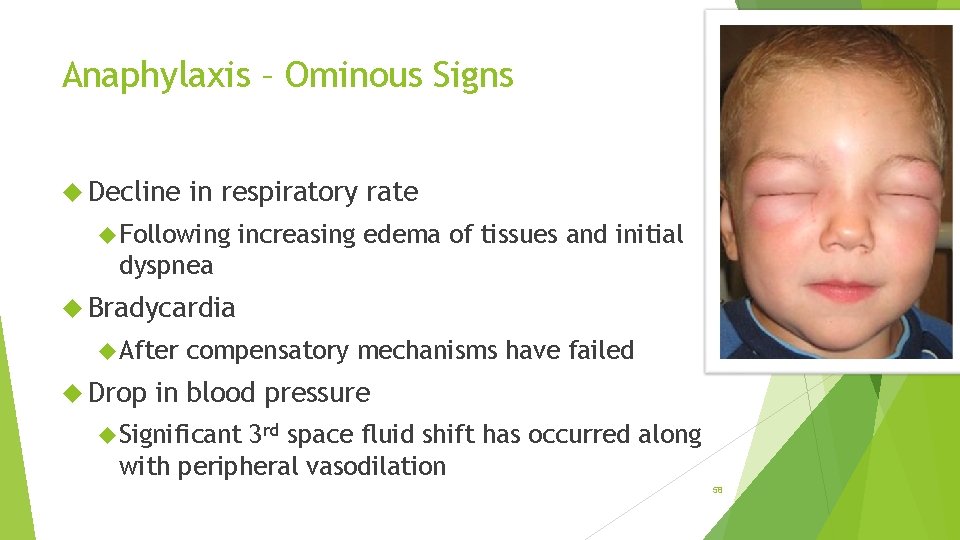
Anaphylaxis – Ominous Signs Decline in respiratory rate Following increasing edema of tissues and initial dyspnea Bradycardia After Drop compensatory mechanisms have failed in blood pressure Significant 3 rd space fluid shift has occurred along with peripheral vasodilation 58
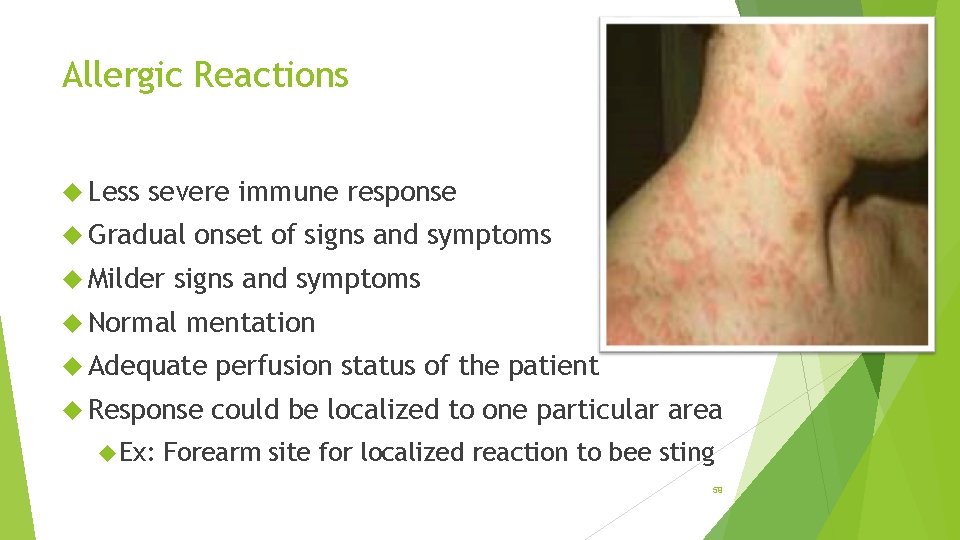
Allergic Reactions Less severe immune response Gradual Milder onset of signs and symptoms Normal mentation Adequate perfusion status of the patient Response could be localized to one particular area Ex: Forearm site for localized reaction to bee sting 59
Allergic Reactions May experience mild flushing, itching, and rash Urticaria May experience mild bronchoconstriction Body Mild (hives) may be present still trying to minimize exposure to antigen abdominal cramps and diarrhea Body still trying to rid self of offending antigen 60
Intervention of Allergic Reactions To know the correct intervention relies on an accurate and detailed assessment Goals Determine Allergic extent of immune response reaction or anaphylaxis 61
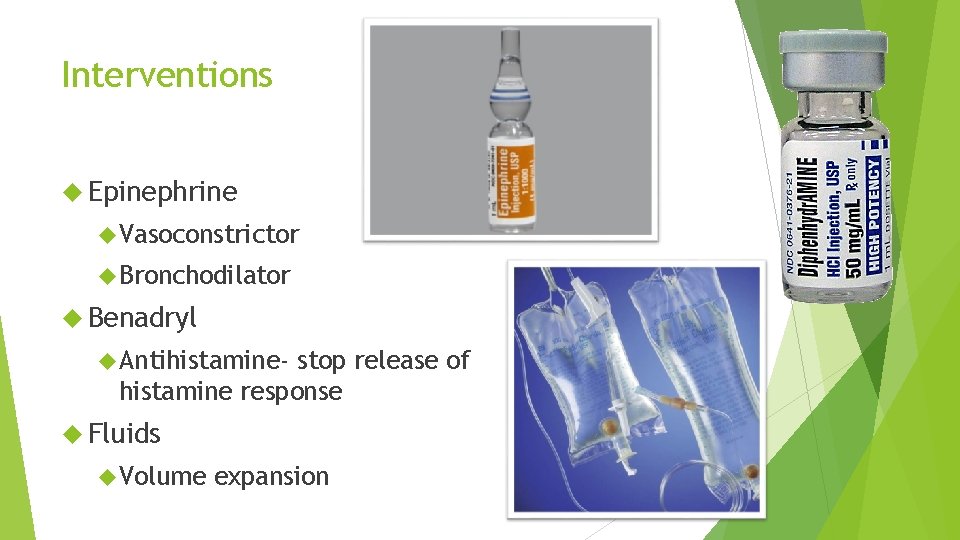
Interventions Epinephrine Vasoconstrictor Bronchodilator Benadryl Antihistamine- stop release of histamine response Fluids Volume expansion 62
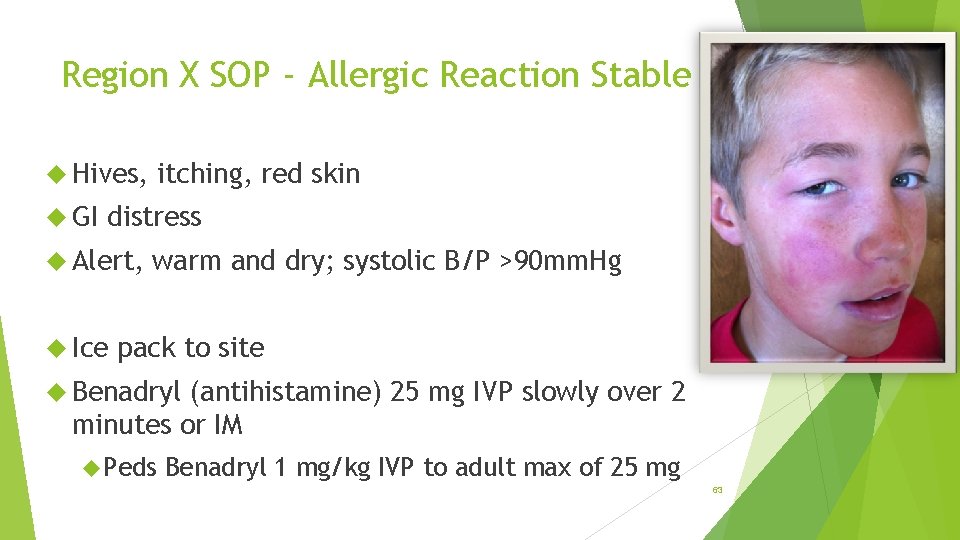
Region X SOP - Allergic Reaction Stable Hives, GI itching, red skin distress Alert, Ice warm and dry; systolic B/P >90 mm. Hg pack to site Benadryl (antihistamine) 25 mg IVP slowly over 2 minutes or IM Peds Benadryl 1 mg/kg IVP to adult max of 25 mg 63
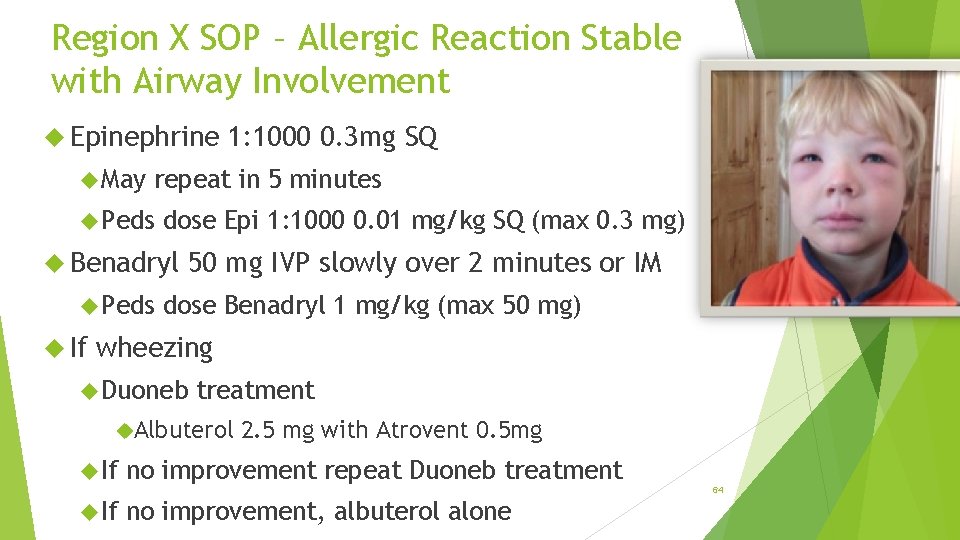
Region X SOP – Allergic Reaction Stable with Airway Involvement Epinephrine May repeat in 5 minutes Peds dose Epi 1: 1000 0. 01 mg/kg SQ (max 0. 3 mg) Benadryl Peds If 1: 1000 0. 3 mg SQ 50 mg IVP slowly over 2 minutes or IM dose Benadryl 1 mg/kg (max 50 mg) wheezing Duoneb treatment Albuterol If 2. 5 mg with Atrovent 0. 5 mg no improvement repeat Duoneb treatment 64 If no improvement, albuterol alone
Region X SOP – Anaphylactic Shock Altered level of consciousness Systolic B/P <90 mm. Hg Secure airway Make sure patient can ventilate/breathe and is adequately oxygenated Goals of treatment ü Open airways ü Support vascular status 65
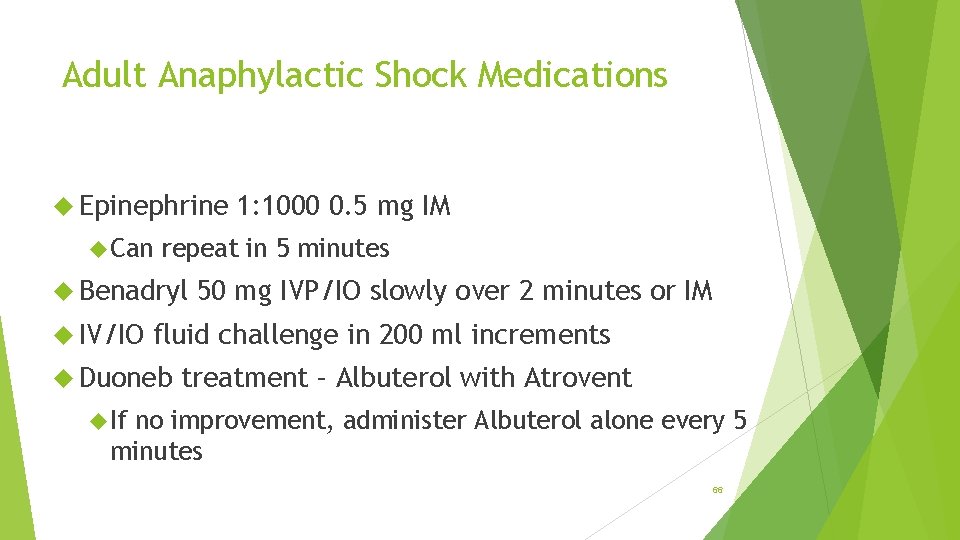
Adult Anaphylactic Shock Medications Epinephrine Can repeat in 5 minutes Benadryl IV/IO 1: 1000 0. 5 mg IM 50 mg IVP/IO slowly over 2 minutes or IM fluid challenge in 200 ml increments Duoneb treatment – Albuterol with Atrovent If no improvement, administer Albuterol alone every 5 minutes 66
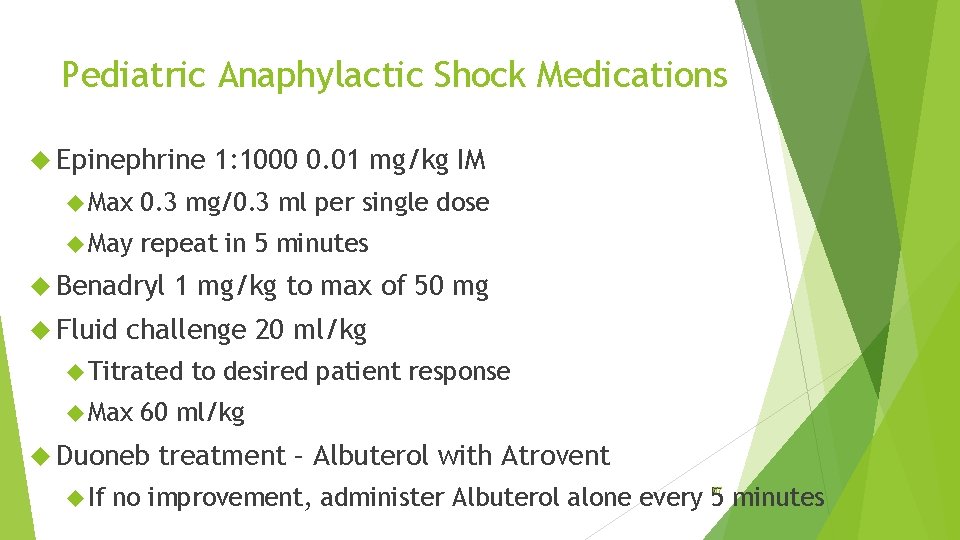
Pediatric Anaphylactic Shock Medications Epinephrine 1: 1000 0. 01 mg/kg IM Max 0. 3 mg/0. 3 ml per single dose May repeat in 5 minutes Benadryl Fluid 1 mg/kg to max of 50 mg challenge 20 ml/kg Titrated Max 60 ml/kg Duoneb If to desired patient response treatment – Albuterol with Atrovent no improvement, administer Albuterol alone every 5 minutes 67
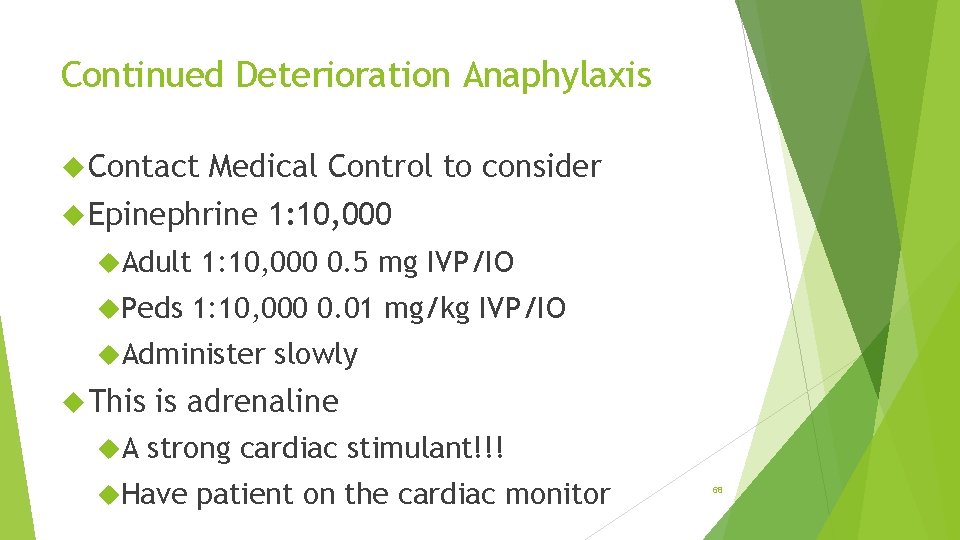
Continued Deterioration Anaphylaxis Contact Medical Control to consider Epinephrine Adult Peds 1: 10, 000 0. 5 mg IVP/IO 1: 10, 000 0. 01 mg/kg IVP/IO Administer This A 1: 10, 000 slowly is adrenaline strong cardiac stimulant!!! Have patient on the cardiac monitor 68
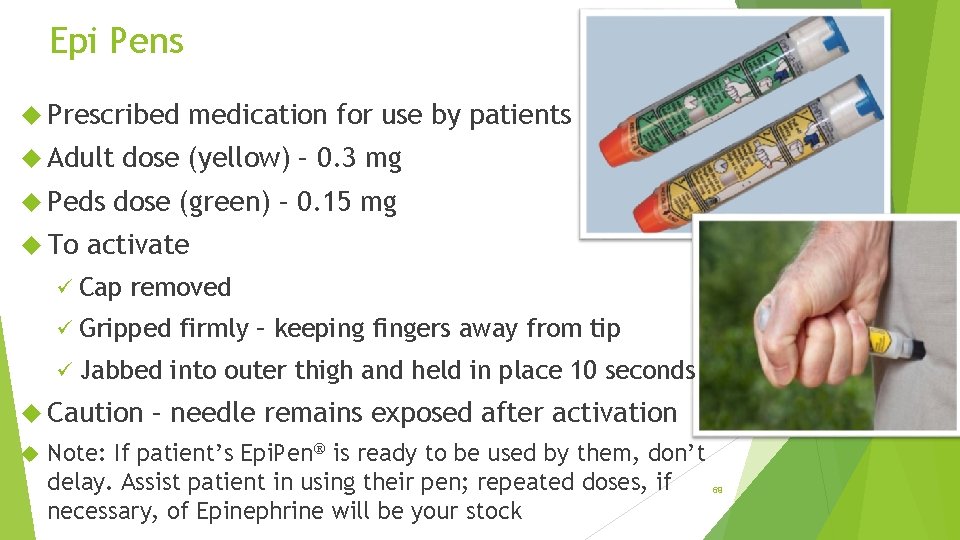
Epi Pens Prescribed Adult Peds To dose (yellow) – 0. 3 mg dose (green) – 0. 15 mg activate ü Cap removed ü Gripped ü Jabbed Caution medication for use by patients firmly – keeping fingers away from tip into outer thigh and held in place 10 seconds – needle remains exposed after activation Note: If patient’s Epi. Pen is ready to be used by them, don’t delay. Assist patient in using their pen; repeated doses, if necessary, of Epinephrine will be your stock 69
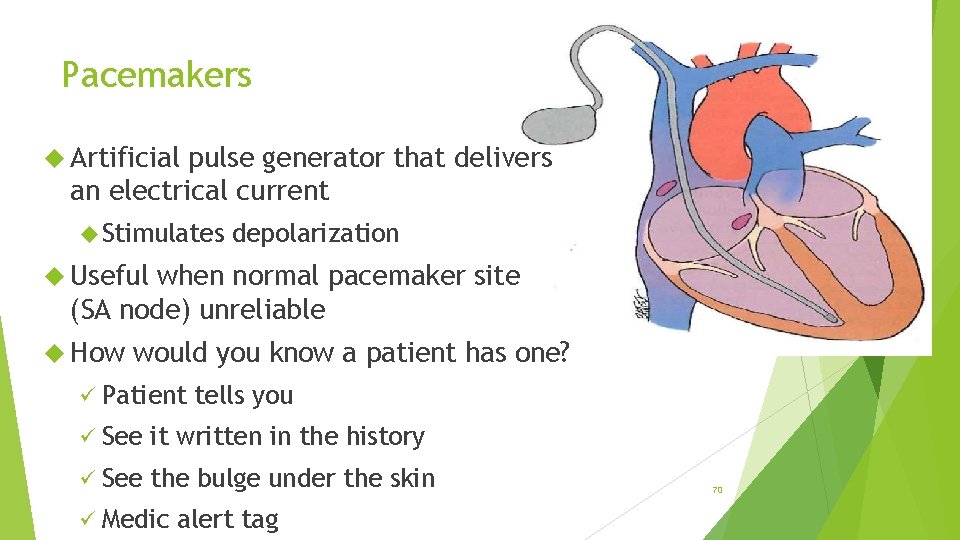
Pacemakers Artificial pulse generator that delivers an electrical current Stimulates depolarization Useful when normal pacemaker site (SA node) unreliable How would you know a patient has one? ü Patient tells you ü See it written in the history ü See the bulge under the skin ü Medic alert tag 70
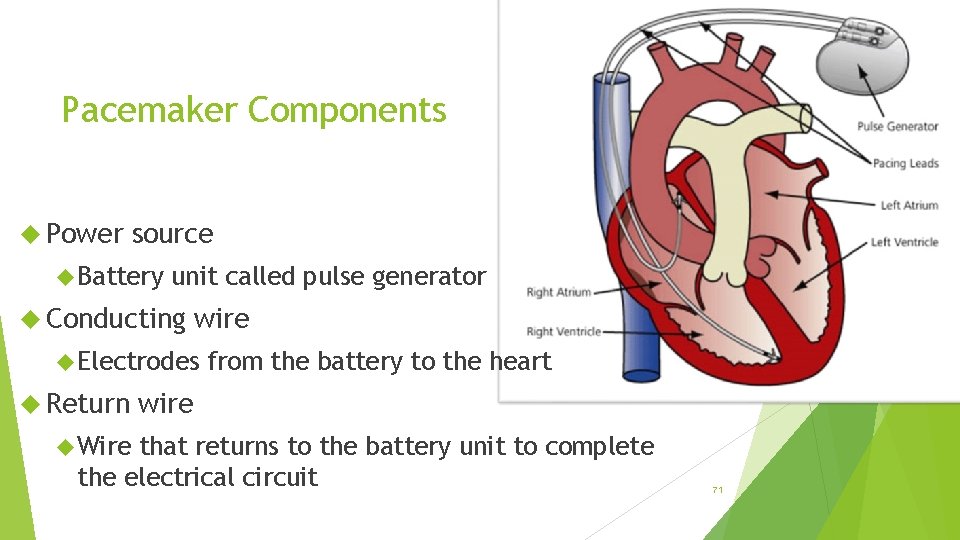
Pacemaker Components Power source Battery unit called pulse generator Conducting wire Electrodes Return from the battery to the heart wire Wire that returns to the battery unit to complete the electrical circuit 71
Pacemaker Types - Temporary Usually used in acute setting and for relatively short periods of time (i. e. : acute MI) Pacing unit outside the body Transcutaneous Transvenous Current – stimulus across the skin – via venous vessel access measured in milliamperes (m. A) 72
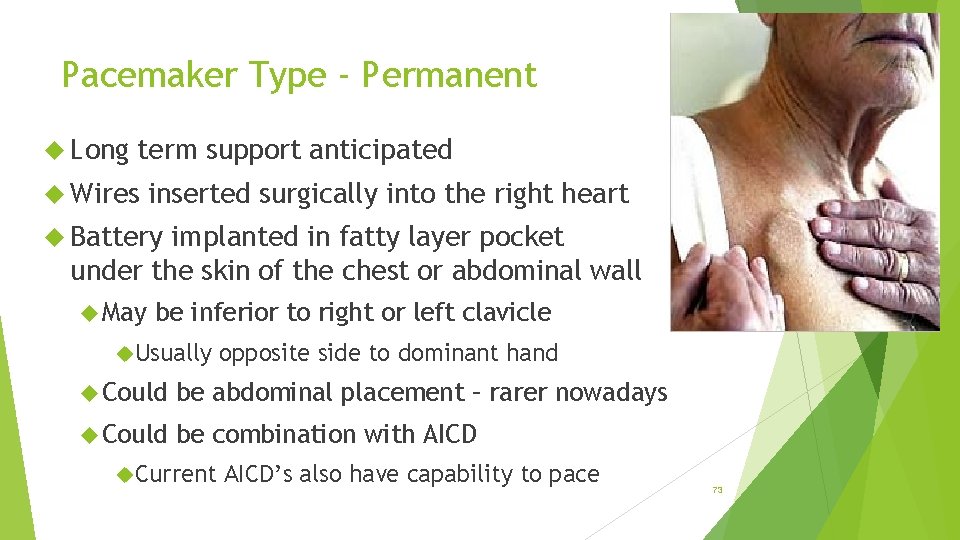
Pacemaker Type - Permanent Long term support anticipated Wires inserted surgically into the right heart Battery implanted in fatty layer pocket under the skin of the chest or abdominal wall May be inferior to right or left clavicle Usually opposite side to dominant hand Could be abdominal placement – rarer nowadays Could be combination with AICD Current AICD’s also have capability to pace 73
Pacemaker Sensing Parameters set on pacemaker determine if pacing stimulus is necessary or is withheld Demand mode – pacemaker functions only when patient’s own rate falls below a preset value Pacemaker Most functions on “demand” common type of pacemaker setting used Fixed mode – pacemaker will fire regardless of what the intrinsic (normal) conduction system does Infrequently seen nowadays 74
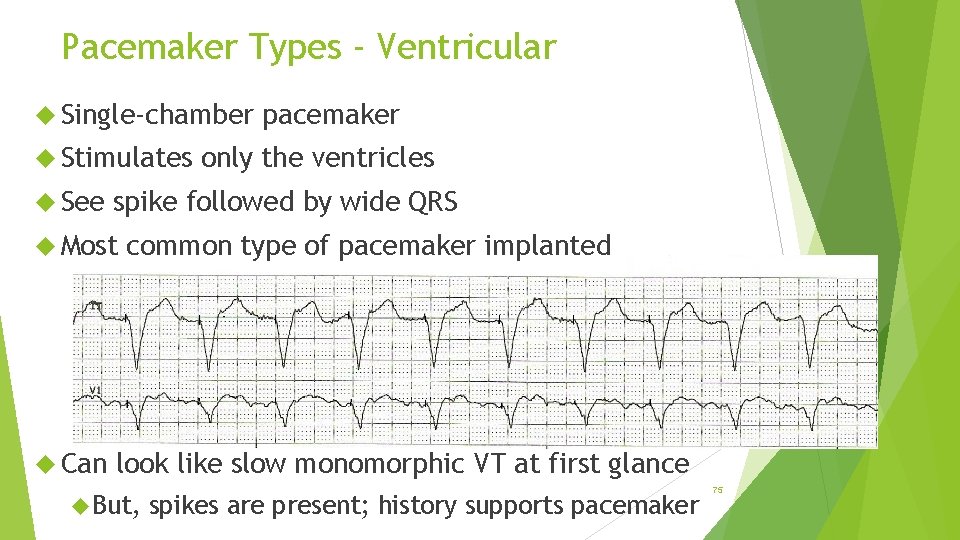
Pacemaker Types - Ventricular Single-chamber Stimulates See only the ventricles spike followed by wide QRS Most Can pacemaker common type of pacemaker implanted look like slow monomorphic VT at first glance But, spikes are present; history supports pacemaker 75
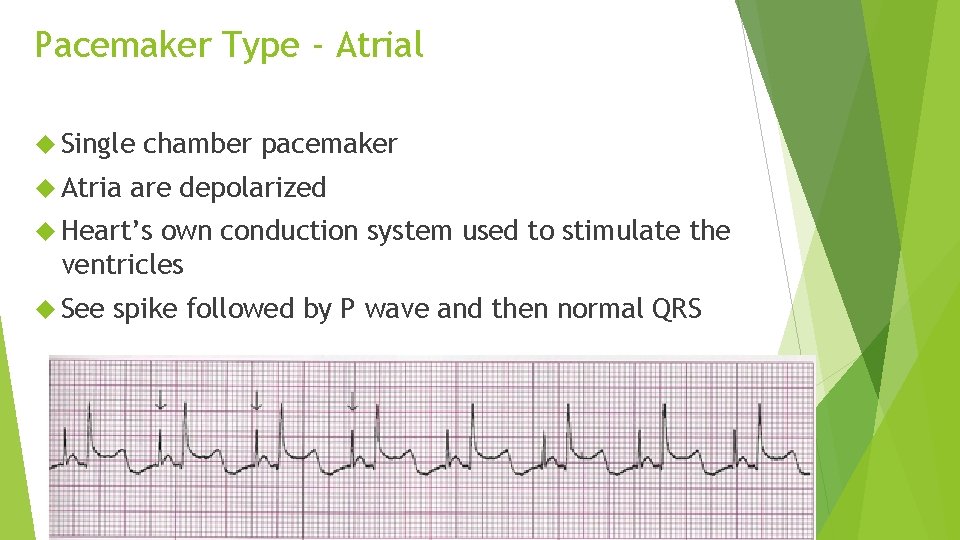
Pacemaker Type - Atrial Single Atria chamber pacemaker are depolarized Heart’s own conduction system used to stimulate the ventricles See spike followed by P wave and then normal QRS 76
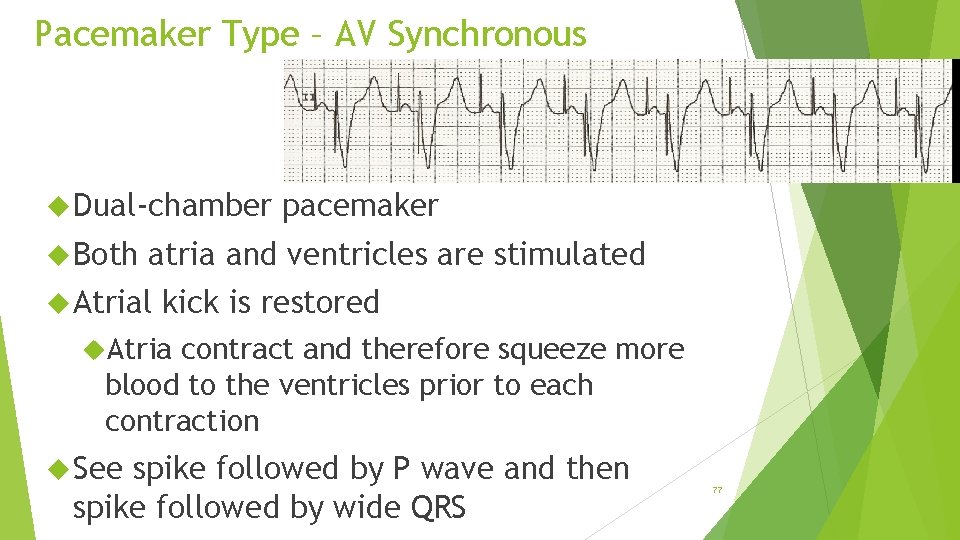
Pacemaker Type – AV Synchronous Dual-chamber Both pacemaker atria and ventricles are stimulated Atrial kick is restored Atria contract and therefore squeeze more blood to the ventricles prior to each contraction See spike followed by P wave and then spike followed by wide QRS 77
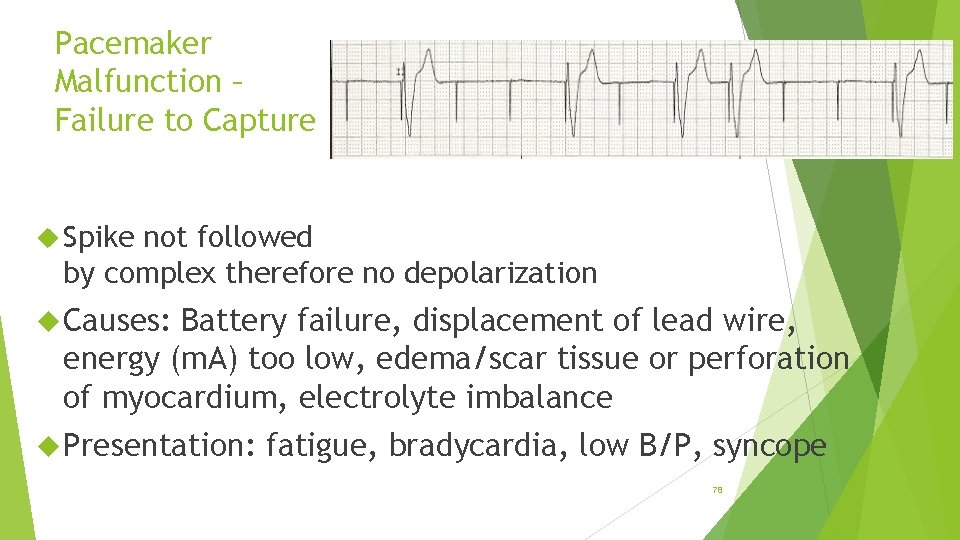
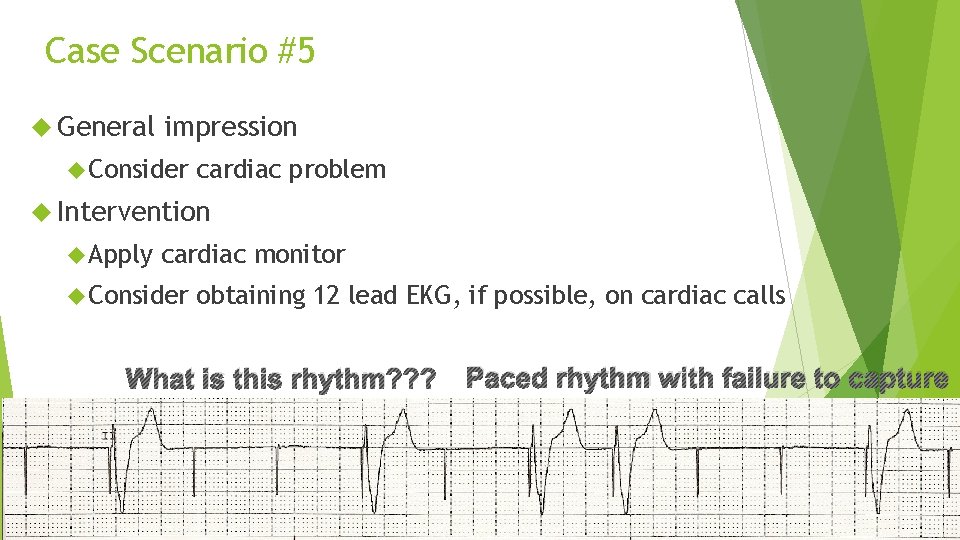
Pacemaker Malfunction – Failure to Capture Spike not followed by complex therefore no depolarization Causes: Battery failure, displacement of lead wire, energy (m. A) too low, edema/scar tissue or perforation of myocardium, electrolyte imbalance Presentation: fatigue, bradycardia, low B/P, syncope 78
Failure to Capture EMS Intervention EMS intervention: reposition patient in case of loss of lead wire contact – turn patient onto left side May Follow “float” lead wire into myocardial wall contact symptomatic bradycardia protocol Administer Apply Atropine 0. 5 mg IVP and prepare to begin operation of TCP 79
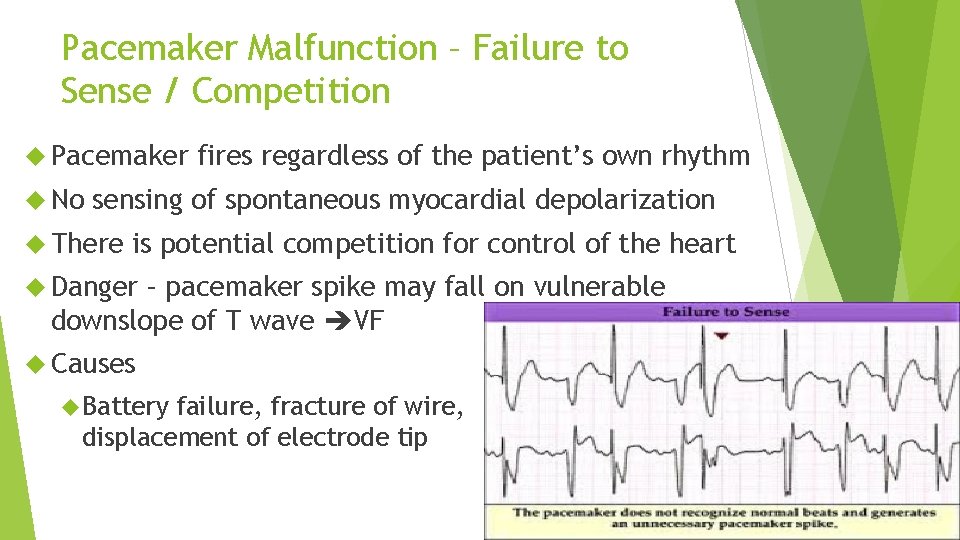
Pacemaker Malfunction – Failure to Sense / Competition Pacemaker No fires regardless of the patient’s own rhythm sensing of spontaneous myocardial depolarization There is potential competition for control of the heart Danger – pacemaker spike may fall on vulnerable downslope of T wave VF Causes Battery failure, fracture of wire, displacement of electrode tip 80
Pacemaker Malfunction – Runaway Pacemaker rate too fast but continues to capture Malfunction Not of impulse generator as common in newer models of pacemakers Typical pacemaker rate set around 70’s (beats per minute) 81
Pacemaker Malfunction – Battery Failure Absence of any spikes when they would be anticipated Can cause life-threatening situation where patient dependent on pacemaker to support a healthy heart rate Close patient monitoring and long battery life usually avoids this problem 82
Assessment of Patient Always check the patient first Determine perfusion status / mechanical response Evaluate the patient’s level of consciousness Evaluate blood pressure to determine perfusion Presence of radial pulse indicates B/P is present EKG strip is printable representation of electrical activity 83
Assessment of Paced Rhythm Does each spike capture? Each Is spike is followed by a complex rate reasonable? Are spikes competing with the patient’s rhythm? Is pacemaker functioning consistently and reliably? 84
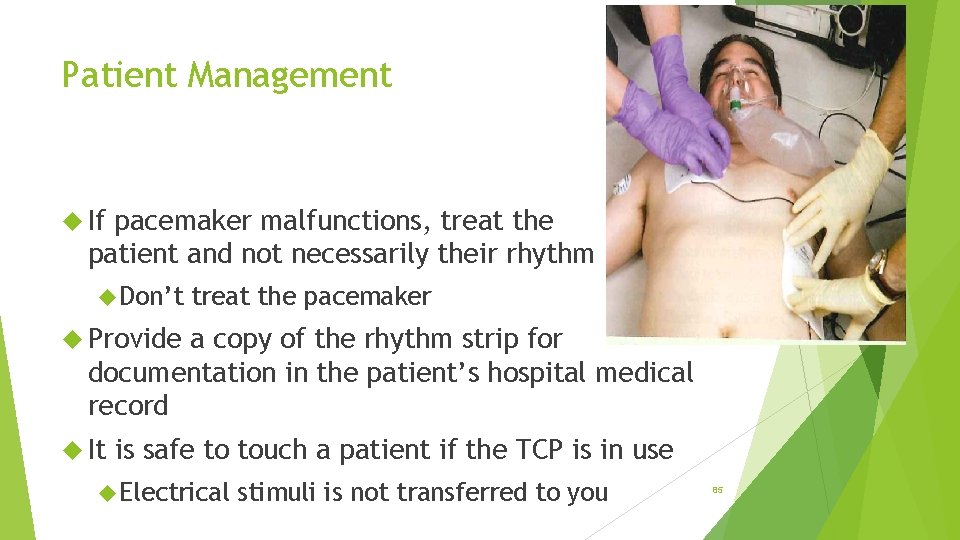
Patient Management If pacemaker malfunctions, treat the patient and not necessarily their rhythm Don’t treat the pacemaker Provide a copy of the rhythm strip for documentation in the patient’s hospital medical record It is safe to touch a patient if the TCP is in use Electrical stimuli is not transferred to you 85
Transcutaneous Pacing – Potential Complications Coughing Skin burns Interference with sensing from patient agitation or muscle contractions Pain Failure Tissue 3 rd to recognize non-capture damage degree burns 86
Documentation of TCP Use Initial Date and repeat EKG rhythms on patient chart and time pacing started Rate Output (m. A) to obtain capture Patient’s response Intervention Valium A 2 mg IVP/IO; repeated to max of 10 mg benzodiazepine to take the edge off Fentanyl A for comfort/pain control measures 1 mcg/kg IVP/IO/IN; repeated in 5 minutes synthetic opioid for pain control 87
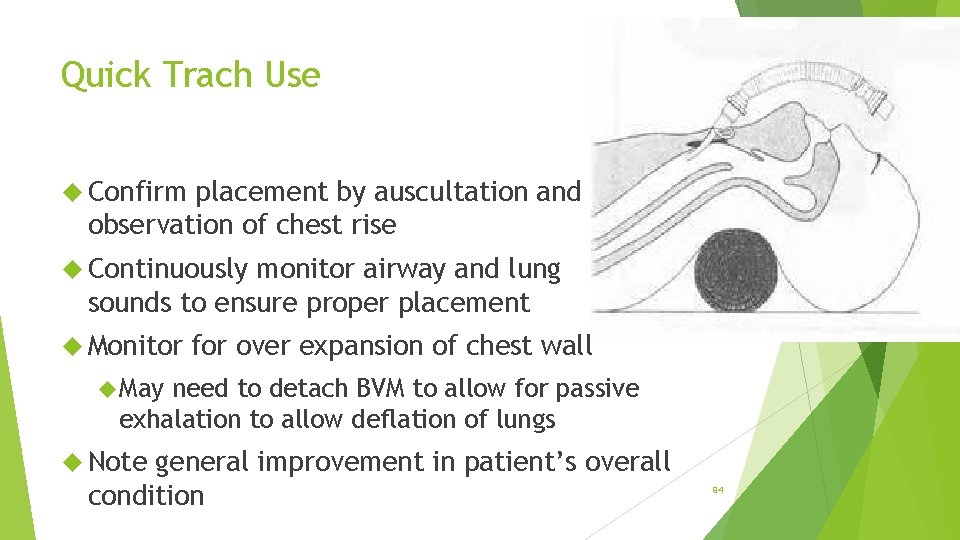
Quick. Trach Indications Emergency assisted ventilations when all other means have failed Contraindications Tracheal Adult Peds transection; other measures are successful device – size 4. 0 mm. ID if >77# (>35 kg) device – 2. 0 mm. ID if 22 -77# (10 -35 kg) <22# (10 kg) – use needle cricothyrotomy procedure 88
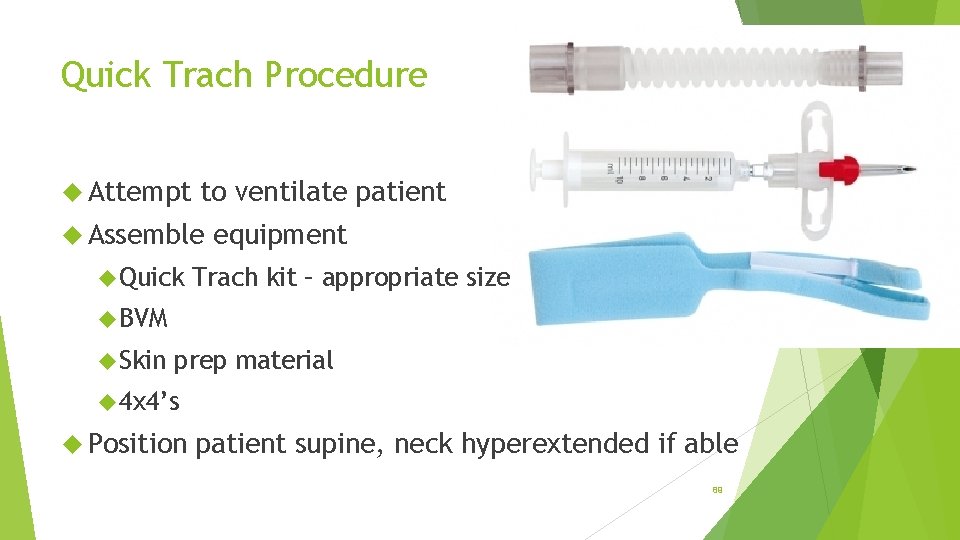
Quick Trach Procedure Attempt to ventilate patient Assemble Quick equipment Trach kit – appropriate size BVM Skin prep material 4 x 4’s Position patient supine, neck hyperextended if able 89
Quick Trach Procedure cont’d Locate Cricothyroid membrane Inferior to thyroid cartilage (Adam’s apple) Superior Palpate to cricoid cartilage from notch upward 1 st bone is cricoid cartilage Go to space just above this bone Cleanse site 90
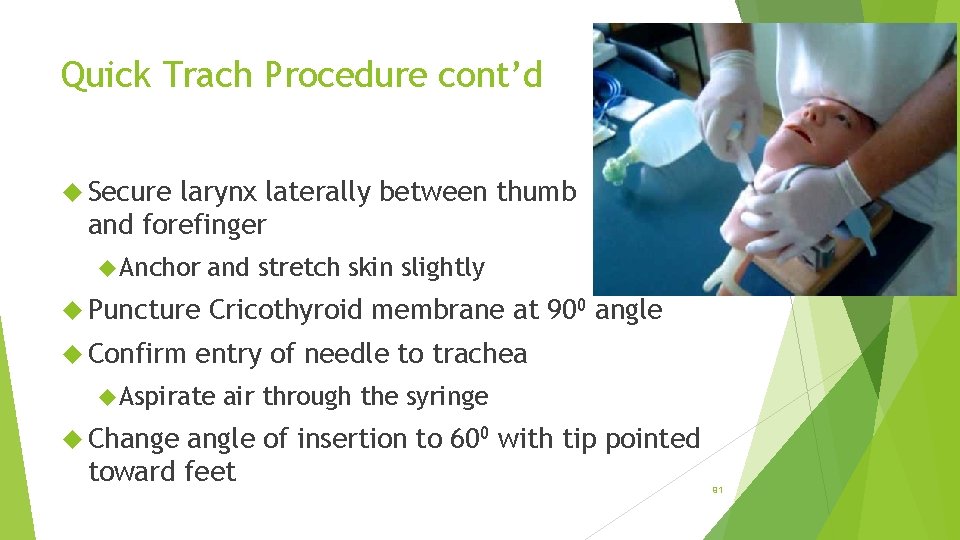
Quick Trach Procedure cont’d Secure larynx laterally between thumb and forefinger Anchor Puncture Confirm and stretch skin slightly Cricothyroid membrane at 900 angle entry of needle to trachea Aspirate air through the syringe Change angle of insertion to 600 with tip pointed toward feet 91
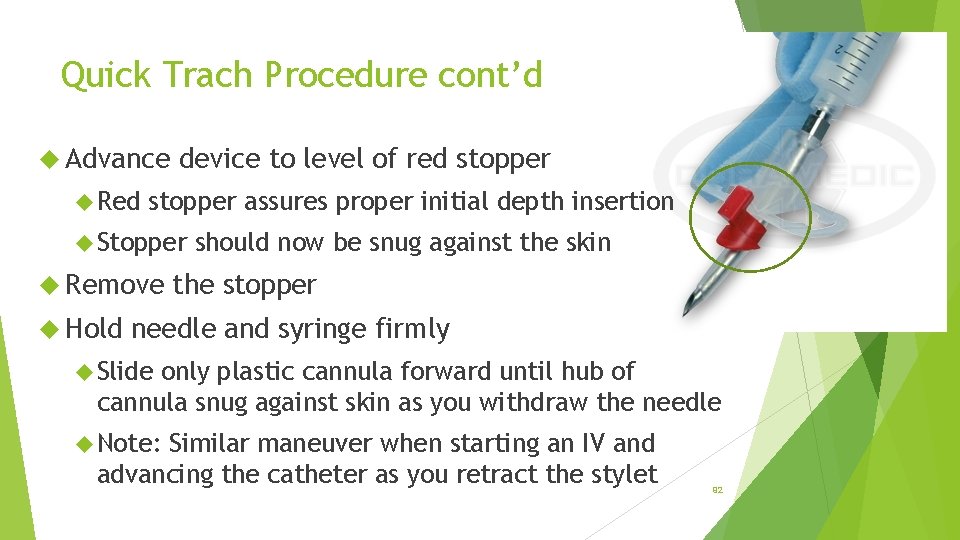
Quick Trach Procedure cont’d Advance Red device to level of red stopper assures proper initial depth insertion Stopper Remove Hold should now be snug against the skin the stopper needle and syringe firmly Slide only plastic cannula forward until hub of cannula snug against skin as you withdraw the needle Note: Similar maneuver when starting an IV and advancing the catheter as you retract the stylet 92
Quick Trach Procedure cont’d Distal end of flexible tubing attached to Quick Trach hub BVM attached to proximal end of flexible tubing Helpful to have flexible tubing already attached to BVM Immediately Use begin to ventilate with 100% O 2 pre-attached strap to secure device Make sure device is snug against skin Device can easily be coughed out Helpful to have one end of strap already attached to device prior to insertion 93
Quick Trach Use Confirm placement by auscultation and observation of chest rise Continuously monitor airway and lung sounds to ensure proper placement Monitor for over expansion of chest wall May need to detach BVM to allow for passive exhalation to allow deflation of lungs Note general improvement in patient’s overall condition 94
Case Scenario Discussion Review presentation of patient Determine your general impression Determine your treatment choice Use your SOP booklets as a resource Discuss reassessment steps Discuss documentation highlights related to the patient situation 95
Case Scenario #1 Patient works on a road crew Complains VS: of feeling lightheaded and dizzy 148/88; P – 90; R – 20; warm and sweaty History: hypertension, high cholesterol, diabetes General impression? Interventions? 96
Case Scenario #1 General impression Heat emergency (exhaustion) Consider diabetic problem (blood sugar 72) Consider other medical problems Intervention Remember to consider other causes of feeling lightheaded and dizzy Cool – remove from heat, remove extra clothing Fluids – 200 ml fluid bolus increments 97
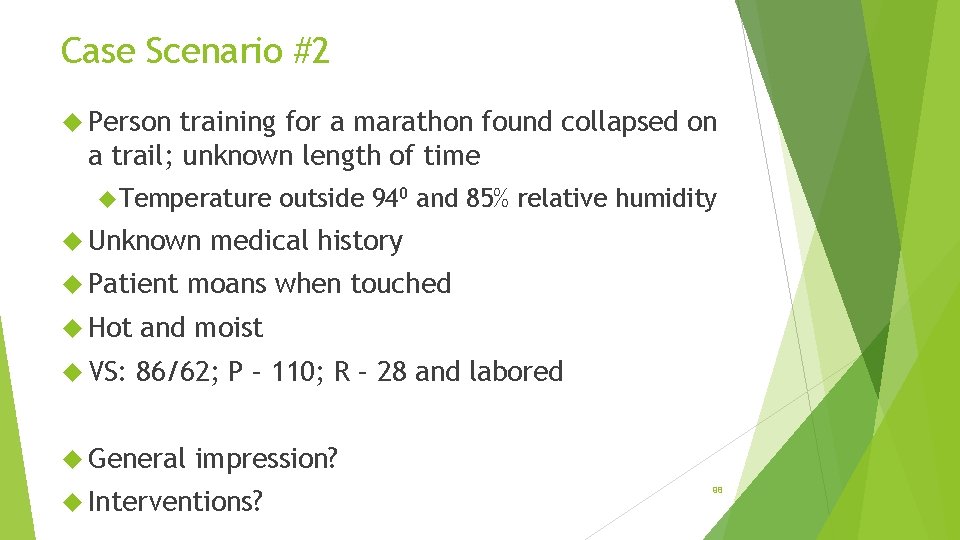
Case Scenario #2 Person training for a marathon found collapsed on a trail; unknown length of time Temperature Unknown Patient outside 940 and 85% relative humidity medical history moans when touched Hot and moist VS: 86/62; P – 110; R – 28 and labored General impression? Interventions? 98
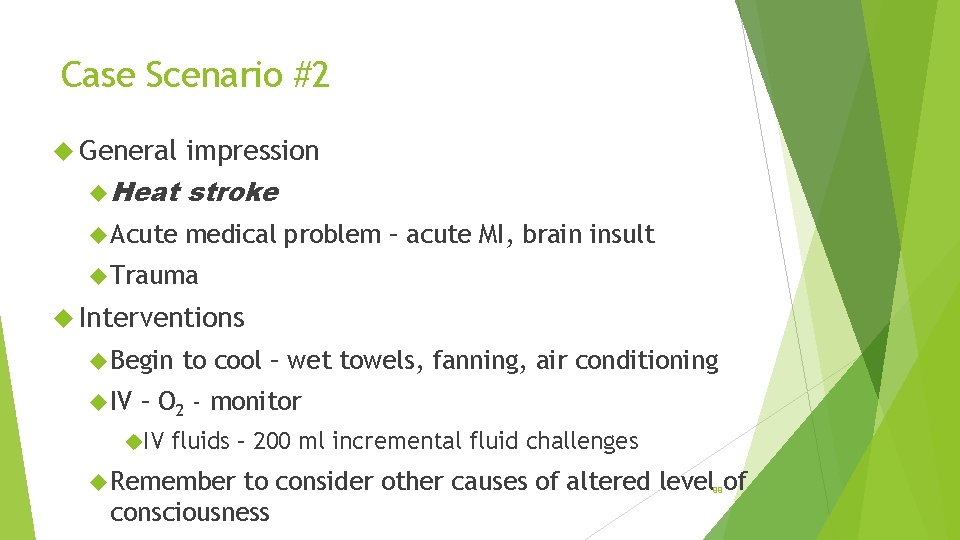
Case Scenario #2 General impression Heat stroke Acute medical problem – acute MI, brain insult Trauma Interventions Begin IV to cool – wet towels, fanning, air conditioning – O 2 - monitor IV fluids – 200 ml incremental fluid challenges Remember to consider other causes of altered level of consciousness 99
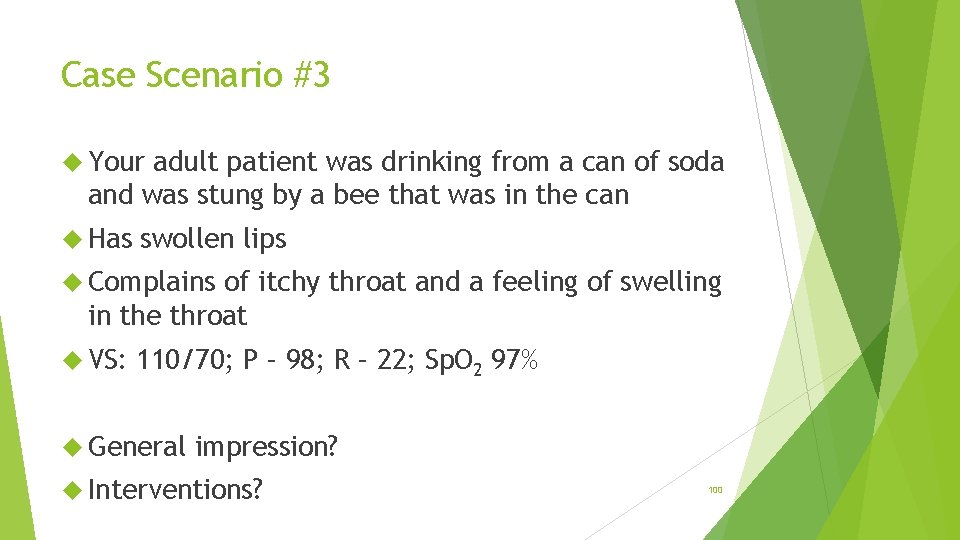
Case Scenario #3 Your adult patient was drinking from a can of soda and was stung by a bee that was in the can Has swollen lips Complains of itchy throat and a feeling of swelling in the throat VS: 110/70; P – 98; R – 22; Sp. O 2 97% General impression? Interventions? 100
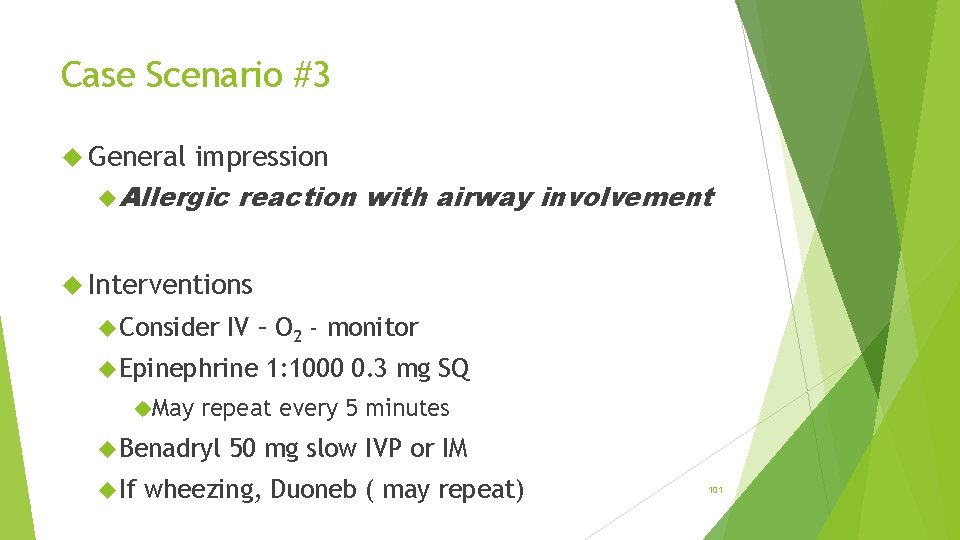
Case Scenario #3 General impression Allergic reaction with airway involvement Interventions Consider IV – O 2 - monitor Epinephrine May repeat every 5 minutes Benadryl If 1: 1000 0. 3 mg SQ 50 mg slow IVP or IM wheezing, Duoneb ( may repeat) 101
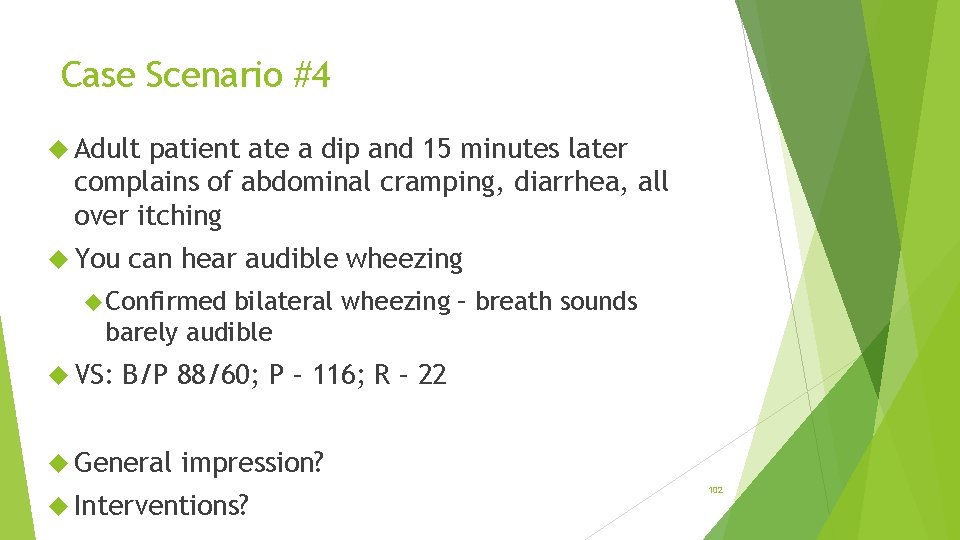
Case Scenario #4 Adult patient ate a dip and 15 minutes later complains of abdominal cramping, diarrhea, all over itching You can hear audible wheezing Confirmed bilateral wheezing – breath sounds barely audible VS: B/P 88/60; P – 116; R – 22 General impression? Interventions? 102
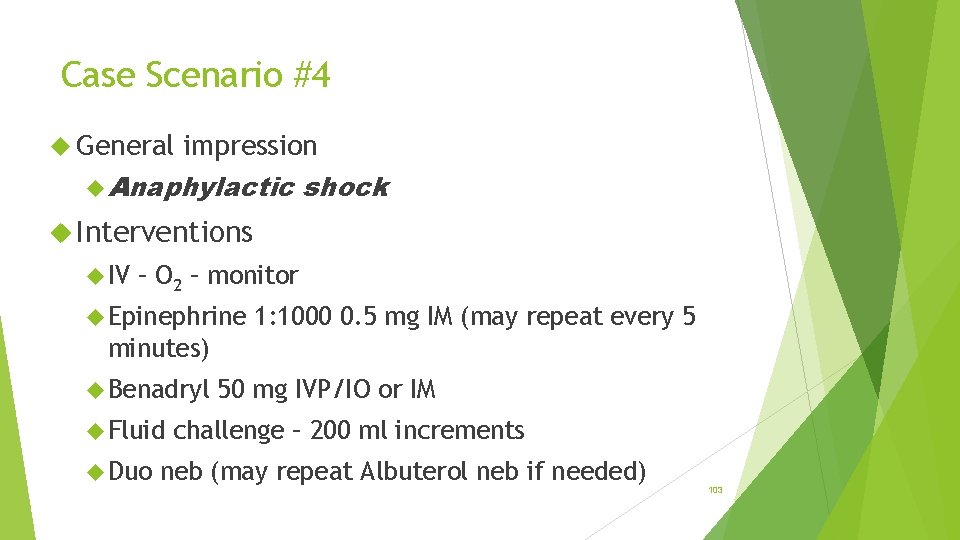
Case Scenario #4 General impression Anaphylactic shock Interventions IV – O 2 – monitor Epinephrine 1: 1000 0. 5 mg IM (may repeat every 5 minutes) Benadryl Fluid Duo 50 mg IVP/IO or IM challenge – 200 ml increments neb (may repeat Albuterol neb if needed) 103
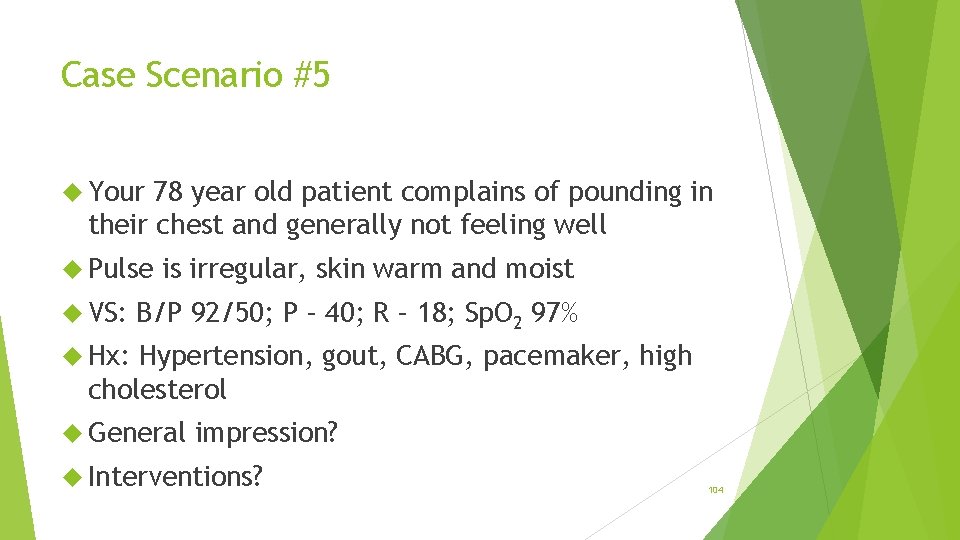
Case Scenario #5 Your 78 year old patient complains of pounding in their chest and generally not feeling well Pulse VS: is irregular, skin warm and moist B/P 92/50; P – 40; R – 18; Sp. O 2 97% Hx: Hypertension, gout, CABG, pacemaker, high cholesterol General impression? Interventions? 104
Case Scenario #5 General impression Consider cardiac problem Intervention Apply cardiac monitor Consider obtaining 12 lead EKG, if possible, on cardiac calls What is this rhythm? ? ? Paced rhythm with failure to capture 105
Case Scenario #5 Impression – Pacemaker with failure to capture Intervention Turn patient onto their left side May “float” catheter into position Support perfusion Consider Prepare Atropine dose for application TCP Consider need for Dopamine drip to support blood pressure Increases strength of cardiac contractions 106
Bibliography Bledsoe, B. , Porter, R. , Cherry, R. Paramedic Care Principles & Practices, 4 th edition. Brady. 2013. Region X SOP’s; IDPH Approved April 10, 2014. Mistovich, J. , Karren, K. Prehospital Emergency Care 9 th Edition. Brady. 2010. http: //www. scientificamerican. com/article/why-does-lacticacid-buil/ http: //www. icufaqs. org/Pacemakers. doc http: //www. cdc. gov/HAI/organisms/cdiff/Cdiff_infect. html http: //www. cdc. gov/norovirus/preventing-infection. html 107