
Summary Week 1 n n n Categorical vs


- Slides: 34
Summary (Week 1) n n n Categorical vs. Quantitative Variables Types of Graphs for Categorical and Quantitative Data Describe a Distribution: (Shape, Center, Spread) Shape: Symmetric vs. Skewed Center: Mean vs. Median Spread: IQR vs. Standard Deviation (not covered) Copyright © 2009 Pearson Education, Inc. Slide 4 - 1
Spread: The Interquartile Range n n Quartiles divide the data into four equal sections. n One quarter of the data lies below the lower quartile, Q 1 n One quarter of the data lies above the upper quartile, Q 3. The difference between the quartiles is the interquartile range (IQR), so IQR = upper quartile – lower quartile IQR = Q 3 – Q 1 Copyright © 2009 Pearson Education, Inc. Slide 4 - 2
5 -Number Summary n n n The 5 -number summary of a distribution reports its median, quartiles, and extremes (maximum and minimum) The 5 -number summary for the recent tsunami earthquake Magnitudes looks like this: We will use the 5 -Number summary later on to create a box plot. Copyright © 2009 Pearson Education, Inc. Slide 4 - 3
Summary: Shape, Center, and Spread n n Mean and Standard Deviation always go together Median and IQR always go together. Use MEAN and STANDARD DEVIATION when the distribution is symmetric and there are NO Outliers! Outliers n Otherwise use Median and IQR. Copyright © 2009 Pearson Education, Inc. Slide 4 - 4
What About Spread? The Standard Deviation n n A more powerful measure of spread than the IQR is the standard deviation, which takes into account how far each data value is from the mean. A deviation is the distance that a data value is from the mean. n Since adding all deviations together would total zero, we square each deviation and find an average of sorts for the deviations. Copyright © 2009 Pearson Education, Inc. Slide 4 - 5
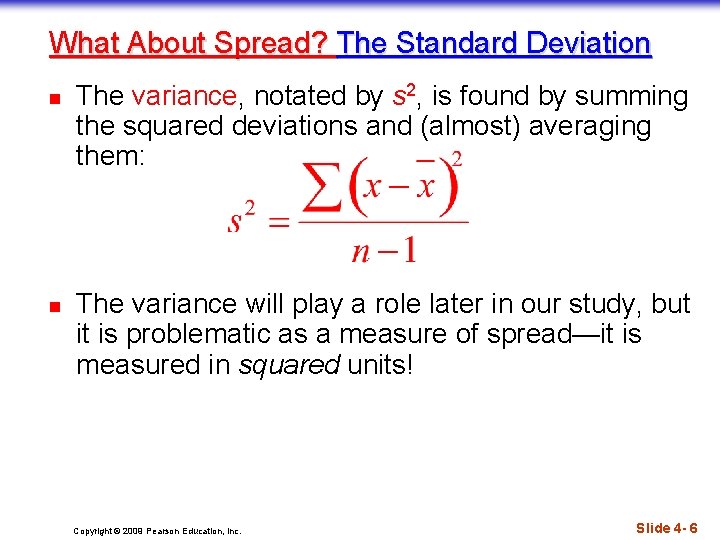
What About Spread? The Standard Deviation n n The variance, notated by s 2, is found by summing the squared deviations and (almost) averaging them: The variance will play a role later in our study, but it is problematic as a measure of spread—it is measured in squared units! Copyright © 2009 Pearson Education, Inc. Slide 4 - 6
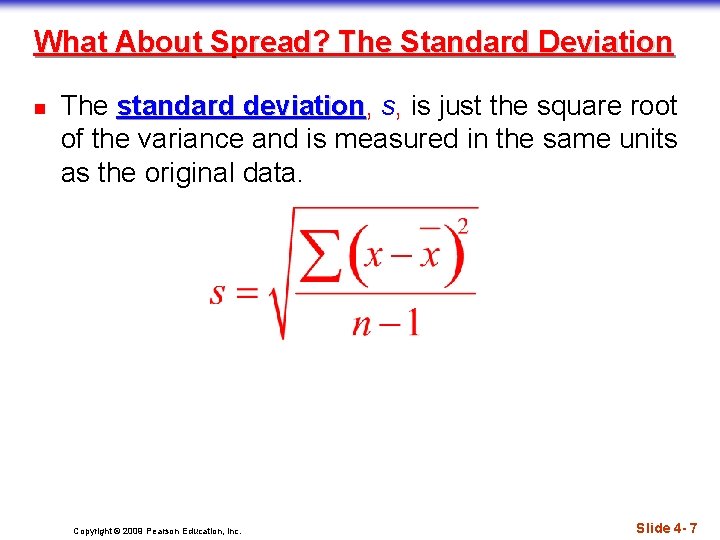
What About Spread? The Standard Deviation n The standard deviation, deviation s, is just the square root of the variance and is measured in the same units as the original data. Copyright © 2009 Pearson Education, Inc. Slide 4 - 7
Thinking About Variation n n Since Statistics is about variation, spread is an important fundamental concept of Statistics. Measures of spread help us talk about what we don’t know. When the data values are tightly clustered around the center of the distribution, the IQR and standard deviation will be small. When the data values are scattered far from the center, the IQR and standard deviation will be large. Copyright © 2009 Pearson Education, Inc. Slide 4 - 8
Chapter 6 The Standard Deviation as a Ruler and the Normal Model Copyright © 2009 Pearson Education, Inc.
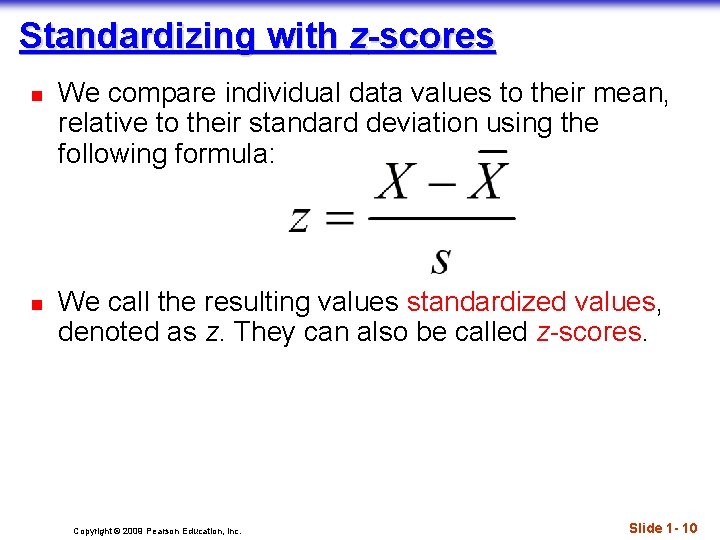
Standardizing with z-scores n n We compare individual data values to their mean, relative to their standard deviation using the following formula: We call the resulting values standardized values, denoted as z. They can also be called z-scores. Copyright © 2009 Pearson Education, Inc. Slide 1 - 10
Standardizing with z-scores (cont. ) n n n Standardized values have no units. z-scores measure the distance of each data value from the mean in standard deviations. A negative z-score tells us that the data value is below the mean, while a positive z-score tells us that the data value is above the mean. Copyright © 2009 Pearson Education, Inc. Slide 1 - 11
Benefits of Standardizing n n Standardized values have been converted from their original units to the standard statistical unit of standard deviations from the mean. Thus, we can compare values that are measured on different scales, with different units, or from different populations. Copyright © 2009 Pearson Education, Inc. Slide 1 - 12
Shifting Data n n Adding or subtracting a constant to every data value adds or subtracts the same constant to measures of position: position center, percentiles, max/min. Its shape and spread - range, IQR, standard deviation - remain unchanged Copyright © 2009 Pearson Education, Inc. Slide 1 - 13
Rescaling Data * When we multiply (or divide) all the data values by any constant, all measures of position (such as the mean, median, and percentiles) and measures of spread (such as the range, the IQR, and the standard deviation) are multiplied (or divided) by that same constant. Copyright © 2009 Pearson Education, Inc. Slide 1 - 14
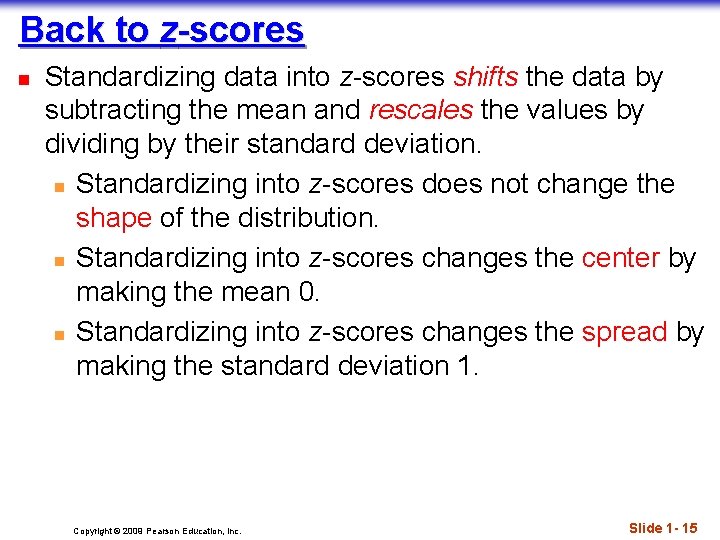
Back to z-scores n Standardizing data into z-scores shifts the data by subtracting the mean and rescales the values by dividing by their standard deviation. n Standardizing into z-scores does not change the shape of the distribution. n Standardizing into z-scores changes the center by making the mean 0. n Standardizing into z-scores changes the spread by making the standard deviation 1. Copyright © 2009 Pearson Education, Inc. Slide 1 - 15
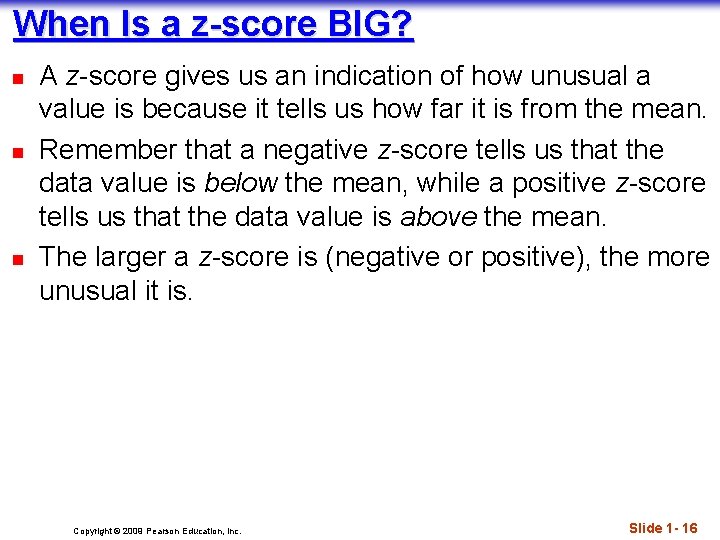
When Is a z-score BIG? n n n A z-score gives us an indication of how unusual a value is because it tells us how far it is from the mean. Remember that a negative z-score tells us that the data value is below the mean, while a positive z-score tells us that the data value is above the mean. The larger a z-score is (negative or positive), the more unusual it is. Copyright © 2009 Pearson Education, Inc. Slide 1 - 16
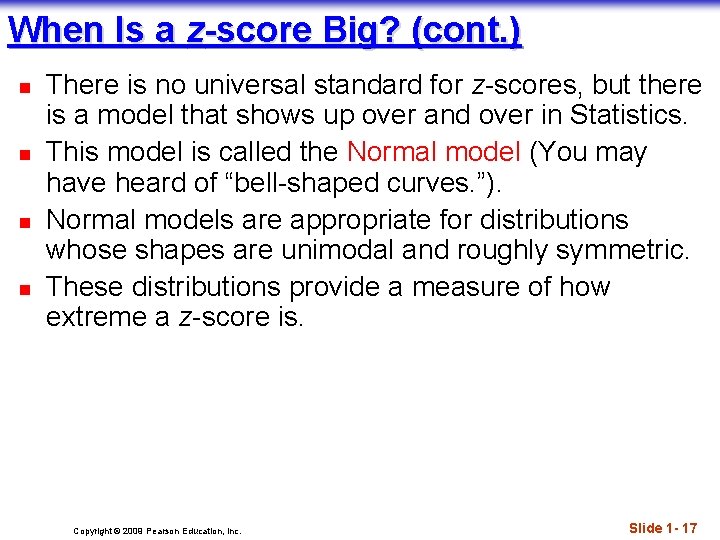
When Is a z-score Big? (cont. ) n n There is no universal standard for z-scores, but there is a model that shows up over and over in Statistics. This model is called the Normal model (You may have heard of “bell-shaped curves. ”). Normal models are appropriate for distributions whose shapes are unimodal and roughly symmetric. These distributions provide a measure of how extreme a z-score is. Copyright © 2009 Pearson Education, Inc. Slide 1 - 17
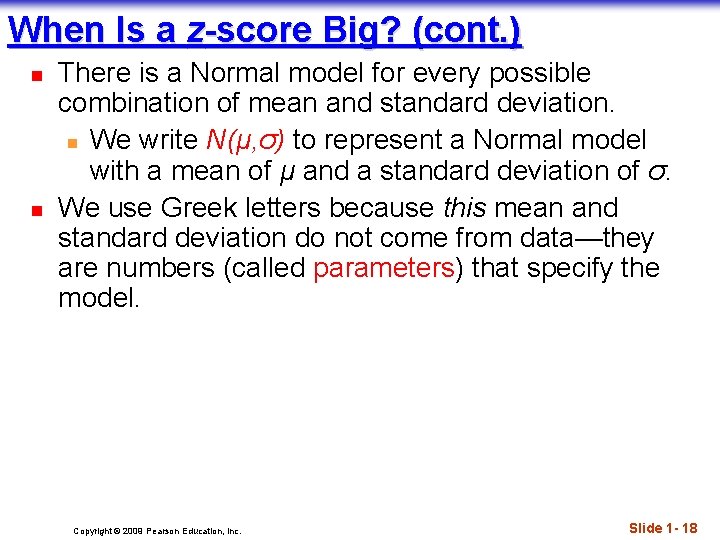
When Is a z-score Big? (cont. ) n n There is a Normal model for every possible combination of mean and standard deviation. n We write N(μ, σ) to represent a Normal model with a mean of μ and a standard deviation of σ. We use Greek letters because this mean and standard deviation do not come from data—they are numbers (called parameters) that specify the model. Copyright © 2009 Pearson Education, Inc. Slide 1 - 18
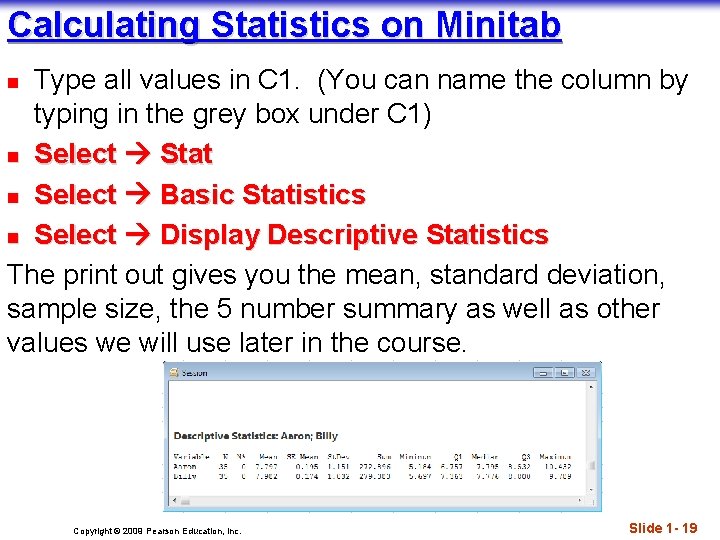
Calculating Statistics on Minitab Type all values in C 1. (You can name the column by typing in the grey box under C 1) n Select Stat n Select Basic Statistics n Select Display Descriptive Statistics The print out gives you the mean, standard deviation, sample size, the 5 number summary as well as other values we will use later in the course. n Copyright © 2009 Pearson Education, Inc. Slide 1 - 19
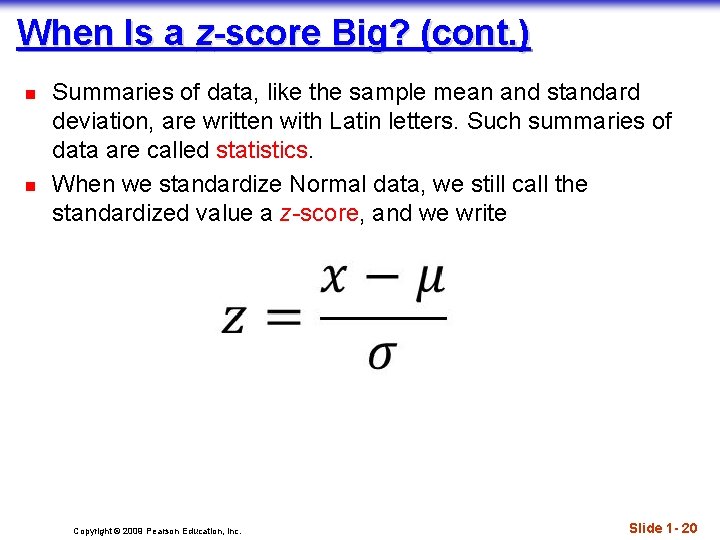
When Is a z-score Big? (cont. ) n n Summaries of data, like the sample mean and standard deviation, are written with Latin letters. Such summaries of data are called statistics. When we standardize Normal data, we still call the standardized value a z-score, and we write Copyright © 2009 Pearson Education, Inc. Slide 1 - 20
When Is a z-score Big? (cont. ) n n When we use the Normal model, we are assuming the distribution is Normal. We cannot check this assumption in practice, so we check the following condition: n Nearly Normal Condition: Condition The shape of the data’s distribution is unimodal and symmetric. n This condition can be checked by making a histogram or a Normal probability plot (to be explained later!). later! Copyright © 2009 Pearson Education, Inc. Slide 1 - 21
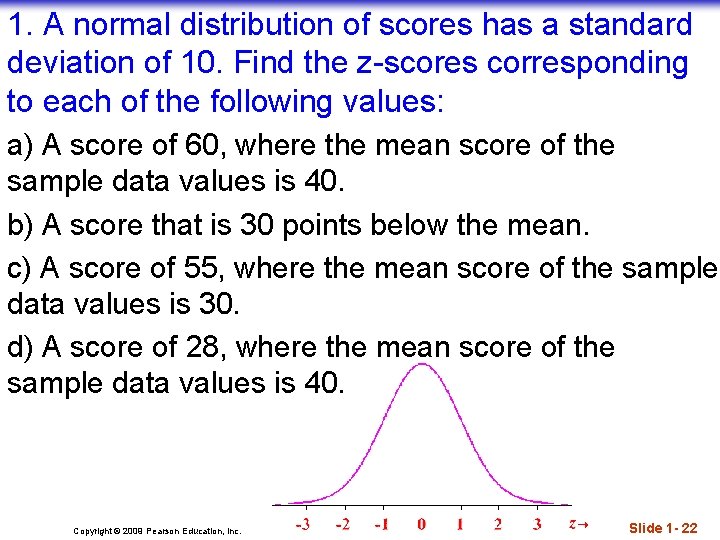
1. A normal distribution of scores has a standard deviation of 10. Find the z-scores corresponding to each of the following values: a) A score of 60, where the mean score of the sample data values is 40. b) A score that is 30 points below the mean. c) A score of 55, where the mean score of the sample data values is 30. d) A score of 28, where the mean score of the sample data values is 40. Copyright © 2009 Pearson Education, Inc. Slide 1 - 22
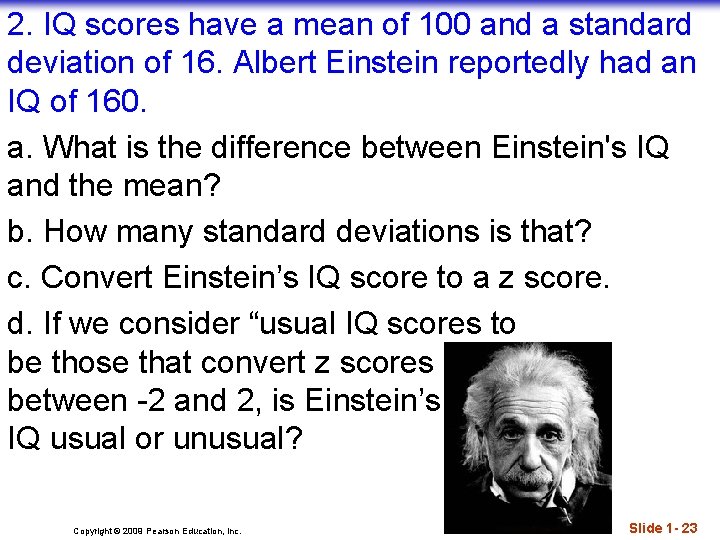
2. IQ scores have a mean of 100 and a standard deviation of 16. Albert Einstein reportedly had an IQ of 160. a. What is the difference between Einstein's IQ and the mean? b. How many standard deviations is that? c. Convert Einstein’s IQ score to a z score. d. If we consider “usual IQ scores to be those that convert z scores between -2 and 2, is Einstein’s IQ usual or unusual? Copyright © 2009 Pearson Education, Inc. Slide 1 - 23
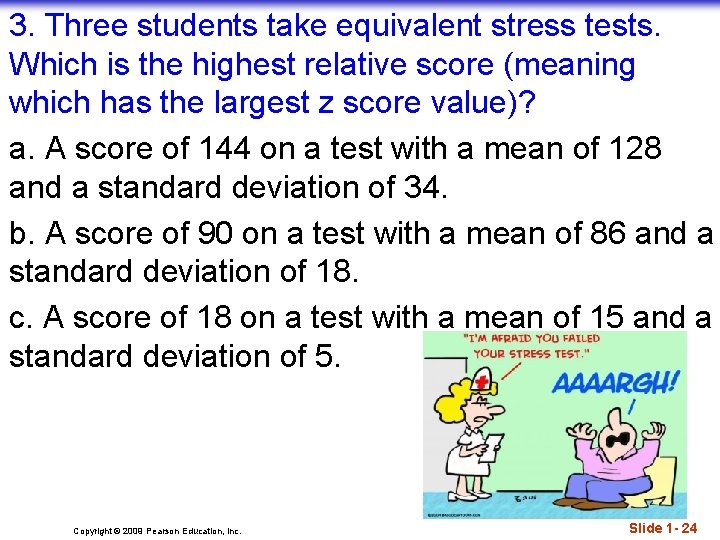
3. Three students take equivalent stress tests. Which is the highest relative score (meaning which has the largest z score value)? a. A score of 144 on a test with a mean of 128 and a standard deviation of 34. b. A score of 90 on a test with a mean of 86 and a standard deviation of 18. c. A score of 18 on a test with a mean of 15 and a standard deviation of 5. Copyright © 2009 Pearson Education, Inc. Slide 1 - 24
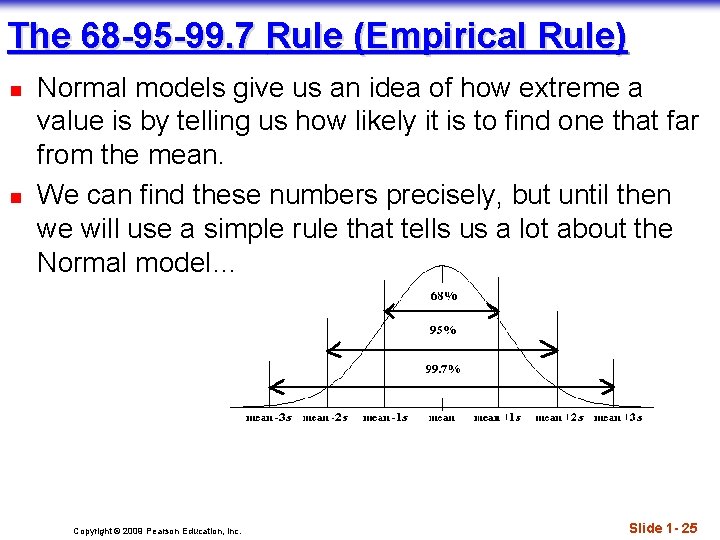
The 68 -95 -99. 7 Rule (Empirical Rule) n n Normal models give us an idea of how extreme a value is by telling us how likely it is to find one that far from the mean. We can find these numbers precisely, but until then we will use a simple rule that tells us a lot about the Normal model… Copyright © 2009 Pearson Education, Inc. Slide 1 - 25
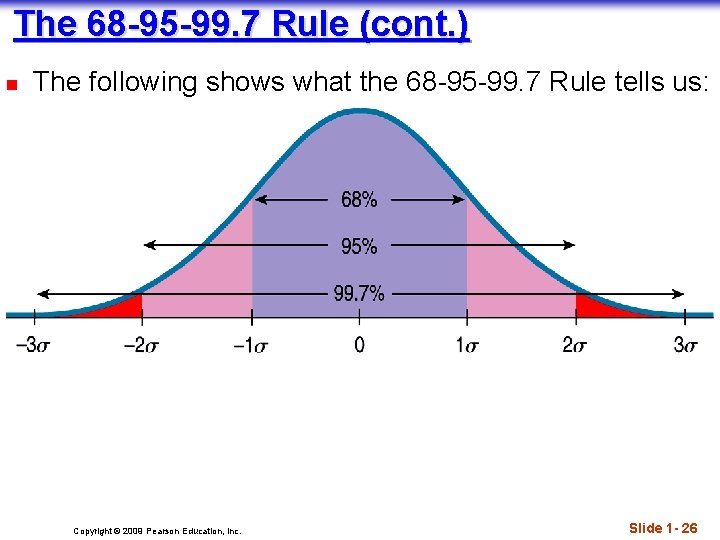
The 68 -95 -99. 7 Rule (cont. ) n The following shows what the 68 -95 -99. 7 Rule tells us: Copyright © 2009 Pearson Education, Inc. Slide 1 - 26
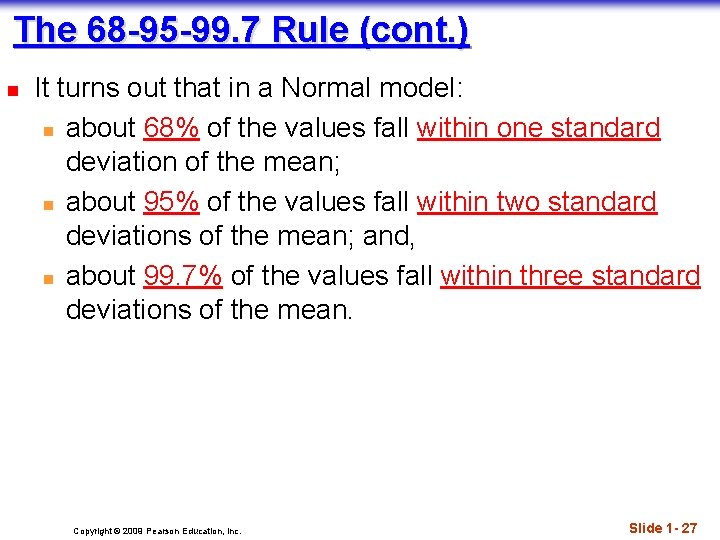
The 68 -95 -99. 7 Rule (cont. ) n It turns out that in a Normal model: n about 68% of the values fall within one standard deviation of the mean; n about 95% of the values fall within two standard deviations of the mean; and, n about 99. 7% of the values fall within three standard deviations of the mean. Copyright © 2009 Pearson Education, Inc. Slide 1 - 27
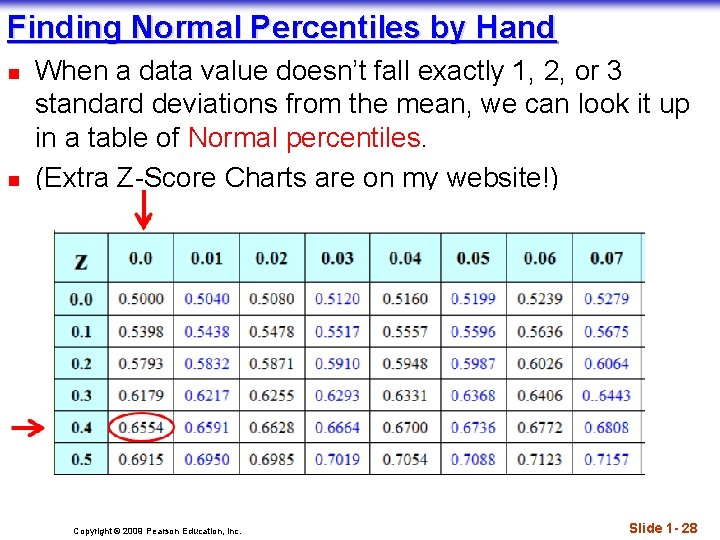
Finding Normal Percentiles by Hand n n When a data value doesn’t fall exactly 1, 2, or 3 standard deviations from the mean, we can look it up in a table of Normal percentiles. (Extra Z-Score Charts are on my website!) Copyright © 2009 Pearson Education, Inc. Slide 1 - 28
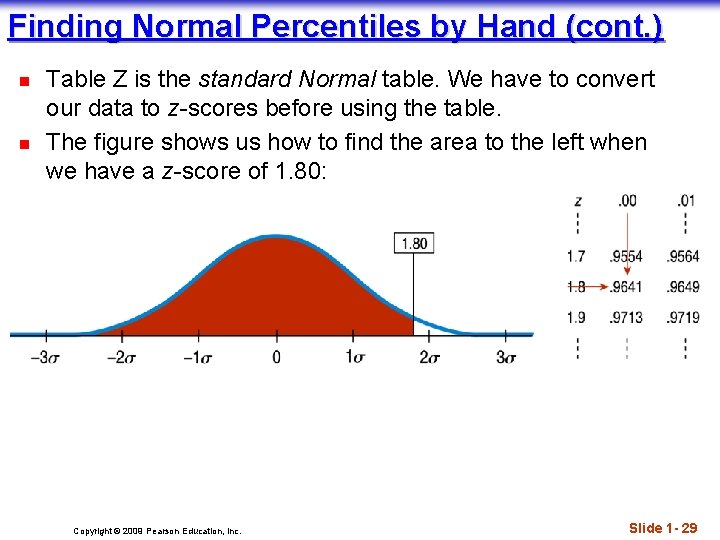
Finding Normal Percentiles by Hand (cont. ) n n Table Z is the standard Normal table. We have to convert our data to z-scores before using the table. The figure shows us how to find the area to the left when we have a z-score of 1. 80: Copyright © 2009 Pearson Education, Inc. Slide 1 - 29
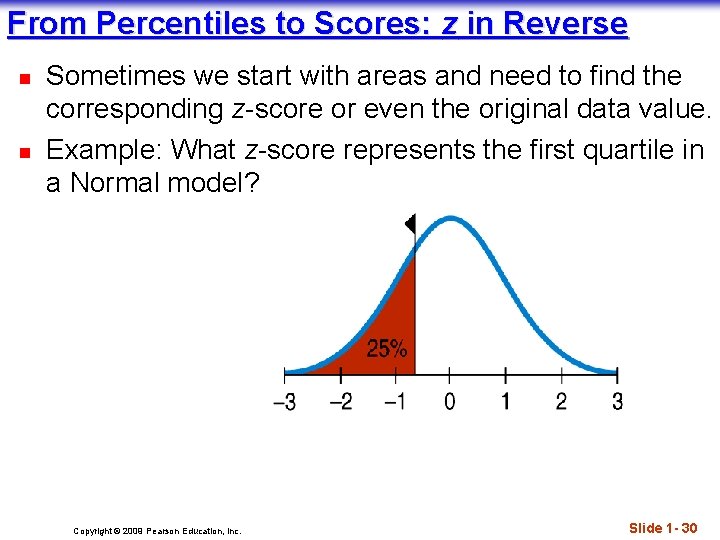
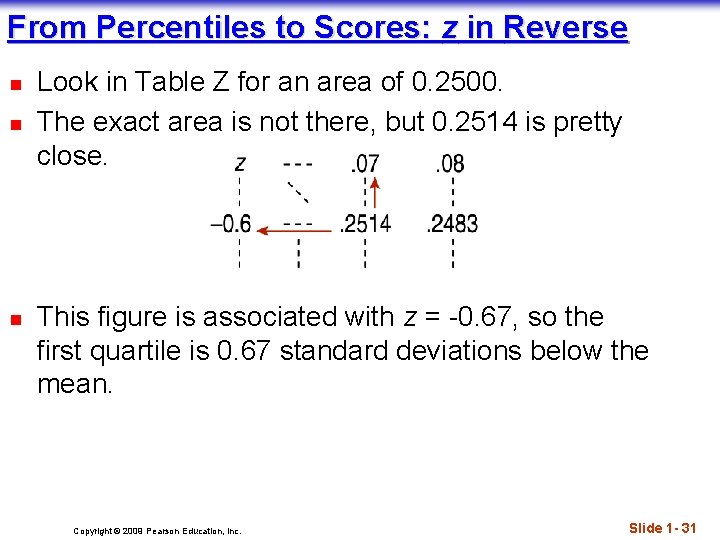
From Percentiles to Scores: z in Reverse n n Sometimes we start with areas and need to find the corresponding z-score or even the original data value. Example: What z-score represents the first quartile in a Normal model? Copyright © 2009 Pearson Education, Inc. Slide 1 - 30
From Percentiles to Scores: z in Reverse n n n Look in Table Z for an area of 0. 2500. The exact area is not there, but 0. 2514 is pretty close. This figure is associated with z = -0. 67, so the first quartile is 0. 67 standard deviations below the mean. Copyright © 2009 Pearson Education, Inc. Slide 1 - 31
What Can Go Wrong? (cont. ) n n n Don’t use the mean and standard deviation when outliers are present—the mean and standard deviation can both be distorted by outliers. Don’t round your results in the middle of a calculation. Don’t worry about minor differences in results. Copyright © 2009 Pearson Education, Inc. Slide 1 - 32
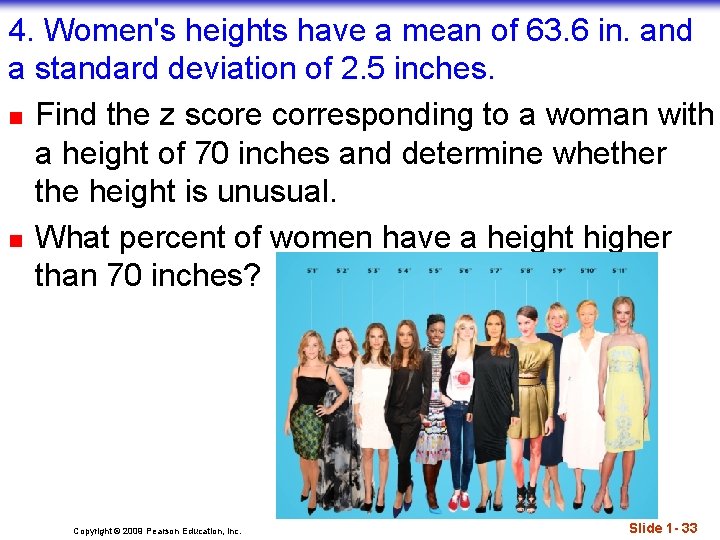
4. Women's heights have a mean of 63. 6 in. and a standard deviation of 2. 5 inches. n Find the z score corresponding to a woman with a height of 70 inches and determine whether the height is unusual. n What percent of women have a height higher than 70 inches? Copyright © 2009 Pearson Education, Inc. Slide 1 - 33
5. As mentioned above, IQ scores are normally distributed with mean 100 and std deviation of 16. a. b. c. d. What percent of people have an IQ of less than 100? What percent of people have an IQ between 84 and 100? What percent of people have an IQ higher than 140? What percent of people have an IQ less than 80? Copyright © 2009 Pearson Education, Inc. Slide 1 - 34