
Summary vs Critique Unit 3 Analyzing Informational Text
- Slides: 6
Summary vs. Critique Unit 3 Analyzing Informational Text
When teachers ask you to write a critique of a text, they expect you to analyze and evaluate, not just summarize. • A summary merely reports what the text said; that is, it answers only the question, "What did the author say? " • Summarizing an article simply means presenting it in a brief format and assuring yourself and your audience that you understand the article. • A critique, on the other hand, analyzes, interprets, and evaluates the text, answering the questions how? why? and how well?
A critique does not necessarily have to criticize the piece in a negative sense. • Your reaction to the text may be largely positive, negative, or a combination of the two. • It is important to explain why you respond to the text in a certain way. • In a critique you must explain why you do or do not accept the information and/or conclusions in the article as correct.
Characteristics of a Summary • Restates what you read in your own words • Presents only the main, or important, details • Maintains a neutral and objective stance
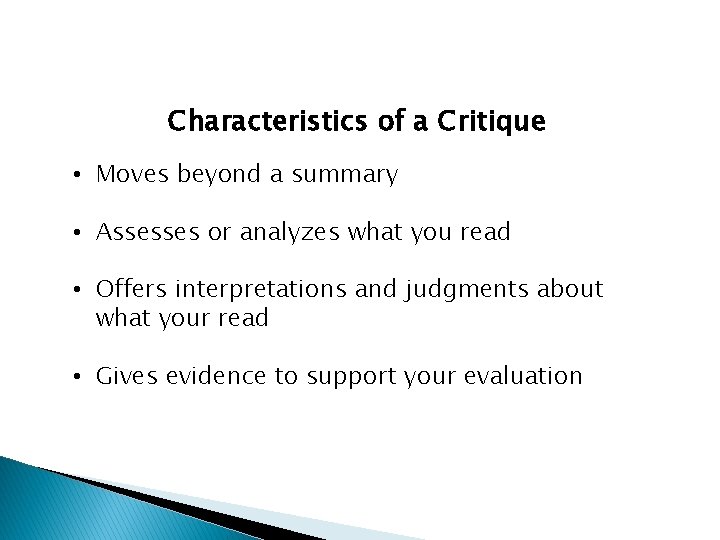
Characteristics of a Critique • Moves beyond a summary • Assesses or analyzes what you read • Offers interpretations and judgments about what your read • Gives evidence to support your evaluation
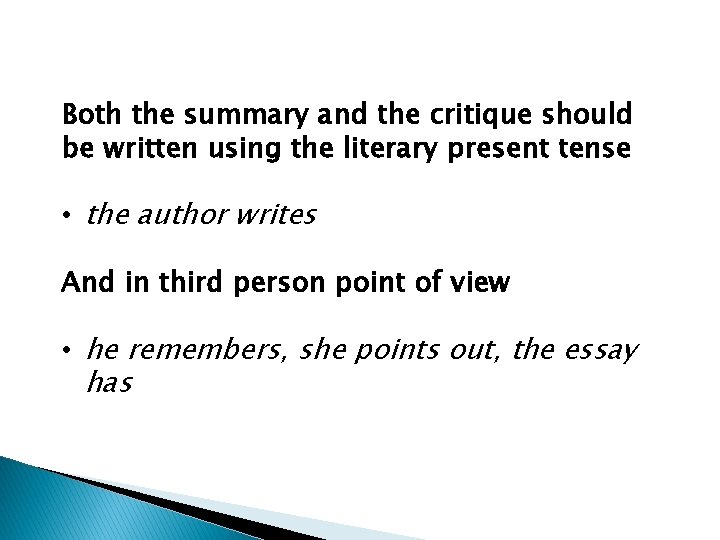
Both the summary and the critique should be written using the literary present tense • the author writes And in third person point of view • he remembers, she points out, the essay has