
Summary vs Analysis How to MAKE or BREAK
Summary vs Analysis How to MAKE or BREAK your CONTENT
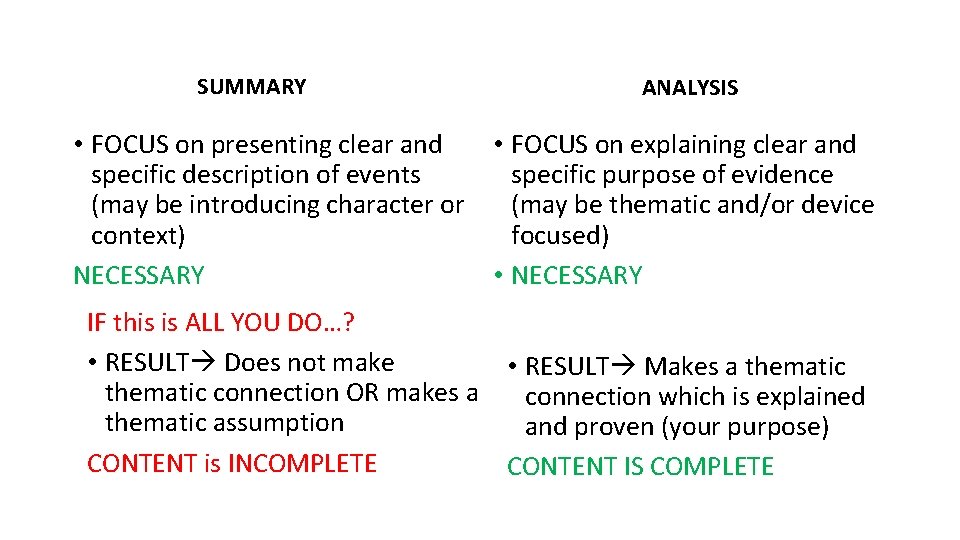
SUMMARY ANALYSIS • FOCUS on presenting clear and • FOCUS on explaining clear and specific description of events specific purpose of evidence (may be introducing character or (may be thematic and/or device context) focused) NECESSARY • NECESSARY IF this is ALL YOU DO…? • RESULT Does not make • RESULT Makes a thematic connection OR makes a connection which is explained thematic assumption and proven (your purpose) CONTENT is INCOMPLETE CONTENT IS COMPLETE
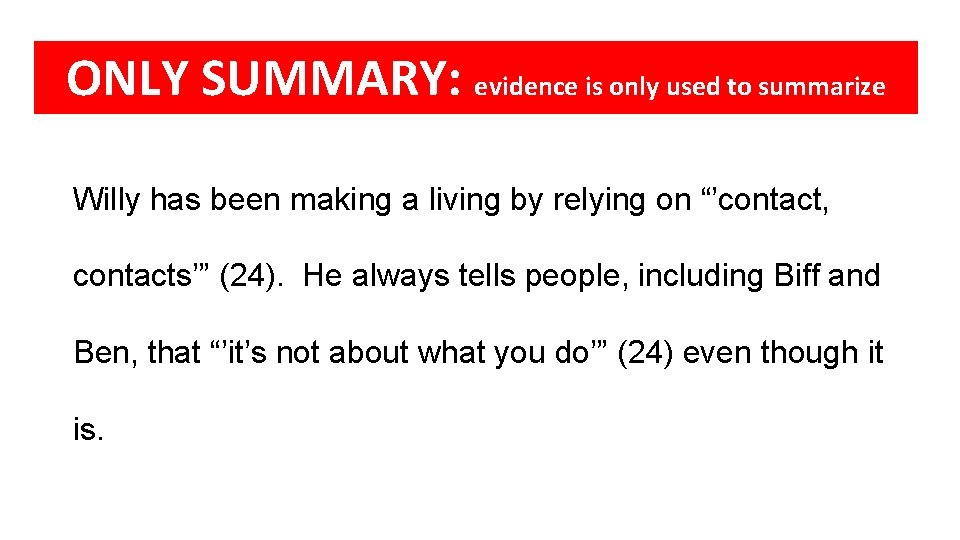
SUMMARY or ANALYSIS? ONLY SUMMARY: evidence is only used to summarize Willy has been making a living by relying on “’contact, contacts’” (24). He always tells people, including Biff and Ben, that “’it’s not about what you do’” (24) even though it is.
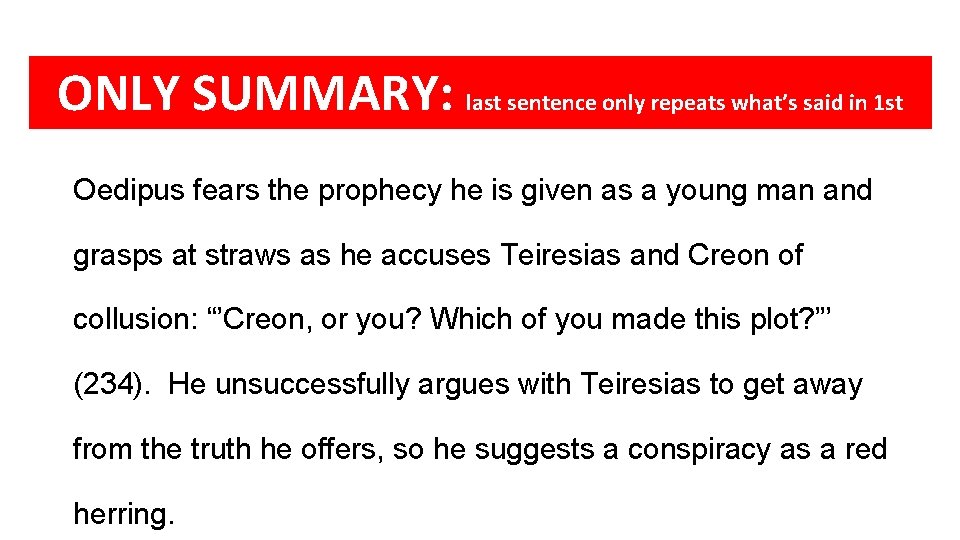
SUMMARY or ANALYSIS? ONLY SUMMARY: last sentence only repeats what’s said in 1 st Oedipus fears the prophecy he is given as a young man and grasps at straws as he accuses Teiresias and Creon of collusion: “’Creon, or you? Which of you made this plot? ”’ (234). He unsuccessfully argues with Teiresias to get away from the truth he offers, so he suggests a conspiracy as a red herring.

SUMMARY or ANALYSIS? ONLY SUMMARY: “analysis” is really just a combination of summary & translation of example They send for a herdsman who was a slave who witnessed the King’s murder at the crossroads. He confirms Oedipus is the murderer he saw, and Oedipus sees his guilt: ‘”Oh God! Did I, then, in my ignorance/ proclaim that awful curse against myself? ’” (746 -7). Oedipus realizes his responsibility for unknowingly murdering the king and for unknowingly condemning himself as the murderer.
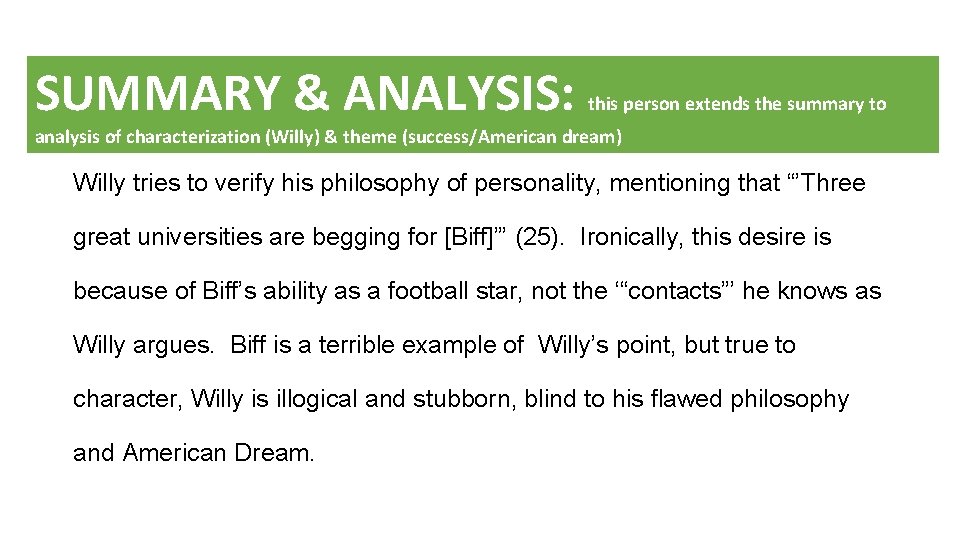
SUMMARY or ANALYSIS? SUMMARY & ANALYSIS: this person extends the summary to analysis of characterization (Willy) & theme (success/American dream) Willy tries to verify his philosophy of personality, mentioning that “’Three great universities are begging for [Biff]”’ (25). Ironically, this desire is because of Biff’s ability as a football star, not the ‘“contacts”’ he knows as Willy argues. Biff is a terrible example of Willy’s point, but true to character, Willy is illogical and stubborn, blind to his flawed philosophy and American Dream.

SUMMARY & ANALYSIS: this person is likely using this part 1 of a SUMMARY or ANALYSIS? contrast between Iocasta before/after the “light” of truth; OTHERWISE, this analysis has no connection to theme and so would suffice only for a simple character analysis Sophocles frames Iocasta as a rational and concerned character, as she coolly mediates the clash Oedipus, her husband, is escalating with Creon, her brother: “’You frantic men! What has roused this wild/ Dispute? Have you no shame, when such a plague/ Afflicts us, to indulge in private quarrels? / Creon, go home, I pray. You, Oedipus, / Come in; do not make much of what is nothing”’ (222 -26). She is clear and direct as she points out their error in decorum and political sensitivity, shutting down the two nobles
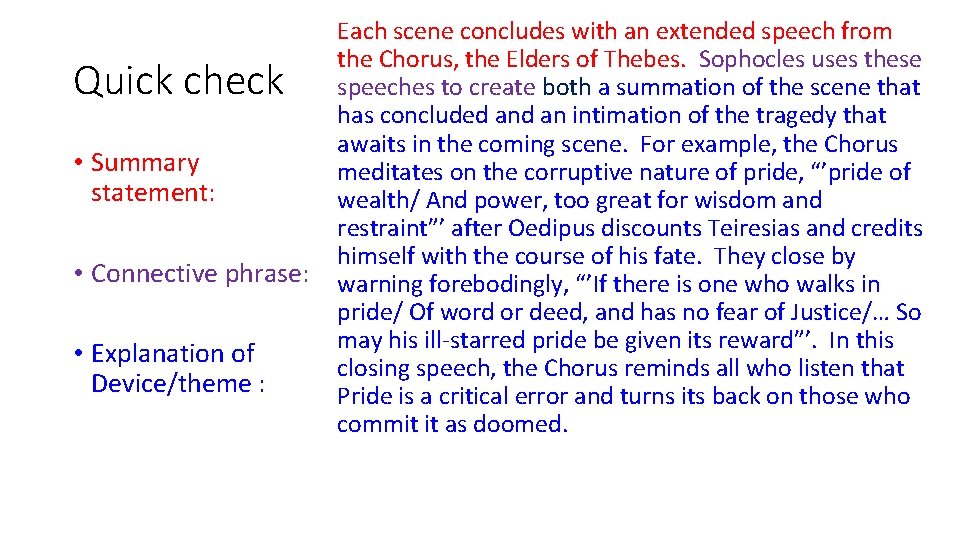
Quick check • Summary statement: • Connective phrase: • Explanation of Device/theme : Each scene concludes with an extended speech from the Chorus, the Elders of Thebes. Sophocles uses these speeches to create both a summation of the scene that has concluded an intimation of the tragedy that awaits in the coming scene. For example, the Chorus meditates on the corruptive nature of pride, “’pride of wealth/ And power, too great for wisdom and restraint”’ after Oedipus discounts Teiresias and credits himself with the course of his fate. They close by warning forebodingly, “’If there is one who walks in pride/ Of word or deed, and has no fear of Justice/… So may his ill-starred pride be given its reward”’. In this closing speech, the Chorus reminds all who listen that Pride is a critical error and turns its back on those who commit it as doomed.
- Slides: 8