
Summary statements on lessonslearned Soren Prestemon Lawrence Berkeley
Summary statements on lessons-learned Soren Prestemon, Lawrence Berkeley National Laboratory LBNL Coordinator & L 3 Control Account Manager for Structures LHC AUP Project logo area LBNL – March 22, 2019
Outline • Lessons learned: • • • Understanding of MQXFAP 2 shell fracture Communicating and handling non-conformance Enhanced QC for flaw detection Implications of integration features Designing within Criteria • Status of shell design moving forward • Satisfy design criteria • Meet integration feature requirements Soren Prestemon Review of the MQXFAP 2 Al-Shell Issue and Lessons Learned 2
We have a general understanding of the issues leading to the MQXFAP 2 shell failure • Very tight radii on a short end shell: • Led to enhanced stress concentrations • Analysis predicts plastic region • strains can exceed the tensile limit of the material and introduce cracks • Propagation of the cracks is then possible under some stress scenarios • Fairly high stress level on (all) shells • Decision to apply collar key interception played a role • Additional elements that may have enhanced the return end shell stress: • Pole key was extended – first time in AUP: • Results in “stiffer” ends • Had been successfully used by CERN • (reduces stresses on coil ends) • RE shell is first to see cold He gas – possible enhanced stress during cooldown • High-conductivity and low heat capacity of Al as compared to yokes, masters, pads, and coils • Tolerances may have resulted in higher stress on end-shell • Typical band of shell stresses measure ~ 25 -30 MPa; end shells typically not monitored Soren Prestemon Review of the MQXFAP 2 Al-Shell Issue and Lessons Learned 3
Communicating and handling nonconformance is critical for the project • The shell cutout radii were flagged by the manufacturer as non-conforming, and accepted • Non-conforming parts must be rejected or quarantined for further review by L 3 and L 2 • Project is providing explicit guidance moving forward • Requires regular communication with vendor in order to minimize cost and schedule impact • If possible we need to avoid just-in-time procurements, where non-conformance leads directly to schedule delay Soren Prestemon Review of the MQXFAP 2 Al-Shell Issue and Lessons Learned 4
Flaw detection is a critical element to avoid fracture of the Al shells • Based on feedback from experts, we have enhanced our flaw QC: • Tightened ultrasonic inspection of the forgings from A to AA • Added post-machining dye penetrant inspection to catch any surface flaws • From each forging we now capture a material drop from which mechanical property samples can be made • Intend to evaluate 10+ K 1 c samples (C-L orientation) to build statistics Soren Prestemon Review of the MQXFAP 2 Al-Shell Issue and Lessons Learned 5
Implications of features added for “downstream” integration need to be properly understood • The cutouts were added during the design phase to address cryostat integration needs • Al shells were initially designed purely to prestress coils via circumferential tension (hoop stress) • We did not fully recognize the implications of the addition of the cutouts • This is mainly a lessons-learned for the team members for future projects • Design Criteria help by providing a ”formalism” to evaluate the impact of design changes Soren Prestemon Review of the MQXFAP 2 Al-Shell Issue and Lessons Learned 6
Design Criteria support the project design on multiple fronts • Guide the analysis process • Enable the project to leverage the material properties within a safe envelop • Provide a systematic “formalism” that instills rigor to the design process • Facilitates design reviews and the evaluation of potential impact of design changes Soren Prestemon Review of the MQXFAP 2 Al-Shell Issue and Lessons Learned 7
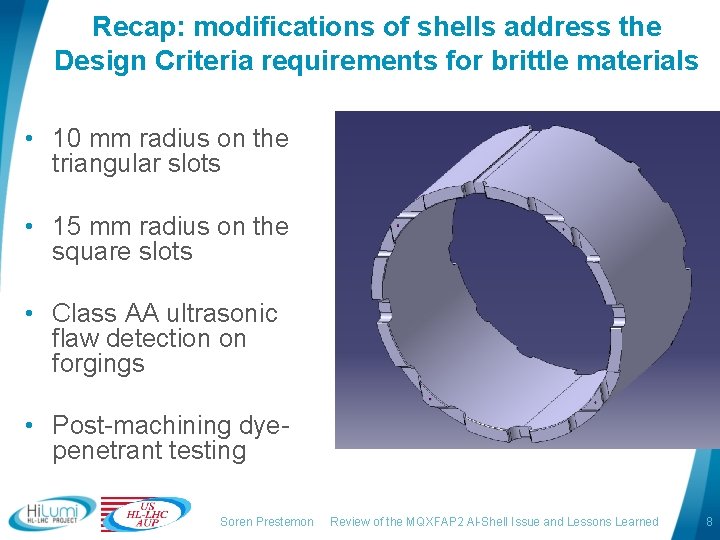
Recap: modifications of shells address the Design Criteria requirements for brittle materials • 10 mm radius on the triangular slots • 15 mm radius on the square slots • Class AA ultrasonic flaw detection on forgings • Post-machining dyepenetrant testing Soren Prestemon Review of the MQXFAP 2 Al-Shell Issue and Lessons Learned 8
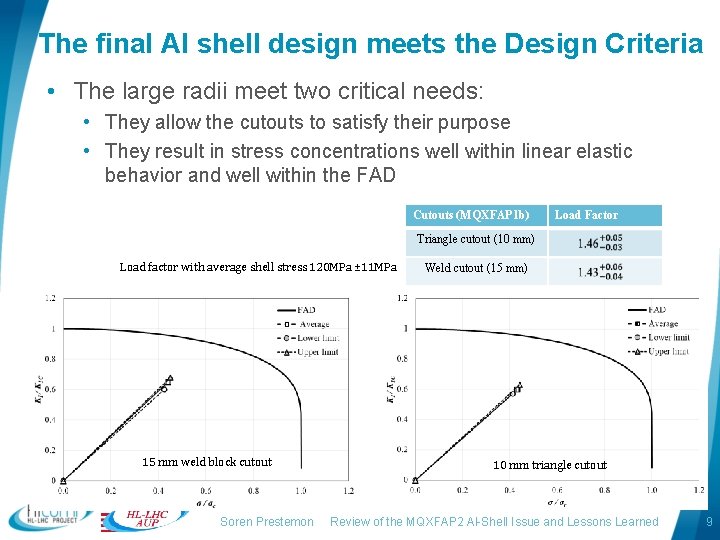
The final Al shell design meets the Design Criteria • The large radii meet two critical needs: • They allow the cutouts to satisfy their purpose • They result in stress concentrations well within linear elastic behavior and well within the FAD Cutouts (MQXFAP 1 b) Load Factor Triangle cutout (10 mm) Load factor with average shell stress 120 MPa ± 11 MPa 15 mm weld block cutout Soren Prestemon Weld cutout (15 mm) 10 mm triangle cutout Review of the MQXFAP 2 Al-Shell Issue and Lessons Learned 9
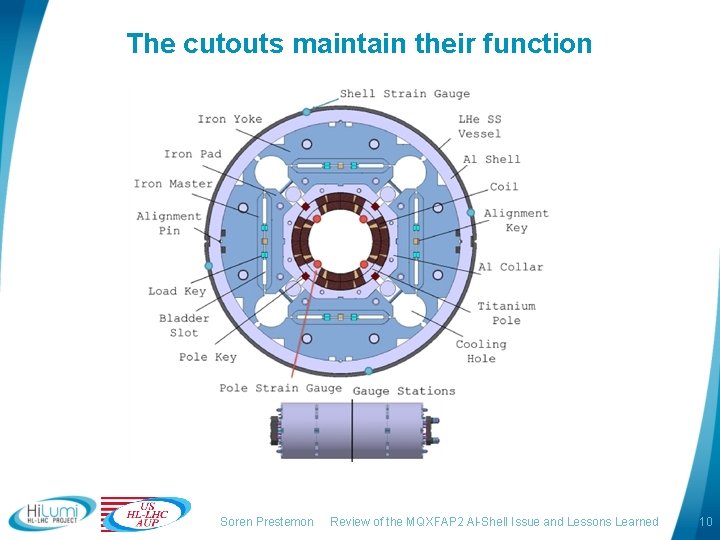
The cutouts maintain their function Soren Prestemon Review of the MQXFAP 2 Al-Shell Issue and Lessons Learned 10
Conclusions • We have developed an understanding of the primary sources at the heart of the MMQXFAP 2 fractured shell • We have developed a thorough set of Design Criteria that enable us to design within a safe envelop for both brittle and tough materials • We now have a design that meets the Design Criteria while satisfying the technical requirements Soren Prestemon Review of the MQXFAP 2 Al-Shell Issue and Lessons Learned 11
Backup Soren Prestemon Review of the MQXFAP 2 Al-Shell Issue and Lessons Learned 12
- Slides: 12