
Summary project CW 49 1 Bonding test connector

Summary project CW 49
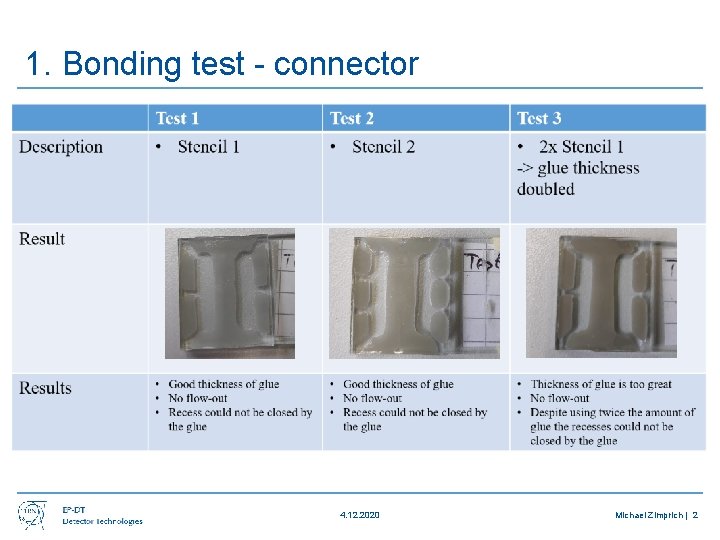
1. Bonding test - connector 4. 12. 2020 Michael Zimprich | 2

1. Bonding test - connector • Ordered new stencils with more, but thinner bridges 4. 12. 2020 Michael Zimprich | 3

1. Bonding test - connector T 1 Description • • T 2 Stencil 1 Recesses filled with syringe • • Stencil 2 Recesses filled with syringe Glue before bonding 20 h after bonding Result • • • Glue doesn’t cover the whole surface O-ring doesn’t touch the glass everywhere No glue in holes No flow-out of glue Leak-test: Air: 3/3 passed; He: 2/3 passed 4. 12. 2020 • • • Glue doesn’t cover the whole surface O-ring doesn’t touch the glass everywhere No glue in holes No flow-out of glue Leak-test: Air: 2/3 passed; He: 0/3 passed Michael Zimprich | 4
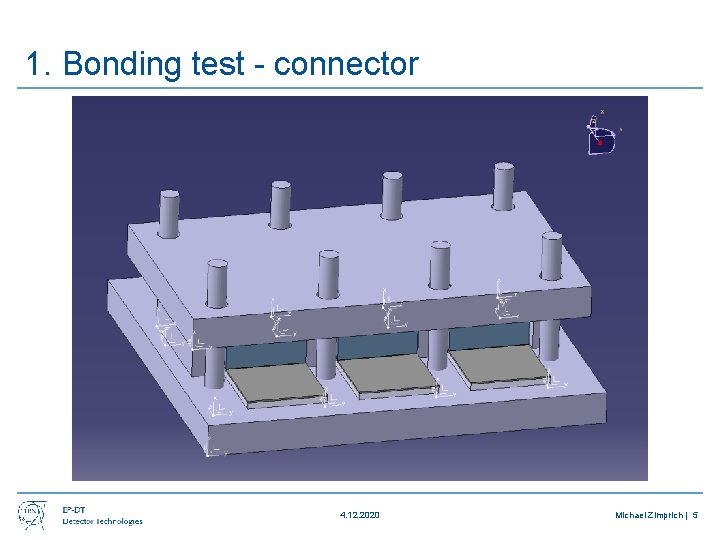
1. Bonding test - connector 4. 12. 2020 Michael Zimprich | 5
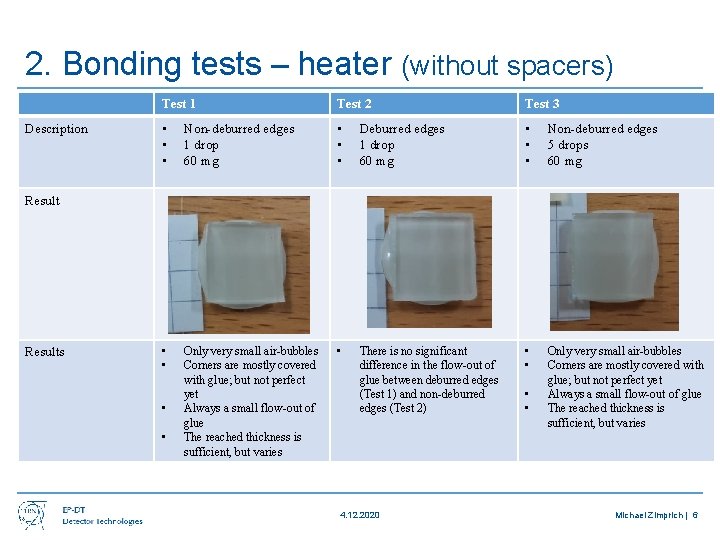
2. Bonding tests – heater (without spacers) Description Test 1 Test 2 Test 3 • • • Non-deburred edges 1 drop 60 mg • • • Deburred edges 1 drop 60 mg • • • Non-deburred edges 5 drops 60 mg • • Only very small air-bubbles Corners are mostly covered with glue; but not perfect yet Always a small flow-out of glue The reached thickness is sufficient, but varies • There is no significant difference in the flow-out of glue between deburred edges (Test 1) and non-deburred edges (Test 2) • • Only very small air-bubbles Corners are mostly covered with glue; but not perfect yet Always a small flow-out of glue The reached thickness is sufficient, but varies Results • • 4. 12. 2020 • • Michael Zimprich | 6

2. Bonding tests - heater (without spacers) Description Test 4 Test 5 Test 6 • • • Surface is sandblasted 1 drop 60 mg Glue applied with stencil 1 Glue applied with stencil 2 Results • The tests with sandblasted tiles showed a higher chance of creating air-bubbles • Corners are mostly not covered with glue • Less flow-out of glue than tests with non-sandblasted surfaces • Sandblasted surfaces prevents the glue from wetting (less flow-out, but corners are not covered with glue • The reached thickness is sufficient • Only very small air-bubbles • Corners are mostly not covered with glue • Almost no flow-out of glue • Thickness is sufficient; only varies a bit 4. 12. 2020 • Only very small air-bubbles • Corners are mostly covered with glue • There is always a small spot in the middle of the edge that is not covered • Almost no flow-out of glue • Thickness is sufficient; only varies a bit Michael Zimprich | 7

2. Bonding tests – heater (with spacers) Description Test 7 Test 8 Test 9 • • • Stencil 2 Spacers = 1. 41 mm Stencil 2 Spacers = 1. 39 mm Stencil 2 Spacers = 1. 44 mm Results • Only very small air-bubbles • Corners are mostly covered with glue • No flow-out • Good thickness of glue: 80 – 110μm (thickest point: top left corner; thinnest point: bottom left corner) • • Only very small air-bubbles Corners are all covered with glue Only small flow-out Good thickness of glue: 60 – 100μm (thickest point: top left corner; thinnest point: bottom left corner) 4. 12. 2020 • • Few small air-bubbles Corners are all covered with glue Almost no flow-out Good thickness of glue; between 40 and 70μm (thickest point: top left corner; thinnest point: bottom left corner) • Using two spacers didn’t change thickness Michael Zimprich | 8
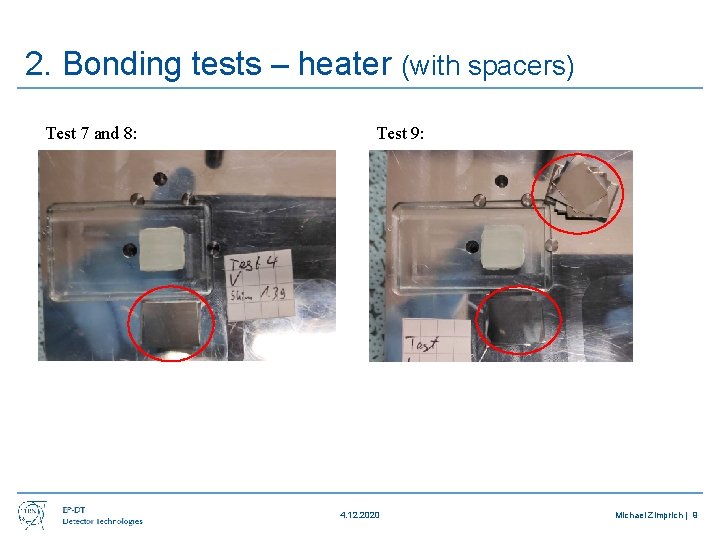
2. Bonding tests – heater (with spacers) Test 7 and 8: Test 9: 4. 12. 2020 Michael Zimprich | 9

2. Bonding tests – heater • Ordered new stencils 4. 12. 2020 Michael Zimprich | 10

Discussion-time Questions? 4. 12. 2020 Michael Zimprich | 11
- Slides: 11