
Summary of Topic 2 n Human visual system
- Slides: 6
Summary of Topic 2 n Human visual system n Cones n Photopic or bright-light vision n Highly sensitive to color n Rods n Not involved in color vision n Sensitive to low level of illumination (scotopic or dim-light vision) G 52 IIP, School of Computer Science, University of Nottingham 1
Summary of Topic 2 n Human visual system n Brightness adaptation n Subjective brightness is a logarithmic function of the light intensity incident on the eye n The HVS cannot operate on the full perceptible brightness range (~10 orders of magnitude) simultaneously n The total brightness range the HVS can discriminate simultaneously is rather small in comparison (about 4 orders of magnitude) n It accomplishes this through (brightness) adaptation G 52 IIP, School of Computer Science, University of Nottingham 2
Summary of Topic 2 n Human visual system n Brightness discrimination n n Perceivable changes at a given adaptation level Weber ratio, DI/I, where I is background, DI intensity change Small Weber ratio - good discrimination Larger Weber ratio - poor discrimination n Perceived brightness is not a simple function of intensity n Mach band pattern n Simultaneous contrast G 52 IIP, School of Computer Science, University of Nottingham 3
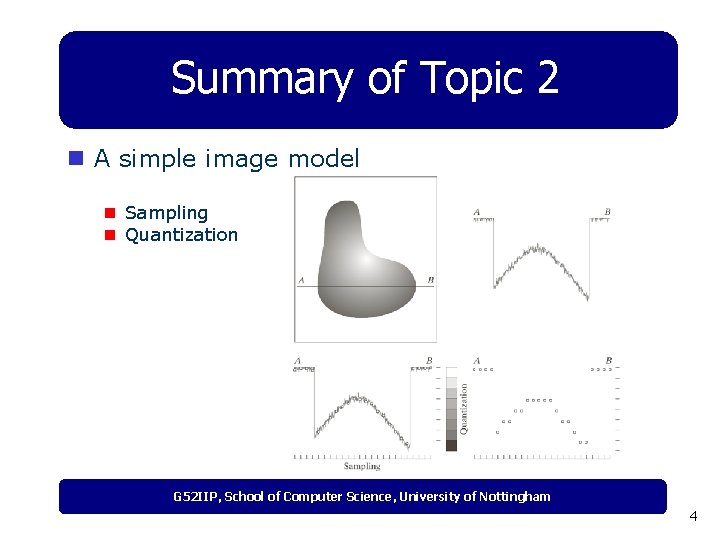
Summary of Topic 2 n A simple image model n Sampling n Quantization G 52 IIP, School of Computer Science, University of Nottingham 4
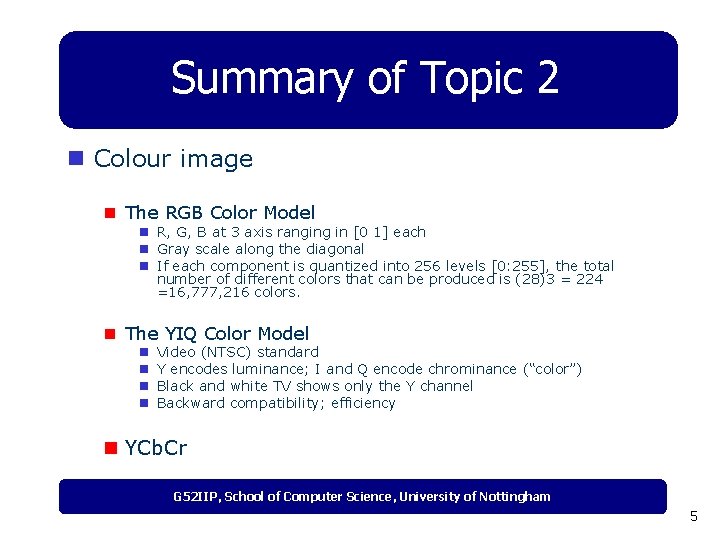
Summary of Topic 2 n Colour image n The RGB Color Model n R, G, B at 3 axis ranging in [0 1] each n Gray scale along the diagonal n If each component is quantized into 256 levels [0: 255], the total number of different colors that can be produced is (28)3 = 224 =16, 777, 216 colors. n The YIQ Color Model n n Video (NTSC) standard Y encodes luminance; I and Q encode chrominance (“color”) Black and white TV shows only the Y channel Backward compatibility; efficiency n YCb. Cr G 52 IIP, School of Computer Science, University of Nottingham 5
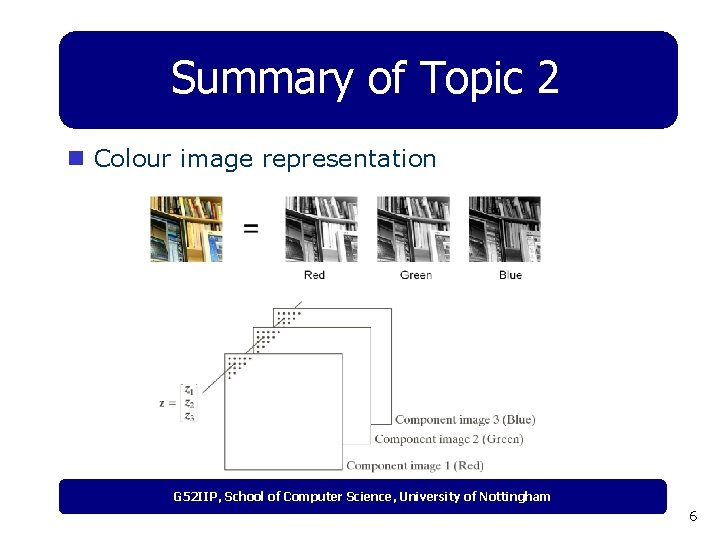
Summary of Topic 2 n Colour image representation G 52 IIP, School of Computer Science, University of Nottingham 6