
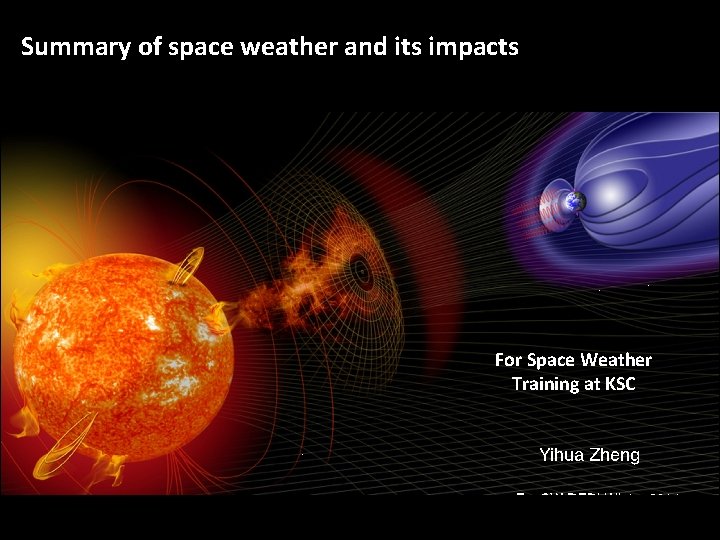
Summary of space weather Over and its impacts
- Slides: 39
Summary of space weather Over and its impacts For Space Weather Training at KSC
Main Drivers of Space weather: Flares/CMEs/high speed solar wind streams 2
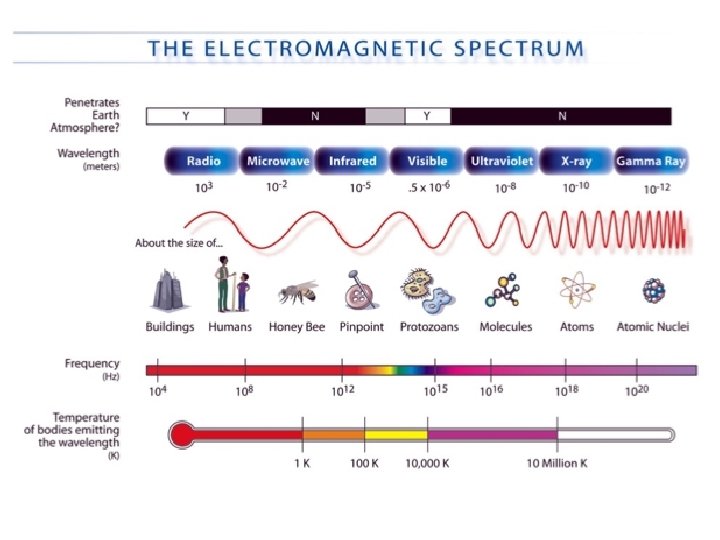
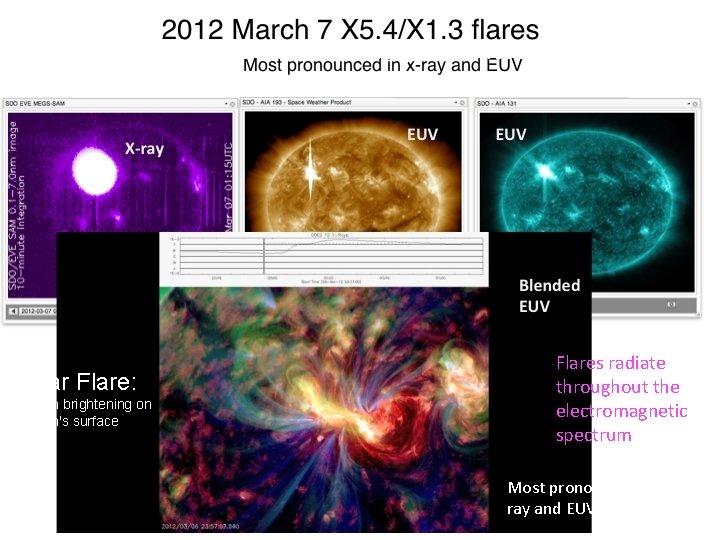
Solar Flares radiation across the electromagnetic spectrum most pronounced in EUV (extreme ultraviolet) and soft X-ray 3
2012 March 7 X 5. 4/X 1. 3 Flares Solar Flare: sudden brightening on the sun's surface Flares radiate throughout the electromagnetic spectrum Most pronounced in xray and EUV
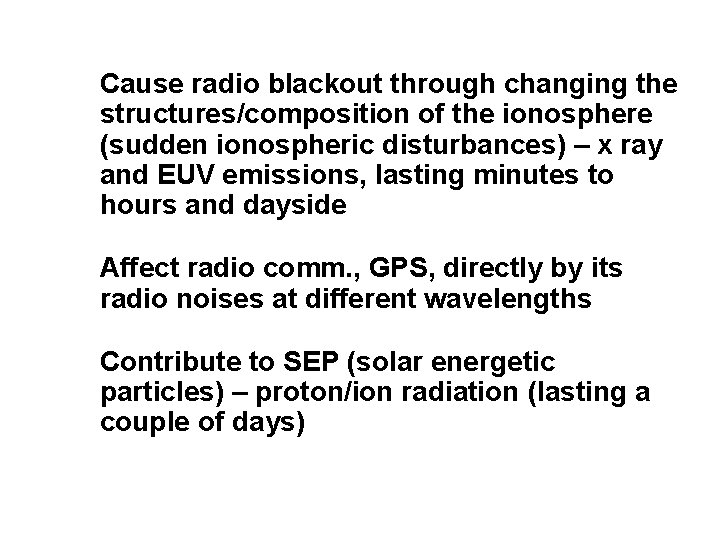
Flare: SWx impacts 1. Cause radio blackout through changing the structures/composition of the ionosphere (sudden ionospheric disturbances) – x ray and EUV emissions, lasting minutes to hours and dayside 2. Affect radio comm. , GPS, directly by its radio noises at different wavelengths 3. Contribute to SEP (solar energetic particles) – proton/ion radiation (lasting a couple of days)
Coronal Mass Ejections (CMEs) 7
CME Massive burst of solar materials/charged particles and magnetic field/flux into the interplanetary space: 10^15 g Kinetic energy 10^32 erg (1 erg = 10^-7 joules) Yashiro et al. (2006) find that virtually all Xclass flares have accompanying CMEs
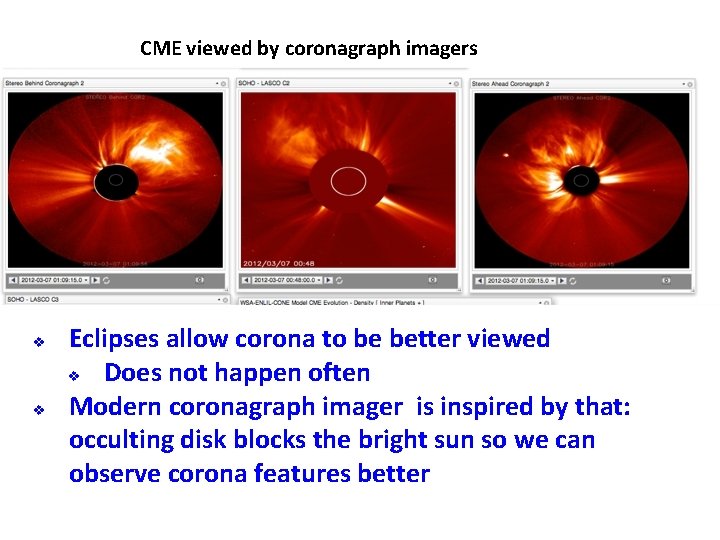
CME viewed by coronagraph imagers v v Eclipses allow corona to be better viewed v Does not happen often Modern coronagraph imager is inspired by that: occulting disk blocks the bright sun so we can observe corona features better
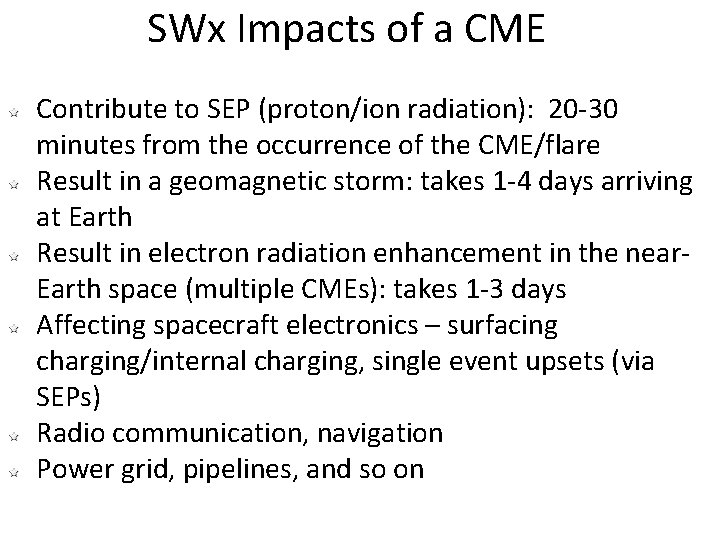
SWx Impacts of a CME Contribute to SEP (proton/ion radiation): 20 -30 minutes from the occurrence of the CME/flare Result in a geomagnetic storm: takes 1 -4 days arriving at Earth Result in electron radiation enhancement in the near. Earth space (multiple CMEs): takes 1 -3 days Affecting spacecraft electronics – surfacing charging/internal charging, single event upsets (via SEPs) Radio communication, navigation Power grid, pipelines, and so on
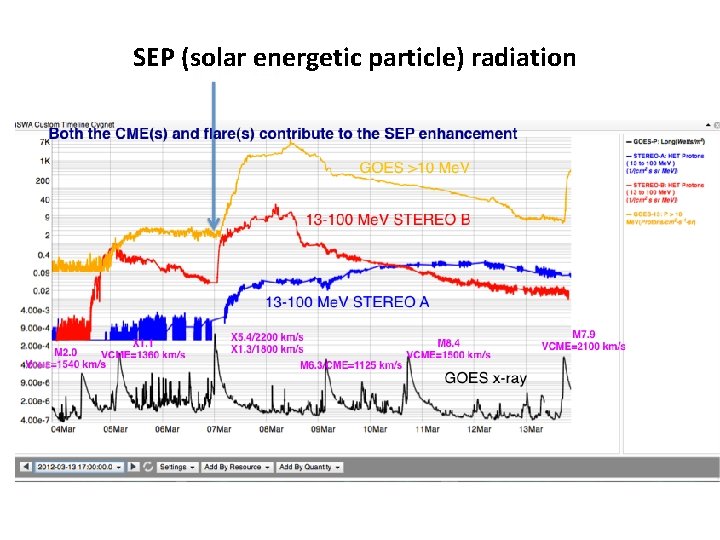
SEP (solar energetic particle) radiation
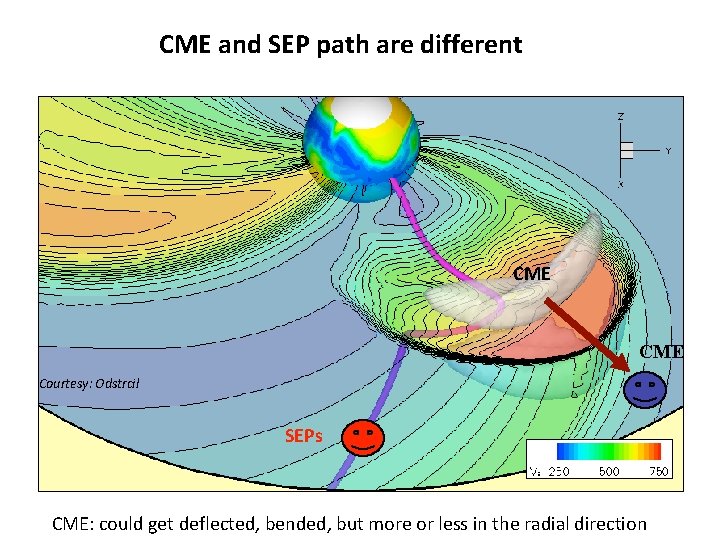
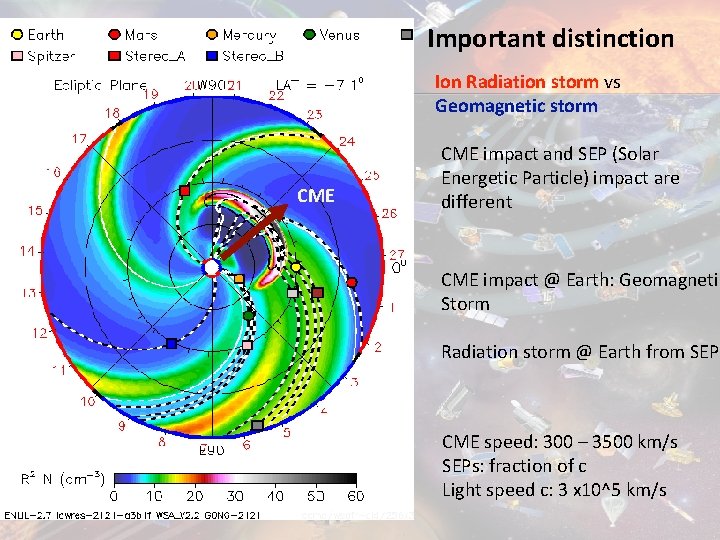
CME and SEP path are different CME Courtesy: Odstrcil SEPs CME: could get deflected, bended, but more or less in the radial direction
Important distinction Ion Radiation storm vs Geomagnetic storm CME impact and SEP (Solar Energetic Particle) impact are different CME impact @ Earth: Geomagnetic Storm Radiation storm @ Earth from SEPs CME speed: 300 – 3500 km/s SEPs: fraction of c Light speed c: 3 x 10^5 km/s
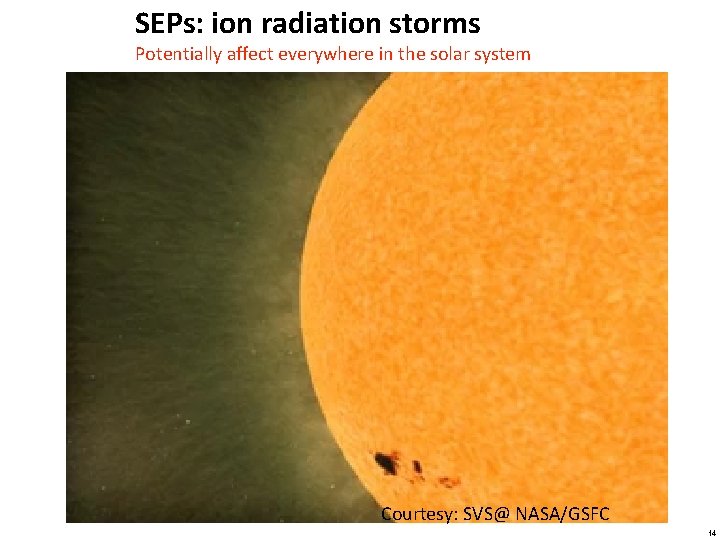
SEPs: ion radiation storms Potentially affect everywhere in the solar system Courtesy: SVS@ NASA/GSFC 14
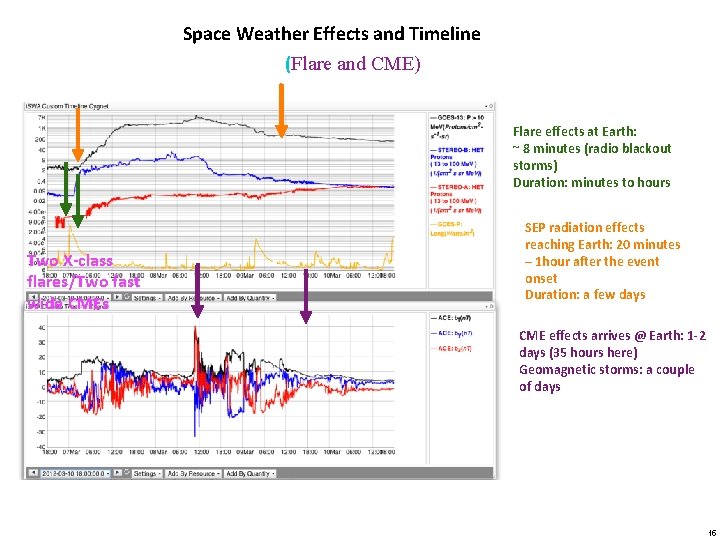
Space Weather Effects and Timeline (Flare and CME) Flare effects at Earth: ~ 8 minutes (radio blackout storms) Duration: minutes to hours Two X-class flares/Two fast wide CMEs SEP radiation effects reaching Earth: 20 minutes – 1 hour after the event onset Duration: a few days CME effects arrives @ Earth: 1 -2 days (35 hours here) Geomagnetic storms: a couple of days 15
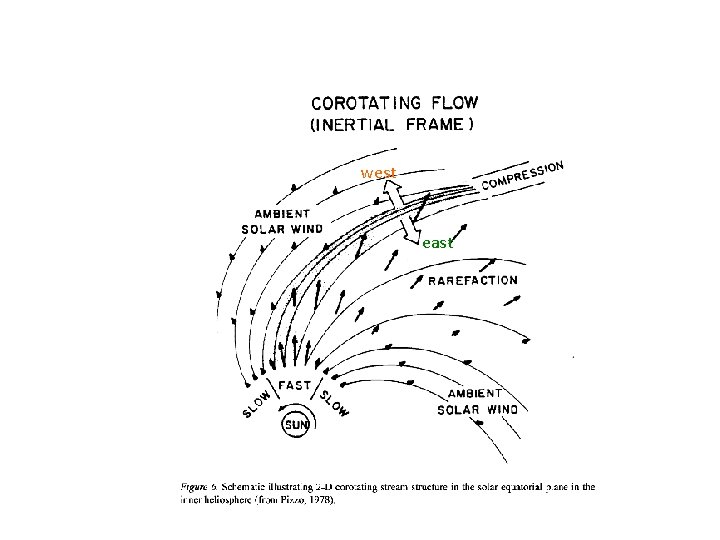
west east
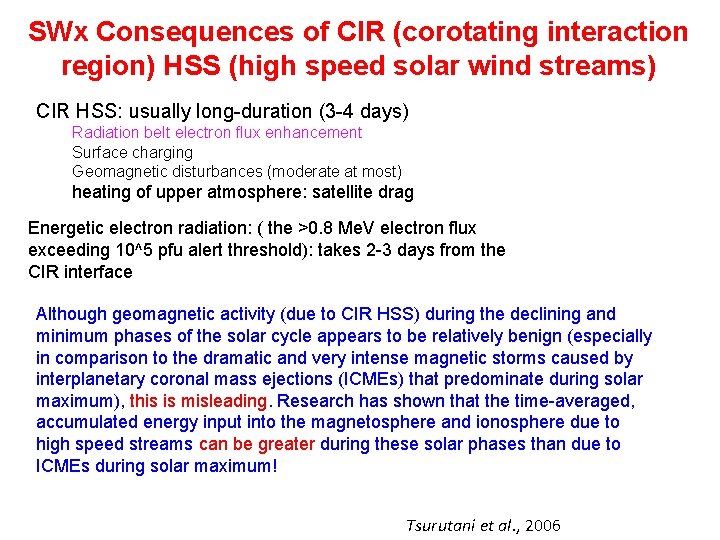
SWx Consequences of CIR (corotating interaction region) HSS (high speed solar wind streams) CIR HSS: usually long-duration (3 -4 days) Radiation belt electron flux enhancement Surface charging Geomagnetic disturbances (moderate at most) heating of upper atmosphere: satellite drag Energetic electron radiation: ( the >0. 8 Me. V electron flux exceeding 10^5 pfu alert threshold): takes 2 -3 days from the CIR interface Although geomagnetic activity (due to CIR HSS) during the declining and minimum phases of the solar cycle appears to be relatively benign (especially in comparison to the dramatic and very intense magnetic storms caused by interplanetary coronal mass ejections (ICMEs) that predominate during solar maximum), this is misleading. Research has shown that the time-averaged, accumulated energy input into the magnetosphere and ionosphere due to high speed streams can be greater during these solar phases than due to ICMEs during solar maximum! Tsurutani et al. , 2006
In-situ signatures of CME and CIR HSS at L 1 (Lagrangian 1) ACE and WIND spacecraft
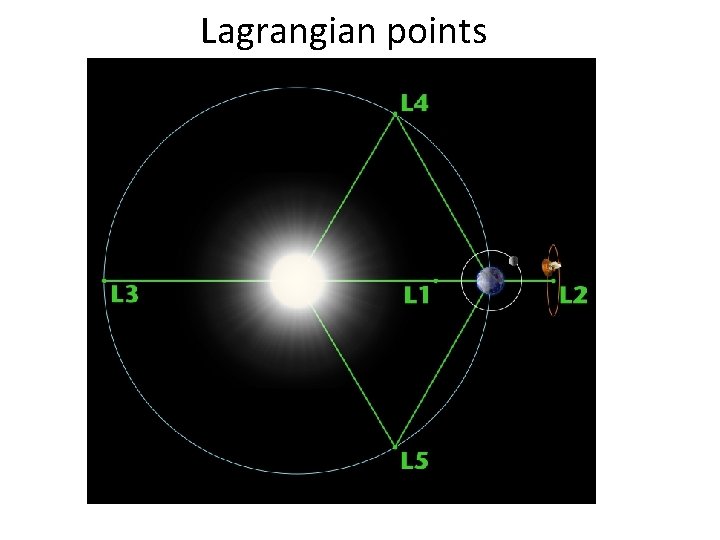
Lagrangian points
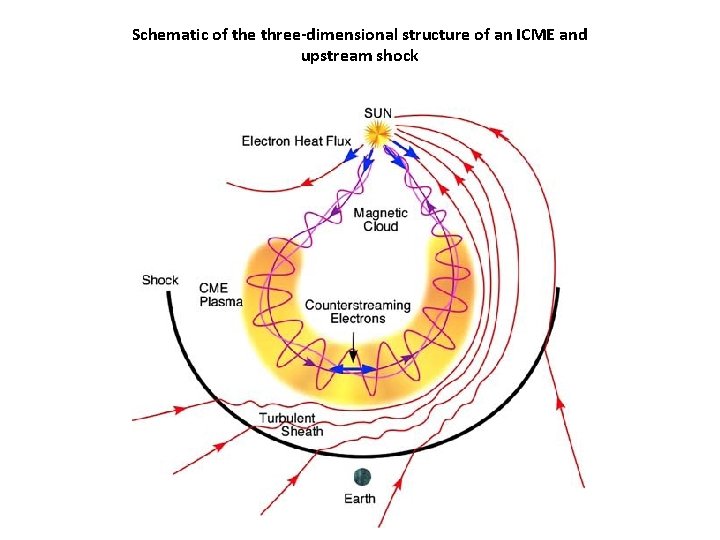
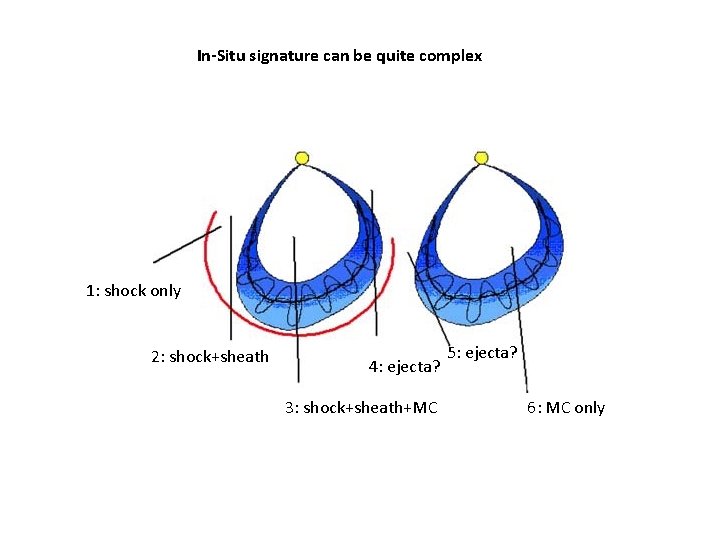
Schematic of the three-dimensional structure of an ICME and upstream shock
In-Situ signature can be quite complex 1: shock only 2: shock+sheath 4: ejecta? 3: shock+sheath+MC 5: ejecta? 6: MC only
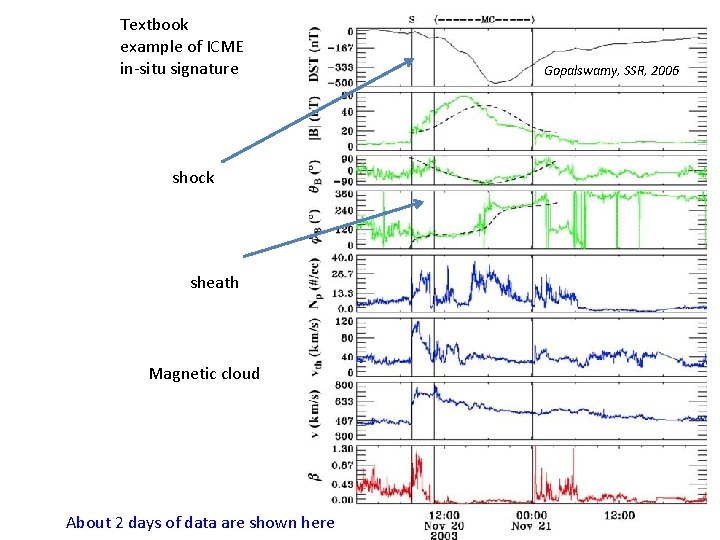
Textbook example of ICME in-situ signature shock sheath Magnetic cloud About 2 days of data are shown here Gopalswamy, SSR, 2006
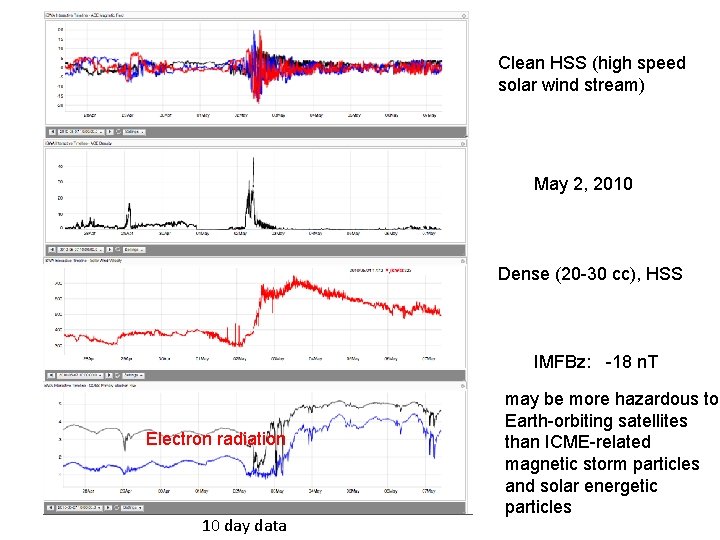
Clean HSS (high speed solar wind stream) May 2, 2010 Dense (20 -30 cc), HSS IMFBz: -18 n. T Electron radiation 10 day data may be more hazardous to Earth-orbiting satellites than ICME-related magnetic storm particles and solar energetic particles
Space Weather in a nutshell
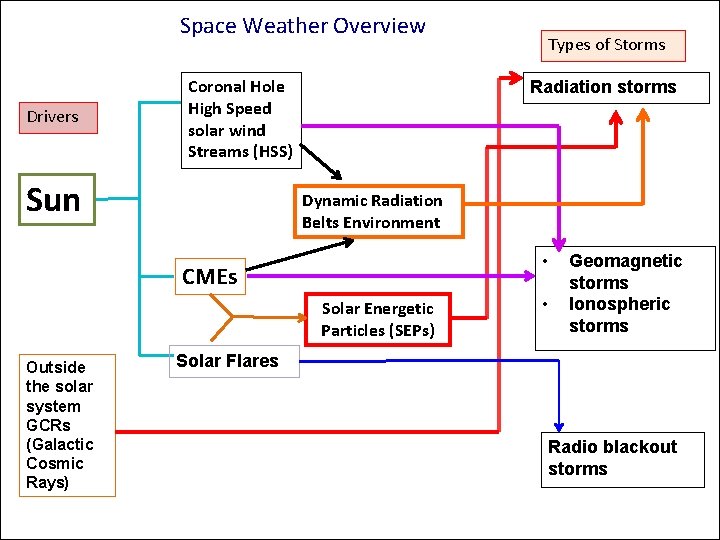
Space Weather Overview Drivers Coronal Hole High Speed solar wind Streams (HSS) Sun Radiation storms Dynamic Radiation Belts Environment • CMEs Solar Energetic Particles (SEPs) Outside the solar system GCRs (Galactic Cosmic Rays) Types of Storms • Geomagnetic storms Ionospheric storms Solar Flares Radio blackout storms
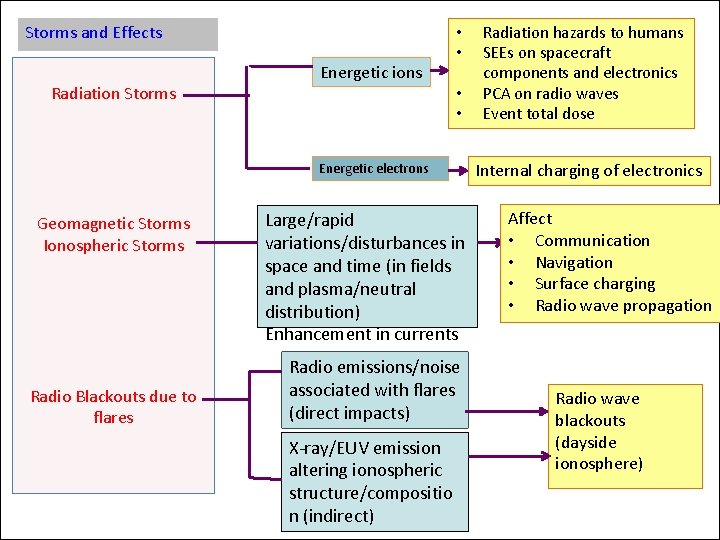
Storms and Effects Radiation Storms Energetic ions • • Energetic electrons Geomagnetic Storms Ionospheric Storms Radio Blackouts due to flares Large/rapid variations/disturbances in space and time (in fields and plasma/neutral distribution) Enhancement in currents Radio emissions/noise associated with flares (direct impacts) X-ray/EUV emission altering ionospheric structure/compositio n (indirect) Radiation hazards to humans SEEs on spacecraft components and electronics PCA on radio waves Event total dose Internal charging of electronics Affect • Communication • Navigation • Surface charging • Radio wave propagation Radio wave blackouts (dayside ionosphere)
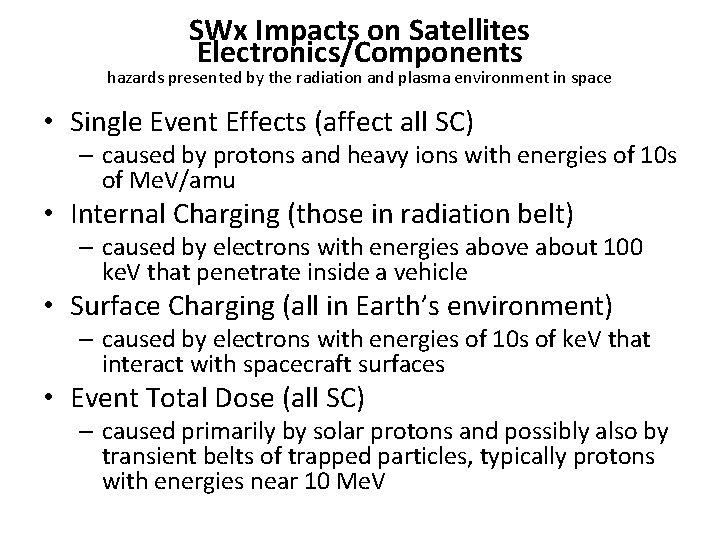
SWx Impacts on Satellites Electronics/Components hazards presented by the radiation and plasma environment in space • Single Event Effects (affect all SC) – caused by protons and heavy ions with energies of 10 s of Me. V/amu • Internal Charging (those in radiation belt) – caused by electrons with energies above about 100 ke. V that penetrate inside a vehicle • Surface Charging (all in Earth’s environment) – caused by electrons with energies of 10 s of ke. V that interact with spacecraft surfaces • Event Total Dose (all SC) – caused primarily by solar protons and possibly also by transient belts of trapped particles, typically protons with energies near 10 Me. V
Effects on Satellite Orbit • Satellite drag (LEO) • Orientation effects (spacecraft that use Earth’s magnetic field for orientation)
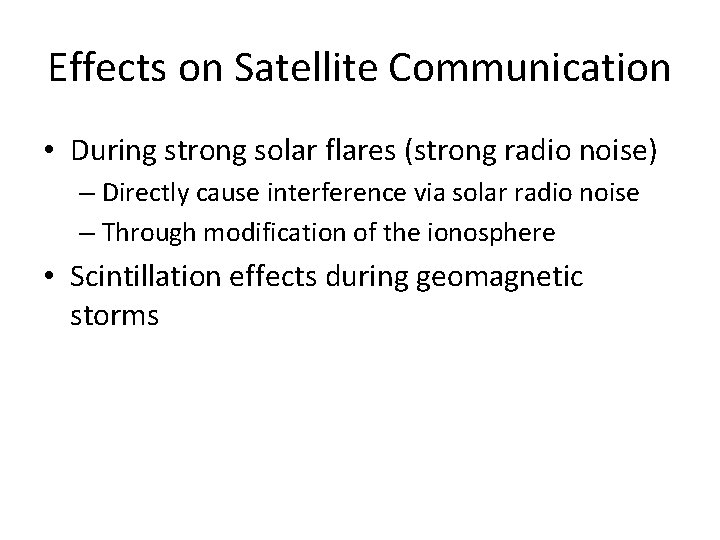
Effects on Satellite Communication • During strong solar flares (strong radio noise) – Directly cause interference via solar radio noise – Through modification of the ionosphere • Scintillation effects during geomagnetic storms
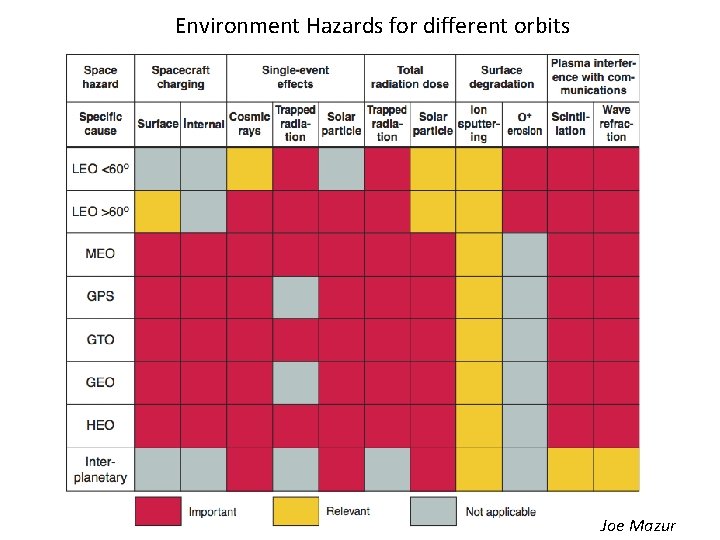
Environment Hazards for different orbits Joe Mazur
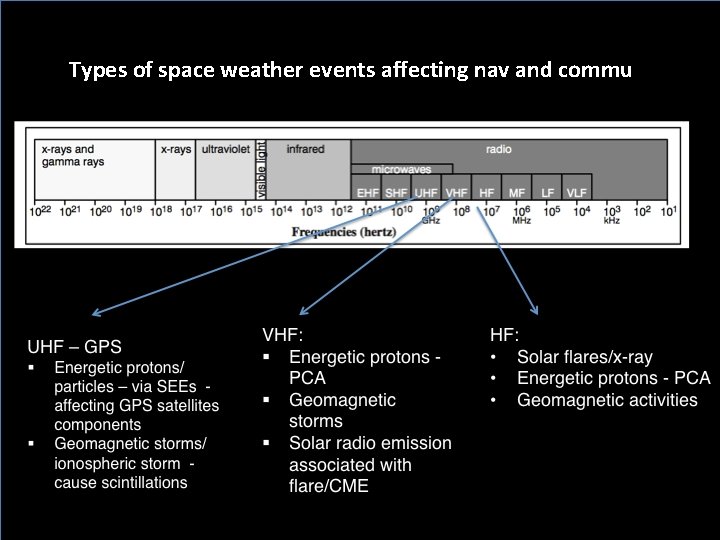
Types of space weather events affecting nav and commu
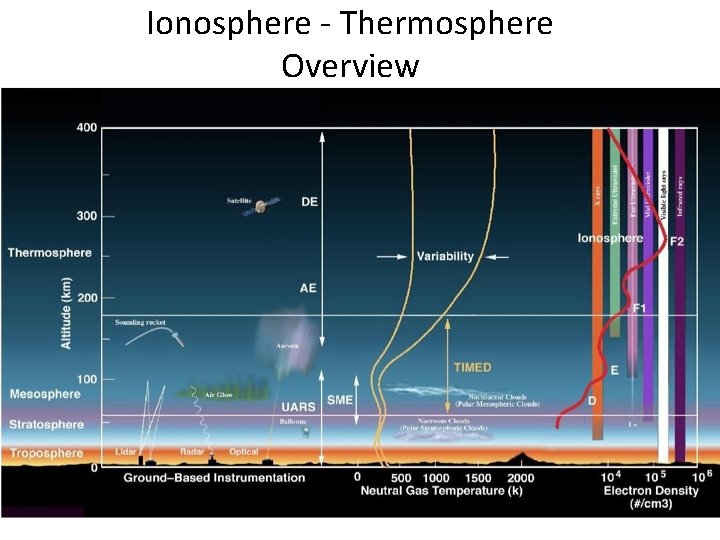
Ionosphere - Thermosphere Overview
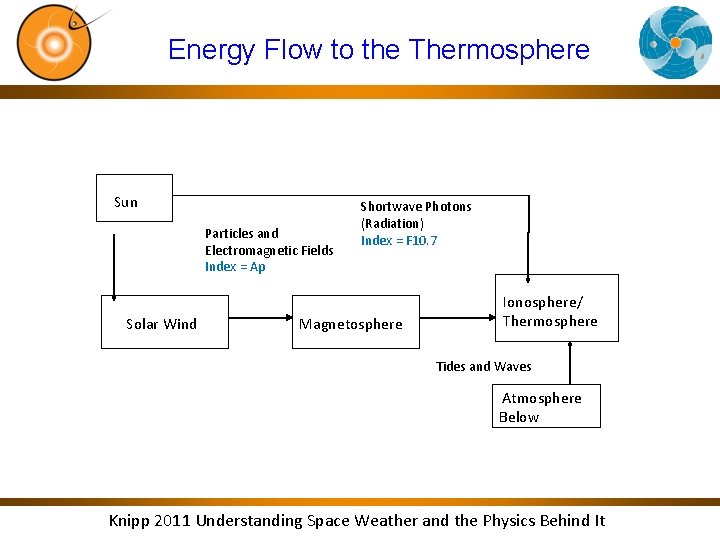
Energy Flow to the Thermosphere Sun Particles and Electromagnetic Fields Index = Ap Solar Wind Shortwave Photons (Radiation) Index = F 10. 7 Magnetosphere Ionosphere/ Thermosphere Tides and Waves Atmosphere Below Knipp 2011 Understanding Space Weather and the Physics Behind It
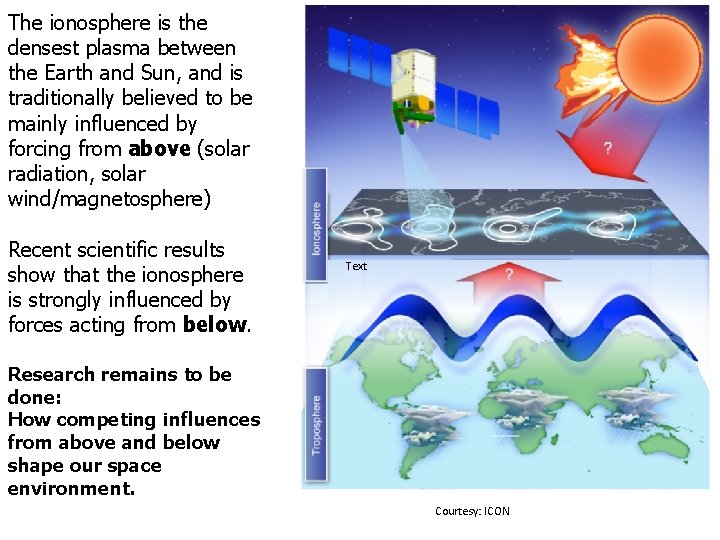
The ionosphere is the densest plasma between the Earth and Sun, and is traditionally believed to be mainly influenced by forcing from above (solar radiation, solar wind/magnetosphere) Recent scientific results show that the ionosphere is strongly influenced by forces acting from below. Text Research remains to be done: How competing influences from above and below shape our space environment. Courtesy: ICON
Tsunami’s impact on the ionospherethermosphere • the Tohoku-Oki tsunami of 11 March 2011 is modeled. • It is shown that gravity wave-induced variations in the neutral wind lead to plasma velocity variations both perpendicular and parallel to the geomagnetic field. Moreover, the electric field induced by the neutral wind perturbations can map to the conjugate hemisphere. Thus, electron density variations can be generated in both hemispheres which impact the total electron content (TEC) and 6300 Å airglow emission. It is found that the TEC exhibits variations of total electron content unit (1 TECU = 1016 el m− 2) and the 6300 Å airglow emission variation is up to ∼± 2. 5% relative to the unperturbed background airglow. Huba, J. D. , D. P. Drob, T. -W. Wu, and J. J. Makela (2015), Modeling the ionospheric impact of tsunami-driven gravity waves with SAMI 3: Conjugate effects, Geophys. Res. Lett. , 42, 5719– 5726, doi: 10. 1002/2015 GL 064871.
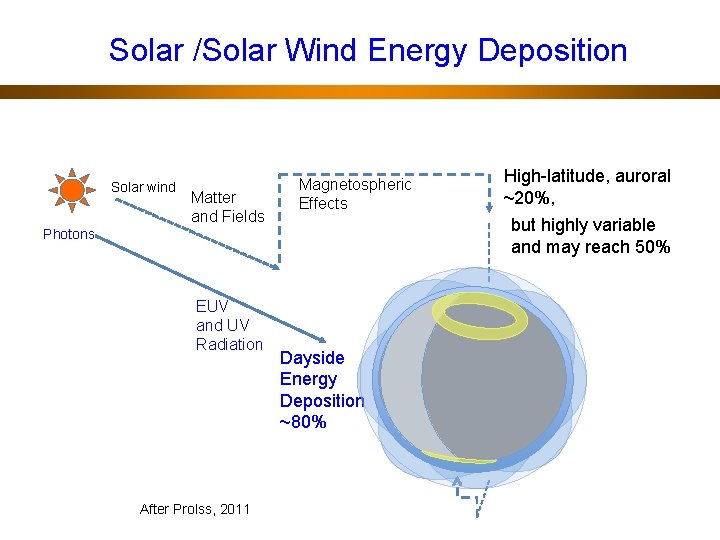
Solar /Solar Wind Energy Deposition Solar wind Matter and Fields Magnetospheric Effects but highly variable and may reach 50% Photons EUV and UV Radiation After Prolss, 2011 High-latitude, auroral ~20%, Dayside Energy Deposition ~80%
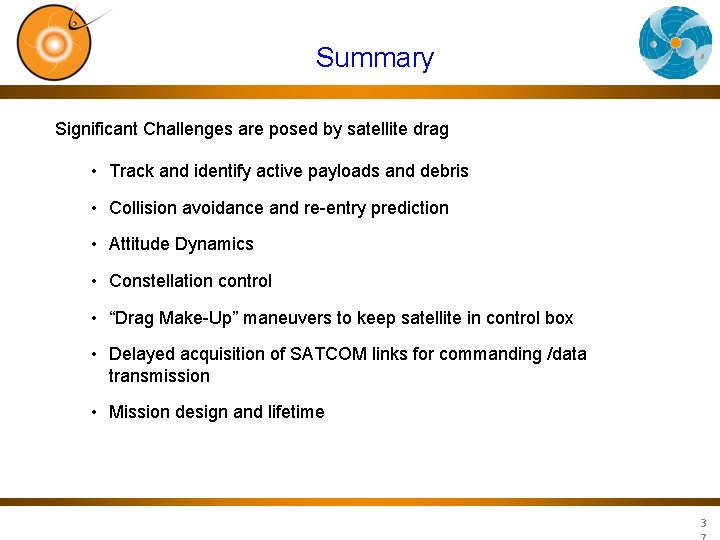
Summary Significant Challenges are posed by satellite drag • Track and identify active payloads and debris • Collision avoidance and re-entry prediction • Attitude Dynamics • Constellation control • “Drag Make-Up” maneuvers to keep satellite in control box • Delayed acquisition of SATCOM links for commanding /data transmission • Mission design and lifetime 3
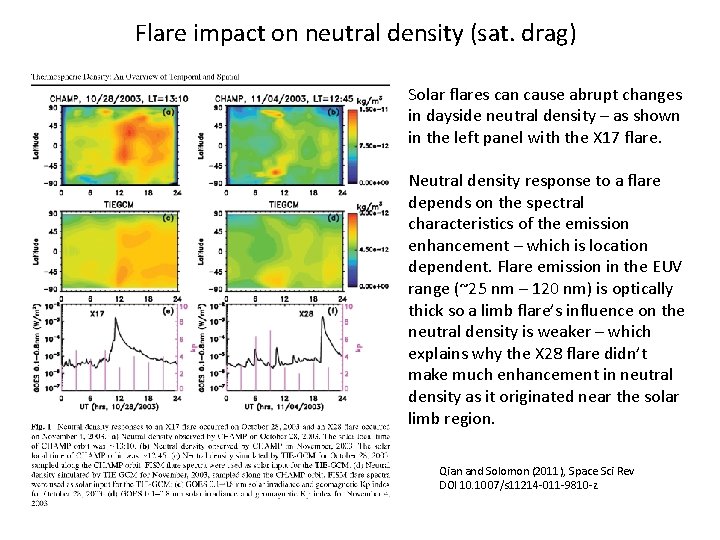
Flare impact on neutral density (sat. drag) Solar flares can cause abrupt changes in dayside neutral density – as shown in the left panel with the X 17 flare. Neutral density response to a flare depends on the spectral characteristics of the emission enhancement – which is location dependent. Flare emission in the EUV range (~25 nm – 120 nm) is optically thick so a limb flare’s influence on the neutral density is weaker – which explains why the X 28 flare didn’t make much enhancement in neutral density as it originated near the solar limb region. Qian and Solomon (2011), Space Sci Rev DOI 10. 1007/s 11214 -011 -9810 -z
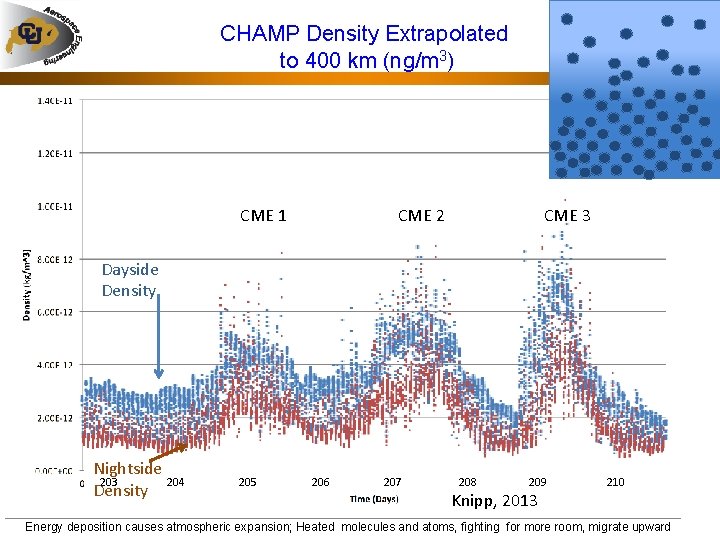
CHAMP Density Extrapolated to 400 km (ng/m 3) CME 1 CME 2 CME 3 Dayside Density Nightside Density 203 204 205 206 207 208 209 210 Knipp, 2013 Energy deposition causes atmospheric expansion; Heated molecules and atoms, fighting for more room, migrate upward