
Summary of session 1 5 talks in session
- Slides: 26
Summary of session 1
5 talks in session 1 • Qing Qin (IHEP) Progress of the HEPS projects • Lin Zhang(SLAC) Beam stability consideration for low emittance storage ring • Masaru Takao(JASRI) Beam orbit stability issues at the Spring-8 storage ring • Chih-Hsien Huang(NSRRC) Beam orbit stability issues for user operations at TPS • Brian Norsk Jensen(MAX lab) Update for the MAX IV stability task force.
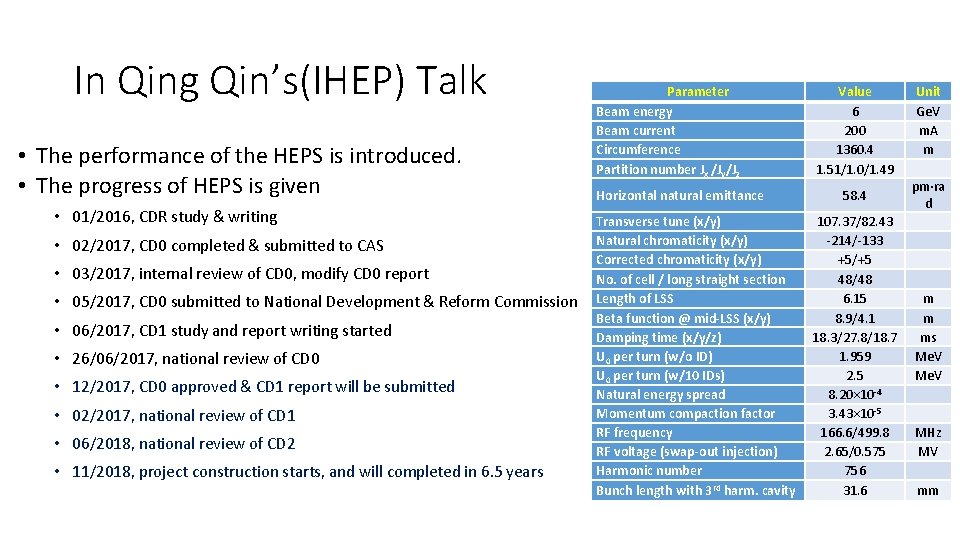
In Qing Qin’s(IHEP) Talk • The performance of the HEPS is introduced. • The progress of HEPS is given • 01/2016, CDR study & writing • 02/2017, CD 0 completed & submitted to CAS • 03/2017, internal review of CD 0, modify CD 0 report • 05/2017, CD 0 submitted to National Development & Reform Commission • 06/2017, CD 1 study and report writing started • 26/06/2017, national review of CD 0 • 12/2017, CD 0 approved & CD 1 report will be submitted • 02/2017, national review of CD 1 • 06/2018, national review of CD 2 • 11/2018, project construction starts, and will completed in 6. 5 years Parameter Beam energy Beam current Circumference Partition number Jx /Jy/Jz Horizontal natural emittance Transverse tune (x/y) Natural chromaticity (x/y) Corrected chromaticity (x/y) No. of cell / long straight section Length of LSS Beta function @ mid-LSS (x/y) Damping time (x/y/z) U 0 per turn (w/o ID) U 0 per turn (w/10 IDs) Natural energy spread Momentum compaction factor RF frequency RF voltage (swap-out injection) Harmonic number Bunch length with 3 rd harm. cavity Value 6 200 1360. 4 1. 51/1. 0/1. 49 Unit Ge. V m. A m pm∙ra 58. 4 d 107. 37/82. 43 -214/-133 +5/+5 48/48 6. 15 m 8. 9/4. 1 m 18. 3/27. 8/18. 7 ms 1. 959 Me. V 2. 5 Me. V 8. 20× 10 -4 3. 43× 10 -5 166. 6/499. 8 MHz 2. 65/0. 575 MV 756 31. 6 mm
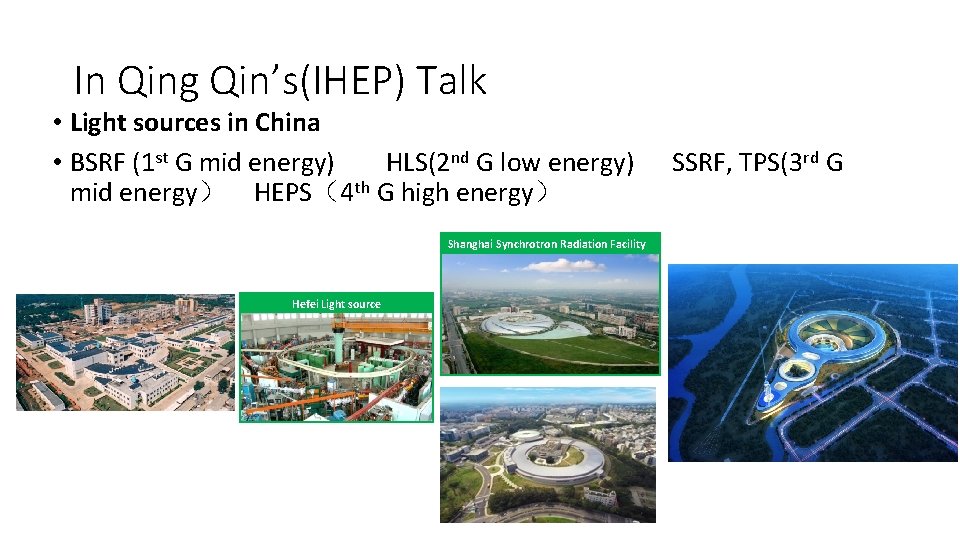
In Qing Qin’s(IHEP) Talk • Light sources in China • BSRF (1 st G mid energy) HLS(2 nd G low energy) SSRF, TPS(3 rd G mid energy) HEPS(4 th G high energy) Shanghai Synchrotron Radiation Facility Hefei Light source
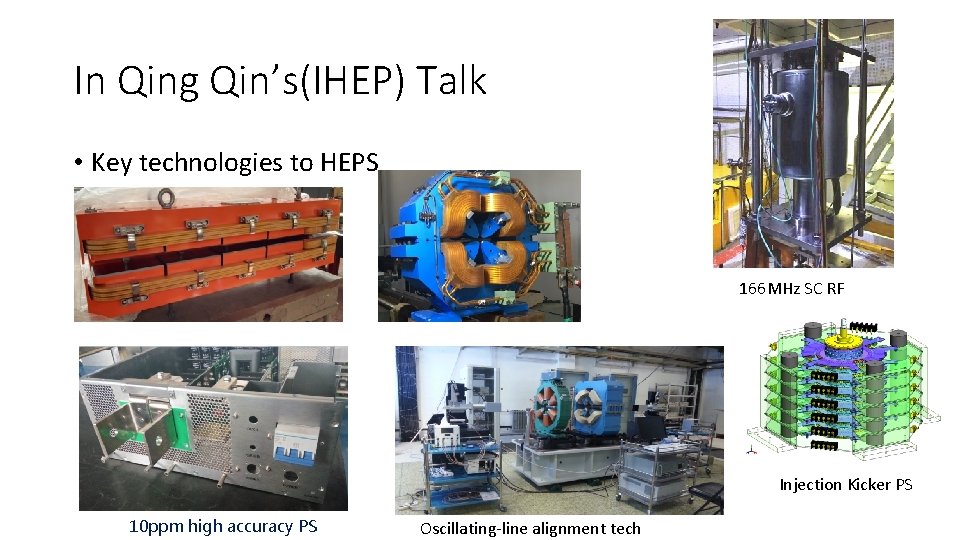
In Qing Qin’s(IHEP) Talk • Key technologies to HEPS 166 MHz SC RF Injection Kicker PS 10 ppm high accuracy PS Oscillating-line alignment tech
Lin Zhang’s (SLAC) Talk • Gives an overview of orbit stability requirement for DLSR. ESRF-EBS as an example. • Gives an overview of ground vibration. • Overview of Magnet-Girder assembly + Damping device • Overview of FOFB
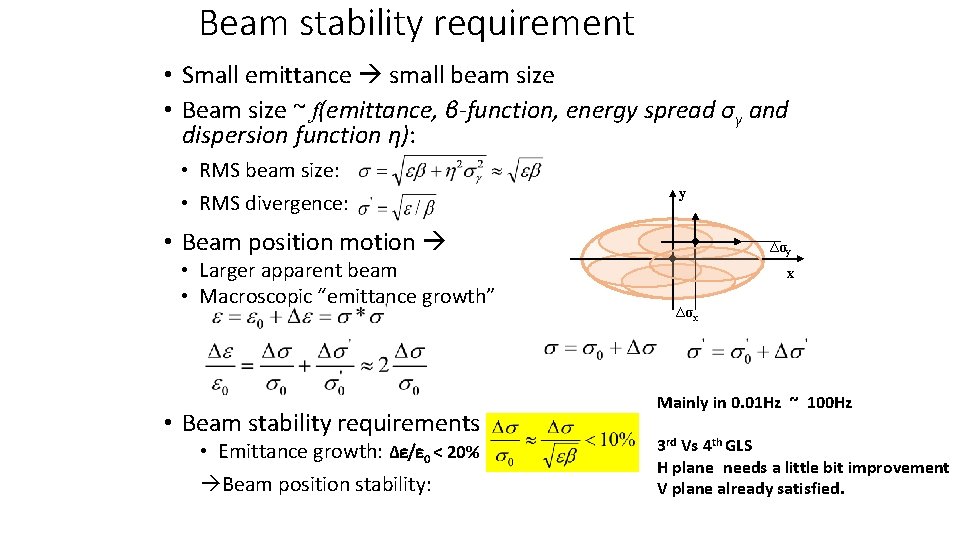
Beam stability requirement • Small emittance small beam size • Beam size ~ f(emittance, β-function, energy spread σγ and dispersion function η): • RMS beam size: • RMS divergence: y • Beam position motion • Larger apparent beam • Macroscopic “emittance growth” • Beam stability requirements • Emittance growth: Δε/ε 0 < 20% Beam position stability: Δσy x Δσx Mainly in 0. 01 Hz ~ 100 Hz 3 rd Vs 4 th GLS H plane needs a little bit improvement V plane already satisfied.
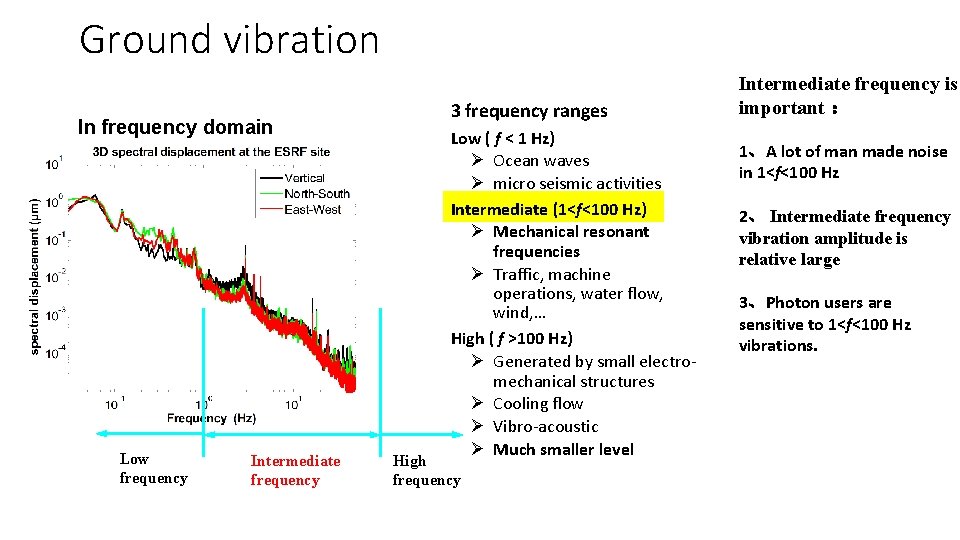
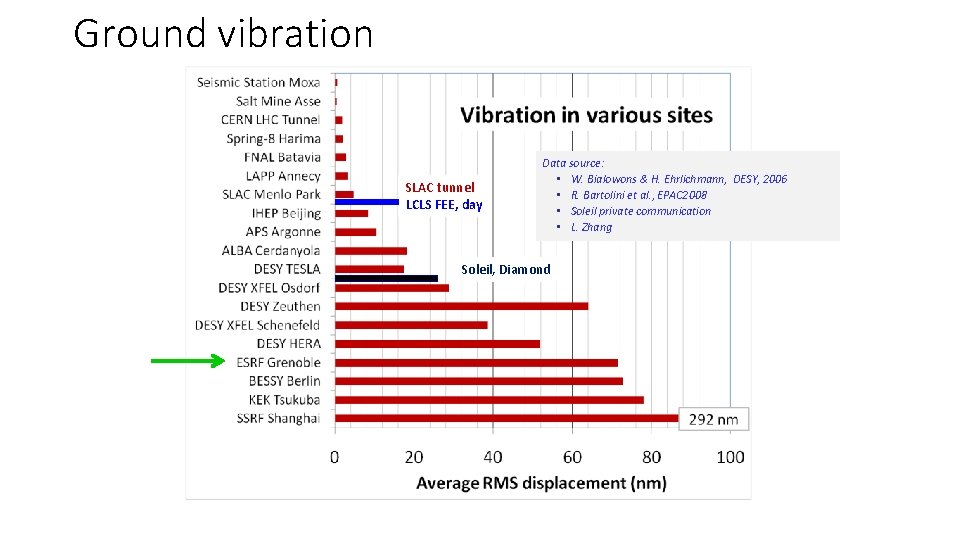
Ground vibration 3 frequency ranges In frequency domain Low frequency Intermediate frequency Low ( f < 1 Hz) Ø Ocean waves Ø micro seismic activities Intermediate (1<f<100 Hz) Ø Mechanical resonant frequencies Ø Traffic, machine operations, water flow, wind, … High ( f >100 Hz) Ø Generated by small electromechanical structures Ø Cooling flow Ø Vibro-acoustic Ø Much smaller level High frequency ESRF Upgrade II, TDS WP-1. 3, Girder design WG, November, 2013 / L. Zhang Intermediate frequency is important : 1、A lot of man made noise in 1<f<100 Hz 2、 Intermediate frequency vibration amplitude is relative large 3、Photon users are sensitive to 1<f<100 Hz vibrations.
Ground vibration SLAC tunnel LCLS FEE, day Data source: • W. Bialowons & H. Ehrlichmann, DESY, 2006 • R. Bartolini et al. , EPAC 2008 • Soleil private communication • L. Zhang Soleil, Diamond ESRF Upgrade II, TDS WP-1. 3, Girder design WG, November, 2013 / L. Zhang
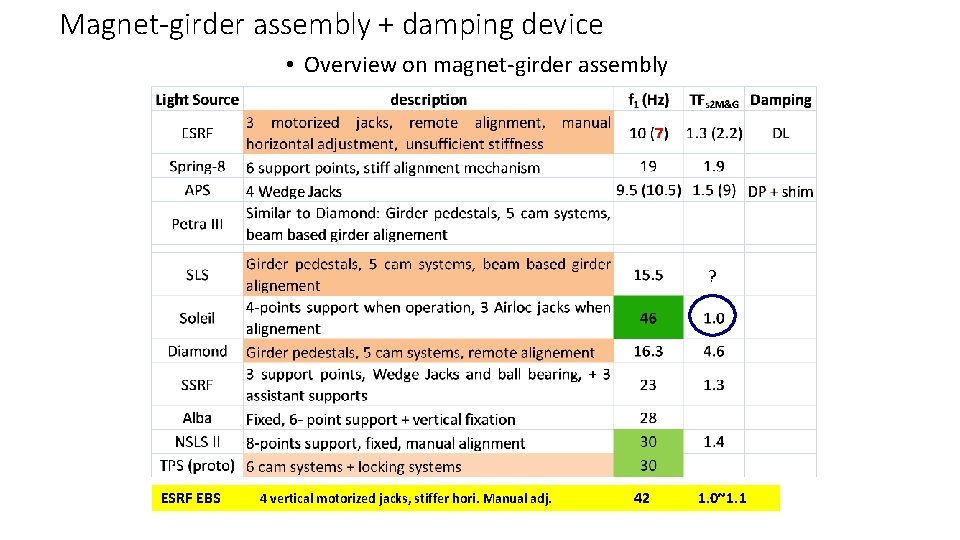
Magnet-girder assembly + damping device • Overview on magnet-girder assembly ? ESRF EBS 4 vertical motorized jacks, stiffer hori. Manual adj. 42 ESRF Upgrade II, TDS WP-1. 3, Girder design WG, November, 2013 / L. Zhang 1. 0~1. 1
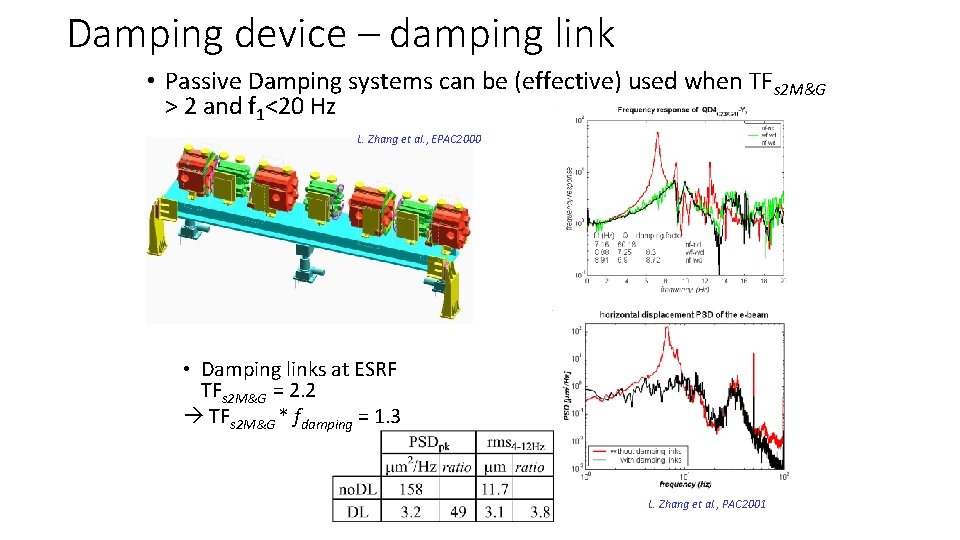
Damping device – damping link • Passive Damping systems can be (effective) used when TFs 2 M&G > 2 and f 1<20 Hz L. Zhang et al. , EPAC 2000 • Damping links at ESRF TFs 2 M&G = 2. 2 TFs 2 M&G * fdamping = 1. 3 ESRF Upgrade II, TDS WP-1. 3, Girder design WG, November, 2013 / L. Zhang et al. , PAC 2001
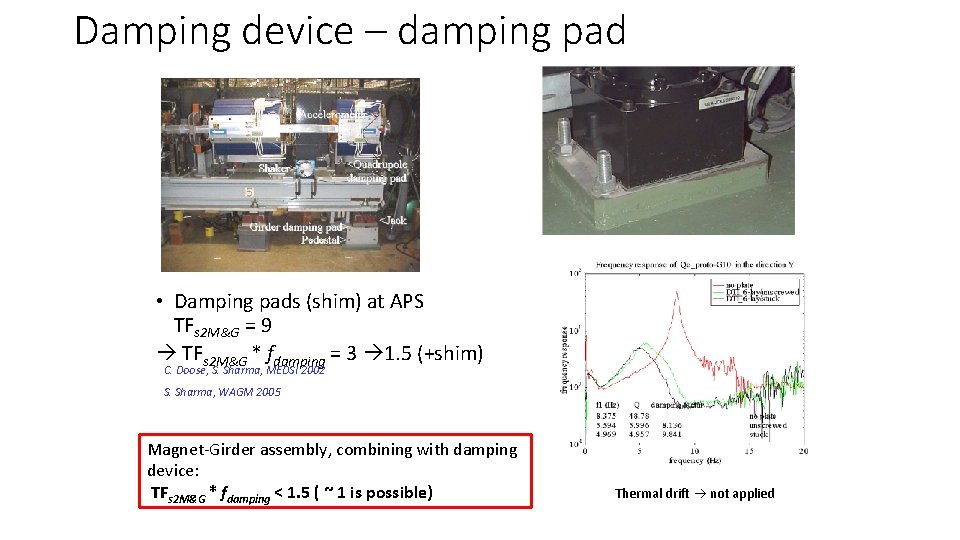
Damping device – damping pad cross section (not in scale) • Damping pads (shim) at APS TFs 2 M&G = 9 TFs 2 M&G * fdamping = 3 1. 5 (+shim) 0. 18 mm VEM 0. 5 mm thin steel plate 2 mm thick steel plate C. Doose, S. Sharma, MEDSI 2002 S. Sharma, WAGM 2005 Magnet-Girder assembly, combining with damping device: TFs 2 M&G * fdamping < 1. 5 ( ~ 1 is possible) ESRF Upgrade II, TDS WP-1. 3, Girder design WG, November, 2013 / L. Zhang Thermal drift not applied
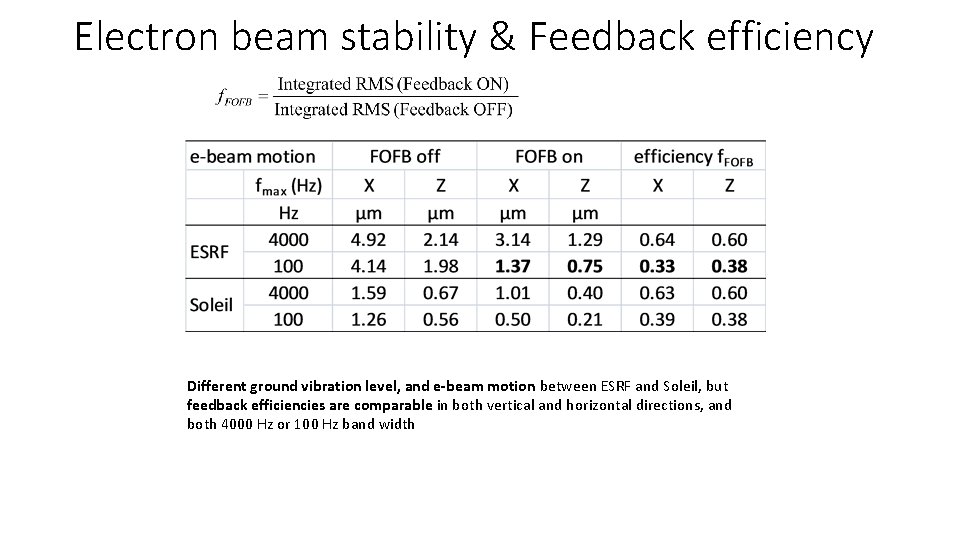
Electron beam stability & Feedback efficiency Different ground vibration level, and e-beam motion between ESRF and Soleil, but feedback efficiencies are comparable in both vertical and horizontal directions, and both 4000 Hz or 100 Hz band width ESRF Upgrade II, TDS WP-1. 3, Girder design WG, November, 2013 / L. Zhang
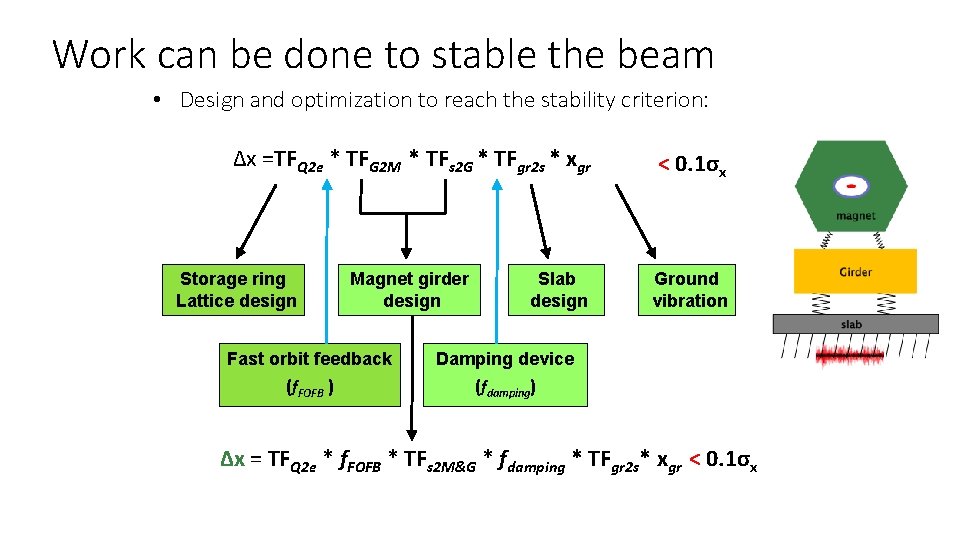
Work can be done to stable the beam • Design and optimization to reach the stability criterion: Δx =TFQ 2 e * TFG 2 M * TFs 2 G * TFgr 2 s * xgr Storage ring Lattice design Magnet girder design Slab design Fast orbit feedback Damping device (f. FOFB ) (fdamping) < 0. 1σx Ground vibration Δx = TFQ 2 e * f. FOFB * TFs 2 M&G * fdamping * TFgr 2 s* xgr < 0. 1σx ESRF Upgrade II, TDS WP-1. 3, Girder design WG, November, 2013 / L. Zhang
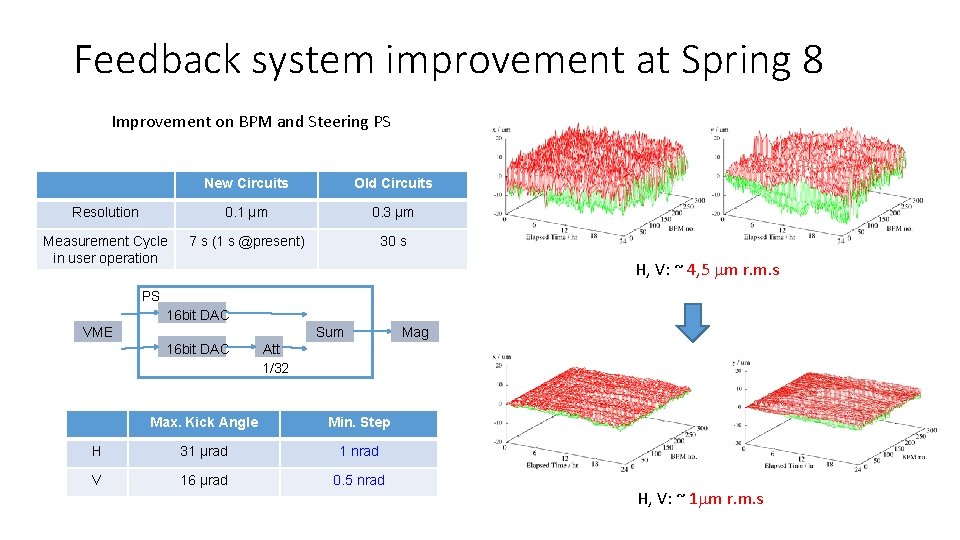
Masaru Takao’s (JASRI) talk • Sources of beam orbit fluctuation and the efforts to suppression them at Spring 8. • Improvement of orbit feedback system
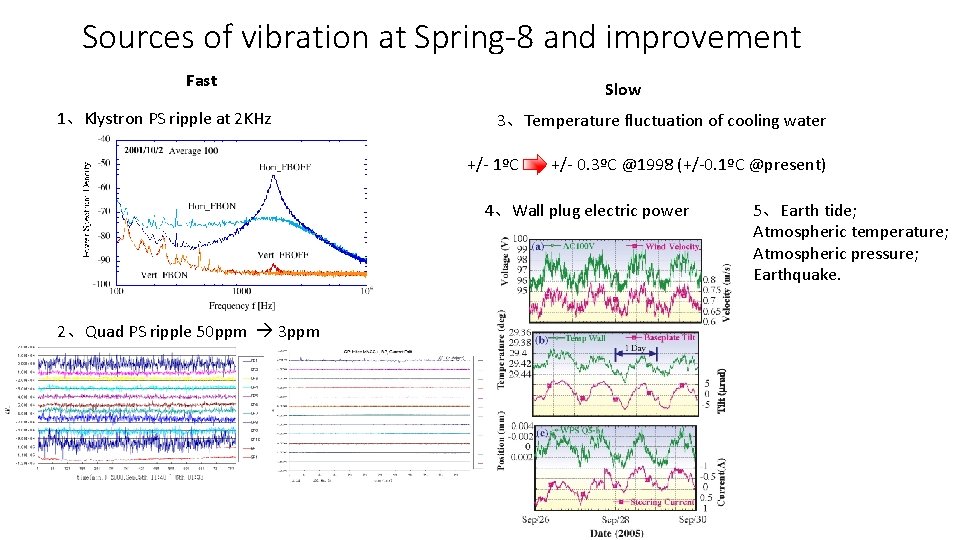
Sources of vibration at Spring-8 and improvement Fast 1、Klystron PS ripple at 2 KHz Slow 3、Temperature fluctuation of cooling water +/- 1ºC +/- 0. 3ºC @1998 (+/-0. 1ºC @present) 4、Wall plug electric power 2、Quad PS ripple 50 ppm 3 ppm 5、Earth tide; Atmospheric temperature; Atmospheric pressure; Earthquake.
Feedback system improvement at Spring 8 Improvement on BPM and Steering PS New Circuits Old Circuits Resolution 0. 1 μm 0. 3 μm Measurement Cycle in user operation 7 s (1 s @present) 30 s H, V: ~ 4, 5 mm r. m. s PS 16 bit DAC VME Sum 16 bit DAC Mag Att 1/32 Max. Kick Angle Min. Step H 31 μrad 1 nrad V 16 μrad 0. 5 nrad H, V: ~ 1 mm r. m. s
Chih-Hsien Huang’s (TPS) Talk • Relationship of ground motion to the beam motion. • Hunting 29 Hz, 40 Hz, 60 Hz, 3 Hz noises. • FOFB system performance at TPS
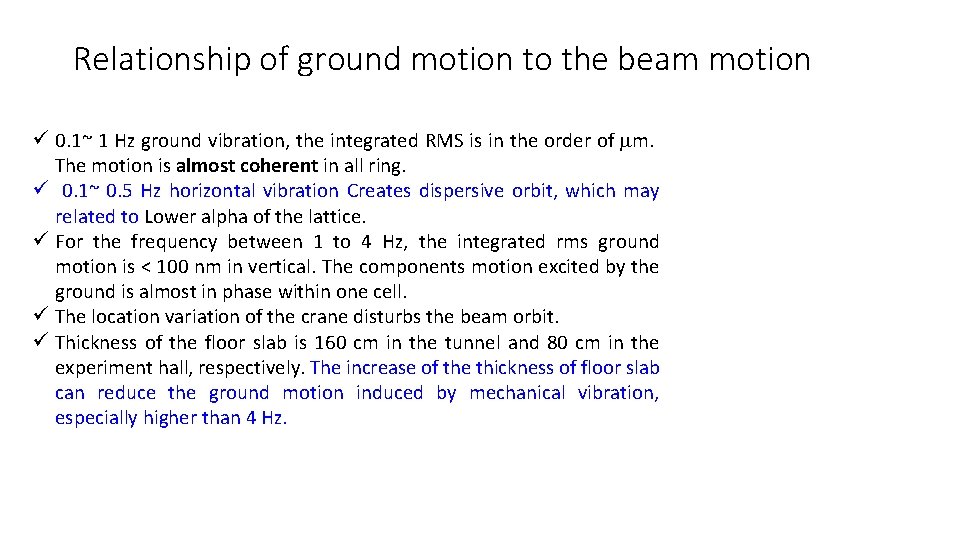
Relationship of ground motion to the beam motion ü 0. 1~ 1 Hz ground vibration, the integrated RMS is in the order of mm. The motion is almost coherent in all ring. ü 0. 1~ 0. 5 Hz horizontal vibration Creates dispersive orbit, which may related to Lower alpha of the lattice. ü For the frequency between 1 to 4 Hz, the integrated rms ground motion is < 100 nm in vertical. The components motion excited by the ground is almost in phase within one cell. ü The location variation of the crane disturbs the beam orbit. ü Thickness of the floor slab is 160 cm in the tunnel and 80 cm in the experiment hall, respectively. The increase of the thickness of floor slab can reduce the ground motion induced by mechanical vibration, especially higher than 4 Hz.
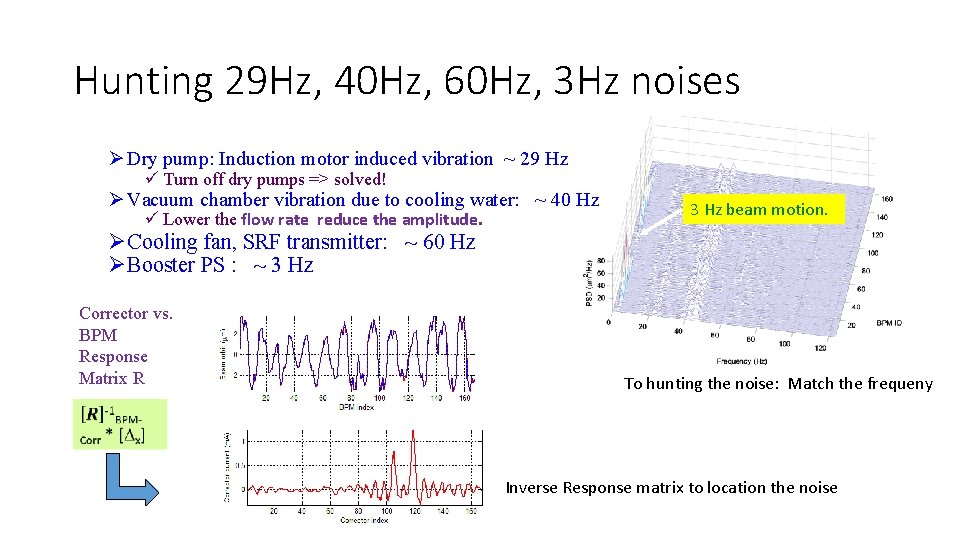
Hunting 29 Hz, 40 Hz, 60 Hz, 3 Hz noises Ø Dry pump: Induction motor induced vibration ~ 29 Hz ü Turn off dry pumps => solved! Ø Vacuum chamber vibration due to cooling water: ~ 40 Hz ü Lower the flow rate reduce the amplitude. 3 Hz beam motion. ØCooling fan, SRF transmitter: ~ 60 Hz ØBooster PS : ~ 3 Hz Corrector vs. BPM Response Matrix R To hunting the noise: Match the frequeny Inverse Response matrix to location the noise
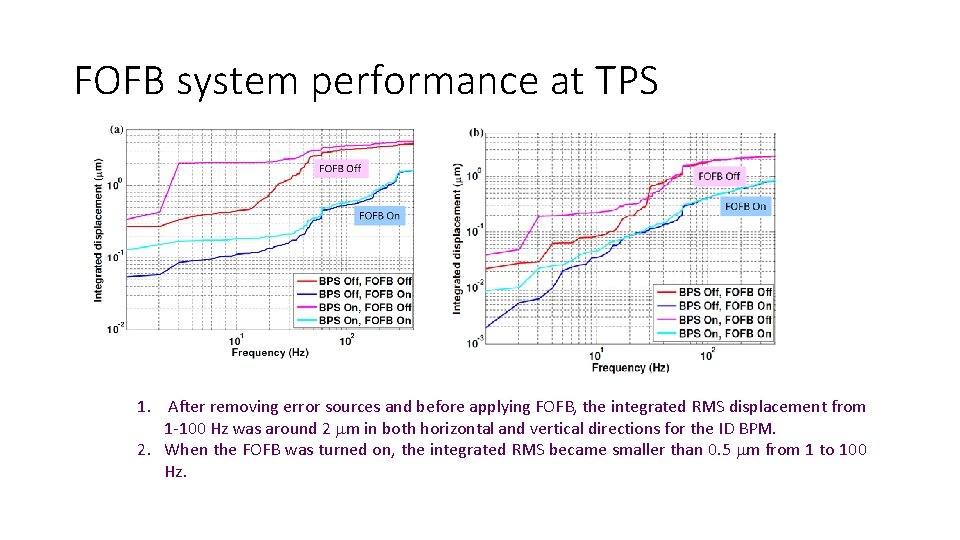
FOFB system performance at TPS 1. After removing error sources and before applying FOFB, the integrated RMS displacement from 1 -100 Hz was around 2 mm in both horizontal and vertical directions for the ID BPM. 2. When the FOFB was turned on, the integrated RMS became smaller than 0. 5 mm from 1 to 100 Hz.
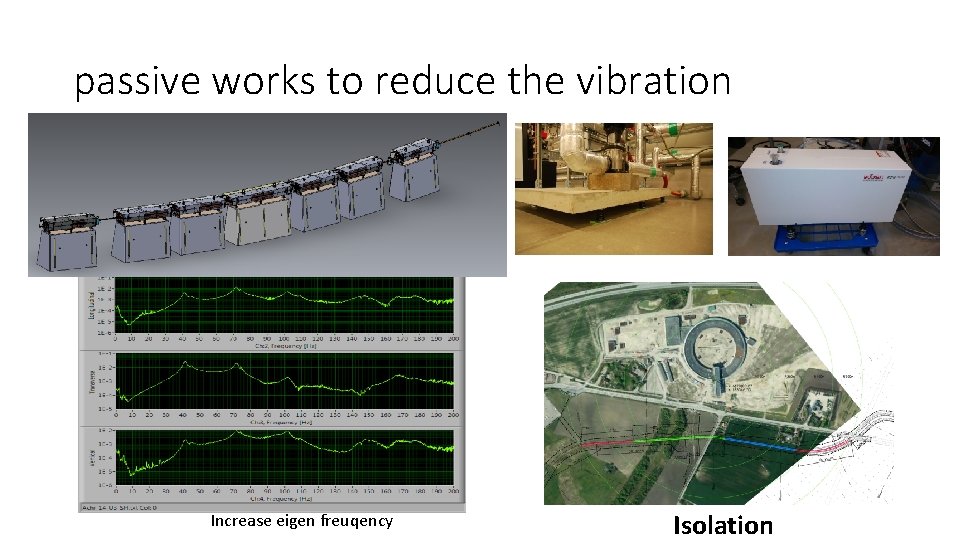
Brian Norsk Jensen’s (MAX lab) Talk • A effective a one-man band to stable the beam at MAX IV • Many passive works to reduce the vibration.
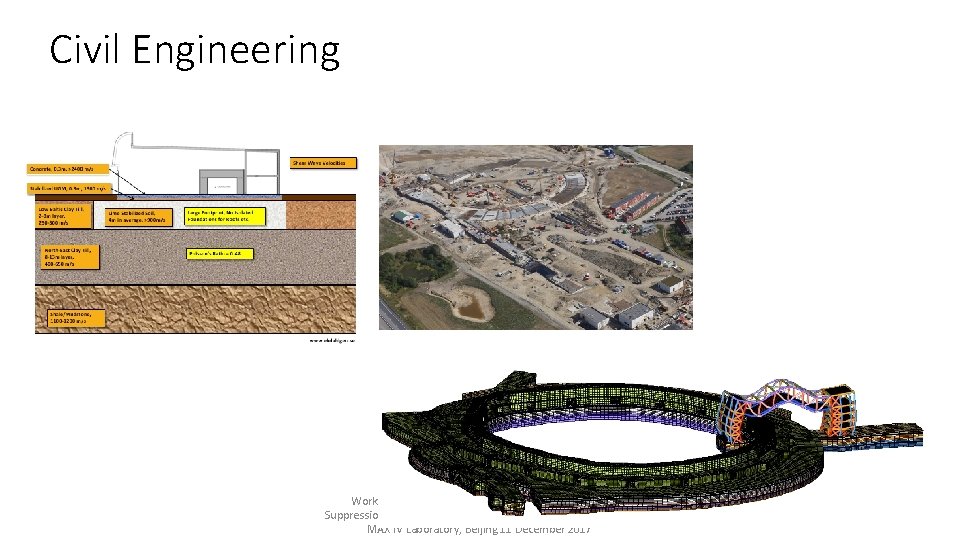
Civil Engineering Workshop on Ambient Ground Motion and Vibration Suppression for Low Emittance Storage Ring Brian Norsk Jensen MAX IV Laboratory, Beijing 11 December 2017
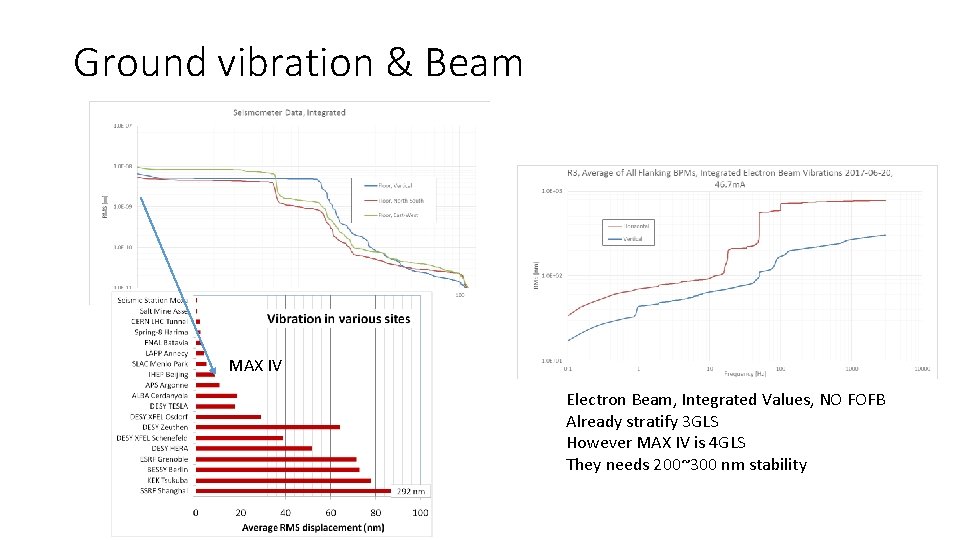
Ground vibration & Beam MAX IV Electron Beam, Integrated Values, NO FOFB Already stratify 3 GLS However MAX IV is 4 GLS They needs 200~300 nm stability
passive works to reduce the vibration Increase eigen freuqency Isolation
Summary • The geological conditions and the environment is important for LS stability. • Passive method is more reliable than feedback. Pile, Slab, Gird, Damping link(pad), isolation. • It common issues that we will face : PS ripple, water flow, temperature, ground vibration, we needs to hunt the source and to eliminate them. • FOFB is essential for high performance of orbit stability.