
Summary of permutations arrangements where the order counts
- Slides: 8
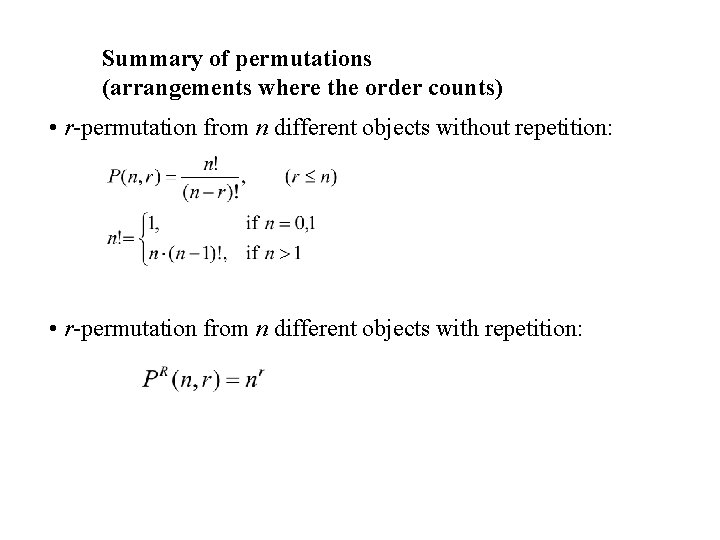
Summary of permutations (arrangements where the order counts) • r-permutation from n different objects without repetition: • r-permutation from n different objects with repetition:
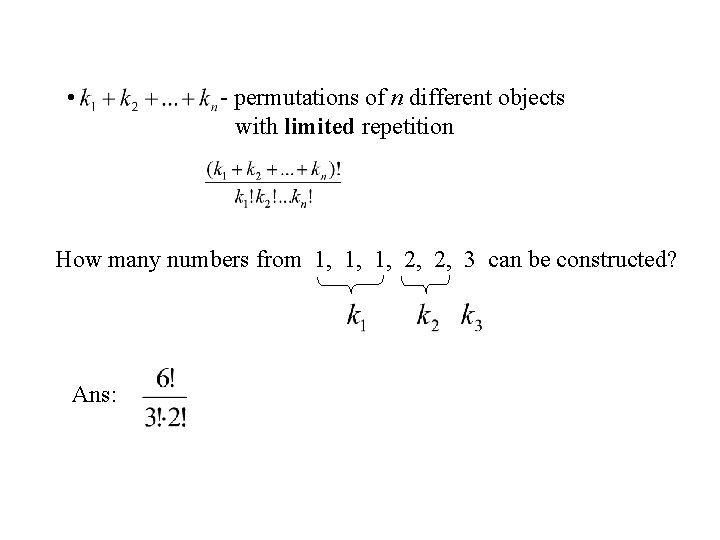
• - permutations of n different objects with limited repetition How many numbers from 1, 1, 1, 2, 2, 3 can be constructed? Ans:
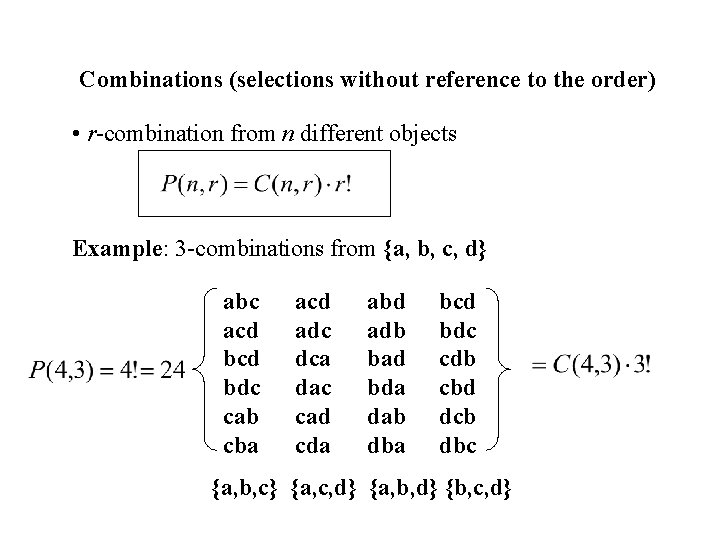
Combinations (selections without reference to the order) • r-combination from n different objects Example: 3 -combinations from {a, b, c, d} abc acd bdc cab cba acd adc dca dac cad cda abd adb bad bda dab dba bcd bdc cdb cbd dcb dbc {a, b, c} {a, c, d} {a, b, d} {b, c, d}
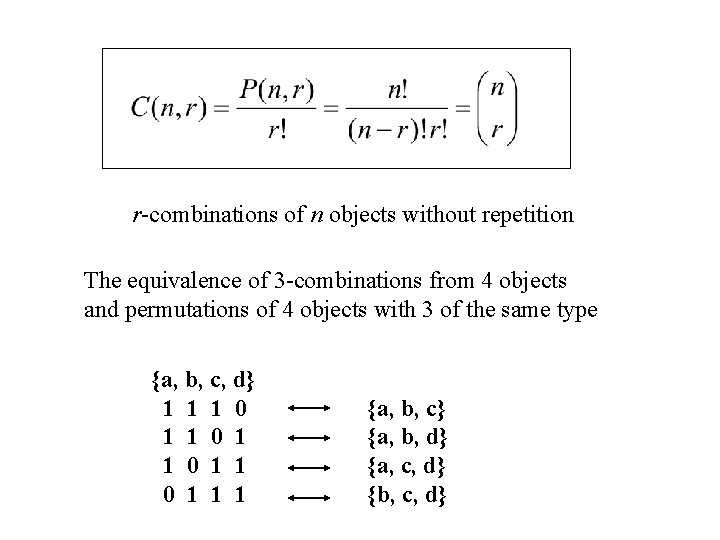
r-combinations of n objects without repetition The equivalence of 3 -combinations from 4 objects and permutations of 4 objects with 3 of the same type {a, b, c, d} 1 1 1 0 1 1 1 {a, b, c} {a, b, d} {a, c, d} {b, c, d}
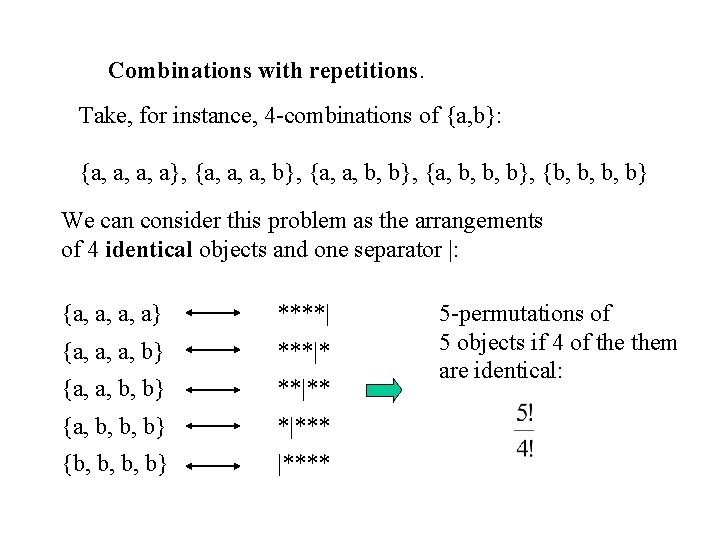
Combinations with repetitions. Take, for instance, 4 -combinations of {a, b}: {a, a, a, a}, {a, a, a, b}, {a, a, b, b}, {a, b, b, b}, {b, b, b, b} We can consider this problem as the arrangements of 4 identical objects and one separator |: {a, a, a, a} ****| {a, a, a, b} ***|* {a, a, b, b} **|** {a, b, b, b} *|*** {b, b, b, b} |**** 5 -permutations of 5 objects if 4 of them are identical:
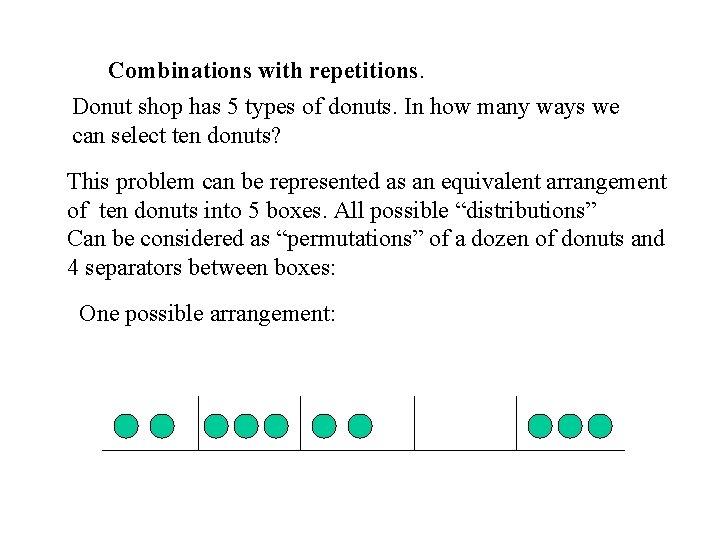
Combinations with repetitions. Donut shop has 5 types of donuts. In how many ways we can select ten donuts? This problem can be represented as an equivalent arrangement of ten donuts into 5 boxes. All possible “distributions” Can be considered as “permutations” of a dozen of donuts and 4 separators between boxes: One possible arrangement:
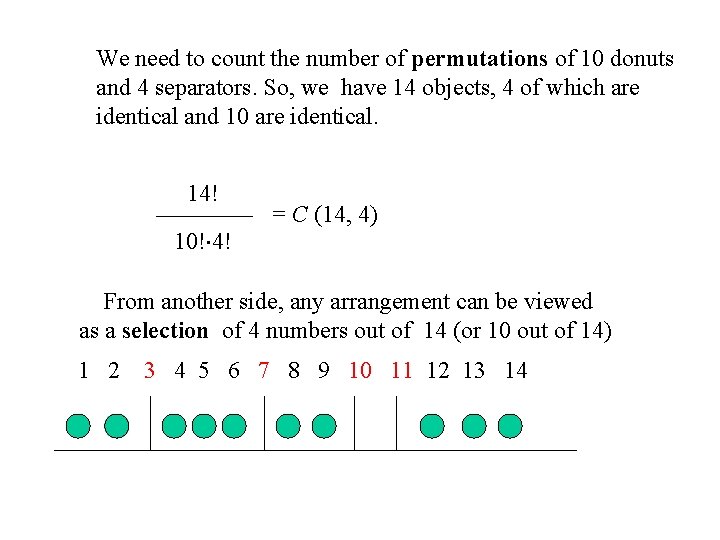
We need to count the number of permutations of 10 donuts and 4 separators. So, we have 14 objects, 4 of which are identical and 10 are identical. 14! = C (14, 4) 10! 4! From another side, any arrangement can be viewed as a selection of 4 numbers out of 14 (or 10 out of 14) 1 2 3 4 5 6 7 8 9 10 11 12 13 14
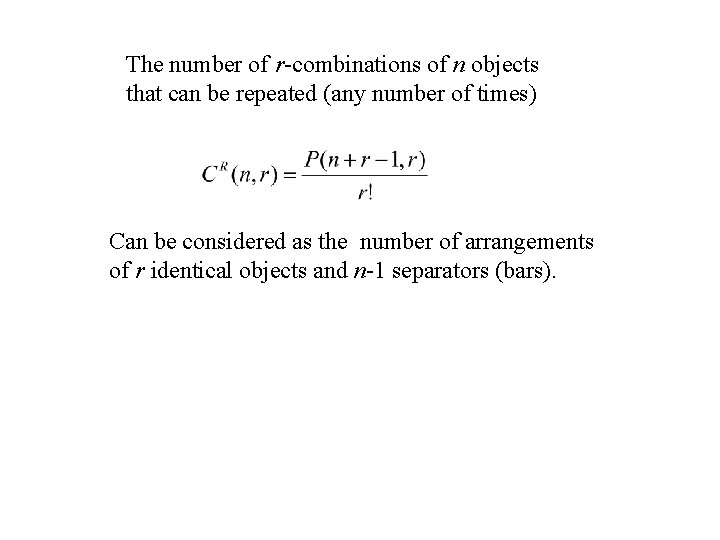
The number of r-combinations of n objects that can be repeated (any number of times) Can be considered as the number of arrangements of r identical objects and n-1 separators (bars).