
Summary of Machine Detector Interface Guinyun Kim KNU
- Slides: 26
Summary of Machine Detector Interface Guinyun Kim (KNU, Korea) International Linear Collider Workshop 2010 Beijing, China, March 2010
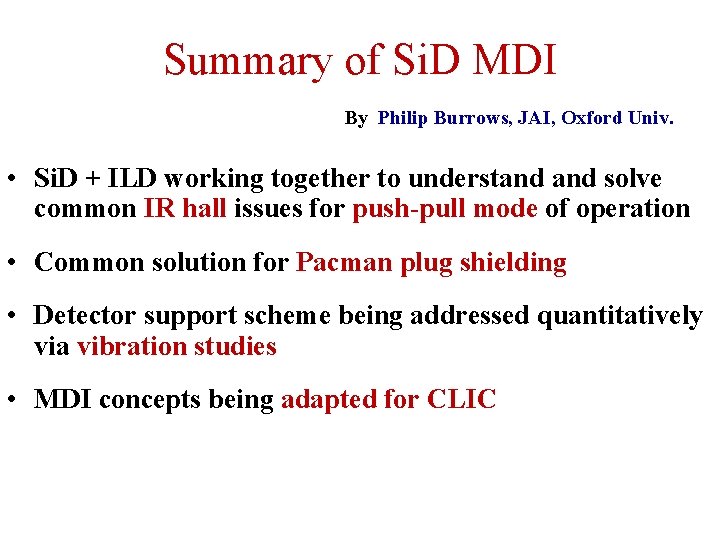
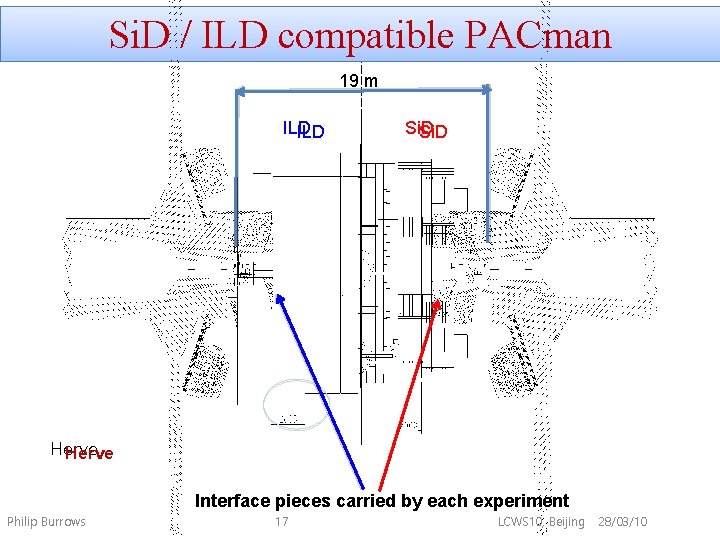
Summary of Si. D MDI By Philip Burrows, JAI, Oxford Univ. • Si. D + ILD working together to understand solve common IR hall issues for push-pull mode of operation • Common solution for Pacman plug shielding • Detector support scheme being addressed quantitatively via vibration studies • MDI concepts being adapted for CLIC
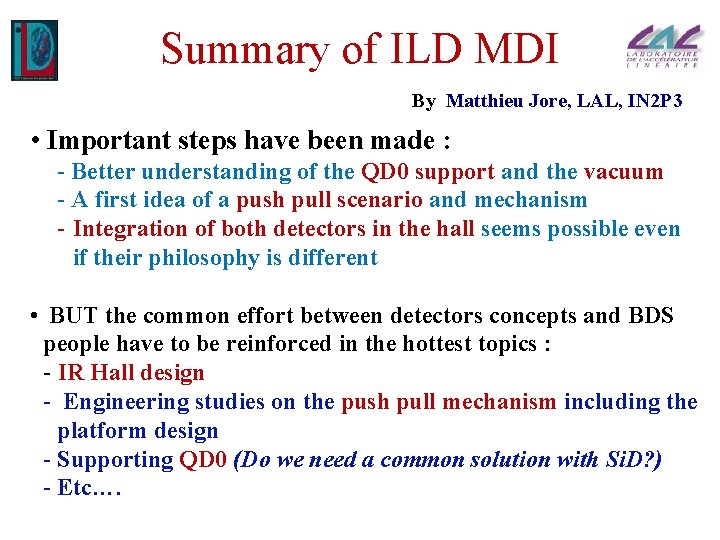
Summary of ILD MDI By Matthieu Jore, LAL, IN 2 P 3 • Important steps have been made : - Better understanding of the QD 0 support and the vacuum - A first idea of a push pull scenario and mechanism - Integration of both detectors in the hall seems possible even if their philosophy is different • BUT the common effort between detectors concepts and BDS people have to be reinforced in the hottest topics : - IR Hall design - Engineering studies on the push pull mechanism including the platform design - Supporting QD 0 (Do we need a common solution with Si. D? ) - Etc….
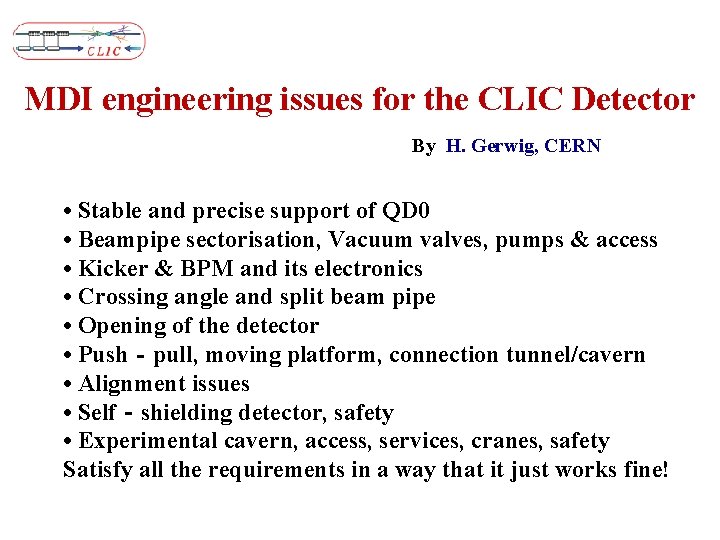
MDI engineering issues for the CLIC Detector By H. Gerwig, CERN • Stable and precise support of QD 0 • Beampipe sectorisation, Vacuum valves, pumps & access • Kicker & BPM and its electronics • Crossing angle and split beam pipe • Opening of the detector • Push‐pull, moving platform, connection tunnel/cavern • Alignment issues • Self‐shielding detector, safety • Experimental cavern, access, services, cranes, safety Satisfy all the requirements in a way that it just works fine!
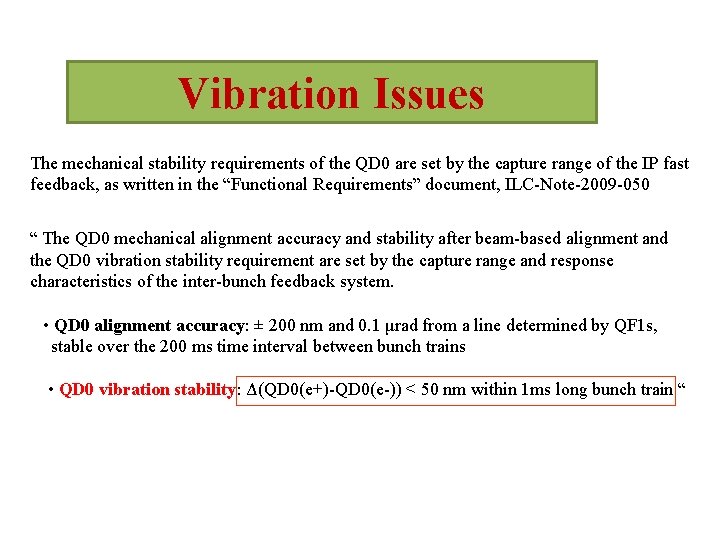
Vibration Issues The mechanical stability requirements of the QD 0 are set by the capture range of the IP fast feedback, as written in the “Functional Requirements” document, ILC-Note-2009 -050 “ The QD 0 mechanical alignment accuracy and stability after beam-based alignment and the QD 0 vibration stability requirement are set by the capture range and response characteristics of the inter-bunch feedback system. • QD 0 alignment accuracy: ± 200 nm and 0. 1 μrad from a line determined by QF 1 s, stable over the 200 ms time interval between bunch trains • QD 0 vibration stability: Δ(QD 0(e+)-QD 0(e-)) < 50 nm within 1 ms long bunch train “
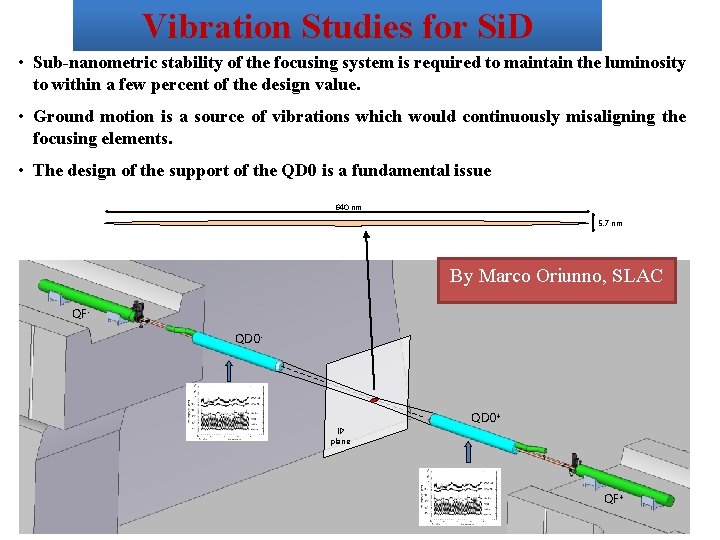
Vibration Studies for Si. D • Sub-nanometric stability of the focusing system is required to maintain the luminosity to within a few percent of the design value. • Ground motion is a source of vibrations which would continuously misaligning the focusing elements. • The design of the support of the QD 0 is a fundamental issue 640 nm 5. 7 nm By Marco Oriunno, SLAC QFQD 0 - QD 0+ IP plane QF+
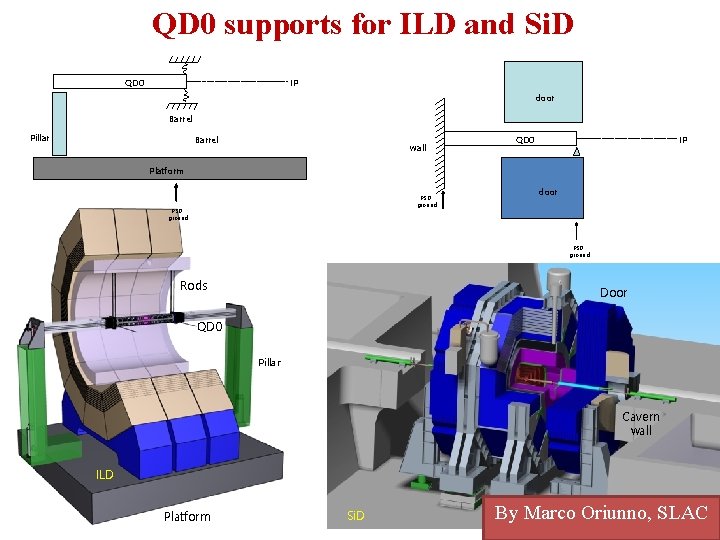
QD 0 supports for ILD and Si. D IP QD 0 door Barrel Pillar Barrel wall IP QD 0 Platform PSD ground door PSD ground Rods Door QD 0 Pillar Cavern wall ILD Platform Si. D By Marco Oriunno, SLAC
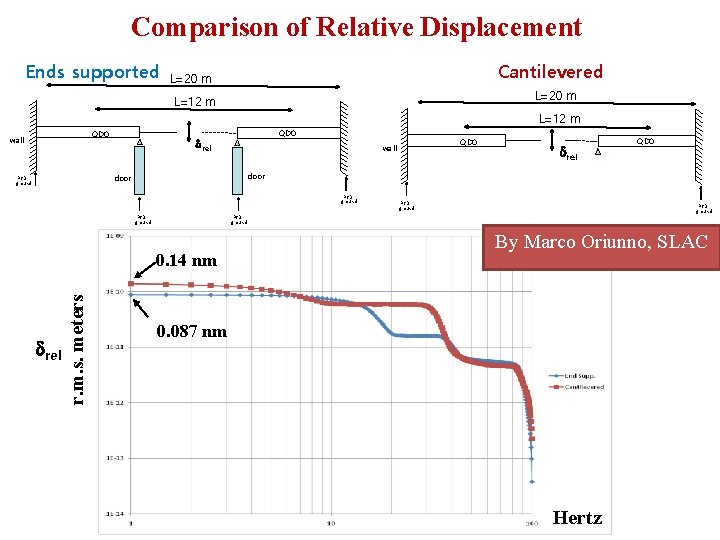
Comparison of Relative Displacement Ends supported Cantilevered L=20 m L=12 m QD 0 wall QD 0 drel PSD ground 0. 14 nm r. m. s. meters PSD ground drel QD 0 door PSD ground QD 0 wall By Marco Oriunno, SLAC 0. 087 nm Hertz
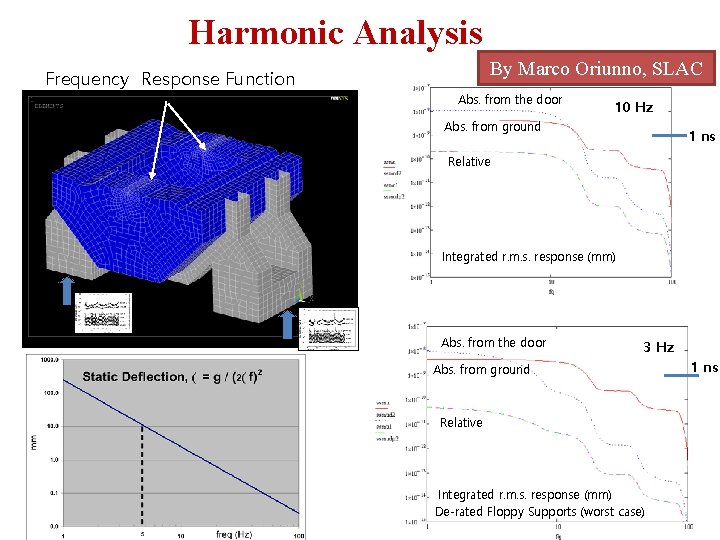
Harmonic Analysis By Marco Oriunno, SLAC Frequency Response Function Abs. from the door 10 Hz Abs. from ground 1 ns Relative Integrated r. m. s. response (mm) Abs. from the door 3 Hz Abs. from ground Relative Integrated r. m. s. response (mm) De-rated Floppy Supports (worst case) 1 ns
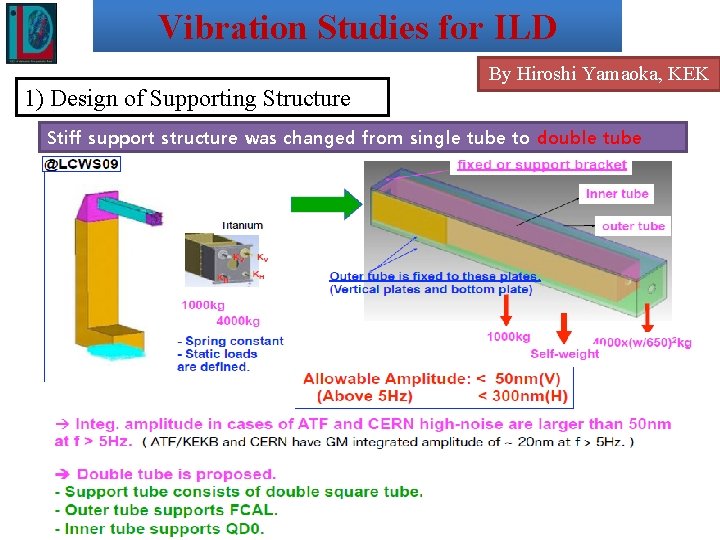
Vibration Studies for ILD 1) Design of Supporting Structure By Hiroshi Yamaoka, KEK Stiff support structure was changed from single tube to double tube
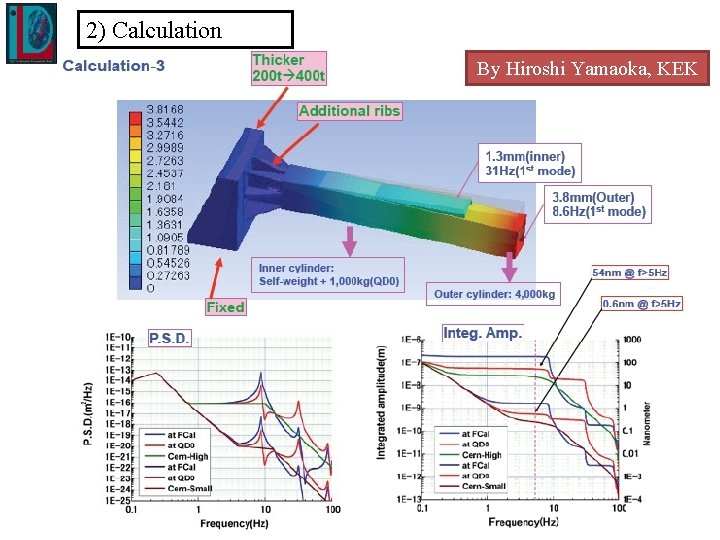
2) Calculation By Hiroshi Yamaoka, KEK
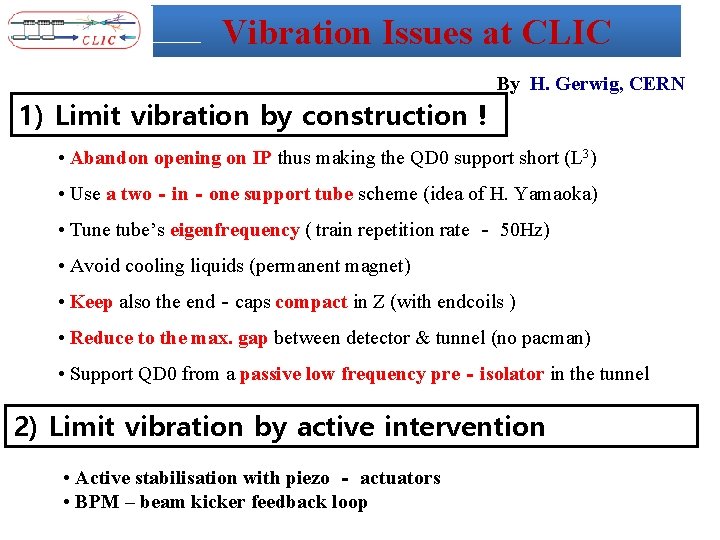
Vibration Issues at CLIC 1) Limit vibration by construction ! By H. Gerwig, CERN • Abandon opening on IP thus making the QD 0 support short (L 3) • Use a two‐in‐one support tube scheme (idea of H. Yamaoka) • Tune tube’s eigenfrequency ( train repetition rate ‐ 50 Hz) • Avoid cooling liquids (permanent magnet) • Keep also the end‐caps compact in Z (with endcoils ) • Reduce to the max. gap between detector & tunnel (no pacman) • Support QD 0 from a passive low frequency pre‐isolator in the tunnel 2) Limit vibration by active intervention • Active stabilisation with piezo ‐ actuators • BPM – beam kicker feedback loop
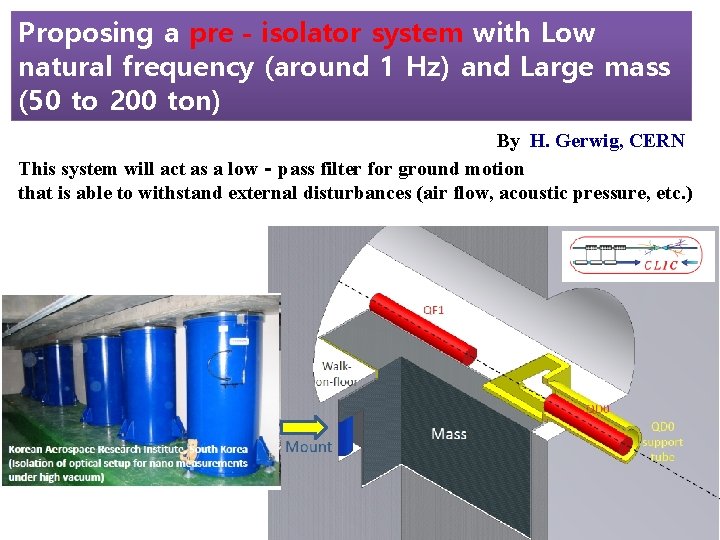
Proposing a pre‐isolator system with Low natural frequency (around 1 Hz) and Large mass (50 to 200 ton) By H. Gerwig, CERN This system will act as a low‐pass filter for ground motion that is able to withstand external disturbances (air flow, acoustic pressure, etc. )
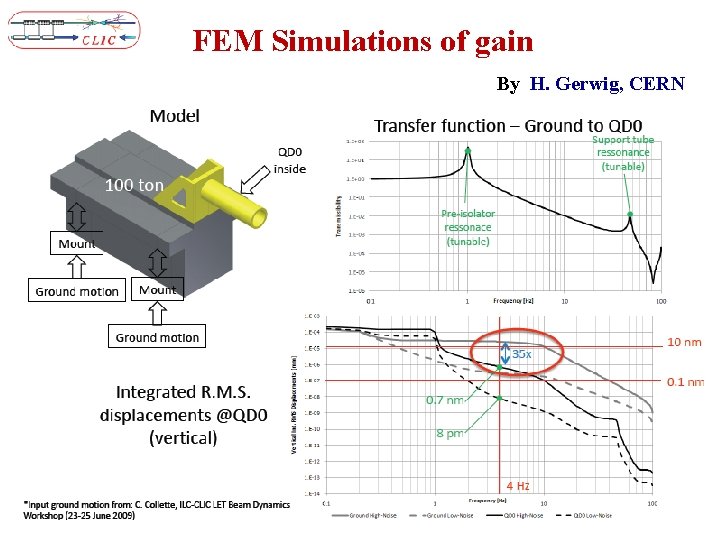
FEM Simulations of gain By H. Gerwig, CERN
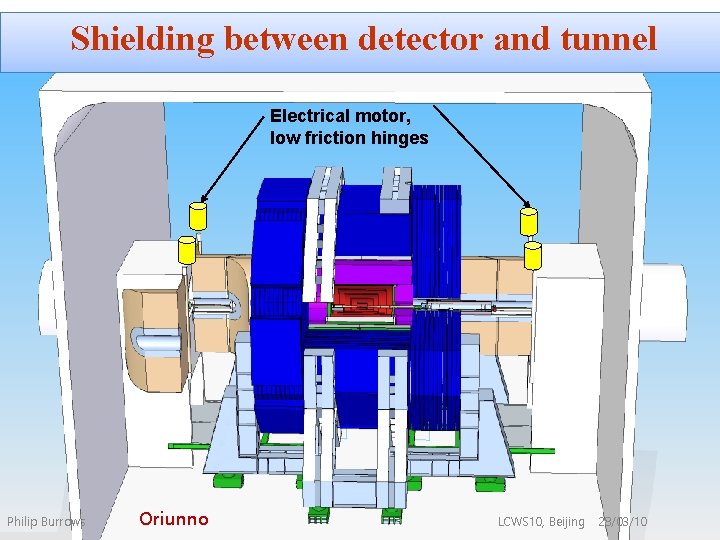
Shielding between detector and tunnel Electrical motor, low friction hinges Philip Burrows Oriunno LCWS 10, Beijing 28/03/10
Si. D / ILD compatible PACman 19 m ILD Si. D Herve Interface pieces carried by each experiment Philip Burrows 17 LCWS 10, Beijing 28/03/10
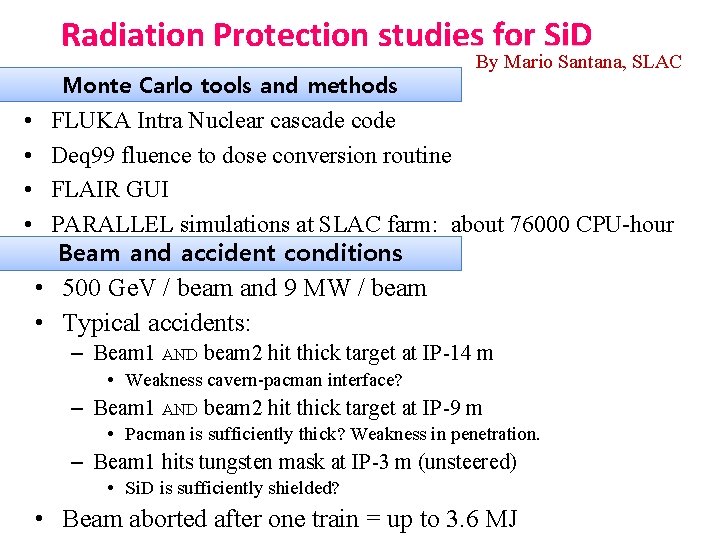
Radiation Protection studies for Si. D Monte Carlo tools and methods • • By Mario Santana, SLAC FLUKA Intra Nuclear cascade code Deq 99 fluence to dose conversion routine FLAIR GUI PARALLEL simulations at SLAC farm: about 76000 CPU-hour Beam and accident conditions • 500 Ge. V / beam and 9 MW / beam • Typical accidents: – Beam 1 AND beam 2 hit thick target at IP-14 m • Weakness cavern-pacman interface? – Beam 1 AND beam 2 hit thick target at IP-9 m • Pacman is sufficiently thick? Weakness in penetration. – Beam 1 hits tungsten mask at IP-3 m (unsteered) • Si. D is sufficiently shielded? • Beam aborted after one train = up to 3. 6 MJ
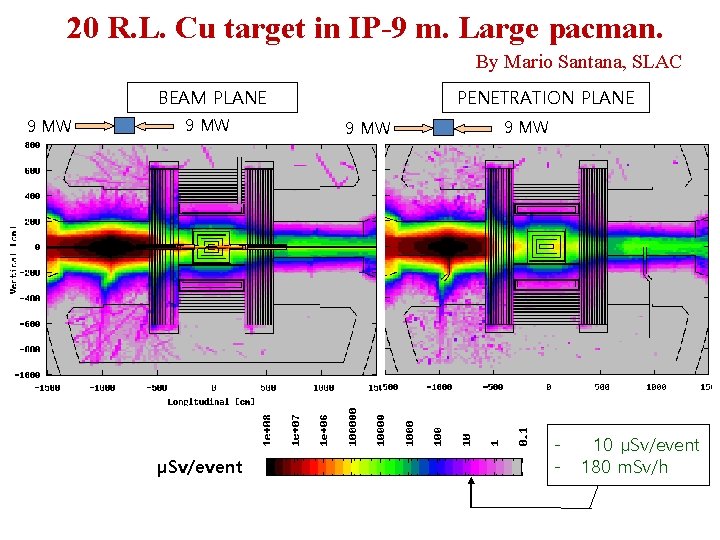
20 R. L. Cu target in IP-9 m. Large pacman. By Mario Santana, SLAC BEAM PLANE 9 MW µSv/event PENETRATION PLANE 9 MW - 10 µSv/event 180 m. Sv/h
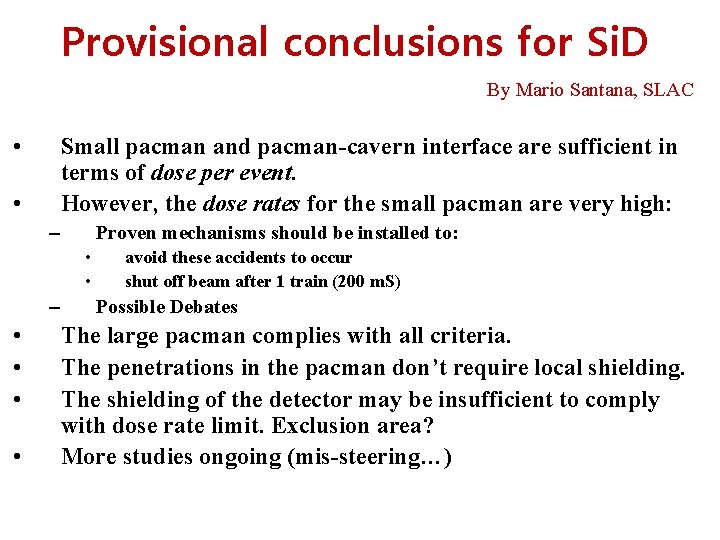
Provisional conclusions for Si. D By Mario Santana, SLAC • Small pacman and pacman-cavern interface are sufficient in terms of dose per event. However, the dose rates for the small pacman are very high: • – Proven mechanisms should be installed to: • • – • • avoid these accidents to occur shut off beam after 1 train (200 m. S) Possible Debates The large pacman complies with all criteria. The penetrations in the pacman don’t require local shielding. The shielding of the detector may be insufficient to comply with dose rate limit. Exclusion area? More studies ongoing (mis-steering…)
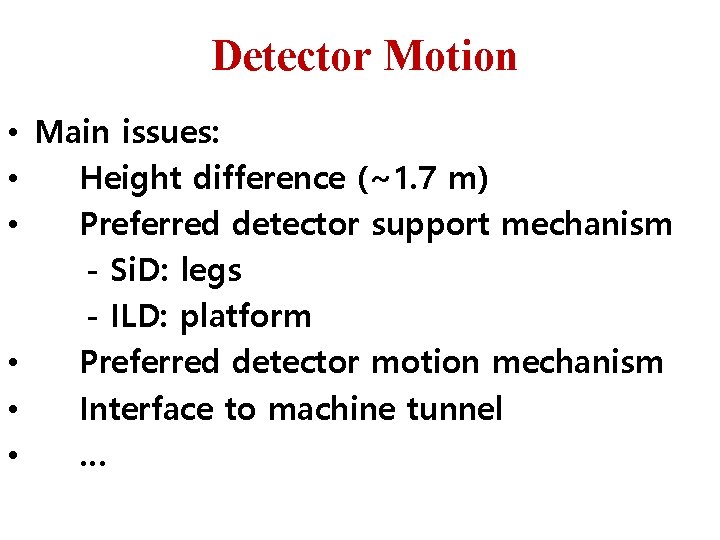
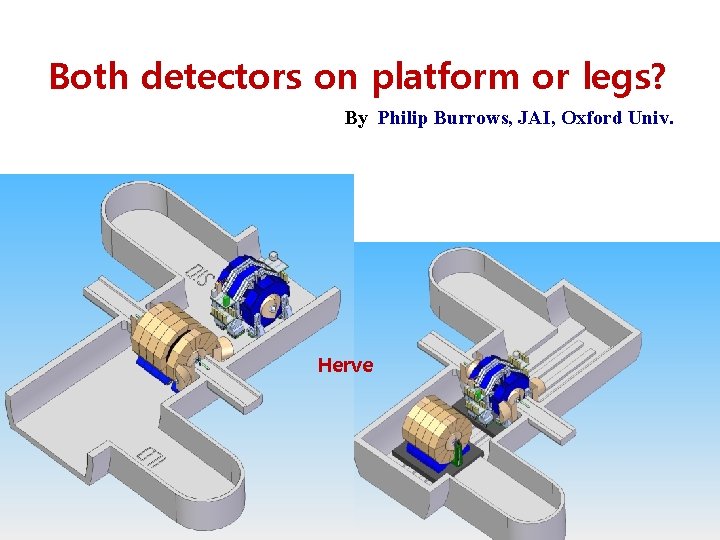
Detector Motion • Main issues: • Height difference (~1. 7 m) • Preferred detector support mechanism - Si. D: legs - ILD: platform • Preferred detector motion mechanism • Interface to machine tunnel • …
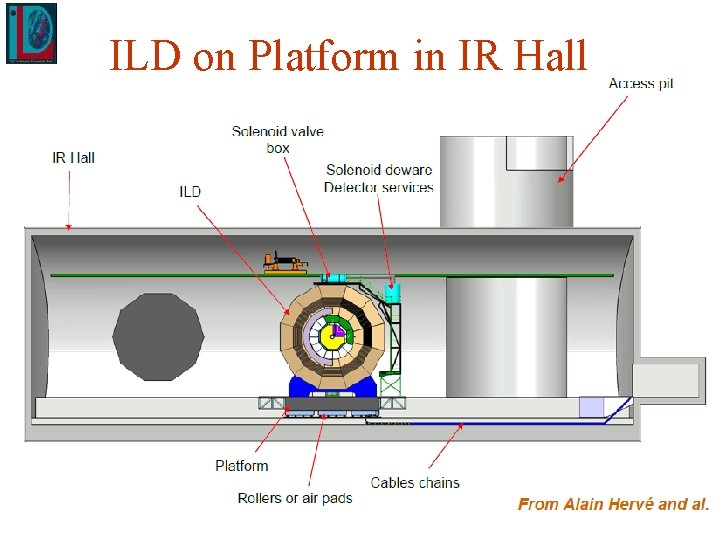
ILD on Platform in IR Hall
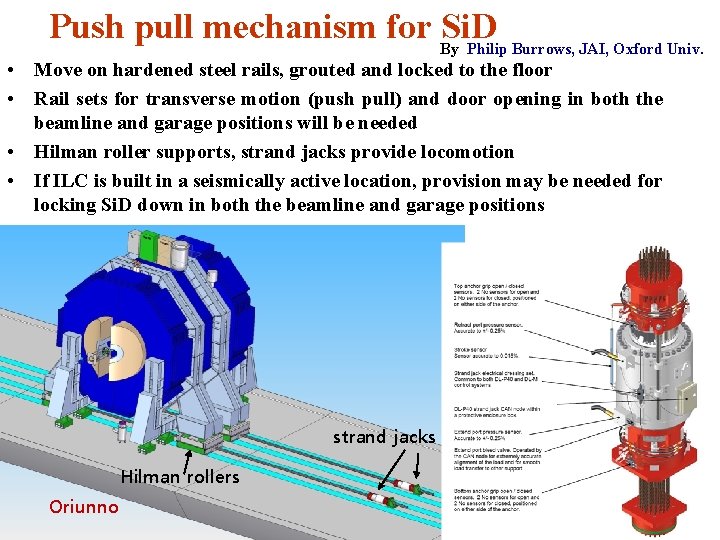
Push pull mechanism for By Si. D Philip Burrows, JAI, Oxford Univ. • Move on hardened steel rails, grouted and locked to the floor • Rail sets for transverse motion (push pull) and door opening in both the beamline and garage positions will be needed • Hilman roller supports, strand jacks provide locomotion • If ILC is built in a seismically active location, provision may be needed for locking Si. D down in both the beamline and garage positions strand jacks Hilman rollers Oriunno
Both detectors on platform or legs? By Philip Burrows, JAI, Oxford Univ. Herve
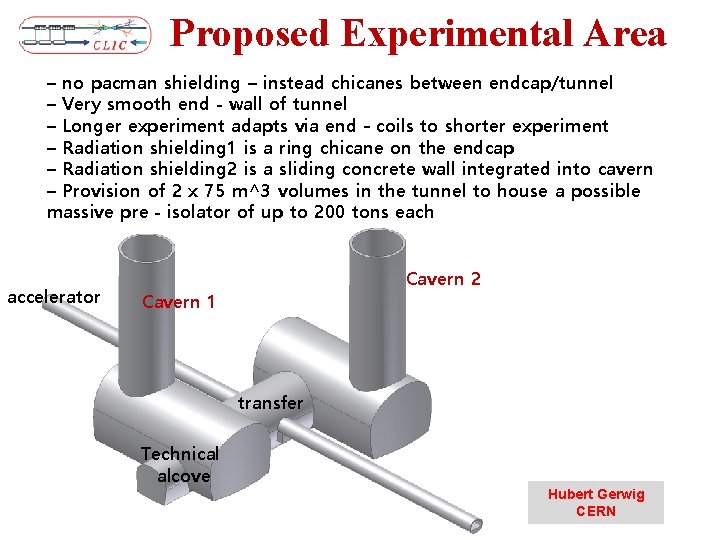
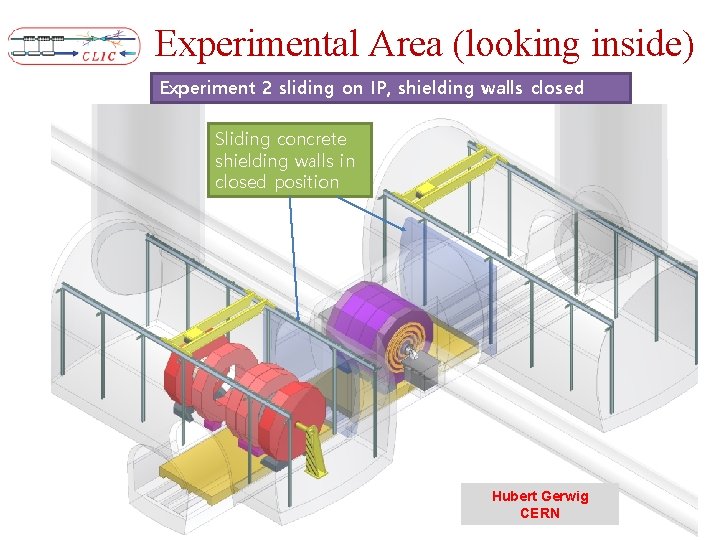
Proposed Experimental Area – no pacman shielding – instead chicanes between endcap/tunnel – Very smooth end‐wall of tunnel – Longer experiment adapts via end‐coils to shorter experiment – Radiation shielding 1 is a ring chicane on the endcap – Radiation shielding 2 is a sliding concrete wall integrated into cavern – Provision of 2 x 75 m^3 volumes in the tunnel to house a possible massive pre‐isolator of up to 200 tons each accelerator Cavern 2 Cavern 1 transfer Technical alcove Hubert Gerwig CERN
Experimental Area (looking inside) Experiment 2 sliding on IP, shielding walls closed Sliding concrete shielding walls in closed position Hubert Gerwig CERN
Other “MDI” Topics Not Discussed • Vacuum studies at ILD (M. Jore) • Simulation of beam-beam background at CLIC (A. Sailer) • Testbeam Measurements with a Prototype Cherenkov Detector (D. Kaefer) • IP feedback prototype status and engineering considerations for implemention in the MDI (P. Burrows) • What could we learn at ATF 2 concerning ILC backgrounds (G. Hayg) • Status of Beamcal Readout Chip (A. Abusleme, T. Markiewicz) • SI sensor Radiation Testing (T. Markiewicz, B. Schumm) • SID Field Maps for Various Iron Configurations (T. Markiewicz, W. Craddock) • Luminosity Measurement at ILC (I. Bozovic-Jelisavcic) • ……